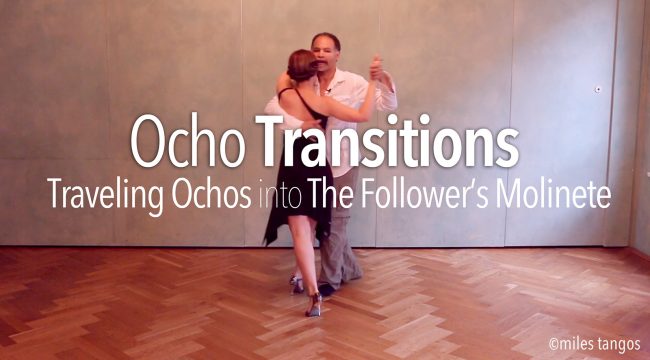
For most people you say the word “Ocho” and only one thing comes to mind. Ummm there are Eight types of Ochos actually. However in Today’s Tango Topic, we deal with that singular type of Ocho and then we tack something on the end to it that makes it more than just a traveling item but a transitional element. The thing that we tack onto the end ? The very venerable and well used singular turn that most people think of when then think of a turn in Argentine Tango: The Follower’s Molinete to the Lead’s Giro. That turn. These two pieces of vocabulary, by themselves, form the backbone of the 7 Basic Moves of Argentine Tango. However, when you put them together, they co-create a well worn pattern that is, unfortunately overused, without any variation, or for that matter distinction! These are amazingly powerful pieces of vocabulary that when executed properly can create such a distinction in our dance that it frequently goes overlooked. Distinction ? Most people lead and follow these ideas the same way each and every time. The distinction comes in how they’re applied to the music! They could be led slowly, the could be adorned, they could be over executed! All of these are possibilities, and yet they’re the same, each and every time. You could quite literally set your watch by them. In Today’s Tango Topic we look at co-combining them so that they work flawlessly each and every time. In this episode of ‘dancing tango better’ (hahahahha) we show you a way to execute these singular pieces of vocabulary so that in the transition state between them, there is no hesitation, no hiccup, no…ummmmm what was that ? It is for this reason that today’s topic is not really about the Ocho itself, but about the Transition between one piece of vocabulary and the next, or Ocho Transitions Part 2 – Traveling Ochos into the Follower’s Molinete!
What is an Ocho Transition ? It is exactly what it sounds like. It’s a transition between a commonly used type of Ocho into another commonly used piece of vocabulary. There are 4 types of Ocho Transitions that rely on 2 of the more common types of Ochos. Milonguero Ochos, which are sometimes referred to as “Lazy” Ochos because the hips of the Follower do not rotate. This type of Ocho is absolutely perfect for dancing in a small space, and requires very little effort to lead and very little effort to follow, hence the reason why they’re called “Lazy” Ochos. The second commonly used type of Ocho is the one that everyone is familiar with, these are called “Traveling Ochos” because they do exactly what they say they do, they “Travel” down the line of dance! A Traveling Ocho is where the hips of the Follower do rotate. A Lead will typically engage one or sometimes both of these types of Ochos as a way to transition into another type of vocabulary, usually as a way to lead upto one of the Eight types of turns that are used in Argentine Tango.
What is a Traveling Ocho to Follower’s Molinete Turn ? It’s quite possibly the single most used transition the Tango world, for those that are Dancing with a Lot of Space. This transition employs the Follower’s taught Ocho technique (applied disassociation) to open into their led Molinete! A bit of clarity as to what a ’Traveling’ Ocho is and is not. A ‘Traveling’ Ocho is an ‘Ocho’ that goes down the line of dance. As shown below:
Plays from YouTube. Pressing play connects you to YouTube. Privacy
It is one of 8 Ocho types that we use quite frequently, and it is the one that most people think of when you say the word. However, there are others, just so you know! Moving on. What is it not ? It’s not a Lazy Ocho (sometimes rightfully referred to as a ‘Milonguero’ Ocho), nor a Circular Ocho, nor a Linear (just to name a few). No this Ocho, is the venerable one that most Followers are forced to do on day one of Following regardless of whether or not they have been properly trained to do them or not. Usually it’s more the ‘not’ variety than anything else. Why are we talking about ochos ? Because this particular variety of Ocho is so venerable that we use it for nearly every kind of transition there is.
Pre-Requisites: So that we’re all clear on this part, note the difficulty rating below, it is not an exaggeration! You would think this is just walking and turning. That would be a mistake. 1.) You must have mastered your walk first and foremost to the point where you are not using your partner (either lead or follow) for stabilization. 2.) You must be familiar with the Traveling Ocho from a Leading perspective as well as from a Following perspective. 3.) You must have mastered Applied Disassociation. This is not a Pivot! And anyone that tells you differently is taking the easy way out. Applied Disassociation is much harder to do but soooo worth it in the end for a variety of reasons, most notably due to its controlled elegance! 4.) You also must have mastered the Follower’s Molinete from both sides of the embrace. While this transition is a natural extension of both ideas put together it’s important that you have them both clearly in your mind before you attempt to put them together. The reason this video exists is to clean up the issues of the transition itself so that you don’t run into the common problems that most people do when they put these things together.
About The Video. This video is 23:52 in length in 1 section. Lead and Follow technique is co-combined.
The funny (strange, not ‘ha-ha’) thing about this Ocho Transition Series is that it is used more often than you would think. So learning both techniques and tools will help you in the long run as you can use both pieces of vocabulary almost anywhere. From a Following perspective, you’re going to make the mistake of believing that this is all about the Lead. And that’s not the case here. You really do want to understand the Milonguero Turn for you, because the question will come up as it always does, when would I do engage one turn over the other ? And who’s actually leading the turn, the Lead or the Follower ? And the answer is a little bit of both in today’s Tango world.
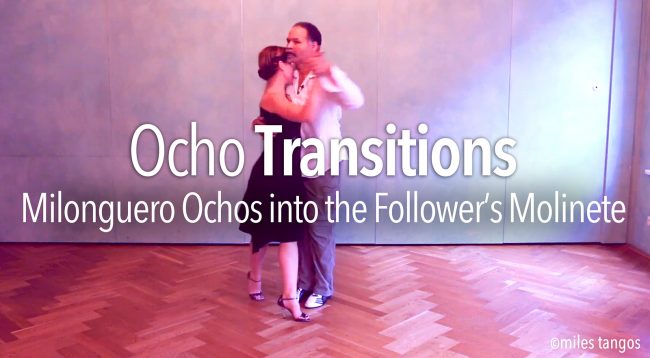
Lazy Ochos into The Follower’s Molinete. This is an odd transition to be certain. It mixes two very different types of tango styles or ideas into one way of dancing. Typically the ‘Lazy’ or Milonguero Style Ocho is done in Milonguero style of dancing, that means that the Lead is not leading the Follower’s hips to rotate at all, ever. And then, all of a sudden, and it is all of a sudden, we ask (note the language here…’ask’) the Follower to engage their Molinete. Not a Milonguero Turn, but a Close Embrace Molinete. Talk about confusing! Oy. So let’s get into L/leading and Following Milonguero Ochos into the Follower’s Molinete!
What is an Ocho Transition ? It is exactly what it sounds like. It’s a transition between a commonly used type of Ocho into another commonly used piece of vocabulary. There are 4 types of Ocho Transitions that rely on 2 of the more common types of Ochos. Milonguero Ochos, which are sometimes referred to as “Lazy” Ochos because the hips of the Follower do not rotate. This type of Ocho is absolutely perfect for dancing in a small space, and requires very little effort to lead and very little effort to follow, hence the reason why they’re called “Lazy” Ochos. The second commonly used type of Ocho is the one that everyone is familiar with, these are called “Traveling Ochos” because they do exactly what they say they do, they “Travel” down the line of dance! A Traveling Ocho is where the hips of the Follower do rotate. A Lead will typically engage one or sometimes both of these types of Ochos as a way to transition into another type of vocabulary, usually as a way to lead upto one of the Eight types of turns that are used in Argentine Tango.
What is a Traveling Ocho to Follower’s Molinete Turn ? It’s quite possibly the single most used transition the Tango world, for those that are Dancing with a Lot of Space. This transition employs the Follower’s taught Ocho technique (applied disassociation) to open into their led Molinete! A bit of clarity as to what a ’Traveling’ Ocho is and is not. A ‘Traveling’ Ocho is an ‘Ocho’ that goes down the line of dance. As shown below:
Plays from YouTube. Pressing play connects you to YouTube. Privacy
Traveling Ochos with Jannie
It is one of 8 Ocho types that we use quite frequently, and it is the one that most people think of when you say the word. However, there are others, just so you know! Moving on. What is it not ? It’s not a Lazy Ocho (sometimes rightfully referred to as a ‘Milonguero’ Ocho), nor a Circular Ocho, nor a Linear (just to name a few). No this Ocho, is the venerable one that most Followers are forced to do on day one of Following regardless of whether or not they have been properly trained to do them or not. Usually it’s more the ‘not’ variety than anything else. Why are we talking about ochos ? Because this particular variety of Ocho is so venerable that we use it for nearly every kind of transition there is.
The Free Tip: ‘Marking’ space means that as a lead you’re going to go with the Follower’s rotation, not ahead, not behind, but with. From a Following perspective you’re going to match the speed of the lead’s torso rotation at all points along the curve…stay with them. Don’t let them get ahead of you!
Pre-Requisites: So that we’re all clear on this part, note the difficulty rating below, it is not an exaggeration! You would think this is just walking and turning. That would be a mistake. 1.) You must have mastered your walk first and foremost to the point where you are not using your partner (either lead or follow) for stabilization. 2.) You must be familiar with the Traveling Ocho from a Leading perspective as well as from a Following perspective. 3.) You must have mastered Applied Disassociation. This is not a Pivot! And anyone that tells you differently is taking the easy way out. Applied Disassociation is much harder to do but soooo worth it in the end for a variety of reasons, most notably due to its controlled elegance! 4.) You also must have mastered the Follower’s Molinete from both sides of the embrace. While this transition is a natural extension of both ideas put together it’s important that you have them both clearly in your mind before you attempt to put them together. The reason this video exists is to clean up the issues of the transition itself so that you don’t run into the common problems that most people do when they put these things together.
About The Video. This video is 12:37 in length in 1 section. Lead and Follow technique is co-combined.
The funny (strange, not ‘ha-ha’) thing about this Ocho Transition Series is that it is used more often than you would think. So learning both techniques and tools will help you in the long run as you can use both pieces of vocabulary almost anywhere. From a Following perspective, you’re going to make the mistake of believing that this is all about the Lead. And that’s not the case here. You really do want to understand the Milonguero Turn for you, because the question will come up as it always does, when would I do engage one turn over the other ? And who’s actually leading the turn, the Lead or the Follower ? And the answer is a little bit of both in today’s Tango world.
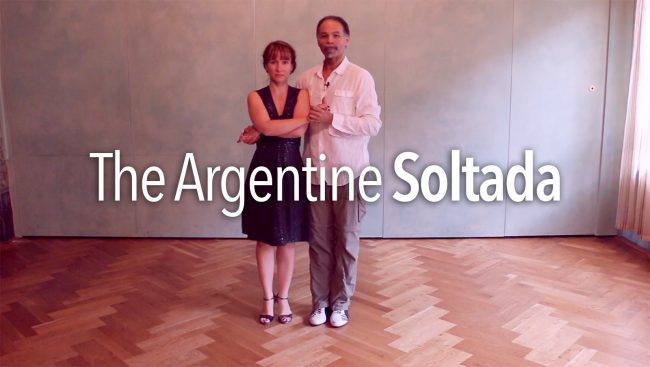
The Argentine Soltada falls into that category of ‘flashy’, some might say ‘cool’, and/or ’nuevo’ tango vocabulary, that depending on your point of view may or may not be tango. For those people that are in the may be tango camp, you don’t really care, you just think it’s the bees knees and want to understand how it works, how to generate it and what other cool things you can do with it. For those people in the not tango camp, you have a point. You’re right, it’s not tango. It’s technically a borrowed turn from Salsa. Today’s Tango Topic is for the first group of people that are interested in expanding their ideas of what’s possible. While it’s true that this kind of vocabulary and exploratory of tango’s dark magic can be, if poorly executed, can be a navigational nightmare and dancing hazard, the feeling is that if you have access to good, clean, clear information, then there’s really no reason in the world why shouldn’t at the very least explore The Argentine Soltada.
What is an Argentine Soltada ? First the word “Soltada” comes from the root Spanish word, “Soltar” which means, when translated from Spanish to English, ‘to release’ or ‘to drop’. When you add the ‘ada’ ending to a Spanish -ar verb it means that the verb ends in a ‘ed’ as it would in English. So in this case, the word translates as either “dropped” or “released”. How does that relate to the move that we’re demonstrating above ? well, it’s not a drop, but in fact a ‘release’. Truthfully the Argentine Soltada is a spin that has been borrowed from Salsa, and made functional in Argentine Tango. The ‘spin’ part isn’t truly a spin, it’s a half of a spin with a variation which we’ll get to in a moment. So it’s a half-spin with a variation with Salsa technique attached to it. In the Soltada we’re describing the flashy part of what the Follower does, and not necessarily what the Lead does. The Lead kinda sorta stands there and waves their arms around a bit, and the Follower half-spins. Ok, that’s a misnomer because the Lead is actually leading the spin, or should be. Typically the Soltada is a way to get into and out of change orientation movements, like the AmericanaEmbrace, or Over-Rotated Sacadas, or Single File Couples Walking, etc…there are loads of applications employing this entry and exit. Now to the rest of the descriptive above, we said that there’s a variation to this ? And there is. The variation is that in a true spin, the foot that the Follower is spining on top of wouldn’t change. Meaning they’d stay on the same foot. In this case, the Soltada requires that the Follower is led to change their weight so that the Couple comes out in the right place. This is an Argentine Soltada.
Free Tip. Your video, which is different from the open user’s video, shows a possible exit from the Argentine Soltada into a walking linear Boleo. There are so many possibilities here that is scary. One of them that is not covered in the video but is implied, and show in the close embrace video series…are the Follower’s obvious back sacadas that are sitting there! While this video shows the Lead forward Sacadas, the Follower’s Forward or Back Sacadas are not shown but are implied!
About The Video: This is a combined video that is 27: 32 in length in 14 sections:
Section 1 – Introduction – 00:01:51 Section 2 – Hand Holds (Lead/Follow) – 00:02:26 Section 3 – Exits (Lead/Follow) – 00:01:31 Section 4 – Review – 00:00:26 Section 5 – Footwork (Lead/Follow) – 00:02;27 Section 6 – Soltada Advice – 00:03:48 Section 7/8 – Soltada Ideas – 00:05:00 Section 9 – Soltada with a Sacada – 00:01:12 Section 10 – Soltada with Single Partner Walk – 00:01:04 Section 11 – Soltada with an Forward Lazy Ochos – 00:01:12 Section 12 – Soltada with an Anti Molinete – 00:01:57 Section 13 – Soltada with a Gooey Gancho – 00:00:57 Section 14 – Soltada with a Linear Boleos (Lead and Follow Boleos – 00:02:56
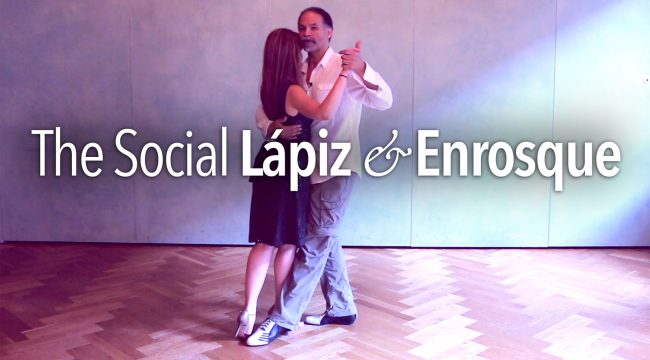
The Spanish word ‘Lápiz’ (pron: lah-pees – emphasis on the ‘LAH‘ and not the ‘pees’) translates to English as Pencil, and the word ‘Enrosque’ translates to English as ‘Screw’ or ‘Thread’. From a Tango perspective these are primarily ideas that relate solely to the Lead’s side of the dancing equation. Mostly. 🙂 A Follower can and does engage in a version of the Lápiz when applying a needle turn in ochos, or a planeo but as it relates to the Enrosque, it is very infrequently done by the Follower on their own. That said, let’s talk about the Social Lápiz & Enrosque.
What is aLápiz & Enrosque ? Let’s take those words one at a time. A Lápiz is a leg extension (and pointing of the foot/toe) done in a circular fashion in response to what the Follower is doing. Usually, this is a leg extension out away from the body (Forward to 12 O’Clock), then around to the side (at Nine O’Clock), and then the back (at Six O’Clock), and then back to collection. The Lápiz is usually done to the Follower’s Molinete or Traveling Ocho on their resulting backstep.
Plays from YouTube. Pressing play connects you to YouTube. Privacy
The Lapiz Exercise
What makes it ‘Social’ is that it is very small, very tiny. Meaning that the footprint (no pun intended) should not take up any more space in the line of dance than say another step forward would. In other words ? No space.
And what about the Enrosque ? An Enrosque is essentially the lead crossing one foot behind the other without space between the crossed feet (better known as a ‘clean’ cross) and then, here’s the hard part, unwinding that cross back to collection without wobbling, wavering, or using the Follower to do it! Typically the Lápiz and the Enrosque Follow each other. First a Lápiz and then the Enrosque.
Plays from YouTube. Pressing play connects you to YouTube. Privacy
The Stability Exercise
The Free Tip. This is going to challenge you. No lie. The rotational pivot that has to occur over the standing foot, will drive you absolutely batty. Now try doing that while your partner is hanging on you, pulling you, pushing you….good luck with that. You must work on your own stability independent of your Follower. So here’s a free hint for you – more compression in the standing knee. The more you have, the easier this becomes. However, you do not want to be on your heel while you’re doing it! 😉 Good luck, you’re going to need it.
Notation: It should be noted that the Lápiz is generally done in concert with the Follower’s Back Step of the Follower’s Molinete; And it can also be done with the Follower’s Traveling Ocho (Back or Forward). It can be done anywhere where the Follower is being led to transit around their Lead. At the same time, it can also be done with the Follower’s side of the Milonguero Turn. However, engaging the Milonguero Turn and then engaging in Lápiz is kinda ‘flashy’ and doesn’t look so good in our opinion.
About The Video. This video is 14:03 in length in 7 Sections
Section 1 – Introduction – 00:00:12 Section 2 – Basic Technique – 00:01:29 Section 3 – Close Embrace Exercise – 00:02:22 Section 4 – Executing The Social Lápiz – 00:03:34 Section 5 – Adding The Enrosque – 00:02:45 Section 6 – The Social Version – 00:04:17 Section 7 – Closing – 00:00:19
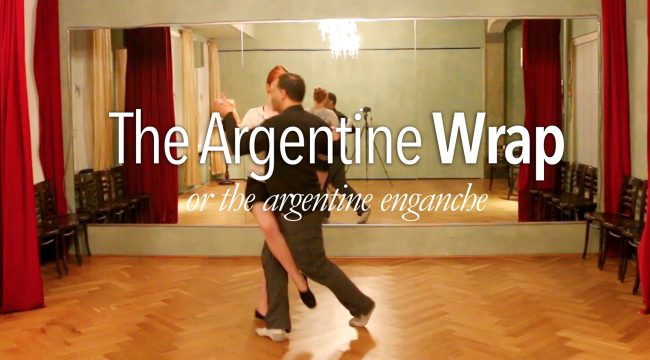
The Argentine Enganche is actually a misnomer of a word. “Wrap” is the Anglo-American version, whereas the Spanish cognate is actually “Enganche”. The words Themselves are somewhat telling, in either language. How’s that ? In the English version something is going to wrap something. In the Spanish something or someone is going to be Enganche’d. The English version refers to one very specific thing, while the Spanish version is a much broader definition. Much broader. This is one of those pieces of Argentine Tango vocabulary where it rightfully classifies as ‘cool’, seemingly ‘intricate’, and definitely worth doing once or twice as spice or accent but certainly not an entire dance filled with them (ahem, hint, hint, hint). That said, let’s talk about the Argentine Enganche and in specific the Argentine Wrap!
What is anArgentineEnganche (or “Wrap”) ? The Enganche is a family of tango movements, and the Argentine Wrap is a limited subset of the Enganche that we want to explore. An Enganche can be but is not limited to where the dancer’s free leg, can engage their partner’s free leg or the open space between their legs in a myriad of different ways through either a Gancho, a Ganchito, a Rebound, un Libre Pierna (a free leg) Columpio (swing), or a version of a Sacada, and/or a Wrap in the English sense of the word. However the Argentine Wrap is a limited subset o f the Enganche idea. A bit more specific really, where the Lead, or the Follower, mostly the Follower in this instance, can, and will, ‘wrap’ their free leg around their partner’s standing leg usually from a side step. However a Wrap can be achieved from either back or forward steps as well, however it is slightly more challenging to do so.
The Argentine Wrap is 1 of 4 Displacements that happen in Argentine Tango. The first that this site has talked about is the Argentine Sacada. The next is the Argentine Gancho. Next is the Argentine Boleo (Social Boleos, Circular Boleos, Linear Boleos) And the very last is the Argentine Wrap (or Enganche). Displacement ? What’s that ? Meaning that the Free leg will either drift away as a result of an invasion as in the case of an invasive step. By default, if someone steps into you, you’re going to step backward or away from them. There are 3 possible responses to this invasive step. 1.) A displacement. 2.) A Default Resolution. and 3.) A Learned Resolution. The video above unfortunately doesn’t make a distinction between 2 and 3. The one that we’re after is #3. A Default Resolution is one that has been developed by the dancer as their goto behavior. In the video above it’s where the Follower allows their leg to go back but they as a result of the invasion allow it to swing but their default training know that that’s a less than desirable thing so they bring it to closure or collection and allow their body to turn as a result.
The Free Tip. Repeat after me Followers – IN, UP, AROUND, DOWN, BACK. That’s your mantra for an Argentine Wrap! That’s what your free leg is going to do. Now saying it, and then doing it, are two very different things. Hence I’d suggest you actually either subscribe to see what “IN” and “UP” actually means or buy the video. One or the other! Lead’s repeat after me: I WILL NOT SQUEEZE, I WILL NOT SQUEEZE, I WILL NOT SQUEEZE! Then when you’re doing repeating that, write it down, and when you’re done with that, keep repeating it over and over and over again! What does that really mean ? With your right arm, you’re not going to squeeze the living daylights out of your Followers! Please, stop doing this!
About The Video. This video comes in at 31m:49s in length in 18 Sections. Both lead and follower technique is combined and integrated in the video.
Section 1 – Introduction – 00:01:46 Section 2 – 5 Points of Follower Technique – 00:01:50 Section 3 – Beginning Lead Technique – 00:02:18 Section 4 – Lead and Follower Technique Together – 00:01:31 Section 5 – The Closed Inside Wrap – 00:01:29 Section 6 – The Closed Outside Wrap – 00:01:19 Section 7 – 5 The Practice Embrace – 00:01:26 Section 8 – The Open Side Outside Wrap – 00:00:25 Section 9 – Open Side Inside Wrap – 00:00:21 Section 10 – Three Lead Errors Detailed – 00:01:54 Section 11 – The Follower’s Choice – 00:02:36 Section 12 – The Back Sacada Wrap Option – 00:02:03, Section 13 – Wrap Review – 00:02:35 Section 14 – The Double Wrap – 00:01:39 Section 15 – The Close Embrace Wrap – 00:01:20 Section 16 – The Follower’s Choice – 00:02:36 Section 17 – The Flashy Wrap – 00:03:37 Section 18/End – Closure/Practice – 00:01:41.
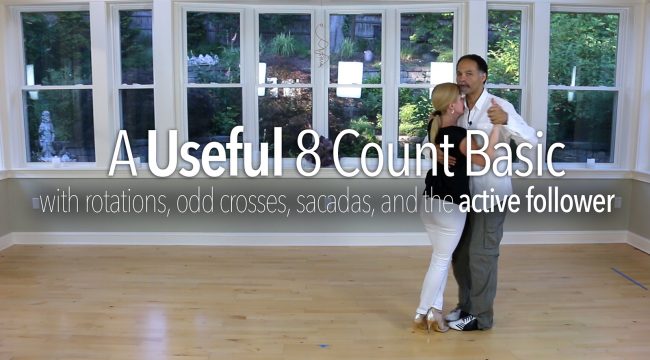
A Useful 8 Count Basic. The 8 Count ‘Basic’ is a term and ‘move’ in tango that refers to 2 very different aspects of Tango that are put together. First the ‘8 Count’ which refers to the musical component, which is the counting of 8 beats. The second is a ‘Basic’, which refers to a simple, easily identifiable, and reproducible pattern of steps which can showcase the foundation of a particular dance form. With regards to Tango, our ‘Basic’ is deeply engrained in our DNA (as it were) as a venerable teaching tool.
We frequently use it to teach the very basic structures of Argentine Tango. We use it to teach a lead to walk, and how to embrace, and how to engage with the Follower. We use it to inform the Follower how to engage an embrace, how to walk, and how to deal with the impulse of a ‘lead’. Furthermore the 8 Count really does force one to start to listen to the music in a very different way, instead of for enjoyment, but rather to learn to be in time with the music, and then to keep time with the music by focusing on the counting aspect of the music, and more importantly the ‘beat’ in very rhythmical, and set or predictable patterns that can easily be managed. Hence the 8 Count of it’s name.
The 8 Count Basic can be, if used properly, a really great primer about Argentine Tango (Aside: The author prefers the Golden Nugget of Tango as that primer but that’s professional bias). The 8 Count Basic goes one step (no pun intended) further, it even teaches both dancers about a rather ubiquitous piece of tango vocabulary: The Argentine Cross! 😉
So while the 8 Count Basic has all this going for it as a teaching tool, as a social dance tool, it has multiple failings! It’s a static pattern or figure! Talk about a yawn fest! Part of the ‘yawn fest’ comes from the fact that it’s repetitive. It never changes, there’s no variation at all. 🙁 However, that’s not it’s only failing. As you’ll see below, it has more than a few!
However, the title of this Today’s Tango Topic is not a misnomer, it’s a reality. There is a version the 8 Count Basic that is actually quite usable. However, before we can talk about a useable version, we first have to define what an 8 Count is, and what it actually looks like, then identify WHY and HOW the 8 Count isn’t useful before we can actually show you a Useful 8 Count!
What is an actual 8 Count Basic ? Put simply, it is a series of 8 steps done in Parallel (shown below) or Cross system, that starts with 1.) The Lead stepping backward with their Right, and the Follower stepping forwards with their Left. 2.) The Lead stepping side with their Left, and the Follower matching that step with their Right. 3.) Here we can invoke either cross or parallel system, by the Lead stepping Forward with their Right outside partner (in Parallel) or changing weight and stepping with their Right (Cross), for now, we’ll keep this in Parallel system, and the Follower stepping backward with their Left. 4.) The Lead continues Forward with their Left and the Follower Backwards with their Right. 5.) The Lead comes to Collection as the Follower crosses their leftover their Right (The Completed Argentine Cross). 6.) The Lead steps forward with their Left, and the Follower steps backward with their Right. 7.) The Lead passes through collection and steps side with their Right, while the Follower passes through collection and steps side with their left. 8.) Both partners come to Collection!https://www.youtube.com/embed/oA8gjP17yLM?ecver=1
The 3 Flaws of the 8 Count Basic. There are 3 built-in ‘flaws’ or errors to the 8 Count that may seem innocuous but really aren’t they’re for lack of a better way of putting it, social dance “no-no’s”. These ‘flaws’, as we’ll call them, aren’t related to the Follower in any way, shape, or form, this is all on the Lead baby. 😉 These ‘flaws’ have everything to do with navigation and floorcraft, and really maintaining the Line and Lane of Dance.
Timmy from Idaho writes in and asks, “Gosh Mr. Tango Topics, what on earth is the Line of Dance ?”.
Mr. Tango Topics Responds: “Gosh I’m so glad you asked Timmy! The Line of Dance is a term that we use in Argentine Tango that describes how the progression of couples is supposed to move in relation to one another as if it were driving along a road, that we maintain the direction that traffic flows (in Argentine Tango), which is counter-clockwise.”
Sheila from Arizona writes in and asks, “Driving along a road ? You mean like lanes of dance ?”
Mr. Tango Topics Responds: “Yes Sheila exactly that. Besides the Line of Dance, we also have what’s called the Lane of Dance. Which refers to ‘tracks’ of dancers as if they were in a racing lane, on a race track. That we ideally want to keep to our specific lane of dance, contained, so that we don’t impact others experience with our own dancing.”
Flaw #1. This flaw refers to the very first rule of Leading Tango as a Social Dance. You do not step backward in the line of dance! The first step of the 8 Count does precisely that! Cue the Wrong Answer Sound.
Flaw #2. This one occurs on step 2 of the of the Basic 8. It’s the Sidestep. Usually out of one’s Lane of Dance.
Flaw #3. This flaw is generated on step 7 of the Basic 8. It’s another Sidestep back into the originating Lane of Dance.
For these three reasons, the 8 Count Basic cannot be used as a social dancing tool. 🙁
What is a Useful 8 Count Basic ? Put simply it is a modification and goes further by actually adding for variations on a theme. The modification has to do with orientation and then actual rotation. That if you modify the orientation of certain steps and you rotate the resulting steps in certain ways then the 8 Count Basic becomes more than useful, it’s actually a lot of fun in nearly any embrace that you can come up with (including the Berlin Embrace)! Not only that there’s a possible surprise at the end that you weren’t expecting that’s sitting there!
The Specific Steps of A Useful 8 Count ? 1.) The Lead curves their back step with their Right. Instead of stepping straight back which would break the first rule of Argentine Social Dance, we curve it so that it doesn’t impact the oncoming dancing couple! The Follower matches that curve by stepping forwards with their Left into their lead. This, one, simple change is quite possibly the game changer for the entire Useful 8 Count! 2.) The Lead steps side with their Left, and the Follower matches suit with their Right. 3.) While a Cross or Parallel version is possible here by invoking a simple weight change, let’s keep things in Parallel Walking System – the Lead steps Diagonally Forward with their Right and incidentally stepping outside partner, and the Follower stepping Diagonally backward with their Left. 4.) The Lead continues Diagonally Forward (the diagonal part is very important because it continues the rotation of the couple) with their Left, and the Follower Diagonally Backwards with their Right. 5.) The Lead rotates at 90 degrees perpendicular to the lane of dance (and pivots, and it actually is a pivot) and comes to Collection as the Follower crosses their Left over their Right (The Completed Argentine Cross) matching the rotation of the Lead! 6.) The Lead steps Diagonally BACKWARDS with their Left, and the Follower steps Diagonally Forwards with their Right. 7.) The Lead passes through collection and steps side with their Right, while the Follower passes through collection and steps side with their left. There is another option that’s sitting here, a very important option! 8.) Both partners come to Collection.
The Other Options ? The video talks about, near the end of the sample above, that there are other options sitting here. There are loads of them, this video only touches on 4 of them. 2 surprises and 2 options. But those surprises are astounding, and the options are implied from the title image: Sacadas! There are in fact 2 Sacadas that are embedding the modified version of A Useful 8 Count Basic. Truth be told one of those Sacadas is right there at the beginning of the non-useful version too!
The Active Follower! This topic doesn’t get talked about a whole lot for a variety of reasons most notably is that it’s frightening to a lot of people, still another is that it is highly misunderstood as to what an Active Follower actually means. While there is an definition on this website of what the Role of the Active Follower actually is and is not, in this instance this particular video only touches on ONE very important aspect of the Active Follower, and that’s ‘energy’. Energy ? Meaning adding more than a little “vim und voive” (liveliness) to what the Follower is doing in respect to this particular piece of vocabulary. However this aspect is an important one going forwards because we want to embed this idea everywhere that the Follower is engaging. Why ? Because far too often they are passive, they are ‘waiting’ for something to happen, instead of something else: Listening! This isn’t simple word replacement by the way, but a completely different state of mind. Put simply when you are ‘waiting’ you are giving up control of what you can and will do! When you are ‘listening’ you have complete control over what you can and will do! And yet this idea of ‘waiting’ for the L/lead is precisely what happens with most Follower from the first moment they step on the floor. As a result it creates in them, and we as Leads come to expect this out of them, a state of being ‘passive’. Which should not be confused with the Passive Follower definition on this site. Passive in the state of giving up their control of what they can and may want to do in relation to the music. The passivity of the Follower in this instance is not only energy based but also in options and opportunities. The Follower tends to shut down as result of being told to ‘wait’ so often. They may hear things in the music but don’t act on them because they don’t want to disturb their lead, and/or interrupt the Lead’s idea of what’s supposed to happen according to the Lead. Well what about the Follower’s idea ? Tango can be a cooperative experience, almost bordering on egalitarian if the Lead creates the space for that to occur. Doing so creates a much more responsive, and rightfully thoughtful Follower that can add interesting ideas and options for the couple to engage in. When a Lead does not create space for the Follower, it’s nothing short of a Monologue of the Lead’s ideas. And while that can be fun to experience how a Lead hears the music, it does get a bit monotonous. There are other ideas, and the role of the Active Follower is just one place. The reason why it’s relevant here is that it can and does show that a piece of executable vocabulary, when engaged with an Active Follower is far more preferable to the lackluster Following aspect that happens far too frequently. To be fair this is not Follower Bashing. Not by any stretch of the imagination. It is in fact LEAD bashing! And while these ideas may seem heretical, almost bordering on insubordination, they’re not. However this is a topic for a different day. More on this later.
The Free Tip. In an ideal world the first cross could be done as usual. As if it were in the line of dance, without the rotational element. However, the Follower rotation sets up the other options that are alluded to in the ‘surprise’ sections above! Which create other options and opportunities for us to explore. Lots of other options!
About The Video. This video comes in at 31m:13s in length in 16 Sections. Both lead and follower technique is combined and integrated in the video.
Section 1 – Introduction – 00:00:49 Section 2 – The 8 Count Basic – 00:01:10 (shown above) Section 3 – Why It’s Useful – 00:00:26 Section 4 – Three 8 Count Flaws – 00:01:53 Section 5 – A Useful 8 Count – 00:02:01 Section 6 – Leading Perspective – 00:01:43 Section 7 – Following Perspective – 00:01:58 Section 8 – The Open Embrace Version – 00:00:40 Section 9 – The Close Embrace Version – 00:01:37 Section 10 – The First ’Surprise’ – 00:02:41 Section 11 – The Inverted ’Surprise’ – 00:03:39 Section 12 – The Basic with Sacadas – 00:02:31 Section 13 – Follower Technique – 00:02:43 Section 14 – with Follower Adornments/Embellishments – 00:00:52 Section 15 – with the Active Follower – 00:04:20 Section 16 – Closure – 00:01:31
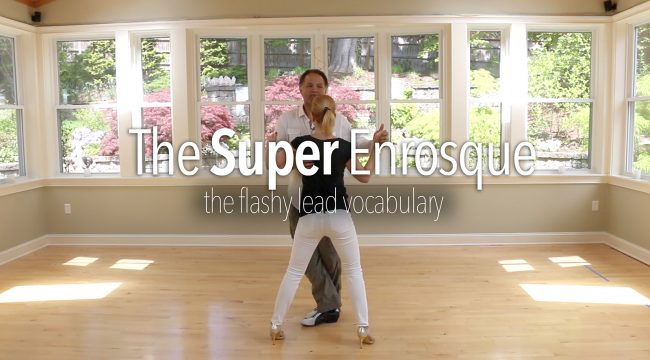
The Super Enrosque. There are only a small handful of things that a lead can do to ‘decorate’ what a Follower is doing. Usually, as Leads, we tend to leave the ‘decoration’ to the Follower. However we can in a small number of ways adorn what the Follower is doing, while they’re doing it. Doing so, tends to draw attention away from the Follower and towards the Lead, but sometimes that is desirable, sometimes. Today’s Tango Topic deals with one of these pieces of Tango vocabulary that isn’t seen too often (for a variety of reasons, see below), that when executed nicely can have a really nice effect on the dance, and at the same time open options and opportunities for both roles, not just the lead! 🙂
Let’s get this out the way, before another word is read, the Enrosque, and it’s kissin’ cousin of Today’s Tango Topic: The Argentine Super Enrosque is quite simply Lead flash, spectacle, and nothing more than that. Furthermore there’s absolutely nothing here for the Follower to do or to think about. Got it. You do not need to add this to your repertoire of tango vocabulary. It does not need to be executed every 3rd step simply because you believe that it’s cool Nor does every Follower want you to do this. Once or twice is fine in a night and then LET IT GO, move on to something else. Trust that the room has seen it all before, they don’t care that you can do 57 versions in 3 minutes, nor should a single song ever be populated with more Enrosques and Super Enrosques than the time it took for you to read this. Never. Ever. This is flashy vocabulary. It’s fun, to be certain but lord knows you don’t need to execute it!
That said, before we talk about what a Super Enrosque is, we have to define what an Enrosque is and is not!
The word ‘Enrosque’ (pron: ehn-RrOhs-kay – accent on the ‘O’) loosely translated to English from Spanish means ‘Thread’ or ‘Screw’. However, from a Tango perspective it has a very specific meaning. This a Lead based piece of vocabulary that can be done as adornment or accent to what the Follower is doing. It’s usually done with the Follower’s Molinete, but can be done anywhere really. But the place where it shines really is the Follower’s Molinete. So what is it ? The Enrosque is where the lead will cross one foot behind the other (in a clean fashion – there should be no daylight between the feet) and as the crossing behind happens there’s usually a pivoting rotation of the bodily position – This is the ‘Screw’ part of the definition of the Enrosque, not the crossing feet part. An actual ‘pivot’ may occur, however where things get flashy and really where the Super Enrosque comes in, is where the Lead engages Applied Disassociation! There is a common misconception that the Enrosque also contains a Lapíz (a lead leg extension) that trails the Follower’s motion. This is not part of the Enrosque! It is it’s own separate thing, and you quite literally must separate these things, one from the other. Doing so will create a greater range of capabilities.
Below you should see one of two videos: Free/Open users will see an Enrosque without any explanation of what should happen, or the paid subscribers should see the Entire Enrosque video from your Lead Technique section which fully explains the technique that generates the example videos. 😉 Without this explanation you’re quite literally pissing into the wind!
What is a ‘Super’ Enrosque ? You’re going to ask yourself this question: If an Enrosque is placing one foot behind the other, or in front, both are true where the feet are in a crossed position, AND (the ‘and’ is very important) there is a pivoting bodily rotation that occurs. Then what on earth creates a ‘Super’ Enrosque ? MORE ROTATION! And in specific More Applied Disassociation, as there’s an enormous amount of super rotation that can occur due to the release of all that pent up energy. And that release creates some really interesting options and opportunities. 😉 So without further adieu: The Super Enrosque!
There’s a lot that’s missing here…you need to subscribe to see the whole article which is extensive.
The Free Tip. In an ideal world the Enrosque is easy, and the addendum Lapíz is a snap. But as you’ll soon see, saying it is one thing, doing it is another! Which is to say that extending your leg for the lapíz after the Enrosque, is going to throw you off balance. You’re going to have stability issues, which is another reason WHY you study this stuff independent of the Follower not with the Follower! You only study with the Follower AFTER you have mastered the skills noted above.
About The Video. This video comes in at 23m:34s in length in 11 Sections. Lead Technique is explained here in the video. No Follower technique is explored.
Section 1 – Introduction – 00:01:33 Section 2 – Applied Counter Disassociation – 00:00:52 Section 3 – Enrosque with Lapíz – 00:01:48 Section 4 – The ‘Super’ Part – 00:04:08 Section 5 – A Few ‘Gotchas’ – 00:01:41 Section 6 – The Super Exercise – 00:01:40 Section 7 – Super Exercise Notes – 00:02:26 Section 8 – The Enrosque with a Follower – 00:02:50 Section 9 – The Super Part – 00:01:25 Section 10 – The Second Side Step – 00:01:20 Section 11 – A Few More Details/Closure – 00:03:05
Milonga-In-Single-Time. Milonga for a lot of people is a very challenging musical genre, and a challenging dance. Which is putting it mildly. Don’t believe that statement is true ? Just watch a Milonga tanda at your next Milonga. Watch how 80% of the floor clears. Mostly people fall into two categories: 1.) LOVE, LOVE, LOVE Milonga. or 2.) RUN, RUN, RUN from Milonga. And there is no middle ground. Those people that fall into the 1st category are usually Followers first who’ve danced more than a Milonga or two with a good Lead that understands HOW to fuse the music with linear compilations of the dance of Milonga. 😉 Those people that fall into the 2nd category are usually split into two subcategories. a.) Leads that have a distinct fear of Milonga because they’ve realized that the music is faster than they think they can dance, and/or they don’t know what to do to it or with it, and then leading that stuff at that ‘speed’. They just freak right the frak out! b.) The Follower who has learned the hard way that they’d rather sit than dance a Milonga with someone who races them around the floor jerking them this way and that. Today’s Tango Topic deals with the second category of dancer and applies to the first category of Follower only in the minimal. That said, let’s dive right into Milonga-In-Single-Time.
Let’s get something out of the way, Milonga-In-Single-Time is not a step or a pattern, this is not going to change what you do to Milonga, well not immediately but it can and will change how you can access Milonga on multiple of multiple of levels.
What is Milonga-In-Single-Time ? This is a construct to help you access Milonga which is more for the Lead and less for the Follower. It’s a tool that can change how the 2nd category of dancer hears Milonga so that they can actually dance it and not freak out to it. In short, it’s a way to slow down Milonga in real time without actually doing anything crazy really. In it’s simplest form it is dropping a beat really.
A little clarity: Milonga from a timing perspective is 2/4 time. Meaning that there are 2 beats per measure. By contrast Tango music is typically 4/4 time, meaning that there are 4 beats per measure.
We typically step on the 1st and 3rd beat of a Tango, and the 1st beat of Milonga. The first note in both cases is the strong beat of the music. The 3rd note is a weaker ‘strong’ beat. While the contrasting 2 and 4 are softer weaker notes. There’s a reason why we’re talking about this stuff of notation and timing and beats and which note we typically step on, and that’s because it’s important that you understand what normally happens.
Try tapping/clapping out the beat here, just a hint, you’re going to want to tap/clap on the 1 and the 3, that’s what your normal walking beat would be. Now here comes the fun part, believe it or not, this is actually Milonga-In-Single-Time even though it’s a Tango. 😉 And that’s the key to this tool right there.
Milonga-In-Single-Time would take a normal Milonga which is 1-2, 1-2, 1-2, and instead turn it into 1-2-3-4, where the 3,4 is the next 1,2 in the sequence! Now we add one more thing, remember we’re only stepping on the 1, not the 3 in this case. So a Milonga like the one used in the video is Francisco Canaro’s ‘Milonga Sentimental’ (see below) would go from 1-2, 1-2, 1-2, to 1-2-3-4 where the 1 is what we walk on, thereby effectively ‘slowing down’ the Milonga! As a result the typical ‘rush’ or freak out that happens for that second class of dancer above never happens because there’s ‘time’, lots and lots and lots of time. 🙂
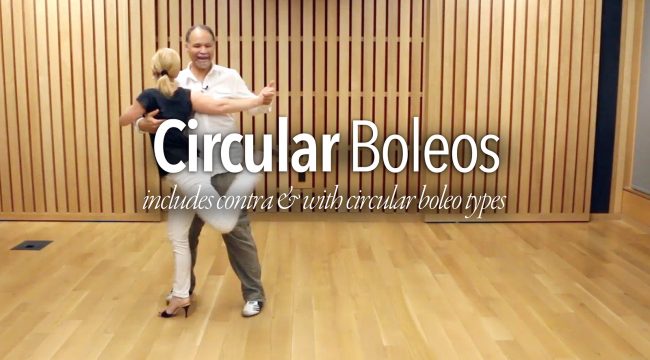
When we see or hear the word Boleo, there’s usually one specific idea that comes to mind, and only that idea. There’s a reason for that, and that’s because one might consider that specific idea to be the ‘Common’ Boleo. Which inadvertently leads one to an inescapable conclusion that there is only one type of Boleo. And that would be an error. A monster error. There are in fact multiple variations on two very specific themes in Boleos. The first is the what you might think of as the “Common Boleo” and that’s the Contra Boleo. Contra meaning that it goes against the direction of the led dancer. And the second is the less common but still very relevant idea of the “With” Boleo. There is a commonly held idea that all Boleos are Contra Boleos, and that’s not entirely true especially when it comes to the ‘With’ variety of Boleos. Each one of these variations on a theme have their types of boleos that we’re familiar with. Tango Topics has coalesced around 3 common ideas of the Boleo: The first is the Social Boleo. This has already been detailed in a previous posting. Typically these are commonly Contra Boleos, but can also be done as With Boleos as well. Then there is the Boleo that you are very familiar with and that’s what’s called a Circular Boleo. And last but not least is an idea that doesn’t get a whole lot of action but has lots and lots of variations on a theme, and that’s the Linear Boleo. In today’s Tango Topic we will discuss the common Circular Boleo first and foremost. So without further adieu, Tango Topics presents it’s variation on a theme: The Circular Boleo.
A little back story: The word Boleo (pron: Boh-Lay-O)comes the root Spanish word “Bolear” which roughly translates into English as “To Shine” or “To Throw”. Boleo is the first person singular, meaning “I throw” or”I shine”. From a Tango perspective we view this as a very specific piece of Tango vocabulary that is nothing short of gob stopping when executed properly, and in time to the music, and typically one very specific type of Boleo, which is the High Circular Boleo. That’s the one that most people think of when they hear the word Boleo. The Boleo is in it’s simplest definition, is one Tango’s four displacements: 1.) Ganchos. 2.) Wraps or Enganches. 3.) Sacadas. 4.) Boleos. The boleo barely classifies as a displacement here because typically the displacement is when the Lead generates a displacement they tend to take the place of where the Follower was in the displacement. In the Circular Boleo, that’s not entirely true and that has everything to do with a tool that we want to engage known as the Rebote Principle. We’ll get to what that means in a bit.
What is a Circular Boleo ? Firstly there are many varieties of Boleos. Tango Topics is only talking about 3 very common ones: Social, Linear, and today’s topic: The Circular Boleo. To be clear there are low circular, midrange circular, and then there are the one’s that everyone thinks of when they hear the word Boleo: The High Circular Boleo. So what is it ? This is a lifting of the leg (Lead or Follow, typically though it’s the Follower’s leg) that tends to curve (hence the circular part) up and sometimes around the Lead. This is why they’re called “Circular” Boleos. In this version of the Circular Boleo, we’re exploring a Mid-RangeCircular Boleo or what Tango Topics refers to as a Mid-Height Circular Boleo.
What’s the difference between a High Boleo and a Mid-Range ? The difference is in it’s application within the Line of Dance. In a High Boleo the Follower is reaching for the stars, as it were, trying to get their leg as high as possible in response to what’s being led. Typically there’s a tiny little problem with this idea. a.) They tend to be rather painful, if you haven’t done the necessary exercises to help with extending one’s leg that high into the air. b.) They tend to disrupt the line and lane of dance because they’re misled in the wrong place (tsk, tsk, tsk). The Follower and the Lead in question quite literally forget for an instance that the Follower is in 3 in. heels for just an instant. And that instant is all it takes for there to be blood on the floor, and someone’s heel impaled into someone’s body parts! So the Circular Boleo that we’re talking about today is a mid-height boleo and doesn’t or shouldn’t really be too energetic or too high. It’s just above waist hight and a little beyond.
About The Video. This video is 2hrs:26m:20s in length in 11 sections. Both lead and follower vocabulary is combined and integrated in the video. There are two sections devoted specifically to the Technique that is required for both roles for nearly all Boleo types.
Boleo Exercise – 00:14:43 The Free Leg Exercise The Controlled Leg Exercise Common Errors – 00:18:37 5 Common Follower Errors 2 Common Lead Errors Follower Technique – 00:24:46 The Walking Steps Reminders Follower Linear Ochos The Follower’s Appreciation Step Basic Boleo Technique Striking The Match Social Boleo Technique Circular Boleo Technique The Follower’s Rebote Follower Posture Follower Leg Control Lead Technique – 00:28:34 The Lead’s ‘Lead’ The Timing Issue Setting Up The Contra Setting Up The With Linear Boleo Technique Frozen Boleo Technique Close Embrace for Boleos – 00:11:29 The Floating Embrace Bumper Car Ochos Close Embrace with Circular Boleos The Rebote Principle – 00:05:15 (shown above) Deeper Contra/With Boleos – 00:16:28 Contra Clarity With Boleo Clarity Deeper Rebote Principles Contra & With Boleos Together At Last Embrace & Posture Reminders Circular Boleos – 00:15:31 Contra Circular Boleos Contra Boleos With Circular Boleos With Circular from Forward Linear Ochos Contra & With Circular Boleos Boleo Examples – 00:10:57
There are many types of Boleoes such as the Circular Boleo and its variations (high, medium, and low), the Social Boleo and its variations, as well as the Contra and With variations on these ideas. Typically most people when they hear the word Boleo they only conceive of the Contra High Boleo that is done in performances. Why ? Because it’s the flashy, sexy one that ‘kicks’ high in the air! That’s why. It’s pretty simple, Boleo = “kick” in their minds. “I want to kick like that…”, as has been said by many of Followers that see these things. What many don’t realize is that a.) Both the Circular and the Social Boleos are built off of the Follower’s ability to have already mastered their disassociation skills and then to apply that disassociation, and really the Follower’s ability to employ clean, clear, consistent Linear Ochos or Traveling Ochos without using their Leads for stabilization or to push off of in any way, shape, or form, and how much work that goes into it, but none of that matters. The only thing that matters is the “Kicking” part! It looks fun and cool. Sigh.
There is, however, another variety of Boleo that almost never, ever gets talked about, which is not built off the Follower’s ability to disassociate, or applied disassociation, or Linear or Traveling Ochos! In fact, this Boleo is built off the one thing that every Follower is already doing, and continually working on: Their Walk! This Boleo requires an understanding of the Follower’s Backstep in all of its myriad of complexities. And if you’re thinking that there is no complexity to the Follower’s backstep, then you, my friend, are living in a fantasy land and have never ever done the work that a good portion of Followers have already done. The role of the Follower’s work in their walk is a lifetime pursuit of diligence and attention to detail to make it cleaner, sharper, crisper, easier….etc. As such this Boleo is built on that work and requires a few things in order to function properly. So let’s get into what is called a “Linear Boleo“.
A little backstory: The word Boleo comes the root Spanish word “Bolear” which roughly translates into English as “To Throw”. Boleo is the first person singular, meaning “I throw”. From a Tango perspective, the Boleo is one of Tango’s four displacements: 1.) Ganchos. 2.) Wraps or Enganches. 3.) Sacadas. and 4.) Boleos. The Boleo barely classifies as a displacement here because typically the displacement is when the Lead generates a displacement they tend to take the place of where the Follower was in the displacement.
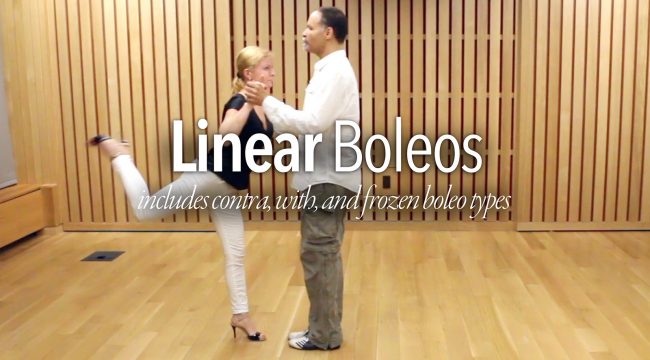
What is a Linear Boleo ? Firstly there are many varieties of Boleos. Tango Topics is only talking about 3 very common ones: Social, Circular, and today’s topic: The Linear Boleo. To be clear there are low linear, midrange linear, and then there are the high Linear Boleo. So what is it ? This is a lifting of the leg (Lead or Follow, typically though it’s the Follower’s leg) that tends to be sent straight back and up. This is why they’re called “Linear” Boleos because they’re in a LINE with the walking step. In this version of the Linear Boleo, we’re exploring a Mid-RangeLinear Boleo or what Tango Topics refers to as a Mid-Height Linear Boleo.
What’s the difference between a High Boleo and a Mid-Range ? The difference is in its application within the Line of Dance. In a High Boleo the Follower is reaching for the stars, as it were, trying to get their leg as high as possible in response to what’s being led. Typically there’s a tiny little problem with this idea. a.) They tend to be rather painful if you haven’t done the necessary exercises to help with extending one’s leg that high into the air. b.) They tend to disrupt the line and lane of dance because they’re misled in the wrong place (tsk, tsk, tsk). The Follower and the Lead in question quite literally forget for an instance that the Follower is in 3 in. heels for just an instant. And that instant is all it takes for there to be blood on the floor, and someone’s heel impaled into someone’s body parts! So the Linear Boleo that we’re talking about today is a mid-height boleo and doesn’t or shouldn’t really be too energetic or too high. It’s just above waist hight and a little beyond.
Common Errors of Boleos:
About The Video. This video is 2hrs:26m:20s in length in 11 sections. Both lead and follower vocabulary is combined and integrated in the video. There are two sections devoted specifically to the Technique that is required for both roles for nearly all Boleo types.
Exercise – 00:14:43 The Free Leg Exercise The Controlled Leg Exercise 7 Common Errors – 00:18:37 (above) 5 Common Follower Errors 2 Common Lead Errors Follower Technique – 00:24:46 The Walking Steps Reminders Follower Linear Ochos The Follower’s Appreciation Step Basic Boleo Technique Striking The Match (above) Social Boleo Technique Circular Boleo Technique The Follower’s Rebote Follower Posture Follower Leg Control Lead Technique – 00:28:34 The Lead’s ‘Lead’ The Timing Issue Setting Up The Contra Setting Up The With Linear Boleo Technique Frozen Boleo Technique The Rebote Principle – 00:05:15 Deeper Contra/With Boleos – 00:16:28 Contra Clarity With Boleo Clarity Deeper Rebote Principles Contra & With Boleos Together At Last Embrace & Posture Reminders Linear Boleos – 00:18:52 (see library) Sending The Free Leg The Contra Linear Boleo The Frozen Boleo Idea The Embrace Question More Frozen Ideas Linear Boleo Advice Boleo Examples – 00:10:57
Install Tango Topics on your iPhone: tap Share, then Add to Home Screen.