You’re out social dancing, and you’re finding yourself with either being led to a lot of Follower’s Molinetes, or the you’re leading the Follower’s Molinete over and over again with very little variation. From a Leading perspective, you’re stuck in Lead’s Mindset, or you’re just out of ideas where you feel like you need to impress the Follower with something new or different. From a Following perspective, you really don’t care just as long as the whirling dirvish you’re dancing with stops every once in a while and leads something else that is a bit less stressful. The only thing you’re caring about right now is staying in front of your Lead and trying NOT to be in the Lead’s armpit.
Today’s Tango Topic deals with a variation on a theme that almost never plays itself out in a crowded Milonga mostly because you know…it’s a crowded Milonga. There’s no space for craziness. However, what we’re talking about today isn’t craziness. It’s a variation on a theme that you already know how to do from a Leading and Following perspective.
So today we’re going to skip all the usual build up to this and generate a bulleted list of what it is that we’re after and why.
With that said, let’s dive into Today’s Tango Topic – The Linear Molinete.
First a reminder of What is “Dancing In A Small Space” (or ‘DIASS’ as Tango Topics refers to this idea) ! There are two parts to the answer to this question:
First, in it’s simplest form, it’s all about the vocabulary and engaging Five pieces of Tango vocabulary. The Five Pieces ? 1.) The 5 of the 6 Ways of Walking. 2.) Milonguero Ochos (sometimes referred to as ‘Lazy’ Ochos)3.) Milonguero Turns (not the Follower’s Molinete). 4.) Back and Forward Crosses (not the Argentine variety, there’s no space!). And 5.) Linear (and Circular) Ocho Cortados. This is all done in Close Embrace. Note that there are no Sacadas, Colgadas, Volcadas, Ganchos, Boloeos, or Death Drops and/or Drags. None. However, there are a whole bunch more pieces of Tango vocabulary that almost never get talked about, or thought of here, that can also be applied, such as Calesitas, Paradas (Step Over), Pasadas (Drags & Sweeps), ’Patter’ (sometimes referred to as ‘Pitter-Patter’), The Incrementals (see Golden Nugget Extensions), just to name a few.
Secondly, there’s the actual ‘Dancing’ part of the statement which is more about movement more than anything else. Said movement is done in a very confined space, no bigger than one meter square, if that. The people that practice this way of dancing, while they may not be conscious of it, there is a sincere desire to not to take up space, mostly because there isn’t any space to begin with. This is moving in milonga environment really, where the distance between couples, on all sides, is no more than about the length of one hand (about 17 centimeters). So from the perspective of the Small Space Dancer, there is precious little space to ‘do’ anything at all due to the conditions of the ronda, so as a result of this confinement, the dancing part is really about the minimal. Everything is done either around the lead, or the space that the couple current occupies and does not extend beyond that space. Quite factually, depending on which city we’re in when dancing this way (Buenos Aires comes to mind), one would take up no more space than the space that one’s feet occupy at that moment in time, and no more than that, but without moving from that spot!
What is a Linear Molinete ? In its simplest form, it’s the Follower’s Molinete spread out along a line instead of a circle around one’s Lead. In the Follower’s Molinete, the Lead engages in a Giro, or a self-turn over a singular spot. The Lead can not move from that spot otherwise it makes work for the Follower. In the case of the Linear Molinete the Lead has several options, however, the simplest one is that as the Follower is led to engage Back/Side/Forward, the Lead can engage Side/Side/Side, or Forward/Side/Back, or Back/Side/Forward with the Follower’s motion. The difference between the circular version of the Molinete/Giro structure and the Linear version is that the Lead’s steps are also Linear as well.
So instead of the Follower’s back step going around one’s lead as it would in a normal Follower’s Molinete, the Lead could invoke a side step with their Follower’s Back step. Or they have, as indicated above, three different options > Side/Forward/Back.
In the example above: The Follower’s back step is indicated by the Lead to go straight back instead of around, and the Lead then goes with them staying the same distance, at the same speed, in the same direction, and at the same level. Only in the example the Lead takes a side step with the Follower’s back step. Same with the Follower”s side step – a linear side step, the Follower goes side, and the Lead matches it. On the Follower’s Forward Step, the Follower is led to go forward and the Lead takes a side step.
This is, in its simplest form, a Linear Molinete for both roles.
About The Video. Total runtime for this video is: 09:08. This is a combined video format, lead and follow technique are mixed together.
Before another word is said, I want to address 3 things: 1.) If you are someone who is a hobbyist of Tango, I have a very special message for you below. Stick around, you’ll want to hear it. 2.) I’m not wearing shoes or socks in the video. And 3.) is the reason why I’m not wearing shoes or socks.
That said….
Story Time: Once long ago when I was just an itty-bitty Tango Miles. After leaving the care and feeding from my first tango teacher (after having been at his feet for 4 months), I was back in San Francisco, CA, living out of a car, and studying tango 7 days a week. All day. Every day. It was my sole enterprise. Tango 24/7. If you don’t know my story, you can go here. In short, I was living out of an enterprise rental SUV and sacrificing everything to learn to dance. Some people call it intense. I called it what I was doing in order to learn to dance Argentine Tango.
During this time, I found 3 or 4 practice partners that wanted to work with me. Wanna see an example ? What I didn’t realize at the time was that I had issues. Serious structural flaws in my walk, my embrace, and my understanding of what I was supposed to be doing. Those structural flaws were compounded by the Follower’s issues as we were ‘practicing’.
I thought I was doing what you were supposed to do, which was practicing what I learned from my teachers. What I realized later on, much later on, all that practice really did was bake in the problems without actually fixing or changing anything. So whatever problems I had never got addressed, even though I was studying with 6 different teachers, for 2 hours every day of the week. Nothing got addressed, changed, or modified. I kept paying my teachers thinking that I was learning tango. I wasn’t. That was their fault and mine and the way that tango is taught today. Nobody wants to tell anyone that what they’re doing is less than desirable. No one wants to give feedback that’s going to hurt someone’s feelings. That doesn’t sell classes. And the goal is to sell private lessons, not improve the quality of dance.
I digress. Throughout all of that I had to back and re-work my foundation later on. I had so many issues that I had to go back to the very foundation of how I walk and literally pull up my tango floorboards and replace the floor I was standing on. It was THAT bad. I had to basically teach myself how to walk all over again, several times. The reason it was several times was because there is a lot of confusion in what different teachers tell people about how to walk. I had to pick and choose from what I thought was clear, definitive information to what was poorly communicated information which moved right into flat out wrong information. From there I had to rediscover everything and figure out what worked, what didn’t and why it didn’t, and then figure out ways to make things work. This rediscovery would later help me in more ways than I knew at the time.
Today when I’m working with a student, they honestly don’t want to do that kind of work. They just want the answers. “How do I …?” so I show them what to do, and then how to do it. But that starts with going right back to their foundation. If they’ve been dancing a while, they think or believe that they already know what they’re doing. And to a certain extent they do. But in reality, the fundamental elements have eluded them and they’ve ended up in a place of physical compromise for whatever reason. Once they get over that fact, and they get into a routine that we’re going to do nothing but walking (as a Lead and as a Follow) for 6 weeks straight, then we begin the real process of learning Tango. They go through a movement study (as seen in the Follower’s Exercise and Lead’s Exercise) to emphasize this point. As time passes and they rediscover their foundation, and we move onto the 5 social figures of Argentine tango, I usually get THIS question:
“Miles, what should I practice ?”.
My answer has always been the same, “Your walk”. However, I do expand on that because it’s not just the walk. It’s also a host of ideas that one wants to skillfully and gently remind of one’s foundation and at the same time guide one towards a cleaner, and better foundation. Which is where I remind them that there are 3 things they want to practice:
I practice in bare feet. However, that’s me. You ? You want to do what’s laid out in the video in SOCKS. Not tango shoes. Put simply the shoe will compensate for your equilibrium issues that you have going on that you may or may not be aware of. So take the shoes off. Further still we want to feel the floor and see what our foot is doing. Specifically you are looking for how your toes are reacting to the stress and strain you are putting on them. If your toes are coming off the floor at any point, you have problems!
The Hobbyist’s Notation.
Let’s address the ‘hobbyists’ in the room. You don’t believe in practicing, and you certainly don’t believe that you need to do any kind of conditioning work. And articles like these are a complete waste of your time. Right ? Your belief is that you are here to have fun and nothing more than that. Am I right ? OK, if that’s true, then let me ask you a SIMPLE question: why are you at every practice, and every milonga, every night or weekend ? If this was JUST a HOBBY then why the attention ? One could rightfully answer: “I’m there to see my friends and to hang out because it’s fun”. Good answer, okay…then riddle me this: If this is just ‘fun’, why are you trying to get better and better dancers to dance with you ? You see a hobbyist wouldn’t care about that stuff. If you’re here to have fun with everyone and that stuff shouldn’t matter to you. Right ? But it does! And that’s the point. It does matter to you. A lot. Because of that, then might I suggest we stop pretending that practicing, form, comprehension, clarity, and that ‘wasting’ all that time on a ‘hobby’ DOES matter because it can and does create a better dancing experience in the end! So let’s dispense with the hobbyist mentality and get down to business?
Part One – Solo Practice Enters the Chat!
It’s right here that I’m going to tell you that the only thing that consistently improves one’s ability to move efficiently and effectively is SOLO PRACTICE. So here’s what you’ll need: a pair of sliding socks, a little grit and determination, and last but not least, a desire to be honest with yourself and not cheat yourself. Every time that you do compromise or give up, you fail yourself! There’s no greater failure than when you do not accomplish what you set out to do. This stuff requires your due diligence. It requires abject honesty. While you are the only one that knows just how much time you put into this stuff, your partners will feel the difference when they dance with you. The efficiency of your movement, the clarity and cleanliness of the motion, and more importantly, your ability to control and contain yourself WITHOUT needing to hold onto anyone else to execute.
Part Two – Preparing the Instrument.
You do have to do a little prep-work. And that prep work is ‘Presence’ to start with. Presence, if you don’t know, is a Tango Topics-ism. It’s the first part of every movement. This state comprises 5 different things: 1.) Feet in Social Collection. 2.) A micro bend of the knees. 3.) Elongation of the Spinal Column. 4.) Lifting the Head! 5.) Breathing through the Solar Plexus. This state of Presence puts the body into a state of awareness and preparedness for anything that comes at it, or you will ask it to do.
Part Three – Working On Your Walk.
The walking exercise isn’t one exercise.
It’s three > Extensions work, WalkingExercise, and finally a ‘Box’ step.
First we start with extensions: Forward, Side, and Back. In these extensions we engage the idea of ‘Walking In Opposition’ in the extreme, and then embed that idea in those extensions. The reason this is done is because it’s set up for Disassociation and Applied Disassociation. Details matter here. Meaning ? You’re working on everything in the extreme, going as far as you can with your opposition AND your extensions as well as your how you’re landing your feet.
Next we engage a ‘version’ of the Walk. Let me be clear, this is an exaggerated walk for several reasons. In my reasoning that exaggeration exists because we’re always “overshooting to under-do”. That means that we want to do things in the extreme here so that later on, when we may want to do something that requires it, it’s not a stretch or a strain but instead it’s easy for us because we’ve already done that work. This version of walk uses a null embrace format so that you can see embrace collapse if that happens and then correct for it. This version uses BOTH forward and backward steps, not just as a lead or as a Follow but both roles! This version also embeds the idea of Opposition, in the extreme. This version also embeds intention (a little forward lean). This idea pays attention to details like how you land your foot, ‘popping the knee’ as we extend backward, intention, passing thru social collection, posture, etc. The idea is to do this slowly, carefully, in a contained way.
Lastly we engage the idea of a Box Step using all 3 steps, going in both directions. Lead left and then Lead Right. Side with the Left, Forward on the Right, Change weight, Side with the right, Back with the Left, and then reverse it.
Part Four – Rotation – Disassociation and Applied Disassociation.
This part of the article ….
Part Five – Fred Torture.
is not visible to you….
Part Six – Time To Spend ?
because you are not a full subscriber …
Part Seven – The Common Errors!
if you subscribed, you’d see the full article and the 45 minute video.
— IF YOU WERE A SUBSCRIBER YOU WOULDN’T SEE THIS ANNOYING MESSAGE! AND YOU’D BE ABLE TO SEE THE FULL VIDEO (46 minutes), and READ THE FULL ARTICLE —
A Notation for Advancing Dancers.
I got news for you. YOU NEED THIS STUFF JUST AS MUCH AS BEGINNERS DO. Perhaps even more so. Your technique needs to be refined, clean, cared for constantly. And if you thinking dancing is the answer here. It’s not. You still have to take care of your foundation. Judiciously. The only different between you doing this stuff and say someone that’s been dancing for a year or so, is that you don’t have to do this stuff as often > once or twice a week. But you STILL need to do it. Just because you have reached your level don’t mean that you don’t have to continue to do your own personal work.
This Work Will Not Make You A Better Dancer!
Wait! What ?!?!?!?!? Let me be clear here: The mere fact that one is working on their walk, and by extension their foundation, this work IS NOT going to make them a better dancer. What it will do is prepare the instrument, their body, IN ORDER to dance with better partners! Let me say that again for those in the back that seem to think steps, patterns, figures, and one’s embrace make you a better dancer. IT DOES NOT! What makes one a better prepared dancer is reworking one’s foundation. Preparing the body and nervous system to build muscle memory, and neurological memory, so that one reacts properly when the time comes. This is the foundation of that work.
This is why we work on ourselves in SOLO PRACTICE and NOT in PARTNER PRACTICE!
The mistake I see so often is someone practicing with a partner. Yes, Tango is a partner dance. So it stands to reason that if the dance is a Partner Dance, then you should be practicing with a partner. Yup. All true. There’s just one little problem with that line of reasoning. This > When you practice with a partner you are taking your issues, and their issues, and co-combining them into one larger issue, and more importantly unintended issues that can and will get generated because you are in an embrace with each other. Put another way > You have your own issues. They have their own issues going on. If NEITHER one of you addresses the underlying issues that you both have individually then you will combine both of your underlying issues to create more problems than either one of you can figure out. You’ll either get frustrated with each other or yourself. Either way, the end result is NOT good!
So ? Solo Practice FIRST and FOREMOST. Clean you. Then add someone else into the equation. See where the bugs are at. Then go back to solo practice and work out where the issues were at…and keep cycling through.
Burying The Lead.
You don’t want to hear this part. But I have to say it, and you’re not going to like it. Even if you do all that work above. Even if you find a practice partner that is doing the same kind of work. You are still going to need someone like Miles to look at what you’re doing, point out the error(s), and then give you a pathway out. What you don’t want to do is watch yourself in a mirror or video or have someone else do that, and then critique yourself. You will miss things. Yes do video, but don’t use a mirror. Video doesn’t lie. You do. You can and will miss things. Further you will misremember and compromise what you’re doing. So in the end even if you do all that work, you will need a ‘Miles’ with good Tango Analytical skills to look at what you’re doing and give you reliable feedback that’s actionable. Which is to say, plan accordingly!
In the end, remember this: every minute of solo practice you invest is a gift to your future dance partners. It’s not just about perfecting steps or looking good; it’s about removing the body noise, ignorant unaware body motion and uncontrolled movements that create problems. All the work of overshooting to under-do, of disassociation and Fred Torture—they’re not about making you a “better dancer” in some shallow sense because this work isn’t about that. It’s about preparing you for the dance of your future self. This is about re-building your foundation towards solid, clean, and consistent so that when you finally step onto the floor with someone else, it’s a dance between two well-prepared partners. That’s the real reward, and it’s absolutely worth the work in my opinion.
One aspect of Musical Interpretation that almost never gets talked about is the how you actually Interpret the Music. How do you develop the skills necessary to allow you to interpret the music in such a way as to make it structured, clear, clean and most of all appear ‘fluid’ ? How do you do that ? That’s what workshops and classes are for, right ? Yes and no. The ‘Yes’ part should be self-explanatory by isn’t. And the ‘no’ part requires a bit of history (see Parts 1 & 2 for that). The long story shortened is that as you’ll see below, most Tango ‘Musicality’ classes or workshops are all on ‘Aspects’ of tango music not what you do wiht the rest of the song. This series is on the what you do with the rest of the song!
Today’s Tango Topic takes shows you the meat and potatoes (as it were) of one way on how to Interpret the Music, with the end goal to create a structured process that allows us to make free choices instead of haphazard choices that don’t necessarily fit what’s going on in the music. In one respect this is about training you, and in another, this is about conditioning you or in this case re-conditioning you to respond in a very structured manner. For most people when they begin this process of Musical Interpretation they are rightfully overwhelmed by the sheer volume of the problem. How do you interpret the music when the topic of Tango Music is so vast ? How do you even begin to tackle the problem because not only is Tango Music vast (over 90,000 pieces and counting, and only a fraction of that we actually dance to on a regular basis) but it’s also insanely multi-layered, and multifaceted? If you thought the vocabulary and the execution of technique was the unending onion, the music itself will drive you right over the wall of madness! How do you solve a problem this vast ?
There is no one way to interpret the music. There is no all-encompassing methodology to interpreting the music, no ‘one-size-fits-all’. There is no ‘right’ and there is no ‘wrong’. There is only desirable and less-than-desirable, so get that thought right out of your head! There are many ways to interpret the music. Some of them are desirable, and a good portion of the processes that you’ve likely come into contact with are less-than-desirable. And there’s a really good reason why they’re less-than-desirable. It’s because they only address a piece of a particular aspect of the music. For example: What do you do when you hear a Sincopa in the music ? (Hint, there are several things you can do)
Answer: One thing you can do and should do is once you hear it, once you are able to recognize the Sincopa (there are 4 types by the way), you can’t walk through it, and yet…that’s exactly what most people do. They walk right through it. Most are confused by the idea of Sincopa. However, Sincopa, is an aspect of the music. It’s not the entire song! What do you do with the rest of that piece of music ? Wander around for 2 minutes waiting for the Sincopa to happen ? No. That’s where Today’s Tango Topic comes in. It, or in this case, theydeal with how to handle the rest of the song! Today’s Tango Topic is about two co-interdependent topics that create the necessary stepping stones towards Interpreting the music fluidly, Alternation & Symmetry.
Before We Go Down The Rabbit Hole. Let’s be clear about the end goal here, the thing that we’re really after: To be able to freely, and fluidly, interpret the music so that our dancing matches what we hear in the music, and then (here’s the hard part) are able to execute that idea musically. HA! Easier written/said than actually done. The methodology on how to do that was covered in Musical Interpretation Part 1 and Part 2. If you’re not familiar with it, please go read it thoroughly before you proceed here. It is a pre-requisite.
However, before we can get to the ‘freely and fluidly’ parts, we have to jump through some hoops for the ‘interpretation’ stuff to actually work on a social dance floor, otherwise, you’re quite literally going to waste your time. First and foremost you absolutely must be able to properly identify the 5 Pause Types, religiously, without fail! You can not and will not be able to interpret the music without them. Everything, everything that Tango Topics talks about musically is built off of this construct. Failure to be able to identify without fail every single Musical Pause in a particular piece of music (Tango, Vals, Milonga, Tango-Milonga, Tango-Vals, Milonga Criolla, Milonga Porteña, etc) and you’re just pissing into the wind, and what Follows will be a complete waste of your time in reading this stuff. Put another way, so that you get the gravity of the situation. Can you correctly identify the 7 pauses in the following piece ?
If so, then you can move on to the next stage of your tango development, interpreting the music. If you can’t, then you’re going to have a problem with today’s tango topics. Why ? Because the topics are based on the idea that the pause must be respected, it’s what breaks up the music into logical, bite-sized chunks that make it accessible to us. Instead of arbitrary 8 count that may or may not actually be present in the music which may or may not have an actual relationship to what you’re hearing in the music. The 5 Pause Types are really markers, and while the piece above only shows you 2 of the 5 (the 1st and the 4th), they’re common enough markers that you should be able to distinguish them. However, doing so religiously ? That’s an entirely different prospect.
Secondly, you must be well versed in the 6 Ways of Walking (from a Leading and Following perspective). This is about walking, not Turning, not Sacadas, not Volcadas, not Ganchos, not Paradas, none of that stuff, but Walking with your partner. Elegantly. Cleanly. Clearly. Tango is by its very nature a ‘walking’ dance at its core. While modern Tango has become a dance all about the turn due to the fact that the ronda doesn’t actually move anymore, and due to the fact that Gustavo Naviera made the Follower’s Molinete ‘sexy’, but instead it does not move so we have to find other things to do while we’re not actually going anywhere, the foundation of that movement is still ‘walking’. So it serves our ultimate purpose to understand, and more importantly, be able to execute the 6 Ways of Walking from either perspective of Leading or Following. Religiously! Failure to do so and you’re not only pissing into the wind but having said piss splatter back at you! Not a pleasant thought. You must, must, must be able to execute a clean, clean, stable walk without hanging, without pulling, without pushing, without compression in any way, shape, or form. Failure to do so, and again, more piss in places you don’t want anything to do with!
These two points cannot be stressed enough. 1.) The 5 Musical Pause Types. and 2.) The 6 Ways of Walking are PREREQUISITES to further going down the rabbit hole here. That said, proceed at your own risk of further confusion. Hence the reason why this part of the topic today is called BEFOREWe Go Down The Rabbit Hole. You have been warned.
The Topics of Alternation & Symmetry: In their simplest forms, these ideas by themselves aren’t all that exciting, and if we’re being really honest, once you see them you’re going to say to yourself, “I don’t get it. Why is this stuff important ?”. Remember that Alternation & Symmetry are only a stepping stone to our ultimate goal of dancing ‘fluidly’, and seemingly freely, but with STRUCTURE! This stuff (Alternation & Symmetry) is that Structure that you’re looking for! It’s the very heart of Structuring Tango Music. Well, truth be told, far more Symmetry than Alternation. These concepts and practices are the answer to the question, “What do I do with the rest of the dance ?”! That said, let’s define these ideas:
Alternation: At its core, Alternation, is exactly what it sounds like – Alternating between two ideas or in this case, pieces of vocabulary. You pick two pieces of vocabulary and then ‘Alternate’ between them. That’s it. It couldn’t be any simpler than that.
Symmetry: Symmetry, on the other hand, is where we start to invoke a little bit of actual structure, and some rules! 5 of them in actuality. But before we get to that part, Symmetry is best defined as ‘executing’ Alternation in mated pairs.
That’s it, that’s all there is to it. You can stop reading now. Back to dancing. What a complete waste of your time, right ? Yup. Sure was. All that build up so that you could basically get to Alternating between two ideas, and then making it Symmetrical. Ok. Duh. So why on earth do you need a video on this stuff ?
Stop and think about it for a moment, do you actually know what it is that you’re Alternating ? or making Symmetrical ? or for that matter why you want to do it in the first place ? Well, of course, the 6 Ways of Walking right ? Not so fast. Yes, and no. Yes, because this is all about walking. And ‘no’ because there are some rules at work here. So you go right ahead and alternate this stuff until you’re blue in the face and see how far that gets you! You may come up with some interesting ideas but until you have mastered the 6 Ways of Walking (told you that you were going to get beat over the head with this stuff), and until you have mastered the 5 Musical Pause Types, Alternation and Symmetry are a complete waste of your time. Remember this is not about dancing to an ASPECT (remember ‘sincopa’ ?) in the music, but what you do with the REST of the DANCE! To be fair, Alternation and Symmetry does not deal with the end of the Musical Paragraph (see section 5), nor does it deal with the very important structural components of the song (see section 7), nor does it deal with how one goes about mapping a song (see section 8), nor does it deal with Accent notes (Section 7), nor Sincopa (Section 7), nor the specifics of a Turn (section 6), nor where (not how) you place an Argentine Cross! (see section 6). So you can alternate until you’re blue in the face, but knowing where this stuff exists and why creates the structure that we’re looking for.
About The Video. This video package comes in at 54m:22s in length in 5 Sections.
Section 3a – Alternation – The Basic Idea – 00:14:35 Section 3b – Alternation – Walking Ideas – 00:06:10 Section 3c – Alternation – With the Music – 00:08:21 Section 4a – Symmetry – The Whole Ball of Wax – 00:17:17 Section 4b – Symmetry – With the Music – 00:07:59
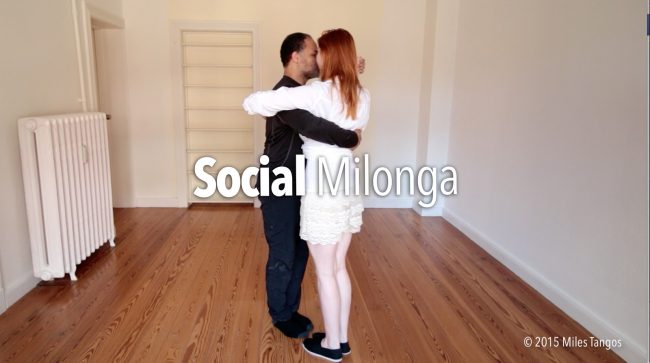
Milonga, and really ‘Social’ Milonga, is a difficult dance to Lead, but an easy one to Follow. Easy, if and only if, the Lead (person, not the action – ‘lead’) has a frakkin’ clue about what they’re doing. If they don’t, you, as the Follower are screwed and not in a good way either! Good Milonga is a step above modern Tango in that it requires both parties to be at their best technique wise. It requires both parties to understand an embrace that is non-compressive, non-restrictive, and have mastered a stable, clean, clear walking platform that does not ‘thud’. There is no need to ‘hang’, ‘pull’, or ‘push’ in any way, shape, or form.
Let’s get a few terms and definitions out of the way before we go any further for the initiated and the uninitiated. The word ‘Milonga‘ has 3 definitions.
1.) It refers to the ‘dance’ party, and social experience that we aspire towards dancing at via classes and workshops and learning the codigos of the dance itself. The whole point of tango is to emulate the Milonga experience as a whole that we would find in Buenos Aires.
2.) It refers to a musical style of music that is typically written as 2/4 time, or at about 80 – 100 beats per minute. There are several versions of Milonga music, not the least of which is Tango-Milonga, Milonga Porteña, Milonga Criolla, and a few others. Candombe is not Milonga, but is frequently confused with Milonga. A poorly trained DJ will add one into a milonga tanda thinking that it’s Milonga music when in fact it’s not.
Further still, a common error is to add a Foxtrot or a Tango Foxtrot, thinking that it’s milonga when it’s not.
3.) Refers to the dance itself, which is a frequently, and mistakenly thought of as a subset of Tango movement, and this is an error. Milonga (not Milonga Porteña or Modern Milonga) begat Tango, and from that Tango as we think of it today grew.
What is ‘Social’ Milonga ? Social Milonga is a Milonga of ease, of least resistance, of effortlessness. It’s what we would dance at the Milonga when Milonga music is played but for a social environment not a performance! Which translates to smaller (very small) movements, and steps. This isn’t about turns, ganchos, volcadas, sacadas, colgadas, death drops, …. no, none of that. Simple, clean, small movement. Rather it’s about linear movements with one’s partner in either close or open embrace (yes Milonga can be done in open embrace), small linear movements that move down the line of dance. Social Milonga should not back up against the line of dance, but rather angle against the line of dance, think of 45º angles so that no one backs up directly into another couple. Social Milonga is small, compact, and doesn’t need to take up a whole lot of space…ever. Horacio Godoy, who is a god of Milonga, is a good example of performance milonga, but it’s still a performance! What he’s doing is nothing short of magical, however…it should be noted that again, it’s a performance and not social dancing. He’s taking up oodles of space, and in the line of dance, you don’t have oodles of space! This is Social Milonga.
Just as a side note: Social Milonga rightfully should never be attempted with a new partner that you’ve never danced with before.
From a Following Perspective, you’re in for a rough ride, because a good portion of your leads don’t have a frakkin’ clue as to what they’re doing when it comes to Milonga. They will either race you around the floor and take a breather in odd places that have no relationship to anything that’s happening in the music, all the while squeezing the living daylights out of you, hoping you won’t notice that they’re not anywhere close to a beat that has any relation to anything that’s happening in the music. Or they’re so timid as to not wanting to step on your toes because they’ve recognized that this is insanely difficult that they back off completely. That’s the bulk of your experience. It’s rare, ever so rare that you have a lead that dances Milonga Lisa with you, and then expands that to Milonga con Traspie, and actually builds a milonga experience on the whole. These leads are rare, but oh such a wonder when you find one. It’s like Christmas morning, Easter day, and a box of chocolates all rolled into one! Fab! At the same time, let’s not kid ourselves…you as the Follower, have to be up for the challenge. Which is to say that your skills in Forward steps, Side Steps, and Back Steps must be absolutely spot on! Repeat after me: “I MOVE ME“. You must be responsible for your own movement. You must listen to what is being led (not waiting but listening) and then engage that movement immediately without fail. If you feel it, you go there, if you don’t feel it, you don’t go there. A good portion of the time, most followers fail these most basic things. And we end up with a less than desirable experience.
From a Leading Perspective, it means that you must have mastered all of the things listed above in addition to understanding and employing ‘Intention’. Why ? Because Milonga is all about the small, tiny movements, not about squeezing the living daylights out of your Followers with your embrace trying to make things small. It’s about leading small, tiny, incremental. It’s not about big, galloping steps…it can be, but isn’t. It’s about the tiny movements between the partners to the accents in the music.
However, the real key to milonga is the Weight Change. Being able to generate it in its myriad of forms without pushing, pulling, using force, and/or compression to accomplish this goal. If you can lead a weight change through opposition or a with-weight change instead of pushing or pulling, you’re onto a better class of leading as a whole.
Leading Milonga, or we should say, “modern” milonga, is a whole different class of leading. And doing it well, is a different kind of Lead (the person, not the action). How’s that ? This is choreographing on-the-fly, they’re making minor adjustments on-the-fly, they’re maintaining the line of dance on-the-fly…are you seeing the trend yet ? > on-the-fly! Is the key component. Mind you this happens in Tango and Vals as well, but there is a difference! The difference is the kinesthetics involved are a whole different class of minimal, minute movement, that is seemingly imperceptible except to the people dancing it, and to the trained eye.
In this version of Milonga the same thing that happens in the 5 Common Social Figures (which is a reduction of vocabulary choices) of Tango, happens in Milonga! Only instead of 5 Common Figures, it boils down to about 4 very specific choices.
1.) A variation of the Baldosa Box. 2.) A very simple and occasional Traspie, with a single Traspie, not multiples but not, and mostly not aligned with the habanera’s El Golpe! (and if you don’t know what that is…follow the link). You might…eeek, learn something. 3.) An occasional scissor step (not a pendulum step). and 4.) Every once in a blue-moon when there is a ‘race’ in the milonga beat and not the habanera, Patter In Milonga is used to accent the race of the beat.
Most of the better Milonga Leads have realized that a simplified Milonga is actually a better way to go than to race around the room which is what typically happens and why the better Followers will say “NO” to a particular Lead/er (follow the link for what that ‘/’ means) repeatedly. The better Milonga Lead will engage this simplified Milonga over and over and over again. It will look somewhat repetitive until you actually dance the Milonga with that Lead and for a time after the shock wears off that you’re dancing Milonga with that Lead it may even feel somewhat repetitive, until you start to listen to the music, and then the genius hits you like a ton of bricks. It’s simplified for a reason, to accent the music itself! Which is to say that you don’t need a vocabulary for good Milonga, what you need is an understanding of Music. And for that you first have to be able to hear the Habanera, and then, and only then can you start to play with the music. Once Habanera awareness occurs, and it will take some time for this to happen, it’s not something that happens overnight. More on this in a bit. Once Habanera awareness occurs, then the refinements of the dance of Milonga start to happen. Sometimes. Some Leads never, ever make this leap of logic > Less Is More. Most of them go in the opposite direction > MORE is BETTER! And this is a mistake. But they don’t and won’t ever realize it for a wide variety of reasons that are too numerous to mention here. Suffice it said, some folks never learn.
And unfortunately this space is too small to incorporate those ideas here. Fortunately for you Tango Topics does possess a Milonga track > Milonga Madness that discusses some, not all, of this stuff. For the rest that isn’t covered in Milonga Madness, we strongly recommend a long series of private lessons with the Author!
From a Dancing Perspective, ‘Social‘ Milonga is insanely difficult to master. It requires all of the above to ‘work’, to ‘function’ with ease. Not an easy task at all. When done properly it’s simply divine. When done poorly…well we’ve all had that happen, and it’s just an absolute disaster. There’s no nice way to put that. More often than not we have all had far too many Milonga tandas that is nothing short of “GAWD PLEASE MAKE IT STOP!”. And a good portion of the time it’s because the embrace needs to be reset and is too restrictive, and/or the Lead (person), needs to actually listen to the beat and then walk (see ? walking, not running) the Follower on that beat…but doesn’t.
The Musical Prerequisite
There is an absolute prerequisite to this milonga business – two things about Tango Music as whole that you, as a Lead, or a Follower must know:
a.) The Musical Pause in Tango Music as a whole! Without understanding this, you’re kinda screwed when it comes to dancing and really milonga as a whole. Oh and if you’re thinking that you can just ‘count’ beats and that will get you to your pauses…no. Fully 40% of Tango music does not contain an 8 count beat. Sometimes its a derivative of 4 yes…but sometimes it’s 4,8,12,16, or 24 beats before you hit an actual rest. So counting is about as useful as a small kitchen appliance unplugged. Why ? Because a good portion of the time, your count will be off for a variety of reasons. 1.) The transfer from shellac to digital (assuming it’s that direct and it almost never is) is probably flawed, scratchy, crackly, and slows down and speeds up. and 2.) Two words for you — TANGO MILONGA, which is to say that that the 2/4 time signature that you’re used to hearing in Milonga Porteña (or Modern Milonga), not so much with that! And that’s just the tip of the iceberg. Long story short, you want to actually learn to hear the 5 Major Types of Pauses in Tango Music.
b.) The Rhythm of Milonga which should not be confused with beat, melody, nor tempo, which is what a lot of you do. You do actually have to understand the Habanera Rhythm which is the basis of ALL Milongas. Not Candombe, Not Foxtrots…MILONGA! If you don’t know what the Habanera is, and/or think you have a handle on it, you really do want to go look at this definition of the Habanera on TangoTopics. This is the Rhythm that you absolutely must pay attention to because it quite literally forms the backbone of the music itself. If you can’t hear that, if you cannot find it in the music, then we have a problem, and it may require you to actually do a little study. Now to be fair, there are some milongas where the Habanera only appears sporadically, there are some milongas where the Habanera is a variation and you have to hear the variation, there are some milongas where the habanera is so distorted and so off of what you think it might be that it’s almost….ALMOST unrecognizable. However, that’s still no excuse for not practicing, and then working on finding the Habanera and then figuring out WTF to do with it.
That said…
Rather than show you charts and images which are about as helpful as a screen door on a submarine…let’s skip to a class summary by Oliver Koklier and Silvina Valz shot at the 2009 Portland Tango Festival. This is probably one of the best didactic Milonga videos you will need to see…ever. What Oliver & Silvina talk about in under 9 minutes will blow your mind. It’s a simple, clean, and clear, almost religious explanation of what Habanera and really the Milonga Rhythm is and is not, and what you can do with it. In 90 seconds they pretty much nail the Habanera. Quite honestly contained within this video is the basis of almost everything you need to know about a Milonga Rhythm. Once you understand the Rhythm of Milonga (and it is a rhythm, not a beat!) it is only then that we start to talk about what you actually do with it.
Ok, now that you’ve got your pound of free flesh that will only help you so far, now comes the real toy, which when this article was written originally hadn’t actually happened yet. Actually this article was written a year before what we’re about to talk about: Milonga Madness. This is going to sound like a sales pitch for Milonga Madness. It’s not. It’s the fact that we really have studied with a lot of people on this topic, spent years and more money than you can shake a stick at, at how to hear Milonga and then dance Milonga. This is one of the ONLY workshops that we’ve ever attended where we came away with a deeper understanding that Milonga does not need or want to be complex. It is a simple thing that does require you to actually hear the Habanera. Without that, then you’re just racing around the room. So here’s our advice. Go subscribe to Milonga Madness, you won’t be sorry! Truthfully, and we say this with how much we teach and talk about tango, it’s even better than all our own videos! Go SUBSCRIBE! Just scroll down to the bottom of the page, and click on the Milonga Madness Button! You’re welcome.
4 Parts of Social Milonga
Part 1.) The Baldosa Box & one of several Baldosa Box Variations Part 2.) Milonga Traspie and the many many variations Part 3.) Scissor & Pendulum steps and variations. Part 4.) Milonga Patter
When talking about Milonga, there are 2 things that have to be addressed in a specific order: 1.) The Musical Component. And 2.) The Vocabulary Component.
The Musical Reminder.
Milonga, the musical style or ‘genre’, has a very specific rhythm which is called the ‘Habanera’. This rhythm is what gives Milonga its signature sound. You must first be able to hear the Habanera, and identify it. Secondly you must be able to discern it’s note structure clearly. Failure to do this and you’re going to have a bitch of a time later on. This is why you see so many people doing what I call ‘racing’ milonga. This is where they literally race around the room, thinking that just because they’re going fast, this is dancing Milonga. It’s not. It’s going fast.
The Habanera consists of 4 notes that repeat constantly. A strong “1” beat note, followed by a strange note called the “El Golpe” Note (EGN), then a weaker “2” beat, and a clear closure “AND” note. This is the Habanera Rhythm as shown below:
Plays from YouTube. Pressing play connects you to YouTube. Privacy
The Habanera Rhythm Broken Down
This is the Habanera Rhythm > “1”, “EGN”, “2”, “AND” and it is what gives Milonga music its unique and signature sound. The funny part is that this rhythm is nearly identical across hundreds of Milonga songs. It never changes. Most rhythms in Tango music change with the wind or so it seems. Not so with the Habanera. This rhythm is in each and every Milonga.
What is the ‘El Golpe’ Note ?
Before we can talk about the ‘El Golpe’ note, we have to back up for a moment. I want you to imagine 4 notes that are equally distant from each other. And to create a bit of distinction here, I want to give each of these 4 notes a unique name. The first note we will call it “Strong 1”. The second note we will call it “1st AND”. The third note we will call “Weak 2”. And the fourth note we will call “2nd AND”. So the structure of these four notes would look like > “Strong 1”, “1st AND”, “Weak 2”, “2nd AND”. Also remember that these notes are equally distant from each other meaning that they’re all played at the same tempo. Capice ?
The “El Golpe” note, which means “the hit” in spanish, would occur between the “1st AND” and the “Weak 2”, but is closer to the “Weak 2” than it is to midpoint between the “1st AND” and “Weak 2”. The “El Golpe” Note (EGN) is what gives Milonga Music its unique sound, and the Habanera Rhythm it’s signature “lilt”.
Candombe is NOT Milonga.
There are songs that are, unfortunately, played as Milongas that are NOT Milongas in a Milonga Tanda. A good example of this is “Toca Tango”by Juan Carlos Caceras. This is NOT a Milonga. It is at best a Candombe and even that’s a stretch. Or another confusing example that is NOT Milonga that is often played in a Milonga tanda is “La Colegiala” by Enrique Rodrigues. This is a FOXTROT and NOT a Milonga. And the way that you know that these are NOT Milongas is they DO NOT CONTAIN A HABANERA RHYTHM! Further if you are hearing actual drums in what’s being played in a Milonga tanda, this is more than likely a Candombe and NOT a Milonga. Further a Foxtrot is 4/4 time not 2/4 as Milonga would be. In the end when you hear a DJ mixing Candombe or FoxTrots as Milonga, IMO it is not only not desirable, it’s confusing at best and should not be done, ever IMO.
The Musical Facts.
Before you can start to do anything in Milonga. You must be able to hear the Habanera Rhythm and hear it clearly. You must be able to discern it, and tease it out each of the 4 notes of the Habanera. If you can not do this, then attempting to dance to the Music of Milonga and more importantly, dancing the Habanera, will be next to impossible. I do not want to intimidate you because there are so many teachers out there that talk about Milonga as it is easy and accessible. This is NOT true in my opinion. It is challenging and can be difficult to master. But that mastery starts with the discernment of first the beat of Milonga which is the “1”, “2” of the Habanera. Then to be able to clearly identify first the closing “AND”. And finally to tease out the EGN, clearly and consistently!
The Vocabulary Descriptions.
This article serves as a reminder for the base vocabulary of Milonga. It’s a forerunner for a longer series that I have been sitting on for nearly 5 years, and I’m now in the process of editing for release. This video reminder leaves it to the viewer to play with these ideas musically and does not impose a solution as to how to interpret the music in its application. Further, this is NOT a deep dive of the vocabulary; it is only a cursory overview. The application of the technique in adherence with the Music will come later in the year. It’s an 10-part series that goes into great depth of Milonga’s vocabulary and how to use it with single-time Milonga as well as with the Habanera Rhythm itself!
Lastly, what’s above is only a sample video of the first piece of vocabulary. If you want to see the rest, then please register as a subscriber to watch the full video above. What’s here will be a description of that overview of the vocabulary of the Dance (Milonga).
1.) ‘Scissor Steps’ (Part 1 Duration 05:54 | Part 2 – Duration 05:15) are cross-body steps that engage ‘opposition’ in order to function properly. If you are not aware of what ‘opposition’ is or why it’s important, then please refer to the tangotopics lexicon on this subject. Scissor Steps are where the Lead is facing perpendicular to the lane (not line) of dance, and steps across their walking position from left to right, and the Follower is led to step right to left at a 45-degree angle perpendicular to the lane of dance. Typically, Scissor Steps are done in the line of dance, down the line of dance. While they are typically done in a linear fashion, they can be done on the circular. However, in this video, they’re only shown on the linear. It should be noted that doing them on the circular would go against the line of dance at some point, which is why they’re not taught or done on the circular. Further along those lines, you can do them on the circular but only when there is lots of space ahead of you and behind you. Typically, Scissor Steps are the basis of everything you do with Milonga vocabulary. They’re also the basis of Milonga Traspie Vocabulary (Pron: ‘Tras-PEE-Ay’).
Side Bar: Milonga Traspie is based on a step that’s very similar to this idea. Where the step is partially weighted on each beat very similar to a ‘Check Step’ or ‘Incremental Step’ in Tango. The only difference is the timing is usually done on the El Golpe note which doesn’t exist in Tango or Vals but does exist in Milonga.
2.)‘Box Figure’ (Duration 05:30). These are typically, 1 step forward, 1 step back and 2 step sides for either role. The steps form a box or a square. This pattern usually creates a problem navigationally IF and ONLY IF they are not angled properly so that the ‘BOX’ forms a diamond shape within the LANE of dance. The problem is if you employ the typical box step ( See Pattern Below ) within the LANE and LINE of dance, then the Lead stepping back is taking a step backwards against the LINE of dance! Which we do not want to do. So to prevent this from happening we ‘angle’ or rotate the box so it becomes a diamond shape within the LANE of dance. And now the backstop doesn’t interfere with the LINE of dance!
Lead > Forward on the right, Collect with the Left, Side with the Right, Collect with the Left, Back with the Left, Collect with the Right, Side with the Left and Collect with the Right.
Follower > Back with the Left and Collect with the Right, Side with the Left and Collect with the Right, Forward, on the Right and Collect with the Left, and Side with the Right and Collect with the Left
Typically Box Figures are done in a Parallel system and in outside partner fashion. Meaning that the Lead is stepping outside the Follower’s standing foot. This ’figure’ also employs opposition on both forward and back steps. Typically. However, they can be done in a Cross system. However, doing so creates unintended and awkward movements that are not typically done in Milonga. You’ll note that in the description above of the Box Figure, that the implied weight changes are all done with the partner. These are known as ‘with weight changes’. Meaning to change the weight WITH your partner at the same time. If the Lead changes weight, or changes the weight of the Follower, intentionally or unintentionally, then the couple has moved from a Parallel system into a Cross system, which will create problems that can only be resolved in an Ocho variation or a Traspie variation. And the OCHO variation in this case is either Type 1 (Lazy) or a Type 3 (Traveling), or a Type 7 (Milonga).
It’s important to recognize that we want the Box Figure to be small and contained. We do not want this figure to take up too much space, no more space than a Baldosa Tile. The Baldosa Tile is/was a standard tile size in Argentina for a time, and refers to a specific size and style of floor tile that was common in all hard surfaces in most ‘dance halls’ in Argentina. Typically those dance halls were in converted basement or 1st floor spaces that contained big patterned tiles. And those tiles are called Baldosa tiles. And those tiles are where the figure gets its colloquial name from > The Baldosa Box Step! Because the step usually traces the corners of the tile size and shape!.
One last thing, the Box Figure itself has a series of Traspie Variations that can be employed on every step > Forward, Side, or Back depending on where you are in the Habanera in relation to the figure itself.
3.)‘Common Box Figure Variation’ (Duration 05:54). There are loads of variations of the Box Figure itself. However in this example we are only adding a singular common variation, which is to add a 2nd walking step!
Lead > Forward on the Right and THEN forward with the Left and Collect with the Right. Then Side with the Right and Collect with the Left. Weight Change. Back with the Right, Collect with the Left. Side with the Left and Collect with the Right.
Follower > Backward on the Left and THEN backward with the Right and Collect with the Left. Then Side with the Left and Collect with the Right. Weight Change. Forward with the Left, Collect with the Right. Side with the Right and Collect with the Left.
The variation occurs in the 2 forward steps for the Lead and the 2 backward steps for the Follower, as well as calling out the necessary weight change to maintain the Parallel walking system. Failure to invoke that weight change and we end up in the Cross system and a stumble! The result is that the Follower will stumble because they’re being led to a side step that IS NOT possible from a standing or weighted foot. Their weight is on their RIGHT, and they’re being asked to move a weight foot which is NOT possible, hence a potential stumble. I say potential because the Follower may solve the problem by moving the free foot, in this case their LEFT, which will generate a Cross system solution and further repetition. Where the only way back to the Parallel system is either Ochos, 3-track walking, or a weight change in the Lead.
And again, this variation has a problem, like all Box Figures, that it only works in the Line of Dance IF and ONLY IF it is angled and rotated slightly. Remember that the Lead’s backstep should NOT go directly backward, but rather ‘curves’ a bit on the diagonal towards the inner track of the lane of dance.
This variation works really well employing the idea of musical alternation. Where we invoke a Box Figure, then a Box Figure Variation, then a Box Figure, and another Box Figure Variation. This variation also works really well with a host of Traspie variations on every single step!
4.)Horacio’s Figure or El Antilugio (Duration 04:10) This is a very, very recent addition to Milonga vocabulary that has become popular in certain places. It’s best described as ‘cross step’, ‘touch-tap’, ‘cross step’. Meaning that the couple crosses as though they were in a scissor step (cross step), and then extends the free leg and then touches the floor in a tap (touch-tap) very similar to Traspie, and then does an opposite cross-step in the opposite direction, and then repeats. This vocabulary is typically done in the LANE of dance and angled perpendicular to it.
5.) Milonga Rebotes (Duration 08:55) These are best described as disassociative moves for one or both roles at the same time (think of a Linear Ocho), where we then engage in an extension (forward, side, or back), and then resolve in one of two ways: a.) Back to the position we started in, OR b.) Into another Rebote. Typically the Rebote is done in the Lane of Dance and perpendicular to it.
6a.) The Milonguero Turn – See The Existing Articles on Technique. This turn is insanely perfect for Milonga. The reason ? Is that it can be done in 2 or 3 notes, and the best part is that there is NO disassociation, which means it’s only straight walking and crosses! As a result, it can be applied in various sub-divisions of the Habanera (detailed below).
6b.) Follower’s Molinete/Lead’s Giro Turn – See The Existing Articles on Technique. This turn has a slight problem with it. It’s the disassociations that take place, they need to be short, and compact. Further the 3 steps don’t necessarily fit because the length of the steps have be very short. I’m not saying that it can’t work, but there’s a way that it can work if you do one thing > Shorten the Side Step to the point of a weight transfer! Doing this makes a Habanera subdivision work just fine. Oh and BTW this solution also works really well for Vals!
7.) Media Luna – See The Existing Articles. This is another PERFECT turn for Milonga and part of the reason it works is because it’s 3 steps. But again, you have to shorten the side step to a weight transfer.
8.) Linear or Circular Ocho Cortado – See The Existing Articles on Technique. 9.) Single Axis Turn(example shown only for subscribers) – See The Existing Articles on Technique. 10.) Argentine Cross(example shown only for subscribers) – See The Existing Articles on Technique. This particular crossing step can work in Milonga but you have to do some set up to make it work.
Total Duration – 13:10. These last 5 are common moves borrowed from Tango. The only difference here is that they’re done in time to the “1”, “2”, “AND” of the Habanera. It should be noted that the “El Golpe” note is excluded for obvious reasons.
Once, not that long ago, Milonga Lisa was all the rage. It was all anyone danced. It was thought, at the time, that to attempt to dance all 4 notes of the Habanera was considered fun, crazy, but fun. As time passed people began to drop one of those notes and danced the “1”, “2”, “AND” structure or danced one of the 4 common sub-divisions of the Habanera Rhythm. And then along came Daniel Trenner, Pedro “Tete” Rusconi, and Daniel’s Bridge to the Tango videos that introduced people to the idea of a “Traspie” or a stumble step (which is what Traspie means) as a way to access the EGN and Milonga con Traspie was born. Oddly enough there is a relationship between the EGN (which means ‘the hit’) and the Traspie and that relationship is a controlled contained deliberate stumble. Which is more like a touch tap more than anything else.
The reason I mention any of this stuff is because all of that material above can be danced as Milonga Lisa or Milonga con Traspie!
The Miles Musical Milonga OPINION.
Now that I have reminded you of the vocabulary of the dance, I would be remiss if I didn’t remind you of the overall importance of learning HOW to hear the Music of Tango above all else, and then using that same information to apply to Milonga. First, we must hear clearly:
a.) The Beat of Milonga (the “1”, or the “1”, “2”) b.) The Habanera Rhythm and the Subdivisions. (see below ‘dancing the habanera’) c.) The Musical Pauses of Milonga. d.) The Sincopé (pron: Seen-Coh-Pah) and 332 elements. e.) The Overall Structure of a Song.
It’s only at this point that, in my opinion, I ‘break milonga’ and focus on hearing the Habanera by itself, independent of everything else. I believe, and this is a hill I will die on, that learning to pick out the Habanera above all else forces you to be clean in applying the vocabulary above. Because if you can’t hear what you’re dancing to, there’s no point in doing anything!
Notation: When it comes to tango music, I don’t count beats, I label them, but don’t count them. I believe that counting beats is useless and teaches the dancer nothing about what specifically they’re supposed to be listening for. I teach listening skills, not counting skills. Below when you see “1”, “2” these are labels to help identify what you’re hearing, and nothing more than that.
There are 5 ideas to Dance to the Music of Milonga (note what I said – the Music of Milonga):
1.) Milonga in Single Time means that you’re dancing on EVERY other beat, or on the “1”. What this does is a.) Divorces the Habanera Rhythm itself from the Beat of the Music. And truth be told there are Milongas where the Habanera literally disappears and you have to keep time until it comes back. b.) It changes the tempo of Milonga from a 2/4 time signature to a 4/4 time signature. Which in layman’s terms means that we just slowed down the Milonga. What this does is makes the music and its nuances that much more accessible because we’re no longer focused on the tempo of the music. I have an entire video on doing precisely this > go look at “Milonga-In-Single-Time”.
Now if you want to be fancy, and really play with a toy, you could dance on the “2” and only the “2” of the Beat structure, and not necessarily the “2” of the Habanera. Because while the “2” is there in the Habanera, there are Milongas where the Habanera is partially obscured and/or goes away entirely for a portion of the song!
There are some very important reasons why we would want to engage in Milonga in Single Time. One of them is that typically what happens with Milonga, which MOST FOLLOWERS HATE, is the ‘racing’ around the floor bits that happen because the Lead only hears the comingled tempo and rhythm/beat and thinks that this is Milonga. It’s not. It’s racing the Follower around the floor which is NOT desirable. So instead we engage in a Milonga-in-Single-Time to alleviate this problem. And in my opinion this is ideally how you would start the tanda. It keeps the music of milonga and the vocabulary accessible to yourself and your dance partner! Imma jus sayin’. That whole > ‘here! let’s race around the floor for 3 minutes’ thing isn’t a whole lot of fun. You want to build up to it and do it in a constructive clear way. This is one way to get there.
2.) Milonga in Normal Time means that you’re dancing the same thing as Milonga In Single Time, only this time you’re hitting the “1”, “2” ONLY, but not the ‘El Golpe Note’ or the following “AND” at the end of the Habanera. This is slightly harder to do than it sounds, and to do well. Further still in order to complete the sequence of clarity in what you’re attempting to do, you’re RESPECTING THE PAUSES. Failure to do this and you’re, again, racing around the floor! Which is NOT desirable. However, this is NOT dancing the Music of Milonga. It’s dancing to the BEAT of Milonga. It’s respecing the Beat but not the notes of the Habanera.
3.) The First Variation of the Habanera. In this idea we dance the “1”, “2”, “AND” but not the “El Golpe Note” (which is what defines it as Milonga). This is where you’re actually Dancing to the Music of Milonga. HOWEVER, you are not Dancing the Habanera.
4.) Dancing the El Golpe Note. This is where things get interesting. We can dance on one of a few subdivisions of the Habanera. Like > “1”, “El Golpe”, “2”. Or “1”, “El Golpe”, “AND”. Or “El Golpe”, “2”, “AND”. Subdivisions ? What does that mean ? It means that you can not dance all 4 quarter notes of the Habanera, not reliably well, and consistently. Doing so would be exceptionally tiring. So instead we make an informed and logical choice by grouping 3 of the notes together which can create some unique and really fun sub-divisions of the Habanera depending on the orchestrations. This is typically where we would invoke a Traspie specifically on the “El Golpe” note.
5.) Dancing the Ancillary. Typically, Milonga contains a lot of ancillary ideas such as trills at the end of the phrase, or ‘runs’ in the phrase, or sincopé at the beginning or ends of the phrase, and/or hitting the 332 of Milonga. If you dance to just these items and divorce everything else, it’s entirely possible to dance to the Music of Milonga in a very unique and interesting way. However, in this instance, you’re no longer Dancing to the Habanera. It’s only loosely dancing defined as dancing to a Milonga because there’s milonga music playing.
Dancing to the Music of Milonga vs. Dancing to the Habanera ?
Up until now I have made it appear that you want to dance ONE or THE OTHER. The fact is that you want to dance BOTH of these ideas. Read that again.
Let me be clear here. You do want to dance both of these ideas, but you want to do them one right after the other not together. You want to get so good to the point where you can turn it on and off like a switch. And that requires a lot of practice, and a lot of listening skills (both of those skills I teach thru a variety of methods).
In short you want to dance to the music of milonga, and then the habanera, one after the other in a structure. And what should that structure be ? Pairs of ideas!
Follow me on this one.
Typically there are an even number of Musical Pauses in a Paragraph. So for the sake of argument let’s assume that there are 6 in a given Milonga paragraph. When you hear a pause you change your vocabulary choices. So at the pause, you pick a piece of vocabulary and between one pause to the next is a “phrase”, and inside that “phrase” you would dance a figure. Capice ?
An Idea > you would dance two of the same figures back to back WITHOUT hitting the El Golpe Note (EGN) using the “1”, “2”, “AND” idea. And then you pick a new figure and dance those two figures back to back where you do invoke the EGN like so > “1”, “EGN”, “AND” or “1”, “EGN”, “2”. This leaves you 2 more pauses and 2 more “phrases” You would then dance 1 figure each of the preceding figures, one WITH the EGN, and one WITHOUT it. And so you really nail it, you would swap the figure that invoked the EGN with the figure that didn’t!
Using this kind of structured methodology creates a kind of ordered framework where you are deliberately choosing to hit the EGN in very specific places!
It should be noted, and this is a huge notation: There are times in a given paragraph where the EGN is present and there are times when it is NOT! You must be able to hear the differences. This is why I teach listening skills first and foremost before doing anything else in Milonga.
Honestly, there is so much here that you could literally spend years on this stuff and never hit bottom. What’s above is the barest hint of playing with the Music and the Vocabulary itself.
My advice ? Learn to hear the music first and foremost. The vocabulary itself is secondary to that. Honestly, if you can walk on the strong “1” and weaker “2”, there’s nothing wrong with that. BTW doing so is actually a thing, and it is called > “Milonga Lisa”. It gets the job done. If you can apply the vocabulary above with that same methodology, then you’re starting to play with Milonga. Adding in the “El Golpe” note and its interesting sub-divisions is where Milonga and Milonga Traspie becomes a bit more interesting and challenging.
This process, if you do it right, should take you about a year of social dancing and clarity BEFORE you actually start dancing Milonga properly and safely.
Dearest Reader: When talking about Musical Interpretation, you’re immediately going to jump to the conclusion that what Tango Topics really means when it says “Musical Interpretation” is ‘Musicality’. No. The word ‘Musicality’ means to be music, that’s what the ‘ity’ ending of the word means. Literally, (from webster’s) “a condition or quality of ‘being’ music”. Tango Topics doesn’t know about you, but we can’t ‘be‘ music. We can listen to the music, we can write the music, we can dance to the music, but we can’t be music. Notice the action verbs there ? Listen. Write. Dance. But in this case not ‘Be’. It is physiologically impossible for something or someone to be music. Because that is the case we want to create a level of detailed and descriptive accuracy with our language, and that is to Interpret The Music. That’s what this series is all about, a way to interpret the music in such a way that no matter who you are dancing with, regardless of your role (lead or follow), that we dance in structured manner that interprets what we’re hearing into dancing format that looks exactly like what we’re hearing.
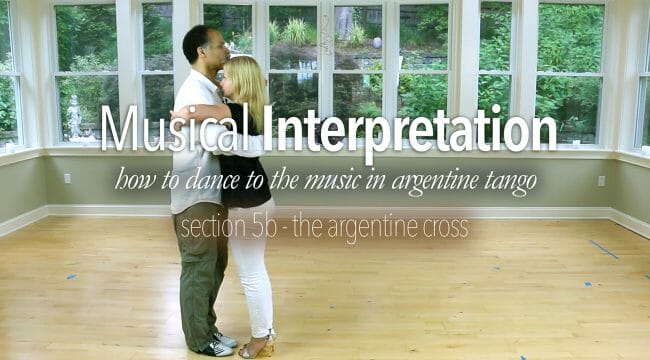
A very important tool to learn when wanting to expand our Musical Interpretation skills is to learn to execute on the beat, not behind it, not ahead of it, but directly on top of it. While this has been expressed clearly in Sections 1 and 2 of the Musical Interpretation guide thus far, it’s taken a whole new level here in Section 5b. Sections 1 and 2 deal with being on beat and ‘respecting the pauses‘, section 5 deals with the specificity, and granular control over when something is done, musically. In Section 5 we’ve only begun to explore the granular control aspects. Today in Section 5b, we’re continuing in that same vein. We’re playing with specific granular control (from a leading and following perspective), with a piece of well known and well worn piece of Tango vocabulary occurring in a very discrete place. The discrete place ? The Musical Paragraph Marker! And the vocabulary ? The Argentine Cross.
From a Musical Perspective let’s address a statement made above, that is absolutely important going forward, and that must be made clear, “there are only 4 (sometimes 5 or 6) Musical Paragraphs”.
What is a Musical Paragraph ? This is a Tango Topics construct, you will not find this anywhere else, or on youtube, nor taught by any other teacher. Put simply, a Musical Paragraph is a series of paired Musical Pauses (usually between 4 and 6 pairs in a single paragraph), that comprises one singular musical ‘idea’, or more importantly, a ‘movement’ in a song. If you stop and you analyze what you’re hearing, you’ll hear 4 distinct sections of a song (sometimes 5 or 6 depending on whether or not there is a singer), each one marked by a Type 4 Musical Pause or what Tango Topics calls “The Musical Paragraph Marker“. This type of Musical Pause serves two important functions. 1.) It is a Musical Pause in and of its own right, which means that you must respect it! 2.) It serves as the declaration between one musical idea and the next. You’ll hear this idea expressed in all 6 of the major forms of Tango Music (Tango, Milonga Porteña, Vals, Tango-Milonga, Tango-Vals, and Milonga Criolla). However the later the music within the Golden Age period the more distinct and clear it is. The earlier in the period, the more muddy it is. So how do you know that you’re hearing a type 4 Musical Pause or the Musical Paragraph ? What you’re listening for is a clear and distinct ‘bum-bum‘. While we won’t play that here for you, you’ll have to do that work on your own (or subscribe so that you can see what we’re on about), you can infer a great deal from just listening to your favorite pieces of music. However, if you were a registered user (it’s free), you would see a slightly different answer to this question here. You’d actually get an example of the Bum-Bum, but alas, you’re not so you’ll have to ‘infer’ and ‘imagine’ instead of signing up as a free user to go a little deeper. 🙂
Here’s a hint though, go listen to Juan D’Arienzo, any of his Tangos or Valses. The reason for D’Arienzo is that his are very easy to hear for the Musical Interpretation beginner,…ummm you! Oddly enough you’ve been hearing them all along. The thing is that you have just haven’t realized it. This idea is in Every. Single. Song. You’ll hear a distinct shift in ideas where the music sharply changes and goes in another direction. The melodies change, the theme changes slight. That’s the ending of one idea, and the beginning of the next or as Tango Topics calls it: The Musical Paragraph.
About The Video. This video package comes in at 32m:20s in total length in 3 Sections.
Section 5a1 – Argentine Cross – Technique – 00:08:22 Section 5a2 – Argentine Cross – With a Metronome – 00:12:19 Section 5a3 – Argentine Cross – With Music – 00:11:39
Musical Interpretation. Another aspect of Musical Interpretation is what happens when you start to apply very specific pieces of Tango Vocabulary to fit with the music. It is through this specificity of the vocabulary choice, and really the granular control of that specificity, not to mention the variation (and the variable control of the variation) that musical interpretation starts to take on its true purpose
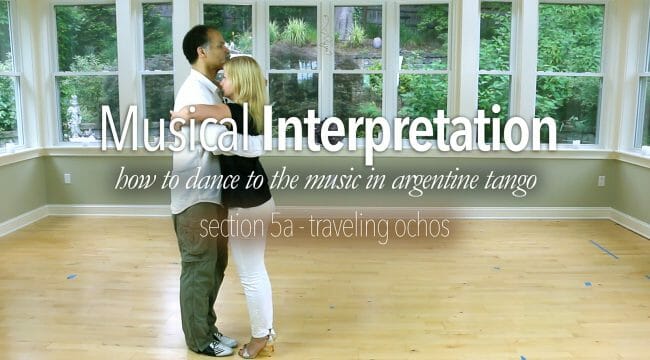
There are 4 pieces of vocabulary that embody the idea of musical interpretation that we use frequently: 1.) Walking. 2.) Ochos. 3.) Turns. and 4.) Crosses. However, those descriptives are at the 50,000 ft level. It’s more likely that we’ll use the 4 types of vocabulary or their variations: 1.) Parallel SystemWalking. 2.) TravelingOchos. 3.) The Follower’s MolineteTurn. And 4.) The ArgentineCross. In Today’s Tango Topic on Musical Interpretation, we look at number two on this list: The Traveling Ocho. Tango Topics recognizes that there are 8 types of Ochos. The Ocho that you usually think of is as a common Ocho is what we call a “Traveling Ocho”, so named because it ‘travels’ down the line of dance, hence it’s proper descriptive name! The distinction is required here because of the seven other varieties such as Milonguero Ocho (sometimes called “Lazy” Ochos), Linear Ochos, or Circular Ochos just to name a few, and as you’ll see in a few sessions, that distinction is an absolute necessity to what we want to do, which is creating variety and lots of variation as well as structure in our dance.
To be clear the Traveling Ocho is a staple of the dance, it’s one of the primary tools or pieces of vocabylary (as noted above) that we use constantly to express our musical intents. We use it so often, so unceremoniously (not like it needs ceremony), but without care, it’s just what we do: Ochos, Turns, Crosses, and Walking. We default to these ideas without thinking about the larger picture of what we’re doing, without structure, without any thought as to how it looks, or more importantly, why we do what we do. Most often we respond out of habit, and very infrequently out of conscious thought. For most Leads they respond out of not knowing what else to do (there are other ideas that you just haven’t considered), and for most Followers its a limited palette of options, so what else could there be (quite a bit actually, but you don’t know that yet) ?
From a Musical perspective, most people respond to just the beat and trying to be on beat. There are other options, even though this video doesn’t show those options, they’re implied from previous videos on the topic of Music Interpretation. For a greater portion of you reading this, in one respect you can walk on beat without thinking about it, it’s easy for you. And for some of you, being on beat is a challenge, and what’s worse is that you don’t know it. Now we add to this Musical perspective the Traveling Ocho! From a Follower’s perspective, they feel pressed into immediate service, especially with the applied disassociation, and thereby can’t keep up with what’s being led. More specifically their execution of their technique goes right out the window, and as a result their execution looks sloppy because they’re being rushed into service. And then there’s the other side of the equation: the Lead (the person) implies a lot of their ‘lead’ (the action) to do said Traveling Ocho, and the result looks haphazard, and off-time or offbeat and/or not even close to the beat.
This is the state of executing a Traveling Ocho in time to the music.
Today’s Tango Topic deals with Section5a of our continuing series one Musical Interpretation. Section 5 deals with 3 common pieces of vocabulary that we use frequently and how to make them musical, and how to practice them. It is broken up into 4 sub-sections this month: Section 5a (this post) is on the use of the Traveling Ocho as a tool to Interpret the Music. Section 5b is on the use of the Argentine Cross (sans the 255 OTHER Cross variations). Section 5c is on the ‘Turn’. And Section 5d puts it all together. That said, let’s get started on the Traveling Ocho in Musical Interpretation.
About The Video. This video package comes in at 28m:38s in length in 4 Sections.
Section 5a – Introduction – 00:02:51 Section 5a1 – Traveling Ochos – Musical Technique/Rules – 00:09:27 Section 5a2 – Traveling Ochos – With a Metronome – 00:10:47 Section 5a3 – Traveling Ochos – With a Sliver of Music – 00:05:33
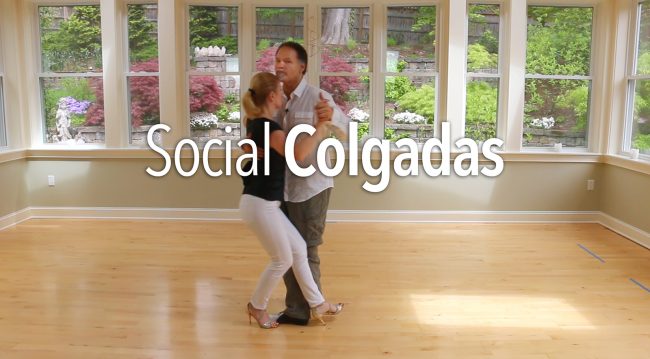
The Social Colgada is in many ways very similar to the Single Axis Turn. That’s because they’re from the same family of vocabulary. So theoretically, if you know one, ha ha ha, you should be able to execute the other. Not true actually, there are stark differences between the two. One primary difference from the Single AxisTurn is that the Social Colgada is done with the partnership in a perpendicular position to each other rotating around a singular axis vs. the Single Axis turn where the partnership is facing each other. Still another is the Single Axis Turn rotates the couple 180 degrees without invoking a second step around, typically. Whereas the Social Colgada is typically a 270 to 360 degree turn!
The Colgada Rap! Before we go any further, truthfully Colgadas are typically manhandling events that most Follower’s want to avoid like the plague. The reason is a.) that they’re poorly executed. b.) they’re usually arm pushing and pulling experiences, and c.) someone (read that as the Follower) invariably gets hurt because their back has been wrenched this way or that. Most of this occurs because the Lead in question has not learned how to properly generate a Colgada. Where Colgadas get a bad rap is because of these 3 aspects which turns off a lot of people, obviously. However a Social Colgada on the other hand, while it has all the potential for these things to happen, is much smaller, and exists within solely within Close Embrace. When executed properly it can be one of Tango’s more elegant specialty pieces of spice or accent vocabulary.
What is aSocial Colgada ? A ‘Social’ Colgada means that the Colgada itself takes up very little space, that it fits within the line & lane of dance, while the couple is in Close Embrace, and instead of executing the Follower’s Molinete to turn the couple, we invoke a Social Colgada. As to a Colgada aspect ? The word “Colgada” comes from the root Spanish verb “Colgar” which translates to English as “Hang”. The word ‘Colgada’ is the past participle version of the verb which adds an ‘ed’ ending to the word. Which when translated to English is ‘Hanged’ or rightfully ‘Hung’. So ? A ‘Social’ Colgada is a move where the Follower (specifically) is in a hanging state off their Lead, deliberately. More specifically, they’re being placed in a position where they’re going to hang. And that’s where we talk about a shared axis, and more importantly balance.
Ideally the Colgada itself is not about taking the Follower off axis, as you may have been told, but rather about creating a state of shared balance & equilibrium along the shared axis between the partnership. As there is always a shared axis between the dancing couple. Truthfully there are actually 6, not one. There’s the lead’s central longitudinal axis, the follower’s central longitudinal axis, and the shared central one between the two dancers which is created by their relationship to each other. It’s the last one that we’re interested in because it generates the space for a Colgada to exist.
The Free Tip. From the Follower’s position, and point is not shown in the video at all, the follower’s knees want to be “soft” or pliant. You don’t want them locked out or bent, but rather a micro-bend to allow for maximum flexibility!
About The Video. This video is 29m:09s in length in 12 sections. Both lead and follower technique are combined and integrated into the video.
Introduction – 00:01:04 The Mordida – 00:02:28 Balance & Planking – 00:03:06 The Kickstand – 00:01:41 The 3 Linear Cologadas – 00:03:08 The Circular Colgada – 00:01:40 The Colgada Embrace – 00:02:15 The Step Over Colgada – 00:02:56 The ‘Social’ Colgada – 00:03:03 In The Line Of Dance – 00:03:44 The ‘Whoosh’ Factor – 00:01:39 A Primary Lead Error/End – 00:01:39
(notation: there is an earlier version of this vocabulary that is in the archive that is still acessible)
You’ve seen them at Milongas, and for most Leads that see them, most think they’re really cool and then want to do them because of their coolness factor. Most Followers when they see them for the first time are rightfully afraid of them for obvious reasons. The Follower is being led to a controlled fall. Controlled is a loose term here because 9 times out of 10, that control never happens, mostly because the Lead has not mastered several things, most notably how to support their Follower without the use of their arms! Typically you’ll see variations of an Argentine Volcada that range in size from large and egregious, taking up ginormous amounts of space, with the more common open side volcadas being the most common variety, all the way down to the more reasonable ‘Social’ Volcada which takes up no space in the line of dance. And then everything in between those two extremes. Today’s Tango Topic deals with 2 specific varieties of these ideas. The common Egregious variety, and the more desirable Social Volcada. That said, let’s dive into The Argentine Volcada.
What is a Volcada ? First, the word ‘Volcada’ comes from the root Spanish verb ‘volcar’ which when translated into English means ‘To Fall’ or ‘To Tip Over’ or ‘To Overturn’. The ‘ada’ ending means, in English, ‘en’ or ‘ed’, or in this case FallEN, FellED, TippED Over, OverturnED. While the translation gives you a tiny idea of what a Volcada is from a Tango perspective, very small, it doesn’t even come close to what it actually is.
A Volcada is nothing more than a glorified Argentine Cross with a 20 to 30 degree forward tilt or bodily slant (for both roles) along the longitudinal axial line for both roles that ideally does not break at the waist. A Volcada itself can be supported or unsupported (which is not desirable) and is usually performed from Cross System or from a standing Mordida. When done properly….and ‘proper’ is a very loose word here because there are a whole series of Volcadas that can be done (safely) that loosely qualify as a ‘Volcada’. These are what are considered shared-axis pieces of tango vocabulary that result in a series of crossed feet for the Follower to either Follower left or Follower right. This is a Volcada.
What is a Social Volcada ? A ‘Social Volcada’ is a little different. This is a version of the Argentine Volcada that is, in our opinion, far sexier and way more svelte than the egregious versions of the Volcada than what you’re used to seeing. The Social Volcada is smaller, tighter, much more ‘cloistered’. It’s referred to as a ‘Social’ Volcada because it takes up about as much space than a typical walking step, maybe less. It fits within the line, and the lane of dance, and does not in any way, shape, or form, extend beyond the couple’s walking frame. This is what makes it ‘Social’. 😉 Why do we bring up this as the topic ? Because in this video, we’re going to go one step beyond the typical Argentine Volcada and focus on the Social variety! 😉 Thereby making the Volcada far more useful in the line of dance. You’re welcome.
A Few Points To Note.
For all intent and purposes, the Social Volcada is the Volcada that you want to do at a Milonga. The typical ‘Argentine Volcada‘:
1.) Takes up way too much space in the line of dance. 2.) It is far more stressful for both roles. and 3.) It can cause way more injury for the Follower.
Let’s spell those out a bit so that you have a bit more clarity.
The typical Argentine Volcada is a flashy piece of vocabulary and when done properly, isn’t just one volcada but actually a whole cadre of motions that can rightfully take up an inordinate amount of space. And when you’re in the line of dance at a crowded Milonga, like in BsAs or Berlin or New York, you just don’t have space for those things. You just don’t. So we ideally want to invoke it’s smaller, safer, easier cousin – The Social Volcada.
The typical Argentine Volcada is very stressful for both roles. From a Leading perspective – The Lead is rightfully taking all of the Follower’s weight and inertia. This causes way more stress than most people want or need while out social dancing. It’s typically a jarring transition into an Argentine Volcada which is where the stress part comes in. Most Leads generate the Volcada without necessarily thinking about it. It’s an after thought of “Hey! That would be cool here” without a whole lot of preparation. From the Follower’s Perspective, they’re at the whim and mercy of their Lead. While they can invoke the Follower’s Kickstand Methodology to stop the Volcada from happening. The fact is that once it starts, the Follower is at the mercy of a Lead that may literally throw them around. Which as you might imagine is stressful.
Lastly, and relating to the point above, the Follower can easily be hurt here because the Lead is quite honestly throwing them around. And if they haven’t been properly prepared or taken care of by the Lead, the Follower can throw out their back, their neck, or any of a host of muscular and nervous system issues that are caused by Leads whipping them around the floor.
A Social Volcada by its very nature does NONE of those things. Ever. At all. It is simpler, cleaner, easier, less stressful and is it’s namesake of smaller! While the technique for the Social Volcada and the Argentine Volcadas are nearly identical. The Social Volcada goes one step further > making it smaller. Waaaaay smaller.
The Free Tip. There is a natural ‘kickstand’ for all Volcadas, a safety mechanism that the Follower can invoke, if they’re not supported in the initiation phase of the Volcada, thereby saving themselves from a trip to the Chiropractor the next morning!
About The Video. This video comes in at 40:31s in length in 4 Sections.
Introduction – 00:01:02 Follower Technique – 00:11:58 Lead Technique – 00:20:28 Follower Technique Two – 00:04:51 Usage Cases- 00:04:24
You’ve seen them at Milongas, and for most Leads that see them, most think they’re really cool and then want to do them because of their coolness factor. Most Followers when they see them for the first time are rightfully afraid of them for obvious reasons. The Follower is being led to a controlled fall. Controlled is a loose term here because 9 times out of 10, that control never happens, mostly because the Lead has not mastered several things, most notably how to support their Follower without the use of their arms! Typically you’ll see variations of an Argentine Volcada that range in size from large and egregious, taking up ginormous amounts of space, with the more common open side volcadas being the most common variety, all the way down to the more reasonable ‘Social’ Volcada which takes up no space in the line of dance. And then everything in between those two extremes. Today’s Tango Topic deals with 2 specific varieties of these ideas. The common Egregious variety, and the more desirable Social Volcada. That said, let’s dive into The Argentine Volcada.
What is a Volcada ? First, the word ‘Volcada’ comes from the root Spanish verb ‘volcar’ which when translated into English means ‘To Fall’ or ‘To Tip Over’ or ‘To Overturn’. The ‘ada’ ending means, in English, ‘en’ or ‘ed’, or in this case FallEN, FellED, TippED Over, OverturnED. While the translation gives you a tiny idea of what a Volcada is from a Tango perspective, very small, it doesn’t even come close to what it actually is.
A Volcada is nothing more than a glorified Argentine Cross with a 20 to 30 degree forward tilt or bodily slant (for both roles) along the longitudinal axial line for both roles that ideally does not break at the waist. A Volcada itself can be supported or unsupported (which is not desirable) and is usually performed from Cross System or from a standing Mordida. When done properly….and ‘proper’ is a very loose word here because there are a whole series of Volcadas that can be done (safely) that loosely qualify as a ‘Volcada’. These are what are considered shared-axis pieces of tango vocabulary that result in a series of crossed feet for the Follower to either Follower left or Follower right. This is a Volcada.
What is a Social Volcada ? A ‘Social Volcada’ is a little different.This is a version of the Argentine Volcada that is, in our opinion, far sexier and way more svelte than the egregious versions of the Volcada than what you’re used to seeing. The Social Volcada is smaller, tighter, much more ‘cloistered’. It’s referred to as a ‘Social’ Volcada because it takes up about as much space than a typical walking step, maybe less. It fits within the line, and the lane of dance, and does not in any way, shape, or form, extend beyond the couple’s walking frame. This is what makes it ‘Social’. 😉 Why do we bring up this as the topic ? Because in this video, we’re going to go one step beyond the typical Argentine Volcada and focus on the Social variety! 😉 Thereby making the Volcada far more useful in the line of dance. You’re welcome.
The Free Tip. There is a natural ‘kickstand’ for all Volcadas, a safety mechanism that the Follower can invoke, if they’re not supported in the initiation phase of the Volcada, thereby saving themselves from a trip to the Chiropractor the next morning!
About The Video. This video comes in at 14m:27s in length in 11 Sections.
Introduction – 00:00:34 Carpa Technique – 00:02:59 Follower Cross Technique Reminder – 00:00:19 Follower Mordida Reminder – 00:00:24 Follower’s Kickstand – 00:01:16 Lead Right Arm/Forearm – 00:01:06 Lead Torso Rotation – 00:01:24 The Lead’s Free Leg – 00:00:31 Follower Posture & Free Leg – 00:03:37 Volcada Details – 00:00:34 Lead Footwork & Steps – 00:00:53 Volcada Demo – 00:00:53