The Turns of Tango

The Turn of Tango is one of the FIVE Social Figures that we use in Tango all the time! There are way more on the site than is represented here on this page. These are just a few samples of the 800+ videos and articles (not including all the other stuff) on Tango Topics for you to watch and learn from. It’s not just the videos, but the articles that contain the most of what you need to know to elevate your dance. 

Milonguero Turn ‘Trick’.

What is the Milonguero Turn Trick ? First and foremost, the Trick itself isn’t a ‘trick’, it’s more of a reliance on Follower Default behaviors. Secondly, the ‘Trick’ only solves the first major hurdle of the Turn itself – The Follower’s Back Cross.

Read More »

The Molinete Giro Structure

The turn itself is taught to every beginner dancer, and every dancer uses this very functional and foundational turn. As this is the case, the turn is so predominant that it is the default motion for every Follower/every Lead whether they realize it or not. The moment that a Lead starts to rotate their body, the Follower will default to the Follower’s Molinete. It should be noted that the Follower’s Molinete doesn’t happen in a vacuum. It happens due to the other side of the equation: The Lead’s Giro. The Lead’s Giro and the Follower’s Molinete co-combine to create the standard turn in Argentine Tango when we talk about turns. So without more yapping, let’s dive into Today’s Tango Topic: The Molinete Giro Structure.

Read More »

Follower’s Molinete

Every social dance has a variation of a very old idea known as a “Grape Vine Turn”, which is generally 3 steps in either a circular or linear pattern. Argentine Tango is no exception to this factoid. Truthfully Tango has spawned and borrowed and given 8 types of turns based

Read More »

The Follower’s Shortened Side Step

What is the Follower’s Shortened Side Step ? It’s exactly what it sounds like, it’s a side step that is much, much smaller. By default when we’re performing the Follower’s Molinete (as Followers) you may have been told early on by various and sundry teachers that we want to create evenly sized steps.

Read More »

Argentine Rock Steps

An Argentine Rock Step is a little different. It refers to a very specific construct, and is not swaying to from side to side, or back and forth, but actually weight transfer to weight transfer (usually back and forth) sometimes with a Resolution (more on that later). In a lot of ways a ‘Rock’ Step appears to look like (operative word) as if the couple dancing were a Rocking Chair.

Read More »

The Argentine Calesita

What is an Argentine Calesita ? The word “Calesita” roughly translates as Carousel or in English, a ‘Merry-Go-Round’. Anytime the you see a ‘sita’ or ‘cita’ ending on a Spanish word, it means that whatever object is being modified is small, or made smaller, tiny. So this is a small carousel, or a small ‘Merry-Go-Round’. The Argentine Calesita is a basically a small turn! It’s nothing more than a variation on a El Giro De Caminando or The Walking Turn.

Read More »

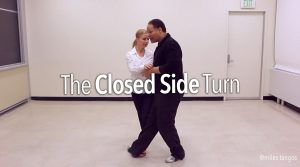
The Close Side Turn

What is a Closed Side Turn ? The simplest way that I can put this is that the Closed Side Turn is a Molinete/Giro structure that turns to the right (for the Lead), and the left (for the Follower) with a very simple modification.

Read More »

The Argentine Media Luna

What is an Argentine Media Luna ? The words, “Media” & “Luna” when translated from their Spanish to English cognates, translate as “Half” & “Moon” or in this case, “Half Turn”. It is exactly what it sounds like but with a Tango twist. In many ways it resembles the Follower’s Molinete. And if you don’t know any better, you could swear that they’re exactly the same…but they’re not….

Read More »

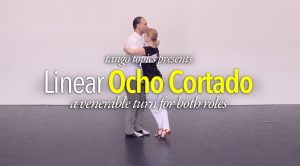
The Linear Ocho Cortado

What is a ‘Linear Ocho Cortado’ ? The are multiple versions or ideas of the Cortado. However, this particular piece of vocabulary is also what we consider to be one of the Seven Foundational Moves of Tango that every dancer must learn in order to be a socially competent dancer. Note that we said, not ‘Lead’, not ‘Follower’, but ‘Dancer’.

Read More »

Circular Ocho Cortado

What is a ‘Circular’ Ocho Cortado ? Put simply it is leading the Follower to a Forward Ocho. However this is a very specific kind of Ocho that we only use for teaching purposes. In this particular case, that teaching Ocho is what’s sometimes called (and this site referred to as such) a ‘Linear Forward Ocho’. They’re called that because these ochos don’t go anywhere at all, and in fact they’re done directly in front of the Lead on a line. Hence the ‘Linear’ part of it’s name. 😉 The Lead invites the Follower to a Linear Forward Ocho across their body (to the open or closed side of the embrace, usually the closed side), and …

Read More »

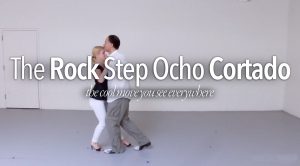
Ocho Cortado Options

‘Ocho Cortado’. The word ‘cortado’ translates into English as ‘cut’ or cutted (which isn’t a word) or an Ocho that is Cut. In today’s version of the modern Ocho Cortado it rarely resembles its ocho variations or ocho roots. It’s no wonder when people say the words for the first few times they get a little confused and can’t see the embedded ocho properties that are sitting there.

Read More »

Ocho Cortado Wrap

What is An Ocho Cortado Wrap ? Put simply it’s a Follower’s leg wrap (an Enganche) mixed with an Ocho Cortado (the ‘Broken’ Ocho). To be fair the Ocho Cortado is not really an Ocho, not by any stretch of the imagination, nor is it a broken one at that. It is more akin to the Follower’s Molinete more than anything else.

Read More »

The Lead’s Molinete

What is a LEAD Molinete ? It is exactly as described, a Grapevine Turn that consists of an applied dissociative backstep, a ‘circular’ side step, and a dissociative forward step. That’s it. It doesn’t get any more complex than that. The only difference is that instead of the Follower doing this vocabulary, the Lead does it.

Read More »

A Common Colgada

What is a Colgada ? The word “Colgada” comes from the root Spanish word “Colgar” which translates to English as “Hang”. The word ‘Colgada’ is the past participle version of the verb which adds an ‘ed’ ending to the word. Which when translated to English is ‘Hanged’ or rightfully ‘Hung’. So a Colgada is where the Follower (specifically) is in a state where they’re going hang off their Lead, deliberately, or more specifically, they’re being placed in a position where they’re going to hang. And that’s where we talk about a shared axis, and more importantly balance, all of this fitting within the line and lane of dance. 

Read More »

Single Axis Turns

The Single Axis Turn is tango specific language to describe a type of turn where the shared axis (that’s the ‘single’ part) movement between the partnership results in a deliberate turn or rotation, more a rotation than anything else. In much the same way that a Volcada is a shared axis movement, the Single Axis Turn is exactly the same in that respect. However, where as in the case of the Volcada, where the partnership goes towards each other, in this case, they go away.

Read More »

DROP ME A MSG HERE

SALE ENDS IN
Days
Hours
Minutes
Seconds

$15.88 off

tangotopics.com is now just 80 dollars for the year. if you sign up and subscribe today, you’ll get all the benefits of tango topics for 15.88 off a premium yearly subscription. click the button below, and your discount will already be applied! If not, enter “TOPICS2025” in the “Have a Coupon” section. 

sale lasts until october 20th. 

Hide picture