Tango Topics info:

Check out the Tango Topics Lexicon for words like Axis and Connection.

Category: Vocabulary

  • The Argentine ‘Dip’

    The Argentine ‘Dip’

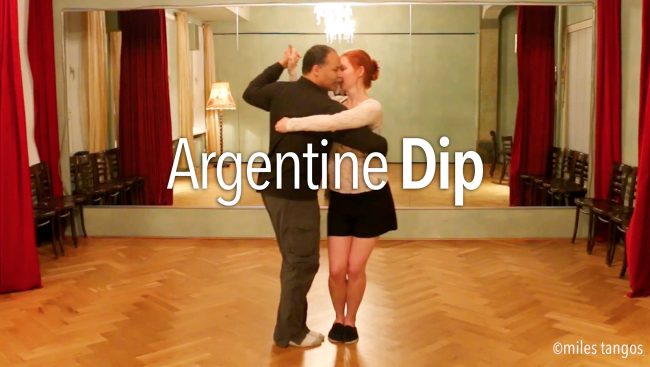
    The ‘Dip’ is a very common form and expressive move used in most social dances. Argentine Tango has it’s own version of a ‘Dip’, however this version of the Dip looks nothing like what you’ve seen before. It’s almost not worth calling it a ‘Dip’ to begin with but it is in truth of fact, the Argentine version does classify as a ‘Dip’.

    Let’s back up a moment and address the possibility that you have no idea what a ‘Dip’ is. A ’Dip’ refers to what is called a Dancing Dip. And it is what it sounds like, a physiological dip in the movement of the couple. Where one partner, the Lead, stops the dance for a moment to express some aspect in the music. Usually that moment is characterized by a long, languid note.  At that point the other partner (the Follower in this case) is led into a controlled, but partial, fall within the embrace of the first partner (the Lead). This is a ‘Dip’ in technical terms. Usually this kind of move is very, very dramatic, and done in the extreme to maximize it’s effect. And the effect is very visual, generating lots and lots visual lines, postures, and poses for the couple. One such idea is the ‘Death Drop Dip’ (which Tango does use in Performance Tango) where the Follower is led to almost touching the ground with their back, and one arm stretched out towards their partner  The Argentine Social Dance version of this idea is the polar opposite of this extreme idea. The Argentine Dip is more felt than it is dip. That said, let’s talk about the Argentine Dip.

    What is an Argentine ‘Dip’ ? Every dance has a form of a ‘dip’ where the Follower is being led to, quite literally, dip their body either forwards or most commonly backward. You’ll see this idea represented in dancing movies from the 1930’s and 40’s, look at the clip below which starts at 01:29, and then wait for it at 01:35! That is a classic dip, more a drop than a dip. But this is the classic dip.

    video
    play-rounded-fill

    Tango has its version of this idea, only it’s not so dramatic, not even close. As a matter of fact you’ve been doing them all along and haven’t even realized it! That’s because the dip is embedded in a very specific piece of tango vocabulary: The Argentine Cross.

    Let’s not make a mountain out of a Mole hill here, after the Follower is led (this part is very important > ‘the follower is led‘, not implied, which frequently happens) to cross their feet in a Normal Cross (See > 256 Argentine Cross Variations) the Argentine Dip can occur at this juncture because it’s an elongated forward step out of the Argentine Cross! There is, however, a catch with this thing. There’s always a catch. And the devil in this case is in the details. And the detail is what specifically is generating the impulse to ‘dip’.

    Aside from the devil in the detail, there’s something else you should know. This isn’t a ‘dip’ per se, not in the traditional sense. Truthfully, it’s a misnomer in terms. It’s more of a ‘hang’ for a long moment more than anything else. It’s not a ‘dip’ as in the sense of the Fred Astaire/Ginger Rogers dip above. It’s not that by any stretch of the imagination. It is however a very, very, very long hang. And even that’s a misnomer, but it’s the closest thing that we can reference that makes any sort of sense.

    The Free Tip. The Argentine Dip does require both parties to aware of what’s going on at all times. This isn’t a situation where you lead and they follow. No. It’s a situational awareness and needs to be trained into the dancer to show exactly what this feels like. The video above is a good start. And the reason is that very few teachers actually show this stuff, let alone talk about it.

    About The Video. This video is 13:14 in length in 5 Sections. Both Lead and Follow technique is co-combined. 

    Introduction/Overview – 03:04
    Engaging Over-Rotation – 03:06
    Close Embrace Details – 01:06
    The ‘Hang’ – 02:45
    Follower Adornments & Embellishments – 01:18

  • The Dark Side Salida

    The Dark Side Salida

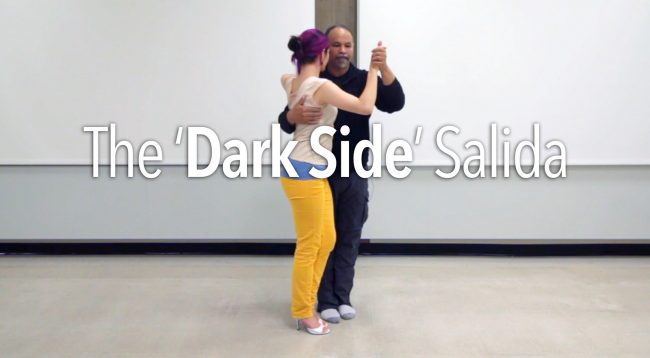
    The Salida. The Spanish word ‘Salida’ translates in English to ‘Exit’ or ‘Left’ as in the past tense of the verb to ‘Leave’. However when we apply this to Argentine Tango it means something else entirely different. It is a process that includes Cabeceo/Mirada, and the Entrada in the line of dance, as well as the Exit (Salida) from the dance, and walking your partner back to where you found them. In BsAs, or more formal Milongas in the world (including Encuentros), this means walking them back to their table. This is the process known as ‘Salida’. However with regards to the dance we typically only equate the word Salida with Entrada phase of the dance, and this is known as a ‘Salida’ Step. An entry (or exit) into (or from) the line and/or lane of dance. There is typically only one that gets talked about and or shown, and that’s the very typical couple side step into the lane of dance. There are, as you might imagine, loads of others. Today’s Tango Topic talks about a very specific and special one referred as the Dark Side Salida.

    What is a Dark Side Salida ? It is a Salida step that is entered into from the ‘Closed’ side of the embrace. Typically any piece of vocabulary that is referred to as such is a Dark Side ‘X’,  where ‘X’ is the vocabulary is the mirror copy of the Open side of the embrace. This has nothing to do with walking systems, or embrace formats. It only refers to the bi-lateral bisection of the body or in this case the couple’s embrace.

    A Dark Side Salida on the other hand is a whole different ball of wax. It’s not your typical side step into the lane of dance, because … because doing so would step you out of the lane of dance and off the floor.  🙁 That would be bad. No. A Dark Side Salida step uses very simple, or basic, tango vocabulary put together to form figure in order to accentuate the ‘Closed’ side of the embrace AS the opening step of the dance! To be fair, while you can use this piece of vocabulary at nearly any point in the dance, employing as the Salida step has certain benefits, one of which is that it has incredible musical properties (not shown in the video).

    About The Video. This video is 12 Minutes in length and shows a very specific Salida step that you can use in the opening of your dance. It can not be purchased at this time, and is only available to Tango Topics Subscribers in the Technique Library. 

  • Lead Exercises

    Lead Exercises

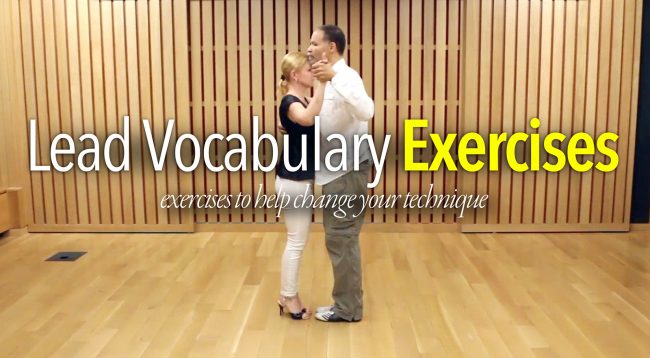
    Most Leads come to the dance floor with the idea in their head of what they’re going to do from the moment they come into the Embrace. This is not always true, but a good portion of the Salon, Marathon, and Encuentro Leads will already have the first few bars of music mapped out. While their dance is not entirely mapped out (tsk, tsk, tsk), the first few measures are, and this is based on the Neurology of Leading that they’ve trained themselves to do over time with experience. And from there they choreograph a dance on the fly that fits the music within the available space (again the Neurology of Leading). To the casual observer, they’re dancing fluidly. Seemingly effortlessly putting one idea behind another.  However, in order to get to this stage of dancing seemingly takes a long time to do.

    There is the traditional method of trial and error to achieve this way of dancing: Which is lots of endless classes/workshops on vocabulary that they’ll almost never use, to pieces of music that they’ll never hear again (thankfully), and then spending lots and lots and lots of time social dancing, and ‘practicing’ (ahem), and throwing in a few private lessons here and there for good measure, and hopefully coming out the other side a slightly improved competent social dancer, which speaks nothing to their embrace, interpretation the music, their ability to execute vocabulary, or attention to detail, or leaving their ego at the door. This is the norm of how things are done. This is ‘trial and error’ because the Lead tries things out and the results are pretty hit or miss most of the time for a variety of reasons that are nuanced to detail here (that’s another topic for another day). Also during this time period, the experience can be long, usually painful, ego-bruising process (if they’re lucky), that can take upwards of two to three years at minimum assuming travel, number of partners, distance to larger and multiple cities, level of diligence and attention to detail in multiple disciplines: Technique, Vocabulary, Musical Interpretation, Codigos, Marathon vs. Encuentro vs. Salon styles of dancing, and a host of other things with the end goal being not just a competent social dancer, but rather a competent social dancer that can freely and fluidly interpret the music with their partners, e.g. dancing fluidly. 

    What if we could shave off (to reduce by) a few months, maybe a year, this process, possibly cut it back to about 6 months entirely ? What if there were a series of stepping stones that could quite rightfully change how a Lead responds to the music, changes how they interpret the music, that reduces their inhibitions, their hesitations, and removes all repetition from their vocabulary choices, and removes any and all excessive usages vocabulary ? That’s where Today’s Tango Topic comes in. 

    There is another method that creates this series of stepping stones (no pun intended) to getting the Lead to a place where they can freely interpret the music, and freely choreograph their ideas that map their vocabulary onto the music so that it fits perfectly. These are Lead Exercises.

    What is a Lead Exercise ? This is a series of linked vocabulary choices that are practiced with some frequency on a weekly basis within the construct of 2 different embrace ideas, as well as with a metronome and NOT a piece of music. The reason ? A piece of music has lots and lots of nuances that can and do throw most people off, it confuses the hell out of them. So rather than work with a specific piece of music, we work with a time signature independent of the musical nuances, or in this case…the beat and ONLY the beat with pauses every 4 or 8 notes. So put simply a Lead Exercise is not about technique in this case, but rather a series of exercises designed specifically to retrain your Leading mind to respond to the changing conditions of the floor, the changing or challenges of Leading someone, what to do next, and most importantly to fix that tiny little problem of the hesitation described below. At the same time, this series of exercise also solves two latter problems of repetition and too much vocabulary by pairing things back to simple constructs to start with, instead of complex vocabulary sequences. Which is all designed to force you to work on the transitional elements rather than remembering steps, patterns, and figures that often fail and don’t necessarily help you all that much.

    About The Video. This video comes in at 21m:40s in length in 9 Sections. Lead Technique is explained here in the video. No Follower technique is explored. 

    Section 1 – Introduction – 00:03:04
    Section 2 – Walking Into Lazy Ochos – 00:01:35
    Section 3 – Walking Into Lazy Ocho – The Other Side – 00:02:05
    Section 4 – Walking Into Traveling Ochos – 00:00:48
    Section 5 – The ‘Dropped’ Traveling Ocho – 00:01:03
    Section 6 – The Close Embrace Variations – 00:02:59
    Section 7 – The ‘Practiced’ Weight Change – 00:00:38
    Section 8 – The 3rd Cross System Entry – Lead Cross Behind – 00:04:05
    Section 9 – The Frequencies/Closure – 00:04:42

    Video pre-requisites: 1.) 6 Ways of Walking. 2.) Milonguero Ochos. 3.) Traveling Ochos. 4.) The 5 Pause Types! 

  • Cross Body Incrementals

    Cross Body Incrementals

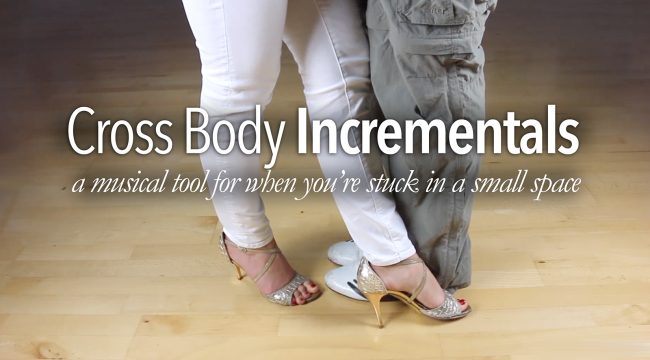
    Let’s get something out of the way immediately, ok…a few things: This particular Tango Topic is a Tango Topics phrase. Meaning that you’re not going to find it in any tango class with any other teacher. Secondly this topic refers to a class of vocabulary that isn’t particularly sexy to talk about, “talk” being the operative word. Thirdly after watching the video above, you’re going to ask yourself, “what’s the point ?”. And you’d be right to ask that question. It’s actually, almost quite boring to watch. Watching it is one thing, doing it on the other hand, is radically different, and it sooooo vicseral in it’s application that you’ll want to spend all of your time doing nothing but just because of the way it feels when it’s done properly.  And that right there is the key component. Doing it properly.

    To be clear a Cross Body Incremental is not necessarily the topic that makes you go, “WOW!!! OMG!! I want THAT!!!”. It’s just not. And yet, this particular topic is quite literally every. single. thing. about tango that you find to be fun, intimate, and absolutely delicious at the same time. It’s that good. So yeah, on the outside looking in, not so much. On the inside,  doing it….OH MY F*CKING GOD!!!! So without further adieu, today’s Tango Topic – Cross Body Incrementals.

    What is a Cross Body Incremental ? In its simplest form a Cross Body Incremental is motion that is generated from Opposition, which results in the Follower’s leg extension across the meridian line of the couple, usually to the opposite side. The distinction between Cross Body Incrementals and a ‘step’, is that there’s typically no weight transfer at all in Cross Body Incrementals. Where it gets its name from is the fact this is all about, say it with me, ‘incremental’ motion. Meaning you don’t have to do this all at once but rather in tiny little bits, which typically match the beat, or an 8th or 16th note in the music (this is NOT shown in the video). So what’s the Cross Body part if it’s just incremental motion ? Isn’t that kinda like Traspie ? No, for two reasons. In Traspie, which is typically employed in Milonga…typically, there is a slight weight transfer. In this instance, there is no weight transfer. Secondly, in Traspie, the motion is usually (very often) linear. Meaning ? That the Lead will invoke the Follower to extend their leg backwards or forward, or side in linear fashion. In this instance, the Follower is being asked to extend and oppose across the Lead’s body, and across the couples meridian line in close embrace. So in essence while it may appear to be a Traspie. It is anything but!

    The Free Tip. While this stuff is all about Opposition, there is another element here at play that has everything to do with ‘Body Position’ and ‘Body Placement’. For those of you that are not keeping up with what those phrases mean, ‘Position’ is where you are in relation to your partner. ‘Placement’ is what you do with that ‘Position’! This is all about ‘Position’. Put another way, if you haven’t seen the video on The Armpit Dancer, then stop here, and go look at the link, and then come back and read this: You need to be ‘buttons-to-buttons’ with your partner or Sternum-To-Sternum. Not in their armpit! Doing so, and this stuff fails! Well, not fail, but not ideal. One side will seemingly work really well, when the other side doesn’t, in specific the Open side of the Embrace will not work very well. The Follower will end up having to contort in all sorts of ways to make this work, none of which are good. So ‘buttons-to-buttons’ is desirable!

    About The Video. This video comes in at 36m:38s in length in 9 Sections. Separate Lead Technique and detailed Follower Technique is explained here in the video.

    Section 1 – Introduction – 00:04:26
    Section 2 – Lead Technique – 00:04:36
    Section 3 – The Weight Change – 00:02:41
    Section 4 – Embrace Clarity – 00:00:53
    Section 5 – Cross Body Close Up – 00:02:34
    Section 6 – Follower Technique – Opposition – 00:05:09
    Section 7 – Follower Technique – Legs – 00:03:05
    Section 8 – Follower Technique – Feet – 00:04:15
    Section 9 – Dancing Ideas/ End – 00:08:20

  • Social Boleos

    Social Boleos

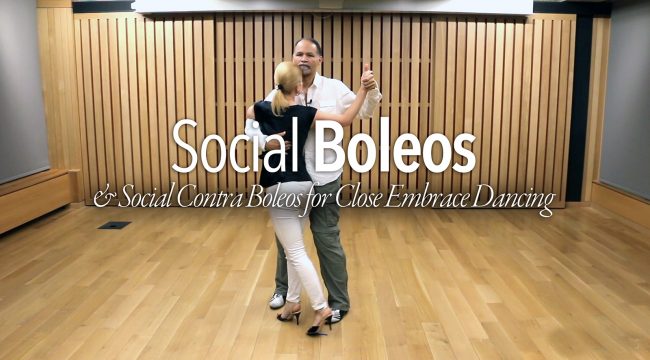
    The word Boleo comes the root Spanish word “Bolear” which roughly translates into English as “To Shine” or “To Throw”. The word ‘Boleo‘ is pronounced: “Boh-Lay-Oh” with the emphasis on the 2nd syllable. Boleo is the first person singular, meaning “I throw” or”I shine”. That’s about where the English and the Spanish meanings stop and take in a completely different meaning from a Tango perspective. From a Tango perspective we view this as a very specific piece of Tango Vocabulary which is nothing short of gob-stopping when executed properly, and in time to the music. Typically for most people when they hear the word Boleo they can only conceive of one type of Boleo, and that’s the flashy, but respectable, High Circular Boleo variety. To be clear, a Boleo, in its simplest definition, is one the four Tango Displacements, (Gancho, Wrap or Enganche, and Sacada being the other 3) that Tango Topics talks about. In the case of the Boleo, the Follower is led to “Throw” their leg behind them in any number of ways. However, that descriptive is a little misleading because the “throw” that is implied isn’t a ‘throw’, it’s a very controlled and contained action that shouldn’t be trifled with. Secondly, there’s a very specific reason why the Boleo occurs, which almost never get’s talked about or shown. There are lots and lots and lots of Boleo videos on YouTube for you to go watch. However, not one of them, not a single one, explains HOW you safely generate one, why a Boleo occurs, and more importantly the necessary skillsets that are required before you can or should attempt to even in engage in one. This video series does. Today’s Tango Topic looks at that set of circumstances and creates a very specific type of Boleo that could easily be called a “Low” Boleo but it is more apt to be called a Social Boleo. So without further adieu or yapping, Tango Topics presents The Social Boleo and Social Contra Boleo.

    What is a Social Boleo ? We must make clear the first part of the Term “Social” of “Social Boleo”. Social in this context that Tango Topics typically defines that word as: 1.) The Ronda of the dance floor, pertaining to the line, lane, and Tango Floorcraft of the couple. 2.) The Milonga experience. Meaning how you enter the room, who you speak to, where you sit, how you sit, what you dance to, who you dance with, how you invite or deny a dance. 3.) Fitting any and all vocabulary choices, regardless of which role is initiating it, within the physical width of the “lane” of dance, and the physical distance of one singular step that goes with the line of dance.

    The definition for a Boleo is as above, but in this context it would be where the Follower (or the Lead) is led (or self-led in the case of the Lead) to extend and then to lift their leg (that’s the throw part from above) behind them in a very controlled and contained fashion that can in certain cases be linear (in or on a line), or circular. Low (sometimes referred to as a ‘Social Boleo’), mid-range, or high (the common one). Quick, languid, and/or frozen. Which are either done “With” the Follower’s motion, or against the Follower’s motion (which would make it a ‘Contra’ Boleo).

    Therefore a Social Boleo is a type of low(emphasis on the ‘low‘ part), circular, ‘With’ type Boleo that can be done quickly or languidly and can also have a frozen component. In this highly specific type of Boleo, the dancer’s foot would never, ever, leave the floor. Typically in High Boleos, the dancer’s foot would come off the floor. In this instance, because these are Social Boleos, the dancer’s foot stays on the floor, and extends in a circular fashion!

    Typically the Social Boleo is ideal for Dancing In A Small Space, the Encuentro Environment, Dancing in confined spaces, and/or certain Milongas in Buenos Aires, like Salon Canning, El Beso, or Cachirulo, and most certainly the quiet, but well attended, Barrio Milongas. The Social Boleo is an easeful, and really, the easiest of Boleos to learn, and then to start dancing, from a Leading and Following perspective. And that’s because, for the most part, you’re already doing them without realizing that you’re doing them!

    About The Video. This video is 37m:34s in length in 15 sections. Both lead and follower vocabulary are combined and integrated into the video.

    Introduction – 00:01:22
    How to Start The Social Boleo – 00:01:05
    The Follower’s Ocho – 00:03:09
    Follower’s Specifics for Back Steps – 00:00:49
    The Follower Stepping Away – 00:00:47
    Leading & Following The Social Boleo – 00:01:54
    The Engine of the Social Boleo – 00:04:33
    Creating The Size of the Boleo – 00:01:24
    The Open Embrace Version – 00:01:19
      — in Slow Motion – 00:01:13
    The Close Embrace Version (and in slow motion) – 00:04:30
    The ‘Rebote’ Idea – 00:01:39
    The Social Contra Boleo – 00:03:09
    A Social Boleo with A Social Contra Boleo – 00:02:56
    Final Thoughts/Closure Items – 00:06:32

  • Lead Ganchos

    Lead Ganchos

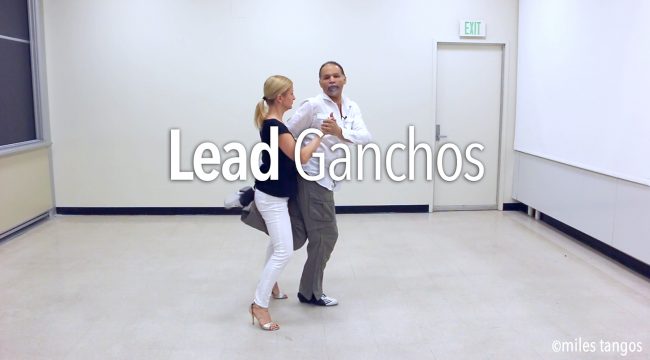
    Lead Ganchos. 9 times out of 10 when you think of a Gancho, assuming you think of one at all, unless you’re a Lead in your Gancho phase, your thought immediately goes to the visual of the Follower doing some crazy sh*t with their leg to the Lead in this seemingly (more often than not) crazy, twisted bodily position – Un Gancho! Truthfully the Gancho can be an ungainly sight, it can also hurt if done improperly, it can also leave a mark on clothing if done inappropriately. At the same time the Gancho can be, assuming it’s done properly, a very nice accent or way to spice up a dance with one or two (no more than that, please) Ganchos for either role. Either role ? Yes, both roles have access to the Gancho idea. It’s just that, as was stated before, most people think of the Follower being led to Gancho their Lead. However, there are a whole swath of Ganchos where the Lead Ganchos the Follower! This is known as a Lead Gancho and is Today’s Tango Topic, so without further yapping, let’s dive into Lead Ganchos!

    What is a Gancho ? In it’s simplest form, in the modern vernacular of Tango, it is a hooking of the free leg around your partner’s leg or thigh. It is an interruption of the extension phase of the step, which can (not always) result in the lifting of the respondent’s leg either as a result of, or by deliberate intention. The typical thinking of a Gancho is that this is something that ONLY the Follower does to the Lead. That’s not the case. A Gancho can be performed for either role!

    What is a Lead Gancho ? Put simply it’s where the Lead, lifts/and then wraps their free leg around the Follower, on the Follower’s Forward, Side, or Back Steps. More lift then wrap, as a ‘wrap’ is something entirely different. However the lift is quite accurate. As the Lead is factually lifting their leg, knee, and foot to ‘Gancho’ the Follower instead of the other way around. More than likely you’ll end up seeing these done on the Follower’s Side Step first and foremost as they are the easiest of the bunch, and less frequently on the Follower’s Forward step next to their lead, and very, very infrequently on the Follower’s Back Step next to their lead.

    The Red Warning Label: Before another word is written and understood by you the reader, let’s get something clear right from the start. A Lead Gancho should not be attempted by a beginner Lead with ‘5 Minutes’ of dancing under their belt. No. This is complex vocabulary that can hurt or injure you and your partners, and not to mention the people dancing around you! And by ‘5 Minutes’, this page means that you should have been dancing a long while. A very long while. And most certainly more than 5 Minutes. Here’s a few benchmarks: Until you have mastered your walk, where you are not THUDding when you walk, pushing, pulling, or compressing the frak out of your partners on a regular basis, when you have mastered the line of dance in the incremental, when you have clearly mastered close embrace dancing constructs and it has become a near ‘fluid’ embrace construct when you want to change things up a bit, that is when you can start to play with a Lead Gancho, and not before. You may not like to hear that but thems is the facts. This isn’t about how quickly you’ve progressed, or the number of classes you’ve taken, or who you’ve studied with! None of that stuff matters. What matters is how you have integrated a stable, secure, safe dancing model into your typical dance! That’s what more than ‘5 Minutes’ means

    The Free Tip. There is one Gancho on the Open Side of the Embrace that is going to kill you. Absolutely kill you. It’s the Parallel System Lead Gancho on the Follower’s Forward Step. Talk about an ouch! If you can manage the rotation in this one AND keep the embrace at the same time, you’re doing pretty good! However chances are you’re going to have to break the embrace. So while this video talks about 6, we only show 5! Ok I show the 6th but it’s kinda convoluted. 😉

    About The Video. This video is 8m:31s in length in 6 Sections and of HD quality.

    Warning: It is strongly recommended before attempting to do this that you watch the series on the Gancho foundation.

    1.) Introduction – 00:57
    2.) Parallel System Gancho – 03:18
    3.) Cross System Gancho – 00:38
    4.) Follower Cues – 00:24
    5.) Lead Ganchos on Forward Steps – 02:00
    6.) Review & End – 00:46

  • Eight Follower Ganchos

    Eight Follower Ganchos

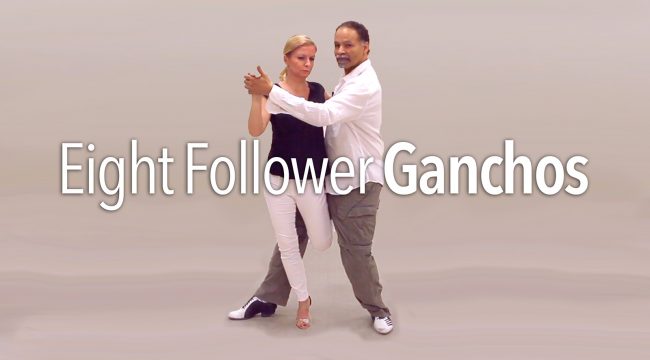
    Eight Follower Ganchos.  There are loads of types of Ganchos (or ‘Leg Hooks’), typically you start off with the 4 Common Ganchos that you see on a social dance floor quite frequently. As you grow into mastery over these there are Self Ganchos – Where the dancer (Lead or Follow) can Gancho themselves; There are Lead Ganchos, which don’t get a whole lot of play – Where the Lead self leads a Gancho onto and into the Follower’s open or free space between their steps; There are rotating Ganchos, as well as Volcada Ganchos, and lastly there are Gooey Ganchos, so named for their seemingly slow motion Gancho action. However one other class of Ganchos that is either misunderstood (for a good reason which we’ll get to in a moment) or just misused is a series of Follower Ganchos that for all intent and purposes look and feel like the 4 Common Ganchos mentioned above. However there is a very stark difference between those Ganchos, and what Tango Topics refers to as the Eight Follower Ganchos.

    What is a Gancho ? In it’s simplest form, in the modern vernacular of Tango, it is a hooking of the free leg around your partner’s leg or thigh. More the thigh more than anything else. Secondarily, it is an interruption of the extension phase of the step, which can (not always) result in the lifting of the respondent’s leg either as a result of, or by deliberate intention to generate a “Gancho”.

    What are the Eight Follower Ganchos ? The Eight Follower Ganchos are Ganchos that look very similar to the 4 Common Ganchos with one major difference: These Ganchos have NO invasion to them. In the 4 Common Ganchos the Lead is creating a Gancho (hook) by invading the Follower’s free space between their steps/legs, and as they do, the Lead continues their torso rotation while articulating their receiving Gancho leg. That receiving leg is the leg that is invading the Follower’s space. In the Eight Follower Ganchos, there isno invasion of the Follower’s free space. None. Further, and quite possibly, more importantly, this series of Ganchos is built off the Follower’s Over-Rotated Ocho which could be the beginnings of the Follower’s Back Sacada but is interrupted instead, and we end up with a Gancho and not a Sacada! It should be noted that in the 4 Common Ganchos we build the Gancho off the Follower’s Circular Back Ocho. In this case, we are extending that to the Over-Rotated Ochos. So instead of 90 degree rotations in Ochos, we’re looking at 180 rotations Ochos. Hence the reason they’re called Over-Rotated Ochos!

    The Free Tip. This Gancho series is not easy for a variety of reasons, most notably because more than likely you have not studied your over-rotations. That’s it right there. Without study and practice of the Over-Rotations, then this entire series of Ganchos isn’t going to work. 🙁

    About The Video. This video is 14m:09s in length in 7 sections. Both lead and follower vocabulary is combined and integrated into the video. There is virtually no technique instruction in this video. Please see 4 Common Ganchos for Technique instruction.

    Introduction – 00:00:37
    Setting Up The Follower – 00:02:50
    The Other Follower Gancho – 00:01:05
    The Weight Change Follower Gancho – 00:03:03
    The Lead’s Forward Step Gancho – 00:01:41
    The Awkward Follower Gancho – 00:03:07
    Closure – 00:01:18

  • The Loco Sacada

    The Loco Sacada

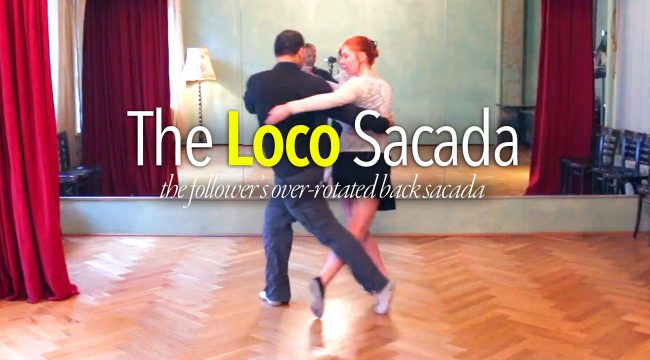
    The Loco Sacada is a misnomer. There’s no actual Sacada that’s named that. We made up the title. 😉  The actual title of this video is The Follower’s Over-Rotated Back Sacada. Kinda long and doesn’t exactly flow off the tongue. Hence the new moniker! You’re welcome.

    We have to back up a bit and tell you that in the former incarnation of Tango Topics when it was the Tango Truisms Project, we created a series of videos that were for sale. This Topic was one of those videos. At the time, it didn’t garner that much attention. But as Tango Topics has grown and there’s one thing we keep getting asked about are more Sacadas, Volcadas, and Colgadas. This video has been sitting in the archive, untouched for almost 4 years. So here we have yet another Sacada. However, the title, is rather apt. It is a ‘Loco’, or as the word in Spanish when translated to its English cognate, ‘Crazy’. It’s crazy because of it’s over-rotation and the way in which the over-rotation occurs.

    Moving on.

    The Loco Sacada is exactly what it sounds like, but before we get into that. We have to issue a warning that most of you do not want to read, or care about because this is quite honestly cool vocabulary for both roles. So first the warning: This is not a simple move (duh). Do not attempt this unless you are under the active guidance of a teacher that knows what they’re doing. You can easily hurt yourself and/or your dancing partners in any number of ways.

    There are certain things you have to have mastered before you should even attempt this stuff. 1.) Your walk must be stable from a Leading perspective as well as from a Following perspective. Meaning that you can not and should not use your fingers, palms, wrists, forearms, and/or biceps for stabilization from or against your partner’s reciprocal body parts. If you have not mastered your Intention-Based Dancing Skills yet and not using the embrace to push, pull, or engage ‘resistance’, then stop right here and go and master that stuff first and foremost. 2.) You must be able to Disassociate and then Apply that Disassociation (known as Applied Disassociation) without thinking about it. Because if you have to think about it, it’s too damned late! 3.) You must have precise and millimeter-level precision control over your legs, and feet. As in where you’re moving them, and how you’re moving them, and where they’re going to, as well as how they’re landing and/or resting.

    If all of that sounds anal and not fun. There’s a reason for it. And that’s so that you don’t end up hurting yourself attempting to do something you’ve seen online without the necessary preparations so that you don’t injure yourself or your partners that this stuff can cause. Which is to say that you must prepare your body appropriately first and foremost. That said, without further yapping, we present for your perusal, The ‘Loco’ Sacada.

    What is a ‘Loco’ Sacada ? This figure, and it is a figure, can be used in Open embrace, or Close Embrace (but not without some modifications) and be initiated in the line of dance if and only if there is ample space to do it. It is an over-rotation of the Follower’s Ocho, employing an Over-Rotated Back Ocho for the Follower into the Lead’s Forward Step. Rightfully most people would never think of employing this figure within the Line or Lane of Dance. And there’s a reason for that. It can take up an inordinate amount of space. Hence the reason why we stated previously that ‘there is ample space to do it’. So what’s ample space ? About 6 meters and a little ‘wiggle’ room on either side just in case things go south, and things ALWAYS go south. So plan on 7 meters to be on the safe side.

    Realistically though, this figure isn’t about using it on a social dance floor. It’s more for study purposes to engage the applied disassociation for BOTH roles, not just the obvious one, the Follower’s role.

    It should be noted that while this is a study-only figure and that it can be invoked on a social dance floor assuming space isn’t at a premium and it can be employed from Close Embrace, that at some point the embrace does have to become ‘Fluid’. Meaning that the embrace will change based on the choice of vocabulary that is employed so that the vocabulary can be accommodated.

    Why should you use a ‘Loco’ Sacada ? You shouldn’t. Not unless you have space, and a dancing partner that has mastered their foundational elements. And even then this is accent or spice vocabulary that is best left for your tango lab work and not necessarily for a social dance floor. Think of it as that piece of vocabulary that you pull out once in a blue moon, near the end of the milonga with a partner that you’ve danced a million times with, and you invoke this ONCE and you let it go and then you move onto other things that are far more important! In other words, this is a study piece that you want to work on and with, to extend your own flexibility, and adaptability to different movements.

  • Ending A Dance

    Ending A Dance

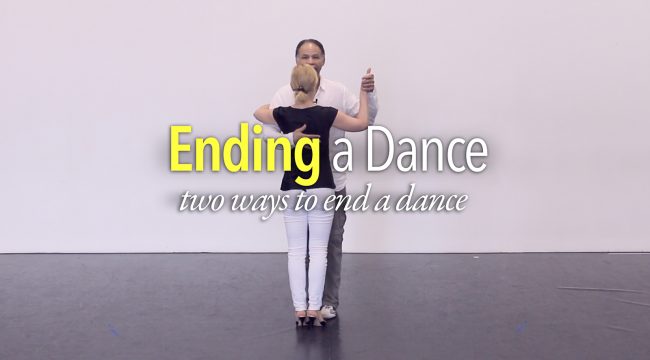
    How To End A Dance. As far as Argentine Tango is concerned we’re taught the steps, the patterns, the figures, a very small amount about the music (that there’s a beat and that you should follow it). We hear these words about ‘following the line of dance’, which is a bit about floorcraft really. We get indoctrinated into the activities, and some never really do, of Cabeceo and to a lessor degree Mirada. And for the most part we’re left to our own devices as to ‘How to start a dance with someone’, ‘What to do during that dance with someone’, and ‘How you may want to interpret the music while dancing’. At no point along the curve has anyone ever said to you, more than likely, “This is how you end a dance with your partner”.

    Guess what ?

    Tango Topics, while what’s about to follow will sound like a sales tool, it is anything but that. It’s express a point that is rarely talked about but rather assumed and not a whole lot of thought is put into it. That said, Tango Topics has put a great deal of thought into ‘How to start a dance with your partner‘. It also has videos on how to Cabeceo and how NOT to Cabeceo. As well the importance and usage of Mirada and why you want to use it. Tango Topics has an inordinate amount of articles (see: Tango Floorcraft) as well as videos on floorcraft and how to engage the idea. It has articles & videos on the specific vocabulary of Argentine Tango to create a little bit of variety and spice in one’s execution of the dance. Like for instance Milonguero Ochos, Traveling Ochos, as well as Ochos Variations, Cortados, Turns, Sacadas, Ganchos, Social Colgadas, Paradas, Social Volcadas, just to name a few. As well as an extensive video series by Detlef Engel and Melina Sedo on Argentine Milonga. It also has extensive video teaching tools on how to listen to the music on the whole, and what you’re wanting to pay attention to and why. It even has a tango thoughts section that can help with your tango issues. Out of all of that, there’s no video and no article that can help you to understand HOW YOU END A DANCE.

    To be fair, there’s a video on how you want to walk someone from the floor, but that’s not really a video and an article on what might seem like common sense when in fact, believe it or not, it’s not common sense for a lot of people.

    So today we’re going to skip all the build up to this and get right down to Today’s Tango Topic – How To End A Dance.

    How Do We Want To End A Dance ? Answer: Simply. Nothing flashy, but very simple and plain which is to say: The way you start a dance is how we want to end a dance. If you started out facing each other, then you want to end up facing each other. How hard is that ?

    How Do We NOT Want To End A Dance ? Answer: In a Pose. Frequently what you’ll see from performances is a ‘Posed’ ending to their dance. Meaning that whatever step they end in, they freeze in a tableau. That ‘tableau’ is usually a very exaggerated and stylized position that almost NEVER happens in tango…ever. Which is great if you’re performing and want to show off. But, in case you hadn’t noticed, you’re not showing off, you’re Social Dancing, and you’re not performing for the room. It’s just YOU and YOUR PARTNER. Which is to say that there’s absolutely ZERO reason to do engage in a Tango ‘Pose’. None. Yes, it may look cool…to you! And, yes, it may be ‘fun’ for about 2 seconds. However, the reality is that you will look a little ridiculous. At the same time if you end with a Pose constantly, it gets (as the Brits say) “Cheeky”. Meaning that it’s just too much. Once or twice in a blue moon, and by that we mean once every few years, but not every song of every tanda. So….ummmmm…not so much with that idea. See the how we want to end a dance above.

    Enter The Salida Step. ‘Salida‘ comes from the root word ‘Salir‘ in Spanish. Which, when translated from Spanish to English, means “to Leave” or “to Exit”. When an ‘IR’ verb in Spanish is put in the past, this is a Past Participle which in English adds an ‘ed’ ending to the verb. In Spanish, we add a ‘ada’ or in this case ‘ida’ ending. Which when translated would make the verb become “Leaved”, which isn’t a word but “Left” or “Exited” is. However, from a Tango perspective, the word Salida means “to leave one’s seat, and enter the floor or the line of dance“. Further still, it also implies the very first step that we engage in as dancers. Typically that first step has always been a side step (Lead Right to Left, and Follower Left to Right) to enter the line of dance as quickly and expeditiously as possible so that we can begin dancing with our partners. Over time the ‘Salida Step’ has become somewhat more intricate in the multiple ways in which we can start the dance and enter the line of dance, thereby expanding the side step to include vast swaths of vocabulary. We even teach a variation on a theme of this idea which we call “The Dark Side Salida” which you should totally go look at. It’s a fun exploration of what you could do to start a dance!

    However the Salida Step also refers to the Closing Step of the Dance! Meaning ? It’s the very last thing that you do. Or in this case invoking the thing we pointed out above, finishing as you started. Facing your partner.

    One More Salida. Over time the Salida Step has also referred to the exiting step. Which is also the step OUT of the Line of Dance. Which in this case, should be, a side step > Lead Left to Right, and Follower Right to Left. This indicates, historically speaking, that we have now ended the dance. While this may sound ‘boring’, and a little antiseptic. It is anything but that. We want to end in such a way that calms things down not ramps things up!

    A Little Squeeze. Typically the end of the dance is a good place to add a bit more a hug, a quick bit of compression to the embrace, to add emphasis to the closure aspect and then a quick release and back to the realities of getting to know this person a bit more.

    However….

    Grrrrrrr…

    This is where a whole swath of Male Leads have gone off the deep end in terms of crossing boundaries. They hold on a little too long. They squeeze a little too tight. And then to add insult to injury, the crown jewel awkwardness > They decide to put their head into the Follower’s neck.

    Ask any Female Follower if they enjoy having a someone they don’t know all that well, have only just met, and that person decides to place their head in the crook of their neck while at the same time turning their face towards that female’s cheek.

    Ask them if they enjoy that ?

    The answer is a qualified “no”.

    Qualified in the sense that if they know that person really well, or they’re married to or dating that person, then it’s sweet…ish…sort of. But for the most part, if that was done out on the street, that Follower would run as far away as possible, as quickly as possible.

    It’s awkward, creepy, strange, and just inappropriate! Which is to say, Male Leads…STOP DOING THIS. You’re crossing boundaries. You may think you’re sharing your ‘soul’ with the female follower you’re doing this to or with, but the reality is that it’s wholly invasive!

    Of course the men that need to hear this message, the men that need to see and feel just how awkward it is, will never hear it because you dear reader aren’t sharing this stuff with them. Which is not a plug to share it, it’s that if you find this stuff invasive and inappropriate then the burden is on you to share this stuff far and wide so that they hear the message.

    Last words. End the dance any way you want, whatever works best for you. However, keep in mind the things were mentioned above. No one, not even this page is telling you what to do. It’s simply pointing out to you that there are desirable ways to engage in the formalities of social convention. Which is to say that ‘simple is best’. Put another way, that we want to end in such a way that we are creating closure with our dancing partners. Or another, there’s closure to the song, yes ? Shouldn’t there be closure to your dancing expression with your partner ? Answer: Yes there should be.

  • Seven Argentine Starters

    Seven Argentine Starters

    For a lot of people, the idea of Leading a dance in Argentine Tango either strikes fear into their heart, and they psyche themselves out to the point where they believe that they can’t do it. Or they overthink the thing to death and reach the same point of thinking they can’t do it or that it’s exceptionally difficult. Or there are those that believe that they feel comfortable enough with Leading a dance. In all three of these types of Leads, regardless of the role (Leading or Following), there’s a moment of “What’s Next ?” right at the beginning of a song. For the Follower, the moment comes in the form of the Follower asking the question in their mind, “What do they (the Lead) want ?” over and over again in their minds. Even though they’ve settled into the embrace, until there is movement, until there is some kind of signal (resistance and compression based or intention based dancing) the Follower exists in a heightened state of hyper-awareness of asking this question. For the Lead, the question becomes “What am I going to do ?” over and over and over again until they’re either forced to move because they’re holding up the line of dance or they fall into their standard opening. In both cases, the dance starts from a place of confusion and cluelessness of “What’s Next ?”. What if as a Lead or as a Follower that state of confusion, that state of feeling dumbfounded were to completely disappear ? What would happen to your abilities as a dancer if you created a series of Openings (and closings) to the dance. Not a series of intricate patterns, no….but rather, simple ways to start a dance that put both Lead and Follower at ease ? That’s where today’s Tango Topic picks up. It addresses what to do at the beginning of the dance with 7 Ways to Start a Dance, as well as 9 Ways not to Start a Dance. So without further yappment, Tango Topics presents the importance of Seven Argentine Starters!

    What Is A ‘Starter’ ? A ‘Starter’ is a bit misleading, no pun intended because one might erroneously reach the conclusion that an Argentine Starter was a specific piece of vocabulary, a pattern, that you can use. Unfortunately that’s not the case. It’s more of a simple primer, actually 7 simple primers, that you can use to create more complex choices. Think of an Argentine Leading Starter as something a Vaudeville dancer would call “Vamping” until you’re ready for something else. Which roughly translates from a Vaudeville perspective of doing the same thing over and over and over until everyone is on the same page, doing what they need to be doing, in the right key, on the right note, singing the right words, in the same steps, and then they can proceed with the next thing. The same thing is true in Argentine Tango to an extent. In it’s simplest form an Argentine Leading Starter is a series of simple movements to begin a dance with. That’s it, that’s all. There’s nothing grandiose about it but there is something calming about it. And that’s the important part. Calming both partners. We desire calm, rational, clearly thought out movement, as well as thought and creating a state of placid, serene, almost tranquil state of mind and body for three distinct purposes: 1.) Getting to a deeper state of integration with one’s partner. 2.) Creating a heightened state of readiness for all that may occur that is as much about awareness as it is about being delightful. 3.) Removing any and all nervousness and confusion because we’re employing simple things that can translate to more complex things later on. This is an Argentine Starter.

    Follower’s Notation. It should be noted that if you’re a Follower, just because this topic sounds like “Leading…” whatever, that shouldn’t pay attention. When the reality is that you DO in fact want to pay attention to this stuff for a wide variety of reasons which we’ll get to in the Follower’s Perspective below.

    The Nine Non-Starters. Let’s paint a picture.

    You finally get the chance to dance with the parnter that you’ve been wanting to dance with all night long. You’ve been waiting for your chance, just the right moment when they’re available, the right tanda, the right…everything. You seize the opportunity with your best Cabeceo/Mirada! The potential partner responds with a hearty nod in your direction. You look around you briefly to make sure that they’re replying to your Cabeceo/Mirada, you look back at them and they smile and nod emphatically that it is indeed you that they’ve said “yes” to. The Lead walks around the dance floor, not across (tsk, tsk, tsk) it, to get to the Follower. The Follower waits for the Lead to get to them, and they stay seated until the Lead gets to them, so that they can extend their hand to the Follower. The Follower, in keeping in the vien of these things, hasn’t jumped up to meet the Lead, because they’re making absolutely certain that this Lead is was the one that accepted your cabeceo for.

    They do so, and they then take the Follower by the hand walking to them entry point of the Milonga floor. And that’s when the Lead invokes the very needed and acceptable practice of: The Lead’s Cabeceo! Once the couple has entry to the floor guaranteed, they both embrace each other in their best, delisioso embrace that they can muster. It’s soft. It’s warm. It’s inviting. It’s lite but engaging. It’s inviting yet comforting. They feel their partner melt into them and vice versa. They match every nuance of their arms and body molding together. They’re both glowing from ear to ear. OMFG!!! They feel good to each other. It’s a delight of the senses. The first few bars of the music are finally breaking through their consciousness. And that’s when the Lead is reminded that they want to impress this Follower with their best move. So they whip out their finest Volcada right from the start.

    NOT!!!!!

    This was a lovely set up to a dance with a lovely partner. Lovely right up to the point where the Lead lost their damned mind and decided to use an Argentine Volcada to start their dance! The embrace setup was nice. The walk to the floor was almost bordering on the magical. Even the Lead Cabeceo was a nice touch. The Follower recognized this as the Lead taking care that they’re not jostled in any way. That they have time. And then….the lead had to go and ruin it with this jarring transition from a lovely experience  to “Here let me try to impress this Follower with my utmost bestest move….”.

    MAJOR ‘NOT’!!!!!

    This is a monster no-no on multiple levels.

    The reality is that as a couple you can start the dance any way you want to do so. But TangoTopics suggests that there are 9 pieces of Tango vocabulary that you do not want to begin a dance with, and the Argentine Volcada is one of those nine! Truth be told all the items on this list of Tango No-No’s all have one thing in common: They’re All Jarring! Meaning that they’ll all transpose from a lovely embrace starting point into OMFG…WHAT WAS THAT!?!?!?!? Poof….wave good bye to the magical moment.

    Think of it this way, imagine that you’re waking up in the morning and you’re having the loveliest of dreams and then your alarm clock goes off with blaring loud music at 6 am in the morning! About the only thing that you can say in that instance is that you’re up. But for you peace of mind and the idea of gently waking from sleep….not so much with that. So without further yappment of what not to do, here are the Nine Ways Not To Start A Dance:

    The Free Tip. There’s a ton of free information in the paid article. However, this idea of an opening for you to consider > is a Dark Side Salida. That will give you a few ideas of what you could do.

    About The Video. This video is 25m:13s in length in 4 sections. Both lead and follower technique are combined and integrated into the video. Bold items below shown in video sample video above.

    Introduction – 00:02:43
    9 Ways Not To Start A Dance – 00:06:08
    7 Ways to Start A Dance – 00:13:59
    Closure With Examples – 00:01:51

Hide picture