Tango Topics info:

Check out the Tango Topics Lexicon for words like Axis and Connection.

Category: Vocabulary

  • Walking Turns

    Walking Turns

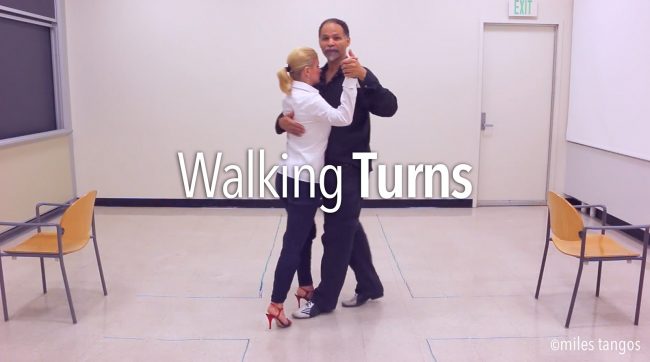
    The Walking Turn. Right from the start the 2nd or 3rd thing a Lead must learn is how to turn the Follower. Usually, most Leads are taught the sexier turn, learning to lead the Follower’s Molinete to their Lead Giro. It’s a harder turn to learn for a variety of reasons, not the least of which is that the Lead must master disassociation first and foremost, and secondarily not to use their arms or hands to push or pull the Follower. That along with the timing of certain aspects of the guidance of the Follower’s Molinete can make it rather challenging. So you would think, given all that, that teachers would eschew teaching the Lead how to generate the Follower’s Molinete in favor of a much simpler turn. Nope. Most teachers go right for the Molinete/Giro combo and skip right past the simplest turn of all: The Walking Turn!

    What is a ‘Walking Turn’ ? It’s a turn where the couple walks in a very tight circle within the line of dance. Obviously this type of turn has issues, in that 2 of it’s steps will go AGAINST the line of dance. However, this can be alleviated by ‘cutting’ the corner of the first turning step, thereby curving the turning step towards being even tighter.

    There are many benefits to this type of turn even though it isn’t taught that often if at all. One benefit is that the turn allows for the continuation of walking with your partner. Still another benefit is that it also allows one to engage any one of the five of the six ways of walking! Usually this turn is done in Close Embrace, and in Parallel Walking System. However, that doesn’t mean that it has to stay that way. 🙂 It can be a very nice exploration, musically speaking, of Close Embrace walking on 3 tracks or Milonguero Ochos or a host of other things.

    The primary reason we use this turn is to add to our repertoire of available turns. We could use the Follower’s Molinete or the Milonguero Turn, or it’s kissin’ cousin, the Calecita. Which, as a side note, is a great addition to the Walking Turn itself. You can go from Calecita to Walking Turn in a continual cycle back and forth. Just a thought. 😉

    The Problem: There’s a reason why this turn isn’t taught all that often. Actually 3 reasons. 1.) It is all too easy for The Walking Turn to become a navigational hazard, meaning that the turn can go outside one’s line and lane of dance when executed by a beginner Lead. 2.) It’s not sexy by comparison to the follower’s molinete, but rather it is very functional. And for some reason we like sexy and eschew functional. 🙂 The problem is that the turn itself while being very easy to learn, can be difficult to execute.  3.) Probably the biggest issue is that after about 2 or 3 steps, depending on the size of your steps, you will invariably be facing against the line of dance. And this is a major no-no!  And if this something your teacher has not told you about, then fire that teacher immediately! Because this is one of those things that you should have drilled into your head! One never, ever, ever walks or dances against the line of dance!

    For these 3 reasons, this is why the turn is almost never taught to beginner leads, because they’ll end up doing all 3 things, thereby freaking out when something doesn’t go right, and thereby screwing up the line of dance which in turn creates a navigational nightmare!

    However, with a little judicious study, and some hard work, the turn can be taught, and then executed with a great deal of control and precision, and eventually can become a useful staple of every Lead’s arsenal of turning tools in today’s modern version of Argentine Tango.

    The Free Tip: This turn can be used in a tight space, but the turn gives up one of its elegant pieces, it’s not gradual anymore. At the same time, there is no more force in the arms in any way, shape, or form. 🙂 That said, the tightness of the turn, the size of it, can be controlled through foot placement, and rotation of the new standing foot. So wherever that foot lands it wants to rotate towards the inside of the walking circle.

    About The Video. This video comes in at 1hr:8m in length in 19 Sections. Both lead and follower technique is combined and integrated in the video.

    Section 1 – Introduction – 00:01:00
    Section 2 – Set Up: 5 Embraces – 00:01:20
    Section 3 – Basic Floorcraft – 00:02:00
    Section 4 – Tango Hapitcs – 00:01:02
    Section 5 – Without The Lead Back Step – 00:00:37
    Section 6 – Set Up – Relationship = Alignment – 00:01:23
    Section 7 – Starting The Turn – 00:02:00
    Section 8 – The Walking Turn – 00:00:58
    Section 9 – The Walking Turn with the 5 Embraces – 00:07:47
    Section 10 – Follower Technique – 00:06:11
    Section 11 – Lead Technique – 00:01:37
    Section 12 – The Relationship – 00:03:21
    Section 13 – Footwork: Close-ups – 00:04:59
    Section 14 – Why Walking Systems – 00:00:58
    Section 15 – Walking Turns with 6 Walking Systems Explained – 00:06:49
    Section 16 – Walking Turns with 6 Walking Systems Applied – 00:11:38
    Section 17 – Walking Turns – Errors – 00:05:44
    Section 18 – Embrace Reminders – 00:04:46
    Section 19 – Closure – 00:02:07

  • The 6,724 Molinete-Giro Variations

    The 6,724 Molinete-Giro Variations

    First and foremost, we have to define a few terms before we get to the bulk of this topic.

    1.) The Molinete is, according to the Tango Topics Lexicon, one of 8 types of Turns that are used in Argentine Tango. The Molinete is the Follower’s side of the turn, which consists of 3 steps > Forward, Side, or Back.

    2.) The Giro, again according to the Lexicon, is the Lead’s side of the Molinete/Giro structure. Which can consist of a no step, 1, 2, or 3 steps in any number of combinations. However, typically it is the NO STEP variety. 

    Typically this is the turn that is taught to every dancer since Gustavo Naivera re-discovered it back in the 1980’s. Although to hear him tell the story, you’d think that it was all his idea. Which is not the case but that’s a horse of a different color for another time. At the time there was a predominant turn in Argentine Tango, and that was what now call “The Milonguero Turn”. Although at the time, it wasn’t called that. .It was simply referred to as “the turn”. Naivera came along and changed all that, all at the same time. Literally with a singular performance. The next day after the performance, the ‘turn’ was no more and relegated to tango history. What took its place was the Follower’s Molinete to the Lead’s Giro or what we call on this site, a Type 1 Turn (See > The Notation System ) or what you now call a ‘Turn’.

    Because this turn is used so often and with such ubiquity, and always done exactly the same way (Lead: No Step to Follower: BSF), it stands to reason that someone would have thought of that there are other ways to engage a Giro-Molinete structure. And as it turns out, there are. Quite a few. But I’m getting ahead of myself.

    That said…

    What is a Molinete-Giro Variation ?

    In simple parlance it uses the typical 3 step pattern of the Follower’s steps, and varies them. Hahahaha.

    Not.

    It would be nice if it were that simple and you could go back to your life. No, the Molinete/Giro Variations are, on the surface > Mind Boggling as you’ll soon see. As you dig deeper, you begin to see that you’ve literally been robbing yourself of options and opportunities left, right, and center!

    Simply put, the MGV (as we’ll refer to them from now on) takes the Follower’s steps (or the Lead’s – that’s a hint by the way), breaks them down to their component elements, then goes 1 step (no pun intended) further by using them OUT OF THEIR NORMAL ORDER in any number of different ways.

    The easiest way the we can talk about this stuff (aside from watching the video) is to make a few qualifications so that it becomes simpler to conceptualize what I’m on about. Without further ado.

    There are 3 steps of the Follower’s Molinete. Those three steps are usually represented as ‘Back’, ‘Side’, and ‘Forward’. However, to save a bit of space and time, we’ll simply refer to those 3 steps as ‘B’, ’S’, and ‘F’ or B-S-F from now on. As you’ll soon see, there’s a need to do this. Oh and we’ll get to the Lead’s Giro in a bit. Not to worry.

    In the MGV we see the 3 common steps for the Follower, are ‘B-S-F.’ However, those 3 steps can be each themselves be any of the 3 TYPES of steps. So instead of B-S-F. The first ‘B’ can be an ’S’ or and ‘F’. The ’S’ can be an ‘F’ or a ‘B’. And the ‘F’ can be an ’S’ or a ‘B’. As a result, if you zoom out a bit, there are not just the 3 possible steps but in fact 27 POSSIBILITIES like so:

    B-B-B    F-F-F     S-S-S
    B-B-F    F-F-B     S-B-S
    B-B-S    F-B-B     S-F-F
    B-F-B    F-B-S     S-F-S
    B-F-F    F-B-F      S-B-B
    B-F-S    F-F-S     S-S-B
    B-S-B    F-S-F     S-S-F
    B-S-S    F-S-B*   S-B-F*
    B-S-F*   F-S-S    S-F-B*
    *= Common Structures. 

    NGL that structure above is DIZZYING. Most people cannot see this stuff at all. They think or believe, erroneously so, that the simple B-S-F structure works just fine and has worked just fine. And they’d be right … for a hot 10 seconds. That is until 1 of 4 things occurs:

    1.) The Molinete/Giro repetition goes ON and ON and ON and ON…
    2.) The Follower starts to rebel and does something else, anything else to break up the effing monotony. 
    3.) The music changes to indicate that there NEEDS to be a change.
    Or 4.) There’s an impact with a couple ahead of, behind, or next to which would change the structure entirely.

    With that in mind, let’s suppose an idea for a moment. A situation that EVERYONE finds themselves in.

    Example: You’re on the floor with your partner, and the floor slowly but certainly gets crowded and you have less and less space to dance in. Most Leads start to get nervous about this because they erroneously believe that their options of vocabulary become limited. Or at least that’s how a lot of beginner and intermediate dancers see things. The more experienced dancer sees this situation as an opportunity. Unfortunately they don’t maximize that opportunity. But I’m getting ahead of myself.

    As the floor becomes more crowded the Lead will begin to repeat themselves over and over again for a wide variety of reasons. Most notably because it’s familiar territory and they believe that they have to keep the Follower moving so that they don’t get bored. What they don’t realize is that the Follower isn’t thinking about that. They’re thinking if they did X the right way, and how did it look ? Did they do what was asked of them, did they miss anything ? Are they hanging, pulling, pushing, compressing, etc. Are they with their Lead ? Are they in tune, in communion, and/or physical clarity with their Lead ? Did they do what that last private lesson talked about ? Are they doing it at all ? That’s what they’re thinking about.

    The Lead on the other hand is obsessing about spacing, timing, and musical issues. And now comes the fun part. The couple literally gets stopped because they can’t go any further down the line of dance. So the Lead defaults to the Follower’s Molinete to their Giro to the Lead’s Left/Follower’s Right, over and over and over and over again. They do this same turn, notated above as ‘B-S-F’ repeatedly. This goes on for what seems like forever. And the Follower does their best due diligence to stay engaged and find something, anything, to not go on autopilot. The Lead is keenly aware that they’re doing the same thing over and over again with slight musical variations here and there but it’s always > B-S-F.

    Are you beginning to see the full extent of the problem yet ? There is NO VARIATION to what they’re doing. It’s the same 3 steps over and over again. Every single time! And it doesn’t matter if they’re unable to move or not. For a little variety they may change things up a bit, by going in the opposite direction > Lead Right/Follower Left, but it’s the same 3 steps in the exact same order, repeatedly!

    Yawn!

    So how do we solve for this problem ? To add even a small amount of variety ?

    Enter The Molinete/Giro Variations!

    If you only activate just 1 variation for a single measure of the music, once every few bars, you add that extra something that takes your dance from ‘meh-yawn’ to ‘that was pretty cool – what did you do there?’. And now you should start to see that the MGV adds not only value but if you zoom out even more, they have immense musical properties that you couldn’t even access before! That’s part of the reason we begin to utilize this stuff.

    Now we take things to a whole other level.

    In the 27 Possibilities above, there’s a few things missing. One of them is the possibility that the Follower may be led to drop a step or not step at all, which is represented as a “0”. By adding this as a possibility, we expand the possible variations from 27 to 60 like so:

    1.) B-B-B  F-F-F  S-S-S
    2.) B-B-0  F-F-0  S-S-0
    3.) B-B-F  F-F-S  S-S-F
    4.) B-B-S  F-F-B  S-S-B
    5.) B-0-B  F-0-F  S-0-S
    6.) B-0-0  F-0-0  S-0-0
    7.) B-0-F  F-0-S  S-0-F
    8.) B-0-S  F-0-B  S-0-B
    9.) B-F-B  F-B-F  S-B-S
    10.) B-F-0  F-B-0  S-B-0
    11.) B-F-S  F-B-S  S-B-F
    12.) B-F-F  F-B-B  S-B-B
    13.) B-S-B  F-S-F  S-F-S
    |14.) B-S-0  F-S-0  S-F-0
    15.) B-S-F  F-S-S  S-F-B
    16.) B-S-S  F-S-B  S-F-F
    17.) 0-B-B  0-F-F  0-S-S
    18.) 0-B-0  0-F-0  0-S-0
    19.) 0-B-F  0-F-S  0-S-F
    20.) 0-B-S  0-F-B  0-S-B

    Is your head spinning yet ? Good. That’s what’s supposed to happen. By adding this possibility we begin to see that there are way more options than we were aware of. This opens up even more options and opportunities for BOTH roles.

    Now let’s really pull your hair out.

    There is another subset of possibilities that we haven’t mentioned but we have implied. You see we’ve been thinking about the Molinete as 3 steps. There are instances where it’s not 3 steps, but 2 for the Follower, and 1 for the Lead. It should be noted, again, that we’re only looking at the Follower’s steps, and not the lead:

    1.  B-B  S-S  F-F
    2.  B-S  S-F  F-S
    3.  B-F  S-B  F-B
    4.  B-0  S-0  F-0
    5.  0-B  0-S  0-F

    And again, a “NULL” or “0” step is a possibility in this instance. 

    Let that sink in for a just a moment while you consider the possibilities.

    If your head hasn’t exploded yet, then this next one will really bend you into knots:

    You do realize that the Lead can do what the Follower is doing, right ?

    I’ll wait while you pick up your skull fragments from the walls and ceiling.

    Ahem.

    This is the part in the conversation where one of two things happens > 1.) I’ve lost you somewhere back in the 27 possibilities section and you’re just beginning to realize that you don’t have a head for this stuff. AND/OR 2.) The B-S-F option works just fine for you and you’ll continue to do it. Screw Miles!

    If I may ? You see, there’s more than a few of you out there reading this stuff that you can’t let this one go. You’ve been appropriately ‘tweaked’. Then there’s the rest of you that dropped off about 10 paragraphs ago and are skimming thru to see if there’s anything where I don’t go on and on and on that isn’t mind numbingly boring with another series of character sequences. For all you folks, I have a little gift for you:

    The sample example in the video above shows the possibility of adding a ‘Back’ or ‘Forward’ Cross to the Lead’s options. It’s not part of the equation. However, what is part of the equation, is that the Follower can be led to that while the Lead is doing one of the variations above!

    This is just the tip of a very, very, very, very large iceberg.

    An Iceberg with 6,724 Possibilities.

    Wait! Where are the 6,724 Possibilities?

    In order to see that you’re going to have to subscribe to the site. What you get with that subscription is the all important Lead, Follow, and Dancing Perspectives that are missing here but are present in the FULL article!

    Oh and there’s a PDF that goes with this, that details ALL 6.724 Variations for Lead and Follow!

    This video comes in at 37 minutes and 12 seconds, and there is no Lead or Follower technique contained in the video.

    If you’d like to see that, and the full video. Consider subscribing.

    Thanks for reading. 

  • The Follower’s Exercise

    The Follower’s Exercise

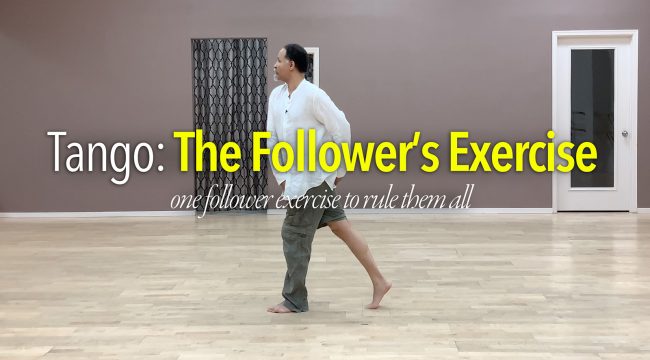
    There are countless drills a Follower can do to sharpen technique, improve control, and fine-tune execution. This site includes several, each designed to strengthen tendons, stretch muscles, and—most importantly—recalibrate neurological awareness and mental habits. But among them, one exercise stands alone.

    It’s the first thing every Follower student does in their private lessons with me. Without exception.

    It is the single most important exercise a Follower will ever do. Why? Eleven reasons, actually (which you’ll see below—assuming you’re a subscriber. If you’re not, you can still fix that for the cost of a monthly subscription).

    At first glance, the exercise looks absurd. Exaggerated steps you’d never actually use on the dance floor. And you’re right—you won’t. But that’s not the point. This is an isolation drill. It’s a neurological reset. A training ground for control, precision, and deep awareness. It sets up everything a Follower will ever do in Tango. And it lays the foundation for one of the most misunderstood, misused, and misnamed techniques in tango: disassociation (a.k.a. “pivot,” a term we don’t use here).

    Let’s be clear: this exercise is deceptively simple. It is anything but easy. It demands obsessive detail, surgical control, and mental clarity. Which is why it drives nearly every Follower a little crazy at first—for two reasons:

    1. Details Matter Here

    Precision matters. A lot.
    Where is your foot landing? Are you crossing over the body meridian ?
    How is your foot landing (in supination or pronation)?
    What’s your level of extension? Are you popping the knee ?
    Are you actually in opposition or faking it? And is the opposition in the extreme as it should be ?
    Where are your arms? Your hands? Your head?

    2.) No Partner Required.

    This is one of those times when you can NOT use a partner to stabilize you. You will feel every instance of your own instability everywhere in every piece of this motion. Further you can not RELY on what you see in the mirror. You will only see bits and pieces of the motion. It’s for this reason you must video everything you’re doing for playback and feedback. You must also be INSANELY RELIGIOUS about doing this work. You can not falter, you can not waver. Ever.

    “But No One Dances Like That!”

    Correct. No one should dance like that. And you won’t—on a social dance floor.

    But here’s what you need to understand:

    a.) The exercise is setting up other things.
    b.) It’s training you in the extreme so that the minimal becomes second nature.
    c.) It’s building control you probably don’t have (yet).
    d.) It’s a full-body isolation drill for balance, control, and proprioception.

    Who Should Do This?

    Short answer: Everyone. Especially experienced dancers.

    But they usually don’t. Why?

    1. They think they’re above this kind of thing.
    2. They see a barefoot man demonstrating a Follower exercise and immediately check out.
    3. They assume I couldn’t possibly have anything useful to say about Follower technique.

    They’re wrong. But that’s their loss. If you’re reading this and doing the work, your gain.

    Why This Exercise Works (If You’re Honest)

    This drill will only help you if you’re brutally honest about what’s happening in your body. If you’re not? It’s a waste of time.

    What you’ll start to notice (and this is where the frustration sets in):

    You don’t actually extend cleanly.
    You bend your knees too much.
    Your extension is inconsistent and visually messy.
    You wobble. A lot.
    You can’t walk in a straight line backward without support.

    And here’s the kicker—if you’re wobbling alone, just imagine what you’re doing in the embrace. If you’re relying on the Lead to keep you upright, that’s a problem. No one wants to be a crutch. If the roles were reversed, you wouldn’t like it either. So let’s stop pretending otherwise.

    This exercise rebuilds your stability from the ground up. No partner required. No excuses allowed.

    Barefoot? Really?

    Yes. And yes, I know: for some people, the moment they see I’m barefoot in the video, they stop listening.

    Here’s why I’m barefoot:

    Shoes compensate. They cover up flaws. They stabilize things for you. That’s not what we want. We want you to feel the floor. Really feel it. Direct contact. Raw data. No buffers. Only then can you train the real systems that keep you balanced and grounded.

    Eventually, we’ll do this work in heels. But only after you’ve built the tendon strength, control, and precision to manage them. Then the heels don’t control you—you control them!

    Heels Are Sexy, But…

    Let’s be honest: heels are gorgeous. They’re sexy. But they’re also unstable torture devices. You’re balancing on the head of a pin. They wreck your joints, cartilage, circulation, and nerves (yes, that nerve behind the ball of your foot that goes numb after 90 minutes—that’s your plantar nerve, and it’s not happy with you).

    And let’s not even talk about the Leads who drill their partners into the floor like jackhammers. It’s not helping. You’re absorbing all of it. In bad shoes. With no training. No strength. Just endurance. And endurance is not the same as training. It’s just pain management.

    That’s why we start in socks or bare feet. You’ll thank me later.

    Final Note

    The “heel work” phase of this training was never posted on this site. It’s something I only ever taught in person during intensives. And maybe one day I’ll share it. But for now, if you want to get there—you start here.

    Do the work. Barefoot. With precision. With brutal honesty.

    The rest will come.

    The Follower’s Exercise: One Exercise to Rule Them All.

    1.) The Turn Out Factor!
    2.) Leg Extensions (Part 1)
    3.) The Straight Line on the Floor!
    4.) The Pigeon Toed Feeling.
    5.) The Weight Transfer.
    6.) Opposition Explained.
    7.) Extreme Opposition Used.
    8.) Homo-Lateral Movement.
    9.) The Long Extension (Part 2)
    10.) The Knee Bend (Compression).
    11.) The Little Lean We Don’t Want.
    12.) Your Body Wavers.
    13.) The Isolation Technique/Ballet Rises
    14.) The Eleven Reminders.
    15.) The Actual Exercise (seen above).
    16.) The Leg/Foot Reminders.
    17.) The Checklist.

    These are the 17 topics that are covered in this extensive article that goes over every aspect of this very important exercise and then some. It’s a full treatise on how to extend one’s leg…as a Follower. Everywhere!

  • The Lead’s Exercise

    The Lead’s Exercise

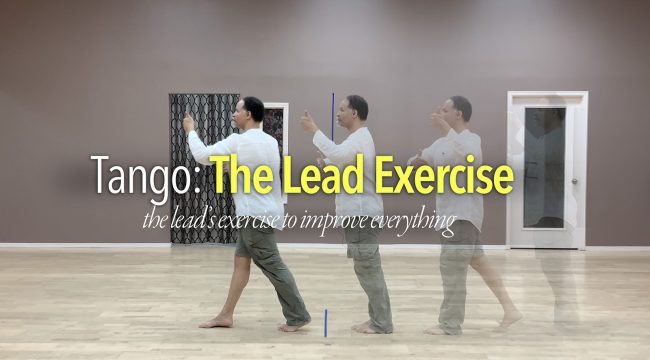
    There are many exercises that one can do as a Lead to improve one’s abilities and executions. To clean them up, sharpen them, hone them. This site boasts a few that have developed over the years and that I teach the intensive student to use to strengthen their tendons and stretch their muscles, and mostly to retool their neurological awareness. However, there’s one exercise that I make every Lead student do in their private lessons. Truthfully it’s the first thing they do when they come into class. Moreover it is the single most important exercise that they can and will ever do for so many reasons. 11 actually, which you’ll see in just a moment (assuming you’re a subscriber). This exercise is, on one level, a precursor and set up for doing everything that the Lead will ever do in Tango. Secondly, it’s also set up for a very important technique that gets talked about but never enacted (disassociation). We’ll get to what those things are in just a bit. And lastly this exercise is seemingly really, insanely, simple. It is anything but that for a wide variety of reasons. Why ? Mostly, it requires exacting precision, control, and an attention to detail that more than likely will drive you batty. It does that with each and every Lead that does it for 2 reasons.

    1.) The attention to detail is absolutely crucial to your awareness and your control.

    2.) The Turn Out Factor (More on that later).

    On the surface, just looking at the sample above, it looks like 4 steps, in the extreme, that you’d never…ever do on a social dance floor. So as far as you’re concerned you’re gonna say to yourself “That’s ridiculous! No one dances like that!“. And you’d be right. You’re never, ever going to dance like that. Ever. Except when you understand a few things about the exercise that a.) It’s set up for other things. b.) it’s doing things in the extreme so that doing them in the minimal, later on, is a piece of cake. c.) it’s creating a level of precision and control that as a Lead you more than likely may not possess today. And d.) It’s one long isolation technique (more on this later). That said, let’s dive into the video that I call: The Lead Exercise > One Exercise To Rule Them All!

    A Few Things…

    1.) This exercise can be done by seasoned dancers, and should be actually, but won’t be for a variety of reasons, as well as the absolute beginner. a.) The seasoned dancer doesn’t read this stuff, they feel it’s beneath them (mostly). b.) The seasoned dancer will take one look at the video above, or just screenshot image and completely disregard what’s here because I’m barefoot.

    Truth be told, the sooner that you start doing this exercise, the easier things will get in more ways than can imagine.

    2.) The simplicity of the exercise itself is beguiling on multiple levels, and also exceptionally frustrating IF and ONLY IF you are honest with yourself. If you’re not honest, then the exercise is exceptionally easy and a complete waste of your time.

    So what are you being honest about ? Where you’re landing your foot and more importantly HOW you’re landing your foot (supination), where you’re sending your leg (the extension), how much opposition you’re actually engaging (extreme opposition), what’s going on with your arms, hands, and your head (where’s your head pointed)! This exercise, done properly, should challenge you in every way possible. The tolerances involved should push you to your extremes, it should push you beyond your comfort zone. And that’s what we want, we want you outside of your comfort zone. Why ? It is only through pushing beyond that zone, that change and awareness begins to happen.  Further the exercise is the embodiment of a simple but overriding principle of Tango Topics: Overshooting to Under do! Why is that relevant here ? Because if you can do this stuff in the extreme, then doing it in the minimal, will be a piece of cake for you, because you’ve already done that and more! That’s why. So you being honest with yourself and what your body is doing is kinda important.

    3.) Seemingly you’re never going to apply any of this stuff. Not true. You’re going to apply it everywhere. Here’s just 2 benefits. a.) You’re extensions. Sometimes called ‘Projections’. Cleaning those up will visually create the lines that you’re looking for. Do yourself a favor, video your walk going forwards from your hips down, from the side. Do it in skin tights or stalkings please, not pants. You need to see your legs. You’ll be surprised at a few things, most notably how much you bend your knees (more on this later), and more importantly how unattractive and inconsistent your extensions are. b.) You should start to notice how unstable you are. How much you wobble when you walk, and the fact that you more than likely can not follow a straight line going forwards! And all done without holding onto someone or using someone else’s walk to keep you from falling forward. If you’re wobbling that much by yourself, imagine what’s happening in the embrace with someone else!! For those of you that will argue, “that’s what the Follower is for”…No, it’s not. No one likes to be used to hold someone else up. No one. If the roles were reversed (and I have done this with Female students), more than likely you wouldn’t like it either. So what on god’s green earth makes you believe that a Female Follower would like it ? Answer ? They don’t. So…not so much with that. This exercise will help you with your stability, with your control, with your executions of everything that you can imagine and more that you can’t.

    4.) Socks or Bare feet. In the video above I’m not wearing any shoes. That immediately and completely discredits the validity of what I’m saying in the video. To those people I say this: The barefoot thing is all about feeling your foot in contact with the floor. The shoes, whether you know it or not, are compensating for you in more ways than you’re currently aware of. So we want to remove any and all compensation! We want you to feel the floor with your foot and not the shoe impacting the floor. And remember this is an exercise.

    Further still on this topic, at some point later on, we do engage what we call ‘shoe work’ for the Lead. Where we engage all of the work above, and then some to apply it in a pair of shoes, only because you’ve done it with precision, control, containment, and you’ve built up the necessary strength in your tendons, it’s not so much of a bother to be in a pair of shoes. The only difference now is that you have control over them. Versus wobbling all over the damned place.

    Put another way, a pair of shoes literally hides things from you. It compensates for your lack of balance with the edges of the shoe. Working in a pair of socks doesn’t allow for that. So therefore once that is mastered, then putting on a pair of shoes should be second nature at that point.

    This article contains the following topics:

    1.) The Turn Out Factor!
    2.) Leg Extensions (Part 1)
    3.) The Straight Line on the Floor!
    4.) The Pigeon Toed Feeling.
    5.) The Weight Transfer.
    6.) Opposition Explained.
    7.) Extreme Opposition Used.
    8.) Homo-Lateral Movement.
    9.) The Long Extension (Part 2)
    10.) The Knee Bend (Compression).
    11.) The Little Lean We Don’t Want.
    12.) Your Body Wavers.
    13.) The Isolation Technique/Ballet Rises
    14.) The Eleven Reminders.
    15.) The Actual Exercise (seen above).
    16.) The Leg/Foot Reminders.
    17.) The Checklist.

    These are the 17 topics that are covered in this extensive article that goes over every aspect of this very important exercise and then some. It’s a full treatise on how to extend one’s leg…as a Lead. Everywhere!

  • Circular Ocho Cortado

    Circular Ocho Cortado

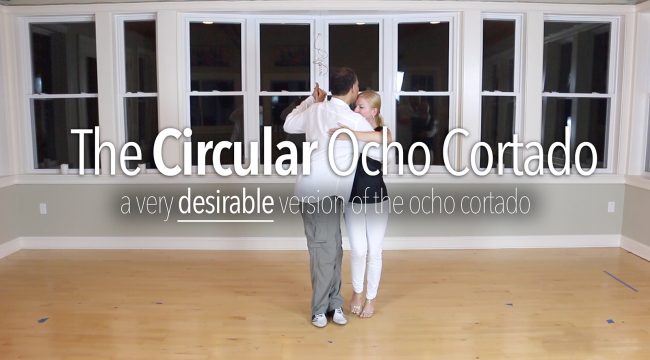
    The Circular Ocho Cortado. First let’s get the language out of the way. The phrase “Ocho Cortado” translates from the Spanish to English like so: ‘Ocho’ translates as the number 8. ‘Cortado’ comes from the root Spanish -AR verb ‘CortAR’ which translates as the infinitive ‘to Cut’ (or to Slice). However, you’ll notice that there’s an ‘ADO’ ending on the verb, which is akin to an ‘ed’ ending of a verb in English as in ‘HelpED’ or ‘LikED’, or ‘WalkED’. It’s the past participle version of the word. 🙂 However, when you put them together the translated phrase almost makes no sense. So we have to move things around a bit for it make sense to an English speaker. So ‘8 Cut-ed’ makes absolutely no sense, however if we invert the words so that it becomes ‘Cut-ed 8’, it starts to make a bit more sense. Typically when dealing with other languages we end up having to infer the meaning. ‘Cut-ed’ in English makes no sense, however…it’s secondary meaning does, ‘SlicED’! A ’SlicED 8’ or Half of an 8! So quite rightfully an Ocho Cortado is a HalvED 8! Language lesson over….

    There are two varieties of the Ocho Cortado, the Linear variety and Today’s Tango Topic: The Circular Ocho Cortado. In the case of the Linear Ocho Cortado, it really is a linear step. Meaning ? That it’s stretched out along a walking line. The vocabulary itself is really great for rounding corners, when you need to ‘cut’ a 90º corner. They’re great for musical interpretation elements. They’re great for cross play. And they’re even better when inverted! 🙂 However, the Linear Ocho Cortado is only taught in certain places. Tango Topics talks about the Linear Ocho Cortado as if it were the default Ocho Cortado. That is not the case. In other parts of the world, The Circular Ocho Cortado is the default and the Linear variety is weird one. In certain places the Linear variety is almost never taught, so you’ll never see it on a social dance floor at all. In certain places, the Circular variety is the odd man out and you’ll never see it either. So today without further adieu Tango Topics presents – The Circular Ocho Cortado. The OTHER Ocho Cortado. [Editorial Note: This site will be cleaning up the language for the Ocho Cortado in the other posts that deal with this to make the clear distinction of Linear vs. Circular.]

    What is a ‘Circular’ Ocho Cortado ? Put simply it is leading the Follower to a Forward Ocho. However this is a very specific kind of Ocho that we only use for teaching purposes. In this particular case, that teaching Ocho is what’s sometimes called (and this site referred to as such) a ‘Linear Forward Ocho’. They’re called that because these ochos don’t go anywhere at all, and in fact they’re done directly in front of the Lead on a line. Hence the ‘Linear’ part of it’s name. 😉 The Lead invites the Follower to a Linear Forward Ocho across their body (to the open or closed side of the embrace, usually the closed side), and then interrupts that motion to invite a change of direction, and that change of direction is the Ocho part. The ‘Cortado’ part comes from the fact that only ONE HALF or one side of the Ocho is danced. Typically an complete Ocho is both sides of the 8 or the Applied Disassociation. However in this case, only one half is done, and as a result we have a Cortado or Halved 8. What makes it Circular is the fact that the Ocho itself is the circular part. The curvature of the opening step into and out of the Ocho (the applied disassociation part) Cortado where the Follower is at first stepping next to their Lead and then back to the same position again.

    About The Video. This video comes in at 31m:28s in length in 9 Sections. Follower and Lead Technique is explained in the video. 

    Section 1 – Follower’s Perspective – 00:12:43
    Section 2 – The Difference Between Linear & Circular – 00:01:07
    Section 3 – Leading Perspective – 00:03:09
    Section 4 – The Open Side Circular Cortado – 00:02:44
    Section 5 – The Close Embrace Version – 00:03:52
    Section 6 – The Lead’s Error! – 00:01:34
    Section 7 – The Lead’s Head – 00:01:34
    Section 8 – Lead/Follower Footwork Detail – 00:03:41
    Section 9 – Closure – 00:00:22

  • The Cross – Getting In Front

    The Cross – Getting In Front

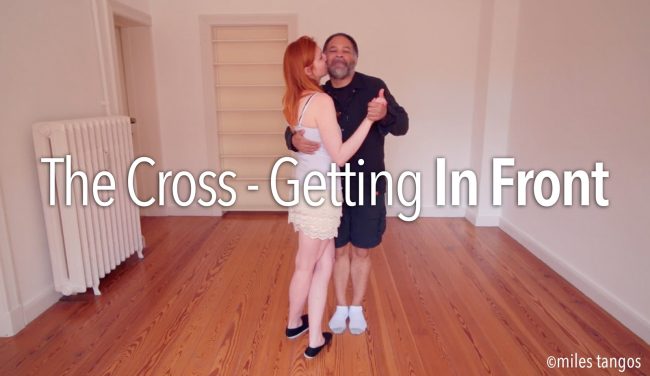
    For most Followers, that haven’t been properly trained, they are rushed into an Argentine Cross right from the start of their Tango dancing lives. Aside from Ochos, it’s the one thing that they’re pressed to do without any training aside from the Lead/er (Controlling Lead hence the ‘/er’ part) that quite literally tells them what to do as they’re doing it. From that moment, right up until this one (assuming you’ve shared this video with them) they more than likely have no idea a.) why they’re crossing their feet. and b.) more importantly what the point of the Cross is, and c.) what it all means.

    The Problem: This isn’t so much a Lead problem as it is a Follower issue. Contrary to what you might have been told, the Argentine Cross does actually serve a function. And believe it or not, it’s not to do a Cross every 15 seconds for no good goddamned reason. No. The function of the cross…is well, you can watch the video for that part. The problem is that not only is the Follower not aware of what the function of the Cross is, they’ve been so indoctrinated into a passive way of dancing that they’ll a.) Willy-nilly cross their feet due Two of the Five Errors of The Cross – specifically the Automagical Cross and the Wimpy Cross (see below), where in the case of the latter, the Follower has to infer what on god’s green earth the Lead is attempting to do. (In the other 3 cases they don’t have to infer, they’re quite literally forced into crossing their feet whether they wanted to or not). and b.) That a good portion of the time, the Follower will end up in the Lead’s Arm Pit. It is for this reason that we talk about – Getting In Front of Your Lead!

    video
    play-rounded-fill

    From a Following Perspective, 10% of this problem is your issue. And it has to do with you understanding that the Cross is actually, in modern Tango, your piece of vocabulary. Not the Lead’s, it’s yours! There are many people that will disagree with this statement that the Cross is the Follower’s vocabulary. The fact is that without you cooperating, the Argentine Cross, is not going to happen. You could say this about almost everything else in Tango, that without you cooperating nothing happens. And you’d be right. However in this instance, this is one of the few places where the Follower has an enormous amount of control of when something is done, how something is done, and most importantly where we go next! All of that from you crossing your feet. In this instance, this one little piece of vocabulary is YOUR place for you to shine, to sparkle, to show off your skillz as a Follower. Instead, what happens ? Well…watch the video.

    To be fair, you have to contend with the Five Errors of the Cross (see above), and then there’s the squeezing, the pushing, the pulling from your Leads. And then there are your issues, while in heels, to contend with. That aside, you do have an issue which is solely yours, which is the whole point of this topic – to get back in front of your lead!

    The simple fact is that your lead (the action, not the person – lowercase ‘l’) either stepped outside partner or stepped into cross system and in either case you’re essentially out of step with them. The whole point of the cross is to get back in front of your Lead (the person).  However, part of your issue is that you’ve been indoctrinated to a way of moving that quite factually doesn’t work for you. The way that you’re moving is to send your leg straight back, and really to cross your body meridian away from the couple. This creates a problem for you, especially when you come to collect your feet in the cross. Your feet look like two mismatched and broken sticks pointing in opposite directions from each other with a watermelon in between them, instead of what they can look like. We do want pretty feet, but we don’t want pretty knees, when we come to collection and even crossed collection! However, there’s a tiny little problem in that your body is in the wrong place, and your hips are all twisted and you’re basically out of alignment with your Lead, and on top of all of that, you’re stuck in the Lead’s arm pit! And there you will stay…sadly. 🙁 Unless…you do something about it. 🙂

    From a Leading Perspective, before we launch into Follower’s side of this. Let’s give credit for this problem, where credit is due. The Lead! Dude, a good 90% of this problem is your fault. Let’s be clear about responsibility here. You created this problem and the Follower is only doing their best trying to fix it. How did this become your problem ? 1.) You lined up with the Follower in your Arm Pit! You placed them in there right from the gitgo (‘start‘ for the non-native english speakers), and what’s worse is that you kept them there, holding them in that spot, because it was convenient for you to pull off some crazy vocabulary, which you think you need to lead every 20 seconds, instead of (gasp!) actually walking with your Follower to the music. Eeeek! Which for some reason is ‘boring’ to you but heaven to them…gosh I wonder why !?!?!?  2.) Your embrace that you think is comfortable is like laying on a bed of nails because it’s too compressive! Think ‘squeeze‘ and you’ll get the right idea. And even if someone tells you that to lighten up and let them loose, you’ll go right back to squeezing the daylights out of your partners because to you think, a.) this is comfortable. and b.) it’s all you know. 3.) Because your right arm is like a vice grip and you have this rather nasty tendency to paddle your Follower’s with your right hand to ‘direct’ them, you somehow believe that this is desirable. Ummmmm not! And lastly you created this problem by 4.) being too damned restrictive and not being responsible by continually placing the Follower in front of you by repositioning your vocabulary to do just that. Instead, doing all 3 previous things to show off to keep the Follower from realizing that you were completely ignorant about 3 steps in and don’t have a plan for the rest of the song let alone for the tanda! Yup, your fault.

    The Dancing Reality is that this stuff happens with such frequency that no one, not even the teachers that you’re studying with pay it any mind. It’s so commonplace that one wonders if anyone is actually teaching technique to specifically create this issue! “Leads! You place the follower in your armpit, and then rush around the room, all the while pulling and pushing! Followers, your whole job here is to stay in the Lead’s armpit and then to come to a crossed collection so that your hips are all twisted up and you’re off to the side of your lead! Ready ? Go!”. Not!

  • The Golden Nugget

    The Golden Nugget

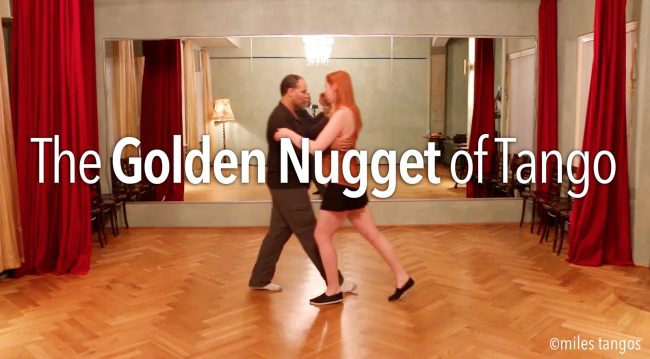
    The Golden Nugget of Tango. Once long ago you were an itty-bitty Tango dancer. You could barely walk, the music was either intriguing or unappealing at best, one or the other. The very idea of going to a Milonga as a neophyte dancer where everyone and god could see just how much you were sucking raw eggs just about scared the bejeebers out of you. Then as you took a few classes, went to a few more milongas you started to feel like you knew what you were doing, sort of. You may have learned a few ‘steps’, gotten some feedback about what you’re supposed to do from a variety of people, you were possibly exposed to a Traveling Ocho, and the Follower’s Molinete (Leading and Following it), and most certainly the Argentine Cross. While at the same time, sort of seeing and hearing that there was an idea to the music but it was too vague for you to ‘get’ immediately other than there was a beat. You saw people dancing very close, and learned that this was called ‘Close Embrace’. You learned about the line of dance, about navigation and floorcraft (not the same things by the way), and something called ‘Cabeceo’…just to name a few. All along the way you made a few friends, people you enjoyed dancing with and enjoyed the learning process. And in the end you still feel like you had a lot to learn. This entire process of feeling like a ‘Social Dancer’ usually took anywhere from 6 months to a year at minimum, depending on the role you were dancing. And even less if you were role swapping right from the beginning!

    What if there were another way ? What if you could have learned a way to Tango that encompassed all of that stuff, but quite literally took 1/10th the time! What if there were a particular pattern that you could use (as a Lead or a Follow) that would’ve allowed you to dance all the foundational vocabulary, that respected the line of dance, protected the follower, but wasn’t repetitive at all unless you wanted it to be! What if there was a pattern that was insanely musical, highly extensible, and easily modified, and easily learned! What if ? Sounds like sales hyperbole huh ? Thank god it’s not.

    You would think that for the beginner dancer such a thing would be a god-send, for either role for a variety of obvious reasons! You would think that for the person that’s been dancing a while, the advancing dancer who has already gone through that trial above, for either role, that they’d clearly love such a thing because it addresses 2 of their primary concerns: 1.) what do I next ? and 2.) I hope I don’t screw up! 

    Enter The Golden Nugget of Argentine Tango.

    What is The Golden Nugget of Tango ? This is a Tango Topics construct. It is a very irregular piece of Tango vocabulary that you won’t find anywhere else. It is one of the very few patterns or ‘steps’, if you want to call it that, that this site actively promotes as a very useful tool that you can take out social dancing today, not next week, not a month from now, but right now, today! However unlike 90% of tango patterns, this ‘step’ has far reaching implications. Put simply this is everything you will ever need to know in order to dance Argentine Tango in one complete package. This is not sales boast, or sales hyperbole. It’s demonstrable fact. The author is living proof of that fact!

    The Golden Nugget (as it is affectionately called) contains the 7 basic ‘moves’ (seriously -> see the link) that you must master in order to dance. However, no one teaches it. And that’s because until recently it didn’t exist. Most Tango teachers will start you off with walking, and then possibly to Ochos, and then show you the dreaded ‘8 Count Basic’ which leads to an Argentine Cross, and/or show you the Ocho Cortado as a place to start pattern wise. And in doing so you, the unwitting student will end up repeating, and regurgitating the same move over and over and over again which makes them appear like a dance studio baby. 🙁

    The Golden Nugget on the other hand replaces all of that stuff. Every. Last. Bit. Not that you don’t need to know walking, ochos, or crosses. No, you should study your walk. Not that you should not study your ochos and perfect them. You rightly should. Not that you shouldn’t rightfully practice the Follower’s Molinete. No. You should do all that stuff. That ‘stuff’ is insanely important and as every advanced dancer will tell you they’re constantly revisiting their foundation to clean up their issues.

    The Golden Nugget solves the two problems above as well. It removes the uncertainty of what to do next because that decision is quite literally embedded into the solution itself. It also removes the problem of not wanting to screw up either and forces you work on and try to execute better or cleaner technique.

    This is the The Golden Nugget of Tango in broad stroke.

    The Free Tip. The funny thing about this figure is the orientation, true. The set up is far more important that you can realize. To put it simply, the Follower is unprotected on 3 sides. With the Golden Nugget ? They’re protected from an impact by another couple or the tables and chairs simply by changing the orientation of how they dance. So not only is the Golden Nugget Line of Dance compliant, not only is it highly extensible, and not only does it reinforce floorcraft, it also has the added benefit of being safe for the dancing couple!

    About The Video. This video comes in at 31m:16s in length in 12 Sections. Both lead and follower technique is combined and integrated in the video.

    Section 1 – Lead – 00:02:42
    Section 2 – Follow – 00:02:03
    Section 3 – Lead/Follow Together – 00:01:50
    Section 4 – Linking Step 1 – 00:02:03
    Section 5 – Linking Step 2 – 00:03:40
    Section 6 – The “Why” – 00:01:36
    Section 7 – Set Up – 00:02:26 (the video above minus the golden nugget)
    Section 8 – Close Embrace Version – 00:01:22
    Section 9 – Embrace Clarities- 00:04:51
    Section 10 – Versatility – 00:01:25
     Section 11 – Cross System – 00:04:38
    Section 12 – Example – 00:02:50

  • Nine Common Tango Habits

    Nine Common Tango Habits

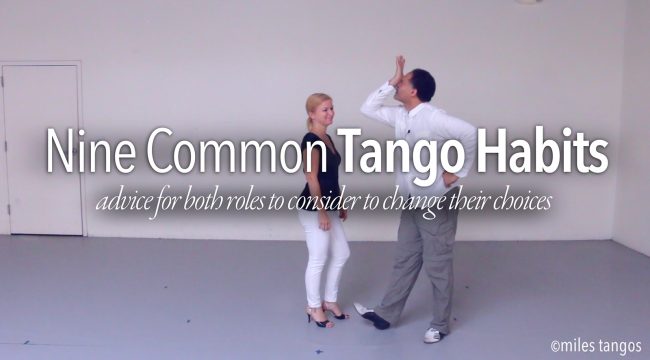
    The deeper we get into Argentine Tango, and the more that we develop, we begin to generate specific habits. Habits of how we move, familiar patterns of vocabulary,  comfortable ways of moving. Which, as a side note, is comfortable for us, but may or may not be so comfortable for someone else. Further, and more importantly, those comfortable ways of moving usually create some very repetitive motions. These are habits that may hinder our long-term development in ways we hadn’t even considered. It’s really the repetition, our habitual way of doing things that need to be watched, checked on, and then dealt with. Today’s post deals with Nine Common Tango Habits we can change in our dance that can lead to less repetition, and greater variance in what we are ultimately trying to create: A very desirable dancing experience for our partners.

    A good deal of dancers like to believe that they are the exception to the rule. They will be different. They’ll be better because they have studied with Magical Teacher X. The common thinking is that a few minutes, or an hour or two a week, or a weekend ‘boot camp’ or a week-long seminar of study with said Magicical Teacher X, and not to mention a few steps/patterns/figures, and then miraculously there will be ‘change‘. Everyone, their partners, everyone will immediately notice the difference and fall madly in love with the difference from where they were to where they are now due to Magical Teacher X. “You studied with X!!!! OMG you’re so much better now!!”.  The belief is that studying with X will create a better and more desirable dancing experience for your partners and more importantly for you.

    While there may be some validity that X is indeed an amazing teacher, it is more than likely something else occurred that the dancer was wholly unaware of after the fact of studying with X: The dancer ‘backslid’! Meaning the reverted back to doing what they were before time spent with Magical Teacher X. Quite realistically almost immediately after leaving X’s presence! And the reason is really a simple one: Comfort. Meaning ?

    a.) What that dancer is doing right now is far more comfortable, than what they were shown to do. So the dancer will revert to what is more comfortable than what they were shown.

    b.) The dancer will ‘drift’ from what they were shown. They’ll misremember what was said, or shown to them, or even if they write down what was shown, the exact language of what was said, the exact bodily positions and placements will not be retained and as a result the dancer will drift to what is comfortable for them to do, not what they need to do. As a result, they’ll begin to miss-practice what was shown to them thereby creating more problems.

    c.) More than likely the dancer will end up using their arms, and hands to push and pull/push their partners.

    The Good News! All of the above sounds almost dire, doesn’t it ? Like what’s the point of studying if you’re just going to backslide and go back to what you’re doing right ? However there is some good news. There are some ways, assuming that you implement them, and (this part is very important) actively want to change what you’re doing that can change your habits. While this video doesn’t go into the technique of how to do A, B, and C (please register, it’s free, and then subscribe to get access to all the details), it does show you Nine Common Tango Habits where we could, if we made a slightly different choice here and there, create a difference or change in how we access and thereby execute our dancing ideas.

    To be clear, ‘Change‘, regardless of whether or not you want to believe it, will only come, if you put the time in to actively take charge of your tango (re)education. And that means concerted, continuous, near daily reminders about the execution of technique, daily solo practice, bi-daily private partner practice, bi-daily or weekly private lessons, and actual social dancing at every opportunity. It means working on your foundation with clear, detailed, and intricately laid out instruction with oodles of visual, verbal, textual, and kinesthetic examples. Every. Single. Day. It means practicing daily. It means daily solo work. It means a daily consumption of tango music. It means analyzing your dance in a constructive fashion with detailed, honest, and clear language to describe what’s actually happening instead of the tried and true euphemisms of tango (“Being on your axis”, “I need resistance”, etc). It also means using video and video feedback of the foundational technique (how you’re walking close up, from the hips to the feet, from the side, and from the back/front) replayed, then demonstrated to the dancer, and then having the dancer replicate what they’ve seen with oodles of video trials. Doing it once correctly is not enough. Doing it a hundred times the same way without error is better! This, for those of you who think this is crazy talk or Perfectionistic Tango, is what Tango Topics has developed and is known as The Intensive Process.

    It is from this process that we have the Nine Common Tango Habits that Tango Topics has identified as places where a dancer can make a different choice. And that if you stack these different choices on top of each other they can by the whole create nuance or variance in the dancer’s choices. And that’s ideally what we’re after. However, understand that if you only make these nine changes, this is not going to improve your ability to dance. Nor will it improve the execution of your dance. Nor will it improve how you hear the music. It will not improve your ability to embrace, or your habitual errors that you aren’t even aware of! The only way those things will change is with a continued, concerted, and detailed study of your movements with a qualified instructor of The Intensive Process! (see: Tango Topics Teacher Training)

    So without further adieu, here are the Nine Common Tango Habits that we want to keep an eye on:

    1.) Stepping Outside Partner. Meaning, that if the couple is walking in Parallel system (lead left to follower right, and lead right to follower left) and the lead steps with their right to the Lead’s left side (the open side of the embrace) the Follower will more than likely believe that what comes next is an Argentine Cross. This is habit. This is also default behavior. There are multiple ideas that are possible here from that simple outside step: An Outside “Snake” Walk (type 5 of 6 of Tango Topics 6 Ways of Walking), the opening step to a Media Luna turn, a scissor step, etc. There are options here, and the idea is that we want to break those habits and make different choices. However, a problem will occur and that’s where when leading a Follower is that because the Argentine Cross is so ubiquitous and done so often, that you’re now invoking their habit instead of their listening skills. And so they’ll immediately think, “Ahhhhh Argentine CROSS!!!!”….and then you’re off to the races, as it were.

    2.) Turning To The Open Side. Most dancers think of a turn to the Open Side of the Embrace. This is the ONLY direction that a turn can happen. There is no other.  Ummm not. Simply put, you do know there is another direction you can turn in ? 😉 There is no rule that says you can only turn to the left (as a Lead, or Right as a Follower). You do know that ?  There are 3 types of turns, specifically, that Tango Topics Talks about that are designed for the Closed Side of the Embrace. 1.) The Linear Ocho Cortado or it’s kissin’ cousin the Circular Ocho Cortado. 2.) The Close Side Turn Trick. 3.) The Close Side Turn. Regardless of the variations of the turns the Closed Side of the Embrace, changing this simple action opens up ideas that you more than likely haven’t even considered. You may also discover that you have a weakness on the Close Side of the Embrace attempting to turn in that direction. You may also discover that you have an instability (as a Lead and as a Follower). And more than likely a little bit of both!

    3.) The Followers Molinete Default. In case you weren’t aware, and you’d be surprised at how many people aren’t aware of this: There are 7 other types of turns. Crazy !?!??! Huh ? Yup. There are seven other types of turns that you can engage in. 1.) Milonguero Turns. 2.) Linear Ocho Cortado & Circular Ocho Cortado. 3.) Rock Step Turns. 4.) Walking Turns. 5.) Calesitas 6.) Colgadas & Single Axis Turns. 7.) The Anti-Molinete Turn. Mind you that last one requires an orientation change, but it’s still kinda cool. The point is that most people only consider this one type of turn as the ONLY turn that is available to you. And as a result your dancing abilities and available options and opportunities become somewhat limited. Very limited. Just as a side note, it wasn’t until about 30 years ago, that the predominant Tango Turn was the Follower’s Molinete but in fact the Milonguero Turn! Gustavo Naveira changed all that, or so the story goes.

    4.) The Rock Step Default. When a lead hits an obstacle they’ll slam on the brakes and immediately go into Rock Step Mode. This has been detailed here on Tango Topics in two places in Practical Tango Advice: The Rock Step Everywhere and The Lead Back Step Issue. Obviously this is not desirable, and yet…how many of you engage in this process continuously ? A LOT! Aside from that, there are other ways to solve for there being an obstacle in the couple’s line of dance. Most notably one could engage any one of the 7 other types of turns to avoid the impending crash of bodies, or one could come to a complete stop and reset the embrace, which is always a good idea no matter what’s going on.

    5.) The Same Five People Default. The reality is that we get comfortable dancing with the people that we enjoy dancing with. And once we get comfortable we tend to only allow a recommended few into our dancing circle for a variety of reasons. Basically this is closing off our options. What you may not realize is doing that limits not only your dance partners, but more importantly it limits your available options and opportunity for growth and change in your dance. You may like what you’re doing but it can easily become stale if you don’t let it out for a breath of fresh air now and again. Meaning that introducing other people into the equation is what’s required here. Those other people will have different ways of reacting to your dancing style and that will create the necessity in you to learn to compensate for them, or more importantly to adapt! And in case you weren’t aware, a Tango dancer’s greatest strength is their ability to adapt every kind of dancer that they may encounter in their tango life! So… more people, means more options and the greater possibility for your dance to be a bit more nuanced and fresh!

    6.) Three Ochos Default! Before we go any further with this one, the reality is that Tango Topics Musical Interpretation series (1 – 5) talks about employing a standard number of Ochos in its Interpretations exercises, and as a standard rule no more than 3 Traveling Ochos in a row. Why ? Because it’s inordinate amount of work for the Follower. And we don’t want them to work so hard, they have a whole bunch of other things to do. This shouldn’t be one of them. Besides repetition isn’t exactly what the Follower signed on for. So…not so much with that one! That out of the way…. The reality is that a greater number of dancers have a set number of Ochos that they’ll lead and follow before they’ll do anything else, and it never, ever varies. So the suggestion is try mixing up from time to time! Fewer or More now and again.

    7.) Traveling Ochos Default. Traveling Ocho. Traveling Ocho. In case you weren’t aware. There are 7 other types of Ochos that you may wish to investigate. For most people when they hear the word Ocho they immediately only think of one variety of Ocho, and that’s the Traveling Ocho. In case you were unclear, and you may be, that there are seven other varieties of Ochos, most notably the 1.) Milonguero Ocho (sometimes referred as ‘Lazy Ochos’). 2.) Linear Ochos. 3.) Circular Ochos. 4.) Over-Rotated Ochos. 5.) Anti-Ochos. 6.) Milonga Ochos. 7.) Time Based Ochos. Remember that what you think of as an ‘Ocho’ is what Tango Topics refers to as a Traveling Ocho. This is the default Ocho that everyone thinks of and only considers this to be the only ocho ever.

    Whether you realize it or not, engaging in Milonguero Ochos, for example, opens up a whole line of dancing that you may not have been aware of, like for instance it opens the possibility for Floating, Linear, or Rotating Crosses down the line of dance. It opens the real possibility for Milonguero Turns to happen. It also opens up a variation on the Linear Ocho Cortado. It also opens up the Close Embrace Sacada options, and a host of other possibilities that occur simply because you’re working with less. Speaking of which the Traveling Ocho tends to take up space, whereas the Milonguero Ocho, or the Floating Backcross does not! Which leads one to working on Dancing In A Small Space! 🙂 You’re welcome!

    8.) The Open Side Opening Step Default. This may come as a shock to you, but in case you were unaware, you have a Left Foot, and a Right Foot! IKR ? Shocking, no ? Why is this important ? Because most people start off the dance on the standard Lead Left Foot/Follower Right Foot! That’s why. This instantly leads to item #9 on this list but it also limits you in terms of what you will normally do. There are other options to as your opening step. Actually 17 of them (In the form of the 6 Ways of Walking), and that’s not including The Salida Steps or Side Step options. Why any of this relevant ? Because it’s yet another way to break your habits of how you access or start a dance. Try this really simple exercise. The next time you start a dance start on the Right Foot (lead)/Left Foot (follower) and see what happens. However if we take that idea to the next level, and it is the next level, now try to start any vocabulary with the Right Foot ONLY (lead)/Left Foot ONLY (follower). And if you want to really add an interesting idea, Leads, you can only step with your Right foot, the Follower can do whatever they like. (See: The Dark Side Salida for more information.)

    9.) Parallel System Walking Only Default – This last one is pretty much self-explanatory, and we’ll just leave you with this idea…there are 5 other types of Walking! What are they ? If you were a subscriber, you would see all 6 methods, while there are a few on screen in the video above, trust that you’re not seeing the whole of it. It’s a bit more complicated than just the 6. Register, (it’s free) and see the entire list!

    The Wrap Up

    Let’s be clear about something watching a 6 minute sampler video, and then the full 20 minute video is not going to change your tango habits. It’s just not. What needs to happen is actual mental discipline. You first have to recognize that there is something better or different and then you have actually go out and get it, and then…here’s the hard part – do it! Watching this video (and if you register to see the full video) is only the first part of changing those habits for the better. The rest is entirely up to you and your process. This video is only the first part of that. It’s a gateway to more diverse and varied tango to step (no pun intended) outside of your regular tango way of dancing. That’s it, that’s all. It will not change your dancing skills at all. It will not change how you access those dancing skills. Nor will it change how you hear the music. You’re still going to hear the music the same way, which by the by you may be missing something. To change how you hear the music, consider registering for our Music Course! All of those things will still be true. However, the one thing that will no longer be true with time and practice is the variances that you put into your dance.

    There’s one thing that is NOT covered in this video. And it’s a notable absence. Most of the stuff that’s discussed here is from a Leading perspective. There’s the Follower’s side of the equation! For that ? Please see our forthcoming video on Adornments and Embellishments. Trust us, it’s an eye-opener!

    Lastly, and mostly, overall enjoy and explore your dance.

    See you in class and on the dance floor!

  • The Americana Embrace

    The Americana Embrace

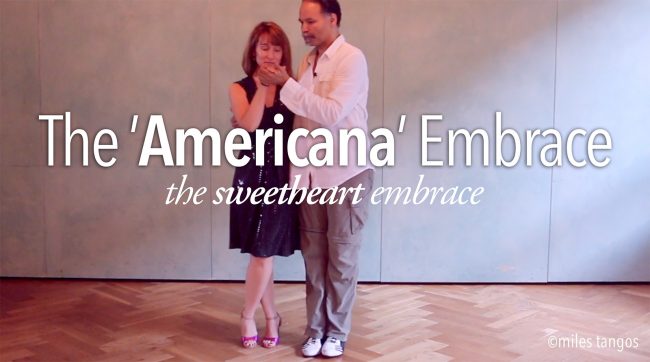
    The Embrace is the hallmark of Argentine Tango. It’s what gives the dance its particular look and most certain it’s ‘feeling’ regardless of whether or not you’re watching the dance or in the dance. Most people, once they get over the hump of ‘close embrace’ (and you’re never really over it, there’s lots and lots and lots of refinement work to be done over the years to come, so you’re never really ‘done’) will tend to stay there, believing that they’ve arrived. And truthfully, they have. While there are variations on a theme within the construct of the embrace (Open, Open Vee, Closed Vee, Single File, Stacked, Floating, Variable or Free, etc) the dance doesn’t change much after that. It’s only the embrace that changes…sometimes. So we ask the question, why on earth would you want change that or do anything to mar that experience of a close embrace with someone to change the embrace ? The simplest answers to that question is heat, expectation, or music. When we say ‘heat’ we’re really talking about the fact a few tandas in on a very hot night, and Tango can be a very sweaty business, so every once in a while you do need to drop the embrace or create space within the couple to allow for the body to cool down. When we say ‘expectation’ we’re talking about the fact that some dancers just don’t mesh well together, they have this expectation of one thing, and then they come into the embrace and it’s sooooo not what they expected. So as a result they may need to change the embrace to allow the dance to work. Or when we say ‘music’ we’re talking about certain pieces of music demand a change in vocabulary choices and different ways to express what’s happening within the music. It is for that reason that we talk about a variation on the theme above – The Americana Embrace.

    What is an Americana Embrace ? This is better known as either a Promenade or it’s sometimes referred to as a ‘Sweetheart’ Embrace. So named because it looks like you’re taking your partner out for a stroll. It just so happens that this ‘stroll’ is on a social dance floor while in the line of dance. Put another way, this is an orientation change that is led by the Lead onto the Follower that results in some really interesting vocabulary choices and changes. To be clear this is not a simple move, it does require some skill and some time to master this as the hand holds can be a little confusing and challenging for both Lead and Follower. So it’s probably a good idea that you leave this out of your dance for a little while until you have mastered you embrace, your walk, and a few other toys. Consider this ‘advanced’ material that beginners should not attempt for quite some time. Oddly enough a Salsa or Swing dancer has, to a point, mastered this embrace format. The difference is that in both Salsa and Swing, resistance based dancing is used to accomplish this goal. Whereas in Argentine Tango we do not want to use resistance but intention! 

    Free Tip – The video above states that there are 3 ways to enter into an Americana. There is a fourth method of entry, and it’s very, very, very flashy. While the Americana Embrace can be very sweet. This 4th entry method is quite literally a game changer because not only does it open doors for us (both roles) it also provides for a completely different embrace format! And what’s that ? Hmmm, to find out, you’re going to have to subscribe. I’ll simply say this, that 4th method is where all the toys are at! And quite honestly, you want the toys!

    About The Video. This video comes in at 12m:59s in length in 4 Sections. Lead and Follower technique is combined. 

    Section 1 – Introduction – 00:02:00
    Section 2 – 3 Possible Entrances – 00:05:50
    Section 3 – The Exit – 00:03:27
    Section 4 – Recap/Example/Final Words – 00:01:24

  • The ‘Check’ Step & Incremental Steps

    The ‘Check’ Step & Incremental Steps

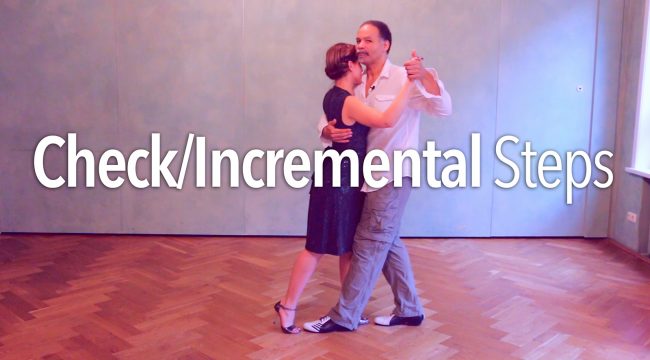
    There are pieces of Tango Vocabulary (steps/patterns/figures) that are very complex. The moment you see them you can’t even begin to imagine or even see yourself doing them. And then there are some that are the polar opposite – insanely simple, which for one reason or another require (seemingly so) no explanation! And then there are some pieces that somewhere in between. Today’s Tango Topic falls into the insanely simple category. However this stuff does actually require video, it does actually require an explanation of what not to do, and it does most certainly require an exploration of what’s possible. But let’s not get away from the fact that it’s a step. Nothing more than that. It looks cool, when executed properly, but it’s insanely simple. Like most things that are insanely simple, the devil is in the details. And those details are where you actually have to execute these ideas. In Today’s Tango Topic we’ll explore this from both sides of the embrace, as usual, and discuss the merits and detractions of playing with this stuff.  So without further preamble….let’s look at the Check Steps & Incremental Steps.

    What is a Check Step ? A Check Step is a bit of a misnomer. First and foremost it is a form of movement that we can and do invoke inside of specific moments like the Ocho Cortado for example. Secondly it is its own type of Tango Vocabulary.

    In the first option, the movement itself is a leg extension done by either Lead or Follower (usually the Follower is led to this), where the leg extends through Perihelion phase of the step, but does not progress to the Transfer phase of the step (basically no weight transfer). This form of movement is especially useful in Traspie, and rightfully could be called Traspie but isn’t. Why ? Because, again, there is no weight transfer. In Traspie, there are greater and greater increments of weight transfers.

    What is an Incremental Step ? An Incremental Step is a step that does include a slight weight transfer, however, it only goes a piece or a part of the way. Think of it as a step that only goes about an inch or two, and then with the next increment, the step goes a little further, and then the next increment goes a little further

    Why are these things important ? These pieces are important for a few reasons. First and foremost, variety. They create the option and/or opportunity for variation to occur. Massive variation in any number of areas. Secondly, because these these are steps, basically, they can be initiated anywhere, under any conditions, with all styles of music. Thirdly, because they’re so simple to do, it means that nearly anyone can do them. So with just a little training (this video), and lot of practice, you can implement this stuff in your dance with very little fanfare. 😉

    The Free Tip. In case you hadn’t realized this Leads, you can play too! Let that sink in for a bit. No. Seriously. Let that sink in. All this time, you’ve more than likely been thinking about leading the follower to X, Y, and Z. How about self leading yourself to an Incremental without the Follower! Assuming you pick your jaw up off the floor, go try it. The effect is two fold. a.) it looks cool. and b.) most Followers will think you’re playing with the music! 🙂

    Related Topics. When you’re done with this article, you want to go look at two other videos. 1.) Cross Body Incrementals, where you can apply these things in Close Embrace. 2.) The Golden Nugget Extensions video. Where you have oodles of options beyond your wildest dreams! 😉

    About The Video. This video is 16m:26s in length in 7 sections. Both lead and follower technique are combined and integrated into the video.

    Introduction/Technique – 00:07:00
    The Weight Transfer Illusion – 00:00:56
    Usage – 00:00:48
    Incremental Sice Steps – 00:01:25
    The Example w/Metronome – 00:01:51
    Close Ups of Footwork – 00:02:12
    The Last Word/End – 00:01:45

Hide picture