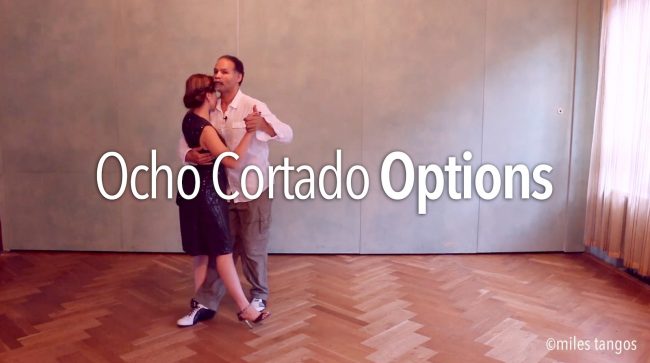
‘Ocho Cortado’. The word ‘cortado’ translates into English as ‘cut’ or cutted (which isn’t a word) or an Ocho that is Cut. In today’s version of the modern Ocho Cortado it rarely resembles its ocho variations or ocho roots. It’s no wonder when people say the words for the first few times they get a little confused and can’t see the embedded ocho properties that are sitting there. When we think of ochos, we tend to only think of BACK (Traveling) Ochos, not their forward variety which is where the confusion comes from. Further still it’s the interruption that of the ocho (hence the ‘cut’ part) that people don’t see which creates more confusion. Today’s Tango Topic takes the idea of Ocho Cortado and adds a few nuances to it that you wouldn’t ordinarily think of or consider, this particular variety of the Ocho Cortado are considered variations on a theme, or ‘Options’. Think of these ideas as what you can do with the Cortado before, during, and, after you execute one. This is nuance vocabulary, variance vocabulary. Ideas to give you a starting point to expand on and to play with. Hence today’s topic, Ocho Cortado ‘Options’.
What are Ocho Cortado Options? This video is a companion piece to Ocho Cortado Wraps. In that video we deal with optional wraps or enganches within the Ocho Cortado. In this video we deal with ALL of the OTHER possible options available to a Lead or Follower with the Ocho Cortado, and in specific the LINEAR Ocho Cortado, not the Circular variety. It should be noted that video starts out with the basis for the movement itself, the Linear Ocho Cortado and then drills down to a whole host of options and opportunities for both roles.
Free Tip – The Follower’s step prior to their crossing step. You want to move your foot in line with the Lead’s closest leg/foot. Why ? Because it places the cross back in front of your lead which is ideally what you want. Otherwise you end up in the Lead’s arm pit. From a Leading perspective, because a lot of Followers aren’t going to do this you have to remember to readjust them towards doing this.
About The Video. This video comes in at 14m:31s in length in 7 Sections. Both lead and follower technique is combined and integrated in the video.
In Tango, we have multiple types of Sacadas, from multiple types of positions, with varying levels of complexities. Typically, the most difficult Sacada to execute for BOTH roles is the Back Sacada. The reason for that is because the Back Sacada usually requires a level of disassociation and applied disassociation that is difficult to accomplish. Most especially if either role has not done the necessary ‘ground’ work to make that happen.
However, there are a series of Back Sacadas that DO NOT require that aspect at all! They’re typically not done for one reason or another, with the most common one being that they tend to break the embrace or the structure of the couple. Because no matter what happens, the back sacada must at some point face against the partner. And the set up for that is problematic, which is where the disassociation comes in.
In this type of Sacada, none of that is necessary. When you stop and you think about it, this type of Sacada is one of the easiest Back Sacadas to execute for a Lead or a Follower. However, in this video, we’re going to look at the Lead’s version of this idea ONLY. And in a later video, we’ll take up the Follower’s version of this idea, which is slightly different in terms of how it would be set up and led. It should be noted that the basic structure of either side of this type of sacada is nearly identical across both roles!
What is a Step Over Back Sacada ?
This is a type of Sacada where one party steps over the leg they’re going to eventually sacada, forwards or back. Typically, it’s done from a Back Step. However, the sacada can also be done from a Forward step for either role. In this instance, we will not be looking at the Forward Step, but just the limited vantage point of the Back Sacada.
The Follower’s Side of the Equation.
For the Follower, there are 3 areas that we need to pay attention to:
1.) The Collapsing Embrace. 2.) The ‘Free’ Leg Component. 3.) Coming To Collection.
Let’s get some issues out of the way before we dive into the details. First and foremost, for you, this is the Lead Sacada-ing you. You don’t need to concern yourself with anything other than keeping your leg in the position it was left in. The reason why this is important is because most Followers are trained to collect their feet after a movement. In this instance, the Lead is literally stopping you from doing precisely that. You see, if you collect your feet, then there’s nothing for the Lead to Sacada! So don’t collect, yet.
Secondly, quite honestly, this is one of those weird moments in your Following experience that’s going to be a bit out of the norm. It doesn’t happen all that often, if ever. However, now that I’m pointing it out and showing just how dead simple this is, be prepared for an onslaught of Step Over Back Sacadas. I am sorry about that. While I will address this later in the Lead’s section of this article, ideally, what should happen is that the Lead should ONLY do this no more than 3 times in a Song. And even that’s a stretch. Lastly, this is one of those moves where you, as the Follower, are waiting for his majesty to do his thing to be flashy and ‘cool’. You basically just have to hang out until he steps backwards into you. When that happens, we ideally want your controlled displacement to occur (see collection below).
The Follower Details.
Collapsing Embrace.This means that your left hand is on his shoulder (more than likely), and your arm has collapsed inward towards you (as shown in the video). Ideally, what we want to have happen is that you want your arm to go AROUND your Lead as they lead you in back step around them.
Free Leg. This refers to a very common issue that crops up, that we as followers want to just let the leg fly freely backwards out of collection. While this is desirable in certain situations. This is NOT one of those times. Ideally, you want to keep your motions separate from each other and really listen to what’s being asked of you. There’s another reason why you want to contain or curtail your ‘free’ leg. Because it’s all too easy for you to let that leg fly and then hit someone behind you! So … try NOT to do this!
Caveat > Most Leads are NOT this clear where they are deliberately leading X to get Y response out of you. So as a result, they’ll muddle through. However, the resistance-based Lead will use their arms and physical pressure to generate those clear individual motions. This is NOT desirable. Ideally, we want our Lead to use intention to generate, ask for, and follow through on any motion that we’re being led to do.
Collect Your Feet. This should be a no-brainer, but sometimes we need the reminder. Remember to collect your feet/bring your feet together in the appropriate places! One appropriate place is when you are being sacada-ed, and the Lead has stepped back into your leg; your leg wants to fly free, but it can’t, and this is where you must remember to invoke a controlled displacement of the leg and bring your feet to collection. As they continue their rotation, it will lead you stepping backwards and ending up back in front of your Lead.
In the role of the active follower, there is something here that can affect what the lead does NEXT and how they do it. By changing the angle of your rotations either towards or away, you affect how close the sacada will be and, more importantly, what is done next. You can actually prevent them entirely by stepping slightly away or by coming to collection everywhere deliberately! Remember, if there’s no leg there, there’s nothing to sacada! Why do this ? By NOT participating here, it prevents the possibility of opening the embrace and further forces the lead to keep things on the simple and clear.
The Lead’s Side of the Equation.
This is really simple for you, just a reminder but:
Final Thoughts.
This is a fun little sacada that can be used in any number of places to either taTangor vaVals MusicHowever, it’s best in taTangousic. Usually late Pugliese, Calo, or D’Agostino. Any music where there are lolongtringy notes. You want to use the loLongstStringyote as the ststep overart!
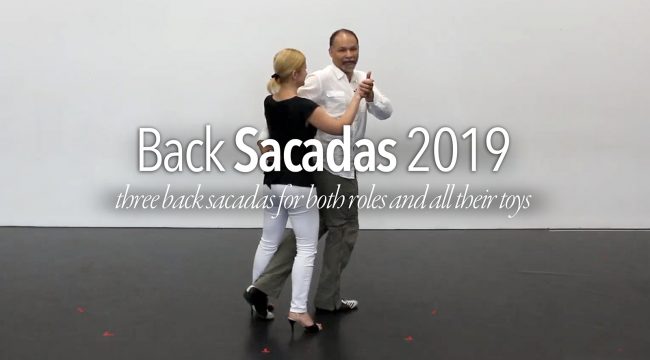
Sacada. Meaning – ‘a-really-cool-move-that-you-think-is-really-complicated-but-is-an-illusion of techniques’. For most people when they see a sacada for the first time, their reaction is one of surprise that a.) it looks really complicated (it’s not). and b.) that they can never see themselves doing one (you will). And these are usually forward sacadas for the Lead into the Follower’s side step. Usually. There are about 1024 sacadas, which drops to 512 when you rule out certain impossibilities. In reality, there are about 10 different ‘flavors‘ of them that when you combine the different flavors of walking systems, that number jumps to an insane number. Things go right off the rails (as the saying goes) when we see a sacada that does not fit into this paradigm. Enter the “Back Sacada“.
Important Notation: This article & video has been re-written, updated, and the video has been completely redone for 2019 going forward. Originally the video that accompanied this article was 31 minutes and 35 second in length. It is now over 1 hr and 35 minutes. The original video is still present and available for purchase, as it contains desirable information. However, the article that represented it is no longer present. 😉 Enjoy.
What is a Back Sacada ? The easiest way to describe this Sacada, which is a displacement, where either the Lead or the Follower will displace and then take the place of their partner by using a Back Step! Generally, these types of Sacadas require Applied Disassociation to make them happen for either role. Typically this type of Sacada is created whereby the Follower is led to Sacada the Lead, whereas the second most common variety is the Lead will Sacada the Follower. Of all the Sacadas that one can lead and follow, this is probably the most challenging for a variety of reasons. Most notably because you quite literally have to have mastery over proprioception in order for them to work properly. Most people, however, do not have the necessary mastery, so they end up bumping into one another and feet getting stepped on, repeatedly. While this isn’t always the case, and not to disparage anyone’s experience of them Leading or Following these ideas, the fact remains that unless proprioception has been mastered then this type of Sacada will repeatedly fail.
The Free Tip. The Back Sacada is only one of 501 possible Sacadas, yes FIVE HUNDRED and ONE, that are available to you. However, this particular Sacada has one unique quality that sets it apart that may not seems apparent to you, in nearly all cases of Back Sacadas, they nearly all require one or both partners to do some form of over-rotation! Meaning that in order for them to work, you must, must, must apply disassociation, and then release that energy that’s built up as if it were a rubber band snapping back to achieve the over-rotation.
About The Video. Total runtime for this video is: 01:38:55. This is a combined video format, lead and follow technique are mixed together.
Introduction – 00:06:22 Disassociation/Applied Disassociation Review – 00:20:54 Trailing Foot – 00:05:27 Leg Extension – 00:11:06 Dangling Foot Error – 00:04:18 First Common Back Sacada – 00:12:35 Second Common Back Sacada – 00:07:00 Dancer’s Cheat/Lead’s Cheat – 00:05:41 First Common Multiple Back Sacada – 00:07:34 Second Common Multiple Back Sacada – 00:02:26 An Interesting Back Sacada and a Surprise Back Sacada – 00:07:47 Close Embrace Back Sacadas/Closure – 00:07:45
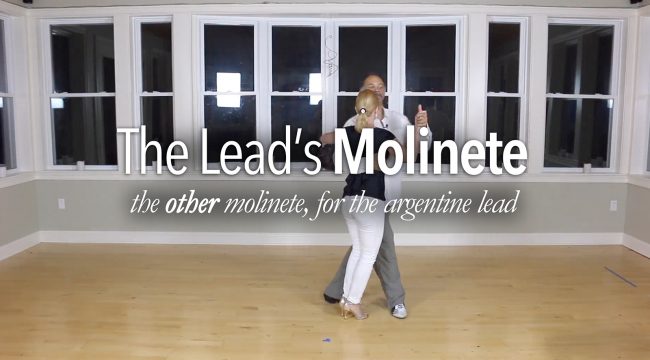
Most people when they hear the word “Molinete” think of the turn that the Follower is ‘supposed’ to do. They generally commingle the Lead’s role of the ‘Giro’ (which is first person singular, from the root Spanish word ‘Girar’, which means “I turn” when translated from Spanish to English). Generally this is the common turn that is taught to all beginners as what the Follower does in order to turn. Generally speaking, nearly all, social dance possess a turn like the Follower’s Molinete, it’s called a ‘Grapevine Turn’, which basically consists of some form of a backstep, some form of a side step, and some form of a forward step. It’s just that in Argentine Tango’s version that version usually contains disassociation and then applied disassociation (or ideally we’d like it to contain that, but frequently does not). For the most part, the line of reasoning is that the Giro/Molinete construct is Follower vocabulary only. However as the title of Today’s Tango Topic implies, you’ve been fed a line of reasoning and gap that doesn’t necessarily add up. Which is to say that this is not jut for Followers! A Lead can and should engage in this idea as well! So without further adieu, today’s Tango Topic is on The Lead Molinete.
What is a LEAD Molinete ? It is exactly as described, a Grapevine Turn, that consists of an applied dissociative backstep, a ‘circular’ side step, and a dissociative forward step. That’s it. It doesn’t get any more complex than that. The only difference is that instead of the Follower doing this vocabulary, the Lead does it. However, this particular version of the Molinete can be done in Open Embrace and in Close Embrace, and almost any embrace format that you think of. It can be done to the Close Side, which is perceptional-ly easier (that’s a fallacy by the way), and to the Open Side of the the embrace. Typically you would think that going to the Close Side would be harder, it’s not. It’s the same amount of work going in either direction.
About The Video. This video comes in at 22m:07s in length in 8 Sections. Separate Follower Technique and detailed Lead Technique is explained here in the video, as well as the combined elements of what has to happen in order for a successful Lead Molinete to function.
Section 1 – Introduction – 00:01:47 Section 2 – Follower Technique – 00:03:48 Section 3 – Lead Technique – 00:02:56 Section 4 – Combined Lead & Follow – 00:04:28 Section 5 – Close Embrace Version Technique – 00:04:36 Section 6 – Close Embrace Example – 00:01:11 Section 7 – Open Side Turn – 00:01:24 Section 8 – Ending – 00:01:13
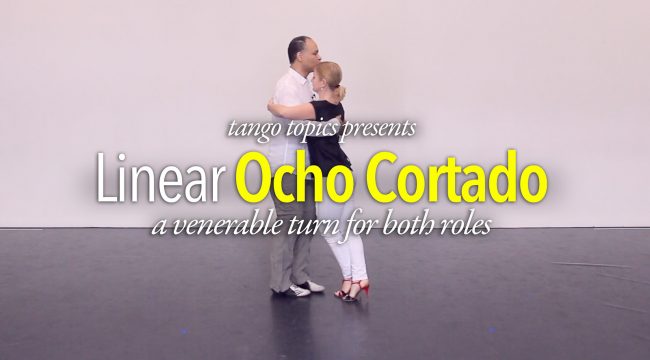
The word ‘Cortado’ translates into English as ‘cut’ or cutted (which isn’t a word in English) or an Ocho that is Cut. In today’s version of the modern Ocho Cortado, it rarely resembles its Ocho roots. It’s no wonder when people say the words for the first few times they get a little confused and can’t see the embedded Ocho properties that are sitting in front of them.
When we think of ochos, we tend to only think of BACK (Traveling) Ochos, not their Forward variety which is where the confusion comes from. Further, still it’s the interruption that of the Ocho (hence the ‘cut’ part) that people don’t see which creates even more confusion.
Today’s Tango Topic looks at this venerable Tango Turn and Vocabulary and looks at the Linear version of it, known as “The Linear Ocho Cortado”. So named because it’s done along a line. It should be noted that Tango Topics contains several variations of this venerable piece of vocabulary and that you really should check them all out. There’s lots and lots and lots of variation with this stuff. Further, still it should also be noted that this Linear Ocho Cortado is the ‘vanilla’ version of the Cortado. It’s the most common form and in Today’s Tango Topic we will not be showing any of the variations of the Cortado. For that, you really should go visit the link below and look at the other options. That said, let’s dive right into Today’s Tango Topic: The Linear Ocho Cortado.
What is a ‘Linear Ocho Cortado’ ? The are multiple versions or ideas of the Cortado. However, this particular piece of vocabulary is also what we consider to be one of the Seven Foundational Moves of Tango that every dancer must learn in order to be a socially competent dancer. Note that we said, not ‘Lead’, not ‘Follower’, but ‘Dancer’. That’s because both roles have a responsibility to this piece of vocabulary which we detail below. The Linear Ocho Cortado or ‘LOC’ as we’ll refer to it from here on out, is not something that is learned in a very specific progression of ideas. First and foremost you must learn how to walk, then Disassociation and Applied Disassociation which translates to Traveling Ochos, then Turns (Usually the Follower’s Molinete to the Lead’s Giro, and the Milonguero Turn as well), then the Argentine Cross, and finally the LOC. The LOC gets its name from the fact that it’s done in a line or along a linear path within the Line and Lane of Dance and does not break that convention. The LOC has multiple uses, from a Parallel System walk (shown in the full video above) to an endpoint or completion element. Meaning that you’ll use it as a resolution from a Molinete/Giro structure (mostly) as an example. The vocabulary itself is done on the beat, while the variations on a theme can be done in half-time, as well as double time. The LOC can be interpreted many, many, many different ways from a musical perspective. That’s one reason why it’s so venerable and versatile.
About The Video. Total runtime for this video is 26:19. Lead and Follower Steps and Technique are separated. The item in bold is unedited and is at the top of this article as a sample.
Introduction – 01:46 Lead Steps – 04:08 Follower Steps – 03:02 The Couple’s Posture – 01:46 Lead/Follower Steps Together – 02:37 The Importance of the ‘Replacement Step’ – 02:23 The Follower’s Side Step Error – 03:04 The Close Embrace Version – 01:05 The Walking Example – 02:20 The Embrace Reminder/Closure – 03:16
In Buenos Aires there is a type of pastry that will blow your mind which is freshly made, hot, and right out of the oven (especially at La Viruta at 5 am – they buy theirs from a local panaderia, con Café con Leche). Truthfully they’re almost like heaven. They’re also insidious, fiendish really, as you can’t have just one! Nooooo. You must have a whole bag of them! No matter how strong your willpower is, trust that you will have several of them, several times a week, and go to your local panaderia (bakery) and you’ll pick them out yourself, and then go to pay for them with a gleeful smile, knowing what’s in the bag! You won’t be able to make it all the way to the front step of your apartment without having one, maybe 3! These pieces of delight are called ‘Medialunas’ and they’re like Crack Cocaine because of their addictive quality! They’re lightly sweet, incredibly fluffy, and soft to the touch…sort of like a croissant but better, muuuuuuch better and oh so delicioso!
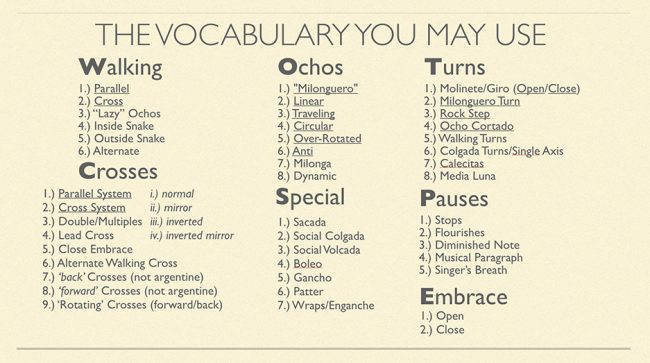
Frequently for the Tango dancer they’ll hear this word and think of the pastry. There is however a piece of Tango vocabulary that has nothing to do with the pasty that causes a bit of confusion, and that’s the Argentine Media Luna, and obviously they’re not the same things. One is a pastry and the other…well, the other is one of the 8 types of common turns that we find in Argentine Tango. The 8 Types ? 1.) The Follower’s Molinete (open embrace, and close embrace) & the Lead’s Giro. 2.) The Milonguero Turn. 3.) The Rock Step. 4.) The Ocho Cortado. 5.) Calesitas. 6.) Walking Turns. 7.) Single Axis & Colgada Turns. There’s one more that doesn’t get used a whole lot and is the subject of Today’s Tango Topic: The Argentine Media Luna.
What is an Argentine Media Luna ? The words, “Media” & “Luna” when translated from their Spanish to English cognates, translate as “Half” & “Moon” or in this case, “Half Turn”. It is exactly what it sounds like but with a Tango twist. In many ways it resembles the Follower’s Molinete. And if you don’t know any better, you could swear that they’re exactly the same. On paper, meaning technically, they consist of the same basic moves, with one major difference: In the case of the Follower’s Molinete, there’s Applied Disassociation on the Back and Forward steps. In the case of the Argentine Media Luna, there is no Disassociation or Applied Disassociation from the Follower!
The Media Luna is used primarily as one way of turning the couple. Not necessarily the Follower, but the couple, down the line of dance. It is frequently used as a stepping stone or entry point to executing something else, as there are many options out of the Media Luna. However in it’s base form it can and should be used to as a navigational element. It’s also, because of its lack of use, a nice surprise to the Follower and a bit of a change up from the same Follower’s Molinete to the Open Side of the Embrace OVER and OVER and OVER and OVER and OVER and OVER again! So quite rightfully, this is a great turn to add to your repertoire from a Leading perspective AS WELL AS from a Following perspective.
The Free Tip. There is one thing about the Media Luna that isn’t mentioned or shown a lot, is that the closed side of the embrace version (the dark side) is awkward. Really awkward. So awkward in fact that more than likely the Follower will look at the L/lead that attempted it and will ask, “Are you out of your ever lovin’ mind ?”. And the reason ? The outside partner step feels strange. It’s not that it’s not doable, it just feels strange.
About The Video. This video comes in at 15m:16s in length in 11 Sections. Both lead and follower technique is combined and integrated in the video.
Section 1 – Introduction – 00:00:25 Section 2 – The Vocabulary – 00:01:43 Section 3 – The Turning Component – 00:00:45 Section 4 – The 2nd Media Luna – 00:01:13 Section 5 – Without The Lead Back Step – 00:00:37 Section 6 – With The ‘Embrace’ – 00:01:15 Section 7 – The Close Embrace Version – 00:01:14 Section 8 – Media Luna Examples – 00:02:55 Section 9 – The Dark Side Media Luna – 00:02:18 Section 10 – The Shorter Side Step – 00:00:37 (edited version above in the sample) Section 11 – The Dark Side Solution/Wrap Up – 00:01:03
The Argentine Calesita. Tango consists, surprisingly so, of an almost dizzying array of ‘steps’ that it quite honestly boggles the mind. Really when you stop and you think about it, it’s just 2 feet, well 4 really, and you can’t even begin to imagine what you could do with 4 feet. The possibilities are nearly endless! Which brings us to Today’s Tango Topic: The Argentine Calesita.
Calesita is not a word that you hear all that often, and quite frankly even if you look it up to translate it, you’ll more than likely be more than a little confused. In the annals of Tango Vocabulary this is one of those things that quite literally have to ask, “What on God’s green earth is a Calesita ?”.
What is anArgentine Calesita ? The word “Calesita” roughly translates as ‘Carousel’ or in English, a ‘Merry-Go-Round’. Anytime you see a ‘sita’ or ‘cita’ ending on a Spanish word, it means that whatever object is being modified is small, or made smaller, tiny. So this is a small carousel or a small ‘Merry-Go-Round’. The Argentine Calesita is basically a small walking turn! It’s nothing more than a variation on a El Giro De Caminando or The Walking Turn with a ‘twist’, there’s always a twist! So what’s the twist ? Instead of the couple walking in a tiny, tight circle, one partner walks in a tight circle around the other. This is Lead vocabulary as well as Follower vocabulary. Meaning that you shouldn’t necessarily get all persnickety that the Follower alone should do this. Many Leads employ this very useful turn as a way to reposition themselves to do something else. It’s a great navigational tool as well. And, obviously, can be used to Interpret the Music. It’s also not that hard, once you get it through your head that you’re not going to employ the Follower’s Molinete or a Milonguero Turn. The reality of this type of motion for the couple is that unless it’s been led before, the Follower will default to their training. The Lead on the other hand, because this is self-led will have issues in different areas.
One More Thing. This stuff is really not that hard to envision but there’s one overriding reason why we actually want to add this into our dance, and it has everything to do with heat. Heat ? Yes, bodily heat. Typically the dance can generate a lot of body warmth and as such, things can get overheated quite easily. So engaging the Argentine Calesita tends to release that heat trap temporarily. Ok, that’s not a real reason but it sounds like one, no ? A good reason that we want to engage the Argentine Calesita is purely a musical one. A good Calesita can be used in any number of ways to accentuate the upbeat, the downbeat, dropping a beat, playing with 8th or 16th notes (almost patter like). This is the primary reason why we use them!
The Free Tip. There is one thing about the Calesita that has not been mentioned above, and it this: 2 or 3 Millimeters of distance is all that it takes to move a Calesita from usable to undesirable. Meaning that it is all too easy to create a Calesita (from a Leading or Following perspective) that is wholly unstable! The entire video shows you how to correct for this problem.
About The Video. This video is 01h:14m:13s in length in 15 Sections. Both lead and follower technique is combined and integrated in the video.
Section 1 – Introduction – 00:01:10 Section 2 – Caveats – 00:05:35 Section 3 – Lead Set Up – 00:07:01 Section 4 – Lead Forward Calecita – 00:02:49 Section 5 – Follower’s Forward Calesita – 00:07:40 Section 6 – with Close Embrace – 00:05:23 Section 7 – with Milonguero/Lazy Ochos – 00:03:47 Section 8 – Calesita with 2 Turns – 00:03:42 Section 9 – Close Up – 00:05:09 Section 10 – Errors – 00:11:42 Section 11 – Footwork – 00:03:11 Section 12-Follower Technique – 00:05:15 Section 13-Lead Back Step Calesita – 00:05:54 Section 14 – Follower Back Step Calesita – 00:05:13 Section 15 – Closure – 00:00:42
There are Eight Turns in Argentine Tango that Tango Topics has identified as Commonly used or Social Turns. There are a few others that are outside of the common eight but for the most part, accept in this moment that there are eight.
Today’s Tango Topic deals with two of those common eight turns and combines them into one movement so that they actually turn down the line of dance. This is an unusual vocabulary for Tango Topics to display because it is one of the very few figures that we teach/show to our Intensive Level Students (in Level 2 & 3) in the combined version that you’re seeing it here. We typically teach these as separate elements and leave it to the student, later on in their level 2 development of solving Tango Problems, to put them together as a possible solution set.
Some things to keep in mind:
In order for a Rock Step, by itself, to function as a turning element a.) there must be multiples of them, and b.) they must ‘curve’ OR there must be a resolution of some sort from one to the next element.
In order for a Linear Ocho Cortado to be used as a turning element, the step prior to the crossing element must be rotated by the Lead, and/or the Follower’s side step must be curved or rotated slightly.
In either case, these pieces of venerable tango vocabulary are at best ‘quarter turn’ vocabulary. Meaning that they’ll only turn about 90 to 120 degrees under optimal conditions. However, combining these two turns increases the rotational from 90 to about 150 to a potential 180 degrees, under optimal conditions.
If all of that seems very technical for you, think of it this way: By themselves, they’re smaller, individual turns or rotationals. Together they have a bigger and better turning radius. Further still, it’s a kind of cool combined turn to do.
Today we’re going to explore this combination, so without further yapping, Tango Topics presents: The Rock Step & Linear Ocho Cortado!
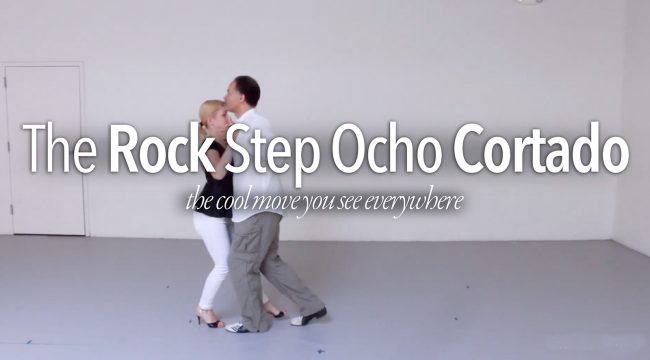
What Is A Rock Step & Linear Ocho Cortado ? First we have to be very clear, if it wasn’t clear above that these are two very different pieces of vocabulary. Very different. And they’re frequently commingled due to the fact that the opening step of the Linear Ocho Cortado (not the Circular Ocho Cortado) looks very similar to a Parallel System Rock Step without the Resolution. Secondly, we need to be clear about the difference between a Rock Step and that opening step of the Linear Ocho Cortado, which is called a ‘Check Step’.
A Rock Step, put simply, is a step where the Follower is led to stepping backwards, engaging a weight change, and then led to a rebote (rebound) into a forward step that may, as an option, resolve into another step. Usually a side or forward step. These steps can be done in Parallel System (meaning opposite feet – lead left to follower right, and lead right to follower left) or Cross System (meaning same feet – lead left to follower left, and lead right to follower right). The most common of the Rock Steps is a Parallel System Rock Step that starts with the Lead left/Follower Right and does not engage a Resolution, but rather curves a bit, about 45 degrees. Further, and lastly, it should be very clearly noted that while the language above is quite ‘passive’ as to what the Follower is being ‘led’ to do, the Follower is by no means a rag doll here or what Tango Topics calls a ‘dead fish’ in the Lead’s arms. Not by any stretch of the imagination. Nor should they be. They can, and should, when engaging in any of the 8 possible Rock Steps, own them completely and step into them with gusto!
A Linear Ocho Cortado, is an North American construct, at best. Why this idea is more prevalent in the United States and Canada is beyond Tango Topics but it is. In this version of the Ocho Cortado, the Follower is led to a Check Step, then a forward step across their Lead’s body, then a side step, and then led back to a crossing step (more on this later). It should be noted that the Follower does have some level of choice in this particular piece of vocabulary. Not just in where they step, but how the cross is executed, more on this particular element in a bit.
Ok, so now that we’ve defined what these things are, we need to combine them, and in doing so, we create a much more dynamic, and not to mention but we will anyway, a far more useful social turn than the turns are by themselves! This is the Rock Step & Linear Ocho Cortado vocabulary.
The Free Tip. Oh boy there’s a ton of possible tips that I could give you here but probably the biggest one of all, aside from the Replacement Step is that you really do want to create variances with your Linear Ocho Cortado, mostly in the Crossing Step and the Side Steps. There are loads that are possible. But keep something in mind, any variation you make must fit musically on the beat, within the pauses. And if you don’t know what a Musical Pause is, then you really should subscribe and go look at the 5 Musical Pause Types, which will invariably lead you (no pun intended) to the 14 Days of Tango Music, and then Tango Del Dia Part 1 and then Part 2. And once you’ve done that, then it will be time to look at how to interpret all of that stuff with actual vocabulary in the Musical Interpretation Series. Let’s be clear about something, musical interpretation is NOT just a Lead thing. It’s as much attributed to the Lead as well as to the Follower for a variety of reasons.
About The Video. This video is 16m:44s in length in 9 sections. Both lead and follower technique are combined and integrated into the video.
Introduction – 00:04:48 (this is the video above) – Linear Ocho Cortado – 00:00:54 – A Check Step – 00:00:13 – A Rock Step – 00:00:23 – Parallel System Rock Step with Resolution – 00:00:22 – The Explanation – 00:00:53 – The Creepy Lead Lunge No-No – 00:01:17 – The Socially Acceptable Idea for the Rock Step – 00:00:45 The Follower’s Replacement Step – 00:01:32 The Rock Step/Linear Ocho Cortado – 00:00:54 The Cross System Version – 00:01:54 The Open Side Version – 00:04:19 The Curving Version – 00:01:20 The Closing Ideas – 00:01:24
The Argentine Rock Step is a very venerable piece of tango vocabulary it’s used quite often as a way to avoid a hazard, and infrequently as a what is primarily supposed to be used for as musical interpretation. More often than naught for a lot of people the addition of the Rock Step is where they stop developing kinesthetically. This becomes their experience, their go to move, and they don’t realize that this is the case. So let’s talk about Today’s Tango Topic: The Argentine Rock Step.
What is A Rock Step ? First let’s define what the word ‘Rock’ means. According to Webster’s Dictionary, the English word ‘Rock’ in this case is being used as a verb. It has a noun form, which means “a mass of stone”. In its verb form, it means “to sway back and forth”. Next, when we apply that idea to Dancing, a‘Rock’ Step means that you have a step that is going to go from weight transfer to weight transfer, very quickly.
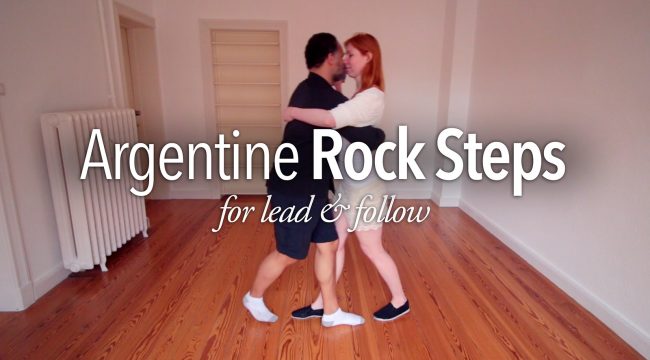
An Argentine Rock Step is a little different. It refers to a very specific construct and is not swaying to from side to side, but actually weight transfer to weight transfer (usually back and forth) sometimes with a Resolution (more on that later). In a lot of ways, a ‘Rock’ Step appears to look like (operative word) as if the couple dancing is a Rocking Chair. The Argentine Rock Step is in the family of ‘Alterations’ of Tango Vocabulary. Meaning that due to a possible Resolution, the Follower’s direction (orientation) changes as a result. One more thing: There is a distinct and clear difference between an Argentine Rock Step and a Check Step and/or Incremental Step as shown in the video below:
Plays from YouTube. Pressing play connects you to YouTube. Privacy
The video above shows the difference between the two (and one possible error that happens quite frequently). A Check Step has no weight transfer forward (for the lead) and backwards (for the follower). In the case of the Rock Step there is a clear, and definitive weight transfer backwards AND THEN forwards. 🙂
The Free Tip. Stop squeezing your partners! This really about intention, or the lack therein. You lock your arm frame and think that in doing so it will stop your partner from moving. No. All it does is put more money in their chiropractor’s pocket! How does this relate to the Rock Step. Frequently the Rock is led and followed as a ‘jerky’ motion. The Rock Step out (the back step for the Follower, the Linear forward step for the Lead) isn’t the problem. It’s the coming back to resolution part, that is usually jerky, the Lead will PULL their partners back to them instead of stepping back gracefully. Tsk, tsk, tsk.
Pre-Requisites: Walking. Weight Changes. Extensions. One does have to have mastered one’s walk and possess stability in their embrace without using the embrace for stabilization against their partners before they can initiate these ideas.
About The Video. This video comes is 14:16 in length in ONE section broken up by markers. Both lead and follower technique are combined and integrated in the video.
Section 1 – Introduction – 00:00:48 Section 2 – Lead Technique/Follower Technique – 00:01:15 Section 3 – Side Step Resolutions – 00:02:06 Section 4 – Parallel Linear Rock Steps (Example: Close Embrace) – 00:00:20 Section 5 – Parallel Linear Rock Steps/Resolution (Example: Close Embrace) – 00:00:18 Section 6 – Cross System Rock Steps – 00:01:27 Section 7 – Cross System Resolutions – 00:02:38 Section 8 – Cross System Examples with Resolutions – 00:01:20 Section 9 – Linked Rock Steps (Multiples) – 00:01:50 Section 10 – Chained Rock Steps with Resolutions & Closure – 00:01:57.