Tango Topics info:

Check out the Tango Topics Lexicon for words like Axis and Connection.

Category: Vocabulary

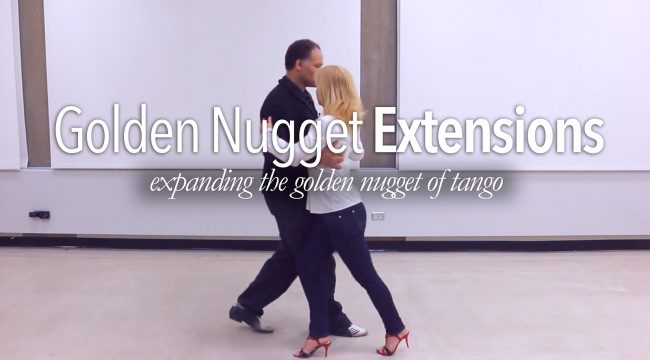
  • Golden Nugget Extensions

    Golden Nugget Extensions

    The Tango Walk is the hallmark of Argentine Tango. It is what sets Tango apart as a social dance, and a performance element. For some people when they talk about the Tango walk, they don’t pay a whole lot of attention to it, it’s just there. For some they hear the words that the walk is important but for one reason or another they just don’t get it. For others, they see that the walk is absolutely everything. It’s the bee’s knees. Anything and everything is possible once you have mastered the walk. Some people only see the walk as what one does in between the vocabulary (the steps, patterns, and figures). However you view the walk, the walk consists of four phases, not a singular element. The 1st of those 4 phases is what we call The Explosion Phase. This is where all the energy for the step is generated. It only happens for a moment. After that the energy dissipates in a controlled fashion throughout the rest of the step. The 2nd phase is The Extension Phase. This is where the leg actually, and fully extends, to a point. The 3rd phase is what we call The Perihelion Phase. In this phase we ‘pop’ the knee, meaning to fully elongate the entire knee area thereby creating a longer and cleaner extension of the leg. This phase is important because it is the mid-point of the step. And finally the 4th phase, The Transfer Phase. In this phase we do four things in sequence. 1.) We begin a sliding action along the floor with the free foot, shaping it, and engaging in supination. 2.) We begin to transfer our weight from one foot to the other, in this case the sliding foot. 3.) We allow the energy of the Explosion Phase to dissipate in a controlled way. And finally 4.) We allow the knee to flex back to the point of compression that we started out with.

    Why are we talking about this stuff ? Because Today’s Tango Topic relies heavily on three of these 4 phases to begin playing with what we call Golden Nugget Extensions.

    What are Golden Nugget Extensions ? We need to back up a bit and explain The Golden Nugget of Tango (TGNoT). TGN is where Today’s Topic gets the basis of it’s name from. TGN is not just another piece of Tango Vocabulary. It makes the idea of Tango very accessible and removes a lot of doubt of what’s going to happen next. It is one of the very few patterns that Tango Topics actually endorses, and teaches, with some frequency. TGN can be very useful in interpreting the music, meaning that it works really well in all 3 styles of Tango Music (tango, vals, and milonga). It is also exceptionally extensible, meaning that you while you have the basic pattern of it, you can change it, modify it, and add to it, adorn it, edit it to fit what you’re doing from a Leading perspective as well as from a Following perspective. There are loads of places in TGN where the Follower has oooodles of control over what’s happening. But that’s a topic for another day to be filed under – The Role of the Active Follower.

    And now we get to the other half of today’s explanation. The title (Golden Nugget Extensions) is a both a double-entendre as well as a deliberate explanation of what it is. First and foremost, it is taking TGN and adding an expansion pack to it. Things you probably hadn’t thought of when playing with TGN assuming that you have watched the video and learned something from it. Secondly, it’s also applying an element of Tango that doesn’t get a whole lot of usage except maybe in Milonga: The Incremental Step (Traspie) & The Check Step. Golden Nugget Extensions fuses these two important elements into one core concept that you want to apply to your dance. This is the Golden Nugget Extensions principle.

    Free Advice. The Incremental Steps that are present in the video, the reversals. Go look at the Incremental video in the archive. That should give you a few ideas from a leading and following perspective as to what you want to be doing here on multiple levels.

    About The Video. This video is 11m:27s in length in 7 sections. Both lead and follower technique are combined and integrated into the video.

    Sacada Introduction – 00:03:26
    Sacada Review – 00:02:37
    Follower Technique – Part 1 – 00:01:15
    Lead Technique – Part 1 – 00:00:50
    Lead Technique – Part 2 – 00:01:05
    Follower Technique – Part 2 – 00:00:55
    Quick Examples – 00:01:20

  • Argentine Barridas

    Argentine Barridas

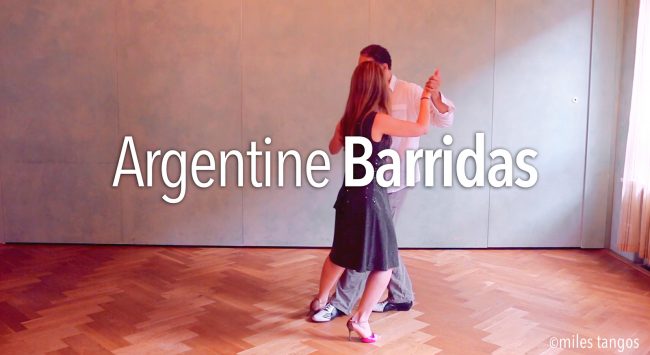
    The word ‘barrida’ translates into English as ‘swept’. And that’s exactly what it is. A sweep. From a Tango perspective this is a somewhat ‘worn’ piece of tango vocabulary that most people see sort of schlock tango schtick. Most people start out with doing it a few times, and then disregard it because they’ve moved on to something else that’s more ‘flashy’. The Barrida is, in common vernacular, a ‘drag’ of the foot (either role can initiate it). And does have a useful application in the dance which is purely musical if not entirely navigational. With that thought in mind, let’s talk “Barridas”, what they are and how they’re useful for both roles of the dance.

    What is an Argentine Barrida ? As if there were another kind of Barrida ? There isn’t. A Barrida in it’s simplest form is where either the Lead’s or the Follower’s foot is deliberately moved from one position to another by either by deliberate intervention or by the illusion of the intervention. In this case, the intervention is by the opposite dancer’s foot seemingly moving the other dancer’s foot. When in fact what is ideally done is to generate the illusion by leading or following a collection and the opposing dancer follows that collection motion with their foot either trailing or leading it so that it appears as if the opposing dancer’s foot is actually generating the motion, when in fact it’s an illusion. This is a Barrida. There are many types of Barridas. Most commonly as the ones where the Lead is generating a Barrida on the Follower’s foot to make it appear as if they’re collecting their feet from the Follower’s side step. Of course, there are multiple, multiple versions of this idea, this is jus tone possible variation on a theme.

    The Free Tip: The Barrida is best done to the Follower’s Back Step and the Lead’s Forward Step on the Open side of the embrace in either Open or Close Embrace.

    Pre-Requisites: Walking. Weight Changes. Extensions. One does have to have mastered one’s walk and possess stability in their embrace without using the embrace for stabilization against their partners before they can initiate these ideas.

    About The Video. This video comes is 14m:21s in length in 8 sections.

    Section 1 – Introduction/Technique – 00:03:01
    Section 2 – Example Barridas – 00:00:16
    Section 3 – Slowed Down Examples – 00:00:52
    Section 4 – The Follower’s Barridas – 00:02:20
    Section 5 – Barrida Ideas – 00:01:27
    Section 6 – Playing With Barridas – 00:00:37
    Section 7 – Reversed Barrida – 00:01:07
    Section 8 – Footwork in Detail/Closure – 00:04:09

  • Argentine Paradas

    Argentine Paradas

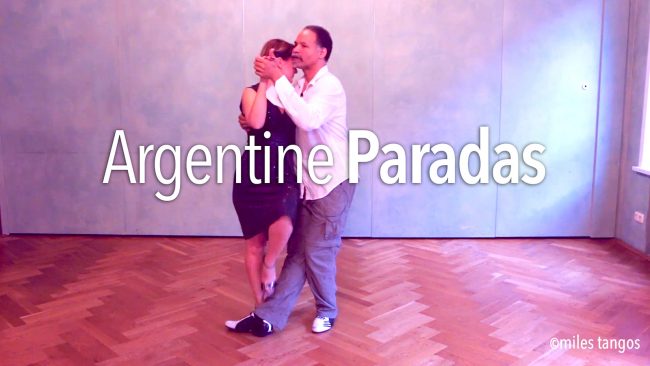
    The word ‘parada’ translates into English as ‘stopped’. And that’s exactly what it is. A stop. From a Tango perspective this is a well worn piece of tango vocabulary that most people see as an element towards engaging the illusion of ‘intimacy’ of the dance, or it’s ‘steamy’ aspects. Anyone inside the dance knows that the ‘steamy’ thing is just that, an illusion, and that there’s real work to be done to make this venerable piece of tango vocabulary useful and musical. The vocabulary gets its name from the fact that we are stopping but it’s an unusual stop. It’s a stop not because you’re stopping the Lead’s motion, but in fact stopping the Follower’s motion. It’s more of an interruption really, because the ‘stop’ is momentary. With that thought in mind, let’s talk “Paradas”, what they are and how they’re useful for both roles of the dance.

    What is a Parada ? The Parada is a stop of motion, usually for the Follower. The Follower is being led to a position where they can not proceed any further due to a physiological obstruction from the Lead’s leg and foot being deliberately, and decidedly, put into the walking path of the Follower. The Follower will be ‘asked’ to step over the obstruction presented by the Lead and from that ‘step over’ the Follower has lots and lots of options.

    The Parada is usually used as an accent to a particular point in the music where a Pause or Stop has happened in the music. However, more of then than not, that’s not its primary usage. It’s just another piece of vocabulary in the Lead’s arsenal of vocabulary as a way to express the intent of the music that is currently occurring at that moment in time.

    From the Follower’s side of the equation typically after the Follower has been led to a ‘stop’, they have a few options and opportunities to engage an adornment or embellishment. The more common of those are where the Follower will take their free foot and slide it up the Lead’s leg and then down the other side, and then proceed towards the next step.

    The Free Tip. The Parada is the Follower’s choice. They can elect NOT to step over, but rather to step around, especially if the Parada is done in open embrace! The video does not go over this point but does show you a few rather important aspects towards this ideal.

    About The Video. This video comes in at 33m:08s in length in 13 Sections. Both lead and follower technique are combined and integrated into the video.

    Section 1 – Introduction – 00:00:52
    Section 2 – Building A Parada – 00:06:59
    Section 3 – Parada Caveat – 00:00:37
    Section 4 – Open Side Parada – 00:01:32
    Section 5 – Closed Side Paradas – 00:00:58
    Section 6 – Embrace Indicators – 00:01:24
    Section 7 – Foot Awareness – 00:01:34
    Section 8 – Rules for Decoration (Followers Only) – 00:01:51
    Section 9 – Follower Embellishments for Paradas – 00:03:46
    Section 10 – Multiple Paradas – 00:03:15
    Section 11 – The Step Over – 00:04:23
    Section 12 – Another Idea – 00:00:35
    Section 13 – Gancho/Barrida from Parada/End – 00:04:27

  • A Common Colgada

    A Common Colgada

    The Colgada is in many ways very similar to the Single Axis Turn. That’s because they share the same basic attributes, and they’re from the same family of vocabulary. So theoretically, if you know one, ha ha ha, you should be able to execute the other. Not true actually, there are stark differences between the two.  One primary difference from the Single Axis Turn is that the Social Colgada is done with the partnership in a perpendicular position to each other rotating around a singular axis vs. the Single Axis turn where the partnership is facing each other.

    The Colgada Rap! Before we go any further, truthfully Colgadas are typically manhandling events that most Follower’s want to avoid like the plague. The reason is a.) that they’re poorly executed. b.) arm pushing and pulling experiences, and c.) that someone invariably gets hurt because their back has been wrenched this way or that. Most of this occurs because the Lead in question has not learned how to properly generate a Colgada. Where Colgadas get a bad rap is because of these 3 aspects which turns off a lot of people, obviously. However a Social Colgada on the other hand, while it has all the potential for these things to happen, is much smaller, and exists within solely within Close Embrace. It is and can be one of Tango’s more elegant specialty pieces of spice or accent vocabulary. 

    What is a Colgada ? The word “Colgada” comes from the root Spanish word “Colgar” which translates to English as “Hang”. The word ‘Colgada’ is the past participle version of the verb which adds an ‘ed’ ending to the word. Which when translated to English is ‘Hanged’ or rightfully ‘Hung’. So a Colgada is where the Follower (specifically) is in a state where they’re going hang off their Lead, deliberately, or more specifically, they’re being placed in a position where they’re going to hang. And that’s where we talk about a shared axis, and more importantly balance, all of this fitting within the line and lane of dance. 

    Ideally, the Colgada itself is not about taking the Follower off-axis, as you may have been told, but rather about creating a state of shared balance & equilibrium along the shared axis between the partnership. As there is always a shared axis between the dancing couple. Truthfully there are actually 6, not one. There’s the lead’s central longitudinal axis, the follower’s central longitudinal axis, and the shared central one between the two dancers which is created by their relationship to each other. It’s the last one that we’re interested in because it generates the space for a Colgada to exist.

    From A Following Perspective let’s get this right out of the way immediately. You’re going to fall, backwards or in this case, to the side away from your lead. That’s the whole point of a Colgada in the first place, the falling part. There’s nothing you can do about it, except to engage teh Follower’s Kickstand (see above in the video). However understand something that the “fall” is a controlled hang more than anything else, and the control comes from two important aspects 1.) the elasticity of the couple’s embrace, and 2.) body position, placement, and balance between the couple. 🙂

    If there is rigidity in the embrace from either partner, nasty things are going to happen. “Elasticity” in this instance is a somewhat relative term, as there does have to be some firmness there, but not to the point where you’re holding on for dear life! That’s not what a Colgada is about. 😉 So yes, dear Follower, you’re going to fall to the side, and yes you’re going to be off-balance, and quite rightfully it’s going to be a little scary for obvious reasons. No one, absolutely no one wants to fall. However in this instance we actually do want to fall, a bit. Not a lot, just a bit. And that’s where the controlled part comes in. It’s a very controlled ‘hang’ through technique, and more importantly through a shared balance point between the partnership.

    Planking: Before we go any further we have to talk about when you “fall”, you’re desire is to stiffen your body, and then ‘Plank’ it to save it from impacting the floor. But before we get there, we’ll engage the Kickstand Mechanism to prevent that from happening. But before the “fall” happens we invoke, as Followers, the ’plank’ of our bodies. What is that ? It means that you’re going to stiffen your body and straighten it out as if it were an elongated piece of wood, falling backwards, hence the term ‘plank’, which refers to a plank of wood. 😉 “Planking” is an error as there is something else we want to do.

    Planking is an error when engaging a Colgada. It is however a perfectly natural response to do this. So don’t freak out. However, planking is not what we’re after. We’re actually after something else. This is why we learn the proper position for a Colgada to exist. What’s the more desirable position for us ? For that, you’ll have to see the video. However the descriptive for it is very simple, it’s almost as if you’re sitting, you’re going to send your hips away from your lead, while keeping your torso with them. Or in the case of the Social Colgada, you’re going to be perpendicular to your lead so you want your hips to go away while the side of your torso faces your Lead.

    The Controlled Hang: Another aspect of the Colgada is that we want our arms, and hands to a certain degree, to be able to slide almost as if you’re arms were a collapsible telescoping bar. ‘Telescoping’ in the adjective form, meaning that one part slides into another. We do not want rigidity in our arms and/or hands. We also don’t want to hold on for dear life with our hands, like your grabbing the lead’s bicep with your spiny fingers. Not. Less than desirable. Instead we want arms and hands to be able to slide within the Lead’s embrace – hence the ‘telescoping’ part. 🙂

    The Kickstand Mechanism: There is a safety mechanism that is built into each and every Colgada, and it’s called The Follower’s Kickstand. What’s that ? It’s where the Follower’s free leg extends backwards as if they were going to step backwards but there’s no weight on it. The Kickstand in this case occurs under ONE condition. If and only if there is no counterbalance (or counter send) from their lead. If there is counterbalance then the Follower should not release from their invited Mordida (see video above).

    From a Leading Perspective the Social Colgada is all about balance. It’s the Lead’s job, function, to create physiological balance, a state of equilibrium, within the couple. Mistakenly this is done with your arms, but instead we want to employ counterbalance the Follower with our mass, not our arms. Our arms are there to ‘guide’ our intention, but the real toy here is counterbalance. Truth be told the Lead (the person not the action) is more than likely going to have more mass than their Followers will posses. And as such the counterbalance point will be slight, while at the same time, the proper ‘sitting’ position of the Colgada will be almost, but not quite planking. So, in other words, the break at the waist, will be slight. 🙂

    The Used Mordida: A good portion of Leads, overuse the Mordida usually mistakenly in the Salida Step of the dance. What’s a Mordida ? It’s a ‘foot’ sandwich. Where the lead, traps one of the Follower’s feet and sandwiches it between the Lead’s feet. Far too often once a Lead learns how to create a Mordida they use it everywhere. As a place to stop, as a place to reset the couple, as a place to end the dance. This is know on Tango Topics as The Unused Mordida. It’s ‘Unused’ because the Mordida is an indicator to the Follower that something is about to change, usually entering either a Volcada, a Barrida, a Parada, or in this case, a Colgada. However in this case we actually use it and rightfully need it to set up the Colgada, because without our feet are going to slide every which way, and we obviously don’t want that to happen.

    video
    play-rounded-fill

    The Arm-y Pushme-Pullyou Colgada: Typically most leads use their arms to generate a Colgada, as has been said, however one aspect of this is that once the Colgada starts the Lead will pull the Follower towards them with their arms instead of directing their intention with their mass. One of these is desirable (mass direction), and one these is not (pulling). This type of error makes almost any Colgada very undesirable. So it’s a good idea to learn how to direct that mass, without pulling or pushing so that the experience is a pleasant one and not one of dread for the Follower! Just a hint, this video shows you how to do that, properly. 

    A Turning Colgada ? The Colgada gets a really bad rap most of the time. It’s poo-poo’d because most people think of it as ‘Nuevo’ vocabulary or open embrace vocabulary. Frequently this type of vocabulary is poorly executed, thereby making it visually unappealing, not to mention wholly uncomfortable. However, this particular version of the Colgada is far from the unsightly ‘nuevo’ aspects that you’re used to seeing, and that’s because of its ‘whoosh’ factor. The ‘whoosh’ is a rush of energy that happens because the couple is turning to one side or the other! Most colgadas are done in linear fashion. This Colgada series is done on the circular, and then to exit the Colgada, the Follower steps, over and (here’s the important part) around their lead!  While this can be done in Open Embrace, and there’s nothing wrong with that, doing so tends to take up way too much space, so instead we want to do this in Close Embrace in no more space than a single forward step. Put succinctly, a Social Colgada, when properly executed (hence the video), can be a way to turn the couple down the line of dance! This aspect of the Colgada makes it a very useful and powerful turning tool for the lead to use in 2 ways: 1.) Navigationally. and 2.) The Spice Factor, which we’re not going to get into.

  • Beginning Tango – The First Lesson

    Beginning Tango – The First Lesson

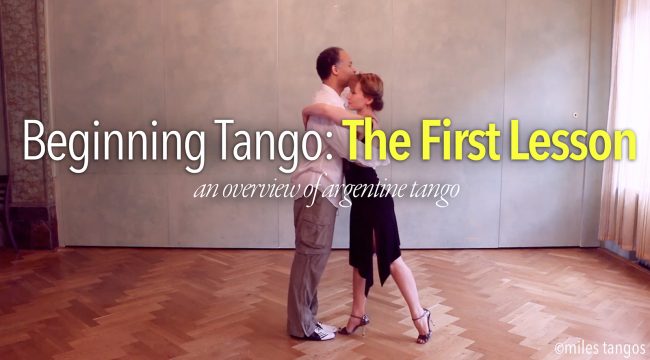
    Notation: The video above is only a sample of the full 15-minute video. Only registered users and subscribers can see the full video.

    Welcome To Argentine Tango. You have stepped into a world where you will find dance, music, pleasure, history, pain, triumph, relief, patience, hurt, conversation, friends, upset, community, loss, communication, love, layers, and a different kind of reality that spans the entire world. Tango is a family, it is a way of life, a dance, a different lifestyle that will last until the next dance or the next life time. You will meet people from all over the world that more than likely will not speak your native language, may not share you political views, will not know where you live or where you come from or care for that matter. With regards to Tango, none of that stuff matters.

    Tango is life (“Tango es vida” in Spanish).
    Tango is a way to have a conversation without speaking.
    Tango is moving to music that will move you to emotional places.
    Tango is technique.
    Tango is communication.
    Tango is choreographed. (stage or performance tango is)
    Tango is entirely improvised. (social tango is)
    Tango is a walking embrace.
    Tango is a nightmare of sweat with nice shoes and nicer clothing.
    Tango is intimate.
    Tango is insanely difficult.
    Tango is beautiful.
    Tango is all over the world.
    Tango is the unending onion.
    Tango is your worst high school nightmare come back to haunt you.
    Tango is sexist, ageist, and gender imbalanced. (yup)
    Tango is grace. (depending on your point of view)
    Tango is an exercise in personal patience.
    Tango is a horizontal desire in vertical form. (uuugh, not)
    Tango is an exercise in minutiae.
    Tango is study.
    Tango is what you make of it.
    Tango is ….

    One word that is often used to describe the conversation of Argentine Tango, is ‘Connection‘. Tango Topics eschews this word because it rightfully has about 7 different meanings which can be found here in our dictionary of tango terms. The point is that you’ll hear the word a lot in a myriad of different ways. The problem with it is that what one person hears, and what another means by it, may be two very different things! And therein lay the rub, as it were. Some beginners find that the language to describe what’s going on, the way in which something is said, is unclear, inconsistent, and lacks any validity or reality to what’s actually going on. What one teacher describes as X and what another describes as X bear little resemblance to each other. There is no consistency to what X actually is. So you may find yourself going a bit crazy. Arrrgh! For instance, you may hear the word “Ocho” from two different teachers or dancers, and when you watch them doing said ‘Ocho’, what one does and what another does bears little resemblance to the other. There are several reasons for this disparity. Language being chief among them. The problem lay with the fact that there lots of gray areas and no standardization in Argentine Tango. The truth is that anyone can teach Tango without any certifications, but they can teach or show you ideas. And the issue with that is there is no consistency with language or examples and/or any standardized or  structured curriculum or what tango is or is not. There is no ‘right’ way to Tango. For most people this is on some level very scary and at the same time very freeing. This mindset opens up the doorway to everything being possible, and also brings up one of the core components of Social Dancing in Argentine Tango: Improvisation. Everything that you’ll see at a Milonga (with the exception of a performance), is entirely improvised!

    Which brings up another point with regards to teaching and learning: You don’t know what you don’t know. You don’t know who’s for reals and who is talkin’ trash. Sometimes a really good indicator of a quality instructor is the size of their class, most times it is not. That just speaks to that teacher’s ability to market and how polished they appear to be. This is not necessarily a good indication of quality instruction. Sometimes the indication that someone is a good instructor is the recommendation from another dancer. However, that recommendation is based on how well that particular person felt comfortable with that teacher and how that person got what they needed to get from that teacher. There may be no objective information there but rather entirely subjective. And sometimes it is the work product of a student thenselves. The ‘work product’ is ideally what you’re looking for. If you like how a particular dance looks when they dance, ask that dancer who they studied with to generate that kind of movement. Ultimately you will need to decide what works best for you. You may change teachers several times to find one that you get and understand. There’s a fly in the ointment with this line of reasoning, and it’s that Tango requires growth, and change, and what you experience now is only a stepping stone to what may come later. The process of learning tango is not through one person but rather many. It is said that to raise a tango dancer in the modern world, it takes a villiage. Tru dat!

    You may have it in your mind from TV, Movies, or social media that Tango is a very romantic or passionate dance. While there may be some truth in your own personal perception of how you can understand what you’re seeing. The reality is far from it. The last thing in the world that most of the better dancers in the room, and on the floor, are thinking about is romantic or sexual desires. It is mostly a very distant after thought. The thing that they’re really after is a really good dancing experience. Which isn’t to say that those thoughts don’t happen, it’s to say that for most people in the room (not all, there are always the creepy dudes….uuuugh!) they’re in the room to dance, to see their friends, to hang out, to dress up, to have a nice time and an evening out listening to very nice music. This is what’s called “Social Tango”, and believe it or not this is part of the reason you’re wanting to study Tango at all > to have a taste of the Milonga Experience. Tango isn’t just about the steps, it’s about the culture of the dance that goes with it!

    Tango is all of these things, and at the same time, none of them. It really depends on your perspective of where you’re at emotionally, intellectually, and the vantage point that you enter the dance with. As Yoda said to Luke Skywalker before he entered the Cave of Evil, “…only what you take with you“. The same is true here in more ways than you can count. It is here that we start the idea of Tango. Tango is only what you take with you.

    In the following article and the video above we address Tango from 3 important aspects.

    1.) The Movement (or Vocabulary) of the dance.
    2.) The Music of the dance.
    and 3.) The Codigos of the dance.

    All three of these things must be studied, practiced, danced, and pursued with equal due diligence, if you want to start on the pathway to being a good dancer in Argentine Tango. Oh and one more thing…and this one you have to get into your head: Instant Mastery ? That’s not going to happen. Tango is going to take you a while, and rightfully a lifetime to ‘master’. Being a beginner, is a good thing in Tango. A very good thing.

    That said, let’s dive into Tango Topics idea of Beginning Tango – The First Lesson. 

    Part One: The Movement of The Dance

    Movement ? What does that mean ? It means the foundations of the dance. Tango consists of three simple steps that will rightfully take you the rest of your life to fully grok and understand. As a side note, one our first teachers used to say, “There are really only two steps in Tango! Your left and your right”. And while this was meant as a joke. It’s an allegorical joke with ooodles of truth bombs to it in ways you haven’t even begun to understand yet. However, for the novice dancer, and even the dancer that may read this and pass this along to you > Tango consists of three steps:

    A Forward Step. (in the video)

    A Side Step.

    And a Back Step. (in the video)

    For the Follower the important step to learn is the structure of the Back Step.
    For the Lead the important step to learn is the structure of the Forward Step.
    And for both roles, they use the Side Step in very different ways and level of executions. If all of that sounds really simple, it’s not. It will take years, and we’re not kidding, literally years to perfect these seemingly simple steps. To make them look, and feel effortless, so that they become part of you

    The reason why this video, and section, is focusing on these 3 simple steps is because they’re related to a very important construct in Argentine Tango: La Caminata or The Walk. Tango is based on the walk. There’s a Zensunni phrase that goes, “If you can walk, you can dance”. It is the foundation of the dance. The walk is everything in Argentine Tango. Make that walk clean, clear, consistent, stable, controlled, and precise, and you’re onto something. Less than that, and you’ll spend years, quite honestly a decade or three, in tango purgatory because you haven’t resolved how to walk yet. And the really bad part about that is that you won’t know it. Uuuugh! Putting on a pair of tango shoes, and/or nice clothes to go with those tango shoes will not hide a less than desirable walk. An unstable walk (from either partner) will result in an embrace (see the next paragraph) that hangs, pulls, and pushes. Which will result in you either being dragged around or you dragging someone else around the floor. Not to mention back pain, and a neck pain that will more than likely require a visit to the chiropractor. And unstable walk may also, more than likely result in you not dancing. This is why it is absolutely crucial to have a Tango Teacher that focuses on the walk to start with, and continually for several weeks into your Tango training. Months really. Years at the earliest. It will take you weeks to unlearn what you think you have learned. Months to retrain your body to do something very different from what it’s doing today. And years to make it part of you. At its core, Tango is a Walking Dance. The more that you focus on that walk, the easier the dance becomes.

    Contained in the walk of Tango is its Embrace. The Embrace is what gives Argentine Tango its iconic look. Most people see Tango as ‘passionate’, or ‘sexy’. The reason is because from where they’re sitting, their frame of reference is of a couple very close to each other so they must be ‘intimate’ with each other, or they’re having some kind of romantic or sexual relationship. That may or may not be true. But the only relationship that the dancing couple is currently having is with their partner, the music, the floor, and the couples around them. The perceptions that other people don’t matter. What you’ll see at a ‘Milonga’ (what is loosely understood as ‘the dance party’) is two basic embrace types: Open Embrace, and Close Embrace. Truthfully there are many types of embraces, which you can explore through our dictionary of embraces. Open Embrace, means that there is ‘space’ between the partnership. Think of it as “Space for Jesus” 🙂 . ‘Close Embrace’ is a lot closer and can be any number of ideas from body-on-body, to body-very-close-to-body, to body-not-touching-but-very-close-to-touching-body and everything in between. More than likely the more common idea that you’ll see presented and danced is “Close Embrace” dancing and its variations. The video above shows you both of these ideas or what Open and Close Embrace is. Realistically as far as the Argentines are concerned, these terms are Norte Americano ideas. Realistically as far the Argentine is concerned, there is only El Abrazo, or The Embrace. There is only one. Theirs. This Open or Close or Vee, or…any one of the distinctions are North American ideas and definitions because we, as North Americans (and really the rest of the world), need the distinction of what we’re seeing coming from the Argentine way of thinking about the dance.

    A skill that is used in the video above to initiate and communicate one’s ideas, and which Tango Topics refers to repeatedly as “Intention” is Intention Based Dancing. What’s that ? In it’s simplest form, ‘intention’, is a way to ask someone to do something with you (not for you or to you. this is an important mental distinction when it comes to intention) while dancing to music. Sounds simple enough, right ? There’s just one little caveat to ‘Intention’ and ‘Intention Based Dancing’  > You can not use your head, arms, shoulders, elbows, forearms, wrists, hands, thumbs or fingers to push, pull, compress, or squeeze to communicate your ideas. Rather your entire body is used with a little lean forward, to the side, or backwards. The arms act as a dummy transmitter, they do not add or magnify the intention of what’s being led or followed in any way, shape, or form, from a Leading perspective or from a Following perspective. Doing so would be considered ‘rude’ and ‘pushing’ someone. However, you will hear in other classes from other teachers, another idea called “Resistance” or “Resistance Based Dancing”. In short, Resistance Based Dancing means that we pull, push, use pressure and force, arm and hand compression, and really strength to communicate our desires and responses. Is one more desirable than the other ? In our opinion, ‘yes’. But that’s for you to decide not for us to dictate. You’ll figure out which one is less work, and is far easier to get but difficult to master, and which one will will leave you in a sweaty mess wondering how you pinched a nerve and why your arms feel like they’ve gone 10 rounds in a prize fight!

    To be clear, all of the stuff above is Foundation. It is the basis of how we move in the dance. Forward, Side, and Back with an Embrace.  More than likely though the thing you’re wondering about is what are the steps, the basic vocabulary of the dance ? There are many ‘steps’ or figures in Argentine Tango. But the Five Common Figures of Argentine Tango is what you’ll run into. Which are: Walking, Ochos, Turns, Crosses, and Cortados.

    1.) Walking. Walking refers to how you walk, when you walk, and why you walk. Tango Topics details the Six Ways of Walking. This isn’t how to walk, but rather what you can do with that walk once you’ve got the hang of it.
    2.) Ochos.  These are a very specific type of vocabulary that can invoke a micro turn or not. There are 8 Types of Ochos that Tango Topics details, and the two more common ones are what we call “Traveling Ochos” and “Milonguero Ochos”. Fortunately for you we have an entire video on this subject and rather than duplicate that effort here, once you’re done with this video, please go load up our Eight Types of Ochos video.
    3.) Turns. At some point beyond Walking and Ochos, you’re going to have to learn how to turn, because the Line of Dance isn’t moving or has ground to a stop but the music hasn’t…and you can’t just stop dancing because the line of dance stops, so for that reason, and a whole bunch of others we have to engage some level of Turning with Tango. And fortunately for you, we have a primer on the Eight Types of Turns in Argentine Tango!
    4.) Crosses. At some point you’re going to run into a really weird thing that will happen, and that’s what’s called “The Argentine Cross”. Put simply, this is where the Follower is led to cross their feet. However, this is not the only type of cross, there are many types of crosses in Tango but this is the most common of all crosses and we have a FREE video on this topic. Just follow the link above and start your free education today.
    5.) Cortado. The last thing that you’ll see, of the basic vocabulary is the beginning of the door opener to other ideas in tango, and that’s the Ocho Cortado. It’s sort of a combination between an MIlonguero Ocho and an Argentine Cross culminating to a Linear Ocho Cortado! These are the Five Common Social Figures of Argentine Tango and they form the basis of what you’ll see at a Milonga when out social dancing.

    End Part One. Want to see the all THREE parts ? It’s free. All you have to do is register. Registration is free. Just scroll down to the form below and fill in your name, ane email address and you’ll be good to go. There’s nothing to buy. Nothing to download. Just pure tango information. Go ahead, what do you have you to lose ?

  • 256 Argentine Cross Variations

    256 Argentine Cross Variations

    Of the Seven Basic “Moves” for the Follower, the Argentine Cross is probably the most overused and, at the same time, least understood and quite honestly, least explored by the modern Tango dancer. It’s just accepted that it happens.

    Just imagine for a moment, that you’re dancing along as a Lead or a Follower and you’re dancing the same Argentine Cross again, and again, and again. After about 5th or 6th time, it would become so rote that you’d stop thinking about it and it would happen by default. No artistry, no distinction, nothing. That is precisely what has happened with the modern version of this idea. The cross has become so ubiquitous that we have stopped exploring it and mining it for its rather unique properties. Like for instance the mere fact that it is the only time in any couple social dance where the Follower willingly (a very important distinction) crosses their feet! Or the singular distinction that there are about 256 Variations of the Argentine Cross, and yet…you only know one of them ?

    Yup. You read that rightly…TWO HUNDRED & FIFTY-SIX different combinations.

    Have you seen the Argentine Cross video ? You may want to go look at that, as it’s the foundation of this video. Without it, these are just interesting ideas but they have no context. The Argentine Cross video is what makes this entire video possible. It’s also FREE if you register. Just scroll to the bottom of this page, and register! And then follow the link below. You’re welcome. 🙂

    The Argentine Cross

    What is a ‘Variation’ of the Argentine Cross ? It is an alteration, a deviation from the ‘Normal’ Argentine Cross, and while the steps themselves don’t change, the direction and options for the Cross do change. This is a ‘variation’. The way that we get to Two-Hundred & Fifty-six is first we accept the direction of the cross. Meaning that it generally goes to the Lead’s left/Follower’s right and walks in Parallel system. The Lead generally steps ‘outside partner’ to the Follower’s right (Lead left) and the Follower crosses their feet (Left over Right). This is a ‘Normal’ Cross. However if we instead step not outside partner Right, but outside partner LEFT (the Lead’s Right this time), and complete the cross that way (Follower crosses Right over Left). This would be a Mirror Image or a Mirror Cross in Parallel System! There are two other parallel crosses sitting here, and it requires us to visualize that if there is a Normal Cross, and a Mirror Cross, then there must be an Inverted Cross and an Inverted Mirror Cross, where in both cases the Follower would cross behind not in front. These are the Four Parallel System Crosses: Normal, Mirror, Inverted Normal, Inverted Mirror (N, M, IN, IM). Aside from Parallel system we have Cross System walking which we can apply to these Crosses, so instead of 4 Crosses, we just doubled to 8 because we’re doing these same crosses, only not in Parallel System, but Cross System! These are the common variations. There are 5 more types of variations, which each time that you add another variation type, it doubles the number of available Crosses. Thereby taking it from 4 to 256 variations!

    Why Do You Need This ? Actually, you don’t. The reality is that while these variations can be danced, and used once in a while as spice or accent material, they’re not meant to be danced! Yup. You read that correctly. They’re not meant to be danced. So why are they here ? They’re there to expand your functional Tango Brain of what is possible with Argentine Tango. This video is all about something that Tango Topics talks about in nearly every post, and it’s never more present than in this one video that exemplifies what we talk about: Options & Opportunites. This video is the epitome of the ideal to expand your foundation, to work your foundation in a myriad of different ways. The video is meant as a way to spark the question “What if…” ?  To get you to start asking questions by showing you a venerable piece of Tango vocabulary that is used every day, and turning it on its proverbial ear. 🙂 Whether or not you ever dance this stuff, remember it’s not about the dancing part, it’s about the mind expansion part! To get you to think outside your proverbial Tango box!

    About The Video. This video comes in at 28m:25s in length in 7 Sections. This video contains has no Lead or Follower Technique. This is a process video for you to explore ideas. 

    Introduction – 04:37
    All 4 Modifiers – 02:54
    All 7 Multipliers – 11:58
    Why ?  – 02:02
    A Few Ideas – 03:28

  • Dancing In A Small Space – Extended

    Dancing In A Small Space – Extended

    Dancing In A Small Space is not without its challenges for a lot of dancers, space, obviously being chief among them. It doesn’t matter what role you’re dancing, you will still experience one, if not multiple, challenges. One common of those areas of concern is, for the Lead, keeping things small enough- at all times while at the same time not being repetitive (hence this post). As a side note, a Lead will tend towards compressing the embrace to ‘protect’ the Follower and may not realize that their version of an embrace is already compressive! So to them adding more compression with their hand or forearm to protect the Follower further, they’re completely aware that they’re adding compression, but what they’re unaware of is just how much compression is there to begin with! For the Follower, the reason that DIASS is challenging is the clear but obvious awareness that the floor is crowded and that they must keep things as tight as possible without injuring one’s self or any of the dancing couples around them. That means so that we’re clear: 1.) The Follower’s Molinete, and in specific their back step, must not go away from their Lead. 2.) The Follower’s Cross (The Argentine Cross), must be clean and small. 3.) Stability is absolutely crucial to your awareness of your surroundings. IF you’re wobbling all over the place, you’re fighting your stability and what not and are not aware of how much space you’re taking up! And that’s just the tip of the scary iceberg. God help you if you’re in BsAs for the first time, trying to dance at either Salon Canning, Villa Malcolm, El Beso…or the like. You’re going to be challenged in ways that this article will not mention but has mentioned in either our BsAs articles (seen here), or our other articles on Dancing In A Small Space.

    All that said, there’s another challenge with Dancing In A Small Space, and that’s the “Lead’s Fallacy”. What’s that ? It’s where the Lead believes, erroneously so, that they can and should add much more vocabulary to keep the Follower interested, or to keep the Follower from being bored, or to seemingly elevate themselves to a better class of dancer. Not true. It is erroneous thinking that will not solve your problems in any way, shape, or form.

    Truthfully you can dance the 5 Social Figures of Argentine Tango all night long and never feel a need to expand on it. It should be noted that usually adding more vocabulary is not necessarily a good thing. Ideally what needs to happen is a complete exploration of the variances of the vocabulary that you currently have access to. Again, not to sound like a broken record, this also means from a Leading perspective as well as a Following perspective. Which is to say: Understand what you’re doing. Explore Your Dance! This is also why it is absolutely crucial that the Lead and the Follower understand the Six Ways of Walking in all of their fabulous and wonderful permutations. There’s a reason why this site keeps advocating this idea, and that’s not only because it works, it’s because you could quite conceivably dance nothing but the Six Ways of Walking all night long with every partner and they’d never be bored, you’d never be bored, and you’d have near-infinite exploration of the dance! And then there’s the next layer, that’s adding the musical permutations that can be explored. Hundreds upon hundreds of vocabulary variations that you can think of and then some.

    So unless these things are done then Today’s Tango Topic is absolutely pointless! That said, let’s dive into today’s topic of Dancing In A Small Space: The Extended Vocabulary Edition (EVE).

    What is DIASS: EVE ? In short, this is a series of 8 pieces of tango vocabulary that tangotopics has identified to be used as accent or “spice” in addition to Five Social Figures (and its variations) as well as volume 1 and volume 2 of Dancing In A Small Space (DIASS) in Argentine Tango. The key component in the sentence here is ‘ACCENT’ or ‘SPICE’. Most of this stuff is a little flash, with the exception of #7 and #8, but aside from those things this stuff is purely to be used as more than a variation and as a  singular usage at best. They should not be used as the repetitive movement over and over again so as to annoy one partner and one’s partner should not expect it, nor should it be required of them either!

    This isn’t rocket science, it’s really simply in fact. ‘EVE’ as we’re calling it, is really just a conglomeration of vocabulary that you see everyday at Milongas that has been modified to fit within the line, and lane, of dance with one monster modification: They’re Smaller than their regular kissin’ cousins. The idea is to make this stuff fit inside the lane of dance, and fit inside the line of dance, and more importantly to take up no more space than the standing spot that you’re currently over. No stepping backwards (mostly). No breaking the line of dance. No exiting one’s lane. One must keep the ronda moving at all times. This is the Marathon/Encuentro/BsAs environment where things are packed tighter than a snail’s ass! In this environment things have to ‘fit’ precisely, otherwise blood or bones will be exposed and we don’t want that to happen…ever. To be fair, and while it was mentioned above, we’re mentioning it here in its definition as a reminder, do not attempt some of this stuff until you mastered walking cleanly, clearly, and without wobbling or needing your partner to walk. If you can’t walk backwards by yourself in a pair of 3 in heels without crossing over your natural body meridian or you can not walk (as a Lead) without crossing over the body’s natural meridian or supinating your feet to do so, then there are issues to say the least that need to be addressed.

    Notation: When the “What is … ” section of an article is blue, that means that the article is freely available to registered, users. When the section is yellow, the article is still free, but the video is for paid users. 😉 

    What are in the Eight Pieces of Vocabulary in EVE ?

    1.) – Follower’s Calecita. (All users) This is basically the Follower walking in Forward or Backsteps (although the latter is uncommon and some difficult to actually lead for a variety of reasons, most notably: habit) around their Lead. Calecitas can be done in Open or Close Embrace, but in this case because we’re talking about DIASS methodology, we’re talking in Close Embrace and making things very small and gradual for both roles. All users.

    2.) – The Simple Sacada. (Freemium/Subscriber) The Simple Sacada can be done in Open or Close Embrace, but this is DIASS so we’re employing it here in small spaces as methodology to engage a turn. Which by the way has an interesting possible side effect where the Follower can be led to engage in a Milonguero Turn as a result instead of the resolution that you see above. The Tango Topics Subscriber sees both of these options in the full 22-Minute video. 🙂

    3.) – Argentine Enganche/Wrap. (Subscriber Only) In North America we call this a ‘Wrap’. Where the Follower’s leg wraps between and around the Lead’s. The problem with these pieces of vocabulary are that they can go wildly wrong, mostly on the part of the Follower who is unconscious of their leg and what has to happen to it. 😉 And when we’re talking about DIASS methodology, that wrap has to be insanely tight, small, and fast. The Follower has to get in and out just as quickly.

    4.) – Single Axis Turn. (Subscriber Only) Seemingly this piece of Tango vocabulary was made for DIASS methodology. Thankfully it takes up very little space. The only problem with it is its entry point, and a failure to engage the Mordita (the foot sandwich). A lot of Followers, and rightfully so, mistake the opening of the Single Axis Turn for a Volcada. Why ? That’s because they start out almost exactly the same way. And due to the prevalence of the Volcada over a Single Axis turn the Follower will mistakenly think “Ahh Volcada”, and thereby release their ‘free’ foot/leg and allow it to swing free. While this isn’t such a huge thing. It does impede the required centrifugal force that is generated by the turn itself. Thereby slowing down the turn.

    5.) – Social Volcada. (Subscriber Only) Yes you can add a Volcada to DIASS. Should you ? That’s a completely different story. All we’ll say is this: Use. It. Sparingly. Like as in ONCE IN A BLUE MOON! There’s a reason why this entire topic is accent vocabulary and not the meat of the dance. This piece completely exemplifies it. Yes it’s loads of fun, and yes it’s cool. But to engage it as your goto move…not so much with that! That said, the SOCIAL Volcada is not an egregious one. Meaning it’s really small and fits within the line and lane of dance. It’s nothing more than a glorified argentine cross, that’s a bit more flashy. There are several examples of this piece of vocabulary here on Tango Topics, here’s just one of them:

    Plays from YouTube. Pressing play connects you to YouTube. Privacy

    6.) – Floating Cross. (Subscriber Only) Arguably on this list this one will create an enormous amount of confusion, because watching the floating cross, and doing/feeling the floating cross are two very different things. There is a tiny amount of ‘lilt’, and that lilt is the floating part. It’s a glorified Follower’s Back Cross, but it’s a back cross that takes its time.

    7.) – Parallel System Rock Step. (Subscriber Only) The quintessential goto move for most Leads. They use it so often and with such frequency that you’d think that it was one of the 7 primary foundational moves. That’s not true of course. But still. This piece, when used properly and not overused (hint, hint, hint … remember this is accent vocabulary here), can create an interesting surprise for the Follower. At the same time the Follower has loads of options to play with Rock Step adornments and amagues, especially with the resolution. The two problems, as with all adornments and amagues is always a.) the Lead not rushing through X. and b.) time! The other problem with the Step Step/Resolution is that it is all too easy for this thing to violate the prime directive of DIASS. It can take up too much space! Oddly enough this particular Rock Step can lead (no pun intended) to the last item on this list….

    8.) – Ocho Cortado. (Subscriber Only) THE goto move of most leads in DIASS, but oddly enough it was left out of the first 2 iterations but was included in the FIVE SOCIAL MOVES

    When are Different Vocabulary Used and Why ?

    In certain types of Tango Events one particular type of moves are used more often and more predominantly than others. The reason is that some types of vocabulary work best depending on the venue and the type of Tango being invoked or danced. For instance:

    Weekly, Local Milonga ? All 8
    Marathon? All 8
    Festival or Mini-Festival ? All 8
    Encuentro ? All but #1 & 3.
    Buenos Aires ? It depends on the venue. But, all but #1,#3,#5. There’s no space for that noise. 

    About The Video. Total runtime for this video is: 25:55. This is a combined video format, lead and follow technique are mixed together.

  • Dancing In A Small Space – Addendum

    Dancing In A Small Space – Addendum

    (Important Notation: If you haven’t seen the Article/Video on “DIASS”, look at that first, otherwise this stuff isn’t going to make a whole lot of sense to you!)

    Quite possibly you’ve been at a Milonga and the available space continues to decrease to the point that it feels cloistered, because of that you feel like you can’t do anything at all. What’s worse, whether you know it or not, due to this experience (from a leading perspective) you start to repeat the same things over and over again, and (from a following perspective) you feel like a record stuck on repeat. Not only is your vocabulary limited at this juncture, but your embrace becomes compressive, restrictive, and wholly uninviting.

    There are a few reasons for this experience to occur, not the least of which is the Fear Of Hitting Someone or Something! And if you’re thinking of this stuff solely from a Leading perspective, think again. Fear happens for both roles, the more cloistered things become, the more disjointed and compressive the dance ‘devolves’ into. It is for this reason that we need to learn how to Dance In A Small Space (DIASS). Honestly, there are very few classes, workshops, and/or tutorials on this stuff. Which has to do with the fact that it’s because the topic is so wide and so incredibly vast that it almost seems like you shouldn’t bother in the first place. Nothing could be further from the truth! Factually speaking, very few teachers talk about this stuff for a few more reasons, because the topic takes into consideration Close Embrace, Close Embrace vocabulary, Navigation, Floorcraft, Musical Interpretation, and the Neurology of Leading, as well as the Experience of Following (which are not the same things by any stretch of the imagination). Tango Topics has already produced a video on this nebulous topic called, “Dancing In A Small Space”. Today’s Tango Topic video is an addendum to Dancing In A Small Space. That said, let’s dive right into Dancing In A Small Space (DIASS) – The Addendum Edition!

    Difficulty Rating: [usr 4.0 text=”true” tooltip=”true”]

    First a reminder of What is “Dancing In A Small Space” (or ‘DIASS’ as Tango Topics refers to this idea) ! There are two parts to the answer to this question:

    First, in it’s simplest form, it’s all about the vocabulary and engaging Five pieces of Tango vocabulary. The Five Pieces ?

    1.) The 5 of the 6 Ways of Walking.
    2.) Milonguero Ochos (sometimes referred to as ‘Lazy’ Ochos)
    3.) Milonguero Turns (not the Follower’s Molinete).
    4.) Back and Forward Crosses (not the Argentine variety, there’s no space!).
    And 5.) Linear (and Circular) Ocho Cortados.

    This is all done in Close Embrace. 🙂 You’re welcome.

    Note that there are no Sacadas, Colgadas, Volcadas, Ganchos, Boloeos, or Death Drops and/or Drags. None. However, there are a whole bunch more pieces of Tango vocabulary that almost never get talked about, or thought of here, that can also be applied, such as Calesitas, Paradas (Step Over), Pasadas (Drags & Sweeps), ’Patter’ (sometimes referred to as ‘Pitter-Patter’), The Incrementals (see Golden Nugget Extensions), just to name a few.

    Secondly, there’s the actual ‘Dancing’ part of the statement which is more about movement more than anything else. Said movement is done in a very confined space, no bigger than one-meter square if that. The people that practice this way of dancing, while they may not be conscious of it, there is a sincere desire to not to take up space, mostly because there isn’t any space to begin with. This is moving in a milonga environment really, where the distance between couples, on all sides, is no more than about the length of one hand (about 17 centimeters). So from the perspective of the Small Space Dancer, there is precious little space to ‘do’ anything at all due to the conditions of the Ronda, so as a result of this confinement, the dancing part is really about the minimal. Everything is done either around the lead, or the space that the couple currently occupies and does not extend beyond that space. Quite factually, depending on which city we’re in when dancing this way (Buenos Aires comes to mind), one would take up no more space than the space that one’s feet occupy at that moment in time, and no more than that, but without moving from that spot!

    About The Video. This video comes in at 12m:01s in 8 sections in HD 1920×1060 resolution. Lead and Follower is combined and commingled, in both videos. This is NOT a technique video. For the technique on each of these topics, please see their respective areas linked in the text below.

    Section 1 – Introduction – 00:00:26
    Section 2 – Cross Body Incrementals – 00:00:37
    Section 3 – Closed Sided Turn – 00:01:51
    Section 4 – Close Side Turn Trick – 00:01:36
    Section 5 – Media Luna – 00:01:47
    Section 6 – Follower Reminder for DIASS – 00:00:37
    Section 7 – Example of 4 Ideas – 00:01:48
    Section 8 – The Wrap Up/Example – 00:02:55

  • Dancing In A Small Space – Primary

    Dancing In A Small Space – Primary

    Dancing In A Small Space. You’re at a Milonga, early, and you have lots and lots of space to dance. There are a few couples dancing, and it feels so spacious to dance ‘freely’. As the night progresses, more and more people show up to the Milonga, and before you know it, there are more and more people on the floor, and about an hour or so later, there is hardly any room to move on the floor. And right about this point, the DJ is hitting their ‘stride’. This is the moment that you get annoyed, pissed really, that you can’t do what you want to do. You begin to cut your ideas short, you inadvertently bump into people, your partner has stepped on someone or so you think, elbows are seemingly everywhere, your choices musically become stilted, and on top of all of that, you feel claustrophobic. As a result, you change lanes out of the outer track of dance, hoping that that will be a little better. Everyone always wants to be in the outer track of dancing. A little while later, the same thing happens, you’re crowded again. You change lanes to the inner mob scene where it’s just chaos and no lane or line of dance, it’s just bodies moving in their own space and god help you if you survive. You step off the floor, and looking at the outer track of dancing and wonder, “How do they dance like that? All bunched up!” or “How is that pleasurable?”. What’s the ‘that’ ? Dancing In A Small Space!

    What is a ‘Dancing In A Small Space’ ? There are two parts to the answer to this question:

    Before we answer that question, there is a misperception that ‘Dancing In A Small Space‘ is strictly “Milonguero” Style of dancing. This is not the case at all. Whether you believe it or not, this is not necessarily a ‘style’ of dance. It’s a marketing term to address a series of ideas that fit under the umbrella of “Salon” dancing. Salon Dancing is vast umbrella that includes most of the styles of Argentine Tango that we’re most familiar with. Dancing In A Small Space is a practical concept that borrows heavily from all of those forms, not just one style. Whatever embrace you use or are comfortable with the ideas contained in this video series can be exceptionally helpful to you.

    First, in it’s simplest form, it’s all about the vocabulary and engaging Five pieces of Tango vocabulary. The Five Pieces? 1.) 5 of the 6 Ways of Walking. 2.) Milonguero Ochos (sometimes referred to as ‘Lazy’ Ochos). 3.) Milonguero Turns (not the Follower’s Molinete). 4.) Back and Forward Crosses (not the Argentine Cross, there’s no space!). And 5.) Linear (and Circular) Ocho Cortados. This is all done in Close Embrace. Note that there are no Sacadas, Colgadas, Volcadas, Ganchos, Boloeos, or Death Drops and/or Drags. None. Not in typical sense. However it should be noted that the Social Vocabulary ideas can be interjected here: The Social Turns, The Single-Axis Turn, The Close Embrace Sacadas, etc. However, there are a whole bunch more pieces of Tango vocabulary that almost never get talked about, or thought of here, that can also be applied, such as Calesitas, Paradas (Step Over), Pasadas (Drags & Sweeps), ’Patter’ (sometimes referred to as ‘Pitter-Patter’), The Incrementals (see Golden Nugget Extensions), just to name a few.

    Secondly, there’s the actual ‘Dancing’ part of the statement which is more about movement more than anything else. Said movement is done in a very confined space, no bigger than one-meter square, if that. The people that practice this way of dancing, are consciously aware of not taking any more space than is absolutely needed. This is dancing in very crowded milonga environment really, where the distance between couples, on all sides, is no more than about the length of one hand (about 17 centimeters, if that). So from the perspective of the Small Space Dancer, there is seemingly (operative word) precious little space to ‘do’ anything due to the conditions of the ronda, so as a result of this seeming confinement, the dancing part is really about the minimal. Everything is done either around the lead, or the space that the couple currently occupies and does not extend beyond that space. Quite factually, one would take up no more space than the space that one’s feet occupy at that moment in time, and no more than that, but without moving from that spot!

    The Biggest Problem! Is perception. How’s that ? A frequent problem that crops up for a lot of people is that they think or believe that the only way to make this stuff work is by pulling their partner into them with their arms, and to go one step further by holding their partner very still, trying to steady their partner, and compressing even more. There’s lots of tension, pressure, and compression.

    This is not true. You do not need to hold on tight to your partner in order to make this stuff work. Truth be told the solution to making Dancing In A Small Space function is actually all about body placement and in specific foot placement and weight distribution. Place these things in the right position and you’re good to go. Put them in less than optimal positions and you’re quite literally screwed and end up squeezing the living daylights out of your partners!

    Let’s Talk About Fear. The other side of the perception problem is the reality that Dancing In A Small Space is going to freak you out! You’re going to be afraid of X, whatever X may be. Mostly because it’s unfamiliar to you. Most leads lose their collective minds when they have to navigate at a crowded Milonga. They’d rather sit than have to step all over someone’s feet or stumbling and bumbling here and there and apologizing everywhere. So rather than dance to their favorite Di Sarli or De Caro, they’ll sit out and wait for the floor to clear a bit. Followers have a slightly different bend on fear, it’s the fear of stepping on someone’s feet, and not necessarily their partners. It’s OTHER people’s feet. Why ? Because they know they’re in 3 in heels and those things are like lethal weapons on their own. One good ‘stomp’ and that’s someone’s night right there at a hospital emergency room!

    Confusion & Consternation. In one respect YouTube has been the biggest boon to Argentine Tango in the last 50 years since Petroleo came along. And that’s because of the proliferation of everyone’s sharing of their ideas of the form, there are way too many notable examples of Tango on youtube to name here. However, the less than desirable is that when you see dancing on YouTube, it is very infrequently actual social dancing. It’s a performance. So the belief or idea in your head when you watch X, Y, and Z performance is that what you’re seeing should be doable on a social dance floor. The reality is that most of that stuff is a.) under certain conditions. and b.) if and only if you drop the egregiousness of the movements themselves. Further still is that fact that what you’re seeing IS A PERFORMANCE, not actual social dancing. Whether you realize it or not, you’re being fooled into seeing that things work on a social dance floor. Yes they work when there’s lots of space, however…when there’s loads of people on the floor and you have no more than a few centimeters between yourself and the next couple ? Not so much with that! Which is to say that, more than likely the performance-y side of what you’re seeing does not work on a crowded dance floor because there’s no space for that stuff. Not now, not ever. 

    [ls_content_block slug=”row-bsas” para=”yes”]

    How Do You Dance In A Small Space ? Carefully. Which is easier written/said, than actually done.

    To be clear this is not an easy practice to learn. There are precious few teachers or dancers that talk about this stuff. Occasionally you’ll find a random class on the subject, at a workshop weekend, or a tango festival but for the most part the people that dance the principles of Dancing In A Small Space, divided up into it’s component elemental vocabulary. It is only during those vocabulary sessions that the thought of how to make things smaller, tighter, much more confined is left up to the instructor to ‘mention’, and that’s assuming that they mention this stuff at all. Usually, they don’t. And so that we’re clear here, this statement or descriptive is not to disparage anyone’s teaching or a specific teacher in any way, shape, or form. Some teachers have a full load and a lot on their minds and this stuff is way down on their list of things to remind you about. Hence this video series. Further down the rabbit hole of ‘Carefully’, while there are very few teachers that talk about this stuff, there are even fewer resources that can be used to practice this stuff. You would think that practicing this stuff in the line of dance would be a good place. And it is to a degree, however, a Milonga is not practice, that’s what a ‘Practica’ is for. A Milonga can be a good experience, but it’s no substitute for actual practicing of the guiding principles of Dancing In A Small Space.

    The How Part:

    1.) Smaller. You would think that just making things smaller would help. It does to a degree. Yes, learning to confine and control one’s body in the execution of X, Y, and/or Z is absolutely crucial. Truthfully the thing that makes this stuff work, is not necessarily about the vocabulary used, but rather about the length of the steps taken, and just how judicious one can be with not only one’s feet, but rather one’s legs!

    2.) Economy. Honestly this is about an economy of motion. Typically on a social dance floor you have the freedom to move and do whatever you want, and take up oodles of space to do it. However, when under the conditions of Dancing In A Small Space, you must look for other ways to do exactly the same thing, but without taking up space to do it. Enter – The Economy of Motion. Why take 5 steps when 1 will do ? Why move forward when there’s no reason to do so, especially when there’s no space to move forward ? Under these conditions one must learn to utilize the space that one has, and work in the minimal. Exceptionally minimal.

    3.) Solo Practice. The reality of Dancing In A Small Space is that it doesn’t just ‘happen’. Not by a long shot. This stuff takes time and patience to get, and so that we’re clear about this one, not at a Milonga! Practice in this case is actually spent in private practice working by one’s self, on one’s execution of one’s technique. This is really about conditioning one’s body to respond in a very specific way, on command. And like it or not there’s only one way to do that: Solo Practice. 

    4.) Private Practice with Tools. You’re going to ask yourself, once you feel like you’ve done the Solo practice execution thing to death, what and how do you actually practice with another person in the embrace ? There are a few exercises that one can train one’s self to do be able to respond to Dancing In A Small Space. There are several ideas laid out in the video above, so you’ll have to see the video to get an idea of what’s there in terms of ideas. But one simple idea is working on making things economical and small, without sacrificing the quality of motion, or form, or speed of what you would normally do. However, this is about conditioning so there are limits that must be place on the dancer so that they learn to mitigate these things, without sacrificing anything. That’s the trick right there.

    About The Video. This video comes in at two parts: Section 1 on the Vocabulary of Small Space Dancing is 22m:46s in length in 11 Sub-Sections. Section 2 is on the How Part of Small Space Dancing and is 13m:49s in 2 Sections. Lead and Follower is combined and commingled, in both videos. This is NOT a technique video. For the technique on each of these topics, please see their respective areas linked in the text below.

    Section 1 – The Vocabulary

    Sub-Section 1 – Introduction – 00:02:14
    Sub-Section 2 – The Walking Turn – 6 Ways of Walking – 00:02:00
    Sub-Section 3 – The Milonguero Turn – 00:01:40
    Sub-Section 4 – The Linear Ocho Cortado – 00:02:38
    Sub-Section 5 – Ideas In Context (Example) – 00:00:38
    Sub-Section 6 – Calesita – 00:00:30
    Sub-Section 7 – Circular Patter (with Example) – 00:02:25 [seen above]
    Sub-Section 8 – Linear Patter (with Example) – 00:02:29
    Sub-Section 9 – Ideas In Context Part 2 – 00:00:58
    Sub-Section 10 – Back Crosses – 00:00:31
    Sub-Section 11 – A Few Exercises – 00:05:44

    Section 2 – The How Part

    Sub-Section 1 – The Example Idea – 00:05:41
    Sub-Section 2 – Resetting The Couple – 00:07:5
    8

  • Five Social Figures Variations – DIASS Edition

    Five Social Figures Variations – DIASS Edition

    Dancing In A Small Space. Typically the idea of dancing within a confined or restricted space is a fearful one for the inexperienced Lead or Follower. Most of that fear exists in either hitting something or someone, or not being able to contain or control what one is doing. So when things in the line of dance get really confined some people get really nervous, and they can’t think outside the box that they’ve put themselves into. The idea of dancing in this environment plays it’s out in a few places, either a crowded local milonga during a special event like a live orchestra, or at a Marathon, an Encuentro (in Europe, not in the United States), or at any Milonga in Buenos Aries. Tango Topics has defined this idea before of what that means and issued two (actually 3, and now 4) videos on the subject of Dancing In A Small Space which we call “DIASS” for short. Today we further the ‘DIASS’ idea a bit by adding a few variations to a theme. The theme being the Five Common Social Figures or the 5 things that we do constantly on at Milonga within the line and lane of dance. Those Five Common Social Figures are as follows:

    1.) Walking.
    2.) Ochos.
    3.) Turns.
    4.) Crosses.
    5.) Cortados.

    To be clear, as there’s a lot of room for interpretation in what those five things actually mean. So let’s clear that up right now:

    1.) Walking. Means that we’re engaging only 1 (Parallel System on 2 Tracks) of the 6 Ways of Walking as a foundation of movement.

    2.) Ochos. Typically the idea of Ochos engages 2 of the possible 8 types of Ochos > The ‘Lazy’ or Milonguero Ocho or the Traveling Ocho (Forward or Back).

    3.) Turns. Turns in Argentine Tango refers to 2 of the possible 8 types of Turns that are commonly used in Argentine Tango. The Follower’s Molinete to the Lead’s Giro, and The Milonguero Turn.

    4.) Crosses. Usually when we’re talking about Crosses, we commonly only refer to one type of cross. However, there are in fact multiple variations and several types of Crosses. In this instance we’re only referring to 1 out of 256 types of Argentine Crosses – The common or Normal Cross.

    5.) Cortado. In most people’s minds there is only one type of Cortado. However, if you’ve been following this site for some time, you’ll note that’s not the case. In this instance, we’re only referring to the Linear Ocho Cortado from the Closed Side of the Embrace.

    These are the Five Social Figures. For more detail on the subject, please go look at the full video in the tangotopics archive.

    Using these five figures as a foundation we can create numerous variations on a theme that work with in the line and lane of dance. Those ‘variations on a theme’ are the foundation of this video which are Five Social Figures Variations that we’re exploring today in today’s Tango Topic.

    First a reminder of What is “Dancing In A Small Space” (or ‘DIASS’ as Tango Topics refers to this idea) ! There are two parts to the answer to this question:

    First, in it’s simplest form, it’s all about the vocabulary and engaging Five pieces of Tango vocabulary. The Five Pieces ? 1.) The 5 of the 6 Ways of Walking. 2.) Milonguero Ochos (sometimes referred to as ‘Lazy’ Ochos)3.) Milonguero Turns (not the Follower’s Molinete). 4.) Back and Forward Crosses (not the Argentine variety, there’s no space!). And 5.) Linear (and Circular) Ocho Cortados. This is all done in Close Embrace. Note that there are no Sacadas, Colgadas, Volcadas, Ganchos, Boloeos, or Death Drops and/or Drags. None. However, there are a whole bunch more pieces of Tango vocabulary that almost never get talked about, or thought of here, that can also be applied, such as Calesitas, Paradas (Step Over), Pasadas (Drags & Sweeps), ’Patter’ (sometimes referred to as ‘Pitter-Patter’), The Incrementals (see Golden Nugget Extensions), just to name a few.

    Secondly, there’s the actual ‘Dancing’ part of the statement which is more about movement more than anything else. Said movement is done in a very confined space, no bigger than one meter square, if that. The people that practice this way of dancing, while they may not be conscious of it, there is a sincere desire to not to take up space, mostly because there isn’t any space to begin with. This is moving in milonga environment really, where the distance between couples, on all sides, is no more than about the length of one hand (about 17 centimeters). So from the perspective of the Small Space Dancer, there is precious little space to ‘do’ anything at all due to the conditions of the ronda, so as a result of this confinement, the dancing part is really about the minimal. Everything is done either around the lead, or the space that the couple current occupies and does not extend beyond that space. Quite factually, depending on which city we’re in when dancing this way (Buenos Aires comes to mind), one would take up no more space than the space that one’s feet occupy at that moment in time, and no more than that, but without moving from that spot!

Hide picture