Tango Topics info:

Check out the Tango Topics Lexicon for words like Axis and Connection.

Category: Vocabulary

  • Five Social Figures

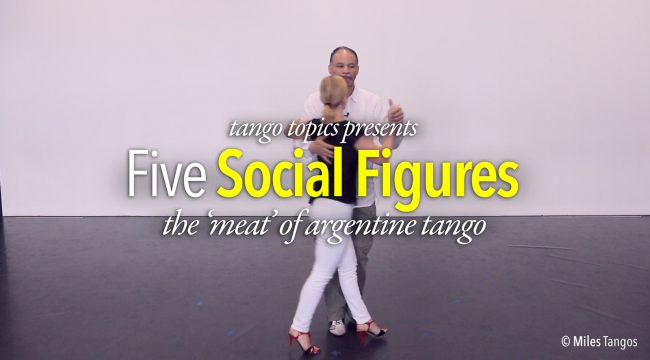
    Five Social Figures

    You’ve been dancing a while, and as you’ve become more and more proficient with the dance, something begins to dawn on you. And this ‘something’ happens for both roles but it’s not immediate. It only happens after you’ve gotten over the learning hump that happens for us all. And then started the refinement hump. It’s near the end of that second phase of the learning curve that this realization occurs. As a side note, not everyone comes to this realization. Some people in fact, never come to it. They’re still stuck in the perpetual cycle of “More IS Better”. Meaning more vocabulary is better. It’s not by the way, but no matter how often you share this stuff with them, no matter how many times you tell them “Less is more”, they can not and will not see that. Uuuuuugh. Assuming that they start the third phase of their development, understanding the music…not learning it, but understanding it, it is generally about this point in time where the realization occurs.

    In case you’re not clear on the Four Phases of Tango Development:

    Phase 1 is Learning the Vocabulary and the Codigos of the Dance for the Milonga Environment.

    Phase 2 is the Refinements of Phase 1, meaning that you’re in a state of constant refinement of the abilities and techniques of the Vocabulary employed.

    Phase 3 is the Musical Understanding of the Dance. This is not learning the music of the dance. That happens in Phases 1 & 2 to a limited degree. And in that case it’s more becoming familiar with the music because it’s played so often, but not really paying a whole lot of attention to it. Phase 3 is where we start to get serious about the orchestras, the structure of the music, the origins of the music, and start to hear the nuances of the music. That last part will go on a long, long, long time even after we’ve passed into the next and last Phase of our development.

    Phase 4 is the Social Dancer is Born.

    To be honest, some people…ok, MOST people skip Phase 3 entirely and graduate to being a Social Dancer without ever having done their musical homework. At the same time Phase 2 (Refinement) and Phase 3 (Musical Understanding) is not necessarily predicated on each other. They can, and sometimes do, happen concurrently with each other, and very rarely does Phase 3 happen in Phase 1. Just as a side note, with our Intensive Study program this actually does happen and quite frequently. They’re not mutually inclusive.

    Today’s Tango Topic is that realization that occurs at near about the end of Phase 2 and/or somewhere in Phase 3. It’s one that we have referenced sporadically in our writings that we’ve sometimes called “Four Common Figures” or “Four Social Dancing Tools” or something very similar. When we stopped and thought about it, it was no longer 4 but in fact 5. It’s really 6, but the 6th is implied and not really a figure, but it’s always there and has a distinct bearing on the other 5!

    So what on earth is this mysterious ‘thing’ that we’ve referenced so sporadically and we haven’t mentioned until this sentence ? Today’s Tango Topic is the title of the video: Five Social Figures.

    What are the Five Social Figures ? In its really basic form, it’s the 5 things that we do all night long with every dance partner. We do these things so often and with such ubiquity that we don’t even consider that we’re doing them or the implications they have for what we’re doing with them, musically or from a floorcraft perspective. The five are detailed below but they are in order of precedence: 1.) Walking. 2.) Ochos. 3.) Turns. 4.) Crosses. & 5.) The Cortado. You can stop reading here, but we can tell you that the vocabulary we just mentioned is kinda barebones and just scratches the surface. And there’s a sort of a gotcha that’s waiting for you near the end of all of this. So you can skip to the end now and read the gotcha, or read on through.

    Why Do You Need This Stuff ? Several reasons. First and foremost, your foundation! Honestly, this should come as a no surprise to you, but if you’re studying with anyone, you’ll notice that they continually take you ‘back’ to 4 simple things: Forward Steps, Side Steps, Back Steps, and your embrace. Because these four things are the foundation of the dance. Embedded in those four things are a host of other things that you are more than likely lacking or you have forgotten about. And it’s those 4 things that are continually screwing up your ability to dance the way you want to dance. So it’s not rocket science what we’re on about here. It’s simple foundational stuff. Which, the deeper you go, you realize isn’t so simple and is in fact far more complex than you thought or you understood. The simpler things appear, the more difficult they are in certain situations, this is one of them. Secondly, this is about understanding your vocabulary and not just from a Leading perspective, but also how it’s received by the Follower, thereby the Follower’s perspective. How it’s understood and why things happen or progress as they do. The issue here is assumptions and lots of them. We want to eradicate those assumptions and make absolutely clear why things happen. And the only way to do that is to remove the assumptions completely. Still, another reason why this stuff is important has everything to do with something that we vehemently and passionately believe in: Facility. Facility, in this case, means the ability to do X, Y, or Z. The Five Social Figures affects your underlying Facility to execute whatever you want to dance, in whatever way or to whatever style or genre of music from a Leading OR Following perspective. It effects Every. Single. Part of the dance! Everything. Facility also means the ability to execute what you desire and WHEN you desire it. Tango vocabulary (Ochos, Crosses, Sacadas, Volcadas, etc) is great, but if you can’t execute that stuff in time to the music, it kinda falls flat. So…ummm yeah, FACILITY! Want one more ? Variations! Let’s roll back the article a bit. Remember we reminded you that you dance the same things over and over and over again ? Dancing Symmetrically opens up loads of options and opportunities for you that more than likely didn’t see. For example: Playing with a Mirror Cross opens up the possibility of leading the Follower to a forward step to the Open Side of the Embrace, which only happens … ummm … NEVER! Gosh, have you thought of what do after that ? Well, here’s an opportunity to do precisely that. Discover the possibilities! And that’s all based on taking that one extra step and resolving differently. There are LOADS more of these things. All of your preconceived notions of what you think the dance is about all changes. And change, whether you believe it or not, is a very good thing. So yeah, you need this stuff.

  • Dancing Symmetrically

    Dancing Symmetrically

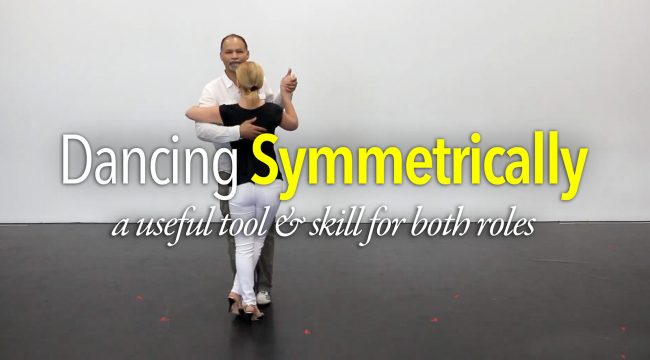
    Today’s Tango Topic is one that has been sitting in the Topics periphery for quite some time. It’s always been one of those topics that once we got through the monster cabal of Tango Topics vocabulary videos, that there would be space and time to dive into what is seemingly a very useless and innocuous topic. A topic that seemingly has nothing to do with the way that you current engage the dance from a vocabulary stand point, or a musical stand point, or from a conceptualization standpoint, or even from a fun position…yes we actually mentioned the word ‘fun‘. We never talk about the level of enjoyment in these things or so it would seem. This is one of those times when the fun-ness factor is rife with what we’re going to suggest today! The actual fact is that today’s topic has everything to do with what you’re doing and how you’re doing it. And while the construct may sound simple, and really dry, and you’ll wonder why on earth you’d do it…doing it on the other hand, not to mention its benefits are far ranging and exceptionally eye opening on multiple levels in ways you can’t even begin to imagine. And the reason it is such an amazing topic has everything to do with a simple thing that has happened to you as a dancer.

    The deeper and deeper you have gotten into Argentine Tango, the more that you come to accept certain things as true, the accepted canon of Argentine Tango. This ‘canon’ is the basis for how you understand the Follower’s Molinete, the Lead’s Giro, the Argentine Cross, the Ocho Cortado, Traveling Ochos, etc., that we tend to think of as ‘Default’ Tango. The things we do all the time – such as the Five Common Social Figures of Tango (See:Five Common Social Figures). Over time we stop listening to other voices or other ideas of how to engage the dance, or how to do X, Y, or Z. There is only X. Most of us become myopic. We only listen to one voice of how things are done: Our own. This becomes the bedrock of our dance, and our dancing experience. We do the same things over and over again, in exactly the same way, with little or no variation. And because no one is giving us any feedback, and/or that we’re not asking for any feedback; nor do we generally know how to do either (See: Giving & Receiving Feedback); nor are we encouraged or inclined to explore beyond that, even and/or until a new dancer that looks interesting shows up that is doing something ‘different‘; nor are we studying privately (for New York Dancers: you should be!). And we settle into a ‘nice’ routine of our staple partners, who again do the same things, the same way, with little or no variation. The same experiences time and time again. Mind you there’s nothing wrong with sameness. However what’s occurred, whether you realize it or not is that your skills have atrophied considerably, and most of that is due to how you see the dance, how you access the dance, and who you dance with regularly. This is what has happened to you.

    Today’s Topic deals with a way to break away from that state and open up a vista that on the surface seems like it’s just X, when in actual fact, it’s the whole alphabet of Argentine Tango! So without further adieu, Tango Topics presents Dancing Symmetrically.

    What is ‘Dancing Symmetrically’ ? There are 3 levels to this idea of Dancing Symmetrically. On the first level it is seemingly all about just turning in one direction more often than another. Nope. We use the example of the Follower’s Molinete/Lead’s Giro structure as the sample piece in that your immediate thinking is that “Oh we’re just turning to the other side in the other direction. I’ve done that. Whatever!“. And that would be a mistake. This concept has far reaching ideas attached to it. More so than just turning in the other direction or starting Traveling Ochos on the Closed Side of the Embrace instead of the Open Side. On the first level it’s about changing directions of how you initiate and dance things. So level 1 is all about the direction things are done in.

    Level two, and this is where things start to bend your conceptions of what you accept as ‘true‘, Dancing Symmetrically changes the common vocabulary of an Argentine Cross and then…Mirrors it! (see video above for an example) There are in fact 256 Types of Argentine Crosses. The Mirror Cross, as it is known, is not only an option of the Cross it’s also a necessary access point to Dancing Symmetrically! How about the the Ocho Cortado ? And if we’re being specific here, and we are, the Linear Ocho Cortado (See: Ocho Cortado) is another access point of the idea of Dancing Symmetrically. So instead of engaging the Ocho Cortado to the Closed side of the embrace, we engage it (as shown) to the Open Side of the Embrace! We showed you this in our video on the Ocho Cortado Options video. These are just two examples of the next layer up of Dancing Symmetrically. On this layer, we are mirroring or reversing not only the vocabulary’s direction but also which sides it can be done on and to. As well as Inverting it, and then Inverting Mirroring it! Level 2 is all about direction AND sides or more appropriately to do something Normally, then to Mirror it, then to Invert it, then to Invert-Mirror it.

    And now we add the 3rd and final level! Reversing the Embrace! Wait! What ? Ummmm WHYYYY??? We’ll get to the why we do this in the sections below. But the end result is that Reversing the Embrace breaks our habits and preconceived notions, and more importantly our assumptions that X is supposed to happen. So that we actually Lead AND Follow what was led! This is Dancing Symmetrically.

    Why Do You Need This Stuff ? Several reasons. First and foremost, your foundation! Honestly this shouldn’t come as a surprise to you, and if you’re studying with anyone, you’ll notice that they continually take you ‘back’ to 4 simple things: Forward Steps, Side Steps, Back Steps, and your embrace. Because these four things are the foundation of the dance. Embedded in those four things are a host of other things that you are more than likely lacking on or have forgotten about. So it’s not rocket science what we’re on about here. It’s simple foundational stuff. Which, the deeper you go, you realize isn’t so simple and is in fact far more complex than you thought or you understood. The simpler things appear, the more difficult they are in certain situations, this is one of them. Secondly, this is about understanding your vocabulary and not just from a Leading perspective, but also how it’s received by the Follower, thereby the Follower’s perspective. How it’s understood and why things happen or progress as they do. The issue here is assumptions, and lots of them. We want to eradicate those assumptions and make absolutely clear why things happen. And the only way to do that is remove the assumptions completely. Still another reason why this stuff is important has everything to do with something that we vehemently and passionately believe in: Facility! Facility in this case means the ability to do X, Y, or Z. This stuff affects your underlying facility to execute whatever you want to dance in whatever way or to whatever style or genre of music from a Leading OR Following perspective. It effects: Every. Single. Part of the dance! Everything. Facility also means the ability execute what you desire and WHEN you desire it. Tango vocabulary (Ochos, Crosses, Sacadas, Volcadas, etc) is great, but if you can’t execute that stuff in time to the music, it kinda falls flat. So…ummm yeah, FACILITY! Want one more ? Variations! Let’s roll back the article a bit. Remember we reminded you that you dance the same things over and over and over again ? Dancing Symmetrically opens up loads of options and opportunities for you that more than likely didn’t see. For example: Playing with a Mirror Cross opens up the possibility of leading the Follower to forward step to the Open Side of the Embrace, which only happens … ummm … NEVER! Gosh, have you thought of what do after that ? Well, here’s an opportunity to do precisely that. Discover the possibilities! And that’s all based on taking that one extra step and resolving differently. There are LOADS more of these things. All of your preconceived notions of what you think the dance is about all changes. And change, whether you believe it or not, is a very good thing. So yeah, you need this stuff.
    Where Can You Find More Information ? Oddly enough you’re in the right place for that. Not to sound like a sales pitch, BUT…. (smile) there are very few places on the web or youtube that show you options and opportunities with regards to Tango vocabulary to expand beyond your Tango horizons. Tango Topics possess a library of over 400+ videos at this point on nearly every imaginable primary topic. So ? Go subscribe, not register, subscribe. The reality is that while a registered user has access to a whole host of free stuff. All the toys of this site are stuck behind a paywall! And the only way around that paywall is to … subscribe. If we may suggest an option: Gold Madness! Click the link and find out more and then start your Tango Exploration today.

  • Close Embrace Sacadas

    Close Embrace Sacadas

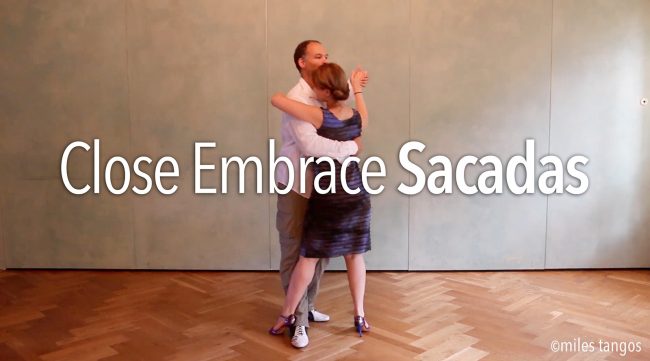
    When we’re first starting out with Tango, both roles see the idea of a sacada as cool, flashy, or impressive. And they are until you realize one simple, but immutable, fact: They’re illusions…of walking technique. The Sacada happens due to an intersection of the Follower’s walk into the Lead’s or vice versa. At the same time, the Sacada is usually relegated to something that is done in open embrace and/or thought of as ’nuevo tango’ vocabulary. You can thank Gustavo Naivera, Fabian Salas, and later on “Chicho” for that one. The Sacada was around long before those three came onto the scene. It just so happens that they made it very popular. One aspect of the Sacada is while they are typically done in open embrace because of the space needed for them and certain variations of them. There is a version of them that is purely for Close Embrace, hence today’s topic: The Close Embrace Sacada!

    What is a Close Embrace Sacada ? It is exactly what it sounds like. It’s a Sacada that’s done from Close Embrace. It’s a controlled displacement where either the Lead or the Follower’s leg will be displaced in a very controlled and refined way. Typically the Close Embrace Sacada is done from the Lead onto the Follower, typically.

    From a Dancing Perspective, the Close Embrace Sacada looks intimate, intricate, and above all else, very hot. No doubt about it. Done right, it screams “WOW”. Done poorly, and well…not so much with that. And that’s exactly what happens most of the time. The intent is there but the execution is poor. So we end up missing the whole effect. Either the intersecting step (lead or follow) was too shallow, too deep, or missed entirely. All of which happen quite frequently. It is only with time and patience, and a lot of practice that we ‘learn’ through trial and error (more error than trial) to execute with precision the a Close Embrace Sacada. To be clear, this variant of Sacadas require precision control, precise intent, and precision execution. To alleviate this problem of precision, you’ll see a lot of Leads (and some Followers) quite honestly watch the feet of themselves and their partners (I make this mistake myself from time to time especially on over-rotated back sacadas). This is a major no-no! It breaks the illusion! This is where we talk about one of my favorite topics that almost no teacher talks about – Proprioception from a Tango Perspective. What’s that ? It’s the ability to sense where your partner is in space and time WITHOUT looking! This is not something that you just learn and it happens. There is no class on this stuff. It is a skill that you build through time, with time, with lots and lots and lots of trial and error. Unfortunately that ‘error’ results in someone’s feet getting bruised sometimes. Trust me, you learn pretty damned quickly after that! Add in Close Embrace Sacadas and this skill is an absolutely necessity! Failure to build this skill and the Close Embrace Sacada is going to be the Close Embrace Bloody and Bruised Toe Extravaganza of Your Worst Nightmares! So how do we develop this skill ? Simple. Stop watching your partner’s feet. That’s the starting point.

    Free Tip: The closer you are, and the tighter the arc of your step around your partner (forward, side, or back), the tighter the resulting Sacada becomes!

    Pre-Requisites: 1.) You must have mastered your walk first and foremost to the point where you are not using your partner (either lead or follow) for stabilization. 2.) You must be familiar with the principles of the Sacada itself. 

    About The Video. This video is 21:45 in length in 9 Sections. Both Lead and Follow technique is co-combined. 

    Overview – 00:58
    Lead Technique Review – 01:05
    Follower Technique Review – 00:48
    Sacadas For Close Embrace Technique – 05:01
    Follower’s Close Embrace Sacada – 03:41
    Follower Forward Step to Lead’s Forward Step – 01:08
    The Other Follower’s Forward Step – 02:05
    Footwork Details – 04:48
    Examples and Review – 01:38

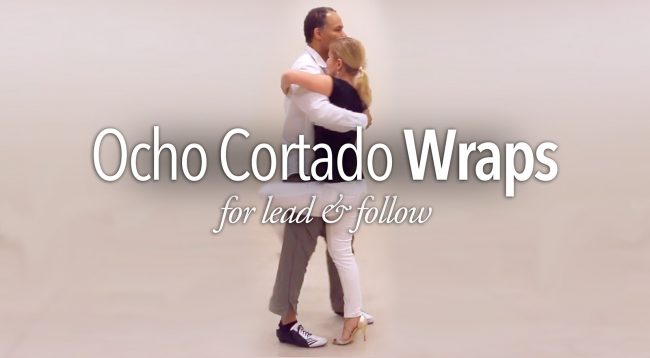
  • Ocho Cortado Wrap

    Ocho Cortado Wrap

    The Linear Ocho Cortado is a venerable piece of tango vocabulary used primarily for cutting turns, adding accents to the ends of musical paragraphs, or just to add a bit more ‘fun’ to the dance. It’s great in open, fabulous in close embrace, and just delish when led and followed slowly. There’s nothing crazier than an Anti-Ocho Cortado (reversing the Cortado, lead doing the follower’s steps & the follower doing the lead’s), while going against the music as counter point. 🙂 However, far too often a fair number of Leads, and a good number of Follower overuse it as if it were going out of style and they just have to get all they can in, before the end of the Ocho Cortado. After about the 3rd time most Followers yawn and yearn for something else, a little nuance, a little spice, a little…something else. While this belief could make most Leads (the person, not the action) cop to the ‘more vocabulary is better’ philosophy that pervades most leading classes, there is another way to go here. And that’s the add nuance. The nuance in this case is today’s Tango Topic: The Ocho Cortado Wrap.

    What is An Ocho Cortado Wrap ? Put simply it’s a Follower’s leg wrap….

    video
    play-rounded-fill

    mixed with an Ocho Cortado (the ‘Cut’ Ocho).

    video
    play-rounded-fill

    To be fair the Ocho Cortado is not really an Ocho, not by any stretch of the imagination, nor is it a broken one at that. It is more akin to the Follower’s Molinete more than anything else.

    What is an Ocho Cortado Wrap ? In it’s simplest form, and there are a few versions of this variation on a theme, it uses the Linear Ocho Cortado’s “Open” Side step as a place for an Enganche or ‘Wrap’ to occur instead of the completion step of the Corrected Cross that we would normally see.

    There are a few benefits to adding a Wrap in this position, one of them is that it allows for variation to occur. More variation instead of the same-ole, same-ole. Furthermore, it also adds a bit of fun for the Follower to engage a really wonderful Wrap or Enganche to the Lead’s invocation. The Wrap component on the side step is not the only possible wrap that’s sitting there. There’s an Enganche on the Follower’s step out of the Side Step. There’s also a Lead Enganche on the step into the Ocho Cortado! Then there’s the reverse Linear Ocho Cortado where the couple would invoke a Linear Ocho Cortado only from the open side of the Embrace. 🙂 There’s also a possible back cross that can occur in either variation as the closing step.

    The Free Tip. The Wrap from the Follower’s perspective is ENTIRELY OPTIONAL, it’s not required. Ever. Meaning ? That the wrap itself is always, always, always, always the Follower’s CHOICE. If they don’t feel safe, or taken care of, then they quite rightfully should not wrap at all, ever. That means no pushing, no pulling, no squeezing, and the invasion of the wrap itself should be just enough to indicate the wrap but not forceful enough to push them into it. They must be given the choice to do it. The wrap itself is entirely learned behavior, this is not something that the Follower is going to do on their own by default. So if you lead it, don’t sit their and expect that it’s magically going to happen. It’s not. There’s a reason why this particular wrap occurs, and you as a lead must create those conditions. And so that we’re absolutely clear here, one of those conditions is not using your arms at all!

    About the Video: This video comes is 21:44 in length in 14 Sections.

    Section 1 – Introduction – 00:00:20
    Section 2 – Ocho Cortado Review – 00:00:48
    Section 3 – Lead Reminders – 00:02:22
    Section 4 – Follower Reminders – 00:03:23
    Section 5 – Ocho Cortado Both Roles – 00:00:23
    Section 6 – The Wrap For Leads – 00:01:33
    Section 7 – The Wrap for Followers – 00:01:42
    Section 8 – Wrap and Cortado Together – 00:01:43
    Section 9 – The Open Embrace Version – 00:00:50
    Section 10 – The Close Embrace Version – 00:01:14
    Section 11 – The Open Side Cortado Wrap – 00:00:40
    Section 12 – Why This ? – 00:01:56
    Section 13 – A Double Wrap – 00:01:53.
    Section 14 – Adding a Lead Gancho – 00:01:19.
    Section 15 – Closing.

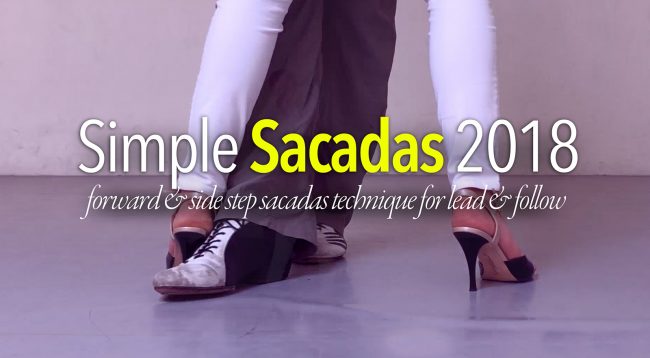
  • Simple Sacadas 2018

    Simple Sacadas 2018

    The Simple Sacada. This video has been in the works for a looooong time. It’s actually taken 4 tries over a 3 year period with 3 different partners to get anywhere close to passing what I had in mind, and it may be revised one more time, but for the time being, this is the final form of what Tango Topics calls a “Simple Sacada”.

    Argentine Tango has many, many different pieces or types of vocabulary (moves, steps, patterns, and figures) that can be developed as a way to express the music in the dance, so that you see the music in visual form. One of those pieces of vocabulary is what we call a “Sacada”. You see them all the time in various forms, and probably because they’ve become commonplace you don’t pay a whole lot of attention to them of if you’re a beginner Lead, and sometimes the beginner Follower, you look at them and think “OMG that’s complicated!”. The visual of what you’re looking at is seemingly so fast, and so intricate that it just blows your mind. Today’s Tango Topic deals with what some consider to be the very first piece of vocabulary after the 7 Basic Moves of Tango. It’s the first real, seemingly intricate and complex (it’s not) tango move that we’re taught as a way to augment our dance.

    So without further yapping :-), Tango Topics presents: The Simple Sacada.

    What is a Sacada ? First, a Sacada consists of a walking step that just so happens to intersect with your partner’s walking step at the same time that they’re stepping forward, side, or back. Secondly and this part you have to keep in the back of your mind: It’s an illusion. An illusion of walking, an illusion of technique, and an illusion of execution. To put it simply the Sacada is really just a walking illusion that intersects with someone else’s walk. And that’s the part that most people are confused by. What they see is the illusion, and try to re-create the illusion instead of focusing on the part that will actually help them to get to the root of the Sacada, the walking part! Which is to say that people focus on the flash and not the substance! It’s just a step forward and side (and sometimes back, but not in Today’s Tango Topic), which is going cut through, and step very close to someone else’s step which results in a displacement of someone’s leg. The hard part for most people is the timing of that displacement, not to mention where that displacement goes. Speaking of ‘displacements’ the Sacada is in the family of Tango vocabulary that are called ‘displacements‘, and that’s because of two factors that occur: 1.) Because whoever is initiating the Sacada will take the place of the one who is receiving the Sacada. You are displacing, and sometimes being displaced. And 2.) The one who is receiving the Sacada will displace their free leg as a result of the intersection of the walk. Further down the rabbit hole, the Sacada is one of the 4 common Displacements that Tango Topics talks about which are: 1.) The Sacada. 2.) Ganchos. 3.) Boleos. 4.) Enganches or what is commonly known as an Argentine Wrap!

    And just for your further edification because some people ask the question “How many types of Sacadas are there ?”. Answer: There are 22 Types of Sacadas, and a total of 501 variations of those 22 Types. And yes we have done the math, and it comes out to 501. The types, just in case you hadn’t thought about it, but we have, are as follows:

    1.) Forward Sacadas (from Linear, Circular, or Over-Rotated Ochos) in Parallel & Cross System.
    2.) Side Sacadas (from a Curved Side Step) in Parallel & Cross System.
    3.) Back Sacadas (from Back step, or Circular or Over-Rotated Ochos) in Parallel & Cross System.
    4.) Linear Sacadas (from a Linear Side Step, or Linear Forward Step) in Parallel & Cross System.
    5.) Chained Sacadas (Think: Cadenas) In Parallel & Cross System.
    6.) Walking Displacement Sacadas in Parallel & Cross System.
    7.) Multiple Forward/Side/Back Sacadas in Parallel & Cross System.
    8.) Multiple Alternate A (same foot) Sacadas (You’ll see an example of this in the Forward Sacadas section).
    9.) Molinete Sacadas (from the Follower’s Molinete, The Lead’s Molinete, and/or the Anti-Molinete).
    10.) Orientation Change Sacadas (See the Anti-Molinete, and/or the American Embrace).
    11.) Two Footed Sacadas (jump into the sacada).

    That’s 11 Types of Sacadas, and each role can perform these, so we end up with 22 Types of Sacadas. Now there are even further variations on a theme of these ideas where you can theoretically mix and match any one of these ideas with another on the list and create a hybrid of the two. However, it was late and we’d already gone through 1002 possibilities and then someone mentioned the concept of Tango Topology and that just blew everything out of the water by halving everything and so we stopped counting there … so 501, and 22 types is enough for one lifetime. 🙂

    Now to the ‘Simple‘ Part. What makes it ‘Simple‘ ? The fact that we’re limiting the Sacada to two of the three basic walking steps: 1.) Side Steps. 2.) Forward Steps. The Sidestep is the more common of the two Sacadas, not the Forward. Usually, in order of precedence, it’s a.) The Lead Sacadas the Follower’s Side Step. b.) The Lead Sacadas Follower’s Forward step. c.)The Follower Sacadas the Lead’s Sidestep, and finally, d.) The Follower Sacadas the Lead’s Forward step.

    The Free Tip.  Your free tip for today is that the Simple Sacada is quite possibly the gateway drug to other, more complex pieces of vocabulary. With that in mind, it is an imperative that before you try this stuff that your walking technique and in specific how you place your foot on the floor be absolutely clear and clean. You want, from a leading or Following perspective to articulate your feet. That articulation creates a desirable visual relationship that we’re looking for. Versus the sloppy entrance that happens soooo often:

    Plays from YouTube. Pressing play connects you to YouTube. Privacy

    About The Video. This video is 31m:39s in length in 14 sections. Both lead and follower technique are combined and integrated into the video. Bold items below shown in video sample video above.

    Introduction – 00:02:32
    Follower Technique – 00:02:11
    Lead Technique – 00:01:35
    Sacada Clarity – 00:00:36
    The Lead’s First Sacada  – 00:02:06
    The Follower’s First Sacada
    Parallel & Cross System Sacadas – 00:03:03
    Close-up Sacada – 00:00:32
    Follower Forward Step Sacadas – 00:03:03
    Lead Forward Step Sacadas – 00:01:46
    Multiple Forward Step Sacadas – 00:02:35
    Close Embrace Simple sacadas – 00:05:38
    The Close Embrace Exercise with Sacadas – 00:03:26
    Simple Sacadas from the Follower’s Molinete/End – 00:01:38

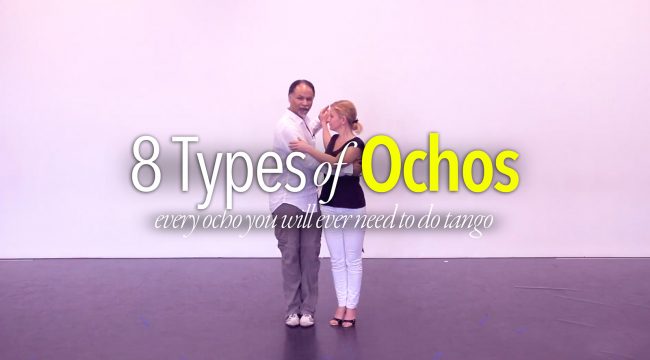
  • Eight Types of Ochos

    Eight Types of Ochos

    Argentine Tango consists of many ways to interpret it’s musical component through movement. One of those movements is called an “Ocho” which when you translate it from the original Spanish into English means “Eight”. The “Eight”, in this case, refers not a number but to a shape that is created by the Dancer’s feet (typically by the Follower, but as you will soon see it can be done by the Lead as well) on the floor when they’re led to do so.

    The Ocho is one of the 7 Basic Moves of Tango Vocabulary (see link) that is used in nearly every dance by every dancer at every Milonga in the world. It is almost as ubiquitous as the Argentine Cross in this respect. So much so that one may lead or follow an Ocho and not even be aware that they’re doing it. The movement is taught as one of the very first things we learn aside from walking. While one’s walk is insanely important, the application of the Ocho is almost, if not as, equally important for both roles. From a Leading perspective, it’s one of the ways that we can create a navigational structure & generate navigational options. We can use the Ocho to interpret the music and to generate musical structure from it. And it also has the obvious ability that allows to use it as filler content until we’re ready to do something else that may lead up to something else. From a Following perspective, it is one of the very first things we are taught to master and must become facile with because our very tango lives depend on it for a whole host of reasons which will become obvious later on down the line.

    That said, let’s take a deep dive into the 8 Types of Ochos for Argentine Tango.

    What is an Ocho ? In it’s simplest form and right up to its most complex form The Argentine Ocho is a learned, and generated motion. Meaning ? That the Ocho is not a natural construct. It is something must be learned and then mastered by both roles, not just by one.

    The Ocho is powered by 1 of 3 types of “Engines of Motion”:

    1.) Crossing Meridian Technique.
    2.) Disassociation/Applied Disassociation Technique. Or
    3.) A Body ‘Pivot’ Technique.

    Each one of these techniques can generate no bodily rotation motion, some bodily rotation motion, or an enormous amount of bodily rotation motion at the point of Social Collection. Where, depending on the type of desired Ocho, that no body rotation or some body rotation will be done at very specific angles (0, 45, 90, or 180 or more degrees) where the dancers’ feet will rotate and body either with or against their dancing partner’s motion. In all but one type of Ocho the dancer (Lead or Follower) will step forwards or backward thereby setting up the next Ocho movement. However, and there’s always a however to these things, there is one type of Ocho where the dancer does not step forward or back but instead changes their weight from one foot to the other and then employs one of the 3 techniques above and does this repeatedly in time to the music.

    It should be noted that the Argentine Ocho in all 8 varieties listed below all invoke Cross-System walking using either Step Half-Step or a Weight-Change Step, or a Cross Behind (not shown in the video) to get into and out of them. If you’re not familiar with this terminology please see their respective links to dive deeper into getting into Cross-System.

    Put simpler: The Ocho is where the dancer (lead or follower) steps into Social Collection with their feet, and then assuming one of the 3 techniques above is used to generate bodily rotation that seemingly starts at the feet, and goes all the way up the body. Seemingly. 😉  The reason the Ocho is called an Ocho as was mentioned before, that the dancer will create a pattern on the floor with their feet, that resembles the number 8. However, over the last few decades, the floor pattern isn’t really adhered to, but instead it’s more a straight, curved line or an arc, with a point on either end of the arc. That point on either end, is where a body rotation can occur, or a point of transition occurs using one of the 3 techniques described above.

    This is an Argentine Ocho

    Notation: When the “What is … ” section of an article is blue, that means that the article is freely available to registered, users. When the section is yellow, the article is still free, but the video is for paid users. 😉 

    What are the Different Types of Ochos ?

    Type 1 – The “Milonguero” Style or “Lazy”  (starts at: 00:03:14) Ocho. In this Ocho, the Follower (usually), is led to stepping in a diagonal 45-degree angle across their natural body meridian thereby engaging in the 1st Engine of Motion. The Follower does not rotate their hips in any way, shape, or form, nor do they need to do so either. Their legs will cross over their natural body meridian in a walking step to do perform the “Lazy” Ocho. The Lead can also self-lead themselves to do this same motion going backward down the line of dance. This Ocho is ideal for small space dancing and it is ideal for the Encuentro environment. The reason it is called a Milonguero or Lazy Ocho is because in this instance the Follower is emulating minimal body movement of the Milonguero style of dance that emulates a Walk. It’s just that this walk crosses over the body’s natural meridian. Of the 8 types of Ochos, it is by far the easiest to do and the most effortless to dance.

    Type 2 – The “Linear” Ocho. (starts at: 00:10:07) In this Ocho, the dancer is led (the Follower) or self-led (the Lead) to using the 2nd Engine of Motion: Disassociation and then Applied Disassociation to self-rotate, due to torsion build up and release. As a result of this type of engine, the dancer rotates to a 90-degree angle perpendicular to their partner, which then can result in either a forward or backward walking linear step on two separate but equal walking tracks. This position is also where the Ocho gets its name from because the Dancer is literally transitioning in front of their dancing partner over a line or a linear space directly perpendicular to their partner. It should be noted that the dancer can employ the 3rd Engine of Motion: A Pivot but it is not desirable to do so. The Linear Ocho can be done from Open or Close Embrace, however it’s typically done from Open Embrace or a Fluid Embrace, as the Close Embrace version of the Linear Ocho can be stressful or uncomfortable due to the fact of some people may want to use arm tension, hand/forearm pressure, compression, and/or resistance in the embrace to generate it. None of that is required. The build-up of Bodily Rotation Torsion via Disassociation, and then the release of that Torsion as Applied Disassociation is what generates the bodily rotation. Primarily the Linear Ocho is used as a teaching tool for both roles to instruct, and then practice, dancer Disassociation and Applied Disassociation. Once learned, Linear Ochos can be employed as a ‘Filler’, or as a navigational tool, or it can be used as an intro that leads into either a series of Sacadas or the opening step to a whole host of vocabulary. “Filler” in the sense that it can be used as some vocabulary to lead into something else or when you’re stuck from a leading perspective. It should be noted that while it’s only hinted at in the video above, the Disassociation and Applied Disassociation element is insanely important. 😉 It is what ‘powers’ all the ochos in this series with the exception of Type 1 and Type 7.

    Type 3 – The “Traveling” Ocho. (starts at: 00:12:55) This Ocho is called a “Traveling” Ocho because it Travels down the line of dance. It is the Ocho that everyone thinks of when they hear the word “Ocho”. Typically this Ocho is done by the Follower, however, a Lead can self-lead themselves to engage in a Traveling Ocho as well (going backward down the line of dance). These can be done in Open Embrace, or Close Embrace, however, predominantly see them done in Close Embrace. Ideally, the Traveling Ocho employs the 2nd Engine of Motion thereby resulting in a 45-degree body rotation to create the desired ‘Traveling’ Ocho. Traveling Ochos can be done with Forward steps or Back Steps, and while the Forward Traveling Ocho requires the Lead to walk backward down the line of dance to do engage in it, the Forward Traveling Ocho is a lot of fun and add a lot of variety to the dance. Not to mention it also opens up lots of other options and opportunities to do other things that you wouldn’t ordinarily see. Traveling Ochos have a few built-flaws to them from a Leading Perspective that are discussed below in the Leading Perspective section. The Traveling Ocho is typically the ‘goto’ Ocho in all environments for a wide variety of reasons, mostly because the other 7 Ochos on this list aren’t taught all that often! Sadly. It should be noted that the dancer could employ the 3rd Engine of Motion: A Pivot but it is not desirable to do so.

    Type 4 – The “Circular” Ocho. (starts at: 00:17:35) The name for this Ocho is a bit of a misnomer because we’re not actually generating a circle but more of an arc around the dancing partner. So rightfully it should be titled, the “Arced Ocho”, but that’s awkward, so we’re sticking with Circular. 😉 The Circular Ocho can be done from Open and Close Embrace, and typically employs the 2nd Engine of Motion, where the dancing partner will rotate 180 degrees on either end point of the walking Arc. Typically this Ocho is done from a standing position. And more often than not it is used primarily as the opening step to the Follower’s Molinete to the Lead’s Giro. The Ocho itself is not really used as a dancing element over and over again, but rather as a singular element to do something else like engaging the Follower’s Molinete, or any one of 12 types of Ganchos, or a series of Paradas, or changes of direction. It is generally not used as a navigational element either primarily because of its awkward embrace nature (see Linear Ochos). Circular Ochos also have a built-in flaw that is discussed below in the Leading perspective section. Notation: The dancer could use the 3rd Engine of Motion but it is not desirable to do so!

    THERE ARE 4 MORE OCHOS

    You can’t see them because you’re not a subscriber

  • Gooey Ganchos

    Gooey Ganchos

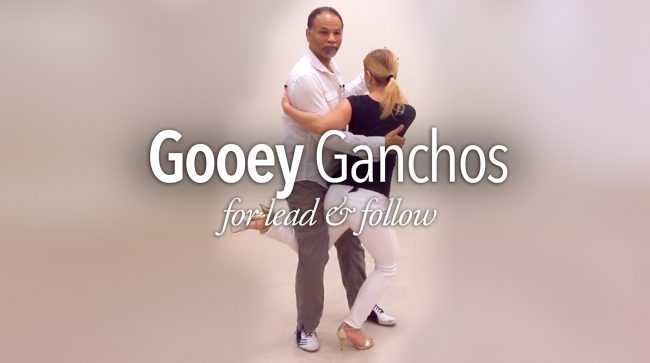
    The are multiple varieties of Ganchos. We have explored the 4 most common ones, today we’re exploring a variant of the idea known as the ‘Gooey’ Gancho. Specifically what makes it ‘Gooey’ and how does it get it’s name. The reason this variety of Gancho is called ‘Gooey’ has everything to do with the speed of the Gancho itself, but it also has to do with the choice of the Gancho in certain respects, as you’ll see. That said, let’s talk about ‘Gooey’ Ganchos.

    What is a Gancho ? In it’s simplest form, in the modern vernacular of Tango, it is a hooking of the free leg around your partner’s leg or thigh. It is an interruption of the extension phase of the step, which can (not always) result in the lifting of the respondent’s leg either as a result of, or by deliberate intention.

    What is a ‘Gooey’ Gancho is a variety of Gancho that is usually executed from either the Follower’s or Lead’s position. It is a slow-motion Gancho, and in particular the ‘Launching’ leg of the dancer who is being “Gancho’d”. Everything prior to the Gancho happening is not the ‘Gooey’ part. The ‘Gooey’ part comes when the leg that is being lifted moves to engage the hooking action of the Gancho in a very slow, but very deliberate way. Very slow. 🙂 Hence the ‘Gooey’ part. 

    About The Video. This video is 22:09 in length in 10 Sections. Lead and Follow technique is combined. 

    Section 1 – Introduction – 00:00:35
    Section 2 – Gooey Gancho Setup – 00:02:33
    Section 3 – Possible Follower Exits – 00:02:45
    Section 4 – Rotational Gooey Gancho – 00:03:25
    Section 5 – Review – 00:01:31
    Section 6 – The Missing Gooey Gancho – 00:03:51
    Section 7 – Employing The ‘Launch’ Aspect – 00:02:00
    Section 8 – The ‘Right’ Way – 00:01:12
    Section 9 – The Real ‘Gooey’ Part – 00:02:20
    Section 10 – Closing – 00:01:25

Hide picture