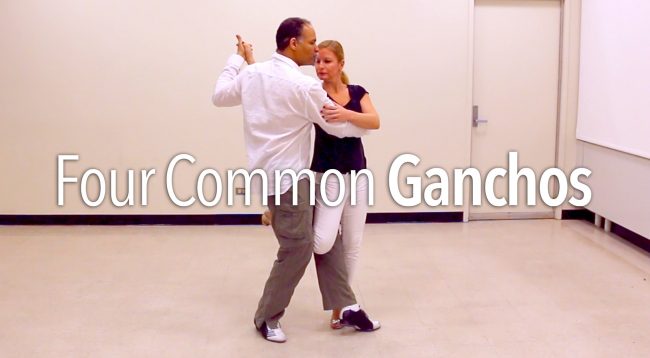
Gancho. The word in Spanish translates to the English word, roughly, as ‘Hook’. From an Argentine Tango perspective, it has a very specific meaning. You’ve seen these things hundreds of times, and while the vocabulary itself has a connotation as being somewhat ‘cheesy’, and only done by beginner leads who don’t know any better, the reality is a that it is a venerable piece of Tango vocabulary that do have a valid place off the main trunk of the Tango history tree. The story goes that while the Gancho existed long before Norberto “El Pulpo” Esbrez came along, his contribution to its storied history is where creativity meets innovation, specifically with regards to ‘elasticity’ and the Enganche. He is/was credited with pioneering and exploration the ‘invasion’ of the standing leg, the response of the free leg, as well as the space in between the opening of a step, and quite factually (if not literally), the intersection of these ideas.
What is a Gancho ? In it’s simplest form, in the modern vernacular of Tango, it is a hooking of the free leg around your partner’s leg or thigh. It is an interruption of the extension phase of the step, which can (not always) result in the lifting of the respondent’s leg either as a result of, or by deliberate intention.
Today’s Tango Topic deals with just Four of the most CommonGanchos and a few of their issues that happen for both roles. While there are many, many, many types of Ganchos to explore and play with, these 4 only scratch the dancing surface of them. They are the foundation for nearly every other Gancho that comes after them. The Rotating Gancho, the Gooey Gancho series, the Follower Gancho series, the Ganchito (which is an itty-bitty Gancho), the Lead Gancho series, the Volcada Gancho, just to name a few, owe their foundation to the Four Common Ganchos in Parallel and Cross System.
The Free Tip. In all 4 of these Ganchos, for the Lead, you want your heel of the ‘free’ leg to be off the Floor. There should be no weight on it. Ever. From a Following perspective, sometimes you’re going to feel this desire to bend backwards, and you can’t.
About The Video.This video package comes in at 49m:29s in length in 8 Sections. What you’re seeing above is only the introduction to the topic before we dive into the topics below. The one you probably want to see is #6 as it contains all 4 of the Ganchos. However, the rest of the videos make that last video possible. They’re all about set up, proper technique, and really the underlying method of how a Gancho works and where things can go terribly wrong, and how to correct for it.
Section 1 – Introduction – 00:07:13 Section 2 – Lead Technique – 00:04:01 Section 3 – Follower Technique – 00:05:38 Section 4 – Free Leg Launch – 00:05:13 Section 5 – Gancho Exercise – 00:05:35 Section 6 – Gancho Set up – 00:06:42 Section 7 – Four Common Ganchos – 00:19:27 Section 8 – Gancho Closeups – 00:15:17
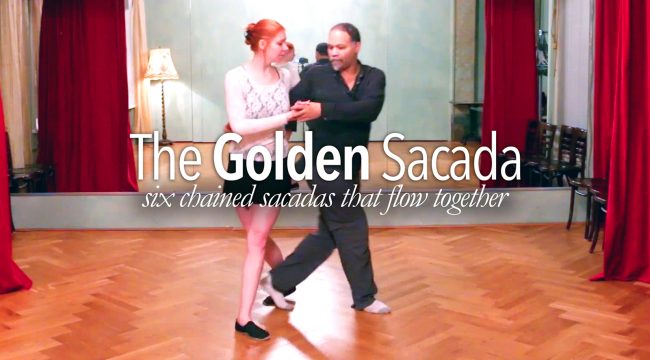
TheGolden Sacada. The Sacada has been discussed here before, so we will not waste your time with rehashing what has been said before except to say that Tango Topics has an extensive archive on the subject. That said, there’s one ‘figure’ that you will rightfully confuse as a figure when in fact it’s something else entirely. And the reason that it’s confusing is that most people see the figure and not the construct that makes it up. Any figure that is derived in Tango can be made up of it’s component elements. Which, when you boil it down, is all about 3 steps: Forward, Side, and Back. Tango Topics likes to teach this particular idea for a variety of reasons, not the least of which is that helps to address several issues that comes up for Leads as well as for Followers. And that’s the “Chained” or Multiple Sacada idea. Which is, in case you’re unclear, a series of Sacadas that flow from one Sacada idea to the next. So without further yapping :-), we give you The Golden Sacada.
What is a Golden Sacada ? The Golden Sacada consists of 6 Sacadas that when placed together create the illusion of them being a ‘figure’ when in fact it’s actually a series of Sacadas that are chained together, or a Chained Sacada that flows quite nicely from one Sacada idea to the next. The reason we call this The ‘Golden‘ Sacada, is that it contains 4 of the 6 most common Sacadas that we’ll use when we dance. The last 2 of the 5 Sacadas are uncommon but do allow for some interesting options and opportunities.
Pre-Requisites: So that we’re all clear on this part, note the difficulty rating below, it is not an exaggeration! Do not attempt this stuff unless the following is true: You have mastered 1a.) your walk. 1b.) your stability. and 1c.) your equilibrium. If you need to stabilize yourself against your partner when walking, if you need to use your hands or arms in any level of tactile compression, if you need are in the habit of watching your partner’s feet, if you are used to using resistance – compression – rigidity – tension – or force to engage your ideas, then The Golden Sacada will be exceptionally challenging for you. Next, you have complete and incremental control over 2a.) Disassociation, and 2b.) Applied Disassociation. Lastly you have mastered precise and detailed levels of Proprioception. These skills are absolutely crucial to the success of The Golden Sacada.
The Free Tip. So the most notable reason why your hips are too close ? This has everything to do with the angle of the 1st Sacada, if it’s too shallow or too oblique, your entry into 2nd sacada will FAIL!
About The Video. This video is 25m:30s in length in 12 sections. Both lead and follower technique are combined and integrated into the video.
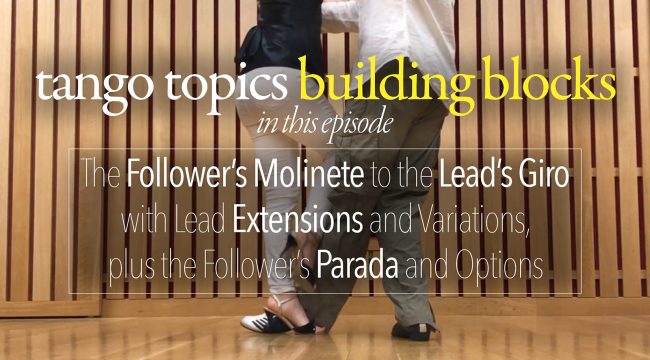
In Today’s Building Block Episode (#1) we have three pieces of tango vocabulary that are used frequently in most people’s dance:
1.) The Follower’s Molinete to the Lead’s Giro. 2.) Lead Extensions (sometimes called “projections”), and 3.) The Follower’s Parada with a few variations on a theme. 😉
However, most times we don’t combine them or put them into useful musical expressions. They’re used to get us from point a. to point b. The first of these elements is so ubiquitous that most people don’t even realize they’re employing them. The second gets used with some frequency as an accent idea. And the last one does get used a fair amount and on the scale of execution its difficulty can create a bit of an issue here and there. So it’s a good idea to go look at the foundational and individual technique item for each of the pieces mentioned above to review these items. Today’s Building Block episode discusses these ideas in relation to your dancing experience and creates options and opportunities that you wouldn’t ordinarily think of. The video above is a very, very, very small snippet of what’s present in the Buiding Block.
That said, let’s dive into Today’s Tango Building Block.
What is a Tango Building Block ? In many ways, Tango is a lot like a set of Lego™ Building Blocks. With just a few simple blocks you can build very complex and intricate structures. Tango is the same way. With just a few basic moves like forward, side, and back you can build very complex movements that can later be applied in very different ways. That’s what makes Tango so amazing. It’s never the same dance twice even with the same partner and the same music!
A Tango Topic Building Block goes one step further. This isn’t just about showing you a move or a step, pattern, or figure but giving you tools that you can integrate into your dance immediately. Ideas that you hadn’t even thought of or considered.
Frequently when we dance, we get very ‘stuck’ in our repetition of the same piece of vocabulary over and over and over again. This series is designed to give you ideas, options, and opportunities to employ differences to add a bit of spice to your dance using very simple ideas.
Let’s get something out of the way going further: This video series and everything in that follows is not a step, pattern, or figure video series. We’re not going to teach you a series of patterns. We believe that steps don’t really help you. Tango, for lack of a better way of putting it, is a dance that is choreographed on the fly, meaning that it is improvised. While that improvisation has some elements to it that are common (the building blocks) how you put those elements together is where the real artistry is at. Put another way, the dance is not ‘canned’, meaning that it is mapped out precisely in time to the music as though you would choreograph a ballet. That would be a performance. What Tango Topics is offering you is a way to expand your dancing repertoire using the vocabulary you already know today, in ways you hadn’t really thought of, and more importantly for use on a social dance floor.
A Few Options:
1.) Linear Forward Ochos with Lead Extensions. 2.) A Lead Back Step Parada and a Lead Bolito! (if you were a subscriber, you’d actually see this one here instead of this annoying notice) 3.) Anti Molinete with Lead Extensions!
However without examples, and without the visuals on the page to help you with these ideas then that’s all they’ll ever be — words on the page!
About The Video. This video is 3 sections and when combined create a singular viewing experience of 44m:33s. Part 1 (19:08) – Explains the 3 pieces of vocabulary with options and variations. Part 2 (19:46) is with a Metronome to show you how some of these ideas can be set to a time signature. And part 3 (05:43) is with a piece of music. There is no Technique discussed in the video. For technique please visit the individual topics.
Part 1 – Explanation (00:19:08) Introduction – 00:00:30 Follower’s Molinete to Lead’s Giro – 00:05:09 Lead Extensions – 00:02:31 Lead Extensions/Lead Bolitos – 00:01:28 Follower’s Parada – 00:03:27 Building Block Ideas w/Traveling Ochos – 00:01:11 w/Parallel Molinete – 00:01:51 w/Lead Extensions – 00:00:59 w/Lead Bolitos – 00:01:37
Part 2 – Metronome Tools. (00:19:46) Introduction & Tools – 00:04:54 Traveling Ochos Lead in – 00:05:26 Lead Extensions w/Molinete from Traveling Ochos – 00:01:45 Lead Bolitos w/Molinete from Traveling Ochos – 00:01:28 Follower’s Molinete w/Follower’s Parada – 00:03:19 Argentine Cross w/Follower’s Parada – 00:02:31
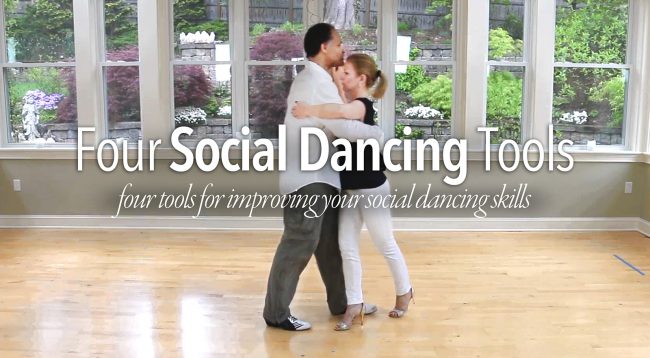
Argentine Tango consists of 3 steps, and only 3 steps: Your Left and Your Right. The 3rd is the Weight Change! 🙂 Another way that people talk about Tango’s steps is to say that the there are only 3 steps: Forward, Side, and Back. Either way you look at it, at some point, usually with the music, the dancers move from position to position via some kind of walking. The are 2 common walking systems in Argentine Tango: 1.) Parallel System Walking and 2.) Cross System Walking. In Parallel Walking, which is sometimes referred to as “Opposite Foot” walking, whereby the Lead steps into the Follower’s Walking paths with the Opposite Foot. For instance if the Lead steps with their Left, the Follower will extend with their Right, and so on. As Tango has grown, developed, and changed, while Parallel system is used as a good tool to get people up and dancing, the star of the show has always been Cross System Walking and Vocabulary. In today’s topic we’re talking about 4 Common Social Dancing Tools that use Parallel Walking as the entry point and NOT Cross System. Meaning ? We’ll start out using Parallel Walking system and then focus on the Transition point on the way to Four very common pieces of Tango vocabulary. So without further adieu, Tango Topics presents the Four Social Dancing Tools.
What are the ‘Four Social Dancing Tools’ ? First, what is a ‘tool’ as we’re defining it here ? A tool is a commonly used element that, and really it’s a transition from one thing to the next, that we use ubiquitously and don’t really pay a lot of attention to because it’s a stepping stone to the really cool thing we have in our minds. This is a tool. It’s the thing we use to make something else. Think of it as a Foundation, or a maker tool. A tool to make other things. And in this case, the Four Social Dancing Tools are maker tools with lots and lots and lots of variation built into them. 😉
These tools are the meat and potatoes of Social Dancing on the whole. While the cool vocabulary (think: Colgada, Volcada, Sacada, Gancho, Boleo, etc) is … ummmm … flashy, this stuff, the Four Social Dancing Tools that are sitting around them, or leading up to them and from them, is where the entire dance is at. Think of it this way, if you remove all the cool, flashy vocab from your dance, what’s left ? The Four Social Dancing Tools!
At the same time, those Four Social Dancing Tools, are really about the Transition points between going from Parallel Walking System to Cross System, most of the time. It should be noted that the Transition point is usually a point of inflection for a lot of dancers. Meaning ? It’s the point where most people have issues. By example the transition is usually where an in/experienced Lead will do one of several things, if not altogether, to get from point a to point b. 1.) They’ll compress the embrace (squeeze their Followers into them with their right forearm to hold them in place or to keep them close). 2.) They’ll rush their Followers and push them from position to position. 3.) They’ll haphazardly invoke leads to do X, Y, and Z, and not complete or follow through on the vocabulary, thinking that the Follower will just ‘get it’ and complete the half-thought that was invoked.
The Four Social Dancing Tools are:
Type 1: Parallel Walking > Milonguero Ochos Type 2: Parallel Walking > Milonguero Turns Type 3: Parallel Walking > Traveling Ochos Type 4: Parallel Walking > Follower’s Molinete
Why Do You Need This Stuff ? Foundation, Foundation, Foundation. That’s why. Or put another way, because these tools work the foundation in a really good way, by breaking them down to their component elements. No one wants to admit that they need help. That their dance isn’t stellar. Furthermore you really don’t know that your dancing skills aren’t absolutely amazing until you see a room full of people all dancing way better than you are. There’s a reason those people have achieved ‘better’. It’s doing work like what you see in the video above. Being able to turn this stuff on and off as if it were a switch. A good portion of the time when we’re dancing we only think about the ‘cool’ toys in our dancing and we neglect the one thing that makes those cool toys possible: Our Foundation. That is, in case you’re not paying attention, this video series and others like it. By employing these four commonly used social dancing elements as your Foundation we work on the underlying elements as well, trying to make them cleaner, sharper, crisper, and that much more fluid. This isn’t about perfection, so get that thought right out of your head, but rather about making our dance flow more freely. There’s knowing the steps of a sequence, and then there’s dancing, and these are not the same things. You can know the steps, but dancing is a whole different thing. These four things can help with that process of ‘dancing’. Dancing does not happen on it’s own. It takes years of practice to create the seamless, flow, and fluidity that you see some dancers exhibit. Seemingly creating something out of nothing and wondering how that was done. These Four Social Dancing Tools are how that was done. By focusing on the foundational elements in each! So if you want your dance to improve, it’s not the fancy vocabulary. It’s make the stuff that surrounds it stellar! This is that ‘stuff’ that surrounds the fancy vocab!
About The Video. This video comes in a combined 50m:37s in length in 4 sections. There is no Lead or Follower Technique explained in this video at all.
Type 1: Parallel Walking > Milonguero Ochos (00:12:33) Type 2: Parallel Walking > Milonguero Turns (00:13:55) Type 3: Parallel Walking > Traveling Ochos (00:12:42) Type 4: Parallel Walking > Follower’s Molinete (00:11:27)
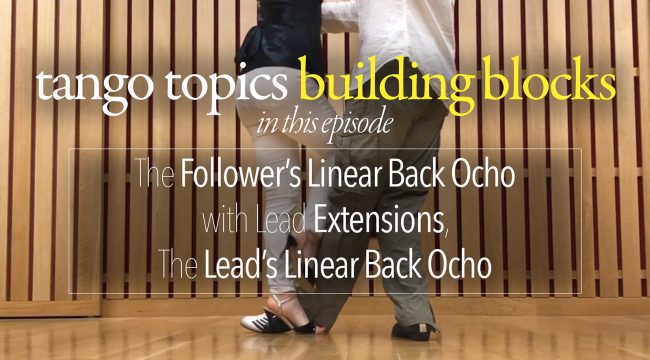
In Today’s Building Block Episode (#2) we have three pieces of tango vocabulary that are used frequently in most people’s dance:
1.) Follower Linear Back Ochos. 2.) Lead Extensions (sometimes called “projections”). and 3.) Lead Linear Back Ochos.
The first of these elements is used so often that most people don’t even realize they’re employing them. The second gets used with some frequency as accent idea. And the last one does not even get a thought because most Leads never even conceive of it. Today’s Building Block episode discusses these ideas in relation to your dancing experience.
Let’s get something out of the way almost immediately: This video series and everything in that follows is not a steps/patterns/figures video series. We believe that these things have their place but in the long run, they don’t really help you to become a better dancer. While the choreography removes the worry of wondering what to do next. The problem with learning choreography is that it is the same dance constantly with little variation! Tango is an improvisational dance. So it’s important to explore how to improvise, and more importantly WHAT to improvise with. What Tango Topics is offering you in this video is a way to expand your dancing repertoire using the vocabulary you already know today, in ways you hadn’t really thought of, and more importantly for use on a social dance floor.
That said, let’s dive into Today’s Tango Building Block.
What is a Tango Building Block ? In many ways, Tango is a lot like a set of Lego™ Building Blocks. With just a few simple blocks you can build very complex and intricate structures. Tango is the same way. With just a few basic moves like forward, side, and back you can build very complex movements that can later be applied in very different ways. That’s what makes Tango so amazing. It’s never the same dance twice even with the same partner and the same music!
A Tango Topic Building Block goes one step further. This isn’t just about showing you a move or a step, pattern, or figure but giving you tools that you can integrate into your dance immediately. Ideas that you hadn’t even thought of or considered.
Frequently when we dance, we get very ‘stuck’ in our repetition of the same piece of vocabulary over and over and over again. This series is designed to give you ideas, options, and opportunities to employ differences to add a bit of spice to your dance using very simple ideas.
Let’s get something out of the way going further: This video series and everything in that follows is not a step, pattern, or figure video series. We’re not going to teach you a series of patterns. We believe that steps don’t really help you. Tango, for lack of a better way of putting it, is a dance that is choreographed on the fly, meaning that it is improvised. While that improvisation has some elements to it that are common (the building blocks) how you put those elements together is where the real artistry is at. Put another way, the dance is not ‘canned’, meaning that it is mapped out precisely in time to the music as though you would choreograph a ballet. That would be a performance. What Tango Topics is offering you is a way to expand your dancing repertoire using the vocabulary you already know today, in ways you hadn’t really thought of, and more importantly for use on a social dance floor.
A Few Options. Here’s a few more ideas of what you would see if you were an actual subscriber to this page, something for you to think about not so that you’ll subscribe but so that you can think about adding it to your own dance:
1.) Linear Forward Ochos for Both Roles! 2.) Calesitas into Walks for Both Roles, Molinetes for Both Roles. 3.) Anti Ochos!
However without examples, and without the visuals on the page to help you with these ideas then that’s all they’ll ever be words on the page.
About The Video. This video is 3 sections and when combined create a singular viewing experience of 44m:11s.
Part 1 (19:37) – Explains the 3 pieces of vocabulary with options and variations. Part 2 (12:57) is with a Metronome to show you how some of these ideas can be set to a time signature. And part 3 (11:37) is with a piece of music. There is no Technique discussed in the video.
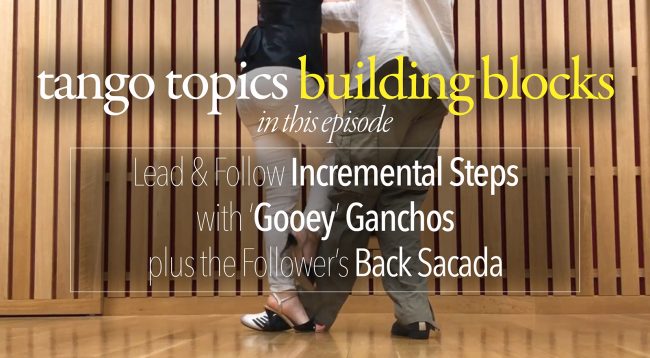
In Today’s Building Block Episode (#3) we have three pieces of tango vocabulary that are used:
1.) Lead & Follow Incremental Steps 2.) The ‘Gooey’ Gancho 3.) The Follower’s Back Sacada.
The first of these elements is used, sparingly, but not as much as they should be. It is probably one of the more musical items that either a Lead or a Follower can engage in that clearly and decisively ‘Interprets’ the Music from their perspective. (Please note the usage of the phrase ‘Interprets the Music’. This is in our concerted opinion a far more useful and helpful way of talking about the umbrella misnomer that is frequently misused: Musicality). In the easiest form, the Incremental Step, is very similar to a Milonga Traspie. The only difference is that the Incremental Step is done outside of the Habanera Rhythm and can be used anywhere. Whereas the Milonga con Traspie is used only inside Milonga, and in specific where we want it to be inside the Habanera, and if we’re being persnickety (and we are) inside El Golpe. And if you don’t know what either the Habanera Rhythm is or what “El Golpe” is, you can see it them both here. The second of these elements is used very infrequently, the Gooey Gancho, and in our opinion not enough, as it is one of the more beautiful forms of the Gancho. But due to the Gancho having been overused and forced onto so many Followers that they rightfully have a distaste of and fear of it, it’s no wonder that it’s not exactly the most popular vocabulary on the block. And lastly, this is the most common form of the Back Sacada, the Follower’s Back Sacada to the Open Side of the Embrace. Usually this piece is done from the Linear Ocho, or the Circular Ocho, but the more common form is from the Follower’s Molinete!
That said, let’s dive into Today’s Tango Topics Building Block.
What is a Tango Building Block ? In many ways, Tango is a lot like a set of Lego™ Building Blocks. With just a few simple blocks you can build very complex and intricate structures. Tango is the same way. With just a few basic moves like forward, side, and back you can build very complex movements that can later be applied in very different ways. That’s what makes Tango so amazing. It’s never the same dance twice even with the same partner and the same music!
A Tango Topic Building Block goes one step further. This isn’t just about showing you a move or a step, pattern, or figure but giving you tools that you can integrate into your dance immediately. Ideas that you hadn’t even thought of or considered.
Frequently when we dance, we get very ‘stuck’ in our repetition of the same piece of vocabulary over and over and over again. This series is designed to give you ideas, options, and opportunities to employ differences to add a bit of spice to your dance using very simple ideas.
Let’s get something out of the way going further: This video series and everything in that follows is not a step, pattern, or figure video series. We’re not going to teach you a series of patterns. We believe that steps don’t really help you. Tango, for lack of a better way of putting it, is a dance that is choreographed on the fly, meaning that it is improvised. While that improvisation has some elements to it that are common (the building blocks) how you put those elements together is where the real artistry is at. Put another way, the dance is not ‘canned’, meaning that it is mapped out precisely in time to the music as though you would choreograph a ballet. That would be a performance. What Tango Topics is offering you is a way to expand your dancing repertoire using the vocabulary you already know today, in ways you hadn’t really thought of, and more importantly for use on a social dance floor.
About The Video. This video is 3 sections and when combined create a singular viewing experience of 31m:07s.
Part 1 (16:55) – Explains the 3 pieces of vocabulary with options and variations. Part 2 (07:05) is with a Metronome to show you how some of these ideas can be set to a time signature. And part 3 (07:37) is with a piece of music. There is no Technique discussed in the video.
For technique please visit the individual topics listed below:
Part 1 – Explanation (00:16:55) Part 2 – Metronome Tools. (00:07:05) Part 3 – Music (00:07:37
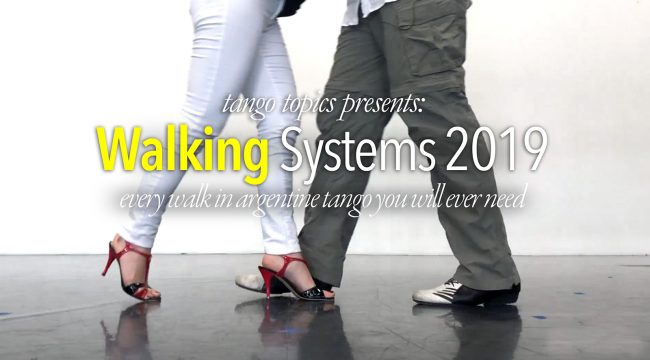
In today’s Tango world when we talk about the foundations of Tango, we talk about “how” to walk. Or actually the mechanics of how we walk, how we extend our legs, what happens to the knees, what happens to the ankles, what happens to the feet, and how we land our feet as a Lead or as a Follow. These things are vitally important as to how to move efficiently, effectively, and with ease. Suffice it said that these things, the how-we-do parts are a matter of opinion in some cases, an informed opinion in others, and still this stuff is not a settled issue at this point almost 100 years on going forward. The reason we mention these things is because this video is not about how to walk, or how to land your foot, or even how to extend your leg. But rather it’s about the different ways, 18 in fact, in which we walk in regards to Tango. And these things are insanely important for two reasons as it relates to Argentine Tango: 1.) Because these 18 ideas are the foundation of everything that you will ever do with regards to tango. They’re the step into and out of every piece of vocabulary. 2.) These 18 ideas are very nature of versatility and really they’re the foundation of improvisation! If you study and practice these ideas to the point of mindful repetition, then you will have the ability that we all seek: Improvisation. That’s not a sales boast to get you to register. That’s a fact. These 18 ideas comprise the pathway that we all seek as Leads or as Follows, to inspire, enhance, and generate a creative interpretation of the Music, or to improvise to any piece of music regardless of genre, or partner, using nothing more than forward steps and back steps! That said, let’s dive into what Tango Topics calls “Walking Systems for 2019“.
What are Walking Systems ? These are the many different ways that we can walk in Argentine Tango. Not the how-we-walk but the multiple methods to the ways in which we might want to walk, first canonized by Gustavo Naveira & Fabian Salas, and then expanded upon here for your edification. The ideas comprise a composite or overall vantage point that no matter what situation one is in, there is a walking solution for that situation. One example of this is the Walking Turn. Most Leads, when they hit an obstacle in their pathway, will invoke a Rock Step as a way to solve that problem. It’s their go-to move. A Walking Turn on the other hand, is another more creative way to solve the same problem while at the same time creates far more options and opportunities for both roles to engage in musically as well as from a vocabulary perspective and a navigational perspective. Tango Topics Walking Systems provide a way into any situation and any number of ways out of a situation that does not include a piece of specialty vocabulary (Volcada, Sacada, Colgada, Parada, Pasada, Boleo, Gancho, Calesita, Rock Step/Resolution, Single Axis Turn, etc) as a possible resolution, or for that matter any of the 7 of the 8 Types of Ochos, OR any of the 8 Types of Turns, or for that matter an Argentine Cross as a potential resolution! No. Walking Systems are the Resolution! They’re the solution to each and every issue that you can come up with. Not to mention they also solve an age old problem for most Leads, “What do I do next ?”. Walking Systems is one of the simplest yet most powerful answers to that question! Because not only do Walking Systems answer the question they go far beyond it!
Years ago when Gustavo and Fabian came up with a way of describing Walking Systems, as they pertain to Argentine Tango, it was a way of systemizing or standardization of the dance. Meaning that if you could look at something and describe what was happening with a simple phrase, then you could also repeat it and build on it! Those standardizations became what we now know today as the two predominant ways in which we talk about Tango Vocabulary and the dance as a whole: Either a piece of vocabulary is done in Parallel System, or Cross System.
Tango Topics Walking Systemsfor2019 encompasses these two primary ideas and adds a bit more to them each, and then goes far beyond them to encompass 4 other ideas which on the surface may appear to not be one or the other, but in reality is both at the same time as you’ll see especially when you get to the section on “Alternates”!!!
Walking Systems expands on these ideas by using Orientation changes, Changes of the Embrace, and lastly a completely new idea (for some of you) that almost never gets talked about but is in fact quite revolutionary in our opinion!
These are Walking Systems for 2019 going forward as Tango Topics sees them.
Why do you need this stuff ? Think of Walking Systems as what you do AFTER you’ve learned the foundations of how one walks as a Lead or Follow. Walking Systems are what you can do with that walk. Hence the ‘ideas’ part above. Another reason why you need this topic in your understanding of Tango is Versatility. And still, another is, and a longer answer, Improvisation. The fact is that you could do worse by just studying this stuff alone. If you did nothing else except studying walking and walking systems, you’d already be ahead of the game but the reality is that most people study the mechanics of walking for about 5 minutes and then move on to the vocabulary that they see everyone else doing, Ochos, Turns, Crosses, and then the specialty vocabulary which is studying all the crazy stuff they think that Followers want so that their Follower’s don’t become bored (Volcadas, Colgadas, etc). This is commonly known as Lead Mindset. This mindset a false belief system that, erroneously, believes that the Lead must perform all sorts of vocabulary and have a dizzying array of said vocabulary that will keep the Follower entertained in the course of dancing with said Lead. This is, of course, not true but no one wants to hear that fact.
Versatility means that these 18 ideas by themselves are just that, ideas. Implying that on their own they’re not going to do much for you. However, when you place one idea behind another and continually swap them out for the next, something very interesting begins to occur: Facility. You begin to have ease, a comfort with exploring the “What If…” realm. At the same time when you put them together, they can form an entire dance all on their own without doing anything else! We know, we’ve spent entire nights doing nothing but these ideas just to prove a point to see how successful or interesting this stuff can get. Versatility means that as a Lead, or as a Follow, you become so conversant with these ideas that variations of these ideas start to emerge on their own! And there are more here that we haven’t even begun to touch on.
Now to the longer answer, is that while no one has said anything about how to put things together, meaning that a Lead must choreograph an entire song on the fly right from the moment they step on the floor. That ‘choreography’ has to come from somewhere, right ? One place it could come from is steps, patterns, and figures. There is a certain comfort in employing steps, patterns, and figures. It gives one a false sense of competency. The real test comes when you run out of figures to employ, lest you repeat one’s self (which we do not want to do), and then you’re stuck with the problem you had when you started. What do next ?!?!?!? Again, you’ve run out of figures and you don’t want to repeat yourself. And this is where Walking Systems comes into play. They replace the need to invoke figures. Completely. It should be noted that another problem with the steps/patterns/figures solution is that somewhere about 10th or 15th figure, and after you’ve danced with every Potential Partner in the room, they all have your number and what you’re capable of doing! Further still is that in order to keep yourself from being ‘stale’ you absolutely must learn new material constantly and pepper in an ever-dizzying array to one-up yourself. How do you spell work ? We spell it “steps, patterns, and figures”. Which is to say, “Not so much with that idea!”.
Improvisation refers to two things: 1.) It refers to creation on the fly of singular or individual steps not a group or pattern of steps or figures but nothing more than walking forwards or backward. But it’s how you do that, hence the walking systems themselves which creates variety. 2.) It refers to the musical interpretation of one note for one step. Which gives you greater levels of granular control over what you’re doing in a dizzying array of possibilities.
The Walking Systems
Before we get into the systems themselves, it’s important to recognize that we walk on paths or ‘tracks’. Meaning that our feet (ankles, and 1st metatarsals) pass very close to each other (slide next to). This is known as “passing through collection”. These tracks do not cross over each other except in very specific circumstances. Think of train tracks, that are very close to each other. Typically there are 2 tracks of walking paths, sometimes there are 3, and sometimes there are 4. Sometimes, as you’ll see, their “Orientation” changes, meaning that in order for some of this stuff to work, either the Lead or the Follower must change their orientation towards or away from their partner in the line of dance. And sometimes that orientation change may invoke an embrace change. That said, on to the Walking Systems:
1.) Parallel System. This walking tool comes in 3 flavors, 1 of which we use all the time. It is the staple of the dance. This system is walking with a partner using opposite feet.
Example: If Follower is led to step backward with their Right leg/foot, the Lead steps into that space that has been vacated with their Left leg/foot, and then continue on with the Lead stepping with their Right leg/foot into the space that Follower just vacated with their Left leg/foot.
This walking system can be done on 2 or 4 tracks without an orientation change and is done without crossing over the body’s natural meridian. As well as on 2, 3, or 4 tracks with an orientation change. However, in the case of 3 or 4 track, these variations can only be achieved by changing the position or orientation of the Follower by use of an “Americana” Embrace either to place the Follower to the side of the Lead or directly in front of the Lead!
The 3 flavors of Parallel Walking are:
Type 1a – 2 Track Parallel walking (with and without an orientation change). Type 1b – 3 Track Parallel with an orientation change. And Type 1c – 4 Track walking with and without an orientation change.
2.) Cross System. This complex walking tool comes in 3 flavors, as well as 3 different types of entry variations, and 2 different exit variations. This system is walking with a partner uses the same feet.
Example: If the Lead steps with their Left leg/foot, the Follower is led to step with their corresponding Left leg/foot, and then continues on with the Lead stepping with their Right leg/foot, and the Follower stepping with their Right leg/foot at the same time.
This walking system can be done on 3 or 4 tracks walking without an orientation change (not shown in the video above), and 2, 3, or 4 tracks with an orientation change. 2, 3, or 4 track these variations must use an “Americana” embrace format either to place the Follower to the side of the Lead, or directly in front of the Lead!
The Two Flavors of Cross System Walking are:
Type 2a – 3 Track Walking without an orientation change using 1 of the 3 entry methods below. Type 2b – 4 Track Walking with an orientation change.
3 Types of Entry Points to Cross System:
a.) Step/Half-Step. (see video) This method can only be used while in motion walking down the line of dance. b.) Weight-Change/Step. (see video) This method can only be used from a standing position and is ideally used or invoked from one of the 5 Musical Pause types. c.) Cross Behind Method. (see video) This method is used as the ‘flashy’ version and can be used from a standing position or while in motion.
2 Different Exits from Cross System:
a.) Step/Half-Step. (see video) In this method, the half-step is on the same side that you entered on with step/half-step. b.) Inverse Half-Step Method. (see video) In this method, the half-step is on the opposite side of the foot that you entered on with step/half-step.
3.) ‘Lazy’ Ochos. This walking tool comes in 2 flavors, the common Follower’s version, and the less common Lead version. This walking tool is where the Follower (or Lead, self-lead’s themselves) is led to stepping across their natural body meridian with each step.
Example: If the Lead steps with their Right, the Follower is led to step with their Right diagonally across their body meridian at a 45-degree pathway angle, while keeping the foot in alignment with the floorboards and not allowing the hips to rotate in any way, shape, or form.
All 3 types of entry points and both exit types can be used with ‘Lazy’ Ochos. It should be noted that Lazy (sometimes referred as to Milonguero Ochos) are both a Walking System and an Ocho in their own right.
Type 3a – “Lazy” Follower Ochos. Type 3b – “Lazy” Lead Ochos.
Surely that’s not all the walking systems, right ? You’re right. It’s not. This is just a taste. 😉 An informed tease. Nothing has been left out of this first 22 minutes of video, including footwork. However, the thing we did leave out was the other ELEVEN walking systems! If you want to read about the other walking ideas, and see examples of them, especially the Type 6 Walking System, which in our opinion is the Bee’s Knees, then you’ll need to register as a Freemium User which costs nothing and you get to read about the other eleven Walking Systems for 2019! If you want to go one step further, no pun intended, and actually Subscribe to Tango Topics, meaning to spend a few dollars/euros/rubles/pesos…then you can see the entire 1hr and 22-minute video on Walking Systems as Tango Topics sees it! Plus you get access to over 400 videos on a wide range of topics and techniques. What have you got to lose ?
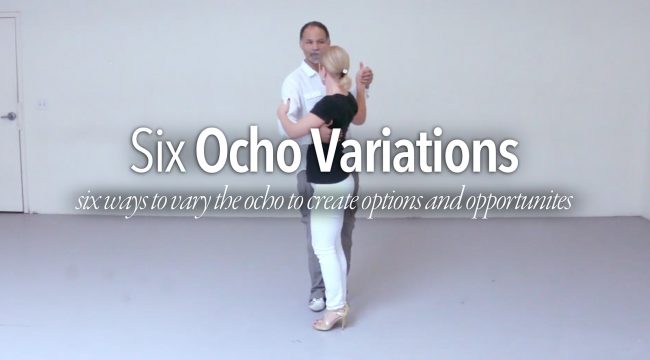
Ochos! They are the stalwart of Argentine Tango. They’re the goto move that keeps the dance moving, almost like the glue that holds everything together. Here’s an interesting experiment to prove if the statement above is valid or not, try not leading or not following them for a little while in the middle of a song, or for an entire song, and see what happens! More than likely you’ll see the validity of the statement, and how often we use them as Transitional Elements. What’s a Transitional Element you may ask ? In it’s simplest form, and yes there are complex forms of this idea, it’s a tool that we use to transition from one Tango idea to the next. Hence there’s a reason why we have detailed 3 of the more commonly used Transitional Elements, which Tango Topics calls Ocho Transitions. You might want to go look at the 3 of the 4 primary Ocho Transitions [ 1.) Milonguero Ochos into the Milonguero Turn. 2.) Traveling Ochos into The Follower’s Molinete. 3.) Traveling Ochos into The Milonguero Turn. 4.) Milonguero Ochos into The Follower’s Molinete (this video is only available to subscribers).] Moving along towards Today’s Tango Topic, there is something else that you may not recognize which is also true: Your understanding of the Ocho itself is not expansive enough. More than likely when we wrote the word “Ochos” above only one image came to your mind. You should know by now that this website details multiple ideas of what a specific piece of vocabulary can be. Take for instance the Ocho Cortado. There are 3 major variations of it. The Circular Ocho Cortado (used in Europe and BsAs), The Linear Ocho Cortado (used in North America and BsAs), and the Ocho Cortado Variations (used everywhere). Or Sacadas, we’ve detailed multiple variations of Sacadas (Simple Sacadas 2018, Close Embrace Sacadas, Crossing Sacada Turns, and Back Sacadas 2019…coming in January ), or any of the 3 types of Boleos (Social, Linear, or Circular), Ganchos (Common Ganchos, Lead Ganchos, Follower Ganchos,Gooey Ganchos), Colgadas, Volcadas…lots and lots and lots of variations. So what would make you believe that there aren’t Ocho Variations here as well. There are in fact Six Common Ocho Variations Tango Topics discusses. So without further adieu, Tango Topics presents the importance of Six Ocho Variations.
What Is An ‘Ocho Variation’ ? It is an Ocho that is varied. Hahahaha. That definition isn’t that far from the truth. Before we dive into the Variations, there’s something that you should know going in which require us to review the types of Eight Types of Ochos that are possible within the structure of Argentine Tango. There are Eight Types ? You thought there was only One, which is our point above. There are in fact Eight that Tango Topics yaps about. So without further delay a little refresher on the Ocho:
Type 1: Milonguero Ochos (sometimes called “Lazy” Ochos). They’re called “Lazy” because there is almost no physiological work for the Follower to invoke the application of this idea. This is the 2nd most common Ocho after Traveling Ochos (see Type 3). This is where the Follower is led to stepping backwards (or forwards) with their legs/feet crossing over their body’s natural meridian line on a 45 degree angle on the diagonal and more importantly their hips do not rotate in any way, shape, or form. Easier done than described or said. Here’s an example >https://www.youtube.com/embed/aname0mIN9s
Type 2: Linear Ochos. These are Ochos that employ Disassociation (from the Lead) and then Applied Disassociation (from the Follower), where the Follower is being led to rotate their torso (via disassociation) and then their entire body 180º (via applied disassociation) perpendicular to their Lead. They are asked to move backward or forwards, typically backward, along a linear line in front of the Lead. Where the Follower’s feet/legs do not cross over their body’s natural meridian line. Where the Lead actually engages Disassociation (not inference) to their Left Side (Open Side), and their Right Side (the Closed Side of the Embrace) which results as Applied Disassociation in the Follower (not a Pivot! Tsk, tsk, tsk).https://www.youtube.com/embed/A0ROD4pTB2Y
Type 3: Traveling Ochos. This type of Ocho is the common one that most people are familiar with, it’s the one that you thought of when the word is used most often. However, in this instance, this particular type of Ocho, and where it gets its name from, is the fact that it ‘travels‘ down the line of dance. Each Ocho invokes a smaller, or lesser amount of Disassociation (from the Lead), and a smaller or lesser amount of Applied Disassociation (from the Follower) which ends up as a 90º rotation perpendicular to the Lead. Typically these should only be done in triplets and not continuously, and going with the Followers motion, and should not be inferred. However, they are typically inferred and the Follower either guesses that they’re being led to Traveling Ochos or because they’ve done them so often they will invoke a Traveling Ocho on their own when none was led, which is better known as ‘The Automatic Ocho‘ or part of their default behavior.https://www.youtube.com/embed/d_UDQBw1n6I
Type 4: Circular Ochos. These Ochos resemble Type 2, but instead of the linear line and 180º in front of the Lead, the Ocho is led on a semi-circular arc 180º in front of the Lead.
Type 5: Over-Rotated Ochos. These Ochos are very uncommon but still a valid form of the Ocho, and to be honest with you loads of work for the Follower, and oodles of fun at the same time. These are Ochos where the Follower is led to an Over-Rotation at 270º to step backward (or forwards) into the space that the Lead has created with the same foot/leg that the Follower is stepping backward (or forwards) with! Example here:https://www.youtube.com/embed/55_Q9MGB0Ac
Type 6: Anti-Ochos. These Ochos resemble Type 2 Ochos except instead of the Lead going with the Follower’s rotation and direction, the Lead goes against it! They’re insanely cool, and looooots of fun to do. Example here:https://www.youtube.com/embed/qW-CeDCK7OY
Type 7: Milonga Ochos. This type of Ocho is only used in one instance, Milonga. And while they resemble the motion of Type 3, the Follower is led to not to step backwards but to rotate over their feet in an actual full body pivot and then change weight and pivot again in the opposite direction, creating the effect of slight but rapid movement down the line dance. This is the only Ocho that seemingly breaks the Tango Topics rule of Resistance when in truth of fact does not and can be led and followed without employing resistance at all. Here’s an example of the Follower’s Milonga Ocho >https://www.youtube.com/embed/2M4Wwv1pue4
Type 8: Dynamic Ochos. These Ochos are more than likely a Tango Topics construct. This is where an Ocho starts out as one thing and is morphed into another type of Ocho where the only requirement is time in relationship to the music! Meaning you might start out in Milonguero Ochos and transition into Traveling Ochos over the course of a few bars of the music.
These are the 8 Types of Ochos. Why list these ? Because our primary topic deals with having the knowledge of these 8 things so that now we can ‘vary’ them into Six possible Variations on a theme.
What are the Six Variations ? The Six Variations are tools used for navigation, music, and just fun or to vary the idea a bit so that you don’t end up doing the same thing over and over again. In the next section we show you what the variations are for this video. However, the short and curly answer is that an Ocho Variation is a variation of one the ideas above that have no been detailed on Tango Topics before this article.
About The Video is 23m:37s in length in 8 sections with a combined technique for Lead and Follow. Item in bold in example video, if the section is partially bolded that means that the section is partially in the video. 🙂
Section 1: Introduction (00:01:32) Section 2: Incremental Ochos (00:04:44) Section 3: Forward Traveling Ochos (00:03:28) Section 4: Forward Milonguero Ochos (00:03:11) Section 5: Lead Traveling Ochos (00:04:09) Section 6: Ocho Reversals (00:01:08) Section 7: Ochos as a Navigation Element (00:01:37) Section 8: Vocabulary Review and Closure (00:03:30)
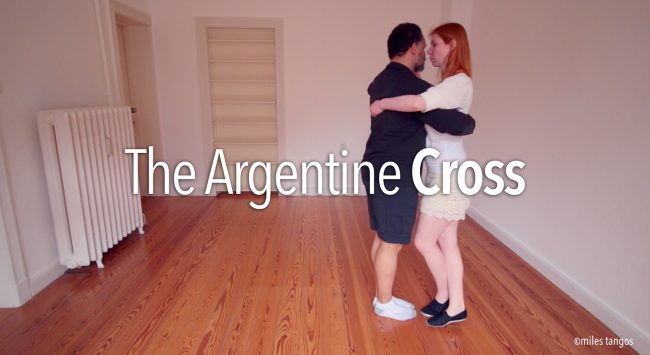
The Argentine Cross. Probably the single most used piece of tango vocabulary. In a given song, you’ll end up either leading or following a Cross a dozen or so times, at minimum! From a leading perspective we believe that we’re leading a cross, when in actuality it’s more like we’re expecting it more than anything else. From a Following perspective we’ve been led to this venerable piece of vocabulary 10 thousand times and then some, and what’s so weird about that figure is that we can’t even recount just one of them. It’s so engrained in us, so ubiquitous, used so often that we will cross our feet by default without understanding why, or even when it happens, or (and here’s the kicker) that we crossed at all!
What is The Argentine Cross ? In it’s simplest form, the ‘Cross’, as it is known, is a distinct and unique piece of Tango vocabulary that doesn’t exist in any other social dance in this form. While there are ‘crosses’ in other social dances, there isn’t another cross like this anywhere else. What makes it unqiue ? For one, in this version of the cross, the Follower is a willing participant, and actually an expectant one. Why ? Because it’s used so often nearly everywhere that you really do have to wonder sometimes if that’s all we ever do in Tango. Two steps and then we cross. You could quite literally spend entire song or tanda doing nothing but Argentine Crosses. Mind you, doing so will not achieve the desired results of pleasure that you’re looking for out of your partner. More like they’ll be insanely bored and pissed off at the same time. So, not so much with the ‘Cross’ for an entire song. Still another reason why this is unique is because, in every other social dance, the Cross is ‘placed‘. Meaning that the Follower is put into position by either crossing the Follower’s legs deliberately which ends in crossed feet, or moving their feet to a crossed position deliberately. In this cross, while the Follower can be placed, or forced, or pushed, which by the way we do not want to do, in this instance, they’re quite decidedly led in a very specific way to put them and their body into a position where they have only one option, to cross their feet, hence the reason where it get’s it’s name from. Further still in every other social dance, their version of a Cross is where the Follower simply crosses their feet. In Argentine Tango, the Follower is walked into a position to thereby cross their feet. This is known as “walking them to the cross”.
About The Video. This video comes in at 21m:13s in length in 6 Sections. This video contains has combined Follower and Lead Technique.
Section 1 – Lead & Follower Technique – 00:11:28 Section 2 – Open Embrace – 00:01:28 Section 3 – Close Embrace – 00:00:54 Section 4 – 5 Errors of The Cross – 00:03:24 Section 5 – Getting In Front – 00:01:51 Section 6 – Examples – 00:01:39
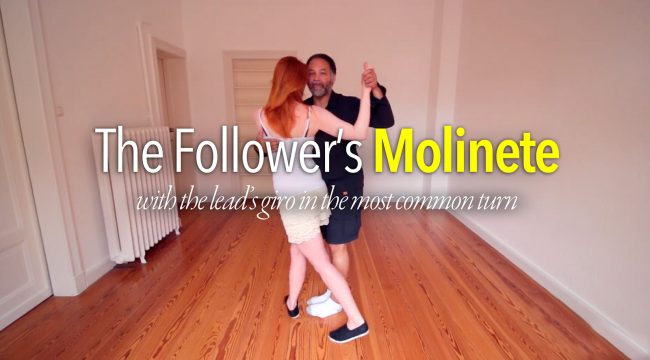
Every social dance has a variation of a very old idea known as a “Grape Vine Turn”, which is generally 3 steps in either a circular or linear pattern. Argentine Tango is no exception to this factoid. Truthfully Tango has spawned and borrowed and given 8 types of turns based on simple walking principles. The Eight functional types of turns of Tango are: 1.) The Milonguero Turn. 2.) The Walking Turn, 3.) The Rock Step. 4.) The Ocho Cortado (Linear & Circular). 5.) The Media Luna. 6.) The Argentine Calesita. 7.) The Colgada Turn (including The Single Axis). And #8, the topic of Today’s Tango Topic: The Follower’s Molinete. The turn itself is taught to every beginner dancer, and every dancer uses this very functional and foundational turn. Just as a side note, up until about 1980, oddly enough, The Follower’s Molinete was NOT the predominant turn. That honor goes to first turn on our list above, the Milonguero Turn. So what happened ? Why was the turn supplanted ? You can thank Gustavo Naveira and Fabian Salas for that. If for no other reason these two men aren’t considered the father’s of Modern Argentine Tango than it should be their introduction of the Follower’s Molinete to the world. Which, strangely enough, had been around in various forms for almost 50 years before they came along and … ahem … ‘discovered‘ the Molinete. Moving along, the Follower’s Molinete did go on to supplant the Milonguero Turn, and it is now the common turning element for all dancers to learn and then to dance. As this is the case, the turn is so predominant that it is the default motion for every Follower whether they realize it or not. The moment that a Lead starts to rotate their body, the Follower will default to the Follower’s Molinete. It should be noted that the Follower’s Molinete doesn’t happen in a vacuum. It happens due to the other side of the equation: The Lead’s Giro. The Lead’s Giro and the Follower’s Molinete co-combine to create the standard turn in Argentine Tango when we talk about turns. So without more yapping, let’s dive into Today’s Tango Topic: The Follower’s Molinete.
What is the Follower’s Molinete ? The term “Molinete” means Wind Mill in English when translated from the Spanish. And as it relates to Argentine Tango this is a Grape Vine Turn with 3 steps. Forward, Side, and Back that executed by the Follower. Which is the reason for the distinction in the moniker, calling it The Follower’s Molinete. So that would lead one to believe, and rightfully so, that there is a Lead’s Molinete. And there is. But that’s a topic for a different Tango Topic. There are two primary versions of the Follower’s Molinete. And the primary distinction is whether or not The Follower’s Molinete is done in Close Embrace or Open Embrace. While the two turns themselves are functionally the same, there are some very nuanced differences between the two. However, at the 50,000 ft level, the turns consist of the 3 steps: Forward, Side, and Back. When you stop and you think about it though, there are actually 4 steps, not three. Even though we would like to use only 3 and it can be done quite easily with practice. There is a fourth step, and it’s a second side step after either the forward or back step. The Follower’s Molinete can start with either the Follower’s Forward step or the Follower’s Backstep. Both will lead to slightly different outcomes. However, the setup for both turns is usually the same: Traveling Ochos! In either case, both the Forward Step, and the Back Step are Applied Disassociative motions which are mostly, and erroneously, thought of as ‘pivots’, which lead to the Follower then extending into a rotating Side Step. It should be noted that of all the foundational moves that the Follower must master, that this is the hardest thing, physiologically speaking that they’ll ever have to do. Ever. It takes considerable time, patience, practice, and did we mention ‘practice’, solo, with a partner, in private instruction to make the Follower’s Molinete fluid. This is not watching a 9 minute video and bam, you have got it down. No. This is going to take a while. A long while. A very LOOOOOONG while. Years. However, having adequate reference material is absolutely key to that process.
About The Video. This video comes in two parts, the Open Embrace version (00:24:12), and the Close Embrace version (00:08:34). This is a combined video format, lead and follow technique are mixed together.
Introduction – 00:01:10 Two Lead Accommodations – 00:00:37 Lead Hip Detail – 00:02:27 Lead Space Detail – 00:00:43 Lead Footwork – 00:01:10 The Close Embrace Dip – 00:01:03 The Recap – 00:00:51
Install Tango Topics on your iPhone: tap Share, then Add to Home Screen.