Limited time offer One year for $99 (regularly $129, save $30) Get your year
Tango Topics info:

Check out the Tango Topics Lexicon for words like Axis and Connection.

Category: Truism

  • The Arm Pit Dancer

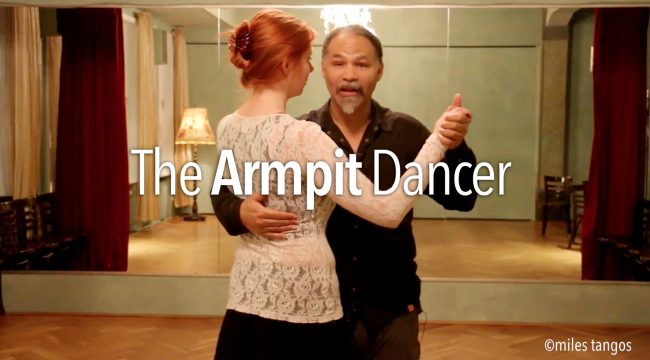
    The Arm Pit Dancer

    For most dancers their embrace is theirs and theirs alone. It’s what separates them from everyone else. It is their signature. Regardless of whether or not that embrace is desirable or not. Mind you they may not realize that their embrace is not desirable, they may not realize that the quality of their embrace is desirable. We like to believe that our embrace is the finest thing since sliced bread, and yet it is that embrace that causes more problems than it’s worth for a greater number of dancers. Take for example an aspect that is frequently passed onto dancers learning close embrace (which turns out to be a grand fallacy) that the Follower must apply ‘Resistance‘ (which generally ends up as ‘Rigidity‘) in order for the Lead/er to feel them. Or still another that the Follower should wrap their left arm around their Lead’s shoulders.

    video
    play-rounded-fill

    Each of these issues, and many more that aren’t listed here create physiological stresses on the couple that we don’t want. And as a result we end up having to compromise our natural bodily structure to compensate for what essentially amounts to an uncomfortable embrace.

    To be clear, and fair, the embrace is not the only problem child here. The other major component to nearly every issue that you can think of comes from one other place, it’s the walk. Or more importantly, one’s stability in one’s walk. Do not discount what you’ll hear in the videos above, and this article as “Ahhh I just need to fix my embrace and then all will be magical!”. Nope. You must, must, must, must, must … let’s stress that one more time with feeeeeling -> you must work on your walk, and in specific, your stability in your walk. And there are loads of exercises you can do to correct for that, one of which has already been covered here “The Ballet Rise“.

    What is an Arm Pit Dancer ? Put simply the Arm Pit Dancer is where most Leads place their Followers in their arm pit in order to dance with the Follower. Here’s the strange part > Most Followers willingly go there and stay there! To be fair, most Leads have a compressive embrace with their right arm so the Follower can not necessarily change their bodily position even if they were a.) aware. and b.) wanted to do so. Why is this a problem ? Read on….

    The Problem: The embrace is massive component to the dance being successful on any level, and yet there is another component is just as important but very infrequently talked about. What’s that ? Body Position and Body Placement for both Lead and Follow! Body Position is where you place yourself within the construct of the embrace, Body Placement is what you do with it (e.g.: vocabulary). The issue is that getting this topic right is the dividing line between ‘ease‘ and ‘work‘, between ‘pain‘ and ‘pleasure‘, between “ouch” and “aaahhhhh“. And yet, no one talks about this thing. So what specifically is the issue ? The fact that a good 90% of the time both Lead and Follow will enter into an untenable embrace structure based on their respective Body Positions right from the start of the dance where the Both dancers will quite literally either place the Follower into their Lead’s Arm Pit, or the Lead will readjust to have the Follower there from the start. And in that we have what is known as “The Armpit Dancer“. 

    From a Following Perspective, this issue is as much yours as it is the Leads’ issue! You either went directly to the Lead/ers arm pit or more importantly you drifted there by means of every cross, turn, and ocho you were ‘asked’ to execute. In short, you are just as responsible for this as the Lead is for allowing the problem to happen in the first place. Let’s go on the theory that you went there by comfort, not by drift, that will happen later anyway. By comfort means that you don’t know anything else. You went right into the armpit of you Lead because you don’t know any thing different. It’s all you know. And quite honestly no one has probably told you that you have a responsibility to be actively ontop of being in front of your lead, and being in their armpit is not that place. Placing yourself in the armpit is less then desirable on several levels: 1.) You’re making work for yourself. 2.) You’re instantly behind on everything that is being asked of you. 3.) You’re more than likely going to end up in long forward steps because of your position.

    Let’s be clear about something, there are certain aspects to the Modern Follow that did not happen 50, 30, and maybe even 20 years ago that does happen today. One of those things is that certain pieces of vocabulary mentioned above are all yours. The Lead may ASK (operative word) for it, but you’re the one that has to execute it with some degree of precision and awareness. And that means that while there’s nothing that you can do about the speed of one of these pieces of vocabulary, there is something you can do to change how things are executed because you’re the one that’s doing the execution! Put simply you are responsible for Forward, Side, & Back, and just how much disassociation you engage to execute X, Y, and Z that is being asked of you. You must place yourself in the right places at all times to allow for these things to occur. That means a.) Execute. b.) Get there in a timely fashion (read that as being on beat). This part is optional, but mostly quite desirable c.) With elegance! Generally the problem is that you have allowed yourself to ‘slip’ in any one of those three steps, in specific the back and forward steps of your Molinete as well as the back step prior to the crossing step of the Argentine Cross.

    To ‘slip’ means that you are out of alignment with your lead. While the video above talks about the Follower’s Molinete where this occurs repeatedly, it also occurs in the Argentine Cross, and you as the Follower need to take control so these things don’t happen. One of the things in your way, unfortunately is a Lead’s embrace that is restrictive that won’t allow you the freedom to move across and around your lead’s body. If the embrace isn’t restrictive, you have the tools you need to accomplish your goals! Technique, and Space! Now the only thing you need to do is execute.

    From a Leading Perspective, this one is as much your issue as it is the Followers! Why are you responsible for this issue ? 1.) It’s your embrace. 2.) You have control. 3.) You’re the one that’s choosing vocabulary, not the Follower. 4.) Navigation! 5.) One of your jobs as a Lead (you have 3), is Music. Your job is to select the beat that the couple is dancing to and on. That is why you are responsible.

    Let’s go on the theory that you are ignorant of why placing the Follower in your armpit is not desirable. That you’re doing what you’re doing out of your own physiological comfort and ignorance:

    Put simply, the Follower has a ton of physical work to do. You, my friend, have a different kind of work to do. While the role of the Follower is all about the physical, your role is intellectual – it’s all about planning. You think, they do. Mind you if you think and do for them, there’s not a whole lot for them to do except look nice and smile. Which is precisely what Tango was for many decades. That’s not the case in today’s Tango world, it’s changing…slowly. The role of the Follower has expanded more over the last 2 decades. And as a result, they have more to do, and you have less to do. The more ? They’re essentially being asked to execute a turn – the how the turn is done, but not when that turn is done (that’s still your job). Still another instance is that they cross their feet automagically because you’re not leading it 90% of the time. Still another is that in traveling ochos (what you call ‘back ochos’), they’re deciding how to ocho and how far that ocho goes, constantly. Put simply, they’re doing the heavy lifting, while all you’re doing is thinking about what should be done in time to the music.

    Those three things (and there are more, these are just the prominent ones) are physical labor for the Follower. Specifically the 1st and the last. Why ? Because they require disassociation and applied disassociation (what you mistakeningly think of as a ‘pivot’) on the Follower’s forward and back steps of their Molinete, and their ochos. 9 times out of 10 you’ll start a turn to the Open side of the embrace (Lead left), using the Follower’s backstep as the opening step either from a stop (bad idea by the way, see a future WHIC video on this topic), or from an ocho (better idea). That disassociation (from you) and applied disassociation in your follower tends to land them right in your armpit and thereby makes it difficult for them to get around you (for a variety of reasons which are not discussed here) for the remaining steps of the turn. The same is true of the ocho! In short, this stuff is work for them, and every time they move from the armpit, they’re having to stretch to go further around you just to end up in the same place. What makes that even more challenging is that you compress the embrace, you turn away from them in turns and in crosses you place them in your armpit deliberately, and you move the center of the circle or you close the distance in crosses, and/or pull them with your left arm, your head is in the way of the turn or cross (watching their feet). Each and every time that you do this it makes their job harder and harder.

    The Dancing Reality. The reality is that this stuff is going to continue to happen. And these words will make no difference. You’ll keep doing this stuff and stressing your heads, bodies, and dances to the breaking point. The reality is that you like dancing like this. You like dancing in pain. You like working harder than you have to. You like force, tension, compression, and resistance. That’s the reality. You see other people doing it and seemingly having fun and think, that’s what I should be doing. What you may not realize is that these people are ignorant of what’s supposed to happen. It’s only after they start rubbing muscles and tendons, that are seemingly strained for some odd reason (!!!!!), and they need a massage or a chiropractic visit the next morning that they realize that Tango is the cause! So ‘no’ you shouldn’t be doing that. What you should do is fix it!

    Paying For The Soup. Change can happen, but only if you want it to happen. And ‘want’ is the key word. First and foremost you have to see that this is an issue. If don’t, then so much the better, that means less work for you. But the reality is that this is a ton of work for both Lead and Follower. Further still you are contorting your bodies to make it happen, and then you wonder why you’re paying a chiropractor every few weeks for an ‘adjustment’. There’s a reason for that, and that’s because you’re contorting your bodies to dance like this. Here’s a helpful hint – STOP DOING IT! As arrogant as that may sound, and quite frankly the whole thing is arrogant, the fact is that it’s not arrogant if you see it as a helpful bit of advice that can stop you from being in pain. 

    Your Free Tip. A key component in this stuff is really about body orientation. One’s own orientation within a given piece of vocabulary, within the construct of the dance changes everything. There are minute changes that must occur every second of the dance, and this must be done without tension, resistance, or force. There should be no pulling or pushing to make these slight orientation changes. These are micro changes really, and unless you make them, sliding into your partner’s armpit or placing them there as a result is going to cause you more problems in 2 or 3 steps than you can possibly imagine. There are a few more components to creating a dance that does NOT end up in someone’s armpit and for that little piece of information, you need to see the entire series on the embrace, and that means you’re going to have to subscribe.
  • 8 Tips To Desirable Tango

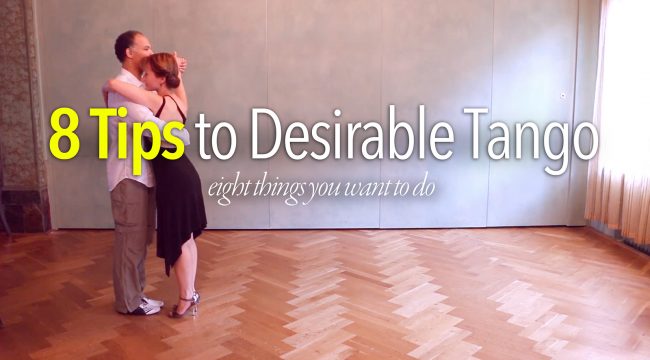
    8 Tips To Desirable Tango

    First, let’s get some language out of the way, the title of this article is not “BETTER” tango, but “Desirable”. As ‘desirable’ is a more realistic term towards the idea of ‘Social Tango’. Believe it or not, the descriptives actually matter here. Because what call a thing is what it becomes in your mind! So the clearer you are in that descriptive, the more clear it is to making it a reality! So for that reason alone, we don’t call this ‘Eight Tips to Better Tango’. No. We refer to this as Eight Tips to Desirable Tango. Secondly, the idea that there is a destination here, that you’ll arrive at being amazing in your dancing skills is absolute bullshyte. There is no destination. Get that thought right out of your head. There is only ‘desirable’ and ‘not desirable’. Third and lastly along the lines of language, ‘Desirable’ is a MOVING target. Meaning ? That the idea that you will one day be a magical dancer is not reality, the goal posts for desirable is always, always, always changing. Always. 

    The more that you have danced, the more that you have learned a way to compromise your body into doing X, Y, and Z that contorts, twists, and mauls you so much so and so often that you erroneously believe that this is how the dance is supposed to be. It’s not. Truthfully the dance is so effortless and easeful that it’s almost scary. The example above shows a couple that is walking together, effortlessly, with ease. Mind you that this ease and effortless ability happened because both partners worked on themselves, individually, on their own technique, in order for the walk to appear as effortless and as easeful as it looks and was. However, you have no idea about this, because you’re so used to moving in your contorted way, using muscled force, hanging, pulling, pushing, and wholly unstable that you think, or believe, that what you are doing is what the couple is doing above. It’s not.

    This couple is moving together is an illusion of techniques. The Lead’s walking technique. The Follower’s walking technique. Together this creates an illusion of effortlessness. When it fact it’s very practiced and second nature to them. This is not something that they learned in 5 minutes in a class once and then magically were able to reproduce this. No. This effortless easeful movement of the couple happens through years of diligent, personal, painstaking, detailed, sometimes disheartening, hard work. Not 5 minutes, not 5 hours, not 5 weeks, not 5 months, but years. 

    The fact is that what you’re seeing is the result of that work. The reality is that if you have to push, if you have to pull, if you have to squeeze, if you have to ‘lead’ with your mouth, if you have to use your arms to direct where the follower is going, if you have to hold on to your lead for dear life because you’re falling all over the place, if you have to squeeze the lead’s arms to stabilize you with every step and on every turn or Ocho, if you have to follow or lead by watching their feet, then you know what ?  You are more than likely compromising your body, contorting it to be able to ‘dance’. This is not tango. This is contortion and it is not easeful or effortlessness by any stretch of the imagination.

    So how do you get to the effortlessness of the dancers above ? Below are 8 Tips to Desirable Tango towards that goal. It is not the only pathway, and this by no means is an exhaustive list of what has to happen, but it is a good starting point. When reading through these points there is something that you absolutely must keep in mind, something that you must not forget: Most of these points (except the musical one) come from a place of self-honesty. The dancers above achieved their level of effortlessness by blatantly and sometimes more often than not by being deeply and harshly self-critical, honest with themselves and their partners, over and over again. Every nuance, every detail, every aspect in exacting precision was scrutinized, reworked, tailored, taken apart and then put back together hundreds of times. If that. It is only through self-honesty and hyper self-awareness that change can occur. It is absolutely crucial towards becoming a dancer that is desirable to dance with. That said, let’s begin….

    Desirable Tip #1

    Working your foundation. While you have heard this page say and me say, and every teacher say that the foundation of the dance is walking. That’s not entirely true. Yes the dance is a walking dance, but the dance almost never walks in Modern Tango, it turns. It would be more accurate to state that the dance is a turning one. But that’s not what this statement really means. “Working Your Foundation”, refers to creating a stable platform from which you can walk, or turn, or cross. ‘Stable’ in this case means that you do not need to hang, you do not need to pull, you do not need to push. You are completely aware of your own equilibrium, and as a result do not need to touch someone in any way, shape, or form in order to move with them. Think of it this way: When you’re walking anywhere (assuming it’s not icy out) do you need to hold onto someone else to do it ? Probably not. So why would you need to do this when dancing Tango ? Answer ? You don’t. And anyone that tells you any different is either lying through their teeth or has a contorted way of looking at the dance that you probably want nothing to do with. So ‘Working Your Foundation’ is really about stabilizing the three primary steps of the dance from a leading perspective as well as from a following perspective, individually (not together), forward, side, and back, independent of someone else. Working your foundation will give you the ability to control your own body without holding onto someone else, being independent and that in turn will allow you, when you are in the confines of the embrace, to be 10 times more controlled, and that control gives you the effortlessness and ease that you seek.

    Desirable Tip #2

    The Onion. Tango is like the unending onion. There is no ‘there’, there is always, always, always something to work on even when you think you have mastered X, you must revisit it constantly with drills and exercises. Constantly. Practice is not, and should not be considered, dancing practice with a partner, but rather should be working the base elements of motion itself – which is stepping forward, stepping backwards, stepping to the side – Forward, Side, and Back. Clean up those things, make those things stable, clear, controlled, contained, consistent, without wobbling, without wavering, without needing to hold on to anyone or anything (no balance bars), and then you’re onto something. The drills and exercises are the onion here because you can always delve deeper into greater and greater levels of control and precision. Finite control is what you’re after here as a Lead and as a Follower! You want to be able to deftly control every aspect of any motion regardless of whether or not you are in an embrace or not! And to be clear, this isn’t about speed, truthfully it’s about slowly, very slow, like a 10th of the speed at which you’d normally do something, it is about doing something thoroughly and slowly and carefully, meticulously detailed and precise control. Through drills and exercises you will gain some measure of finite control, and that finite control will allow you to master forward, side, and back under most conditions.

    Desirable Tip #3

    Learn to Lead AND Follow at the same time. Don’t put it off to wait until you have mastered X. The fact is that you will never master X.  So you may as well start sooner, rather than later. Further still, you will acquire the dance that much faster. Some people are put off by this statement and erroneously think or believe that it means giving up the masculinity or femininity of the dance. Not true. My father always used to say to me “Know Your Stuff”. He meant to educate myself, illuminate the dark corners of topic to know it inside and out. So that when challenged I could speak knowledgeably at the dinner table on a topic and not sound like the proverbial village idiot. The same thing is true here. While you may never use the skill, that doesn’t mean that the knowledge can not and will not benefit you on multiple levels. It does and can do exactly that and a whole lot more.  Right now you have a way of seeing the dance as sort of a ‘Black Art of Leading’ and a ‘Screwup skill of Following’. What does that mean ? It means that for Followers they’re afraid or fearful of leading because it seems so hard. The fact is that you know more about Leading than the lead does! Why ? Because you’ve been led by every awful lead in the room that squeezes, pulls, and pushes, and you know what that feels like and you don’t want to do it. From a Leading perspective, you lead something and the Follower doesn’t follow it but they’re ‘supposed’ to. The fact is the reason why they don’t follow it is because you’re in denial about what you’ve actually led. If you lead it, they will follow it. It’s that simple. If they’re not Following it, it’s because you aren’t leading what you thought you were. So swapping roles every time you learn something new will help you to understand how and why X, Y, and Z works. Didactically breaking it down to it’s component elements (forward, side, back). This isn’t about steps and patterns and learning it, it’s about learning how the coupleship works in relation to what is and how something is being led and followed. This isn’t new information folks. It’s old information. Most of the better dancers that you will see and have seen have all learned to lead and follow and some of them do it elegant and some not so much but that’s more than you have done. So if they can do it, why can’t you ? 

    Desirable Tip #4

    Drop your ego. It’s getting in the way. The fact is that you are fearful of making mistakes, and looking like you don’t know what you’re doing. Guess what ? Every one knows that you don’t know what you’re doing. So get used to it. Some of those people that you’re trying to impress recognize this. Some of them don’t and they’re judgmental about it. They point, they snicker, and they talk about you behind your back or so you think. The fact is that some of them just don’t give a rats frak about you and what you’re doing. That’s reality. Look, you’re going to make mistakes. Lots of them. As a matter of fact, those mistakes are absolutely crucial to you learning what you need to learn. If you put on airs and try (operative word ‘try’) to always get every thing right, or proper, and try to over lead every single physiological aspect or follow every single motion, you’ll never learn to dance. Never. Making those mistakes are absolutely crucial to you building a ‘database’, if you will, of motion and movement. And the only thing that stops you from building that database is your ego. Get rid of it.

    Desirable Tip #5

    Learn your music. Seriously. As arcane as Tango music can be, and it can be just that, its also one of the worlds most multi-leveled, multifaceted styles or genres of music ever devised. It’s quite simply the bee’s knees of the music world on multiple levels. This isn’t about knowing the orchestras, or the singers, or knowing the dates, and places of the events those people’s lives. But trust me when I say that that stuff actually helps you. So knowing it is a benefit. As it gives you the insights to the men and their music. No, this is about understanding the structure of the music and how to listen to it. And that starts with not counting beats, ever. There is another way to handle tango music and counting 8’s and beats is not tango music. It’s all about the pauses folks. Learn the pauses and you’ll master tango music in a way that you can’t even begin to imagine. Just as a side note, as a gold+ user of this site would give you access to the necessary tools of hearing the pauses and musical exercises to help you to practice it.

    Desirable Tip #6

    Tango is a Social dance. Meaning you have to be a social person. If you’re not, then you’re going to have a rather difficult of a time when it comes to meeting people, which will result in getting dances. While it’s true that Tango can help you get out of your shell, to a limited degree. The fact is that Tango can be very isolating due to its focus on technique and the mastery of that technique. So making friends makes that mastery process seem less daunting. So the easiest thing you can do for yourself is to drop whatever you project about yourself to being true, put on a persona (if you have to) of being nice, and pleasant, and then here’s the hard part > start talking to people. Start with an introduction “I’m ….” and then ask who they are and where they’re from. Probably one of the easiest and the more challenging things to do if you’re the shy type, is not seem awkward around the whole reason you’re there, which is to dance. So here’s a simple solution: Talk to people. Ask what they do, where they come from, how they got here, what their day was like, find out about them. Don’t try to look for a dance. The dancing part will happen. Honest. It will. But probably the biggest piece of advice we can give you is to try (operative word in the sentence) to be friendly with everyone you meet. This is far more important that you can imagine it to be. Yes there will be people that for one reason or another will not like you. Don’t let that get in the way of saying “Hello” to everyone and that includes the people that may not like you. It will drive them mad that you’re nice to them. And the reality is that you are being nice to them for a very good and important reason, because this isn’t about being snobby or trying to get on people’s good side. It’s about generating a desirable attitude for yourself, and really the people that you dance with and ultimately the room. The confines of the Milonga can be really awkward, so all you’re really doing is taking the edge off that awkwardness by investigating who these people are, where they come from, how they operate in the world, how they came to be there, and why they’re still there.

    Pro Conversation Tip: Do not ask “Sooooo….how long have you been dancing ?”. Not. Major no-no. You can ask who someone studies with, or where they study, or if they study at all. But if you want to open up a tango conversation beyond the who are you and how they got there, here’s a good one: “Who is your favorite orchestra, and why ?”. Now a likely answer to this is going to be Di Sarli, Canaro, and/or Troilo. However, the more seasoned dancer will answer that question, especially the why part, with the era of the named orchestra (the years) and what specifically was going on for that orchestra at the time. Still another question that will open up a tango dialogue, “Of the three dances, which one is your favorite and why ?”. This one will net you a very varied answer and also open up a wide range of possibilities in places to go with it after that. A very common response from Leads depending on where they’re at in their Tango development either Tango, or Vals. For Follower’s you’ll get a qualified “Milonga with the right Lead!”. Still another one that will open a conversational door is “Where do you practice ?”. An obvious one, “What’s a good Milonga to go to and on which night ?”. And if you live in a small town where they’re only one milonga a week, if that, then a good question to ask anywhere is, “How do you like the Music tonight?”. Which will of course open up a long dialogue on the quality of music, the dj, and the floor’s response. 

    Desirable Tip #7

    Practica, Milonga, Marathon, Encuentro. Put simply, all the classes, workshops, and private study with X, Y, and Z are practically useless unless you actually use it. This is what I call the neurology of dancing (leading or following). There’s something that happens to you within the line of dance, where you are under stress to perform X, Y, and Z. Where you have limitations that you must execute within a given limitation. Where you have move within the construct of the line of dance IN TIME TO THE MUSIC so that you don’t hit or collide with tables, chairs, or other couples. And that only comes from actual dancing. You have to try this stuff out, refine it, play with it, change it, modify it, work with it. So while solo practice is good, going to classes is also good, private practice is even better, and videoing that stuff to improve on it is excellent. What you’re really doing is ‘vamping’ until you’re at a Milonga! And dancing within the confines of the Milonga experience is really what you’re after. And even this is a skill unto itself (see my video on Preparing For Buenos Aires or Dancing In A Small Space). But that’s what you’re shooting for. Going out social dancing once a week is nice, 3 or 4 times a week is better! Go to every practica, every milonga, and then travel for marathons, and encuentros as much as you can. Don’t just dance with all the best dancers in the room but everyone. Every dancer can teach you more about every possible condition that you will run into out there in the dancing world. The more that you do this, the more you will understand how to handle X, Y, and Z. More dancing, can create a more well rounded dancer and dancing experience.

    Desirable Tip #8

    Video Practice. The fact is that mirrors and your ego lie to you every time you dance. You can’t see everything because you’re too busy contorting your body to ‘make’ the dance happen instead of dancing. So you quite honestly can’t see what you need to see in order to make things better. It is for this reason alone (and a whole host of others) that you quite literally must video your private practice dances, and then here’s the hard part – WATCH THEM! What are you looking for when you watch them ? You’re looking for how you leg extends, how your foot lands on the floor, you’re looking for signs of compression, you’re looking for signs of bodily contortion (head tilting towards, or away from your partner), you’re looking at arm positions, hand positions, you’re looking for issues of posture, you’re looking for where and how your foot comes off the floor when it should be on the floor at all times. You’re looking for repetition of vocabulary (the same move over and over again) with no variations. You’re looking for wobbling when you walk, the areas of instability in a turn, you’re looking for the lack of indications of a lead, or the over forcefulness of a lead. You’re looking for all of these things and many more, and probably chief among these is what you are doing (as a Lead or as a Follower) in time to the music. Answer this question, “Is what I am doing in time to the beat, the pauses, and musical phrasing of the music ?” If the answer to any one of those questions is “NO” then you have issues that need to be addressed and I got news for you, it’s not about going back to school to learn to count. It’s about learning how to hear the music properly.

    In conclusion, we’re not saying that any one of these things, and the levels of excruciating, and exhaustive details will change what you’re doing. we are saying that they all will! Doing them on a regular basis will start you off in the right direction that you need to have, so that you change your dance into a far more satisfying dancing experience.

    The fact is that no one likes to be criticized and singled out for their dancing, and then to have it characterized as ‘awful’. We all like to believe that what we’re doing is perfect and wonderful and amazing. The reality is far from this. To witness this stuff and have it pointed out to us is embarrassing and personally painful. However, the sad fact is that this is exactly what does happen and is happening to you and around you in a myriad of different ways. One of them is people saying “no” your cabeceo or mirada (especially from the better dancers in the room), or you sitting most of the night (and not because you want to sit either), or you not dancing because you don’t want to look like you don’t know what you’re doing. There’s a way around all of that: Study, practice, and take private lessons to up your game because the reality is that you need them. Yes, they can be expensive, especially with the more popular and better teachers but you need their honest and clear feedback. And if you aren’t taking privates and you felt like you haven’t gotten a lot out of them, then look at our Five-Point Guide to Private Lessons. It can really help you to getting the most out of your private lessons with almost any teacher!

  • You ARE Hanging, Pulling, & Pushing!

    You ARE Hanging, Pulling, & Pushing!

    You’re at a Milonga, and you dance with someone that feels light, soft, engaged, and effortless to dance with. In the course of dancing with them, you ask them what they do for a living and they’re reluctant to tell you what it is that they do. And eventually in the 30 seconds of the next song you wheedle it out of them, that they teach Tango. “Brilliant!” you think, so you believe that is the appropriate time to ask them for feedback about your dancing, and how to fix it right then and there.

    First and foremost, no this is not the time to do this. Truth be told, they’re not there to pick you up as a student. They’re more than likely there to be social and to dance. Just like you. However, before we go any further it’s important to address this topic full on: There are some teachers who’s whole goal is to sucker you in with a dance and then sell you a package of stuff you don’t need. What you may not realize is that they’re not a very good teacher but you don’t know that, and you have no way to judge their teaching ability. The ability to teach and the ability to dance are very different skills! Those who do both equally well are rare finds. But again, you don’t know this. You’re still buzzing from the fact that their dance with you seemed effortless, easeful. And still another realization that may not hit you, this person may not understand both roles! Meaning ? Example, if you’re a Follower, and the guy you just danced with self-identified as a teacher, he may or may not follow socially. 🙂 How does that relate ? You’re asking to learn from a male teacher how to Follow socially who do not Follow, cannot Follow, and has never studied Following except in passing, and even then he’s heavy, slow, lethargic, and does all the things that he’s not supposed to do. Ummmm excuse me ? How is this guy going to help you as a Follower ? He may know how to lead X, Y, and Z, but that doesn’t necessarily mean that he’s studied Follower technique, nor how to execute it, nor that he’s ever danced it in his entire life! The same is true from the other side of the gender, meaning a female Follower teacher and a Male student dancer. Just because she Follows well does not mean that she instantly understands how to lead X, Y, and Z or how to execute it. So in other words, do your homework before you sign up for lessons with these people.

    Secondly, you’re breaking all sorts of rules with regards to the social dance and you should not be asking anything of anyone at this point, you’re there to dance, and be social, nothing more than that! Dance, smile, drink, have fun. Not engage in a conversation of technique and classes. It’s a social dance, not a lecture on technique. Separate the two please. 🙂

    Now to the questions you have in your mind – and really the biggest of them all. “How do you feel to them ?“.  Honestly, awful, more than likely, but they’re not going to say that to you. Doing so would crush you. You don’t have the mindset to handle that kind of truth, even though you say that you want the truth. You don’t. Not yet anyway. A student must be well prepared to hear this kind of truth (I usually do this with a dancing video as the set up for the truth that comes later in that same session). And beyond that, most of these teachers will never tell you this. They’ll never tell you how you really feel to them, and beyond that nor will they correct you about what you’re doing. They’ll fill you up with stuff you should be doing but never, ever correct you with how you are doing X, Y, and Z that they just showed you. This is not teaching by the way. It’s wasting your money. You’re there to learn to dance better than you are right now, it’s their JOB to correct you and if they’re not doing that then there’s a problem there. Put another way, telling you the truth of what and how you’re doing will drive business away from them (As a teacher, I speak truth, and I don’t care about your feelings, or your money. What I care about is teaching you to be self-aware, honest, a better dancer, and most importantly not to need me anymore).

    Further still, describing to you how you feel will not help you either. Why ? Because you don’t possess the language, nor the skill set, to understand their answer (mostly because you haven’t studied with them), and quite frankly neither do they but you, nor they, don’t know that. Why ? Because the language set to describe X, Y, and Z in Tango is usually fraught with misnomers that can drive a person mad. How’s that ? Take for instance, a phrase that gets’s tossed around like it’s a get out of jail card frequently – “You’ve lost your axis!“. Really ? Hmmm, the human body has THREE primary Axises. Which one ? And more importantly to the statement itself is the absolute ludicrousness of that statement. You can’t lose an axis, they’re always there, always! They don’t magically disappear. It’s not like you lost your keys, “whoops! where did I put my keys!?!?!?!” or to the point “Hmmm where did I put my axis ?“. No. Fallacy, bullshit, and balderdash language! So what is more desirable language here ? In this instance, when talking about “Axis” it’s important to recognize the context of how the statement was used. As it could mean any one of about 15 different things! For instance, ‘balance’, ‘stability’, ‘pressure’, ‘compression’, ‘tension’, ‘force’, and that’s just the tip of the iceberg! So asking someone how you feel to them is a little like opening up Forrest Gump‘s proverbial box of chocolates! Want another tango fallacy ? Try “Over your balance”, or “On your weight”, or a personal favorite of mine “Pivot!”.

    So now the question becomes, if you can’t ask at a Milonga, and the teacher’s that you may or may not want to study with aren’t going to tell you the truth, or be precise in their language, where can you get consistent help that can change your dance for the better ? Fortunately for you the resource for answering that question is right here. Just hit the green button!

  • Cabeceo: Asking A Woman To Dance

    Cabeceo: Asking A Woman To Dance

    (note: this is my opinion of how things should work, take it with a grain of salt.)

    ASKING A WOMAN TO DANCE

    She walks into the room, kisses, and hugs her friends on her way to putting down her shoe bag, and then finding her seat to put on her shoes. It seems like she’s kissing and hugging everyone in the room for cryin’ out loud. Finally, she finds half a chair at the crowded milonga, and slips off her street shoes into what appears to be brand new Madame Pivots, all sparkly and shiny new. Just as she finishes her right shoe hook, she looks up and is immediately whisked away out of her chair by a favorite Lead. One tanda, two tandas, three tandas, she comes off the floor to get some water, and no sooner does her foot hit the carpet, when another Lead takes her by the hand, and off they go. One tanda, two tandas, and off the floor to head for water, and a chair! She’s looking a little disheveled after that last Lead. He was a bit rough on her, but she smiled through it, he had some nice qualities. She sits for the first time in 45 minutes, drinking her water, and finally catching up with a friend. Legs crossed and eyeing the room, and avoiding it at the same time.

    Gentlemen, how do you ask this Follower for a dance ?

    Well to be honest with you there are many ways of asking a woman to dance as there are stars in the sky, and they all basically involve the same thing: Being a Gentleman, and not an asswipe! However before we can ask this follower to dance, we need to at least acknowledge a few things: You and your technique, and/or the lack therein. 

    Before you go out social dancing: You want to address your issues. More than likely you have issues, we all do, we are all not perfect dancers. However, the issues that are being referenced here are the ones that you can’t see. They’re structural in nature, and quite honestly you don’t necessary have the training to suss them out. Not kidding. No joke. It is for this reason that we suggest the following: Get thee into some private lessons, and focus on your posture first and foremost, your walk with regards to that posture, and last but not least > your posture, with your walk, with the embrace. Dude look, its not about the steps and the patterns. I know you think you can ‘dance’, I know you believe that you’ve taken a few classes with (fill in the blank), and they’ve taught you some really cool and fancy moves that god him/herself would deem as ‘Yup! That’s pretty cool!”. The fact is, that your posture is more than likely the source of 40% of your issues with followers, and the other 50% is your embrace!!! which is being generated by a poorly executed and unstable walk which you are thereby blaming on the Follower for following your lead which is incomplete at best! Put simply, your embrace is probably like a vice grip and you just don’t realize it. Perhaps you use your left arm as a metronome (bouncing up and down in time to the music). Or on top of that, you’ve been told that you must have ‘resistance’ from her, she has to push into your hand, otherwise you can’t feel her or what she’s doing. There are some teachers that teach ‘Resistance’ Based Dancing, and there some are some that don’t. Most men, when they have the tables turned on them and the ‘resistance’ based dancing mirrored back to them…they never want to do that again, ever! It’s frakkin’ work!!! What we’re wanting is ‘Intention’ Based Dancing.

    There are many things to work on before you ask this Follower to dance, but these things are very important to creating a lovely experience for the Follower, not you, the Follower. Believe it or not, contrary to what you might believe or have been told, the dance is all about the Follower. Without them there is no dancing! Got it ? So it stands to reason that we want to create a quality experience without ego, without arrogance, and without being an ass, but rather a humble but clear lead. Doing all of these things, private lessons (not group classes), focusing on your embrace, your walk, and of course the music (more on that later), and then focusing on the Follower’s enjoyment will create the desired results that you’re looking for on multiple social levels and dancing levels. This isn’t about fancy moves, or steps/patterns/figures. It’s about generating an experince that makes the Follower say one singular word at the end of the tanda: “Another ?“.

    So with all that said and done, can you ask this Follower for a dance yet ? Ummmm not quite….

    Before you can go down the road there’s a list of 9 don’ts and 5 do’s that you want to do, sort of like a check-list, before you can ask this Follower to dance: 

    The Nine Don’ts!

    1.) Do not walk up to her and extend your hand and expect to get a dance! Not…not!
    2.) Do not stalk her around the room. This video shows the follower version of the idea.
    3.) Do not cross a dance floor to get to her.
    4.) Do not walk up to her, stop 5 feet from her, and then Cabeceo her!
    5.) Do not verbally ask her for a dance (there are exceptions to this).
    6.) Do not stand outside the ladies room and get her as she’s coming out. (can you say “awwkward!” ?)
    7.) Do not sit 2 chairs away from her ‘eyeing’ her and expect her to dance with you. (“creeepy!” ewww!)
    8.) Do not come up behind her and tap her on the shoulder.
    9.) Do not sit down next to her and then talk her to death waiting until she does accept.

    The Five Do’s!

    1.) Make certain that you are reasonably dry, and not dripping sweat. Nobody really likes to bathe in sweat, so for this reason always, always have a change of shirt if you’re the profusely sweaty kind of man. Think of it this way, do you want to go home smelling of perfume ? Probably not. Well then she has absolutely ZERO desire to go home smelling like a gym locker! So keep the sweat to an absolute minimum.

    2.) Have a pleasant ‘odor’ to you. This doesn’t mean aftershave but some deodorant is a good choice. Preferably one that doesn’t REEK!

    3.) Make certain you are well manicured. This means that your nails are clipped, hands washed, or cleaned with soap BEFORE you dance with her!

    4.) Have pleasant breath. Two words for you: Breath Mints! Need I say more ?

    5.) Get a towel or something to use as a handkerchief! Place it in your suit jacket pocket, you are wearing one…right ? And at the end of each song, wipe the sweat from your hands, and from your neck, nose, and forehead. Keep your sweat to yourself…let’s not share it, shall we ?

    Ok, so now that we’ve read you the riot act about what to do, and how not to engage her…can you ask her for a dance yet ? 

    One more thing…and it’s kinda imporant: It is strongly suggested you actually know the music that you are asking her to dance to before you ask her to dance. Meaning that just because there is music playing, and you want to dance with her, it is actually rather helpful for you to have some understanding of what you’re listening to, and then dancing to. A fair amount of the time, most lead/ers (and men in particular) quite literally wander around the floor, no where close to the walking beat of the music, not engaging the natural musical pauses that exist in the music, nor picking an instrument to dance to, or even dancing to the singer along, not even an accent note. They wander from vocabulary choice to vocabulary choice without an eye towards what it looks like, what it feels like, and most importantly how it relates the music that they’re ‘dancing’ to. So it is for this reason that you a.) learn what you’re listening for. b.) learn what you’re listening to. c.) then practice that (pauses & then phrases) religiously with an eye towards creating structure from your Musical Interpretation. Structure ? What’s that ? Each piece of music has a very particular lattice work of how it is played and then laid out to you the listener. There are 4, sometimes 5, movements in 2 to 3 minute song, depending on whether or not there’s a singer involved. Those movements, if you will, are the structure or latticework of the song itself. You want to structure your dance around that latticework so that it enhances what you’re listening to and thereby shows anyone that’s watching you dance with your partner that it matches what’s going on, musically! Unfortunately that’s not what happens a good 90% of the time, and we end up with wandering all over the floor! 

    Now to the QUESTION: HOW ????

    The right and proper way to ask her for a dance is to stand or sit approx. 30 to 40 ft from her, and make concerted, direct eye contact with her. It’s her choice at that point to accept or deny your invitation. Give her lots of space my friend. This is elegance in practice. There is a code of operation here and you want use it. Now mind you, sometimes its a little dark in these rooms, and the milonga organizer just doesn’t set up the room in such a way that you can actually send a cabeceo and actually have it seen. In BsAs its a little challenging in some rooms…but it does work.

    Plays from YouTube. Pressing play connects you to YouTube. Privacy

    Understand something else, that if she says “NO”, that does not mean that you get up from your chair, and walk over to her and perform one of the 9 don’ts. No, no, no! Bad form. You simply move onto the next follower that you would like to dance with. “NO” means “NO”. It unfortunately means NOT EVER, IN THIS LIFETIME. DON’T EVEN THINK IT! Now to be fair, that’s not entirely true, “NO” sometimes means NOT RIGHT NOW. How do you know the difference ? You don’t! Again, her call my friend, not yours. You’ve made your interest known at this point….move on. She’ll either pick up the ball later, or not. However, don’t sit there and be all mister pouty face, that’s not going to get you anywhere! This also means don’t ask again that night, again, at all. That also means that you don’t eyeball her all night long either! Once and let it go. Got it ? Trust me, she got the message.

    There are a few Exceptions to the Rules:

    1.) There are women out there, that a.) can’t see 10 feet in front of them, (furthermore neither can you my friend!) and/or b.) Do NOT understand what cabeceo is and how it works. I’ve heard stories of women that go to BsAs and don’t get that men are literally throwing spears at them in terms of cabeceo, and these women are completely oblivious to the practice. And yet when you ask them later, they’re like “Huh ???? What ? Cappa-what ?”. I’ve seen it happen, been party to it, not surprised by it, its just a lack of understanding of the codigos. Now in some cases these women are saving you face by being socially deliberate as to feign ignorance. How do you know the difference ? You don’t. You have to take people at their word until proven otherwise. Which is to say, if she declines your invitation, and then accepts someone else’s and then later on claims to be ignorant of the codigos…draw your own conclusions from there. To be fair there are some men who will not take ‘no’ as an answer, and will walk across the floor and extend their hands to her and get ‘the’ dance. Think nothing of it. Let’s just say that if you watch her face while she’s dancing with him, that should tell you everything you need to know about what she’s enduring at that juncture!

    2.) If you know her fairly well, are on better than speaking terms with her, and have hung out with her, then you can verbally ask for a dance.

    3.) If you’ve just been introduced to her, you can verbally ask her for a dance right then and there, but it is a little awkward.

    4.) If you’ve been seated at her table, you can ask her for a dance, and truth be told I believe you’re expected to dance at least one tanda with her, it would be rude not to do so. There are even exceptions to this ‘suggestion’.

    5.) If you have a friend that knows her fairly well, you can ask for an introduction but that’s about it, and then employ rule #3.

    Having said all of that….breathe, smile, cabeceo.

    See what happens!

  • Mirada: Asking A Man To Dance

    Mirada: Asking A Man To Dance

    (note: this is my opinion of how things should work, take it with a grain of salt.)


    For those of you who are just arriving at the party…or even if you’ve been dancing a while…or if you’ve come to the party from another dance, the question of “How do you ask a Man to dance in Tango ?”. Or as you learn why can’t you ? (we’ll deal with that one later in the article). In Ballroom, Swing, or Salsa, you just ask, and no one would ever think of saying “NO” to your polite request. Tango, on the other hand, is another ball of wax entirely! So how do you ask ? Well, that’s what this guide is all about: A safe, and a ‘Tango’ correct, way of going about the process that offends no one, and furthermore actually helps you to dance more frequently!

    A few things need to said, before we get to the ‘how’ part…these are a few  requirements before you ‘ask’.

    1.) There is nothing wrong with asking a man to dance in the United States and/or Europe. Everywhere else, it’s a little different. However, ladies you must understand that doing so anywhere may not get you the desired results that you’re looking for. The reason is because so many of the Leads adhere to one of several older codigos (codes of the dance). So for that reason, try not ask a man to dance ‘verbally’ (there is an exception to this suggestion). Otherwise you may end up sitting all night long. You will be, seemingly, punished for doing so. Why ? There are some men that see the idea of a woman asking a man to dance as absolute heresy. And there are a greater number of women that feel the same way by the by. There is an order to things and doing so is a violation of that ‘order’ in their minds. At the same time, there are some men that actually appreciate a women when she asks, however those men are few and far between. So if in doubt, just don’t go there unless we invoke the exception below.

    2.) A woman’s role in the dance has traditionally been to be the ‘follower’, and while I detest the use of this word because it usually isn’t about following per se but rather about being ‘submissive’.  In today’s Tango world the idea of a submissive Follower is changing slowly, but it is changing. In any other dance, especially in the United States & most certainly BsAs, a woman is trained to be an active participant–this is not so in Tango. It wasn’t until very recently, and we’re talking up until about 20 – 30 years ago and even that’s a stretch, that the dance has started to relax some of its ideas, but this one, unfortunately or fortunately (depending on your point of view) is not going away any time soon. In short, you have been trained to be ‘submissive’ and may not even realize it.

    3.) Understand that while you are asking someone to dance, or wanting to dance with someone, they are not obligated to accept your invitation.

    Facts You Need To Understand: 

    1.) The better the Lead, the less inclined he is to dance with you, if they don’t know you or haven’t seen you dance. And while you may believe that you’re up to the challenge, more than likely you are not and you need to accept this fact until you change certain things about your embrace, about your walk, about how you respond to certain types of kinesthetic movements (leads – the action, not the person).

    2.) It’s not fun. In the case that you’re operating under the (de)illusion that Tango, as a dancing form, is just ‘fun’. Yes it is, but only if certain things are present. The less you know, the more ignornant you are of the form, the more fun it seemingly is. However, as you discover just how much you don’t know, this is where ego comes into the equation, the more you realize that tango requires some work.

    3.) Skilled Dancing. Tango requires that the dancing pair be very skilled in a variety of areas, not the least of which is body kinesthetics, the vocabulary of the dance, the vocabulary of a particular style or ‘flavor’ of the dance, and of course the music!  In specific, a deftness of touch that far exceeds what you believe possible, a level of kinesthetic movement that is far more subtle than you will ever experience in any other dance, and a level of technique and attention to detail that is absolutely insane on the surface.

    4.) Painful. You may not realize this right now, depending on where you are in your tango journey, but you may in fact just be ‘painful‘ to dance with. Painful in the sense that you are generating tension, pressure, force, compression, resistance, with your embrace. Coupled with that usually comes instability and using your lead for a whole host of things, most notably stabilizing you everywhere in turns, crosses, and ochos! Even micro-stabilizations.

    5.) The other facts. It doesn’t matter how pretty you are, and/or what you are wearing, and those nice ‘Tango’ shoes that you just bought are virtually worthless!

    This stuff is not here to not to put you in your place, or to make you feel bad about yourself, or to elevate the Lead/ers (see the ‘notation’ at the end) in the room to ‘god’ like status, their egos are big enough as it is. No. These points refer to the ‘better’ Leads (the person, not the action) in the room, not the run of the mill ‘push’ and ‘pull’ Lead/ers that populate every milonga within a 1000 mile radius. These points are reminders about the clean, clear, haptically (level 1 – 3) sensitive Lead that does employ feather-light touch, that does not use compression or restriction to achieve their goals, that does not use pressure, resistance, or force as a means to communicate any message to their follower in any way, shape, or form.  Most Followers, unless they’ve led, will not understand what it takes to lead at this level, conversely, most Lead/ers do not understand what it means to lead this way either. It’s called Intention Based Dancing and it is a level above what you’re used to dancing with and once you have a small taste of it, you’ll want more of it. At the same time, a Follower at this level must also not wobble, generate instability in their walk or use their lead for stability in any way, shape, or form. Why is this relevant because this type of Lead demands that you are deft and sensitive to dance with, that’s why.

    The Exception. There is an exception to asking a man to dance, and it should be at the top of the list below but is left out because the list below assumes that you don’t know someone personally. That you haven’t already danced with that person several times previously! So what’s the exception ? Just that, if you know someone personally, or that you’ve been introduced to them by a trusted party there’s no reason in the world not to suggest that you dance together. Note the language there, ‘suggest’. Not ask, but suggest. How should you suggest ? “Hey I’ve got my new _________ (shoe brand) on, want to help me try them out ?”, “Gosh that was a less than desirable tanda with _______, I need a gentle Lead like you _______ (name of Lead you’re speaking to), would you care to do the honors please ?”, or “MMMmmmm Milonga! Gosh I would love to dance to this”…etc. Note that there is no direct askance here in these ? Note that he has the choice here to decline. The notation here is that if you know someone than a simple verbal request of an indirect nature will achieve the desired results. Yelling “HEY BOB, LET’S DANCE!”so that the whole world can hear it, not so much with that. Discretion and decorum are important here!

    HOW TO ASK A MAN TO DANCE and GET IT!

    1.) Mirada. This is a socially acceptable way for a woman to ask a man to dance and no one need know that you’re doing it! If you don’t know what it is, in short, a Mirada is making direct and clear line of sight eye contact with an intended dancing partner while they are not dancing with someone, and once contact is established, you indicate with a nod of your head or your eyebrows that you would like to dance with that person (note: walking up to someone and nodding your head, indicating you’d like a dance, is considered poor taste, this is better known as the “Stalker Cabeceo”).

    2.) Conversate. Walk around at a milonga. Put your shoes on and walk around and engage people in conversation, not just the men…but the women too. Remember this is a ‘Social’ dance and while you are there to dance, you’re also there to be social. That means to engage in conversation, chat, drink with, and be friendly with people. However if you spot a Lead that you’d like a dance with, do not ask directly, but rather engage him in conversation.

    Here’s the Trick: Near the end of the conversation, employ the following line any way you’d like to word it: “At some point, and if you’re interested, I would like to dance the last song of a tanda with you if you are free”.

    Why this method ????

    • 1.) What you’re doing is indicating that you’re open to a dance with him later!
    • 2.) You’re also putting the onerous task of deciding when that dance happens clearly in his lap. Notice you used the word “Later”, not “Tonight”. Later could mean a few weeks from now. The important part is that he’s clearly deciding IF and WHEN that dance happens, not YOU.
    • And 3.) Lastly note that its the last song of a tanda…not a full tanda! Why the last song ? Because if he doesn’t like dancing with you, he’s not obligated to go any further. But more than likely he will! Also note the last word, “free”. What you are doing is making it very clear that you are a last resort, when he thinks of it.

    Now here’s the hard part. Finish the conversation and then walk away! Do not look back, do not go bother him again, do not engage in further discussion of the topic. Move on to other people. Talk it up, girl!

    3.) Circulate. That means to place yourself where every Lead can see you, typically on the corners of the room and change placements once every 30 minutes. Do not hide, do not sit slumped or hunched over–sit upright in the damned chair, legs crossed (show’m if you’ve got’m), head up, and smiling! No one wants to dance with a frown. When you do get up and move, be obvious about it. That means that as you are changing your placement and going to a new spot, smile, make eye contact with everyone as you do…don’t just look at the ground. This is work girl and it takes active work to do it well.

    I feel I must; you must do all of these things to have the desired affect you want…which is to dance consecutively all night long, preferably with the guys you want to dance with and not with the men that you don’t want to do dance with. However, doing this once and then stopping is not going to have the desired effect. It is cumulative! It also goes without saying that it helps to dress the part, meaning put on that slinky dress you’ve been dying to wear–you know the one that is skin tight in all the right areas…men do like curves…sadly, it’s a sad truism. But it does work to a limited degree, but not with the better dancers in the room, they really don’t care what you’re wearing, they only care about one thing: dancing well!

    Going to group classes once a week is all fine and good, however, that’s not going to improve your abilities. What will improve them ? Private lessons on your walk and your embrace! Lots and lots and lots of practice, practice, practice, practice, practice…and more practice! I am not kidding. Every day. You must improve beyond just getting around the floor and not looking like an idiot! If you’re there to socially chat up your friends that’s one thing, and you should not expect to get the dances you’re wanting and this guide is nearly useless to you. However, if you are actively improving your dance, by practicing, taking lessons religiously, and traveling to other cities to dance with other people on a regular basis, this is one of the only ways that your skills will leapfrog over everyone else in the room! If you don’t practice, then you shouldn’t complain that you’re not getting the dances you want. If you don’t put in the time to improve, then you shouldn’t complain that so-and-so isn’t dancing with you. There’s a reason so-and-so isn’t dancing with you, its mostly and probably because you feel like a ton of bricks to dance with, you’re hanging, and/or are highly unstable.

    Lastly, there is a cumulative effect here, you must do all 3 of these things with 10 or 15 guys in a night, and you’ll almost never sit at a milonga again! It takes time and concerted effort to do what I am suggesting, however, I’ve done this myself when I was out following socially only, and I know many men and women use it, even on me, and it works. It takes time and dedication to get this to work, but it does work.

    Good luck!

    Notation: See the definition of the usage of the word “Lead” and all it’s variations before reading any futher.

    The distinction of the descriptive nomenclature of leading language is rather necessary when trying to discuss this stuff in a verbal or textual way without the visual in front of you. Further still that without the distinction the terms themselves can be rather confusing if just using ‘leader’. Further I, as a teacher, make the distinction between an Intention Based Dancer (in the role of…) and a Resistance Based Dancer (in the role of) and one way that I can make that distinction is through the nomenclature. You may disagree with it but it does create, in my mind, a level of granular clarity to further the distinction of resistance dancing vs. intention dancing.

  • Five Common Follower Errors

    Five Common Follower Errors

    Today’s Tango Topic is for the Advancing Follower. It is for the Follower that wants to see a few tango habits that they may not be aware of. It is for the Follower that is on a pathway towards greater physiological and kinesthetic awareness. It is for the Follower that has an awareness about their technique and how they’re executing it. It is for the Advancing Follower that wants to create a dancing experience that is extremely desirable for their Leads. If this sounds like you, then read on. If not, then don’t bother with this stuff. Honestly. It’s a complete waste of your time. And no we’re not kidding. Why ? Because what’s above and below is about what some call being a Tango Perfectionist. There are those Follower’s who just come to the Milonga to meet people, to get out of the house, to have a nice time, maybe have a glass of wine and talk with their Tango friends. If that’s you, then these things, as far as you’re concerned are a complete and utter waste of your time. So don’t bother reading any further. Better yet, here’s a nice cat video you should go watch…

    Also what’s contained in the video above, and what’s in the article below has absolutely NOTHING to do with Follower Technique in any way, shape, or form. There’s no information here for the role of the Follower. However, that doesn’t mean that the Lead should tune out, in fact ideally we want the Lead to tune in here. Why ? So that they can recognize these things when they happen and point them out during practicas and or private practice with their partners, and more importantly be aware of them so that when they happen, they can at the very least not freak right out!

    Just as a very important aside, what’s seen above in the video and what’s discussed below should not be seen as Follower Bashing, or blaming the Follower from a Male writing perspective, or piling onto what amounts to blaming the Follower for everything. No. Let’s be clear about what this video is about: These are reminders, and nothing more than that. Everyone needs reminders about what NOT to do. The more visual, verbal, kinesthetic, physiological reminders you have, the less that you’ll make these mistakes.  Also if you want some equal opportunity remindering going on, please go look at the Five Common Lead Errors. This site equally reminds both roles that they have work to do! It should also be noted that Leads reading/watching the video above not get all high and mighty, that it validates their line of thinking. Not. The Lead has issues and needs just as many reminders if not more.

    Moving right along, today’s Tango Topic deals with 5 of the more common elements that happen for the Follower without involving the embrace. It should be noted that these are not the only things, it just means that we didn’t have time to include the entire list here or to shoot them all. Not to mention we do mention some of this stuff in the 9 Spaces of the Active Follower. So not to be repetitive, we’ve shortened the list to just the 5 most common elements. To be fair, there are a host of things that a Follower needs to be aware of no matter what stage of their development they’re in, in order to create a dance that is desirable. Like for instance:

    Embrace (duh).
    Kinesthetics (Physiological Pressure)
    Posture.
    Stability.
    Foot Placement.
    Leg Extensions/Projections
    Weight Change.
    Walk.
    Vocabulary Execution.
    Musical Understanding.
    Cabeceo/Mirada.

    and that’s just the tip of the proverbial iceberg. This listing is just a small taste and by no means the exhaustive list of things a lead has to be conscious of. Nor is the video above meant to be an exhaustive list, more like a brief reminder of things for you to consider. It should be noted that this list looks an awful lot like the Lead’s list. With a few notable exceptions, most notably the musical interpretation parts! So why not include those here ? Because they’re not required for the role of the Follower. They ARE required when the Follower wants to start their transition from Beginner Follower to Passive Follower. And then once they’re mastered the role of the Passive Follower, which takes a good long while, then from Passive Follower to Active Follower. Once they’ve started the transition the Follower does need to start interpreting the music and to be aware of those possible or potential musical interpretations. 😉

    That Said!…

    From the Intensive Process comes Five Common Follower Errors that Tango Topics has pulled from it’s archives, reshot, retooled, and condensed into byte/bite sized chunks for easy digestion.

    This is by no means going to change your dance. Not one little bit. In order for change will only occur, if you put the time in to actively take charge of your tango (re) education. And that means concerted, continuous, near daily reminders about the execution of technique, solo practice, private partner practice, private lessons, and social dancing. It means working on your foundation with clear, detailed, and intricately laid out instruction with oodles of visual, verbal, textual, and kinesthetic examples. Every. Single. Day. It means practicing daily. It means daily solo work. It means daily consumption of tango music. It means analyzing your dance in a constructive fashion with detailed, honest, and clear language to describe what’s actually happening instead of the tried and true euphemisms of tango (“Being on your axis”, “I need resistance”, etc). It also means using video and video feedback of the foundational technique (how you’re walking close up, from the hips to the feet, from the side, and from the back/front) replayed, then demonstrated to the dancer, and then having the dancer replicate what they’ve seen with oodles of video trials. Doing it once correctly is not enough. Doing it a hundred times the same way without error is better! This, for those of you who think this is crazy talk or Perfectionistic Tango, is what Tango Topics has developed and is known as The Intensive Process.

    These individual elements by themselves, won’t necessarily create a dance that’s unbearable or undesirable, but over time because we’re dealing with ingrained habit, and behaviors these things tend to repeat themselves so it is possible for a someone in the leading role to generate an experience that isn’t exactly desirable. However, understand that if you just make these 5 changes, this is not going to improve your ability to dance. Nor will it improve the execution of your vocabulary. Nor will it improve how you hear the music. It will not improve your embrace, or your other habitual errors that you aren’t even aware of! The only way these things will change is with continued, concerted, and detailed study of your movements with a qualified instructor of The Intensive Process!

    So without further adieu, here are 5 Common Follower Errors.

    1.) Lifting The Foot Off The Floor. The video clearly shows that when the Follower extends their leg, their foot comes off the floor on upon ‘landing’. This is not desirable. Ideally we, as Followers, want to keep our feet in constant contact with the floor at all times in a myriad of different ways. Sometimes the foot landing generates a “THUD!” as direct result of the lift itself. There are several reasons why the lifting error, and why the THUD! error occurs. Whatever those reasons are, the end result is that as a direct result of the primary issue the Follower is generating an instability in their walk. Their walk becomes inconsistent and uncontrolled. It’s not like they’re wobbling all over the place like a jellyfish, no. But they do become unstable and they have a greater tendency towards using their arms, and specifically their hands to stabilize themselves using their Lead to do so. As a result there’s greater tendency towards the Lead feeling the Follower as leaning or hanging. And if this is in Close Embrace, everything is magnified! Part of the role of the Follower, in the execution of their technique is about generating consistent physiological exactitude, and predictability to a certain degree. This is why it’s important that the Follower practice the execution of their technique over and over and over again. So that they can generate consistent, predictable, definable executions of X, Y, and Z. 🙂 And that starts with their underlying technique of how the execute their foundational movements. That’s why it’s also important that the Follower go back and revisit their foundation repeatedly, as well as not just revisit, but video what they’re doing and how they’re doing it to prevent these issues from occurring in future.

    2.) Bent Knee as the Leg Extends. This item should be a no-brainer but sadly isn’t. And while you may think that it’s nitpicking, or perfectionistic, or anal. The reality here is that the bent knee on the extension has two very important reasonings why this is a monster error that Followers may want to remove from their execution. Why ?

    a.) As the video above points out, the leg line that is generated is unflattering to the Follower, and the couple as a whole.

    b.) The lines that the Follower generates is witnessed by other dancers and sometimes, while the Lead my not be able to distinguish why they don’t want to dance with a particular Follower, this aspect does come up. It shows that the Follower isn’t extending or projecting far enough which in their minds shows that the Lead will have to work harder than they’d like to.

    Ideally, as Followers, it would be very desirable the leg to fully extend or more importantly to create a straighter line with the leg that matches the L/lead’s visual leg line. So in short this means that the Follower wants their knee not to bend in the middle (Or during the Perihelion phase) of the step. We want the knee to ‘pop’, where the back of the leg and the knee become fully distended. Some will hear this as the Follower’s knee never bends. And that’s not the case at all. The knee has to bend in order to take weight. This full extension of the knee area is only temporary. It only happens for a micro-moment and then we move on from that.

    Plays from YouTube. Pressing play connects you to YouTube. Privacy

    3.) Stepping Away in the Molinete. This tiny little problem can occur in all three steps of the Follower’s Molinete. However, it happens with greater frequency in the Follower’s Back Step of the Molinete. There are 2 primary reasons why this error happens.

    a.) The Lead’s hips are typically in the way of the Follower, so as a result it’s impossible for the Follower to complete their Applied Disassociation and then to extend their leg around their L/lead. Thereby the Follower steps away from the Lead specifically in their Back Step.

    b.) Habit.

    This last one is where things get dicey. They’ve had to make this accommodation with Leads so often that they believe that no matter what happens they should step away so much so that they do it by default without even thinking about it. That’s the only way that things can happen. This is their default behavior. And this is the problem right there. To be fair, a good portion of the L/leads that a Follower dances with will exhibit this problem. However, what they may not realize is that the choice itself has other unintended consequences. One is that the circle that they’re generating with their Molinete becomes oblong, thereby creating a choice for the Lead to either compress the Follower to ‘keep them close’ or to force the Lead to step into a misshaped Follower’s Molinete, specifically on the Back Step! Which as a result creates an instability in the couple. Some Leads use their physiological, their physical strength to force the Follower to stay close, which as a result slows the fluidity of the turn itself. And then we end up with half turns which co-create gaps or holes in the line of dance because we’re not completing the Molinetes that we desire to. Uuuuuugh. It’s like a string of dominos. One thing leads to another. It should be pointed out that the Lead (the person, not the action), generated this entire issue simply by keeping their hips in the way!

    Plays from YouTube. Pressing play connects you to YouTube. Privacy

    4.) The Unled Auto Ocho. This particular form of the Ocho is clearly an error. It’s where the Follower feels a Traveling Ocho starting and they continue on doing them, even though there is no actual lead (the action) for them from the Lead (the person). To be fair there are a fair number of teachers and schools of tango thought that say that the Lead should start the Follower off on a vocabulary item, and the Follower’s responsibility is to continue that idea until directed to do something else by the Lead. Then there’s a school of thought that says that the Lead leads everything, and leaves nothing to chance. Then there’s the school of thought that says that the Lead acts more as a guide allows the Follower to invoke what they felt, and that if the Follower doesn’t get what was ‘led’, that the Lead should just go with what the Follower is doing. None of that stuff is helpful. Ideally what we’re seeking is the Follower to no Auto Ocho on their own, but rather to ‘listen’ very carefully to the Lead at all times instead of Auto-Anything (Ocho, Molinete, Cross, etc). At the same time the Follower wants to invoke a simple rule: If you feel it, then go there, if you don’t, then don’t go there. To be fair, most L/leads are not clear with their intent. They’re halfway between this or that, and the Follower has to infer what’s happening 80% of the time. At the same time, you also have to remember that the Follower has more responsibility in today’s Tango world than they did 40 years ago. Their Molinete, their Ocho, their Crosses are all controlled more by their own executions than by the Leads that invoked them in the first place! So as a result they have much more autonomy than they did 40 years ago. That said, they still have to listen intently and make a rapid decision as to whether they were asked to do X. If not, then don’t. This advice gets into a tricky area when we’re talking about the 9 Spaces of the Active Follower! Because an Active Follower would look at that statement of “IF not, then don’t” and then apply a reason to do. One of them would be the simplest of all, “If there’s musical reason, then do!”.

    5.) The Automatic Argentine Cross, need we say more ? Sadly we must. The Follower has been led to so many crosses in their Tango life by now it’s not even funny. So as a result this frequency they have developed over a period of time of what Tango Topics calls ‘Default Behavior’. This is where they have certain ways of doing things, certain responses, that becomes their standard or go to methodology. Most of this Tango Topic concerns Default Behavior. As a result of this Default Behavior they ‘hear’ two steps outside partner coming from their L/lead, and they’ll automagically cross on their own. To be fair, or clear, this is as much training as it is default behavior, as there are some Tango schools that teach this idea. The idea ? Again, two steps outside partner, the Follower should cross their feet no matter what. There’s some plusses and minuses to this line of reasoning. One of them is that it creates certainty, predictability in the Follower. You know that if you invoke this with a Follower that X will happen. The minus is that if the Lead wants to invoke something similar two steps outside partner and NOT end up in a crossing step, then there’s an issue! You can obviously see why this is a common error. As it happens in a dance where the Follower may be led to those same two steps outside partner and it’s not an Argentine Cross at all! An example of this would be perhaps an Outside Snake Walk (one of the Six Ways of Walking) or a Walking Alternate (another of the Six Ways of Walking). Both of these elements invoke two steps outside partner, and neither end in the Follower crossing their feet! And that’s just the tip of the proverbial iceberg.

    The Proverbial Fix-All. The reality is that we’re dealing with habits here, and habits no matter how ingrained they are, are very difficult to break. Which is to say that even if you have the reminders and the reasonings for those reminders above laid out clearly, you’re still going to do these things. And the reason is that it’s unconscious habit. And the only way to break those habits is to perform a simple but very difficult test at the beginning of every movement: ‘Listen’ (or Physiologically Feel) what’s being asked of you. If it’s X, then do X. It’s that simple. That’s sometimes easier said, or written, than it is done for a variety of reasons, most notably the Lead that you’re dancing with isn’t exactly Mr. Clear or Mr. Clean with what they’re asking you to do. Further they’re squeezing the living daylights out of you. Further still they’re tilting their head into you, or they’re so unclear that you’re quite honestly having to guess what the frak X, Y, and Z was and you just hope you go it right. We understand that may happen. However, these 5 Common Follower Errors are not for when you’re dealing with the Local Unclear Lead that can’t dance their way out of a wet paper bag with a map, a flash light, and a guide dog. No. These suggestions and reminders are here for your ultimate goal of dancing with that Delish Lead that’s visiting from God knows where!

    Back to the ‘Listening’ Advice: At the beginning it’s going to be challenging and you’re going to miss a lot of stuff. But remember that Tango is a lot like a foreign language. You’re not going to get the nuances of that language for a long time to come. As time passes you’ll get more and more and more familiar with the language and become more fluent in it. Which is to say that the more that you dance tango the more that you’ll make fewer and fewer mistakes with what you heard and that test will go much faster so that you can make a judgement call as to what’s happening. It should be noted that this is a very necessary and required step towards becoming a Passive Follower, on the way to becoming an Active Follower.

  • Your Trip to BsAs

    Your Trip to BsAs

    The fact is that for a lot of you, 2 weeks in Buenos Aires is all you can really manage. You’ll go, spend scads of money on airfare, apartment, shoes, clothes, privates with X and Y, and then spend every waking moment taking class after class after class in those 2 weeks. You’ll be filled with Tango morning, noon, and night. Milongas, classes, food, more milongas, more classes. Your every waking moment will be tango, tango, tango…which is the whole reason you’re there in the first place. You didn’t fly 10000+ miles to sit on your ass you know!

    From a Leading perspective, yes you’re going to get your head handed to you from the moment you land, yes you’re going to be intimidated, and yes you’re going to have more than a few dances with people from all over the world that will challenge you, change you, and bless you…all at the same milonga in the same night. That’s day one. The rest is an uphill climb for a variety of reasons.

    From a Following perspective, same as above. You’ll see footwork that will confound you and then you’ll want to take privates to be able to do just that. Go ahead, knock yourself out.

    The Dancing Reality is:

    a.) You’re not going to be able to retain 90% of what you’ve seen, heard, or practiced. Even if you video the end result. The “how” you got there will elude you. And it’s the ‘how‘ part that’s insanely important!

    b.) Most of what you have seen, heard, or tried to practice, you’re going to screw up and misremember. You’ll think you’re doing one thing, when in fact you’re doing another! The kicker is that you won’t notice it.

    c.) Most of what you will see, hear, and learn will screw with your head because a good portion of the information is specific to just BsAs. Meaning that it only applies to BsAs.

    d.) Most of what you will experience from shows and classes is showy noise that does not and can not work in the line of dance. The trick is to focus on the social stuff that you can actually use in the line of dance. The real trick is being able to see the difference between Tango for Export and Social Tango!

    d.) The trick to getting the most out of your trip to BsAs is working on your foundation (your walk, your stability, your underlying technique). This can create change in you. Steps, patterns, figures, or dancing like X, Y, or Z will not help you. Change comes from how the foundation is put together. 🙂

    e.) The Argentines are a lovely people. They are. They’ve been through hell and back again. There is one immutable fact, no matter how ‘nice’ they are, they’re STILL not going to dance with you until you prove that you have a handle on this Tango thing…that means:

    From a Leading perspective: Following the line of dance, not killing your partners with crazy, bullshit vocabulary (all 502 Sacadas known to man, or the 410 types of volcadas, etc all thrown into one song), and not bumping into anyone causing blood or limb loss. While at the same time looking elegant.  All the while, making it musical, fun, and engaging for your Follower partners and showing them off! This may prove to be challenging for you because the embrace will be filled with levels of compression, and the walk will be a near constant ‘impact’ that you’ll feel of the follower’s foot on the floor – not to mention the hanging, the pulling, and the pushing. If you’re looking for ‘stellar’, you’re lookin’ in the wrong place! Good luck!

    From a Following perspective: Dancing with the locals is a bit easier. They’re actually wanting to dance with you, and not because you’re stellar either. It’s because you’re Norte Americano. The fact that you’re female and susceptible to their charms is…icing on the cake! Truth be told you’ve never had a man woo you like an Argentine man will. And the attention is unlike anything you’ve ever experienced (unless you’re Italian, or from NYC, and in which case you got this).

    f.) The floors, at certain times of the years, are packed. Read that as Jan – Mar. That’s the ‘high‘ season. When every teacher in the known universe is in Buenos Fuckin’ Aires. The floors are packed with teacher/dancers…of a sufficient quality that will quite literally blow your mind. The rest of the year, if you’re looking for that experience…good luck with that. It’s like a ghost town by comparison. Keep that in mind when you’re booking your trip, and looking for the dancing reality that is Buenos Aires.

    g.) Two fucking weeks is not fucking long enough. Quite honestly, you’re wasting your time and your money by spending two weeks there. It’s a waste of money to rush down there for 2 weeks. You ideally want to be there at least a month, and really 3 and that’s just the tip of the iceberg. Quite honestly those first 2 weeks is just getting the lay of the land. The rest of the time is figuring out how you’re going to extend your stay by another 2 to 3 months! Realistically, you’ll be afraid and isolated the first few days. You’ll wonder how on earth you got yourself into this mess. Going to the Milongas and classes and wonder ‘WTF!‘. In the end you’ll be so sad when you leave that you’ll have forgotten the depths of the horrors your were thinking just a few days earlier.

    h.) Learn to pace yourself. All the running around you’re going to do is going to tire you out no matter how old or young you are. You can not do it all. Realistically it’s about finding good experiences, not about the quantity of those experiences. Quality is the order of the day. And learning how to pace yourself in the face of those quality experiences in the mass that is BsAs is quite essential.

    i.) You’re going to find people that you groove with, and not groove with. You will dance really well with some people and not others. There’s a reason for this: You’re all at very different places in your tango development. The more experienced you are as a dancer will allow you to dance with nearly everyone and create a ‘nice’ experience, and know how to manage those dances to make them palatable for both parties. The less experienced dancer (the ones that hang, pull, push,can not navigate the floor musically. And then a few days later…you’ll ‘magically‘ be able to dance with X, Y, and Z for some reason. Again, simple reason, you’re getting in tune with the pace of Tango, and the idea of Tango that is BsAs. That getting in tune will leave you when you go back home.

    j.) Tango is very different at home than what you’ll experience in Buenos Aires. Very different. And yet…it is the same thing. Which is to say that while it looks the same, the music is the same, the people are the same…the experience itself is vastly different for a reason:  Dancing in Buenos Aires is about a way of life. At home, you’re trying to imitate that way of life in a 4 or 5 hour time period through a Milonga. The Milonga is a way of life in Buenos Aires, better known as “Tango Es Vida”. Once you understand this thing, Tango then takes on a whole different way of being as does your ‘two weeks‘ in BsAs. ©Tango Topics.

  • Humble: Teacher vs. Maestro

    Humble: Teacher vs. Maestro

    The word ‘maestro‘ in spanish tends towards meaning a ‘master teacher‘. In english we tend towards removing the word ‘master‘ from that definition and end up with ‘teacher’. Nothing could be further from a bastardization than that.

    Let’s back up a bit and get a bit personal. When my students call me ‘Maestro‘, I immediately correct them and refer to myself as a ‘teacher‘ and a barely competent one at that. I advise them that I have only been dancing for 10 years and teaching for 8 (9 if you count my first workshops in Boise, ID. And then private classes in San Francisco and then later on Portland, OR. while I was making up my mind), and in many eyes in the Tango world I am a baby that’s still wet behind the ears just learned how pee straight! They giggle at this, but it’s the truth. I am a baby. I admit this freely and openly. I am not a ‘Maestro’ by any stretch of the imagination. Nor do I respond to being one, ever. In 40 or 50 years, maybe.  Now ? Hahahahaha, NOT! At best I happen to have spent the better portion of the last 10 years devoted to the study, dance, application, and understanding how to educate you into being a better dancer. Does this make me a ‘Maestro‘ ? No. What it does do is give me a certain license to investigate, then describe, then discover, pull apart, put back together, investigate deeper, and then try to figure out how X, Y, and Z is accomplished within a given framework. Now comes the hard part…explaining that to you via 7 different modalities, and in any one of 11 different types of learning modes so that you get it and are able to replicate it, fully grok it, and then are able to pull it off with ease. Does that make me a ‘Maestro‘ ? No. Not by a long shot.

    Yes this process gives me a greater perspective than you, I can turn an idea inside out, upside down, invert it, mirror it, revert it, and then apply it here and there on a whim… it is a freedom to play, and then to explore, and then to arrive at some layer of mastery over the form. But it does not by any stretch of the imagination mean that I am ‘Maestro‘ in the typical sense of the word the way that you mean it when you say it.

    So what is a ‘Maestro‘ ?

    In it’s simplest explanation, this is a person who has the ability to do all of the above plus – the ability to execute with perfect clarity every, single, time. This doesn’t happen over night but in fact over many, many, many years … decades in fact. Where you can turn this stuff on and off like a switch without thinking about it while at the same time adding perfectly executed nuance and subtly. While I can do those things as well…a ‘Maestro‘ executes it with far greater skill and a deftness of nuance that in my 10 years I can not hope to achieve. I bow to a greater power than myself.

    The Fact of the Matter.

    There are lots and lots and lots of Tango Teachers in the world. Some of them are desirable. Some of them are…ummm…hacks at best, doling out barely understood information and oft repeated phrases that they think are helping their students but truly isn’t.

    However, there are very few ‘Maestros‘ in the world.

    I’ll give you an example of what I mean.

    Comparing me (as a teacher) is one thing to someone like Chicho. But putting me on a stage next to Chicho is very obvious. He’ll wipe the floor with me. 😉 That’s a ‘Maestro‘. Going a little deeper with Chicho for just one second, here’s a guy that repeatedly (in nearly every performance) will go off-beat because he can, and executes it with deft clarity that a.) you see it. and b.) you’re amazed by its execution! and here’s the kicker, you actually have to stop and say…’holy frak! that was off-beat!’. Whereas I ? I understand off-beat, I can execute off-beat, and I can dance off-beat if I want to, however…to throw it in there as an off-the-cuff execution ? Hahahahhahahahahaha!

    Still another is that Horacio Godoy will regularly play with Tango Sincopa in a very tradition sense of the word, and then what is called ‘pitter-patter’ to emphasize the Sincopa that’s happening in the music. Me ? I can hear the sincopa. I can hit the sincopa when I want to. I can hit patter any time I want. I can even plan it out because I know the song. Horacio ? Good christ! He’ll do all that AND then add a double time and then a half-time on top of it because he can without even thinking about it in Milonga. That my friends is a ‘Maestro’. I am a teacher. Those are ‘Maestros’. Never confuse the two.

  • Picking Your Teacher

    Picking Your Teacher

    At different stages of your Tango life you’re going to be faced with the task (and it is a task) of picking the ‘Right’ Tango teacher. Sometimes because of where you live you may only have one, and if you’re lucky two people that are teaching. Those people are teaching what they know and most of the time it is rudimentary Tango ideas and concepts, but you don’t know that. Sometimes those one or two people are absolutely fabulous social dancers, they’re teaching not because they want to teach, but because they have to teach to train people for them to dance with so that they don’t die in the Tango Wilderness where they live. Sometimes you’re lucky enough to live in a city like New York, Berlin, Moscow (etc), and as such you are blessed with a plethora of teachers. So you can quite honestly be picky. You can get other people’s opinions as to what ‘X’ is like as a teacher, and then try out their weekly classes to see if you’d like to study with them further.

    As a beginner the question of who to study with is an easy question to answer because you don’t know any better, so you’re going to pick the first one that comes along that has any information. If you’ve been dancing for a while you’re seemingly going to be more selective by picking classes and topics that interest you, and more often than not, the personality of the teacher, believing that this is the right teacher for you. More often than not, sadly, most people are impressed by the dancing of the couple, and not their ability to convey an idea. They’re impressed by the performance of a couple, and it is assumed that if they dance like that, then they must be good teachers. People immediately equate one skill (dancing) with another (teaching). This is erroneous thinking. However, that’s where we start in today’s quest of Picking Your Teacher.

    The Reasons Why. We have to back up a bit and look at the reasons why you are looking for a teacher in the first place.

    From a Leading perspective, 1.) Your spouse or partner is interested in Tango, and they’re dragging you along because it’s a way to do something together. 2.) You need to get out more and someone you know suggested trying Tango. You’ve heard it’s hard but you like a challenge. 3.) You’ve been dancing a while now, and have seen the benefits of taking classes and regular study. You want more steps. 4.) You really want to dive in and take apart your dance. You’ve seen what X can do, and you really like how they dance. They’re impressive. Their steps, patterns, & figures. You’re turned on by the ‘moves’, and not necessarily ‘how’ they’re executed. This, you believe, will help you to pick a ‘good’ teacher and ultimately to become a better dancer.  Usually you’ll pick a man for these things because men lead, and women follow and that is the order of things. (clearing the throat….the proverbial ‘ahem’ sound: NOT!).

    From a Following perspective, 1.) Tango doesn’t scare you. You’ve been wanting to do this for a while and you want your (enter intimate name of your partner here). 2.) You need to get out more, Tango looks sexy and there’s all that touching. It will make you feel sexy. (ahem). 3.) You’ve got a friend that suggested to you that you try Tango and you’re interested…maybe just one class. 4.) You’ve been dancing a little while and classes seem to be going well. You’re getting dances and meeting people and having a bit of fun. 5.) You’ve seen this really amazing girl do some really cool things, and while she doesn’t teach, you try to emulate her. You asked her who she studies with and pointed you at ‘Y’. 6.) You know you need the work. You want better dances. It’s that simple. You’re ready for the work. Guys tell you all these things and you feel like an idiot most of the time. You don’t know if any of it is true and classes aren’t really working at this point…so private lessons are your thing. 7.) You’re impressed by the local follower/teacher that you are exposed to, how they extend their legs, how they embrace, and you want to emulate this because they’re getting dances and they never sit unless they want to. They’re always dancing. They have beautiful feet.

    Judging A Teacher.  Taking a class with a particular teacher is a good way of trying out a teacher. It shows you a small slice of how that person understands and engages the ideas of Tango.

    Pay close attention to 4 parts of their class:

    1.) Beginning of classes.
    2.) The Topic itself.
    3.) How the information is disbursed and to whom ?
    4.) The End of class.

    These 4 things are the arbiters of ‘good’ or the ‘right’ teacher. How they manage their teaching experience for all to see and glean what they can from it. 

    Beginning of class – What does this teacher start with ? Do they have you walking around behind them in a circle to a piece of music, stomping out the beat of the music ? Dancing with a partner through a ‘mock’ tanda to warm you up ? Do they start class with a technique exercise ? Or do they start with an exercise while they call out things to focus on, and demonstrate while you are doing it with them ? Hint: You want the last one. 

    Introducing a topic – Are their topics based on what you’re hearing in the music ? Or is a topic born from the exercise that you started with ? Again, you want the latter of the two. 

    Gender Roles – Do they split up the women and men ? Meaning the Men do one thing only, and women do one thing only and you’re supposed to do your part and nothing more. Or are you invited, and encouraged to swap roles and engage in a discovery of what and how X, Y, and Z functions ? Again, you want the latter of these processes. 🙂 

    (Notation: Role swapping is a good thing because not only does it give you a well rounded perspective of the dance, it also creates empathy for the other side of the embrace, and furthermore (believe it or not) you actually develop much faster as a dancer and you understand the vocabulary in far greater depth and detail than if you had focused solely on your ‘gendered’ role.)

    End of class – Do they end class with a demonstration of X, Y, and Z to a piece of music ? Or do they end class with a list of where all the ‘gotchas’ are at and their possible resolutions –> where things don’t work, why they fail, further and more importantly do they show you all the possible variations of an idea in parallel, cross, open or close embrace, and how it fits into tango, milonga, and vals ? Again, you want the latter!

    Look At Their Students. It is assumed that once someone takes on the teaching mantle that they have rightfully assumed the role of grand maestro (maestra) and are king (or queen) of all they survey. Ummmm…not. The fact is that a good portion of people that hang up their shingles as call themselves ‘teachers’ realistically know a little more than you do. This is not true of all of them, so as not to disparage anyone, but there are a fair number of those folks out there that do fall into this category. So how do you separate the ones that just started, from the one’s that know what they’re talking about ? Take a hard, but long look at their students! Look at the long line of their students. Not the line to get into their classes. No. The line of dancers that have studied with them. If you like what you see…then that may be a good place for you to start your investigation of whether or not this is a good teacher for you. However, understand that what you see, you may not understand, yet. A good portion of the time you really do have to be educated in what you’re seeing. Just like you had to be educated in watching a tango performance to see the nuances. The same is true here. Furthermore you have, by now, more than a few preconceived notions of what you think is ‘good’, or ‘bad’ Tango. And the notions of that language of ‘good’ or ‘bad’ will, believe it or not, get in your way and your ability to pick teachers. You must be educated about what real technique is, and why it’s important to build a desirable foundation. And more importantly what a desirable foundation is and is not. A teacher that understands these things will explain this to you and reinforce it in every single session! 

    Dancing Is Not Teaching. Dancing and teaching are not the same things. Choosing a teacher based on whether or not they dance well as the sole criteria for whether or not the can teach you to dance is not a good idea. These are two very different skills. Far too often people make the mistake (followers) of being impressed by this the skill to dance thinking that equates to the skill to teach. You see it’s not about steps, patterns, and figures (leads) regardless of role, its about the technique of moving well, and more importantly their ability to explain the underlaying principles of HOW X, Y, and Z is done, and in every use case of it failing, where it fails, how it fails, and how to correct for it as well as the variations on a theme or an idea.

    Put another way – watching a teacher dance, or dancing with that teacher just shows you that they know how to do X, Y, and Z. What it doesn’t tell you is how they can communicate those ideas to you and more importantly to the way in which you learn! The reality is that people learn at different speeds, and in vastly different ways. One size does not fit all. And that’s exactly what group classes are, one size fits all – cookie cutter tango!

    There are certain areas of teaching that you want to focus on with regards to picking a teacher, these are some critical things to think about:

    Critical Feedback.  Teaching you to do something is one thing. Giving you prompt, clear, consistent feedback of how you do X, Y, and Z (assuming they give any), how you feel (what it feels like – the kinesthetics involved), how you look, your embrace, your walk, your disassociation, your collections is absolutely critical to your ability to progress beyond your current skillset. Put another way, when they give you feedback is their feedback critical or effusive ? Do know if they’re telling you the truth ? Do they blow smoke up your ass with effusive complimentary commentary that tells you absolutely nothing about what you’re doing. “Yes dear, you’re doing just fine, fabulous …. keep up the good work!”.  Ideally you want a teacher that says in clear, constructive language, sometimes harsh or hard to hear, “Look bub, you’re screwing up here, here, and here…oh and while we’re at it…here, here, here, here and here!”. And then to say to you in no uncertain terms, “And this is how you fix it…”. And then goes on to show you the most important part of why you’re there: The How-To! Critical feedback is hard to hear, but one of the most crucial parts to your development as a dancer. You can’t see your own errors, and you can’t see how to fix them. Hopefully your teacher can and does have a solution for them. “Hopefully” ? Truthfully, just because said ‘teacher’ wears the teacher hat does not mean that they are the sole of all wisdom. 

    Homework. Do they send you on your way with a pat on the back and/or a hug while they’re counting your money ? Or when you’re done with class/private lessons, do they provide you with a study plan of what you need to work on before you’re next meeting. Do they give you exercises to work on ? Do they have exercise videos for you to watch or to remind you of all the things you should be doing ? Do they give you a series of daily regimes that you must accomplish between now and your next session ?  Again, you want the latter. 

    Progress. Do they acknowledge your presence outside of classes or instruction time with a kiss and a hug and that’s it ? OR do they a.) actively keep track of you when you’re out dancing at a practica or a milonga. b.) watching whether or not you’re doing what they’ve shown you to do. c.) comment on your dancing after a milonga or during your next private lesson and d.) engaging you outside of lesson time with reminders and support to get you to your next level of dancing ? Again, you want ‘D’.  

    A teacher is not there to blow smoke up your ass. Nor are they there to collect the cash. They are there to educate you about Tango. You on the other hand are there to make mistakes, lots of them. It is only through those mistakes that you will learn, grow, and change. Further still, you absolutely require their feedback, and that means that you must, must, must be willing to ask questions, engage, take control of your own education, invest in doing the necessary research about how you look, how you feel, and more importantly to hear that feedback from them, and be willing to ask for it.

    If you think class is about getting it right, that’s a mistake. It’s better that you make the mistakes in class vs. out on a social dance floor. Why ? Several reasons. First and foremost because believe it or not class is about making mistakes. John Dewey, a famous 18th centure educator, said “We learn best by doing”. He was right. And that doing takes time. It’s not about doing it right, it’s about the learning to do it right. So that you know and understand what it is that you are doing and why! Secondly, and some people will radically disagree with this reason: Because like it or not the Tango world can be very judgmental. You’ll go to a Milonga or a Practica, and there will be people watching you and judging your abilities. Yes, they’ll smile and talk you up one side So you would rather have a teacher that will tell you truth about how you feel and look, and then to show you the realities of your dance than blowing smoke up your ass for an hour and you leave with a happy smile on your face, and then at milongas sit all night long or not get the dances you desire. A good teacher, and really the ‘right’ teacher, does that for you. 

    Look, the classroom is a crucible, in it we burn away all the irrelevancies that do not matter, and in it’s place we seek to inform, educate, illuminate, and ultimately get down to truth of how to do X, Y, and Z.

    Which Teacher Do You Want to Have ? 

    a.) The ‘show & copy’ teacher. Meaning they show you, and you’re expected to copy what they’re doing exactly and when you don’t copy it exactly, they move on to the next ‘show & copy‘ to repeat the cycle.

    b.) The ‘show, copy, add music’ teacher. Meaning at the end they add a piece of music to make it all seemingly fit together.

    c.) The ‘show, build, copy, and then add music’ teacher. Meaning that yes they show you a piece at a time, building the elements that create X, Y, and Z and then add music at the end.

    d.) The ‘explain, build, explain, build more, explain, discover, build, discover, explain, discover, build, test, try, build more, add music, build more, explore more, discover…oops, class is over’ teacher.

    You decide which of these teachers you want to have teaching you about what Tango is and is not. 

Hide picture