Limited time offer One year for $99 (regularly $129, save $30) Get your year
Tango Topics info:

Check out the Tango Topics Lexicon for words like Axis and Connection.

Category: Music

  • The Five Pause Types Methodology & Primer

    The Five Pause Types Methodology & Primer

    What are the 5 Pause Types ?

    The 5 Pause types are in every piece of tango music you have ever heard from the golden age. They are best described as ‘musical rests’ or a simply a ‘pause’. However unlike normal musical pauses, a Tango Pause is slight different and has very specific characteristics that makes them easily identifiable.

    Plays from YouTube. Pressing play connects you to YouTube. Privacy

    Using the 5 Pause Types = Simplified Musical Interpretation!

    Before we get into identifying the pauses using the example of Juan D’Arienzo’s “Nada Mas”, you’re going to ask “Miles ? Why the ‘F’ do I care about this sh1t ?”. The reason has to do with Musical Interpretation. Note what I said there. “MUSICAL INTERPRETATION”, and NOT “Musicality”. That word, does not mean what you think it means. We’ll get into that in another post. However, the long story short here is that the reason you want to play with this stuff is that it not only greatly simplifies Musical Interepretation but actually frees you up. Furthermore, and this is huge, it not only changes your dance for the better and cleans up the ronda, BUT it creates a clear 1 to 1 relationship in what you’re hearing in the music with what you’re seeing on the floor.

    So theoretically if you’re hearing the 5 Pause Types AND you’re dancing them as intended, your dance SHOULD resemble the music! Which frequently DOES NOT happen!

    There are 13 Pause Types ?

    There are in actuality, a of total 13 types of pauses that I have identified. Meaning that there are 8 more types of pauses. So why not list the other 8 ? Because they are orchestrally specific and they don’t happen as often. The remaining 8 pauses are really categorized as ‘Orchestral’ pauses and are all lumped together.

    The Five Types are … ?

    Type 1 is a Stop or Cessation of Music. Sometimes this is quick, sometimes it last for a whole beat, but it’s clearly identifiable.

    Type 2 is an Instrumental Flourish. Sometimes this is a Violin Flourish, or more often in certain orchestras a Piano Flourish or Trill.

    Type 3 is an Orchestral Pause. This one is an ODD Pause Type, it doesn’t happen all that often. But it does happen here in this example, and we use it here as a marker, a placeholder for the remaining 8 pauses that are identified. However in this example it’s called ‘A Diminished Note’. This one sounds like a the music drifts off for a beat and then immediately comes back.

    Type 4 is a Paragraph Marker. This is what gives the music structure as you’ll see in a bit. This pause type serves 2 very distinct purposes. It is a Pause in its own right. BUT it is also a marker between two very different musical ideas. Which is clearly identified as a sharp shift in the musical direction. So how do you know you’re hearing a Type 4 ? It’s the ‘BUM-BUM’. These only happen 4 to 5 times in a song. And they usually mark the end of one musical idea and the beginning of the next. That ‘Bum-Bum’ that you hear is indicative of the the ‘Shave and a Haircut’ idea that happens at the end of every piece of tango music! Listen to the ends of the every tango you’ve ever heard, with 2 exceptions (Rodriquez and Tanturi), and you’ll hear a ‘Bum-Bum’. However if you go back thru the song, you’ll also hear those ‘Bum-Bum’ happen as well. Those are PARAGRAPH Markers!

    Type 5 is the Singer’s Breath. Put simply every time that the singer breathes, that’s a Pause! It also, if you’re listening closely, reinforcing a pause that ALREADY exists in the music.

    Some Variations!

    As always with this stuff there are some variations. What’s below is a very late addition to what I was calling v3. And is now v4 of the work or Version 4. In this version, we add some needed nuance, but the basic structure and format still exists. We’re just adding a bit of nuance to the typing scale above.

    The Type 2 Pause has 4 variations that you’ll hear with some frequency depending on the orchestra.

    Type 2/1 – Piano <- means that you’ll still hear the piano but it’s specified as such.
    Type 2/2 – Violin <- specified as the violin.
    Type 2/3 – Bando <- specified as the bando.
    Type 2/4 – Notes <- this is a series of notes that trail off, usually these are piano notes.

    The Type 4 Bum/Bum has 3 variations that are very infrequent but again, depending on the orchestra, you’ll hear it and wonder.

    Type 4/1 – Bum/Bum – Notes <- This is where you’ll hear the BUM/BUM and series of notes that trail off.
    Type 4/2 – Bum/Bum – Violins <- This is where you’ll hear the notes of the BUM/BUM but their with the violins
    Type 4/3 – Bum/Bum – Bando <- Bando playing the BUM/BUM


    The Type 5 Pause is the Singer’s Breath and this one requires a bit of clarity. Typically what happens UNDER the Singer’s breath is a paragraph is being repeated. Usually it’s the 1st or 2nd musical paragraph that’s being ‘sung’. As a result the pauses that are sitting there haven’t gone away. They’re still there. And the singer is emphasizing those pauses when they take a breath which also happens to reinforce those existing pauses. So when you see these marked up in the archive as such, it’s still a type 5 pause but if you listen closely you’ll hear the specificity of the STOP, PIANO, ORCHESTRAL, or BUM-BUM under their BREATH.

    Type 5/1 – Breath/Stop
    Type 5/2 – Breath/Piano
    Type 5/3 – Breath/Orchestral
    ‘Type 5/4 – Breath/Bum-Bum

    You Need Practice!

    The reality is that that hearing this stuff for a few minutes IS NOT GOING TO CHANGE anything about what you’re doing. This stuff requires DAILY practice. So with that in mind, you know it would help if you had a resource that you could practice along with, right ?
    I got you boo! > https://tangotopics.com/musical-pause-library/

    This is a library of a few songs from my archive that have been VISUALLY typed for you. There are literally hundreds of songs like this in the archive that are only open to my intensive level students, sorry premium users. Where I have gone thru and typed a song for them so that they can practice on their own. And now you have access to a VERY modernized and updated version of this idea in the Pause Library. I will be adding to this library on a daily basis. So check back often.

    A Few Important Facts of the Method!

    There is NO 8 Count here.

    None. Zero.

    You do not need to count beats.

    Never.

    As a matter of fact if you’re counting beats, then you’re doing this wrong.

    Let me stress with absolute clarity so that you hear it:

    YOU DO NOT NEED TO COUNT BEATS, EVER!

    Are we good ?

    Another fact: There are times when an 8 count will land on a pause. Sometimes. However, this does not mean that this is always true. The reality is that it’s not as you’ll see with some songs. Pauses happen with greater, seemingly, UNSTRUCTURED frequency than the typical musical 8 count beat methodology. The 8 Count Beat Methodology is consistent. The Pause Methodology is NOT consistent. Which is what gives it its ability to appear improvisational. And this is what gives the Methodology one of its core strengths over the other 3 competing methodologies of musical interpretation. There is structure and there is consistency in the method.

    Another ? > The A/B Methodology which is what most people are used to seeing in phrasing charts, does NOT work here. There is a patterning that does occur with some orchestras, but that patterning IS NOT CONSISTENT across EVERY orchestra. It’s an anomaly more often than not. Which is to say, recognize it, acknowledge it, and then move on to the overall idea of structure.

    Last one > All Pauses are ALIGNED with the beat. Meaning that if you’re tapping out the beat with 1 hand, and tapping out the pauses with the other, your pause and beat should align on the pause! There are times when this is NOT true, and it occurs when the singer is singing. When this happens, sometimes their quick phrasing which necessitates them taking a quick breath to fit everything in, forces an unaligned pause/beat. Treat it as anomaly and a feature, not a bug.

    The A/B Rhythmical Method and The 5 Pause Types.

    While there are places where repeating rhythmic structures occur, those structures typically START and END with a pause! Which is to say that you can still utilize what you’ve acquired with that methodology. It’s just that now you have a superstructure to put them into place. Meaning that one of the problems of the A/B methodology is that there is no overriding superstructure. And now there is one > The 5 Pause Types acts as a overlaying lattice work to the individual A/B methodology!

    The Beat is STILL King!

    Do not think for an instant that you do not need to be aware of the beat. You do. You must. And in fact, you must be hyperaware of it. Even more so. Your sense of musical time with this methodology must be unforgiving – AT ALL TIMES. Put simply ? The Beat is KING! The Pauses are secondary to the Beat. The Pauses are ‘Markers’ really. They are just places for you to re-gather yourself and generate clear structure. However, the base unit for when that happens, is still the beat.

    A Warning!

    Once you are able to hear the pauses, that’s where the fun begins. However, I am not going to lie to you, that it’s going to take a little while to hear the pauses reliably and consistently. But once you do, you will never hear tango music the same way again. Furthermore you will never dance to tango music the same way again either.

    Now What ?

    Plays from YouTube. Pressing play connects you to YouTube. Privacy

    Ok so once you are able to hear the pauses reliably what do you do with that information ?

    There are 3 things we want to and the first one of insanely easy, and there’s a good reason for it.

    1.) Tango’s Reset Button. This comes in two parts.

    a.) Resetting the Couple. Have you ever been dancing along and you notice that your partner starts to drift or it becomes increasingly difficult to keep them in front of you, or they end up in your armpit ? Using the pauses stops that from happening. It gives you time and space to logically, rationally, reasonably reset your partner. Also that reset doesn’t look haphazard or random but well placed, and more importantly, it FEELS like the right spot for it.

    b.) Resetting the Embrace. Again, dancing along, and you notice that your partner’s embrace becomes more and more rigid as if trying to hold you in place. It can become uncomfortable over time. However, if we reset the embrace in a logical place, using the pause, then it’s not uncomfortable for too long.

    Using the pause allows us, to reset things back to a state of comfort AND usability so that we’re always always in front of our partners, not creating discomfort with our embrace, and we’re at the ready.

    To be fair, there is another way to engage a full reset while dancing and that does NOT require using the pause, but instead requires the application of the “2 Millimeter” Methodology and Practice which most people don’t do. This is a very deft hyper-awareness and activity that requires you to be constantly aware of body position and placement and adjust on the fly WITHOUT disturbing the embrace OR your partner or making them aware that you’re doing exactly that, while in the moment. This sounds easy, but trust that it’s not. These are micromovements, microchanges in pressure and more importantly body position, and body placement each and every step. However, using the pause to engage in a reset is a good practice to get into.

    Now that that’s out of the way, here’s the deep reason why we play with pauses!

    2.) Vocabulary Change! This a logical place to change your vocabulary choice as a Lead or as a Follow. For the Lead its’ changing walking systems to turns, or crosses, or sacadas (etc). For the Follower it’s a wonderful place to drop in a well timed Adornment! Not an Embellishment, but an Adornment. Because you’re rightfully adorning the music!

    And the 3rd reason why we engage the pause, is that it gives us the ability to create VISUAL STRUCTURE!

    3.) Structure! This the beginning of Musical Structure. Employing the Pauses and the Musical Paragraphs, we begin to see and hear that there is structure. Only now we can access it thoughtfully and carefully! Whereas before you were haphazzardly randomly sort of hitting it. Or more importantly you were copying and pasting someone else’s idea of musical interpretation and pasting that onto you. Which 9 times out of 10 didn’t really fit the space, the partner, or the music.

    Want more info ?

    First and foremost, I lead a weekend workshop (see the link) that goes over this stuff. Come and I’ll show you a much easier way to engage in Musical Interpretation that creates options and opportunities for you to express yourself! This isn’t about learning technique, or my idea of some step, pattern, or figure. No. This is allowing you to do you, only musically!

    Secondly if you can’t attend a workshop, and who has time for that, then there’s always this website. I actually go over this stuff in a 15 part video series that shows you how to play with this ideas. You can see bits and pieces of it right now, for free (and who doesn’t like ‘free’ ?). However, you do have to subscribe. 🙁 You do eventually have to pay for the soup.

    Final Thoughts.

    I’m not going to lie to you, if you haven’t figured it out by now, Tango is hard. It’s not fun. If you’re serious about the form and most people are not, then for a long time it’s not going to be fun. The reason is that there is an enormous amount of information to process, correct, interpret, re-correct, and re-process over and over and over again.

    And buried in all of that is the process of Musical Interpretation. And the way that it’s taught today is specifying an Orchestra and or a set series of patterns that can be applied ONLY to a specific orchestra as if that is supposed to evoke or elicit some kind of magical experience. The problem, as was stated previously, is that you’re copying and pasting a teacher class dancer’s solution onto you. And 9 times out of 10, it doesn’t work for a whole bunch of reasons. Most notably is that’s them and you’re not them!

    However, using the 5 Pause Types Methodology is far easier than the 8 Count Beat – A/B Methodology that passes for Musical Interpretation most of the time. It allows for greater control as well as greater flexibility because you’re not tied to a specific exacting series of steps, but instead you’re tied to the idea of the music and what it inspires. And that very change is what opens up options and opportunities for both roles.
  • Musical Interpretation with Turns

    Musical Interpretation with Turns

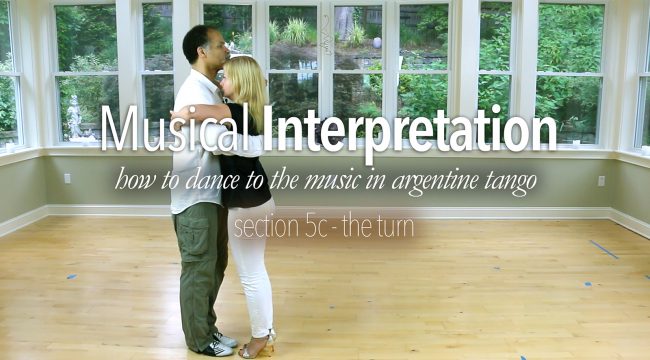
    Dearest Reader: A very important component in modern argentine Tango is the ‘turn’. Without the turn in the equation almost no one would be able to dance. Why ? While most people think or believe, and as is oft repeated, “Tango is a walking dance.” This is no longer the case. That being the state of the Tango world, then we as dancers need to understand the ‘turn’ and more importantly, how to apply it…musically. While anyone can perform a turn, which is easy once you’re over the hump of the steps you’re ‘supposed’ to do, the issue at that point is to apply it musically! And more importantly where to apply it. Today’s Tango Topic deals with the when and where but not the how. So without further yapping, a Musical ‘Turn’.

    Some Considerations. This is a subscriber based website. While there are understandably places, where unless you are a subscriber you’re not going to see all the toys. That’s not going to happen. I gotta eat just like you do you know. However rather than be stingy with this information that I paid for, I choose to share bits of that information that can help you to help yourself. However if you want all the toys, and to fully understand what I’m talking about and why, instead of cherry-picking ideas out of context, then it would help yourself to subscribe. So if this looks like an ad to you, I assure you that it’s not. It’s free information that you can use.

    Before we dive into talking about Musical Turns, we have to address a few things that will come up in reading this article –

    1.) Tango Topics does not advocate the non-musical practice that some people teach or engage in known as ‘counting beats’ but rather understanding and then employing the 5 Musical Pause Types. Everything that Tango Topics advocates musically is built off this construct.

    2.) In the instance of the Musical Turn, while we don’t have to hear a specific pause type, as is the case with the Argentine Cross, we do have to be able to hear them religiously without fail. This is one of those things that has to be so ingrained in you that you quite literally have to do it in your sleep. Sadly this process is not something that you can study for 5 minutes and then automagically be able to ‘get’. No! This is a process of a.) understanding. b.) application. and c.) practice, practice, practice with LOTS of corrective feedback. Fortunately this website has the necessary tools to help you to learn to discern this information for yourself! It will take you about 60 days of time to get the idea and once you do, your dance will never be the same. Ever.

    3.) There is this erroneous belief that a lot of dancers engage in that the Lead is really the only person that needs to hear the music in order to access it. So the Follower shouldn’t really engage in hearing the music at all. They should just Follow what is being led. Ahem. This is so much of a ‘Not’! This article and nearly every article on this site advocates the role of the Passive Follower and the role of the Active Follower, and the role of the Follower in general. You’ll notice that nearly every article starts with the Follower’s Perspective because it’s that important! Here, in this instance, the reality is that the Follower must hear the beat. While they don’t necessarily need to hear the structure of the music, they do need to be acutely aware of the beat, and more important than that the time signature of the music. Constantly.

    What is a Musical Turn ? First and foremost it is a ‘Turn’ or rotation that that the couple initiates within the line and lane of dance that can exist in one of three places in the music. 1.) The space between the musical pauses (which is what typically occurs). 2.) The actual musical pause itself, this is known as turning ‘On the Pause’. Or 3.) The notes just before or after the musical pause. 🙂

    Secondly, a Musical Turn is a construct that starts, and ideally ends, on an accented note. That accent can be but is not limited to a Strong 1 of a 4 count, or it could be the odd lone accent note. However it can almost never exist inside a Sincopa structure, not without breaking the turn into paired movements. It can never exist inside a La Variacion (not socially) not without massive modifications to the structure of the ‘Turn’ in order to match the speed of La Variacion, and not without exacting precision in the execution of one’s technique. Otherwise it looks sloppy and appears ‘off’. A ‘Turn’ could be done off-beat, meaning on the upbeat and not the downbeat. However doing so can look, and more importantly ‘feel’ out of place. The only reason to do this is to extend your musical abilities, to flex your musical muscles. In other words, because you can. Which is to say, that just because you can do a thing, doesn’t mean that you should do a thing.

    In Tango music we typically walk on the strongest 1st note and the weaker 3, always. Hardly ever do we walk on the strong 2, and much weaker 4 (especially if it’s Biagi). In Vals we have several options where we can walk on the 1 (which is what typically happens), or the 1-2, or the 1-3, or the 2-3. However this article will not cover those aspects, as dancing to Vals is a whole different idea all together. Nor will this article cover Milonga, again…very different ideas and dynamics.

    Thirdly a Musical Turn can be but is not limited to, as the accent of the dance itself. Because Tango is no longer a walking dance, but in fact a turning dance, the turn itself is the accent itself and becomes the entire construct of the dance.

    What is meant by the word ‘Turn’ ? Most people when they hear the word ‘Turn’ they think of The Follower’s Molinete/Lead’s Giro construct. There’s a good reason for this line of thinking, it’s because this particular type of turn is the first turn that most people are taught. It’s also the one that they see repeated over and over again all night long while social dancing. It is the ubiquitous and common vocabulary. What they may not realize, what you may not realize, is that there are 7 other common turns that we have to choose from. Which are, in case you’re wondering: 1.) Walking Turns. 2.) Calesitas. 3.) The Linear Ocho Cortado or Circular Ocho Cortado. 4.) Rock Step Turns. 5.) Colgada & Volcada Turns (including Single Axis Turns which are in the Colgada family). 6.) Media Lunas (or “half-turns”). and finally 7.) The Milonguero Turn. If you’re having trouble visualizing these ideas, please visit the links so that you can see them in all their glory. 🙂

    It’s important to recognize that we don’t just want to employ one single type of turn constantly. Further that sometimes it’s judicious for floorcraft purposes that the ubiquitous Follower’s Molinete/Lead Giro may not work due to space, time, and the ability of the dancer isn’t quite up to snuff (yet). So for these two reasons it’s important for us to begin to employ other types of turns and make it so that we’re just as facile with these other types of turns to create facility in our dance from a leading perspective as well as from a following perspective.

    About The Video. This video package comes in at 34m:57s in length in 3 Sections.

    Section 5c1 – Turns – Not Technique – 00:06:51
    Section 5c2 – Turns – With a Metronome  – 00:20:57
    Section 5c3 – Turns – With Music  – 00:07:09

    Pre Requisites for Musical Interpretation Section 5c

    1.) Musical Interpretation 1 & 2 with the 6 Walking Systems
    2.) Musical Interpretation 3 & 4 with Alternation & Symmetry
    3.) Musical Interpretation 5a with Traveling Ochos
    4.) Musical Interpretation 5b with The Argentine Cross

  • The Structure of a Song (and a Tanda).

    The Structure of a Song (and a Tanda).

    Of all the articles that I’ve written about in Tango and of all the videos I’ve shot, this is probably the most controversial and most seminal work I’ve ever done. Not because it is groundbreaking. It is. Not because it shows deep technique. It does not. It is because it goes against everything that you have been socialized to do. Note what I said there > SOCIALIZED to do and everything that every teacher has ever told you to do! What follows is one method of how to interpret the music. Buckle up!

    A song in Tango (the genre, not to be confused with the entire idea of tango music), consists of 5 to 6 musical paragraphs. Those musical paragraphs are generally 6 to 8 phrases in length. Each one of those phrases is punctuated by 6 to 8 musical pause types based on the 5 Musical Pause Types of Argentine Tango music (See article). 

    SIDE BAR: It should be made clear that the ‘phrases’ that you’re used to identifying in the 8 Count Beat Methodology ARE NOT THE SAME phrases as the phrases in the 5 Pause Type Methodology. The reason ? In the 8 Count Beat Methodology, they’re arbitrary markers that are independent of the structure of the music > IE — Every 8 beats you change regardless of what’s happening musically. Typically that methodology does NOT respect the CHARACTER of the music. Further still that methodology leads to the typical A/B methodology which again does not respect the aforementioned. The 5 Pause Types Methodology does! So that pauses and phrases are actually representative of the music and structure.

    From this idea, we can start to think about how best to: a.) Structure what we’re doing. And b.) answer the all-important question that every Lead has at the beginning of their tango lives, “What do I do ?”.  As time passes, they ask that question less and less. The answer reveals itself through repetition of what works for them, and more importantly, what no one complains about.  They develop patterns, ideas, and things that they believe have succeeded.  They actually don’t know if any of what they’re doing has succeeded because they haven’t done any investigation to ask the question. And even if they do, they look for confirmation bias to confirm their belief that X is in fact true. While all that is happening, if it happens at all, there’s a lot of fumbling around in the dark. There is some trial and error. More error than trial in most cases.

    In this article, we are going to answer a very basic question: “How Do I Dance The Structure of a Song?” And if we extend the idea beyond that, ultimately the entire tanda! Also, in this article, we will continually reference the ‘FIRST DATE’ mindset. 

    First and foremost, if you’ve gotten this far and are wondering “What on earth is this Five Pause Types thing that Miles is yammering on about ?”, then not only have you not been keeping up with the Madness that is Miles Tangos (mad in his own mind for certain), but you have certainly been missing a few things. So it is STRONGLY RECOMMENDED that you go down that rabbit hole  before you do anything else. Why ? Because everything that I will talk about from this point forward uses that as a reference point. If you fail to understand the 5 Pause Type Methodology, you’re going to miss the whole nine yards of this article. In fact, it’s the underbelly of the whole thing. 

    Secondly, this article and the video go hand in hand. Further, they invoke a rule-based system to guide you into working structures that you do not want to violate for now, until you are very familiar with the idea.  Also, don’t believe for one instant that I don’t practice what I preach. I do constantly. This isn’t a case of do what I do and shut up about it. Everything that you see in the video, I do constantly. 

    Next, this is NOT a technique video at all. It is, however, assumed that you have more than a passing understanding of proper tango technique. But also the 5 Social Figures of Argentine Tango. If you don’t, then this video may be more than a little confusing to you. If that’s the case, then I strongly suggest you put this idea aside for a while until you do. Because the things that I am going to suggest here are going to run counter to everything you’ve been told. You have to have been dancing for a while to develop a sense of the Milonga environment as well as having a command of the vocabulary used in that environment. This isn’t a sales pitch — BUT it is strongly recommended that you subscribe to the site, become a paying subscriber so that you can see and take advantage of the materials that the outside user doesn’t have access to like > THE FIVE SOCIAL FIGURES of ARGENTINE TANGO. 

    Next, it is assumed that you will be dancing in Close Embrace. While these ideas can be applied to Open Embrace dancing. The very first suggestion will seem more than a little ‘creepy’ if done in Open Embrace. So you may have to modify these ideas for such. 

    Next, it occurs to me that we do need to talk about what LANE this all takes place in. In my mind, I’d like to see this done in the outer track. However, I know some of you folks like to be in the inner tracks. Do as you wish here but I always dance in the outer track.

    Next, we have to Floorcraft issues with this stuff. And so that we’re clear here, do not confuse the complete idea of Tango Floorcraft as just a spacing issue here. It’s not. This is stuff is all about Floorcraft. You must keep time, make safe, choreograph, and keep things moving in the line of dance at all times. And sometimes that means stretching things out to fit within the pauses and or the paragraph. And sometimes that means shortening them to fit, which may mean dropping certain ‘fluff’ or ‘filler’ ideas. 

    Lastly, it is also assumed that you have a clear and present understanding of Intention-Based Dancing. Meaning that you do not use resistance, tension, force, your arms, hands, or fingers to direct or indicate to your dance partner what you would like them to do. If you do not, then pushing and pulling your way through these ideas defeats the entire purpose of the instruction set, which is easeful. And resistance-based dancing is NOT easeful. In fact, it’s downright stressful. 

    That said, let’s dive in. 

    The First Song of the Tanda. 

    There are a few assumptions that we need to address in what follows. a.) You cabeceo someone and then walk around the floor (not across) the floor to get to them. b.) This is the first song of the entire tanda. c.) You’ve never danced with the person you cabeceoed before. d.) This is a TANGO or VALS tanda ONLY. Milonga is its own separate thing. So you would NOT do this with Milonga at all. 

    And now for the instruction set. 

    The First Paragraph – This first paragraph suggestion is going to run counter to everything that you’ve been taught. Everything that you’ve seen socially. Why ? Because your first instinct with your partner is going to be to get on the floor and get moving immediately. And under normal conditions, with a crowded Milonga and soon to be a crowded floor, this advice is not only to hold up the line of dance, it’s going to piss off a lot of people that want to get moving and do their thing. The mindset ? It’s the complete opposite of what you want to do and why!

    I want you to imagine that you’re on a first date with someone and you’re just getting to know someone. Question: Do you show that first date your most intimate of intimates right off the bat or do you wait a little while to fly your freak flag ? I’ll put this another way, when you invite a new friend over to your place, do you clean up first so that they don’t think you’re a slob or do you let them see how you really live ? Most people, most sane people, want to put their best foot (no pun intended) forward. With that spirit in mind, you are going to do something that seems on the surface so whacked that you will reject it out of hand. And what’s that ? The Advice > You’re going to spend that entire first musical paragraph getting into the embrace with your partner.  You’re literally going to burn that entire first paragraph doing nothing but getting into the embrace and getting comfortable with your partner.

    The Reason > I know there are a lot of people that will radically disagree with this instruction. And I also know why they’ll disagree with it. The most common reason being that if you take that amount of time, you’re going to piss off the LINE of people trying to get onto the floor. True. Further, I also know that it will seem creepy. Also true! I also know that some will see it as controlling and controversial. All true. So why do it ? Let’s first address the floorcraft move. If you follow the instruction, you’re thinking that you are going to enter the line of dance at the general entry point. And that would be wrong. In fact, you are going to walk your dance partner ACROSS THE ROOM to the furthest most point AWAY from the entry points to the dance floor (in case there are multiples)! Secondly, the most important reason this is done is to CREATE THE CONVERSATION with your partner to that particular orchestra and that particular tanda. As we all know, going forward, not every partner is the same, and you have not danced to every orchestra with every partner. So believe it or not, you have an opportunity here to express different parts of yourself with that particular orchestra and perhaps the same partner or someone new! Again, FIRST DATE! Which I believe addresses the ‘Creepiness’ factor as well as the controversial factor. So in other words, > Sit Down and Listen! 

    You are only going to do this once, and only once. You are going to use bits and pieces of this idea throughout the beginnings of each song, but not for this length of time.

    The Second Paragraph – This is really going to a.) piss off a whole swath of Leads, and b.) Make a whole swath of Followers insanely happy. The Advice > You are going to do nothing but engage one of the 6 Ways of Walking. Now in your brain what I said and what you heard were two very different things. Remember I said above that it’s important you familiarize yourself with the 5 Social Figures of Argentine Tango ? The first figure is … say it with me > THE SIX WAYS OF WALKING. In your brain what you heard was PARALLEL SYSTEM WALKING. What I said was engage ONE of the SIX WAYS of WALKING! It’s at this point, you may not begin to see the logic of what I’m doing and why. Again > FIRST DATE territory. You are not wasting time here vamping until you’re ready. You are in fact BUILDING an idea very carefully. You are sculpting with your walk very judiciously. You are using that walk (one of the 6 ways of walking) to express the music! Now you can engage in Symmetry and Alternation if you want by switching to any of the other 4 ways of walking. FOUR ? Miles, you said SIX! Yup. I did. But you’re going to put aside one of them. In specific > The Type 3 Walk – The ‘Lazy’ Ocho. So you’re really only going to use 5 of the 6 Ways. And at this point you’re only playing with 4 of them in this paragraph! The timing ? > You want to slow things down to HALF TIME as an option. OR you could follow not the beat but an instrument on the beat. I suggest either the bando or the violins. Which is to say, when you hear either, that’s when you walk. Trust me, using this methodology, it adds a completely different character to what you’re doing and why! 

    The reason ? This gives the follower time to get comfortable with you, and more importantly, it gives you time to get comfortable with them. You do not want to rush into vocabulary here. Again, > FIRST DATE. Stop wanting to spew your wad here. Bad idea. Take your time with this stuff. Some of the most satisfying experiences we have as human beings are when we take our time with certain things. Ahem. This is one of those times. So … take your time with your walk here. You’re only going to do this ONCE, so don’t blow it. It’s a single paragraph. 

    The Third Paragraph – In most Tango Songs of 5 Paragraphs, the 3rd Paragraph is the Singer’s Paragraph. However, if there is a paragraph between the Second and Singer’s Paragraph, then you want to do this. The Advice > This is where you introduce Ochos. Now, before you get all excited — Remember this is the first song of the tanda. Also remember that you’re still on your first date. Meaning ? These are not your typical Type 3 Ocho that you use all the time. In fact, they’re a Type 2 Ocho or a Type 3 Walk known as the ‘Lazy’ or Milonguero Ocho! 

    The Reason ? We do not want to make the Follower work AND/OR jar or jostle the Follower! 

    Now, if you’re one of those Leads that has never Followed in their lives and sees it as beneath them, then what I am about to say is going to go right over your head! The Traveling Ocho is a F-ton of work for the Follower. It also causes way more problems than it’s worth — And yes I AM going to mention it — Lazy Ochos do none of that. And again, not to mention but I will, the way that most Leads use that Traveling Ocho, it’s certainly a PIA for most Followers. Here we are taking it off the table. You will get to use it later in the 3rd song of the Tanda. In this instance, we are using it in what’s called ‘Alternation’ fashion. Meaning you’re going to alternate it with a walk using the Pauses of the Paragraph as the change points. Meaning that when you hear a pause, you change from a walk to a Lazy Ocho, and vice versa. Ideally, we want to start the Paragraph with a Walk, then Lazy Ochos, and then proceed from there to the Singer’s Paragraph.

    Side Bar: There are a whole bunch of Followers that have no idea what a ‘Lazy’ Ocho is and they will default to the only ‘Ocho’ they’ve ever been taught. And for that reason you just have to roll with this one. You can not force the Lazy Ocho here. You just have to go with the idea that they understand. They’ll get the hint soon enough that what they’re doing is entirely too much work. Furthermore, and this goes right to the heart of those Leads that like to a.) talk to their Followers while their dancing — UMM … DON’T, and b.) This is not the time to instruct the Follower in the line of dance while you are dancing with them on the merits of a Lazy Ocho over a Traveling Ocho. Furthermore, Followers this is not the time to ask the question either. Milongas are for dancing — not for teaching. Not for talking. It is not a class. 

    The Singer’s Paragraph – This is probably the single most important paragraph of the entire piece of music unless this is an instrumental. In which case this paragraph will get replaced with the 4th paragraph, which we’ll talk about in a minute. And just so that we’re clear, I do NOT discuss this in the video. This is something you will only get from the article. Moving on….

    The Advice > In the Singer’s Paragraph, we are going to do nothing more than WALK USING ONE of the SIX WAYS of WALKING! 

    The Reason ? The singer is there for a reason, and primarily that’s to give voice to the emotional story of the music. The singer is telling a story, literally singing it. And because of that, we don’t want to do anything that would detract from that storytelling. In fact, you want to drop everything and literally just walk to the pauses! You can add in some variation of alternation here and there. But really, it’s all walking. My first tango teacher used to say, “The singer gets the girl for you! So let them and stop interrupting them!”. Meaning ? The singer has a beautiful voice, and you want to let that singer’s voice speak for you. And if you’re busy adding tons of vocabulary on top of that, then you’re completely missing the point of the Singer in the first place. In other words ? STFU and let the singer do their damned job! 

    Now to be fair, most people do not speak ‘Lunfardo’ (Argentine Spanish slang), which is what the lyrics are written in. And because of that, most don’t understand it nor have they spent years living in 1930s Argentina. Nor has anyone for literally decades. So some of the turn of phrase has fallen out of use, but the ideas and concepts are not that foreign to most people. Boy meets girl. Boy chases girl. Boy falls for girl. Girl breaks boy’s heart. Etc. Because of this, it’s really easy to hear the emotional content even if you don’t understand the words. You can hear the excitement, the thrill, and the loss in the timbre of the singer’s intonations. So — In this instance let the singer do their job. 

    The Singer’s Paragraph Notation. Sometimes, not always, but sometimes the Singer’s Paragraph appears as the 3rd Paragraph and NOT the 4th. When that happens, as it did in the example song in the video (Carlos Di Sarlis – No Esta), then simply follow the advice of the Singer’s Paragraph no matter where it appears.

    The Alternate Fourth Paragraph – In the case of an instrumental and NOT a singer in this position, you’re still going to walk, but you’re going to add in strong usage of ALTERNATES and INSIDE/OUTSIDE SNAKE WALKS adjusted to the Pauses. The Reason ? We are world building here. We are building up a lot of potential that we may use elsewhere, but again, remember first date mindset. The entire first song of the tanda is that first date! So we keep things insanely simple and easy. We do NOT stress the follower or the Lead. As an alternative or an expressive idea here, you can engage in walking turns using one  of the Five of the Six Ways of Walking, OR Lazy Ocho Walking Turns, OR Lazy Ocho Back Crosses Turns … What I reference on the site as Floating Back Crosses on a Circle. You can also make the choice of going half time here, respecting the pauses, and/or adjusting to an instrument on the beat! Again, dancing this way adds depth and character to the music! 

    The Last Paragraph – OK, in this paragraph you’re going to say, “This is the paragraph that we’re going to go crazy and blow my wad. Right ?”. Ummm no. Get that thought right out of your head. Why would you build all that potential just to blow it all in one singular paragraph ? In short, no. Keep in mind you still have 3 more songs to go, and keeping with the DATE Metaphor we want to do something VERY specific here. The Advice > In this paragraph, assuming there is NO La Variacion, we are going to use a structured methodology. 1.) Parallel Walk to the First Pause. 2.) Lazy Ochos to the Second Pause. 3.) Alternate to the 3rd Pause. 4.) Parallel Walk to the Fourth Pause. 5.) Lazy Ocho to the 5th Pause. 6.) And finally ending on Walk to the Cross at the final ‘BUM-BUM’ of the song. Where the Follower’s crossing steps happen directly on the BUM-BUM. 

    IF there is a La Variacion, then you can invoke Patter to adjust to the faster tempo of the Variacion but we intersperse that patter with a break, then going in the opposite direction of the patter we started with. In the end we are going to end on the BUM-BUM with a walk to the cross! So the structure should be something like > 1.) Parallel Walk to the First Pause. 2.) Lazy Ochos to the Second Pause. 3.) LA VARIACION – Patter to the left. 4.) Patter to the right. 5.) And finally ending on Walk to the Cross at the final ‘BUM-BUM’ of the song.

    You should have noticed something by now. Up until now, there have been no traveling ochos, no turns, and certainly no follower’s molinete/lead giros, no cortados, and no crosses. Anywhere. None of that stuff. As a matter of fact, this is the ONLY time when you’re going to invoke a singular cross in the entire first song of the tanda. Why ? Again beating a dead horse — WORLD BUILDING and FIRST DATE!  

    The song ends, you do NOT hold the embrace here. You release when the last note ends. Do not linger. Again, first date. You don’t want to seem too creepy.  Some people have a hard time knowing their boundaries and knowing what’s acceptable and what isn’t. So here’s my advice: The last note ends, release the embrace IMMEDIATELY. And the older you are, the more disaffected you want to be for a whole swath of reasons. Let your dancing speak for itself — not your want to hold someone. 

    The Embrace Component that ‘Breathes’.

    This is another, as we say in English, ‘Pink Elephant in the Room’. What’s that ? Your idea of the embrace and my idea of the embrace is VERY different from each other. Further the reason why this stuff matters is because you’re going to read what’s below and think that you’re doing the same thing you always do. It’s not. So I’d like to present you with another thing that has to be addressed before you make this attempt > Revisit this idea on the embrace. And when you’re done with that, look at this item on ‘2 Millimeters‘. And finally > This is about constantly re-adjusting your body position and body placement not with your arms but with your feet. The arms are merely coming along for the ride without compression, or hanging. The desirable conversation is happening cuerpa de cuerpa. The arms and hands are merely VISUAL constructs. However you continually have to reposition them for the optimal visual but at the same time, NOT use them to direct or be directed. They’re there for visual decoration, like window dressing. There will be a lot of people that will be upset by this statement. Further they’ll dismiss it out of hand because it doesn’t vibe with what they’ve been told or their own confirmation bias like > 1.) They like to believe in the flowery, emotional, experience that they’ve cultivated as reality. or 2.) Their focus is resistance based dancing that teaches and demonstrates that if you push here, and pull there that you get what you want. or 3.) They’re completely unaware of their own physicality. And that’s just the tip of the iceberg. The fact is that the embrace construct that I teach, demonstrate, and dance constantly is not an opinion or style. It’s a fact of dancing tango that is Intention Based.

    The End of the First Song.

    Let’s pause here. Just a reminder — this is a subscription site, and for that reason, the rest of this information here can only be seen by a paying subscriber. I have already released an enormous amount in this article, and not to mention this side. Which is to say if you agree with this, or just want to see how this story turns out and why, then may I suggest you pay for a month and see what happens ? At the very least, you get to read this rest of this article, and you’ll have access to all the resources here in. I’m just saying. This is not a sales pitch, however what follows after this…is one.

  • A Method for Tango Improvisation

    A Method for Tango Improvisation

    Improvisation in tango is one of the most desired skills, and at the same time one of the hardest to achieve. The reason is simple: improvisation means generating your own solutions in real time—not copying someone else’s. That’s not easy. In most areas of life—building a computer, repairing a car, writing code—it’s perfectly acceptable to copy and adapt someone else’s solution. But dance doesn’t work that way. Dance forces you into a place where you want to express an idea through movement, and often the challenge is that you don’t yet know what that movement should be or how it should unfold.

    This is why choreographing a song takes patience, trial, and error. Sometimes the path forward is a clear vision, sometimes it’s only a vague feeling. And in tango, improvisation is both the thing most dancers are chasing—because it offers inspiration, originality, and personal expression—and also the thing that is hardest to teach, harder still to execute well, and nearly impossible to replicate through traditional teaching methods.

    So if improvisation seems impossible, how do we even begin to teach it? The answer is that there is a method—but it depends on a few critical things being ‘true’: Your Walk, Your Embrace, Your Vocabulary, and Your Musical Interpretation. We’ll return to why those four matter, and what “clean” really means in each case, at the end. First, let’s look at the actual pathway: how improvisation can emerge from the simplest movements you already know.

    By ‘true’, I mean ‘clean’, ‘consistent’, ‘clear’ WITHOUT > resistance, tension, force, compression, one’s arms or fingers to direct or be directed, hanging, pulling, pushing, or leaning. More on this later – see ‘The Pink Elephant In The Room’ below. 

    The Tango Topics Method of Tango Improvisation.

    This method uses extensions, dissociation/applied dissociation, and individual component movements, as well as Beat and the 5 Pause Types as the building blocks for generating a type of improvisation that can be combined with contemporary tango vocabulary to generate a dance that is easily accessible and very familiar with near-infinite possibilities!

    You’re going to have questions, like “what is defined as a ‘component’”? We’ll get to that in just a minute.  

    There are several primary goals with this kind of improvisation:

    i.) Give the dancer an easy pathway to being ‘creative’ with their dance, while at the same time generating order and/or structure with their dancing that is easily achieved.
    ii.) Create relief from the ’same-ole-same-ole’ that you see all too often > turn to the left, turn to the right, walk, turn to the left, turn to the right, walk to the cross. Repeat. 
    iii.) Use familiar vocabulary that the dancer already knows without adding anything else to their equation. 

    A Thought Experiment, Part 1: Components as Building Blocks

    Stick with me on this one, because this is the foundation of the whole idea.

    Imagine you’re in the line of dance with your partner, walking on the beat, respecting the pauses and musical paragraphs. At the next available pause, you choose from one of the familiar movements you already know. Maybe it’s a 2-, 3-, or 4-track Parallel walk. Or perhaps a Cross-system walk. Maybe Lazy Ochos, or one of the Inside/Outside Snake Walks, or one of the 6 Alternate Walks. Or in other words, 1 of the 6 Ways of Walking.

    At the next pause, you switch to one of the 8 Types of Ochos. At the next, one of the 8 Common Turns. At the following pause, perhaps any of the 8 Types of Ocho Cortados. Then maybe you spice it up with a piece of specialty vocabulary — a Gancho, a Boleo, a Sacada, a Colgada, a Volcada. Finally, at the close of the musical paragraph, you resolve with one of the 256 Types of Argentine Crosses.

    These 6 categories — Walking, Ochos, Turns, Cortados, Crosses, and Specialty Vocabulary — are what I call COMPONENTS. They are complete structures in themselves, and you can use them to fill the space between pauses, matching steps to beats, rhythmical structures, or instruments.

    This is, in fact, how most dancers work: they string together full components from start to finish, without variation. It feels safe, predictable, and familiar to dance that way. 

    However, this is NOT improvisation! While there is freedom to do what you want, you’re typically following someone else’s idea of WHEN to do X, Y, and Z. This is known as the A/B methodology of Musical Interpretation. 

    A Thought Experiment, Part 2: Elements Inside Components

    Now let’s zoom in. Let’s take one of those components like the Follower’s Molinete to the Lead’s Giro (a type 3 turn in Tango Topics lingo).

    Most dancers see the Molinete as three steps: forward, side, back — usually in the sequence back/side/forward, repeated around the leader. That’s the component view.

    But each of those steps is made up of smaller elements:

    1.) Intention (forward or back) and Opposition.
    2.) Extension (sometimes called projection).
    3.) Weight transfer.
    4.) Collection or passing through collection.
    5.) Disassociation or applied disassociation (for forward and back steps especially).

    So instead of only seeing “three steps” we see the five underlying elements that make them possible.

    Now here’s the key: What if, instead of always completing the full Molinete component, you started to dance the elements themselves? What if you mixed elements with components, or alternated between the two?

    Answer: You’d suddenly have more variation and more possibilities than you could ever exhaust — without adding a single new step, figure, or pattern!

    In other words, you already know everything you need. You just, more than likely, hadn’t seen the complexity hidden inside the familiar!

    Bridge to the ‘Rules’.

    So where does this leave us? We now know that tango isn’t just about stringing together components, and it isn’t only about breaking them down into elements. Improvisation happens when you choose—sometimes a full component, sometimes a single element, sometimes a mix of both.

    But choice without structure quickly turns into noise. Too many options can feel overwhelming, and without direction, variation becomes chaos.

    That’s why we need a framework. Not restrictions, but a set of simple guidelines that hold the dance together while leaving room for creativity. Think of it as structured chaos: freedom inside clear boundaries.

    The Four Rules of Tango Topics Improvisation Method.

    Closing the Circle

    If even one of these is missing or muddled, improvisation becomes fragile—because tension, imbalance, or unclear signals muddy the choices. But when all four are reasonably clean (not perfect, just clean enough), the rules of improvisation suddenly come alive.

    That’s the pathway. Not memorizing endless figures, not copying someone else’s choreography. Instead, using what you already know—refined, cleaned, and recombined—to create improvisation that is personal, musical, and endlessly variable.

  • Musical Interpretation – Parts 3 & 4

    Musical Interpretation – Parts 3 & 4

    One aspect of Musical Interpretation that almost never gets talked about is the how you actually Interpret the Music. How do you develop the skills necessary to allow you to interpret the music in such a way as to make it structured, clear, clean and most of all appear ‘fluid’ ? How do you do that ? That’s what workshops and classes are for, right ? Yes and no. The ‘Yes’ part should be self-explanatory by isn’t. And the ‘no’ part requires a bit of history (see Parts 1 & 2 for that).  The long story shortened is that as you’ll see below, most Tango ‘Musicality’ classes or workshops are all on ‘Aspects’ of tango music not what you do wiht the rest of the song. This series is on the what you do with the rest of the song! 

    Today’s Tango Topic takes shows you the meat and potatoes (as it were) of one way on how to Interpret the Music, with the end goal to create a structured process that allows us to make free choices instead of haphazard choices that don’t necessarily fit what’s going on in the music. In one respect this is about training you, and in another, this is about conditioning you or in this case re-conditioning you to respond in a very structured manner. For most people when they begin this process of Musical Interpretation they are rightfully overwhelmed by the sheer volume of the problem. How do you interpret the music when the topic of Tango Music is so vast ? How do you even begin to tackle the problem because not only is Tango Music vast (over 90,000 pieces and counting, and only a fraction of that we actually dance to on a regular basis) but it’s also insanely multi-layered, and multifaceted? If you thought the vocabulary and the execution of technique was the unending onion, the music itself will drive you right over the wall of madness! How do you solve a problem this vast ?

    There is no one way to interpret the music. There is no all-encompassing methodology to interpreting the music, no ‘one-size-fits-all’. There is no ‘right’ and there is no ‘wrong’. There is only desirable and less-than-desirable, so get that thought right out of your head! There are many ways to interpret the music. Some of them are desirable, and a good portion of the processes that you’ve likely come into contact with are less-than-desirable. And there’s a really good reason why they’re less-than-desirable. It’s because they only address a piece of a particular aspect of the music. For example: What do you do when you hear a Sincopa in the music ? (Hint, there are several things you can do)

    video
    play-rounded-fill

    Answer: One thing you can do and should do is once you hear it, once you are able to recognize the Sincopa (there are 4 types by the way), you can’t walk through it, and yet…that’s exactly what most people do. They walk right through it. Most are confused by the idea of Sincopa. However, Sincopa, is an aspect of the music. It’s not the entire song! What do you do with the rest of that piece of music ? Wander around for 2 minutes waiting for the Sincopa to happen ? No. That’s where Today’s Tango Topic comes in. It, or in this case, theydeal with how to handle the rest of the song! Today’s Tango Topic is about two co-interdependent topics that create the necessary stepping stones towards Interpreting the music fluidly, Alternation & Symmetry.

    Before We Go Down The Rabbit Hole. Let’s be clear about the end goal here, the thing that we’re really after: To be able to freely, and fluidly, interpret the music so that our dancing matches what we hear in the music, and then (here’s the hard part) are able to execute that idea musically. HA! Easier written/said than actually done. The methodology on how to do that was covered in Musical Interpretation Part 1 and Part 2. If you’re not familiar with it, please go read it thoroughly before you proceed here. It is a pre-requisite.

    However, before we can get to the ‘freely and fluidly’ parts, we have to jump through some hoops for the ‘interpretation’ stuff to actually work on a social dance floor, otherwise, you’re quite literally going to waste your time. First and foremost you absolutely must be able to properly identify the 5 Pause Types, religiously, without fail! You can not and will not be able to interpret the music without them. Everything, everything that Tango Topics talks about musically is built off of this construct. Failure to be able to identify without fail every single Musical Pause in a particular piece of music (Tango, Vals, Milonga, Tango-Milonga, Tango-Vals, Milonga Criolla, Milonga Porteña, etc) and you’re just pissing into the wind, and what Follows will be a complete waste of your time in reading this stuff. Put another way, so that you get the gravity of the situation. Can you correctly identify the 7 pauses in the following piece ?

    video
    play-rounded-fill

    If so, then you can move on to the next stage of your tango development, interpreting the music. If you can’t, then you’re going to have a problem with today’s tango topics. Why ? Because the topics are based on the idea that the pause must be respected, it’s what breaks up the music into logical, bite-sized chunks that make it accessible to us. Instead of arbitrary 8 count that may or may not actually be present in the music which may or may not have an actual relationship to what you’re hearing in the music. The 5 Pause Types are really markers, and while the piece above only shows you 2 of the 5 (the 1st and the 4th), they’re common enough markers that you should be able to distinguish them. However, doing so religiously ? That’s an entirely different prospect.

    Secondly, you must be well versed in the 6 Ways of Walking (from a Leading and Following perspective). This is about walking, not Turning, not Sacadas, not Volcadas, not Ganchos, not Paradas, none of that stuff, but Walking with your partner. Elegantly. Cleanly. Clearly. Tango is by its very nature a ‘walking’ dance at its core. While modern Tango has become a dance all about the turn due to the fact that the ronda doesn’t actually move anymore, and due to the fact that Gustavo Naviera made the Follower’s Molinete ‘sexy’, but instead it does not move so we have to find other things to do while we’re not actually going anywhere, the foundation of that movement is still ‘walking’. So it serves our ultimate purpose to understand, and more importantly, be able to execute the 6 Ways of Walking from either perspective of Leading or Following. Religiously! Failure to do so and you’re not only pissing into the wind but having said piss splatter back at you! Not a pleasant thought. You must, must, must be able to execute a clean, clean, stable walk without hanging, without pulling, without pushing, without compression in any way, shape, or form. Failure to do so, and again, more piss in places you don’t want anything to do with!

    These two points cannot be stressed enough. 1.) The 5 Musical Pause Types. and 2.) The 6 Ways of Walking are PREREQUISITES to further going down the rabbit hole here. That said, proceed at your own risk of further confusion. Hence the reason why this part of the topic today is called BEFORE We Go Down The Rabbit Hole. You have been warned.

    The Topics of Alternation & Symmetry: In their simplest forms, these ideas by themselves aren’t all that exciting, and if we’re being really honest, once you see them you’re going to say to yourself, “I don’t get it. Why is this stuff important ?”. Remember that Alternation & Symmetry are only a stepping stone to our ultimate goal of dancing ‘fluidly’, and seemingly freely, but with STRUCTURE! This stuff (Alternation & Symmetry) is that Structure that you’re looking for! It’s the very heart of Structuring Tango Music. Well, truth be told, far more Symmetry than Alternation. These concepts and practices are the answer to the question, “What do I do with the rest of the dance ?”! That said, let’s define these ideas:

    Alternation: At its core, Alternation, is exactly what it sounds like – Alternating between two ideas or in this case, pieces of vocabulary. You pick two pieces of vocabulary and then ‘Alternate’ between them. That’s it. It couldn’t be any simpler than that.

    Symmetry: Symmetry, on the other hand, is where we start to invoke a little bit of actual structure, and some rules! 5 of them in actuality. But before we get to that part, Symmetry is best defined as ‘executing’ Alternation in mated pairs.

    That’s it, that’s all there is to it. You can stop reading now. Back to dancing. What a complete waste of your time, right ? Yup. Sure was. All that build up so that you could basically get to Alternating between two ideas, and then making it Symmetrical. Ok. Duh. So why on earth do you need a video on this stuff ?

    Stop and think about it for a moment, do you actually know what it is that you’re Alternating ? or making Symmetrical ? or for that matter why you want to do it in the first place ? Well, of course, the 6 Ways of Walking right ? Not so fast. Yes, and no. Yes, because this is all about walking. And ‘no’ because there are some rules at work here. So you go right ahead and alternate this stuff until you’re blue in the face and see how far that gets you! You may come up with some interesting ideas but until you have mastered the 6 Ways of Walking (told you that you were going to get beat over the head with this stuff), and until you have mastered the 5 Musical Pause Types, Alternation and Symmetry are a complete waste of your time. Remember this is not about dancing to an ASPECT (remember ‘sincopa’ ?) in the music, but what you do with the REST of the DANCE! To be fair, Alternation and Symmetry does not deal with the end of the Musical Paragraph (see section 5), nor does it deal with the very important structural components of the song (see section 7), nor does it deal with how one goes about mapping a song (see section 8), nor does it deal with Accent notes (Section 7), nor Sincopa (Section 7), nor the specifics of a Turn (section 6), nor where (not how) you place an Argentine Cross! (see section 6). So you can alternate until you’re blue in the face, but knowing where this stuff exists and why creates the structure that we’re looking for.

    About The Video. This video package comes in at 54m:22s in length in 5 Sections.

    Section 3a – Alternation – The Basic Idea – 00:14:35
    Section 3b – Alternation – Walking Ideas – 00:06:10
    Section 3c – Alternation – With the Music – 00:08:21
    Section 4a – Symmetry – The Whole Ball of Wax – 00:17:17
    Section 4b – Symmetry – With the Music – 00:07:59

  • Teaching Musical Interpretation

    Teaching Musical Interpretation

    First let’s get a few things out of the way, more than likely you are thinking about ‘Musicality’ when we invoke the clearer and much more direct implication: Musical Interpretation. Yes ? If so, then understand that what you’re actually saying when you invoke this term is that you want to ‘be’ music. Which is entirely impossible. You can dance to the music, you can write the music, you can listen to the music, but ‘be’ the music ? Not unless you’ve become a sheet of musical notation of late. No. You can not ‘be’ the music. Sorry. This reality of specificity is exceptionally important when teaching Musical Interpretation.

    Secondly, Tango Topics does have a Tango Music Section, it has a library of over 1000+ pieces that are updated with some frequency. It also has a collection of tango music educational videos that were part of the Tango Intensive and are now available to paying subscribers. This Tango Music Archive and Educational Tool is constantly being expanded with new quizzes and video resources to help you to hear what is probably one of the most underused and misunderstood aspects about Tango music: The Musical Pause. One student asked me once, “how do you hear something that isn’t there ?”. Answer ? By learning that there are tell tale signs, markers really, that are indicative to every type of Musical Pause. There are 13 of Musical Pause types in Argentine Tango, with 5 common ones. It’s the 5 common ones that we study at first, and then practice hearing, and once you begin to hear them, you will start to do things dance-wise that you never thought of before.

    Thirdly, there are a number of Tango teachers out there that teach the idea of the 8 count beat. There’s just one tiny little problem with this idea. Fully 60% of tango music does not contain an 8 count beat in a specific measure, nor is it consistent! That number includes Tango-Valses, Tango-Milongas, Milonga, Vals, and the Tango-Foxtrots which are erroneously played as Milongas which aren’t Milongas at all. Again, this stuff is in the music library and the educational tools.

    Lastly, in the last few years there has been an outgrowth of books on Tango music, these are more about the histories of these musicians and their life stories more than anything else. Do not confuse these with learning or studying the music. At the same time, don’t mishear this last statement as bashing or disparaging these valuable resources. Learning the histories of the orchestral leads, and what their music was all about is a vital and insanely important part of educating yourself about Tango Music. Once you understand the man and his musical tastes, you have a bare hint of the musical tapestry that you’re dancing to, combine this with knowing where the musical pauses are at and you’re onto something! Something that can quite literally change your dancing life. Mind you, again, this is all included in the Tango Music Section of Tango Topics, it’s part of Tango Del Dia – 30 days, Tango Del Dia – 15 Days, and Tango Del Dia – Advanced. Each Tango Del Dia has a section that requires you to go out and find the requisite information (which is available on the web in multiple places) and educate yourself about the composers and orchestral leads.

    If all of this sounds like an Ad for Tango Topics in one respect you’d be right, and in another you’d be wrong. How’s that ? The right part is that it is informing you that said musical resource on Tango Topics is already there and growing by the day. The wrong part is that the I’m laying the groundwork for the statements below:

    The Real Challenge

    1.) Learning the Pauses. First let’s dispense with the fact that you ‘Yes you must know where the beat is at’! That’s a given. Tango Topics does an adequate job of giving you the tools to hear the beat, not to mention describes what the on or down beat is, also what the off beat is and how to hear it, as well as the tempo of the music, and the frequent error that happens in relation to ‘tempo’ for a lot of people when hearing and then dancing to the music. Learning the Pauses is only one method of learning the music. The other major method is to memorize, note for note every tango song. Good luck with that. Learning the Pauses method (or the Tango Topics method), is all about hearing the markers that are there. They’re present in EVERY piece of tango music. Every. Single. One. In 10+ years of study and practice, since I came up with this idea, I’ve listened to over 10,000 pieces, and each and every one of them contains these markers. Learn the markers, and cool things start to happen to your dancing, and not just from a Leading perspective but also from a Following perspective.

    Frequently, all too frequently for my taste, you have tango teachers that speak ONLY to the Leads in the room, and the Followers are there as instrumentations to the Lead’s execution. This extends to hearing and executing the music as well. As a side note: I detest this way of talking about the dance. I absolutely abhor it. There is another way of discussing the roles of the dance and it’s music that does not degenderize or disassemble the dancers in this way. The role of the Active Follower, which in my opinion should be the evolutionary goal of every Follower to aspire towards being an active Follower, winds through the right of passage through the role of the Passive Follower first. But as such the role of the Follower is to not only hear the beat, and to execute it, but is also to engage with the musical pauses as well. As there are LOADS of things the Follower can engage in as those pauses occur that can not only decorate, but quite literally change the course of dance for the better. Simply by engaging the musical pauses.

    At the same time, once you hear the pauses, that’s great, but it’s not enough. You must practice this idea, constantly for weeks, if not months on end to the point where it becomes second nature in you. There are 3 reasons why we want to engage the musical pauses. 1.) To reset the embrace and to reset the couple. 2.) It is a logical place to change our vocabulary choices. and 3.) It is the beginning of what will become the structure of the dance or ‘phrasing’.

    If this sounds like a lot of work. It’s not. It’s actually a lot of fun, while at the same time being very challenging. The reality is that you don’t need to know every song note for note, just learning the markers is enough! Tango Topics has a number of free resources that if you just go register (it costs nothing), you can access the free musical resources, there’s about 10 standard quizzes that touches on this stuff. https://tangotopics.com/techniquelib… Mind you, only a registered user can see this resource. So if you go, and you get an error, it’s because you’re not logged in as a registered user!

    2.) Learning Phrasing. Once you hear the pauses, and are able to execute them, this is only the first part of the process. The next part is what you do with them! And this is NOT open to interpretation yet. There are some rules that we have to learn first that can help us to dance in a much more elegant way. However before we get there we have to first engage this idea of the Musical Phrases. Put simply the musical phrases are what happens between the pauses. So once you hear the pauses, you can infer where the musical phrases are at! Capice ? This topic should not be confused with ‘Phrasing’. Learning the Phrases is only a component of Phrasing which is the activity of what you DO with those Musical Phrases.

    And this where most people turn off. And yet it’s the place where they want to turn on. The thing that most people have in their heads about musical phrases is that they believe or think (as I did, especially the way they are explained) is that you must know note for note these specific ‘phrases’ in order to do X to them. That’s not true. It’s a complete fallacy. The reality is that this is a long process of unlearning what you have learned and then applying an idea to that musical phrase. First you must hear the pause, and what’s in between the pauses IS the phrase, now comes the hard part: What you do with it IS the Phrasing Part!

    There are several methods to creating awareness about this stuff. One of them is what’s called the Simple Musical Assignment Method which was detailed in Tango Truisms Volume 3 – Truism 1112 . Which is, as simple as it sounds, a simple replacement method. How’s that ? When you hear X in the music, you do/execute Y in your dance. Really simple. There are some obvious flaws to this idea. However, it is only a stepping stone to a much larger idea, and that’s the next method in this stepping stone approach, the Complex Musical Assignment Method. This method expands on the idea of Simple Replacement and instead of waiting until the next pause to do something you instead insert a singular complementary idea in between the pauses, there are rules to these ideas.

    Example: Assuming you hear a type 2 pause, what should come next is either one of the 6 ways of walking, or the 8 kinds of ochos, or the 10 types of turns. Pick one. However, doing so, you can choose a preselected type of complementary walk, ocho, or turn that will easily lead into the next pause! This method has some benefits that allows for greater flexibility in one’s dance, and there’s a seemingly endless variety of things to do. But there is a built-in flaw to this method. The flaw is that there is structure to a piece of tango music. And that structure must be adhered to, and this is where the last method comes into the play. 

    3.) Learning Mapping. The very last method of learning to create a successful interpretation is what Tango Topics refers to in its Intensive Sessions, as “Mapping”. This is 3 step process, that generates shall we say ‘clarity’ over what you want to do as a Lead or as Follower. It does not matter. Mapping asks the student to learn a very simple code which represents all of that stuff above, and then to map out the first 40 seconds of a song, and what they’d do it. The next part is to dance that map. What the student learns is that their idea was overly ambitious to begin with, and they realize that they have to pair it down. And this is where the real education begins. But this is only the first part of the process, because now we have to respect the musical structure that the composer intended. And now we’re thinking about planning a dance with that structure in mind (again from a leading perspective as well as from a following perspective). The very last part is dancing that structure on a regular basis! Easier said, than done.

    The End Result ? The entire goal of this process is what Tango Topics refers to as Social Dance Musical Interpretation. The goal is not to perform for the 15th row, but to make your dance fun, engaging, exciting, and a pleasant and pleasing experience. However, getting there is a long process, which can take upwards of a year of your life, which almost no one wants to do for what is essentially a ‘hobby’. And therein lay the problem of teaching Musical Interpretation! 

    Do we teach you little repeatable steps and patterns that can easily get repetitive, and highly annoying ? And in the end you end up needing more and more patterns and figures in order to make things continually exciting to your partners ? You’ll spend ooodles of money on that method. And this method is exactly the same method that every teacher wants you to invest in. I don’t. I want to be rid of you as soon as is humanly possible. Why ? Because, like you, I want to go out social dancing with nice partners!

    There is another way, and that’s the Tango Topics Method:

    1.) Learn your tango foundation (about 3 to 4 months)
    1.5.) Learning the pauses. (about 60 days ish near the end of step 1)
    2.) Then executing both roles. (about 6 to 9 months)
    3.) Add in the Simple Replacement Method. (2 to 3 weeks)
    4.) The Complex Replacement Method. (2 to 3 weeks)
    and finally….
    5.) Mapping ( 1 to 2 months).

  • Musical Interpretation with the Argentine Cross :-)

    Musical Interpretation with the Argentine Cross 🙂

    Dearest Reader: When talking about Musical Interpretation, you’re immediately going to jump to the conclusion that what Tango Topics really means when it says “Musical Interpretation” is ‘Musicality’. No. The word ‘Musicality’ means to be music, that’s what the ‘ity’ ending of the word means. Literally, (from webster’s) “a condition or quality of ‘being’ music”. Tango Topics doesn’t know about you, but we can’t ‘be‘ music. We can listen to the music, we can write the music, we can dance to the music, but we can’t be music. Notice the action verbs there ? Listen. Write. Dance. But in this case not ‘Be’.  It is physiologically impossible for something or someone to be music. Because that is the case we want to create a level of detailed and descriptive accuracy with our language, and that is to Interpret The Music. That’s what this series is all about, a way to interpret the music in such a way that no matter who you are dancing with, regardless of your role (lead or follow), that we dance in structured manner that interprets what we’re hearing into dancing format that looks exactly like what we’re hearing. 

    A very important tool to learn when wanting to expand our Musical Interpretation skills is to learn to execute on the beat, not behind it, not ahead of it, but directly on top of it. While this has been expressed clearly in Sections 1 and 2 of the Musical Interpretation guide thus far, it’s taken a whole new level here in Section 5b. Sections 1 and 2 deal with being on beat and ‘respecting the pauses‘, section 5 deals with the specificity, and granular control over when something is done, musically. In Section 5 we’ve only begun to explore the granular control aspects. Today in Section 5b, we’re continuing in that same vein. We’re playing with specific granular control (from a leading and following perspective), with a piece of well known and well worn piece of Tango vocabulary occurring in a very discrete place. The discrete place ? The Musical Paragraph Marker! And the vocabulary ? The Argentine Cross.

    From a Musical Perspective let’s address a statement made above, that is absolutely important going forward, and that must be made clear, “there are only 4 (sometimes 5 or 6) Musical Paragraphs”.

    What is a Musical Paragraph ? This is a Tango Topics construct, you will not find this anywhere else, or on youtube, nor taught by any other teacher. Put simply, a Musical Paragraph is a series of paired Musical Pauses (usually between 4 and 6 pairs in a single paragraph), that comprises one singular musical ‘idea’, or more importantly, a ‘movement’ in a song. If you stop and you analyze what you’re hearing, you’ll hear 4 distinct sections of a song (sometimes 5 or 6 depending on whether or not there is a singer), each one marked by a Type 4 Musical Pause or what Tango Topics calls “The Musical Paragraph Marker“. This type of Musical Pause serves two important functions. 1.) It is a Musical Pause in and of its own right, which means that you must respect it! 2.) It serves as the declaration between one musical idea and the next. You’ll hear this idea expressed in all 6 of the major forms of Tango Music (Tango, Milonga Porteña, Vals, Tango-Milonga, Tango-Vals, and Milonga Criolla). However the later the music within the Golden Age period the more distinct and clear it is. The earlier in the period, the more muddy it is. So how do you know that you’re hearing a type 4 Musical Pause or the Musical Paragraph ? What you’re listening for is a clear and distinct ‘bum-bum‘. While we won’t play that here for you, you’ll have to do that work on your own (or subscribe so that you can see what we’re on about), you can infer a great deal from just listening to your favorite pieces of music. However, if you were a registered user (it’s free), you would see a slightly different answer to this question here. You’d actually get an example of the Bum-Bum, but alas, you’re not so you’ll have to ‘infer’ and ‘imagine’ instead of signing up as a free user to go a little deeper. 🙂

    Here’s a hint though, go listen to Juan D’Arienzo, any of his Tangos or Valses. The reason for D’Arienzo is that his are very easy to hear for the Musical Interpretation beginner,…ummm you! Oddly enough you’ve been hearing them all along. The thing is that you have just haven’t realized it. This idea is in Every. Single. Song. You’ll hear a distinct shift in ideas where the music sharply changes and goes in another direction. The melodies change, the theme changes slight. That’s the ending of one idea, and the beginning of the next or as Tango Topics calls it: The Musical Paragraph.

    About The Video. This video package comes in at 32m:20s in total length in 3 Sections.
     
    Section 5a1 – Argentine Cross – Technique – 00:08:22
    Section 5a2 – Argentine Cross – With a Metronome  – 00:12:19
    Section 5a3 – Argentine Cross – With Music  – 00:11:39

  • Musical Interpretation – Parts 1 & 2

    Musical Interpretation – Parts 1 & 2

    Musical Interpretation. When most people hear the phrase ‘Musical Interpretation’ they usually end up looking at you with a blank stare, blinking their eyes at you now and again, until you use the word that makes sense to them: “Musicality”. And then they’re like, “Weeeeellll! Why didn’t you say so in the first place…..”, and then it’s like you’re best buddies again! 

    First and foremost, let’s get something out of the way. “Musicality” doesn’t mean what you think it does, as you’ll soon see. Secondly and most importantly the word itself means ‘to BE music’! Hmm, you can write the music, you can listen to the music, you can dance to the music, but you can not…if I am not mistaken, BE music. It is impossible. However, you can INTERPRET the Music! 

    The Workshop Problem. A class or workshop tutorial on ‘Musicality” doesn’t actually teach you about music, nor does it teach to dance to the music as a whole. A 1hr (or 1.5 hr) workshop or even a 6 week series is not going to teach you to dance to the music. The topic is wide and vast, and seemingly overwhelming. Further still, the very idea that you can ‘interpret’ the music is so far beyond most people’s understanding (or so they believe) that it overwhelms them when they begin to see the complexity of the topic at hand. 

    Usually most people’s experience with ‘musicality’ workshops that they’ve had in the past is as follows: 1.) you are first shown/taught a step, a pattern, or a figure. 2.) You go through several rotations of partners learning the step/pattern/figure. 3.) The last 15 minutes to half hour of class is showing you the same example of the figure you’ve spent 45 minutes learning only now somehow, magically, it goes with a piece of music or a style of music or an aspect that is specific to that piece of music that may sometimes occur here and there. 4.) You’re shown a few variations on a theme of the figure, and somewhere about the 3rd or 4th your eyes start to glaze over. 5.) The idea of Counting Beats is reinforced: On the 2nd beat you step here, on the 3rd beat the Follower is supposed to step there, on the 4th….and so on.

    Is this dancing ? No.

    It’s a game of Twister, only to music. 🙁

    What is ‘Musical Interpretation’ ? Musical Interpretation is a term that brings together two very different skillsets that should not be confused or co-mingled together. And they usually are, sadly. Both have to be accessed at the same time in order for Musical Interpretation to work properly, however these are two very different skills that must be pursued with all due diligence.  

    The first part is ’Musical’. Which can be, but is not limited to – Either role hears the music in a very specific way, whereby they’re collectively, and/or separately, able to hear the beat, pause, and phrase (not phrasing – that’s entirely different idea) within the overall structure of a piece of music. This is about hearing the music, and its individual components. Not acting on them, but instead hearing them, keeping track of them, and understanding what’s going on. That last part is insanely difficult to do, and takes some time to get. Sometimes, ok – a lot of the time, most people get too wrapped up in their own excitement of the next part of this stuff and never focus on the one thing that they absolutely must… AND/OR they focus on one aspect (the beat, usually) alone and believe that this will be ‘enough’. It’s not by the way. This idea is, and this is not to disparage your ideas, can be almost pedestrian in nature. We do want to aspire to something more that accentuates the nuance and spirit of the music, not just it’s beat alone.

    The second part is ‘Interpretation’, which is what you do with that beat, pause, and phrase (the ‘phrasing’, that’s the doing part of phrases) of the overall piece of music so that you see the movement or dancing part in the music. Ideally this is the desired result. However, and this where Interpretation takes on its real meaning. While you can vary that idea to express a point, a counterpoint of the music, but in the end, one is always working towards creating a larger vision of the music. Not to just visually represent the song note for note or phrase to phrase, but to show its nuances as well as its overall presence in the physical world. This is the beginning of ‘Interpretation’.

    A Few ‘Musical’ Problems. There are some problems with the Musical part above that must be addressed first and foremost. One problem that comes up a lot of people is that they’re beat challenged and don’t know it. 1.) They run too fast (ahead of the beat and actually think it’s one thing when it’s another). 2.) They run too slow (same problem as too fast, only in reverse). And/or 3.) They are slightly ahead, or slightly behind the beat, and/or running across the beat all at the same time.

    Compounding the beat problem is that most of you reading this from a Leading perspective have been taught to Count Beats which is about as useful as a small kitchen appliance that’s been unplugged. From a Following perspective you’ve been taught to “do your thing as long as it doesn’t interrupt the lead (small ‘l’, the action, and not the person ‘L’) without actually ‘hearing’ what it is that you’re ‘not interrupting’.

    Next we have the Musical Pause or ‘Rest’ issue that is frequently misread, misunderstood, or ignored completely by design or as is more likely the case, ignorant that a Musical Pause actually exists and is not arbitrary, but in fact built into the music and must be respected. But a question comes up in this, which is one reason why it’s highly misunderstood, “How do you hear something that isn’t there ?”.

    Still another issue that compounds the Musical problem is purely psychological. Some people have been told from a very early age that they can’t find a beat to save their lives. This message is so ingrained that they buy into this fallacy without question over time. Still another is that some are so wrapped up in the fear of not getting the beat, or not understanding it, that their anxiety over their inadequacy that they anticipate the beat in the wrong places, and at a the wrong times. The common solution for a lot of Leads to these problems is to learn lots of steps, patterns, and figures to mask the overall problem.

    How to Clean Up The Musical Problem ? In order to clean up the problems above, five things must happen in sequence:

    1.) (Beat Course) Clarify what the beat is, and is not, and then develop a regime to teach how to hear a beat within its proper tempo (speed) consistently. What are the markers for a beat, and what to listen for.
    2.) (Beat Course with Exercises) Recalibrate someone’s innate (and quite natural) ordering and sorting skills, as it relates to hearing the ‘pattern’ of the music out of the chaos of the music, with the goal to hearing and retraining someone to hear ‘Musical Time’.
    3.) (Pauses Course) Introduce the Dancer to the 5 Common Types of Musical Pauses that occur everywhere in Tango Music, and then practice hearing those pauses every day for 44 days with examples of Tango, Vals, and finally Milonga music of where a pause is, and then type those pauses, consistently through daily Tango del Dia quizzes. 😉 Starting with the 14 Days of Tango Music.
    4.) (Accents Course) Introduce the dancer to Musical Accents, Off Notes, La Variacion, and The Singer, and employ Tango Del Dia Level 2.
    5.) (Structure Course) Introduce the dancer to the overall structure of the music and the 6 (sometimes 8) parts of a song.

    About The Video. This video package comes in at 52m:32s in length in 6 Sections, and 8 Subsections.

    Section 1 – Opening – 00:02:48 (this video is above)
    Section 2 – The ‘What’ Part – 00:10:59
    Section 3 – The ‘What’ Example – 00:05:40
    Section 4 – The ‘How’ Part – 00:03:02
    Section 5 – Level 1 – 00:12:32
       – part 1 – walking on every beat – parallel system. (metronome)
       – part 2 – walking on every other beat – parallel system. (metronome)
       – part 3 – walking on every beat to the pauses – parallel system. (metronome/music)
       – part 4 – walking on every other beat to the pauses – parallel system. (metronome/music)
    Section 6 – Level 2 – 00:17:37
       – part 5 – walking on every beat to the pauses – 6 ways of walking. (metronome)
          a.) parallel. b.) 3 track cross. c.) milonguero ochos. d.) inside ‘snake’ walk. e.) outside ‘snake’ walk. f.) alternate walk ‘a’.

       – part 6 – example dance – walking on every beat to the pauses – 6 ways of walking. (music)
       – part 7 – walking on every other beat to the pauses – 6 ways of walking. (metronome)
          a.) parallel. b.) 3 track cross. c.) milonguero ochos. d.) inside ‘snake’ walk. e.) outside ‘snake’ walk. f.) alternate walk ‘a’.
       – part 8 – example dance – walking on every beat to the pauses – 6 ways of walking. (music)

  • Musical Interpretation with Traveling Ochos! :-)

    Musical Interpretation with Traveling Ochos! 🙂

    Musical Interpretation. Another aspect of Musical Interpretation is what happens when you start to apply very specific pieces of Tango Vocabulary to fit with the music. It is through this specificity of the vocabulary choice, and really the granular control of that specificity, not to mention the variation (and the variable control of the variation) that musical interpretation starts to take on its true purpose

    There are 4 pieces of vocabulary that embody the idea of musical interpretation that we use frequently: 1.) Walking. 2.) Ochos. 3.) Turns. and 4.) Crosses. However, those descriptives are at the 50,000 ft level. It’s more likely that we’ll use the 4 types of vocabulary or their variations: 1.) Parallel System Walking. 2.) Traveling Ochos. 3.) The Follower’s Molinete Turn. And 4.) The Argentine Cross. In Today’s Tango Topic on Musical Interpretation, we look at number two on this list: The Traveling Ocho. Tango Topics recognizes that there are 8 types of Ochos. The Ocho that you usually think of is as a common Ocho is what we call a “Traveling Ocho”, so named because it ‘travels’ down the line of dance, hence it’s proper descriptive name! The distinction is required here because of the seven other varieties such as Milonguero Ocho (sometimes called “Lazy” Ochos), Linear Ochos, or Circular Ochos just to name a few, and as you’ll see in a few sessions, that distinction is an absolute necessity to  what we want to do, which is creating variety and lots of variation as well as structure in our dance.

    To be clear the Traveling Ocho is a staple of the dance, it’s one of the primary tools or pieces of vocabylary (as noted above) that we use constantly to express our musical intents. We use it so often, so unceremoniously (not like it needs ceremony), but without care, it’s just what we do: Ochos, Turns, Crosses, and Walking. We default to these ideas without thinking about the larger picture of what we’re doing, without structure, without any thought as to how it looks, or more importantly, why we do what we do. Most often we respond out of habit, and very infrequently out of conscious thought. For most Leads they respond out of not knowing what else to do (there are other ideas that you just haven’t considered), and for most Followers its a limited palette of options, so what else could there be (quite a bit actually, but you don’t know that yet) ?

    From a Musical perspective, most people respond to just the beat and trying to be on beat. There are other options, even though this video doesn’t show those options, they’re implied from previous videos on the topic of Music Interpretation. For a greater portion of you reading this, in one respect you can walk on beat without thinking about it, it’s easy for you. And for some of you, being on beat is a challenge, and what’s worse is that you don’t know it. Now we add to this Musical perspective the Traveling Ocho! From a Follower’s perspective, they feel pressed into immediate service, especially with the applied disassociation, and thereby can’t keep up with what’s being led. More specifically their execution of their technique goes right out the window, and as a result their execution looks sloppy because they’re being rushed into service. And then there’s the other side of the equation: the Lead (the person) implies a lot of their ‘lead’ (the action) to do said Traveling Ocho, and the result looks haphazard, and off-time or offbeat and/or not even close to the beat. 

    This is the state of executing a Traveling Ocho in time to the music.

    Today’s Tango Topic deals with Section 5a of our continuing series one Musical Interpretation. Section 5 deals with 3 common pieces of vocabulary that we use frequently and how to make them musical, and how to practice them. It is broken up into 4 sub-sections this month: Section 5a (this post) is on the use of the Traveling Ocho as a tool to Interpret the Music. Section 5b is on the use of the Argentine Cross (sans the 255 OTHER Cross variations). Section 5c is on the ‘Turn’. And Section 5d puts it all together. That said, let’s get started on the Traveling Ocho in Musical Interpretation.

    About The Video. This video package comes in at 28m:38s in length in 4 Sections.

    Section 5a – Introduction – 00:02:51
    Section 5a1 – Traveling Ochos – Musical Technique/Rules – 00:09:27
    Section 5a2 – Traveling Ochos – With a Metronome  – 00:10:47
    Section 5a3 – Traveling Ochos – With a Sliver of Music  – 00:05:33

  • La Variación (The Variation of Tango Music)

    La Variación (The Variation of Tango Music)

    Years ago when we were just itty bitty tango dancers and really just starting to understand the world Argentine Tango, the codigos, the seemingly endless hours of technique classes, the social dynamics. It was all very overwhelming. On one particular afternoon after months of doing our daily music exercise (picking a singular piece of music and deconstructing it into its 4 major parts, sometimes 5). We ran across something, an artifact that didn’t make a whole lot of sense at the time. We put it aside for ‘later’. ‘Later’, came about 5 YEARS later when watching a friend’s video on youtube and them raving about this thing called “La Variación“. What in the blueblazes was THAT ? Naturally this piqued our interest and off to the races we went. A few hours later when we came up for air, we discovered that we had already discovered this thing FIVE years earlier and made a note of it to go back and figure out what this thing was. Then something else happened after our re-discovery and we wondered why it wasn’t taught, if it all. Because when you stop and actually hear it, you realize this stuff is everywhere and then it’s like the flood gates open.

    What is “La Variación” in Tango Music ? It’s a variation of the musical theme. Each piece of Tango Music has a major theme, and that theme can be ‘varied’, hence the term. La Variacion happens in a very specific place within the music. Usually near the end of the piece about 30 seconds before the end of music. Not all compositions posses one but a good portion of them do. Sometimes this variation will run at double time, sometimes even faster than that. A good indicator that you’re hearing La Variación is to listen for when the musical instruments, and in specific the bandoneons, ‘go crazy’. They seemingly speed up to an ungodly fevered pitch and tempo.

    video
    play-rounded-fill

    What you may not realize is that, like most people, you dance right past this thing all the time without paying any attention to it’s signifigance. It’s in nearly every piece of tango music, by every major orchestra, in almost every age after a certain point. If you listen to the piece above by Pugliese, which you’ve probably heard 10,000 times, and you hear La Variación, is that there is clearly a beat under it that you can walk to. And so that we’re clear, there’s nothing wrong with walking to that beat. What you can’t do is just dance past it. There’s something you should be doing to it. Actually one of two things. One of those things is walking. The other … well … read on. If you want an example of walking to the beat of La Variación in one of the more popular Variación pieces (Pedro Laurenz – ‘No Me Extraña’, and yes this is in our library for all subscribed users), look at this example, the fun begins at 1:41.

    Rightfully in today’s Tango world, with the state of Modern Tango being what it is (because it turns a LOT). It is seemingly sometimes impossible to engage La Variación due to a few factors – space being chief among them. Skill being another. Still one more is awareness (musical, partner, and space). However, the mere fact that you know that it’s there and more importantly that you’re aware of La Variación is half the battle! Mistakenly you may be tempted to think that this is just a ‘Lead’ thing. Nope. The Follower has a role here as well and it’s NOT to just FOLLOW what’s being led! This is in our opinion a very misunderstood role here. The Follower can and should dance La Variación when led to do so. This should be an awakening to the trained ACTIVE Follower in all of us that hear La Variación and want to dance to it!

    Very few teachers teach this idea of the music and the dance, for several reasons, most notably it’s fallen out of fashion. Furthermore it can sometimes be rather destructive to the line of dance IF engaged inappropriately. Still another and this is it’s Achilles Heel: It requires you to up your game skillwise. You can not simply just dance La Variación without upping the execution of your technique. Otherwise, and this is what we alluded to earlier, you look sloppy. This is the primary reason why it’s not mentioned, taught, or discussed. Typically and historically speaking, the La Variación was used in the Milongas throughout the 40’s and 50’s and much later on as Tango resurged in the 80’s as a way to ‘test’ the Lead, and really the dancing couple, to see if they had their collective sh*t together. If you danced it, and were witnessed doing so, and doing it well, you got the ‘nod’. If you danced it poorly…well…ummm…no ‘nod’. Which is to say that the other dancers in the room thought well of you, or they didn’t. You were good, but if you danced La Variación, you were …. one of the cool kids! This was a way for the dancers to test each other. To see if they could one-up each other.

    In today’s Tango world, that still happens, just less frequently, and on an informal basis between friends and dancers. In the last 2 years there has been a formalization of La Variación into a sort of competition that shows off the skills and the stamina of the dancers. Which is sort of what it was before. Bragging rights if you will. Today it’s being elevated to a whole other layer of bragging rights, a competition. If you search for it online, we’re certain you’ll run across it.

    Mind you, in the example above with Biagi, this is a slow version of La Variación, there are loads and loads of these things out there, all you have to do is listen for it. This is one more reason why you want to pay attention to the structure of Tango Music. Still one more layer to the onion that you think you’ve heard 10,000 times, but 10,00 and 1, now you hear something entirely different that changes your perspective and bam, you see that the mountain you thought you had conquered is even bigger and badder than you thought!

    Variation in Variación. In our definition of what La Variación above we stated that La Variación usually happens about 30 seconds before the song ends. There are many instances where that’s not true. It happens much sooner in a piece. The funny thing is that you hear this stuff all the time, and don’t pay any attention to it. Below is an example of what we’re on about. What we have here is an example where La Variación occurs at 1:48 into the piece! Clearly not at the end. And in such a recognizable piece. This is Juan D’Arienzo’s 1971 version of “La Cumparsita”. If you go and listen to the more popular version that you hear all the time (the 1951 or 1963 versions which are slightly different from each other in clarity and in terms what he did with the piece), you’ll hear a very clear and different idea that occurs at 1:48. The example below starts at 1:06 of the piece and goes through to lead up to the La Variación so that you hear the progression.

    video
    play-rounded-fill

    That said, it wouldn’t kill you to start your Tango Music studies with Tango Topics. We have a range of courses to help you hear the structure of Tango Music itself, as well as what to do with it using our Musical Interpretation Series.

Hide picture