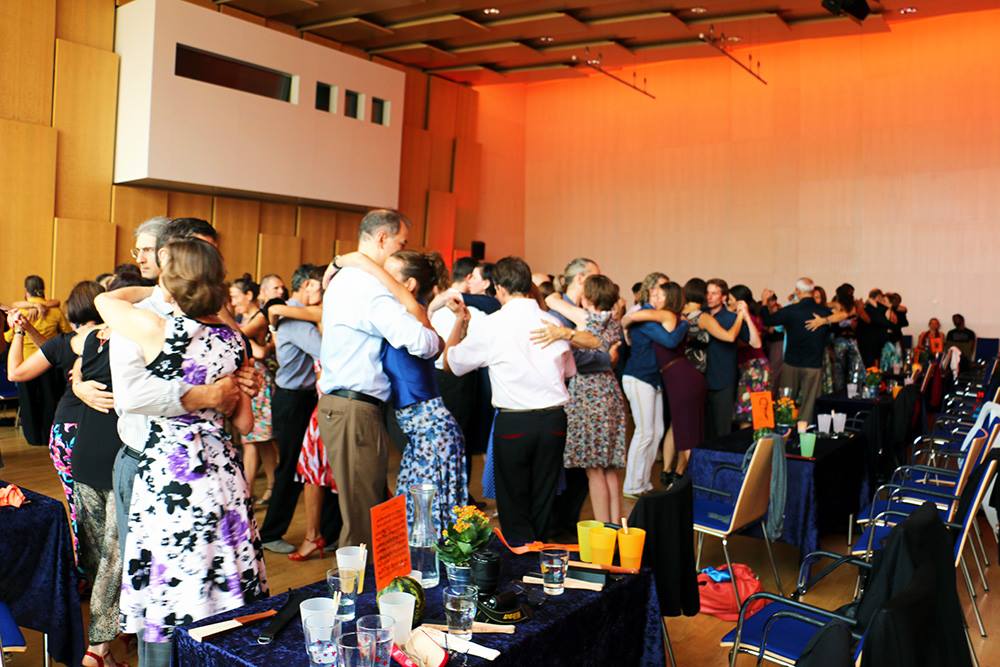
Classes Are Great

Free Registration to Tango Topics & get your free Tango Primer
For the advancing dancer that wants to go deeper you can also
subscribe and get a Gold, Gold+, Gold+Video, Diamond, &
Diamond+Video subscriptions (all in monthly or yearly formats)
Scroll down to continue your tango journey today!

Today’s #Tango Thought #002: Ballet dancers know all too well that a good dance teacher is strict, hard as a nails, and won’t let you get away with anything. That’s called “Discipline”. Because they know that it’s the details that matter the most. Note the plural. One detail by itself means nothing, a bunch of them ? That’s the difference between you and “Mmmmmmm that was lovely….”
#TangoDancing #TangoTeaching #TangoClass #SocialDancing #TangoTopics


Please fix the errors above

MORE REMINDERS

Compression

‘Compression’ means that you’re either pulling your partner into you and/or at the same time restricting their movements in a myriad of ways (hand, arm, head). As a Lead this typically manifests itself with your right forearm. As a Follower compression is typically done with your left forearm around your lead’s shoulder (tsk, tsk, tsk, it should not be there).  

Read More »

The Follower’s Work

The Follower’s Work. These words may come as a surprise to you dear reader considering that this page has seemingly ‘bashed’ or disparaged the role of the Follow in any number of ways, however: The role of the Follower is work. This is by no means a complete list, but just a taste: A Follower must master in order to ‘dance’ with a particular Lead their stability, their walk backwards, and forwards to the side without wobbling.

Read More »

Facility

Facility can be, but is not limited to, Familiarity with Vocabulary, Execution of the Vocabulary, also it’s about Balance, Equilibrium, Kinesthetic Awareness, Kinesthetic Listening, The Neurology of Leading, The Neurology of Following (which is how you respond to something from a follower’s perspective), Proprioception, and last but not least Extending Your Capabilities. We’ll get to that last one in just a bit. Two of the more common aspects of Facility are Execution and Proprioception. So let’s quickly review what Tango Topics means when it refers to these ideas…“

Read More »

The Talking Cabeco/Mirada

If you’ve been dancing a little while, or for many years, at some point along the curve you’ve heard the word ‘Cabeceo’. Which roughly translates as a slight nod or nodding of the head (Cabeza) for the Lead to invite a Follower. The Follower’s side of that same invitation is referred to as a ‘Mirada’ (to look at, or ‘looked’). It’s an oddity that almost no one knows about the Follower’s side of the equation, that the Follower can ask for a tanda, employing the same methodology. It just has a slightly different name.

Read More »

Good/Bad & Dancer/Teacher

At the beginning of our Tango lives, most people go to a Tango Class to learn how to dance Tango. Some people throw caution to the wind and just go to the Milonga and ‘learn’ on the dance floor sometimes with positive but most of the time with disastrous results. And some people take the route of skipping group classes all together and start with one-on-one sessions to begin their Tango journey.

Read More »

The Neurology of Leading – Part 2

A question that comes up for some leads, not all leads, but some Leads (big ‘L’) is why is it important that you spend a lot of time listening to Tango music, and more importantly to mark the music ? Typically you’ll hear this question as “I have a life you know ? I have things to do. I can’t sit around all day long just listening to song after song after song for days, weeks, months, marking up every song in some crazy 8 count beat sort of way, and then try to memorize all that all so….

Read More »

The Tango Haus

What’s below is a small snippet of 13m:06s audio podcast of Today’s Topic on the benefits and detractors of building community using the idea of a Tango House. “What I refer to as the Tango ‘Haus’ idea. In this case this is the German spelling of ‘HAUS’. I just like the way it sounds. But we can use the American spelling of ‘House’. So a few years back and I may be bastardizing some history here. There was a tango house, and I’m not going to name the city, that grew up out of a U.S. based city. This community, at the time had a number of teachers in its area, and they were all using the typical model of how they wanted their students to learn to dance.

Read More »

The Turning Dance

The dance is no longer a walking dance, it’s a ‘Turning Dance’. And as such that means that you need to study the Follower’s Molinete from a Leading perspective as well as from the Follower’s perspective. Why ? Because it will become your go to vocabulary choice.

Read More »

Talking While Dancing

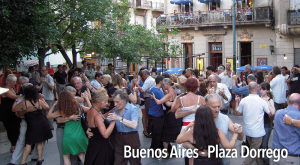
Tango is a ‘Social’ dance. Meaning that the whole reason you are there is to hang out, meet new people, and to be social with each other. The dancing part is what brings us together but it’s really about being a social creature. That’s why it’s called a ‘Social’ dancing. Social in this case means talking and sharing your day or what’s been going on with you. Mostly it’s lots of talking, sharing, listening, and more talking.

Read More »

Tango Accents

You may not realize this but you have an accent. The place that you live in, the people that you dance with, the teachers that you have studied with, and last but not least, the variation of those ideas from the original, creates a local tango ‘accent’. Every city where Tango is danced has an accent which is specific to that place and to that place alone. Boston, San Francisco, Paris, London, Berlin, Moscow, etc. They all have one, up to and including Buenos Aires, especially Buenos Aires! The difference between your local flavor of Tango and say Boston, Paris, and London, is like night and day within a spectrum of ideas.

Read More »

10 REASONS TO SUBSCRIBE

There are 4 Levels of Access: Free, Basic, Premium, and Premium+. Free pays nothing but gets a perk just for signing up. 

1.) Free Users get to see 5 of the 125 Different Tango Topics on the site. Plus you get access to the entire Tango Reminders and Tango Ideas sections of the site. These are short form Topic descriptors with a little detail about the topic and the video.

2.) 
Basic and Premium users Save A BOATLOAD of MONEY! Buying this stuff outright is expensive.

3.) Basic, Premium, and Premium+ users get access to the ALL ARTICLES and THE FULL ARTICLE which you can’t see right now.

4.) Basic, Premium, and Premium+ users have way better video resolution: Free = 420p, Basic = 720p, Premium = 1080p and 4K. 

5.) Basic, Premium, and Premium+ users get the ‘Dancing Perspectives’ & ‘The Soup’ sections of the document you just read (Lead, Follow, and Dancing) which are open to you. And that’s where all the good stuff is at. 

6.) Video Downloads! 

7.) Access to the Tango Topics Music Library (22 Curated Golden Age Orchestras)

8.) Access to ‘Tango Del Dia’ – Our Music Education System with access to 14 Days of Music, 30 Days of Music Education, and 30 More Days of Tango Del Dia. 

9.) We explain things, break the vocabulary down in a visual way, from multiple angles, showing feet, hands, and close ups! Yes there’s a lot of talking but we want you to understand what it is that you’re doing and why, not just steps, patterns, and figure

and #10:
No more annoying ads at the bottom of the page, begging you to subscribe! 

Keep something in the back of your mind: What you’re seeing in a youtube video is a couple that is performing for the 15th row for a room full of people. They’re not social dancingWhereas this website is all about ‘Social Tango’  or how to make things function on a social dance floor. Social Dance floor ? Your local milonga! They are showing you flashy moves as a presentation, to show off! But not stopping and talking about how this works which is what you need to see. This website and all of it’s content show you the how and  why you’d want to put that piece of vocabulary there, or how to make things work. This website is all about those things and more!

You could watch Tango YouTube videos and thereby spend your time, trying to infer, and figure out how things may work in that particular situation. Bend your body this way or that, twist and force this position or that. Place your foot here or there and figure it out. This is known as Tango Twister.  Which can be a lot of fun, but more than likely it won’t help you, because you’re missing something: The explanation from an experienced teacher showing you how to properly excute this stuff from a Leading Perspective as well as from a Following Perspective!

The goal of YouTube videos is to get you to study with those teachers in person. The goal of Tango Topics videos allows you to work at your own pace, in the comfort of your own space, so that you can play them over and over again to improve your understanding of the vocabulary or technique being described to therefore better your dancing experience. The goal of classes and workshops is to get you to come back over and over and over again, thereby spending more money with that teacher. This website and the videos under it are here to act as a resource for you to help you to improve your dance. Pay once and you’re done.

Eventually, one way or another you’re going to pay for this lesson, either here and now, or with them. TANSTAAFL! The difference between that lesson and this ? Is that you get to play this lesson over and over and over again. Further still, there are supporting materials (other videos) that help to explain the language and the underlying technique of how and why things work, so you can easily reference those things in the corresponding articles that go with the material, and or any language in the Tango Topics Dictionary. 

DROP ME A MSG HERE

Hide picture