Floorcraft

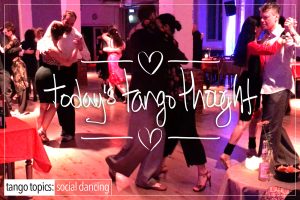
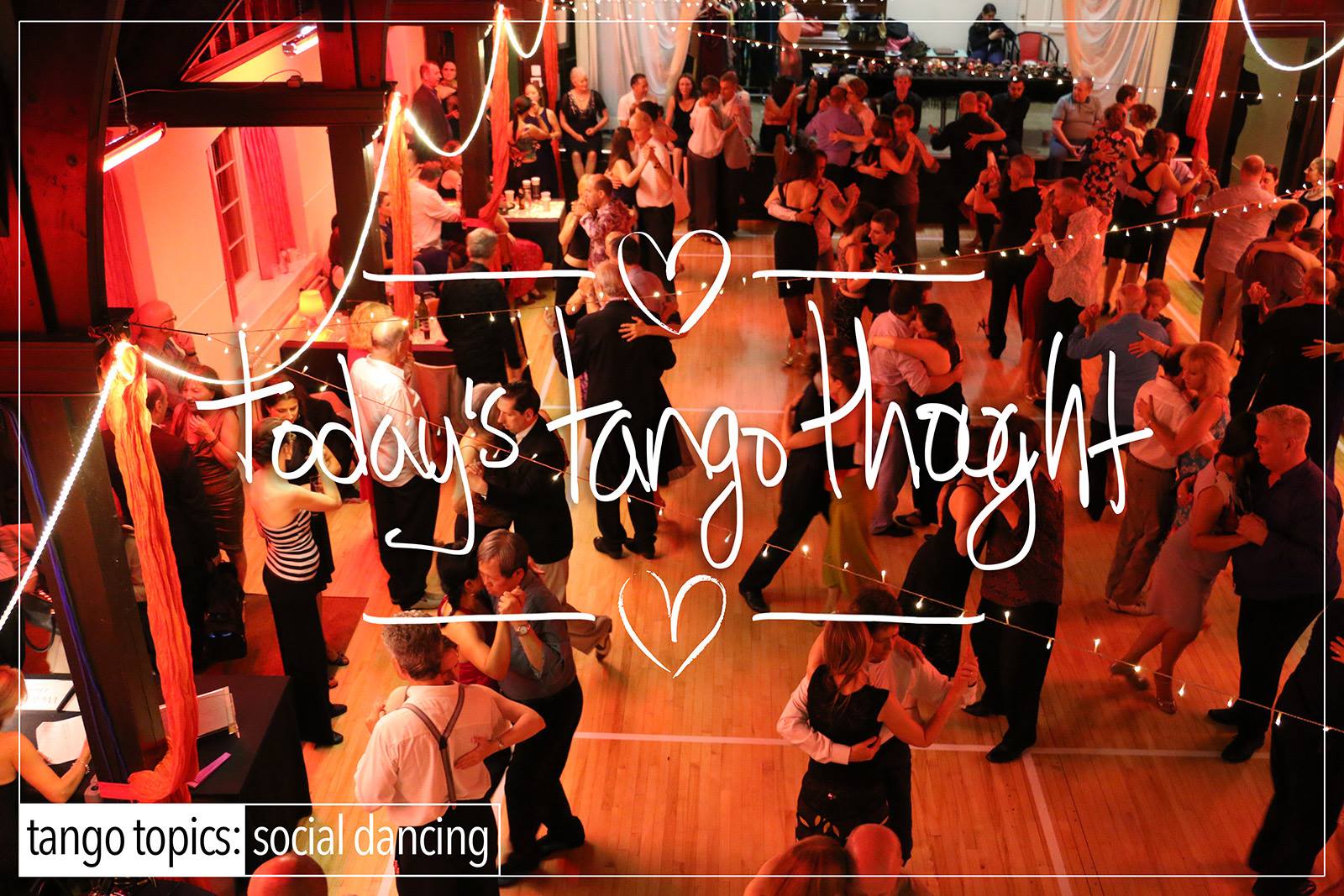
Floorcraft” best defined, in layman’s terms, as: Following the couple ahead of you, trying not to hit tables, chairs, or to bash your partner into anyone or anything, whilst simultaneously using non-repetitive vocabulary, in time to the music, all while keeping the rotunda moving. That definition is a bit simplistic. And the reason is because the term itself is wide ranging and covers a lot of ground. Here’s another that still quite broad but closer:

How to navigate the floor while dancing with your partner and not hitting the couples ahead, or behind you. As well as not touching the tables, and chairs. All the while interpreting the music, concurrently interpreting the beat and the musical pauses to fit the tango vocabulary while maintaining the spacing between the couples.

However, a.) That rarely if ever happens except at Marathons and Encuentros. b.) Floorcraft is almost never mentioned at Milongas. and c.) The only time that your teacher mentions it is when they’ve been reminded of it by some online post like this one, and then they pay it no mind because it generally conflicts with step/pattern/figure that does not in any way, shape, or form fit within the line and or lane of dance that you as a Lead or a Follower are dancing in. Generally speaking.

Floorcraft by its very nature is a recent construct of the dance, we did not need to discuss this stuff about 50 years ago. Why not ? Because at that point in time, the Ronda actually moved. In the tango world of today, it does not move. At all. If ever. There is a lot of grandstanding. There’s way too much vocabulary. Too much “flashiness”.  And probably the biggest problem, way too much Turning, instead of walking on the beat, the to pauses, within the phrases moving down the line of dance.
MORE REMINDERS

Wood Floors

The toy of choice for most dancers is a ‘Sprung’ floor! That’s a work of art, science, and pure magic. Sprung floors are to dancers, what honey is to bees.  A ‘Sprung’ floor ? What’s that ? A Sprung floor is a dance floor that easily absorbs shocks, giving it a softer feel. Such floors are considered the best available for dance and indoor sports and physical education. They enhance performance and greatly reduce injuries.

Read More »

Tango Cities

Today’s Tango Thought covers a labor of Tantalus … where is Tango danced and in what cities ? What follows is by no means an exhaustive list of places where tango is danced, it only scratches the surface.

Read More »

The Row of Men That Stand

There’s that row of men that stand at every milonga. They hover. They waver from side to side. They stand with their arms crossed. All by themselves. They never sit, and they seemingly never dance. There’s usually a row of them, more than 3 or 4. And no matter what happens, you almost never see them dance. There’s a reason for that. It’s because a good portion of the better Followers in the room has had a less than desirable experience with them.

Read More »

The Follower’s Molinete

Typically referred to as ‘The Molinete’. This is the ubiquitous turn that everyone uses, even though there are 7 more that are equally as useful, it has the default turn for most dancers. The part that you should pay attention to is the second word in that phrase, ‘Follower’. This is Follower specific vocabulary. There is a Lead component to it, which is called a ‘Giro’ (translated from Spanish to English it means “I turn”) , but this is really all about the Follower.

Read More »

La Cumparsita

At the end of nearly every Milonga in the world, that you will ever attend, while you will hear more than a few familiar songs, there are a handful that have very specific meanings. One of them is played at the end of the night to signify that the Milonga has come to end, which should be a cue to find your favorite partner and to dance with them. The song ? “La Cumparsita” or as it is translated into English, ‘The Little Carnival’.

Read More »

The Same People

You have local friends that you have acquired through the dance. They met you at a very specific point in your tango development. You’ve danced with them over and over again. You almost never say ‘no’ to them because they’re fun to dance with or they’re nice people. Over time you settle into a nice, almost comfortable routine of your dancing friends, where you’ll go to the practica or milonga,

Read More »

Practice (part 1)

For most people the idea of practice is about practicing the dancing part. Not about the actual "practicing" part. Practice really wants to take apart what one does, how one does it, while asking for feedback & input. Then asking questions, and then figuring out where things aren’t working and why, to smooth out the rough edges of something, and then continually refine, and refine, and refine it so that it becomes effortless.

Read More »

Men (Age)

Welcome to the Department of the Obvious Department. Today’s menu of the Obvious includes: Men not asking for directions when lost, Men over talking Women, Men squeezing the living daylights out of their partners, and last but not least the Age of a Man has nothing to do with his ability to get dances!

Read More »

Good Lead ?

There are many things to look for in a ‘Good’ Lead. Like for instance, the ability to keep time within the beat structure meaning that they’re placing their Follower’s on beat and not necessarily themselves. Still another is their posture which is reflected in the Follower’s posture as well. Still one more is the ‘cleanliness’ by which they execute a particular piece of vocabulary. That said ‘execution’ is done sharply, with snap and polish, and shows off their Follower, and in doing so, themselves. 😉 Those are some good signs of what qualifies as a ‘good’ lead (the action, not the person).

Read More »

10 REASONS TO SUBSCRIBE

There are 4 Levels of Access: Free, Basic, Premium, and Premium+. Free pays nothing but gets a perk just for signing up. 

1.) Free Users get to see 5 of the 125 Different Tango Topics on the site. Plus you get access to the entire Tango Reminders and Tango Ideas sections of the site. These are short form Topic descriptors with a little detail about the topic and the video.

2.) 
Basic and Premium users Save A BOATLOAD of MONEY! Buying this stuff outright is expensive.

3.) Basic, Premium, and Premium+ users get access to the ALL ARTICLES and THE FULL ARTICLE which you can’t see right now.

4.) Basic, Premium, and Premium+ users have way better video resolution: Free = 420p, Basic = 720p, Premium = 1080p and 4K. 

5.) Basic, Premium, and Premium+ users get the ‘Dancing Perspectives’ & ‘The Soup’ sections of the document you just read (Lead, Follow, and Dancing) which are open to you. And that’s where all the good stuff is at. 

6.) Video Downloads! 

7.) Access to the Tango Topics Music Library (22 Curated Golden Age Orchestras)

8.) Access to ‘Tango Del Dia’ – Our Music Education System with access to 14 Days of Music, 30 Days of Music Education, and 30 More Days of Tango Del Dia. 

9.) We explain things, break the vocabulary down in a visual way, from multiple angles, showing feet, hands, and close ups! Yes there’s a lot of talking but we want you to understand what it is that you’re doing and why, not just steps, patterns, and figure

and #10:
No more annoying ads at the bottom of the page, begging you to subscribe! 

Keep something in the back of your mind: What you’re seeing in a youtube video is a couple that is performing for the 15th row for a room full of people. They’re not social dancingWhereas this website is all about ‘Social Tango’  or how to make things function on a social dance floor. Social Dance floor ? Your local milonga! They are showing you flashy moves as a presentation, to show off! But not stopping and talking about how this works which is what you need to see. This website and all of it’s content show you the how and  why you’d want to put that piece of vocabulary there, or how to make things work. This website is all about those things and more!

You could watch Tango YouTube videos and thereby spend your time, trying to infer, and figure out how things may work in that particular situation. Bend your body this way or that, twist and force this position or that. Place your foot here or there and figure it out. This is known as Tango Twister.  Which can be a lot of fun, but more than likely it won’t help you, because you’re missing something: The explanation from an experienced teacher showing you how to properly excute this stuff from a Leading Perspective as well as from a Following Perspective!

The goal of YouTube videos is to get you to study with those teachers in person. The goal of Tango Topics videos allows you to work at your own pace, in the comfort of your own space, so that you can play them over and over again to improve your understanding of the vocabulary or technique being described to therefore better your dancing experience. The goal of classes and workshops is to get you to come back over and over and over again, thereby spending more money with that teacher. This website and the videos under it are here to act as a resource for you to help you to improve your dance. Pay once and you’re done.

Eventually, one way or another you’re going to pay for this lesson, either here and now, or with them. TANSTAAFL! The difference between that lesson and this ? Is that you get to play this lesson over and over and over again. Further still, there are supporting materials (other videos) that help to explain the language and the underlying technique of how and why things work, so you can easily reference those things in the corresponding articles that go with the material, and or any language in the Tango Topics Dictionary. 

DROP ME A MSG HERE

Hide picture