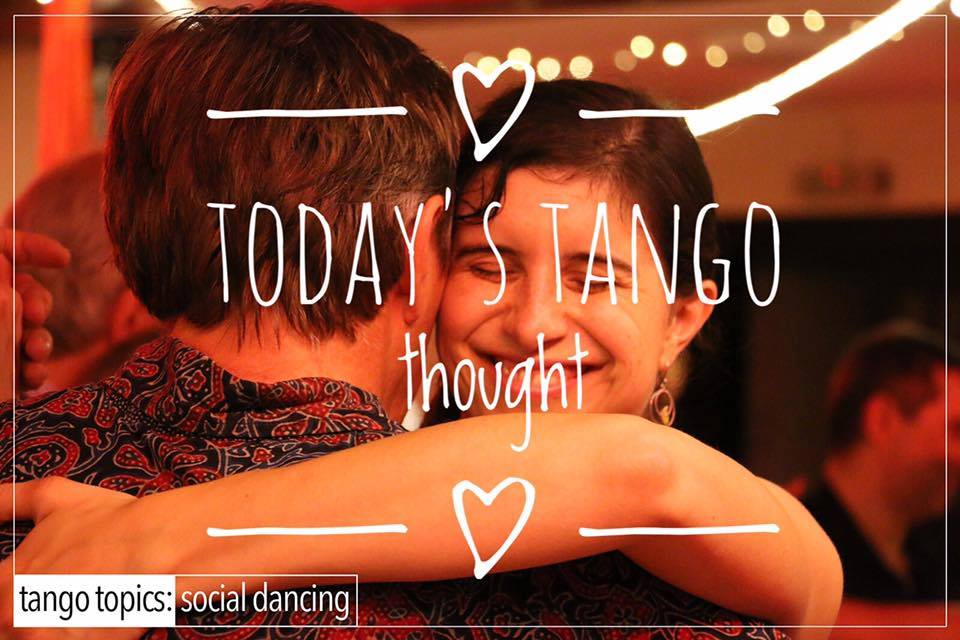
Embrace Awareness

There’s nothing nicer than a warm, cuddly embrace. Unfortunately a good portion of the time that embrace is marred by too much compression (in 1 of 5 or all 5 possible problem areas), engaging unneeded resistance, too much physiological pressure in any one of the 5 areas. The embrace is there as a construct, a frame if you will, to give the dance it’s iconic look. However it’s not there to be used to push, or pull or to hang on your partners. The independent, and skilled dancer does not need or rely on the embrace for stability or to ‘communicate’ in overt ways, but rather resides in smaller and smaller physiological cues from their partner, which is far more desirable. It’s also the reason that some people will not dance with you because you do not employ this way of dancing. So the cuddly embrace can happen, but only if both partners do not need to rely on each other at all for stability in any way, shape, or form.

MORE REMINDERS

On My Balance

Frequently with Argentine Tango we use language that we think is descriptive of what we’re doing but in actual fact is either not that or so far from the mark it is more confusing than anything else. Before we go any further, it is possible that in reading this that you may not see the issue at all. That you know what the speaker meant, and that’s the important part, right. Wrong. That’s the problem right there. The inference. If you have to infer that X or Y is occurring then there’s far too much ‘wiggle’ room for errors in understanding to crop up.

Read More »

Presentation Tango

There is a very popular idea in Tango that gets paraded around a lot, an idea which gets confused with Social Tango which is NOT Social Tango at all but rather it’s about the steps, patterns, and figures is known as ‘Show’ Tango, ’Scenario’ Tango, ‘Stage’ Tango, ‘Fantasia’ Tango, or Presentation Tango.

Read More »

Proprioception

According to Webster’s Dictionary the word ‘Proprioception’ comes from the latin word ‘proprius’ meaning “one’s own” or “individual”, and ‘capio’ or ‘capere’ meaning to take or to grasp. The word itself means a perception of one’s own body in space and time, as in the awareness of one’s body in space and time, as it refers to bodily position in space and time.

Read More »

The Tango Haus

What’s below is a small snippet of 13m:06s audio podcast of Today’s Topic on the benefits and detractors of building community using the idea of a Tango House. “What I refer to as the Tango ‘Haus’ idea. In this case this is the German spelling of ‘HAUS’. I just like the way it sounds. But we can use the American spelling of ‘House’. So a few years back and I may be bastardizing some history here. There was a tango house, and I’m not going to name the city, that grew up out of a U.S. based city. This community, at the time had a number of teachers in its area, and they were all using the typical model of how they wanted their students to learn to dance.

Read More »

A Community Tanda

What is a Community Tanda ? Put simply it’s a Tanda whereby the participants of a Milonga are invited, and then wholly encouraged, to dance with someone that they have NOT danced with before or at all.

Read More »

Getting To Buenos Aires

You’ve been dancing for a while, and you keep seeing these posts about Buenos Aires. Your dream has slowly developed to go to Buenos Aires, to experience for yourself what all the fuss is about. First there’s the dancing, you’ve heard it’s the best. There’s the shoes! OMG the shoes. Then there are friends that have been and rave about teacher X or Milonga Y. You’ve see the videos of performances at Salon Canning (but didn’t know it was Salon Canning), the pictures from Milongas, and thought to yourself that it didn’t look all that challenging than your local milonga there are just more people. You’ve heard that Spanish isn’t necessarily a requirement because there’s a lot of foreigners that speak English, and a good portion of the teachers speak it too. So you if you went, you wouldn’t really need to learn Spanish. 

Read More »

The Female Lead

This post isn’t about the benefits of learning to lead for the woman that dances, of which there are many. No. Nor is it about the hyper awareness of all the things you do not want to do as a Follower, which is going to happen by default. Nor is this post about the supposition that women of a certain age swap shoes and end up leading because no one wants to lead them anymore. Not. Nor is it about the fact the simple fact that some women do enjoy leading quite a bit and are actually (contrary to what you might believe) pretty good at it. No. Today’s Tango Thought is all about Women that WANT to Lead! (Just as a side note, most of this stuff also applies to the male lead too, you need the reminders).

Read More »

10 REASONS TO SUBSCRIBE

There are 4 Levels of Access: Free, Basic, Premium, and Premium+. Free pays nothing but gets a perk just for signing up. 

1.) Free Users get to see 5 of the 125 Different Tango Topics on the site. Plus you get access to the entire Tango Reminders and Tango Ideas sections of the site. These are short form Topic descriptors with a little detail about the topic and the video.

2.) 
Basic and Premium users Save A BOATLOAD of MONEY! Buying this stuff outright is expensive.

3.) Basic, Premium, and Premium+ users get access to the ALL ARTICLES and THE FULL ARTICLE which you can’t see right now.

4.) Basic, Premium, and Premium+ users have way better video resolution: Free = 420p, Basic = 720p, Premium = 1080p and 4K. 

5.) Basic, Premium, and Premium+ users get the ‘Dancing Perspectives’ & ‘The Soup’ sections of the document you just read (Lead, Follow, and Dancing) which are open to you. And that’s where all the good stuff is at. 

6.) Video Downloads! 

7.) Access to the Tango Topics Music Library (22 Curated Golden Age Orchestras)

8.) Access to ‘Tango Del Dia’ – Our Music Education System with access to 14 Days of Music, 30 Days of Music Education, and 30 More Days of Tango Del Dia. 

9.) We explain things, break the vocabulary down in a visual way, from multiple angles, showing feet, hands, and close ups! Yes there’s a lot of talking but we want you to understand what it is that you’re doing and why, not just steps, patterns, and figure

and #10:
No more annoying ads at the bottom of the page, begging you to subscribe! 

Keep something in the back of your mind: What you’re seeing in a youtube video is a couple that is performing for the 15th row for a room full of people. They’re not social dancingWhereas this website is all about ‘Social Tango’  or how to make things function on a social dance floor. Social Dance floor ? Your local milonga! They are showing you flashy moves as a presentation, to show off! But not stopping and talking about how this works which is what you need to see. This website and all of it’s content show you the how and  why you’d want to put that piece of vocabulary there, or how to make things work. This website is all about those things and more!

You could watch Tango YouTube videos and thereby spend your time, trying to infer, and figure out how things may work in that particular situation. Bend your body this way or that, twist and force this position or that. Place your foot here or there and figure it out. This is known as Tango Twister.  Which can be a lot of fun, but more than likely it won’t help you, because you’re missing something: The explanation from an experienced teacher showing you how to properly excute this stuff from a Leading Perspective as well as from a Following Perspective!

The goal of YouTube videos is to get you to study with those teachers in person. The goal of Tango Topics videos allows you to work at your own pace, in the comfort of your own space, so that you can play them over and over again to improve your understanding of the vocabulary or technique being described to therefore better your dancing experience. The goal of classes and workshops is to get you to come back over and over and over again, thereby spending more money with that teacher. This website and the videos under it are here to act as a resource for you to help you to improve your dance. Pay once and you’re done.

Eventually, one way or another you’re going to pay for this lesson, either here and now, or with them. TANSTAAFL! The difference between that lesson and this ? Is that you get to play this lesson over and over and over again. Further still, there are supporting materials (other videos) that help to explain the language and the underlying technique of how and why things work, so you can easily reference those things in the corresponding articles that go with the material, and or any language in the Tango Topics Dictionary. 

DROP ME A MSG HERE

Hide picture