
In it’s simplest form, the Milonguero Turn is one of the easiest of turns to accomplish with regards to Argentine Tango. It allows of the couple to stay with each other, and allows for an easeful experience vs. the Follower’s Molinete that is the default turn today. And last but not least, it allows for the partnership to stay facing each other, while at the same time not expending a great deal of energy to ‘turn’ whereas the Follower’s Molinete does precisely that. While the Milonguero Turn is not sexy, it’s easy to see why it was abandoned in favor of it’s sexier cousin. That said, don’t discard it simply because it’s not sexy, use it because it is insanely functional!
Tooltip Tags: Link
-
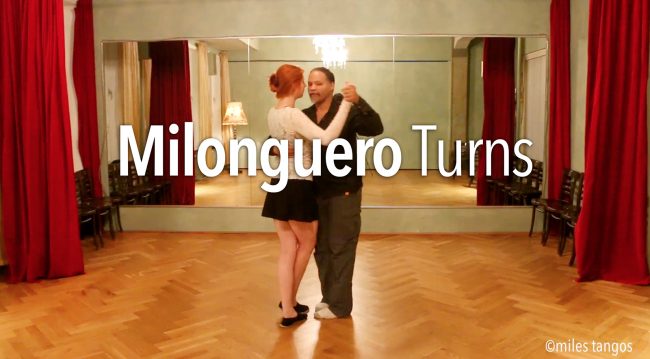
Milonguero Turn
-
Social Dancing
‘Social Dancing‘ has two definitions.
1.) It means the action of going out dancing to your milonga for the evening. The goal is to be social with people, not to perform for the 15th row or to practice with someone but rather to engage in the activity of dancing Tango out in public and communicating with people.
2.) The activity of dancing to a series of ideas, ideals, and concepts that might loosely be equated with ‘Milonguero Style‘ of dancing (or Dancing In A Small Space – DIASS). However, this isn’t about a style, but rather about ideas that also coalesce around certain aspects of Codigos, which when you combine with Dancing In A Small Space and it’s chosen vocabulary, they co-create and combine to create ‘Social’ Tango and really ‘Social’ Dancing for Argentine Tango.
When using the word ‘Social’, it’s easy to confuse it with two other different definitions:
a.) An informal gathering of people, and ideas, to form a group of like-minded individuals.
b.) When a person engages and interacts with an informal or formal group.
-

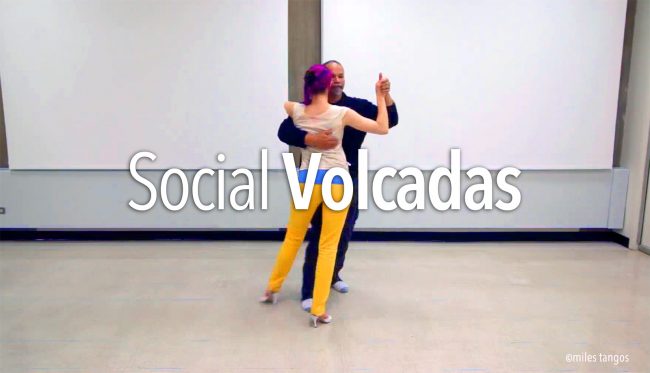
Social Volcada
A Social Volcada is a Volcada that is smaller and fits within the LANE and LINE of dance. It should take up no more space than a single walking step. The reason it’s called a ‘Social’ Volcada is not only because of its size but rather because of functionality and emphasis on the Social Dance movement that is occurring within Argentine Tango today. When using the word ‘social’, it’s easy to confuse it with two other different definitions: 1.) An informal gathering of people, and ideas, to form a group of like-minded individuals. 2.) When a person engages and interacts in an informal or formal group. In this instance, ‘Social’ refers to a series of ideas and concepts that might loosely be equated with Milonguero Style of dancing (or Dancing In A Small Space – DIASS). However, this isn’t about a style, but rather about ideas that also coalesce around certain aspects of Codigos that when combined with Dancing In A Small Space and it’s chosen vocabulary, co-create and combine to create ‘Social’ Tango and really ‘Social’ Dancing for Argentine Tango. Paid Subscribers can see a Social Volcada in all it’s glory, here!
-
No-No
Tango No-No. These are things that no matter how much training you’ve had you’re going to continue to do this these until, or unless you consciously begin to change your behavior. There are Lead No-No’s, Follower No-No’s, and Dancer No-No’s in any number of ways. What’s below are just some of the more common ones:
Plays from YouTube. Pressing play connects you to YouTube. Privacy
-
No-no Volcada
No-no Volcada. This refers to an error in leading the Volcada that is either forced, pushed, pulled (more likely), and unsupported (most certainly unlikely).
Plays from YouTube. Pressing play connects you to YouTube. Privacy
-

Side Steps
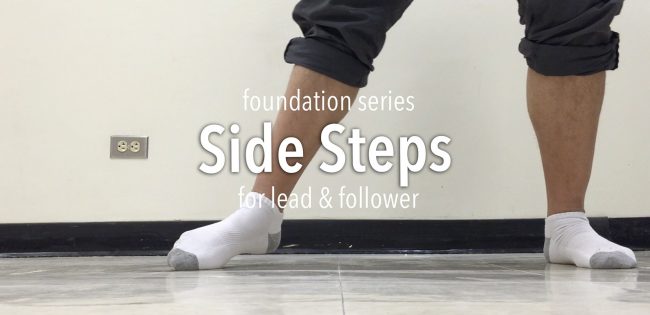
A Side Step is not what you think it is. It’s a whole thing. It’s not just a ‘step’ to the side. No. There’s actual technique in how you extend your leg, how you use your foot to take the step itself, how you engage the floor, and a host of other details that we’re not going to get into here. There’s a whole treatise on this stuff in our foundation videos > https://tangotopics.com/foundation/side-steps/
Just to give you a taste of the number of stuff the crops up for the side step, play the video below:Plays from YouTube. Pressing play connects you to YouTube. Privacy
-
Axis
Plays from YouTube. Pressing play connects you to YouTube. Privacy
The Axis Lie with Miles Tangos The word itself, from a Tango perspective, typically has come to refer to an idea of balance, or sometimes one’s equilibrium. Usually when this word is used it’s used as a way to describe someone’s inability to be stable when walking or in a movement. Sometimes it refers to someone’s body position in relation to their partner. Sometimes, very infrequently, it’s used to communicate that someone is hanging, pulling, pushing, or using their embrace to stabilize themselves against their partner.
As you can clearly see, there’s a lot of confusion when using this word.
Tango Topics sees the usage of this word as a wholly inaccurate, imprecise, and a convoluted way of talking about these things.
Further still when talking about ‘axis’ in relation to the human body, your body has 9 Axes. Which one ? The assumption is the Longitudinal Axis is the one that we’re after. However, that axis changes with a few variables. Most notably which foot you’re standing on, as well as where you are in relationship to your partner. The closer you are to your partner it’s no longer a singular longitudinal axis, but rather a shared longitudinal axis that may be invoked or used, and depending on which foot that you’re on it will change as well. Axis isn’t what you think it is.
A better, more accurate way of talking about this stuff is to use the three words used above: 1.) Balance, 2.) Equilibrium, and 3.) Position. Like this >
“When we’re walking together, I am experiencing some balance issues coming from you”.
Or “When we’re in the line of dance, I have a concern about equilibrium between us…”
Or “Hmmm, I feel like we’re not in the right position with each other which is co-creating some equilibrium and or balance issues…what do you think ?”.