Tango Topics info:

Check out the Tango Dictionary for words like Axis and Connection.

Tooltip Tags: Link

  • I Move Me

    I Move Me

    I Move Me.  Means that YOU, as the Follower, are responsible for taking the initiative to ensure that your technique is spot on. When you feel or sense the intention from your Lead that you apply your technique to the best of your ability while you engage your body and muscles, and respond quickly to get from point ‘a’ to point ‘b’ in an expeditious manner.

  • Traveling Ocho

    Traveling Ocho

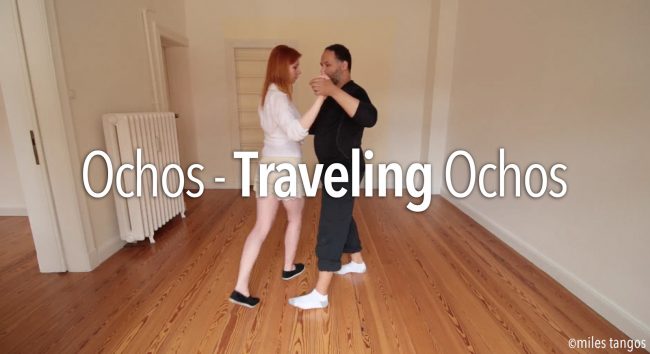
    Traveling Ochos are a staple of Argentine Tango vocabulary. It is the common variety of Ocho that is used constantly, and it is also the first and only Ocho that most people learn. When most people think of an Ocho, the Traveling Ocho is what comes to mind. Tango Topics created a distinction of types of Ochos because there are more than one kind (there are 8 actually). This variety is called a ‘Traveling’ Ocho because of what it does: It ‘travels’ or moves down the line of dance! It is also one of 4 pieces of common vocabulary [ 1.) Parallel Walking. 2.) Traveling Ochos. 3.) Follower’s Molinete. 4.) Argentine Cross.] that is used ubiquitously as a way of expressing the dance.

    Plays from YouTube. Pressing play connects you to YouTube. Privacy

  • Americana

    The Americana. Sometimes this is referred to as a ‘Sweetheart‘ Embrace. The reason is that you look like you’re walking along together with your sweetie! This is an orientation change that is initiated by the Lead to either a.) Open up the embrace. b.) To engage in different or variable vocabulary changes that can occur from this. Click the link for more information.

  • Circular Patter

    Circular Patter. This is a variation on Linear Patter. Meaning ? That instead of little tiny steps executing in along a line, for either role, it is executed (by either role) in a circle around the partner!

    Plays from YouTube. Pressing play connects you to YouTube. Privacy

  • Milonga Ochos

    Milonga Ochos are just what they sound like, Ochos that happen in Milonga. ‘Sounds like’ and ‘are’, are two very different things. First of all, the Milonga Ocho is very small. Tiny actually. Sometimes this variety of Ocho is called a ‘Baby’ Ocho because of there size. However, rightfully we refer to them as Milonga Style Ochos. The reason ? Because we use them in Milonga, a lot…hence their name. However, they can be applied elsewhere but more often than not we use them in Milonga. And the reason is because of the speed and size that you can invoke and use them. The video below is not done at speed, quite deliberately so that you can sort of see the technique that is at work. Secondly the Milonga Ocho can apply disassociation, but that disassociation is insanely fast, and in doing so an enormous amount of energy is built up and then released very quickly. One might be tempted to employ resistance with these things and that would be a mistake. Resistance is not required at all to make a Milonga Ocho occur. If the technique is applied properly, one need never apply resistance, ever.

    Plays from YouTube. Pressing play connects you to YouTube. Privacy

  • Sacada

    Sacada. As far as Argentine Tango is concerned this word means: To displace and then to take the place of. It is one of 4 common displacements that happen in the dance. There are, at last count, about 501 (not kidding) possible Sacadas that are available at any one period of time. Tango Topics has detailed only a small number of them: Back Sacadas, Forward Sacadas, Side Sacadas, Close Embrace Sacadas, and the venerable Crossing Sacada Turn.

    The Simple Sacada is the most common. It’s where the Lead (or the Follower) steps into space of their partner, next to the trailing foot of their partner.

Hide picture