Tango Topics info:

Check out the Tango Dictionary for words like Axis and Connection.

Tooltip Tags: Link

  • Follower’s Molinete

    The Follower’s Molinete is considered to be the common turn of Argentine Tango. This is the turn that is taught at the beginning of most foundation courses. It is one of 8 possible turn types that is usually taught and danced. The turn consists of a disassociative Backstep, a ‘circular’ Side step, and a disassociative Forward step, all done around, not away, from the L/lead. The turn can be done in Open Embrace, Vee Embrace, Berlin Embrace, or Close Embrace formats, each with varying levels of challenge and easefulness.

    At the same time, it should be noted that typically this particular turn is the ‘expected’ turn of most Followers, it is by no means the only turn. At the same time it should also be noted that while there is a Follower’s component, there is also the Lead’s Giro that goes with it that comprises the entire Molinete construct.

    Lastly, it should be noted that while there is a Follower’s Molinete, there is also the Lead’s version of this construct as well: A Lead Molinete!

  • Berlin

    [Berlin. City of amazing wonders. Including, Tango. You’d think that Berlin is not a hotbed of Tango. And you’d be very wrong. It is the hotbed of Tango in Europe at the time of this writing. That may change with time. However, over the last 5 to 10 years it has only grown in popularity for dancers to visit and end up staying there because of it’s ability to create a certain class of dancer that rivals what you’ll find in anywhere else in the world, including Buenos Aires! Want more information, and incidentally to wet your appetite for tango that is stellar and amazing and offputting at the same time ? Click the link! See also the Berlin Embrace.

  • Foundation

    Foundation. While Argentine Tango has it’s ‘8 Count Basic‘, and is considered by many to be a ‘basic’ of the dance. It is not the Foundation of the dance. The Foundation of the dance consists of the following 5 things:

    1.) Presence.
    2.) Forward Steps, Side Sides, Back Steps (for Lead & Follow).
    3.) Embrace.
    4.) Weight Changes
    5.) Partnership.

    One might consider Music to be on this list of Foundation. However, when we’re talking about Foundation, we’re really talking about movement, not what you’re moving to, but how you’re moving, and that’s these 5 things that Tango Topics considers to be the most important foundational elements of the dance.

  • Cabeceo

    Cabeceo. The preferred way to ask a Follower to dance a Tanda with the Lead that has asked.

    The Spanish word “Cabeceo” comes from the root Spanish -ar verb “Cabecear” which means to ‘nod’. In the noun form of the word, it means ‘head’ which is “Cabeza”. From an Argentine Tango perspective the word has come to mean “A head nod to indicate the question of a dance”. Note that the definition here is from the Lead’s perspective, asking the Follower to dance, and not the other way around. That’s because this is Lead specific.

    Cabeceo is just one of the the social rules of conduct of the Milonga, which when put together comprise “Codigos”, or the codes of the dance.

    Also cabeceo can, and should, also be used to ask for entry into the line of dance from one Lead to another, this is called a Male Cabeceo.

    What about a Follower asking for a dance ? See Also > Mirada.

  • Gancho

    A ‘hooking’ of the leg by either the Lead or the Follower to their partner when invoked to do so.

  • Calesita

    Calesita

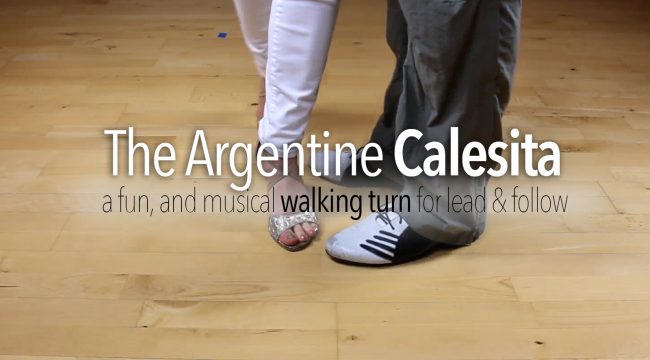
    Calesita. Probably the easiest way to describe this is to call it nothing more than a forward (or backwards) walk around the Lead (or the Follower) in either Open or Close Embrace. See Calesitas for more information.

  • Golden Nugget

    The Golden Nugget. Refers to a foundational piece of Tango vocabulary that you will see no where else, which is taught by no one else except Tango Topics and it’s progenitors. The Golden Nugget is an exceptionally useful piece of tango vocabulary that allows both Lead and Follow to dance all night long with near infinite variation and musical interpretation which encompass the 7 basic moves of Argentine tango in one single pattern!

  • Circular Ocho

    Circular Ochos are an Ocho construct that is used from a stationary position (for the the Lead). It’s where the Follower is being led to semi-circular steps that employ applied disassociation at the semi-circular opposition points. The size of of the semi-circule can be anywhere from 60, 90, to 120 degree arc. However, the larger the arc, the more difficult it becomes to make the semi-circle look like a semi-circle.

    Plays from YouTube. Pressing play connects you to YouTube. Privacy

  • Haptics

    Haptics. This term is a recent addition. It refers to the 5 levels of tactile pressures that are used quite frequently in Argentine Tango.

  • Resistance

    Resistance

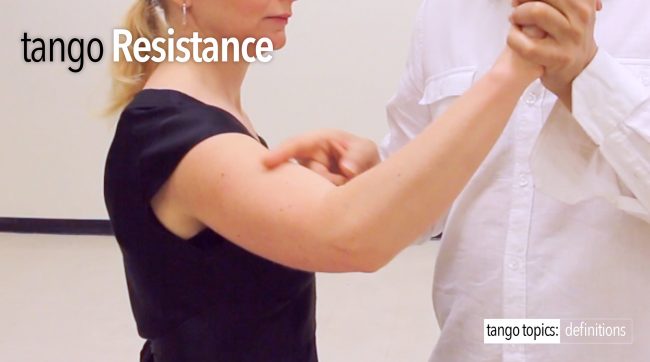
    Resistance. This employs the use of one’s arms, and hands to indicate a direction (from a leading perspective) or that one is responding to execute a piece of vocabulary (following). Sometimes this is referred to as Resistance Based Dancing, and is the polar opposite of Intention Based Dancing.

    See > https://tangotopics.com/definition/definition-resistance/

Hide picture