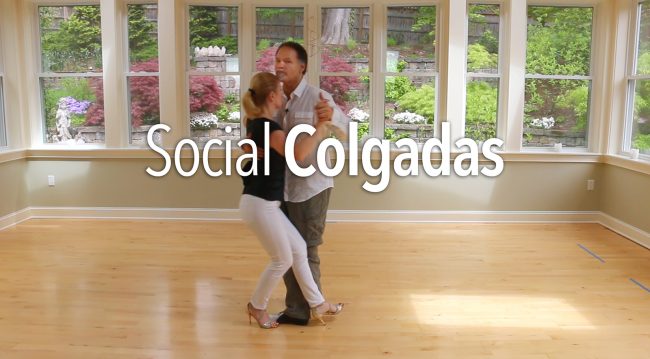
A Colgada, from the root Spanish word, “Colgar” which means, when translated to English, “To Hang”. The ‘ada’ ending is akin to ‘ed’ in English, or the past tense. Or in this case it means ‘Hung’. A Colgada is a very advanced construct and should not be attempted by beginners, or even intermediate dancers until they have had proper instruction to do so.
Put simply the Colgada construct is a broken lean, at the waist (from both partners), away from the dancing partner, by both partners where the partnership uses their arms to sustain the physiological contact. There are many versions of a Colgada in Open and Close Embrace. See Social Colgadas.
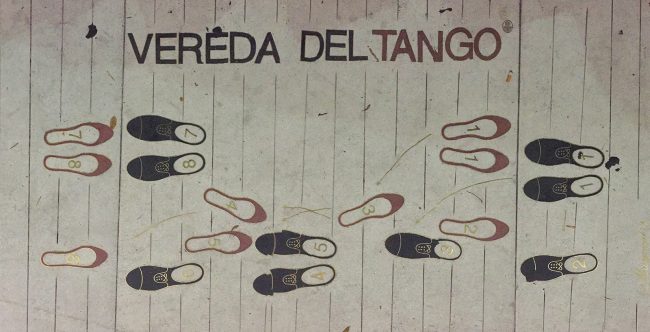
Every dance has a ‘Basic’, this is Argentine Tango’s “Basic” Step. It consists of 8 steps that match a musical 8 count, which is how it got its name – The 8 Count ‘Basic’.
The image above is one of two ground reliefs in Buenos Aires. This one was taken outside La Viruta. The feet in black are the Lead’s steps, and the other are the Follower’s. What’s probably most interesting about the relief is that it depicts a cross systemcross.
The word ‘Basic’ refers to a standard step or pattern that is taught as Foundation, seemingly if you know this foundational element, you can dance Argentine Tango. This isn’t true by the way, Tango requires a bit more than this in order to dance it. But the 8 count is an outdated starting point.
Put simply this is the only piece of social dancing vocabulary where the Follower is being led to cross their feet and they’re doing so because they want to, not because they have to. It’s a willful cross. There are many versions of a cross in Argentine Tango: Back Cross. Forward Cross. Side Cross (!!!). Linear Cross. Floating Cross. Rotating Cross. And of course the Argentine Cross which is the most common that you see everywhere.
For women, Age does matter. Sadly. The fact is that the younger and prettier you are, the more physically attractive you are, the more likely you are to get dances. That’s fact. I mean we’re dealing with ‘men’ here so … well do the math! However just because said younger and prettier girl gets the dance does not necessarily mean that said Follower will keep it. A good number of better leads, will actually over look said younger and prettier girl because they know that said Follower can barely walk, turn, embrace, or for that matter breathe properly. That is, unfortunately, only about 10-20% of the available L/leads in the room. See the Definition on this topic!
The ‘goto’ move in most beginners, and later on a ubiquitous figure and staple of the dance. This is steps 2 thru 5 of the Basic 8. Which can be done in Open or Close Embrace, at any point of the dance.
Plays from YouTube. Pressing play connects you to YouTube. Privacy
The Axis Lie with Miles Tangos
The word itself, from a Tango perspective, typically has come to refer to an idea of balance, or sometimes one’s equilibrium. Usually when this word is used it’s used as a way to describe someone’s inability to be stable when walking or in a movement. Sometimes it refers to someone’s body position in relation to their partner. Sometimes, very infrequently, it’s used to communicate that someone is hanging, pulling, pushing, or using their embrace to stabilize themselves against their partner.
As you can clearly see, there’s a lot of confusion when using this word.
Tango Topics sees the usage of this word as a wholly inaccurate, imprecise, and a convoluted way of talking about these things.
Further still when talking about ‘axis’ in relation to the human body, your body has 9 Axes. Which one ? The assumption is the Longitudinal Axis is the one that we’re after. However, that axis changes with a few variables. Most notably which foot you’re standing on, as well as where you are in relationship to your partner. The closer you are to your partner it’s no longer a singular longitudinal axis, but rather a shared longitudinal axis that may be invoked or used, and depending on which foot that you’re on it will change as well. Axis isn’t what you think it is.
A better, more accurate way of talking about this stuff is to use the three words used above: 1.) Balance, 2.) Equilibrium, and 3.) Position. Like this >
“When we’re walking together, I am experiencing some balance issues coming from you”. Or “When we’re in the line of dance, I have a concern about equilibrium between us…” Or “Hmmm, I feel like we’re not in the right position with each other which is co-creating some equilibrium and or balance issues…what do you think ?”.