Talking While Dancing

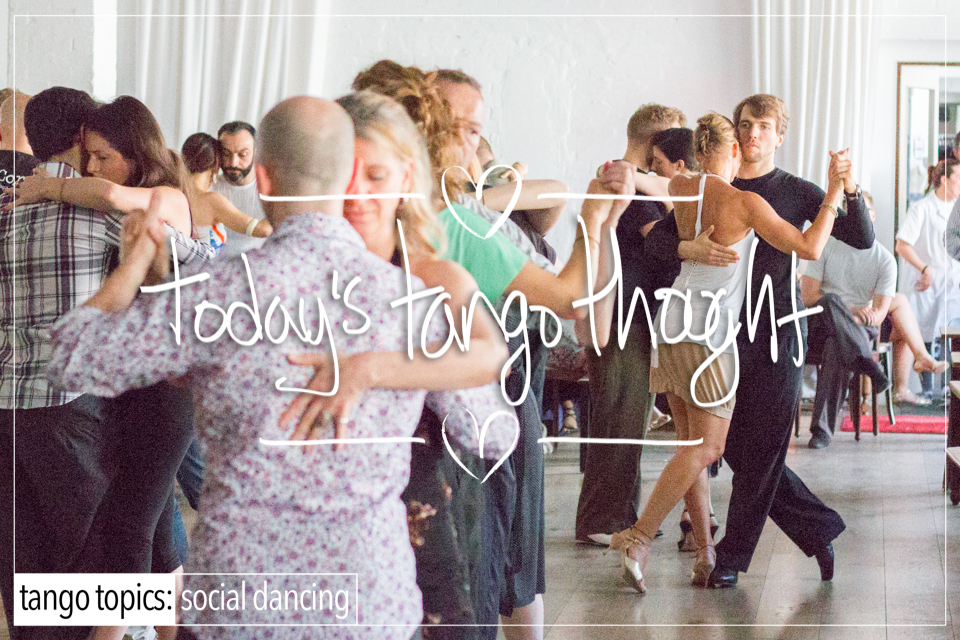
Tango is a ‘Social’ dance. Meaning that the whole reason you are there is to hang out, meet new people, and to be social with each other. The dancing part is what brings us together but it’s really about being a social creature. That’s why it’s called a ‘Social’ dance. “Social” in this case means talking and sharing your day or what’s been going on with you. Mostly it’s lots of talking, sharing, listening, and more talking.

However one thing is true that probably no one told you, that the ‘talking’ part ends the moment your feet hit the floor and you’re in your partner’s embrace.

To be clear, there’s an axiom that the more advanced dancer adheres to for a variety of reasons: “If you’re talking, you’re not dancing”.

What does that really mean aside from the obvious STFU ? It means simply that IF you are talking to your partner AS you are dancing with them, you are more than likely (not always, but most certain more than likely) not really focused on dancing with them, nor your own technique, nor what’s happening around you, nor your embrace. Your balance, posture, stability, foot placement, leg trajectory, all suffer because you’re not focused on what you’re supposed to be doing. As a result you’ll start to miss things, you’ll start grabbing on for balance and stability, you’ll engage pressure (tsk!), compression (tsk!), tension (tsk!), force (tsk!). All because you’re rather focused on the talking part instead of the dancing part. Put simply, your technique suffers when you are talking instead of dancing. You forget how to execute ‘X’ properly because you’re too busy talking. Those wonderful private lessons you’re taking, will all go right out the window because you’re talking instead of dancing, instead of focusing on your dance.

Argentine Tango requires all of your focus, all of your awareness, not just some of it, not a piece but all of it. If you’re talking you’re going to miss things, very important little tiny things. And those little tiny things are the dance. The devil, in this case, really is in the details and when it comes to Argentine Tango the details matter, immensely.

Some people believe that they’re capable doing two or more things at once or multitasking. Studies have shown that when you’re  ‘texting & driving’ things tend to not work out so well. The same is true here just without (thankfully) the deadly consequences. Unfortunately Argentine Tango doesn’t work that way. You need to focus all of your attention on the details, the nuance, and more importantly the music, and your partner. This is one reason why the better dancer in the room is ‘better’ because they’re not talking while they’re dancing. They save the talking part for either before the tanda, during the song breaks, or after the tanda, but not while they’re dancing with their partners.

Do what you want, but quite honestly, unless you can sing (ON KEY please), you’re doing nothing more than distracting your dance partner by talking to them while you believe you’re dancing with them. To be clear, this isn’t the tango police dictating to you how you should or shouldn’t social dance, nor is it arrogance, or anything else that would prevent you from hearing the message of Talk Less, Dance More. It is a simple reminder that talking is a distraction. Let the singer, the music, and the dancing do all the talking for you.
MORE REMINDERS

Tango Reputation

No matter how hard you try (positively or negatively) you’re going to acquire a ‘Tango Reputation’. Meaning ? How you engage socially, how you dance, who you dance with, how ‘good’ you are, how often you dance, if you teach, where you teach, who you teach with, whether or not (if you teach) you dance only with your students or with others, if you teach others while dancing (tsk, tsk, tsk), whether or not you dance milonga, how good your milonga skills are, whether or not you lead and follow or not.

Read More »

Toe vs. Heel (Follower) ?

In case you have been living under a rock, this Thought is going to shock you somewhat. There is a debate that has been raging for quite some time now. The debate ? Should the Follower step forward with their heel first, or their toe first ? Better known as the Heel or Toe debate only for Followers, not for Leads as is the usual debated topic.

Read More »

The Follower’s Work

The Follower’s Work. These words may come as a surprise to you dear reader considering that this page has seemingly ‘bashed’ or disparaged the role of the Follow in any number of ways, however: The role of the Follower is work. This is by no means a complete list, but just a taste: A Follower must master in order to ‘dance’ with a particular Lead their stability, their walk backwards, and forwards to the side without wobbling.

Read More »

It’s Too Late

Frequently most dancers after they ‘learn’ something will fail to solo practice it, as well as use it at a social practica, which as a result fails to deepen their fluidity when dancing so that when X, Y, and Z is led or followed they ‘miss’ it and hesitate. Thereby creating the impression that they’re inept dancers.

Read More »

The Walking Debate

A good portion of Follower’s close their eyes while dancing. The Lead, obviously, can’t close their eyes, but they do cast their eyes towards the floor to watch their Follower’s feet (tsk, tsk, tsk). They close their eyes for a variety of reasons: 1.) To be able to concentrate better. 2.) To ‘feel’ their partner in a more ‘connected’ way. 3.) To not be so distracted by the rest of the room. 4.) To feel more intimate. 5.) To tune out.

Read More »

The Powerful Follower

What is a Powerful Follower ? A Follower that has first and foremost a.) the force of the Follower’s muscles (legs – quads & glutes specifically) engaging with acceleration, power, and strength….

Read More »

The Row of Men That Stand

There’s that row of men that stand at every milonga. They hover. They waver from side to side. They stand with their arms crossed. All by themselves. They never sit, and they seemingly never dance. There’s usually a row of them, more than 3 or 4. And no matter what happens, you almost never see them dance. There’s a reason for that. It’s because a good portion of the better Followers in the room has had a less than desirable experience with them.

Read More »

Proprioception

According to Webster’s Dictionary the word ‘Proprioception’ comes from the latin word ‘proprius’ meaning “one’s own” or “individual”, and ‘capio’ or ‘capere’ meaning to take or to grasp. The word itself means a perception of one’s own body in space and time, as in the awareness of one’s body in space and time, as it refers to bodily position in space and time.

Read More »

Practice (Part 8)

The question of what to practice for most dancers is really simple. The belief is that you should practice ‘dancing’. And this is not always the case. To be fair, while Tango does require a neurological adjustment on multiple levels which can only be attained from actual dancing – this is called ‘the neurology of dancing’, this is a given. However, in order to get to that place where refinements can actually occur in one’s dance, one has to practice, and that practice is not, so that we’re clear, with a partner, it is individually or solo practice.

Read More »

10 REASONS TO SUBSCRIBE

There are 4 Levels of Access: Free, Basic, Premium, and Premium+. Free pays nothing but gets a perk just for signing up. 

1.) Free Users get to see 5 of the 125 Different Tango Topics on the site. Plus you get access to the entire Tango Reminders and Tango Ideas sections of the site. These are short form Topic descriptors with a little detail about the topic and the video.

2.) 
Basic and Premium users Save A BOATLOAD of MONEY! Buying this stuff outright is expensive.

3.) Basic, Premium, and Premium+ users get access to the ALL ARTICLES and THE FULL ARTICLE which you can’t see right now.

4.) Basic, Premium, and Premium+ users have way better video resolution: Free = 420p, Basic = 720p, Premium = 1080p and 4K. 

5.) Basic, Premium, and Premium+ users get the ‘Dancing Perspectives’ & ‘The Soup’ sections of the document you just read (Lead, Follow, and Dancing) which are open to you. And that’s where all the good stuff is at. 

6.) Video Downloads! 

7.) Access to the Tango Topics Music Library (22 Curated Golden Age Orchestras)

8.) Access to ‘Tango Del Dia’ – Our Music Education System with access to 14 Days of Music, 30 Days of Music Education, and 30 More Days of Tango Del Dia. 

9.) We explain things, break the vocabulary down in a visual way, from multiple angles, showing feet, hands, and close ups! Yes there’s a lot of talking but we want you to understand what it is that you’re doing and why, not just steps, patterns, and figure

and #10:
No more annoying ads at the bottom of the page, begging you to subscribe! 

Keep something in the back of your mind: What you’re seeing in a youtube video is a couple that is performing for the 15th row for a room full of people. They’re not social dancingWhereas this website is all about ‘Social Tango’  or how to make things function on a social dance floor. Social Dance floor ? Your local milonga! They are showing you flashy moves as a presentation, to show off! But not stopping and talking about how this works which is what you need to see. This website and all of it’s content show you the how and  why you’d want to put that piece of vocabulary there, or how to make things work. This website is all about those things and more!

You could watch Tango YouTube videos and thereby spend your time, trying to infer, and figure out how things may work in that particular situation. Bend your body this way or that, twist and force this position or that. Place your foot here or there and figure it out. This is known as Tango Twister.  Which can be a lot of fun, but more than likely it won’t help you, because you’re missing something: The explanation from an experienced teacher showing you how to properly excute this stuff from a Leading Perspective as well as from a Following Perspective!

The goal of YouTube videos is to get you to study with those teachers in person. The goal of Tango Topics videos allows you to work at your own pace, in the comfort of your own space, so that you can play them over and over again to improve your understanding of the vocabulary or technique being described to therefore better your dancing experience. The goal of classes and workshops is to get you to come back over and over and over again, thereby spending more money with that teacher. This website and the videos under it are here to act as a resource for you to help you to improve your dance. Pay once and you’re done.

Eventually, one way or another you’re going to pay for this lesson, either here and now, or with them. TANSTAAFL! The difference between that lesson and this ? Is that you get to play this lesson over and over and over again. Further still, there are supporting materials (other videos) that help to explain the language and the underlying technique of how and why things work, so you can easily reference those things in the corresponding articles that go with the material, and or any language in the Tango Topics Dictionary. 

DROP ME A MSG HERE

Hide picture