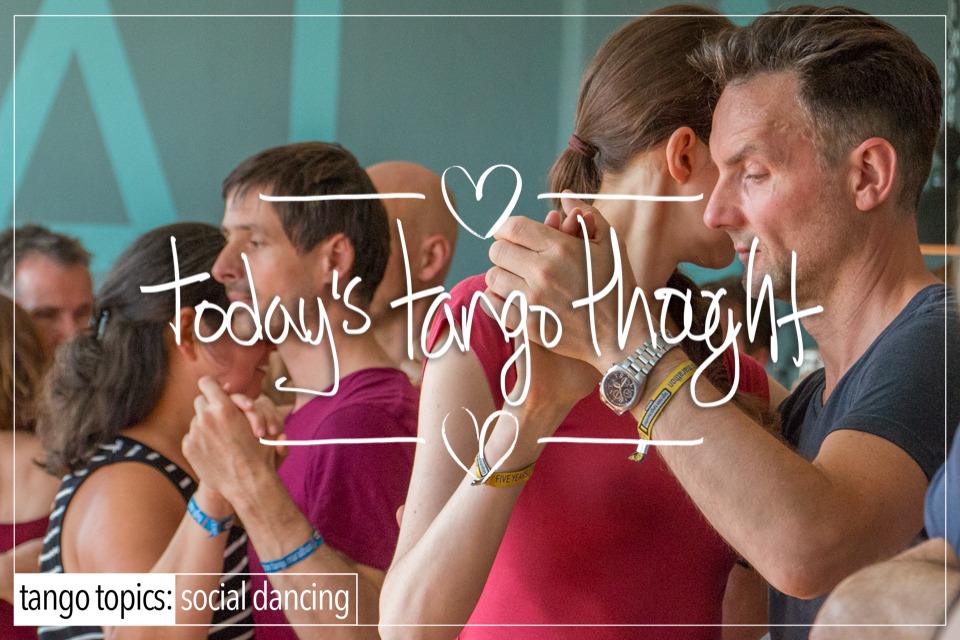
Watching The Feet

(this thought is also discussed and seen in this video > Watching The Follower’s Feet)

Put simply – If you can see your partner’s feet while dancing with them…there’s a problem.

The problem ? Well actually there are several that you’re completely unaware of.

1.) We have this instinctive desire not to want to hit or hurt anyone, not to step on their toes, not to stub their toes or ours, for obvious reasons. And as a result we tend watch our feet and our partner’s feet so that we can avoid the dreaded ‘toe bashing’ that will invariably occur if we don’t keep an eye on things down there. Hence the desire to watch our partner’s feet.

2.) After a while watching our partner’s feet becomes second nature to us. While we will start the dance with our heads up, we’ll almost invariably droop our heads and then our shoulders so that we can focus on watching our feet.

3.) We have a fear of not stepping in the right places. We need to watch our partners feet and our own so that we can verify and validate that the step is in the right place at the right time. This is failure to develop proprioception. A very important skill that both roles must develop in order to dance well.

4.) We don’t realize it, but we’re actually breaking the visual vertical line of the couple each and every time we watch our partner’s feet.

and lastly…

5.) We will compromise our body position just so that we can watch our partner’s feet. We’ll turn our heads, and then our entire body, and further the Follower will move towards the Lead’s armpit (even more than they do already tsk, tsk, tsk) in order to watch the Lead’s feet. And the Lead will place them in the arm pit just so that they can watch the Follower’s feet.

Why does any of this stuff matter ? Honestly, several reasons –

a.) Visual: The visual vertical line of the couple is broken. We want to create a nice couple silhouette within the embrace construct. And each and every time we watch our partner’s feet we break that visual vertical couple’s silhouette.

b.) Position: The body position and placement of the couple creates an alignment issue that quite factually puts the Follower at a disadvantage that makes them feel as though they’re rushing to catch up.

c.) Vocabulary: At some point you’re going to want to do back sacadas, colgadas, volcadas, or any single axis turn just to name a few, and those movements require mastery over proprioception. 😉

d.) Navigational: While you’re watching your Partner’s feet, you’re not paying attention to what’s coming next, how much space you have to navigate, and the oncoming dancers.


MORE REMINDERS

Head Tilt

The tilt or position of one’s head (for lead or follow) is far more important than you might imagine. First and foremost, where the head points the body tends to follow. There’s a reason for this, your equilibrium, contrary to popular belief your balance is not generated in the center of your belly. This ‘myth’ is better known and often repeated as to indicate your ‘core’ muscles. This is a lie.

Read More »

Learning Castellano

Learning to speak and write in Spanish can be lots of fun. Doing so can really force you to understand that your own language is really wacky, that it is fully of colloquial phrases that when translated is a literal mess of confusion, and furthermore forces you to really start looking at your own culture and choices. However when it comes to Argentine Tango, and ultimately going to Buenos Aires, the question comes up … “Do you really need to learn to speak Spanish ?”

Read More »

La Viruta

Let’s get the details out of the way. The sight lines are awful. It’s dark, pitch dark in certain parts of the room. It’s crowded, and hot even with the A.C on in the ‘summer’. The drinks are expensive. The tables are small, assuming you can find one or have reserved one (which is recommended). The ‘hot’ area, meaning a place to ‘get’ dances, in the room is in front of the bar at the back left side of the room, and the entrance fee is on par with everywhere else (see end). There’s a restaurant upstairs, and on Mondays and Tuesday nights there is Salsa there. The rest of the week, it’s all Tango baby. There are classes nearly every night of the week, for different levels.

Read More »

The Non-Gender Cabeceo

What is a ’Non-Gender Cabeceo’ ? A Non-Gender Cabeceo works exactly the same way that a Gendered Cabeceo works. There’s nothing special or different about it. The practice is exactly the same regardless of Gender, or at least it should be. If same sex dancing, or role fluidity, is permitted at Milongas, Marathons, and Encuentros, then the same rules apply in a Gendered Cabeceo.

Read More »

Practice (part 1)

For most people the idea of practice is about practicing the dancing part. Not about the actual "practicing" part. Practice really wants to take apart what one does, how one does it, while asking for feedback & input. Then asking questions, and then figuring out where things aren’t working and why, to smooth out the rough edges of something, and then continually refine, and refine, and refine it so that it becomes effortless.

Read More »

Practice (Part 8)

The question of what to practice for most dancers is really simple. The belief is that you should practice ‘dancing’. And this is not always the case. To be fair, while Tango does require a neurological adjustment on multiple levels which can only be attained from actual dancing – this is called ‘the neurology of dancing’, this is a given. However, in order to get to that place where refinements can actually occur in one’s dance, one has to practice, and that practice is not, so that we’re clear, with a partner, it is individually or solo practice.

Read More »

Giving Up Tango

There comes a point in your Tango life for one of several reasons where you find yourself in an odd place – the want to give up Tango. The most common reason is that you’re just not getting the same thing from the dance as you used to get from it. You go to Milongas. You find yourself sitting more, talking more, and dancing less.

Read More »

Saying ‘No’.

So without further variance, below is a 10 step process in “How to say ‘No’, and not dance with Y!” 🙂

Read More »

Snobby People

The fact is that there are snobby people everywhere. There are always going to be the ‘holier than thou’ among your local group, and really anywhere you travel. The fact is that you can’t get around them, you have to deal with them, and there is a way to do that. Ok, truthfully you could avoid them all night long if you wanted to but that doesn’t help you very much.

Read More »

10 REASONS TO SUBSCRIBE

There are 4 Levels of Access: Free, Basic, Premium, and Premium+. Free pays nothing but gets a perk just for signing up. 

1.) Free Users get to see 5 of the 125 Different Tango Topics on the site. Plus you get access to the entire Tango Reminders and Tango Ideas sections of the site. These are short form Topic descriptors with a little detail about the topic and the video.

2.) 
Basic and Premium users Save A BOATLOAD of MONEY! Buying this stuff outright is expensive.

3.) Basic, Premium, and Premium+ users get access to the ALL ARTICLES and THE FULL ARTICLE which you can’t see right now.

4.) Basic, Premium, and Premium+ users have way better video resolution: Free = 420p, Basic = 720p, Premium = 1080p and 4K. 

5.) Basic, Premium, and Premium+ users get the ‘Dancing Perspectives’ & ‘The Soup’ sections of the document you just read (Lead, Follow, and Dancing) which are open to you. And that’s where all the good stuff is at. 

6.) Video Downloads! 

7.) Access to the Tango Topics Music Library (22 Curated Golden Age Orchestras)

8.) Access to ‘Tango Del Dia’ – Our Music Education System with access to 14 Days of Music, 30 Days of Music Education, and 30 More Days of Tango Del Dia. 

9.) We explain things, break the vocabulary down in a visual way, from multiple angles, showing feet, hands, and close ups! Yes there’s a lot of talking but we want you to understand what it is that you’re doing and why, not just steps, patterns, and figure

and #10:
No more annoying ads at the bottom of the page, begging you to subscribe! 

Keep something in the back of your mind: What you’re seeing in a youtube video is a couple that is performing for the 15th row for a room full of people. They’re not social dancingWhereas this website is all about ‘Social Tango’  or how to make things function on a social dance floor. Social Dance floor ? Your local milonga! They are showing you flashy moves as a presentation, to show off! But not stopping and talking about how this works which is what you need to see. This website and all of it’s content show you the how and  why you’d want to put that piece of vocabulary there, or how to make things work. This website is all about those things and more!

You could watch Tango YouTube videos and thereby spend your time, trying to infer, and figure out how things may work in that particular situation. Bend your body this way or that, twist and force this position or that. Place your foot here or there and figure it out. This is known as Tango Twister.  Which can be a lot of fun, but more than likely it won’t help you, because you’re missing something: The explanation from an experienced teacher showing you how to properly excute this stuff from a Leading Perspective as well as from a Following Perspective!

The goal of YouTube videos is to get you to study with those teachers in person. The goal of Tango Topics videos allows you to work at your own pace, in the comfort of your own space, so that you can play them over and over again to improve your understanding of the vocabulary or technique being described to therefore better your dancing experience. The goal of classes and workshops is to get you to come back over and over and over again, thereby spending more money with that teacher. This website and the videos under it are here to act as a resource for you to help you to improve your dance. Pay once and you’re done.

Eventually, one way or another you’re going to pay for this lesson, either here and now, or with them. TANSTAAFL! The difference between that lesson and this ? Is that you get to play this lesson over and over and over again. Further still, there are supporting materials (other videos) that help to explain the language and the underlying technique of how and why things work, so you can easily reference those things in the corresponding articles that go with the material, and or any language in the Tango Topics Dictionary. 

DROP ME A MSG HERE

Hide picture