Years ago when we were just itty bitty tango dancers and really just starting to understand the world Argentine Tango, the codigos, the seemingly endless hours of technique classes, the social dynamics. It was all very overwhelming. On one particular afternoon after months of doing our daily music exercise (picking a singular piece of music and deconstructing it into its 4 major parts, sometimes 5). We ran across something, an artifact that didn’t make a whole lot of sense at the time. We put it aside for ‘later’. ‘Later’, came about 5 YEARS later when watching a friend’s video on youtube and them raving about this thing called “La Variación“. What in the blueblazes was THAT ? Naturally this piqued our interest and off to the races we went. A few hours later when we came up for air, we discovered that we had already discovered this thing FIVE years earlier and made a note of it to go back and figure out what this thing was. Then something else happened after our re-discovery and we wondered why it wasn’t taught, if it all. Because when you stop and actually hear it, you realize this stuff is everywhere and then it’s like the flood gates open.
What is “La Variación” in Tango Music ? It’s a variation of the musical theme. Each piece of Tango Music has a major theme, and that theme can be ‘varied’, hence the term. La Variacion happens in a very specific place within the music. Usually near the end of the piece about 30 seconds before the end of music. Not all compositions posses one but a good portion of them do. Sometimes this variation will run at double time, sometimes even faster than that. A good indicator that you’re hearing La Variación is to listen for when the musical instruments, and in specific the bandoneons, ‘go crazy’. They seemingly speed up to an ungodly fevered pitch and tempo.

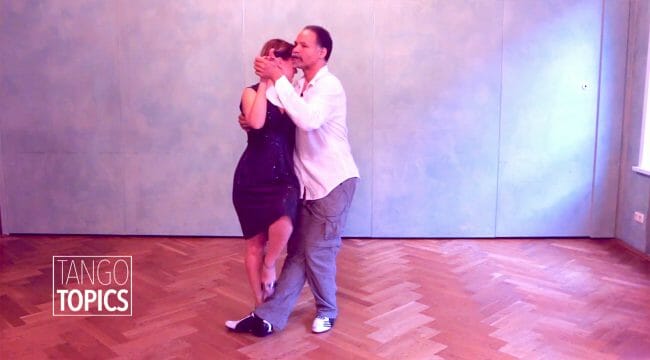
What you may not realize is that, like most people, you dance right past this thing all the time without paying any attention to it’s signifigance. It’s in nearly every piece of tango music, by every major orchestra, in almost every age after a certain point. If you listen to the piece above by Pugliese, which you’ve probably heard 10,000 times, and you hear La Variación, is that there is clearly a beat under it that you can walk to. And so that we’re clear, there’s nothing wrong with walking to that beat. What you can’t do is just dance past it. There’s something you should be doing to it. Actually one of two things. One of those things is walking. The other … well … read on. If you want an example of walking to the beat of La Variación in one of the more popular Variación pieces (Pedro Laurenz – ‘No Me Extraña’, and yes this is in our library for all subscribed users), look at this example, the fun begins at 1:41.
Rightfully in today’s Tango world, with the state of Modern Tango being what it is (because it turns a LOT). It is seemingly sometimes impossible to engage La Variación due to a few factors – space being chief among them. Skill being another. Still one more is awareness (musical, partner, and space). However, the mere fact that you know that it’s there and more importantly that you’re aware of La Variación is half the battle! Mistakenly you may be tempted to think that this is just a ‘Lead’ thing. Nope. The Follower has a role here as well and it’s NOT to just FOLLOW what’s being led! This is in our opinion a very misunderstood role here. The Follower can and should dance La Variación when led to do so. This should be an awakening to the trained ACTIVE Follower in all of us that hear La Variación and want to dance to it!
Very few teachers teach this idea of the music and the dance, for several reasons, most notably it’s fallen out of fashion. Furthermore it can sometimes be rather destructive to the line of dance IF engaged inappropriately. Still another and this is it’s Achilles Heel: It requires you to up your game skillwise. You can not simply just dance La Variación without upping the execution of your technique. Otherwise, and this is what we alluded to earlier, you look sloppy. This is the primary reason why it’s not mentioned, taught, or discussed. Typically and historically speaking, the La Variación was used in the Milongas throughout the 40’s and 50’s and much later on as Tango resurged in the 80’s as a way to ‘test’ the Lead, and really the dancing couple, to see if they had their collective sh*t together. If you danced it, and were witnessed doing so, and doing it well, you got the ‘nod’. If you danced it poorly…well…ummm…no ‘nod’. Which is to say that the other dancers in the room thought well of you, or they didn’t. You were good, but if you danced La Variación, you were …. one of the cool kids! This was a way for the dancers to test each other. To see if they could one-up each other.
In today’s Tango world, that still happens, just less frequently, and on an informal basis between friends and dancers. In the last 2 years there has been a formalization of La Variación into a sort of competition that shows off the skills and the stamina of the dancers. Which is sort of what it was before. Bragging rights if you will. Today it’s being elevated to a whole other layer of bragging rights, a competition. If you search for it online, we’re certain you’ll run across it.
Mind you, in the example above with Biagi, this is a slow version of La Variación, there are loads and loads of these things out there, all you have to do is listen for it. This is one more reason why you want to pay attention to the structure of Tango Music. Still one more layer to the onion that you think you’ve heard 10,000 times, but 10,00 and 1, now you hear something entirely different that changes your perspective and bam, you see that the mountain you thought you had conquered is even bigger and badder than you thought!
Variation in Variación. In our definition of what La Variación above we stated that La Variación usually happens about 30 seconds before the song ends. There are many instances where that’s not true. It happens much sooner in a piece. The funny thing is that you hear this stuff all the time, and don’t pay any attention to it. Below is an example of what we’re on about. What we have here is an example where La Variación occurs at 1:48 into the piece! Clearly not at the end. And in such a recognizable piece. This is Juan D’Arienzo’s 1971 version of “La Cumparsita”. If you go and listen to the more popular version that you hear all the time (the 1951 or 1963 versions which are slightly different from each other in clarity and in terms what he did with the piece), you’ll hear a very clear and different idea that occurs at 1:48. The example below starts at 1:06 of the piece and goes through to lead up to the La Variación so that you hear the progression.

That said, it wouldn’t kill you to start your Tango Music studies with Tango Topics. We have a range of courses to help you hear the structure of Tango Music itself, as well as what to do with it using our Musical Interpretation Series.