Limited time offer One year for $99 (regularly $129, save $30) Get your year
Tango Topics info:

Check out the Tango Dictionary for words like Axis and Connection.

Tag: enrosque

  • The Social Lápiz & Enrosque

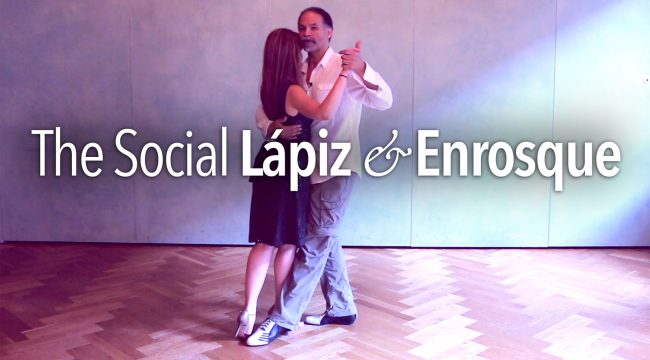
    The Social Lápiz & Enrosque

    The Spanish word ‘Lápiz’ (pron: lah-pees – emphasis on the ‘LAH‘ and not the ‘pees’) translates to English as Pencil, and the word ‘Enrosque’ translates to English as ‘Screw’ or ‘Thread’. From a Tango perspective these are primarily ideas that relate solely to the Lead’s side of the dancing equation. Mostly. 🙂 A Follower can and does engage in a version of the Lápiz when applying a needle turn in ochos, or a planeo but as it relates to the Enrosque, it is very infrequently done by the Follower on their own. That said, let’s talk about the Social Lápiz & Enrosque.

    What is a Lápiz & Enrosque ? Let’s take those words one at a time. A Lápiz is a leg extension (and pointing of the foot/toe) done in a circular fashion in response to what the Follower is doing. Usually, this is a leg extension out away from the body (Forward to 12 O’Clock), then around to the side (at Nine O’Clock), and then the back (at Six O’Clock), and then back to collection. The Lápiz is usually done to the Follower’s Molinete or Traveling Ocho on their resulting backstep.

    Plays from YouTube. Pressing play connects you to YouTube. Privacy

    The Lapiz Exercise

    What makes it ‘Social’ is that it is very small, very tiny. Meaning that the footprint (no pun intended) should not take up any more space in the line of dance than say another step forward would. In other words ? No space.

    And what about the Enrosque ? An Enrosque is essentially the lead crossing one foot behind the other without space between the crossed feet (better known as a ‘clean’ cross) and then, here’s the hard part, unwinding that cross back to collection without wobbling, wavering, or using the Follower to do it! Typically the Lápiz and the Enrosque Follow each other. First a Lápiz and then the Enrosque.

    Plays from YouTube. Pressing play connects you to YouTube. Privacy

    The Stability Exercise

    The Free Tip. This is going to challenge you. No lie. The rotational pivot that has to occur over the standing foot, will drive you absolutely batty. Now try doing that while your partner is hanging on you, pulling you, pushing you….good luck with that. You must work on your own stability independent of your Follower. So here’s a free hint for you – more compression in the standing knee. The more you have, the easier this becomes. However, you do not want to be on your heel while you’re doing it! 😉 Good luck, you’re going to need it.

    Notation: It should be noted that the Lápiz is generally done in concert with the Follower’s Back Step of the Follower’s Molinete; And it can also be done with the Follower’s Traveling Ocho (Back or Forward). It can be done anywhere where the Follower is being led to transit around their Lead. At the same time, it can also be done with the Follower’s side of the Milonguero Turn. However, engaging the Milonguero Turn and then engaging in Lápiz is kinda ‘flashy’ and doesn’t look so good in our opinion.

    About The Video. This video is 14:03 in length in 7 Sections

    Section 1 – Introduction – 00:00:12
    Section 2 – Basic Technique – 00:01:29
    Section 3 – Close Embrace Exercise – 00:02:22
    Section 4 – Executing The Social Lápiz – 00:03:34
    Section 5 – Adding The Enrosque – 00:02:45
    Section 6 – The Social Version – 00:04:17
    Section 7 – Closing – 00:00:19
  • The Super Enrosque

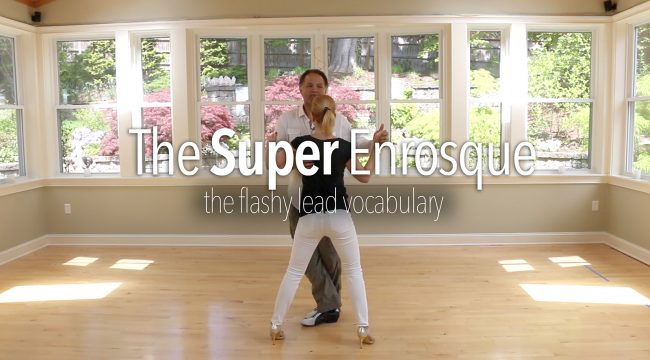
    The Super Enrosque

    The Super Enrosque. There are only a small handful of things that a lead can do to ‘decorate’ what a Follower is doing. Usually, as Leads, we tend to leave the ‘decoration’ to the Follower. However we can in a small number of ways adorn what the Follower is doing, while they’re doing it. Doing so, tends to draw attention away from the Follower and towards the Lead, but sometimes that is desirable, sometimes. Today’s Tango Topic deals with one of these pieces of Tango vocabulary that isn’t seen too often (for a variety of reasons, see below), that when executed nicely can have a really nice effect on the dance, and at the same time open options and opportunities for both roles, not just the lead! 🙂

    Let’s get this out the way, before another word is read, the Enrosque, and it’s kissin’ cousin of Today’s Tango Topic: The Argentine Super Enrosque is quite simply Lead flash, spectacle, and nothing more than that. Furthermore there’s absolutely nothing here for the Follower to do or to think about. Got it. You do not need to add this to your repertoire of tango vocabulary. It does not need to be executed every 3rd step simply because you believe that it’s cool Nor does every Follower want you to do this. Once or twice is fine in a night and then LET IT GO, move on to something else. Trust that the room has seen it all before, they don’t care that you can do 57 versions in 3 minutes, nor should a single song ever be populated with more Enrosques and Super Enrosques than the time it took for you to read this. Never. Ever. This is flashy vocabulary. It’s fun, to be certain but lord knows you don’t need to execute it!

    That said, before we talk about what a Super Enrosque is, we have to define what an Enrosque is and is not!

    The word ‘Enrosque’ (pron: ehn-RrOhs-kay – accent on the ‘O’) loosely translated to English from Spanish means ‘Thread’ or ‘Screw’. However, from a Tango perspective it has a very specific meaning. This a Lead based piece of vocabulary that can be done as adornment or accent to what the Follower is doing. It’s usually done with the Follower’s Molinete, but can be done anywhere really. But the place where it shines really is the Follower’s Molinete. So what is it ? The Enrosque is where the lead will cross one foot behind the other (in a clean fashion – there should be no daylight between the feet) and as the crossing behind happens there’s usually a pivoting rotation of the bodily position – This is the ‘Screw’ part of the definition of the Enrosque, not the crossing feet part. An actual ‘pivot’ may occur, however where things get flashy and really where the Super Enrosque comes in, is where the Lead engages Applied Disassociation! There is a common misconception that the Enrosque also contains a Lapíz (a lead leg extension) that trails the Follower’s motion. This is not part of the Enrosque! It is it’s own separate thing, and you quite literally must separate these things, one from the other. Doing so will create a greater range of capabilities.

    Below you should see one of two videos: Free/Open users will see an Enrosque without any explanation of what should happen, or the paid subscribers should see the Entire Enrosque video from your Lead Technique section which fully explains the technique that generates the example videos. 😉 Without this explanation you’re quite literally pissing into the wind!

    What is a ‘Super’ Enrosque ? You’re going to ask yourself this question: If an Enrosque is placing one foot behind the other, or in front, both are true where the feet are in a crossed position, AND (the ‘and’ is very important) there is a pivoting bodily rotation that occurs. Then what on earth creates a ‘Super’ Enrosque ? MORE ROTATION! And in specific More Applied Disassociation, as there’s an enormous amount of super rotation that can occur due to the release of all that pent up energy. And that release creates some really interesting options and opportunities. 😉 So without further adieu: The Super Enrosque!

    There’s a lot that’s missing here…you need to subscribe to see the whole article which is extensive.

    The Free Tip.  In an ideal world the Enrosque is easy, and the addendum Lapíz is a snap. But as you’ll soon see, saying it is one thing, doing it is another! Which is to say that extending your leg for the lapíz after the Enrosque, is going to throw you off balance. You’re going to have stability issues, which is another reason WHY you study this stuff independent of the Follower not with the Follower! You only study with the Follower AFTER you have mastered the skills noted above.

    About The Video. This video comes in at 23m:34s in length in 11 Sections. Lead Technique is explained here in the video. No Follower technique is explored. 

    Section 1 – Introduction – 00:01:33
    Section 2 – Applied Counter Disassociation – 00:00:52
    Section 3 – Enrosque with Lapíz – 00:01:48
    Section 4 – The ‘Super’ Part – 00:04:08
    Section 5 – A Few ‘Gotchas’ – 00:01:41
    Section 6 – The Super Exercise – 00:01:40
    Section 7 – Super Exercise Notes – 00:02:26
    Section 8 – The Enrosque with a Follower – 00:02:50
    Section 9 – The Super Part – 00:01:25
    Section 10 – The Second Side Step – 00:01:20
    Section 11 – A Few More Details/Closure – 00:03:05

Hide picture