video
play-rounded-fill

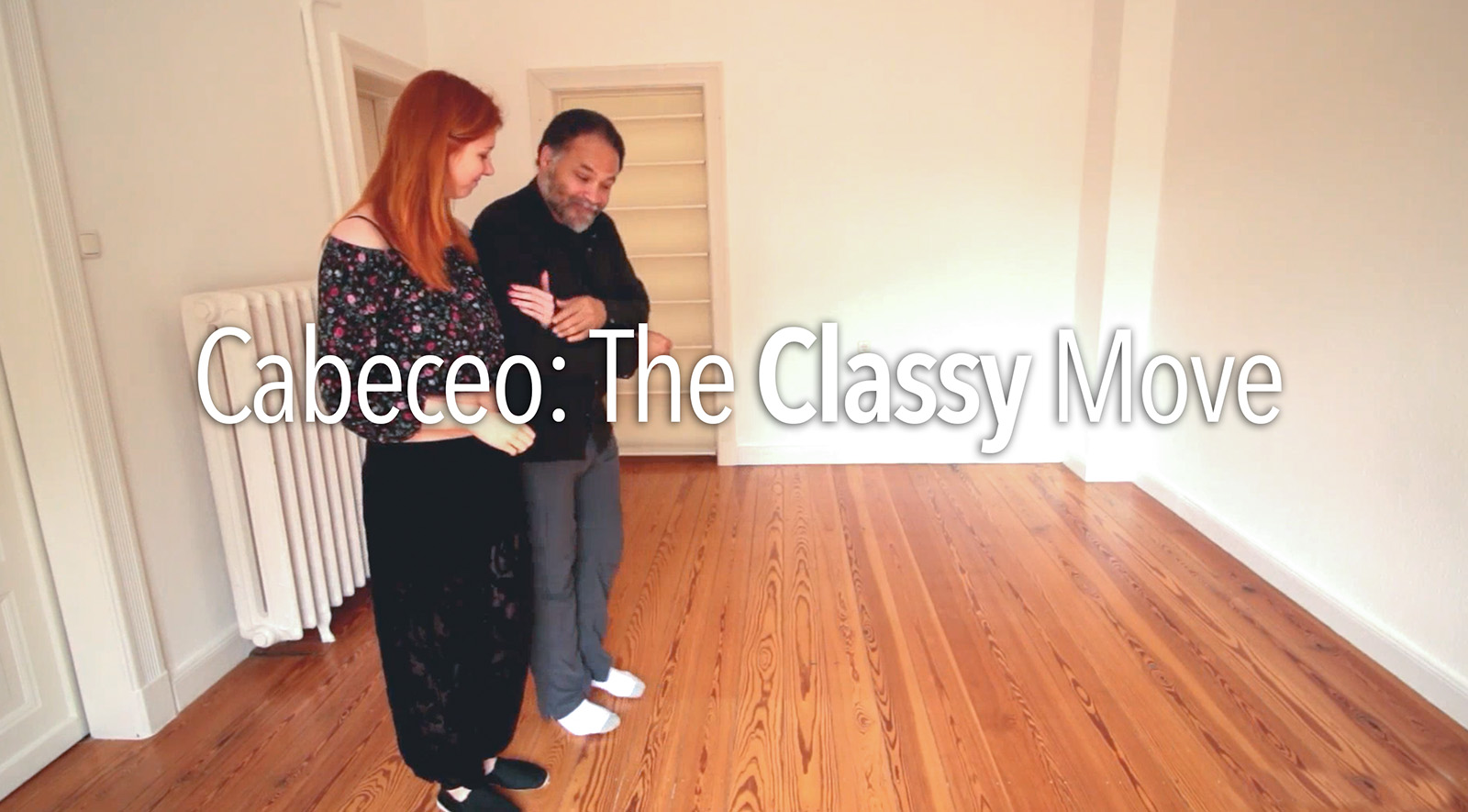
The ‘Classy’ Move

Argentine Tango has a lot of wonderful vocabulary that could be called ‘Moves’. Some are very svelte, some are incredibly sexy, and some are downright amazing to the untrained eye. However, there is one move that does not require a trained eye, and doesn’t require years of training. As a matter of fact a complete beginner can master this in under 10 seconds. Sadly there are no classes or workshops on this one, except maybe this Topic.

Truth be told, the beginner dancer that does this will make themselves, and their dancing partner look absolutely fabulous regardless of how the dance went.

What is it ? It’s The ‘Classy’ Move.

This is a piece of Tango vocabulary that you absolutely want to have in your arsenal, no if’s, and’s, or but’s about it.

Let’s set this up – You invite someone to dance with you, preferably employing Cabeceo. You escort them from their table (or wherever you found them) to the floor. The dance ensues, with a bit of small-talk between the songs, and then the Tanda ends. 🙁 You say, “Thank you” and your partner responds appropriately. Up to this point everything is going well, but this is where the ‘advanced’ dancer rushes off the floor leaving their partner standing there, but you however employ – The ‘Classy’ Move!

Ready ?

This is The ‘Classy’ Move: You escort your partner back to where you found them! 🙂

Tango has certain protocols that over the years have developed into it’s own thing called ‘Codigos’. It’s the way we enter the room, ask for dances, figure out where to sit, who to talk to and why, this is the social aspect of the dance called ‘Codigos’ or the Codes of the Dance.

Sadly The ‘Classy’ Move is not taught, shown, or reinforced at all. And as a result of that lack of social knowledge you have whole generations of dancers that just rush onto and off the floor looking for their next partner, leaving their current partners standing there. In polite society, this is considered rude behavior. Codigos solves those nasty social problems that we typically create in our rush to get what we want. We can still get what we want, with elegance, and decorum, while looking fabulous doing it!

Escorting your partner from the floor – The Single Classiest Move in Tango.

And just so that we’re clear, if this sounds like the Tango Police, or claptrap, or arrogance, or as if you’re being dictated to, then you’re missing the point of the Topic. Which is ? To remind you that Tango is not about the moves, steps, patterns, or figures, or even the music, it’s about the Social aspect of the dance. Hence the reason it’s called a ‘Social Dance’. And that means treating people with respect, not rubbernecking and rushing from one dance to the next.

One More Thing: Some people will see a very typical male lead/female follower dynamic in this post. Meaning that ‘men’ are the perpetrators of this Tango ‘Crime’. 🙂 This is not case. This is not a man thing, it’s a people thing. Women do this too for a variety of reasons. So let’s not gender bash here, it’s not necessary, or warranted. This is a people thing.

A piece of this post was originally part of Tango Truisms Volume 3 – 1076. It has been updated a lot from the original post.

MORE REMINDERS

The Importance of Two Millimeters

Contrary to what you might believe or think, distance, space, and rightfully precision absolutely matters when it comes to Argentine Tango. Let’s back up a bit and define a few things before we delve too deeply into today’s Tango Thought. Precision as defined by Webster’s Dictionary (2017) is a noun as derived from the English word ‘precise’ which is itself an adjective meaning “definitely or strictly stated, defined, or fixed”. Clear ? Not. In short, ‘Precision’ means that there is an area of exactitude, and/accuracy, finite accuracy, finely tuned acute and tight accuracy. And that just about sums up what has to happen with regards to Argentine Tango.

Read More »

Men (Age)

Welcome to the Department of the Obvious Department. Today’s menu of the Obvious includes: Men not asking for directions when lost, Men over talking Women, Men squeezing the living daylights out of their partners, and last but not least the Age of a Man has nothing to do with his ability to get dances!

Read More »

Going to El Corte ?

The words "El Corte" translated to English from Spanish literally means ‘Cut, Court, or Edge’. However, in the Tango world the word has another meaning: Nijmegen, The Netherlands. What’s in/at Nijmegen ? A dance studio of certain renown: El Corte! Think of El Corte as one of your GoTo destinations. Assuming you want to experience a quality of dance in an environment that is at once fun, and at the same time entirely engaging on multiple levels. Caveat: You do need to have your sh*t together if you visit, while at the same time you must be willing and open to a whole different way of looking at the dance (again, on multiple levels).

Read More »

Practice (part 1)

For most people the idea of practice is about practicing the dancing part. Not about the actual "practicing" part. Practice really wants to take apart what one does, how one does it, while asking for feedback & input. Then asking questions, and then figuring out where things aren’t working and why, to smooth out the rough edges of something, and then continually refine, and refine, and refine it so that it becomes effortless.

Read More »

Getting To Buenos Aires

You’ve been dancing for a while, and you keep seeing these posts about Buenos Aires. Your dream has slowly developed to go to Buenos Aires, to experience for yourself what all the fuss is about. First there’s the dancing, you’ve heard it’s the best. There’s the shoes! OMG the shoes. Then there are friends that have been and rave about teacher X or Milonga Y. You’ve see the videos of performances at Salon Canning (but didn’t know it was Salon Canning), the pictures from Milongas, and thought to yourself that it didn’t look all that challenging than your local milonga there are just more people. You’ve heard that Spanish isn’t necessarily a requirement because there’s a lot of foreigners that speak English, and a good portion of the teachers speak it too. So you if you went, you wouldn’t really need to learn Spanish. 

Read More »

Good Lead ?

There are many things to look for in a ‘Good’ Lead. Like for instance, the ability to keep time within the beat structure meaning that they’re placing their Follower’s on beat and not necessarily themselves. Still another is their posture which is reflected in the Follower’s posture as well. Still one more is the ‘cleanliness’ by which they execute a particular piece of vocabulary. That said ‘execution’ is done sharply, with snap and polish, and shows off their Follower, and in doing so, themselves. 😉 Those are some good signs of what qualifies as a ‘good’ lead (the action, not the person).

Read More »

Posture

As has been said, many times, which is exceptionally important, and is frequently mentioned by many dancers almost immediately is: Posture.

Posture for most people boils down to the following two lines:

“Head up!”.

“Elongate your Spinal Column.”

This is a ‘good’ posture for most people.

Sounds easy enough, right ? Just lift your head up, and then ummmm ‘elongate’ your spinal column.

Read More »

The Shoe Lip

Today’s Tango Thought is a bit of Tango minutiae that seems unimportant at first, but is in reality very important actually. It is an awareness that can help you to understand why certain kinesthetic instabilities (regardless of gender) exist: A fair number of street shoes, male or female, have a thick hard leather construct known as the ‘Sole of the Shoe’. The Sole serves several purposes, one of which is to protect your feet from harm, still another (which relates to today’s thought) and secondly it’s what we call the ‘Shoe Lip’.

Read More »

Men That Don’t Study

Men. Oy. Tango is hard enough, but adding ego to the equation just creates a whole other level of issues that most women can agree is a lot like a pissing contest. Before we lay into this like white on rice: Being fair, not all men have an ego when it comes to Tango. A smaller number of them do recognize that Tango is a study. As such it requires them to do their homework, on a regular basis. And ‘homework’ in this case means private study, solo practice, solo study, musical study, on a daily basis.

Read More »

10 REASONS TO SUBSCRIBE

There are 4 Levels of Access: Free, Basic, Premium, and Premium+. Free pays nothing but gets a perk just for signing up. 

1.) Free Users get to see 5 of the 125 Different Tango Topics on the site. Plus you get access to the entire Tango Reminders and Tango Ideas sections of the site. These are short form Topic descriptors with a little detail about the topic and the video.

2.) 
Basic and Premium users Save A BOATLOAD of MONEY! Buying this stuff outright is expensive.

3.) Basic, Premium, and Premium+ users get access to the ALL ARTICLES and THE FULL ARTICLE which you can’t see right now.

4.) Basic, Premium, and Premium+ users have way better video resolution: Free = 420p, Basic = 720p, Premium = 1080p and 4K. 

5.) Basic, Premium, and Premium+ users get the ‘Dancing Perspectives’ & ‘The Soup’ sections of the document you just read (Lead, Follow, and Dancing) which are open to you. And that’s where all the good stuff is at. 

6.) Video Downloads! 

7.) Access to the Tango Topics Music Library (22 Curated Golden Age Orchestras)

8.) Access to ‘Tango Del Dia’ – Our Music Education System with access to 14 Days of Music, 30 Days of Music Education, and 30 More Days of Tango Del Dia. 

9.) We explain things, break the vocabulary down in a visual way, from multiple angles, showing feet, hands, and close ups! Yes there’s a lot of talking but we want you to understand what it is that you’re doing and why, not just steps, patterns, and figure

and #10:
No more annoying ads at the bottom of the page, begging you to subscribe! 

Keep something in the back of your mind: What you’re seeing in a youtube video is a couple that is performing for the 15th row for a room full of people. They’re not social dancingWhereas this website is all about ‘Social Tango’  or how to make things function on a social dance floor. Social Dance floor ? Your local milonga! They are showing you flashy moves as a presentation, to show off! But not stopping and talking about how this works which is what you need to see. This website and all of it’s content show you the how and  why you’d want to put that piece of vocabulary there, or how to make things work. This website is all about those things and more!

You could watch Tango YouTube videos and thereby spend your time, trying to infer, and figure out how things may work in that particular situation. Bend your body this way or that, twist and force this position or that. Place your foot here or there and figure it out. This is known as Tango Twister.  Which can be a lot of fun, but more than likely it won’t help you, because you’re missing something: The explanation from an experienced teacher showing you how to properly excute this stuff from a Leading Perspective as well as from a Following Perspective!

The goal of YouTube videos is to get you to study with those teachers in person. The goal of Tango Topics videos allows you to work at your own pace, in the comfort of your own space, so that you can play them over and over again to improve your understanding of the vocabulary or technique being described to therefore better your dancing experience. The goal of classes and workshops is to get you to come back over and over and over again, thereby spending more money with that teacher. This website and the videos under it are here to act as a resource for you to help you to improve your dance. Pay once and you’re done.

Eventually, one way or another you’re going to pay for this lesson, either here and now, or with them. TANSTAAFL! The difference between that lesson and this ? Is that you get to play this lesson over and over and over again. Further still, there are supporting materials (other videos) that help to explain the language and the underlying technique of how and why things work, so you can easily reference those things in the corresponding articles that go with the material, and or any language in the Tango Topics Dictionary. 

DROP ME A MSG HERE

Hide picture