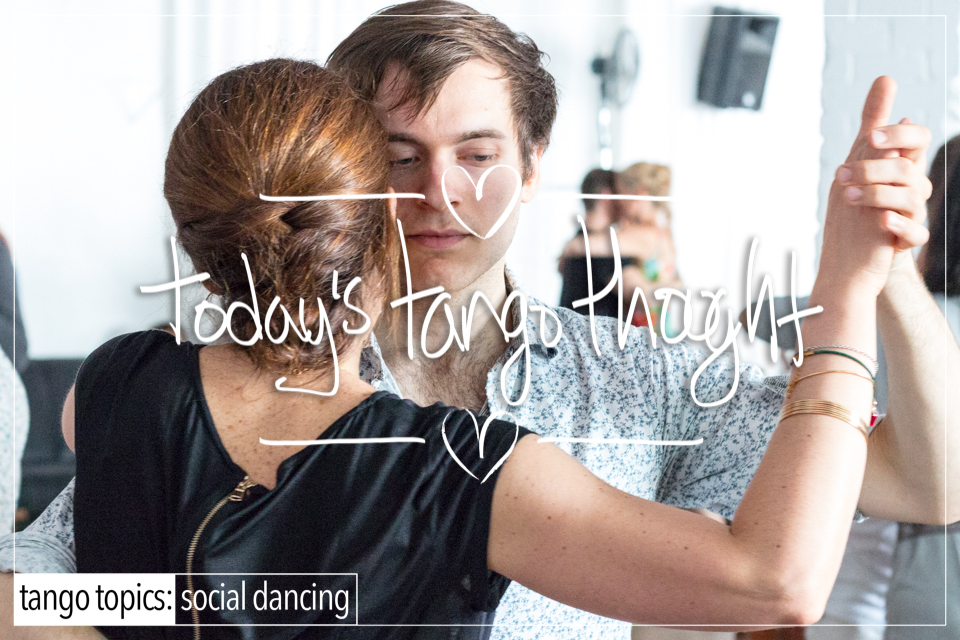
Wine & Tango

For a lot of people, they come to tango and have their requisite glass (or two) of wine and then they dance. They walk in the room, put on their shoes and make a bee-line for the bar and order their ‘glass’ of wine. Then they proceed to sit for a tanda or two drinking it, and then they ‘dance’.

Stop and think about something for a moment: Wine is alcohol (duh). Alcohol is a depressant, not a stimulant, it lowers our inhibitions and ability for rational thought. It allows us to do things while under its effects (inebriation) that we wouldn’t normally do. Like for instance, ‘drunk dial the ex’, or taken to the extreme – driving while intoxicated (tsk, tsk, tsk). Typically the average ‘wine’ drinker never gets beyond the tipsy stage….they can ‘hold their liquor’ as it were.

One thought that passes through your mind in this ‘delighted’ state is that you ‘feel’ better as a dancer, as far as you’re concerned. From your perspective, you are a lot more ‘free’ with the music and your partners when you’ve had a glass of wine. And you might even believe that your dancing improves as a result. Ahem. That’s not the case. It’s really not. It’s a perception. Your response times go down not up, you miss crucial subliminal cues, your sensitivity drops off and you become less aware (not more) of how much pressure, tension, and force you’re using to either lead or follow your partner. And that’s just the tip of the iceberg.

This is probably something you don’t want to hear, and you’re not going to change your behavior because some web page by some obscure (ha!) tango teacher tells you that wine has a deleterious effect on the dancer. While it may ‘take the edge off’ one’s fear, apprehension, or trepidation, wine does impair your balance, which thereby affects your stability, and furthermore, it dulls the effect of hyper-awareness which is an absolute requirement to dancing to your optimum efficiency.

You may have noticed that the better dancers in the room, do not drink wine, beer, at all. Not until after they are done for the night. They’ll wait a while until they’ve had their important dances before they’ll have a beer or a glass of wine, and even then…it’s questionable.

And just so that we’re absolutely crystal clear, because someone will invariably read this and get all indignant about their drinking habits. No one is calling you alcoholic, or that you have a drinking problem, or that you feel you must respond with “I only have X# of glasses…”. No one is judging you. This topic is here to get you to think about your choices. Nothing more than that. Get a grip, facts is facts, not alternative facts, but hard cold evidence that is centuries old. Alcohol causes problems. How hard is that ?

To the Virgins, to Make Much of Time

The Tango Topics Opinion: Wine and Dancing do not mix. There are many people that will tell you the polar opposite, or say that having a glass of wine while they’re dancing, or beer, or any alcohol improves the experience for them. The medical and scientific research on the subject of wine or alcohol and anything you’re doing suffers. Why is this so hard to get ? The reason is really simple, because people like their vices. It’s that simple. Sadly. The author hasn’t had a drop of alcohol in 20 years at the time of this writing. Not because he’s an alcoholic and can’t control his liquor. No, it’s because he learned a very basic fact early on that Alcohol in any form at any level does one no good at all. It impairs one’s mental faculties, it generates a false perception of the world, and when it comes to dancing…it’s just not going to help you in any way, shape, or form.

That said.

No matter what this Tango Thought reports to you, no matter the science involved, no matter what is written here, you’re going to continue to do what you have always done because you like it, because it’s comfortable for you, and because you can. Why stop doing something if it causes no harm in the first place ? Right ? You’re right. This life is very short, so why not grab all the gusto while you can. Or as Robert Herrick in his poem ‘To the Virgins, to Make Much of Time‘, “Gather ye rosebuds while ye may….”, so why not ? Right ?

Assuming you’ve gotten this far, and assuming you haven’t throw out the baby yet, here’s a thought: Try dancing without the wine/beer and see what happens. For this to have any real effect, try it for a whole month and see what happens to your dancing as a result.
MORE REMINDERS

Facility

Facility can be, but is not limited to, Familiarity with Vocabulary, Execution of the Vocabulary, also it’s about Balance, Equilibrium, Kinesthetic Awareness, Kinesthetic Listening, The Neurology of Leading, The Neurology of Following (which is how you respond to something from a follower’s perspective), Proprioception, and last but not least Extending Your Capabilities. We’ll get to that last one in just a bit. Two of the more common aspects of Facility are Execution and Proprioception. So let’s quickly review what Tango Topics means when it refers to these ideas…“

Read More »

Cake!

Should you eat before, or after a milonga, or not at all ? Some people say “before, so that you don’t get hungry during the milonga”. But then they complain that they can’t move as freely. Some people say “After! Because I’ll be ravenous”. But then these same people quite factually ‘grumble’ (meaning their stomachs are growling because they’re hungry) while they dance with you. Some people are in the ‘not’ at all category! They can seemingly contain their exertion and not require sustenance before, during, and after a milonga.

Read More »

Fear of Milonga

The fact is that some folks have a justifiable fear of Milonga! No not the dance party, nor the music at the milonga, no…this fear refers to the abject fear that is expressed by some people when Milonga music is played because now they must dance ‘Milonga’ moves to milonga music. The reason ? Either it’s the speed at which it is seemingly danced, or the music that is perceived to be ‘fast’, movements/steps/patterns/figures that are associated and specific to Milonga. Some people just freak right out when it comes to milonga. Some people actually break out in a cold sweat at the very thought of it, Lead or Follow.

Read More »

Social Dancing

Social Dancing’ means going out with friends, or to meet friends, at a Milonga, for the purpose of getting together to dance Argentine Tango (or most any other dance) better known as ‘Social Tango’. The emphasis is on the social part, and not the technical part.

Read More »

Wood Floors

The toy of choice for most dancers is a ‘Sprung’ floor! That’s a work of art, science, and pure magic. Sprung floors are to dancers, what honey is to bees.  A ‘Sprung’ floor ? What’s that ? A Sprung floor is a dance floor that easily absorbs shocks, giving it a softer feel. Such floors are considered the best available for dance and indoor sports and physical education. They enhance performance and greatly reduce injuries.

Read More »

La Viruta

Let’s get the details out of the way. The sight lines are awful. It’s dark, pitch dark in certain parts of the room. It’s crowded, and hot even with the A.C on in the ‘summer’. The drinks are expensive. The tables are small, assuming you can find one or have reserved one (which is recommended). The ‘hot’ area, meaning a place to ‘get’ dances, in the room is in front of the bar at the back left side of the room, and the entrance fee is on par with everywhere else (see end). There’s a restaurant upstairs, and on Mondays and Tuesday nights there is Salsa there. The rest of the week, it’s all Tango baby. There are classes nearly every night of the week, for different levels.

Read More »

The Practica

The idea of a Practica is ‘theoretically’ to Practice what you have learned. To try out what you have been shown, with multiple partners, as if you were in a class rotation. It is ‘theoretical’ because while the theory is nice, the reality is a little different.

Read More »

5 Reasons

Why does someone enter the Tango world ? What drives them to engage in Argentine Tango ? Not what makes them stay but why do they get involved with Argentine Tango ? There are commonalities to why someone walks this pathway, no pun intended. These are distilled down to about Five Common Reasons why someone enters Tango. These are the reasons why and not the reasons why someone stays in Tango. Those are very different reasons, but rather why they started dancing in the first place.

Read More »

Tango Reputation

No matter how hard you try (positively or negatively) you’re going to acquire a ‘Tango Reputation’. Meaning ? How you engage socially, how you dance, who you dance with, how ‘good’ you are, how often you dance, if you teach, where you teach, who you teach with, whether or not (if you teach) you dance only with your students or with others, if you teach others while dancing (tsk, tsk, tsk), whether or not you dance milonga, how good your milonga skills are, whether or not you lead and follow or not.

Read More »

10 REASONS TO SUBSCRIBE

There are 4 Levels of Access: Free, Basic, Premium, and Premium+. Free pays nothing but gets a perk just for signing up. 

1.) Free Users get to see 5 of the 125 Different Tango Topics on the site. Plus you get access to the entire Tango Reminders and Tango Ideas sections of the site. These are short form Topic descriptors with a little detail about the topic and the video.

2.) 
Basic and Premium users Save A BOATLOAD of MONEY! Buying this stuff outright is expensive.

3.) Basic, Premium, and Premium+ users get access to the ALL ARTICLES and THE FULL ARTICLE which you can’t see right now.

4.) Basic, Premium, and Premium+ users have way better video resolution: Free = 420p, Basic = 720p, Premium = 1080p and 4K. 

5.) Basic, Premium, and Premium+ users get the ‘Dancing Perspectives’ & ‘The Soup’ sections of the document you just read (Lead, Follow, and Dancing) which are open to you. And that’s where all the good stuff is at. 

6.) Video Downloads! 

7.) Access to the Tango Topics Music Library (22 Curated Golden Age Orchestras)

8.) Access to ‘Tango Del Dia’ – Our Music Education System with access to 14 Days of Music, 30 Days of Music Education, and 30 More Days of Tango Del Dia. 

9.) We explain things, break the vocabulary down in a visual way, from multiple angles, showing feet, hands, and close ups! Yes there’s a lot of talking but we want you to understand what it is that you’re doing and why, not just steps, patterns, and figure

and #10:
No more annoying ads at the bottom of the page, begging you to subscribe! 

Keep something in the back of your mind: What you’re seeing in a youtube video is a couple that is performing for the 15th row for a room full of people. They’re not social dancingWhereas this website is all about ‘Social Tango’  or how to make things function on a social dance floor. Social Dance floor ? Your local milonga! They are showing you flashy moves as a presentation, to show off! But not stopping and talking about how this works which is what you need to see. This website and all of it’s content show you the how and  why you’d want to put that piece of vocabulary there, or how to make things work. This website is all about those things and more!

You could watch Tango YouTube videos and thereby spend your time, trying to infer, and figure out how things may work in that particular situation. Bend your body this way or that, twist and force this position or that. Place your foot here or there and figure it out. This is known as Tango Twister.  Which can be a lot of fun, but more than likely it won’t help you, because you’re missing something: The explanation from an experienced teacher showing you how to properly excute this stuff from a Leading Perspective as well as from a Following Perspective!

The goal of YouTube videos is to get you to study with those teachers in person. The goal of Tango Topics videos allows you to work at your own pace, in the comfort of your own space, so that you can play them over and over again to improve your understanding of the vocabulary or technique being described to therefore better your dancing experience. The goal of classes and workshops is to get you to come back over and over and over again, thereby spending more money with that teacher. This website and the videos under it are here to act as a resource for you to help you to improve your dance. Pay once and you’re done.

Eventually, one way or another you’re going to pay for this lesson, either here and now, or with them. TANSTAAFL! The difference between that lesson and this ? Is that you get to play this lesson over and over and over again. Further still, there are supporting materials (other videos) that help to explain the language and the underlying technique of how and why things work, so you can easily reference those things in the corresponding articles that go with the material, and or any language in the Tango Topics Dictionary. 

DROP ME A MSG HERE

Hide picture