The Shoe Lip

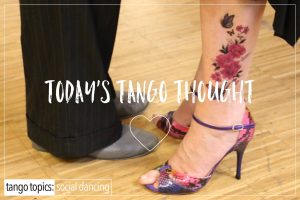
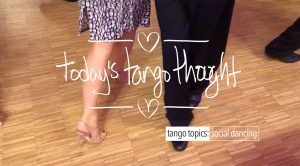
Today’s Tango Thought is a bit of Tango minutiae that seems unimportant at first, but is in reality very important actually. It is an awareness that can help you to understand why certain kinesthetic instabilities (regardless of gender) exist: A fair number of street shoes, male or female, have a thick hard leather construct known as the ‘Sole of the Shoe’. The Sole serves several purposes, one of which is to protect your feet from harm, still another (which relates to today’s thought) and secondly it’s what we call the ‘Shoe Lip’.

First the Shoe Lip acts as a stabilizing agent. When you roll too close to the 1st or 5th metatarsal (big toe and little toe respectively), the shoe lip prevents you from toppling over, it’s just enough to stop the topple, and too small to get in the way of you walking!

Secondly the Sole of the Shoe of which the Shoe Lip is a part, is about 3 to 4 millimeters in thickness. The thicker the sole is, the more it can and does inhibit your ability to ‘feel’ the sensation of your foot coming in contact with the floor, and more over what part of your foot you have placed all of your weight into and onto. The Sole of the Shoe not only prevents the aforementioned sensations but also prevents the ability to correct for it! Why ? Because if you can’t feel it, you can’t correct it. You can clearly feel the error happening due to your sensation of equilibrium, but for one reason or another you actually stop the process of alignment.

Individually these issues by themselves can create instabilities, however when you co-combine them, which typically happens, they create a heterodyning series of instabilities that becomes untenable and you become even more unstable.

To be fair, most Follower shoes (read that as ‘heels’) do not contain a lip, but they do contain an over exaggerated arch that any podiatrist will tell you is not good in the long run of say ‘2 hrs’. So while the Follower doesn’t have a Shoe Lip to contend with, they do have an Over-Exaggerated Arch that isn’t good for them, which they to have to learn to walk in (3 in heels). Or as Ginger Rogers was heard to say “I do everything that Fred (Astair) does, only  backwards and in Heels!”.

Further still, the Shoe Lip thing only happens for the male Lead. You won’t see too many Follower heels with a protruding Shoe Lip. Usually the Sole is flush with the shoe edge. Some brands of mens’s shoes do have the projected lip and an even thicker than useful sole thereby preventing them from feeling the sensation of the floor.

So what’s a good rule of thumb when selecting a shoe ? Handmade, no shoe lip, and a soft (ish) bottom sole that allows for a flexible range of motion, so that in the end you can feel the floor, learn to change, and really, correct your equilibrium issues.

MORE REMINDERS

5 Reasons

Why does someone enter the Tango world ? What drives them to engage in Argentine Tango ? Not what makes them stay but why do they get involved with Argentine Tango ? There are commonalities to why someone walks this pathway, no pun intended. These are distilled down to about Five Common Reasons why someone enters Tango. These are the reasons why and not the reasons why someone stays in Tango. Those are very different reasons, but rather why they started dancing in the first place.

Read More »

The Male Follower

This post isn’t about the benefits of Following for the Male that dances, of which there are many, such as hyper awareness of all the things you do not want to do. No. Nor is this post about dancing in heels (which can be quite educational on many, many levels), nor the benefits of actually doing that work. Nor is this post about the simple fact that some men do enjoy Following quite a bit (the author included) and are actually (contrary to what you might believe) pretty good at it. No. Today’s Tango Thought is all about Men That WANT to Follow and some pointers that you want to think about doing.

Read More »

Physiological Control

Control is a really hard thing to get. It takes a while to have precise, or precision, control over exact foot placement, which is insanely important. It takes time to build up the necessary minute control that one needs to have over one’s body. A millimeter here, a millimeter there, cumulatively, can make all the difference between a dance that sucks (for both parties) and one that is absolutely fabulous. Precision control is where all the toys are at.

Read More »

La Cumparsita

At the end of nearly every Milonga in the world, that you will ever attend, while you will hear more than a few familiar songs, there are a handful that have very specific meanings. One of them is played at the end of the night to signify that the Milonga has come to end, which should be a cue to find your favorite partner and to dance with them. The song ? “La Cumparsita” or as it is translated into English, ‘The Little Carnival’.

Read More »

Lead Bashing

Bashing ? Meaning that you’re throwin’ some shade, picking on, pointing out the errors of, giving some shit, pointing fingers at, trash talking, talk down, blaming and shaming, and the euphemistic UK’ism “taking the piss”. While that last one is more about making fun of someone, that’s not actually what this idea is all about. It’s about disparaging someone, or in this case, from a Tango perspective, the L/lead’s abilities (the person, and the action).

Read More »

Saying ‘No’.

So without further variance, below is a 10 step process in “How to say ‘No’, and not dance with Y!” 🙂

Read More »

Good Lead ?

There are many things to look for in a ‘Good’ Lead. Like for instance, the ability to keep time within the beat structure meaning that they’re placing their Follower’s on beat and not necessarily themselves. Still another is their posture which is reflected in the Follower’s posture as well. Still one more is the ‘cleanliness’ by which they execute a particular piece of vocabulary. That said ‘execution’ is done sharply, with snap and polish, and shows off their Follower, and in doing so, themselves. 😉 Those are some good signs of what qualifies as a ‘good’ lead (the action, not the person).

Read More »

Wine & Tango

Stop and think about something for a moment: Wine is alcohol (duh). Alcohol is a depressant, not a stimulant, it lowers our inhibitions, and ability for rational thought. It allows for us to do things while under it’s effects (inebriation) that we wouldn’t normally do. Like for instance, ‘drunk dial the ex’, or taken to the extreme – driving while intoxicated (tsk, tsk, tsk). Typically the average ‘wine’ drinker never gets beyond the tipsy stage….they can ‘hold their liquor’ as it were.

Read More »

10 REASONS TO SUBSCRIBE

There are 4 Levels of Access: Free, Basic, Premium, and Premium+. Free pays nothing but gets a perk just for signing up. 

1.) Free Users get to see 5 of the 125 Different Tango Topics on the site. Plus you get access to the entire Tango Reminders and Tango Ideas sections of the site. These are short form Topic descriptors with a little detail about the topic and the video.

2.) 
Basic and Premium users Save A BOATLOAD of MONEY! Buying this stuff outright is expensive.

3.) Basic, Premium, and Premium+ users get access to the ALL ARTICLES and THE FULL ARTICLE which you can’t see right now.

4.) Basic, Premium, and Premium+ users have way better video resolution: Free = 420p, Basic = 720p, Premium = 1080p and 4K. 

5.) Basic, Premium, and Premium+ users get the ‘Dancing Perspectives’ & ‘The Soup’ sections of the document you just read (Lead, Follow, and Dancing) which are open to you. And that’s where all the good stuff is at. 

6.) Video Downloads! 

7.) Access to the Tango Topics Music Library (22 Curated Golden Age Orchestras)

8.) Access to ‘Tango Del Dia’ – Our Music Education System with access to 14 Days of Music, 30 Days of Music Education, and 30 More Days of Tango Del Dia. 

9.) We explain things, break the vocabulary down in a visual way, from multiple angles, showing feet, hands, and close ups! Yes there’s a lot of talking but we want you to understand what it is that you’re doing and why, not just steps, patterns, and figure

and #10:
No more annoying ads at the bottom of the page, begging you to subscribe! 

Keep something in the back of your mind: What you’re seeing in a youtube video is a couple that is performing for the 15th row for a room full of people. They’re not social dancingWhereas this website is all about ‘Social Tango’  or how to make things function on a social dance floor. Social Dance floor ? Your local milonga! They are showing you flashy moves as a presentation, to show off! But not stopping and talking about how this works which is what you need to see. This website and all of it’s content show you the how and  why you’d want to put that piece of vocabulary there, or how to make things work. This website is all about those things and more!

You could watch Tango YouTube videos and thereby spend your time, trying to infer, and figure out how things may work in that particular situation. Bend your body this way or that, twist and force this position or that. Place your foot here or there and figure it out. This is known as Tango Twister.  Which can be a lot of fun, but more than likely it won’t help you, because you’re missing something: The explanation from an experienced teacher showing you how to properly excute this stuff from a Leading Perspective as well as from a Following Perspective!

The goal of YouTube videos is to get you to study with those teachers in person. The goal of Tango Topics videos allows you to work at your own pace, in the comfort of your own space, so that you can play them over and over again to improve your understanding of the vocabulary or technique being described to therefore better your dancing experience. The goal of classes and workshops is to get you to come back over and over and over again, thereby spending more money with that teacher. This website and the videos under it are here to act as a resource for you to help you to improve your dance. Pay once and you’re done.

Eventually, one way or another you’re going to pay for this lesson, either here and now, or with them. TANSTAAFL! The difference between that lesson and this ? Is that you get to play this lesson over and over and over again. Further still, there are supporting materials (other videos) that help to explain the language and the underlying technique of how and why things work, so you can easily reference those things in the corresponding articles that go with the material, and or any language in the Tango Topics Dictionary. 

DROP ME A MSG HERE

Hide picture