video
play-rounded-fill

Physiological Control

Control is a really hard thing to get. It takes a while to have precise, or precision, control over exact foot placement, which is insanely important. It takes time to build up the necessary minute control that one needs to have over one’s body. A millimeter here, a millimeter there, cumulatively, can make all the difference between a dance that sucks (for both parties) and one that is absolutely fabulous. Precision control is where all the toys are at.

If you’re thinking that this is perfectionism. Think again. This is a necessary pathway to dancing with the people that you want to dance with. You know, that 10% of the room that are very skilled dancers, who look beautiful (visual lines and what not) to dance with and only dance with the other 10% of the room. If you want those dances, then that means you’re going to have to up your game. And upping your game in this case starts with having detailed, precise, precision control over every aspect of your movements. Foot placement, hand pressures, micro forearm placements and pressures, micro finger placement and pressures…etc. All of this boils down to hyper awareness of one’s own body. If all of that sounds like work to you, that’s because it is, at first. Later on it won’t be work, it will become part of your regime of awareness. You want better ? You want to dance with better dancers ? You want to dance with that 10% of the room ? Guess what ? That means work! This stuff isn’t handed to you on a silver platter just because you show up in a pair of nice shoes.

Lastly if you’re thinking that a few classes on this or that are going to help, think again. This isn’t about classes, this is about private practice, mindful practice, and repetition as part of a daily solo practice regime which should start with a series of tango exercises and finish off with walking exercises!
MORE REMINDERS

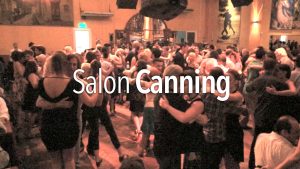
The Former Salon Canning

There are very few places left in Buenos Aires that still evoke the majesty of Tango’s yesteryears, for many, that is Salon Canning. From the moment you walk in the door, down the long hallway towards the white double door ‘entrance’ to the dance floor, you know you’re in a special place. The walls are lined with pictures of dancers that have come and gone, artwork and photography from local tango artisans. The entry hallway almost looks athenian, almost. It may help that the columns outside add to that idea.

Read More »

Men That Don’t Study

Men. Oy. Tango is hard enough, but adding ego to the equation just creates a whole other level of issues that most women can agree is a lot like a pissing contest. Before we lay into this like white on rice: Being fair, not all men have an ego when it comes to Tango. A smaller number of them do recognize that Tango is a study. As such it requires them to do their homework, on a regular basis. And ‘homework’ in this case means private study, solo practice, solo study, musical study, on a daily basis.

Read More »

The Practica

The idea of a Practica is ‘theoretically’ to Practice what you have learned. To try out what you have been shown, with multiple partners, as if you were in a class rotation. It is ‘theoretical’ because while the theory is nice, the reality is a little different.

Read More »

The Tango Haus

What’s below is a small snippet of 13m:06s audio podcast of Today’s Topic on the benefits and detractors of building community using the idea of a Tango House. “What I refer to as the Tango ‘Haus’ idea. In this case this is the German spelling of ‘HAUS’. I just like the way it sounds. But we can use the American spelling of ‘House’. So a few years back and I may be bastardizing some history here. There was a tango house, and I’m not going to name the city, that grew up out of a U.S. based city. This community, at the time had a number of teachers in its area, and they were all using the typical model of how they wanted their students to learn to dance.

Read More »

Being Criticized

The truth is that this is critical feedback, about what you’re doing and how you’re doing it. Hopefully that critical feedback or criticism is done with exacting detail, which is needed for analysis, breakdown, and then reconstruction or rebuilding your posture, walk, embrace, vocabulary, and/or musical interpretation. Without that critical feedback, you will continue to make the same mistakes over and over again thinking that everything is happy and lovely when in fact it’s not.

Read More »

The Non-Gender Cabeceo

What is a ’Non-Gender Cabeceo’ ? A Non-Gender Cabeceo works exactly the same way that a Gendered Cabeceo works. There’s nothing special or different about it. The practice is exactly the same regardless of Gender, or at least it should be. If same sex dancing, or role fluidity, is permitted at Milongas, Marathons, and Encuentros, then the same rules apply in a Gendered Cabeceo.

Read More »

Giving Up Tango

There comes a point in your Tango life for one of several reasons where you find yourself in an odd place – the want to give up Tango. The most common reason is that you’re just not getting the same thing from the dance as you used to get from it. You go to Milongas. You find yourself sitting more, talking more, and dancing less.

Read More »

Saying ‘No’.

So without further variance, below is a 10 step process in “How to say ‘No’, and not dance with Y!” 🙂

Read More »

Toe vs. Heel (Follower) ?

In case you have been living under a rock, this Thought is going to shock you somewhat. There is a debate that has been raging for quite some time now. The debate ? Should the Follower step forward with their heel first, or their toe first ? Better known as the Heel or Toe debate only for Followers, not for Leads as is the usual debated topic.

Read More »

Presentation Tango

There is a very popular idea in Tango that gets paraded around a lot, an idea which gets confused with Social Tango which is NOT Social Tango at all but rather it’s about the steps, patterns, and figures is known as ‘Show’ Tango, ’Scenario’ Tango, ‘Stage’ Tango, ‘Fantasia’ Tango, or Presentation Tango.

Read More »

10 REASONS TO SUBSCRIBE

There are 4 Levels of Access: Free, Basic, Premium, and Premium+. Free pays nothing but gets a perk just for signing up. 

1.) Free Users get to see 5 of the 125 Different Tango Topics on the site. Plus you get access to the entire Tango Reminders and Tango Ideas sections of the site. These are short form Topic descriptors with a little detail about the topic and the video.

2.) 
Basic and Premium users Save A BOATLOAD of MONEY! Buying this stuff outright is expensive.

3.) Basic, Premium, and Premium+ users get access to the ALL ARTICLES and THE FULL ARTICLE which you can’t see right now.

4.) Basic, Premium, and Premium+ users have way better video resolution: Free = 420p, Basic = 720p, Premium = 1080p and 4K. 

5.) Basic, Premium, and Premium+ users get the ‘Dancing Perspectives’ & ‘The Soup’ sections of the document you just read (Lead, Follow, and Dancing) which are open to you. And that’s where all the good stuff is at. 

6.) Video Downloads! 

7.) Access to the Tango Topics Music Library (22 Curated Golden Age Orchestras)

8.) Access to ‘Tango Del Dia’ – Our Music Education System with access to 14 Days of Music, 30 Days of Music Education, and 30 More Days of Tango Del Dia. 

9.) We explain things, break the vocabulary down in a visual way, from multiple angles, showing feet, hands, and close ups! Yes there’s a lot of talking but we want you to understand what it is that you’re doing and why, not just steps, patterns, and figure

and #10:
No more annoying ads at the bottom of the page, begging you to subscribe! 

Keep something in the back of your mind: What you’re seeing in a youtube video is a couple that is performing for the 15th row for a room full of people. They’re not social dancingWhereas this website is all about ‘Social Tango’  or how to make things function on a social dance floor. Social Dance floor ? Your local milonga! They are showing you flashy moves as a presentation, to show off! But not stopping and talking about how this works which is what you need to see. This website and all of it’s content show you the how and  why you’d want to put that piece of vocabulary there, or how to make things work. This website is all about those things and more!

You could watch Tango YouTube videos and thereby spend your time, trying to infer, and figure out how things may work in that particular situation. Bend your body this way or that, twist and force this position or that. Place your foot here or there and figure it out. This is known as Tango Twister.  Which can be a lot of fun, but more than likely it won’t help you, because you’re missing something: The explanation from an experienced teacher showing you how to properly excute this stuff from a Leading Perspective as well as from a Following Perspective!

The goal of YouTube videos is to get you to study with those teachers in person. The goal of Tango Topics videos allows you to work at your own pace, in the comfort of your own space, so that you can play them over and over again to improve your understanding of the vocabulary or technique being described to therefore better your dancing experience. The goal of classes and workshops is to get you to come back over and over and over again, thereby spending more money with that teacher. This website and the videos under it are here to act as a resource for you to help you to improve your dance. Pay once and you’re done.

Eventually, one way or another you’re going to pay for this lesson, either here and now, or with them. TANSTAAFL! The difference between that lesson and this ? Is that you get to play this lesson over and over and over again. Further still, there are supporting materials (other videos) that help to explain the language and the underlying technique of how and why things work, so you can easily reference those things in the corresponding articles that go with the material, and or any language in the Tango Topics Dictionary. 

DROP ME A MSG HERE

Hide picture