Offer ends in Offer $99 for 1 year 1daysd 12 58 00 One year for $99 Get your year
Tango Topics info:

Check out the Tango Dictionary for words like Axis and Connection.

Tag: social tango

  • Mirada: Asking A Man To Dance

    Mirada: Asking A Man To Dance

    (note: this is my opinion of how things should work, take it with a grain of salt.)


    For those of you who are just arriving at the party…or even if you’ve been dancing a while…or if you’ve come to the party from another dance, the question of “How do you ask a Man to dance in Tango ?”. Or as you learn why can’t you ? (we’ll deal with that one later in the article). In Ballroom, Swing, or Salsa, you just ask, and no one would ever think of saying “NO” to your polite request. Tango, on the other hand, is another ball of wax entirely! So how do you ask ? Well, that’s what this guide is all about: A safe, and a ‘Tango’ correct, way of going about the process that offends no one, and furthermore actually helps you to dance more frequently!

    A few things need to said, before we get to the ‘how’ part…these are a few  requirements before you ‘ask’.

    1.) There is nothing wrong with asking a man to dance in the United States and/or Europe. Everywhere else, it’s a little different. However, ladies you must understand that doing so anywhere may not get you the desired results that you’re looking for. The reason is because so many of the Leads adhere to one of several older codigos (codes of the dance). So for that reason, try not ask a man to dance ‘verbally’ (there is an exception to this suggestion). Otherwise you may end up sitting all night long. You will be, seemingly, punished for doing so. Why ? There are some men that see the idea of a woman asking a man to dance as absolute heresy. And there are a greater number of women that feel the same way by the by. There is an order to things and doing so is a violation of that ‘order’ in their minds. At the same time, there are some men that actually appreciate a women when she asks, however those men are few and far between. So if in doubt, just don’t go there unless we invoke the exception below.

    2.) A woman’s role in the dance has traditionally been to be the ‘follower’, and while I detest the use of this word because it usually isn’t about following per se but rather about being ‘submissive’.  In today’s Tango world the idea of a submissive Follower is changing slowly, but it is changing. In any other dance, especially in the United States & most certainly BsAs, a woman is trained to be an active participant–this is not so in Tango. It wasn’t until very recently, and we’re talking up until about 20 – 30 years ago and even that’s a stretch, that the dance has started to relax some of its ideas, but this one, unfortunately or fortunately (depending on your point of view) is not going away any time soon. In short, you have been trained to be ‘submissive’ and may not even realize it.

    3.) Understand that while you are asking someone to dance, or wanting to dance with someone, they are not obligated to accept your invitation.

    Facts You Need To Understand: 

    1.) The better the Lead, the less inclined he is to dance with you, if they don’t know you or haven’t seen you dance. And while you may believe that you’re up to the challenge, more than likely you are not and you need to accept this fact until you change certain things about your embrace, about your walk, about how you respond to certain types of kinesthetic movements (leads – the action, not the person).

    2.) It’s not fun. In the case that you’re operating under the (de)illusion that Tango, as a dancing form, is just ‘fun’. Yes it is, but only if certain things are present. The less you know, the more ignornant you are of the form, the more fun it seemingly is. However, as you discover just how much you don’t know, this is where ego comes into the equation, the more you realize that tango requires some work.

    3.) Skilled Dancing. Tango requires that the dancing pair be very skilled in a variety of areas, not the least of which is body kinesthetics, the vocabulary of the dance, the vocabulary of a particular style or ‘flavor’ of the dance, and of course the music!  In specific, a deftness of touch that far exceeds what you believe possible, a level of kinesthetic movement that is far more subtle than you will ever experience in any other dance, and a level of technique and attention to detail that is absolutely insane on the surface.

    4.) Painful. You may not realize this right now, depending on where you are in your tango journey, but you may in fact just be ‘painful‘ to dance with. Painful in the sense that you are generating tension, pressure, force, compression, resistance, with your embrace. Coupled with that usually comes instability and using your lead for a whole host of things, most notably stabilizing you everywhere in turns, crosses, and ochos! Even micro-stabilizations.

    5.) The other facts. It doesn’t matter how pretty you are, and/or what you are wearing, and those nice ‘Tango’ shoes that you just bought are virtually worthless!

    This stuff is not here to not to put you in your place, or to make you feel bad about yourself, or to elevate the Lead/ers (see the ‘notation’ at the end) in the room to ‘god’ like status, their egos are big enough as it is. No. These points refer to the ‘better’ Leads (the person, not the action) in the room, not the run of the mill ‘push’ and ‘pull’ Lead/ers that populate every milonga within a 1000 mile radius. These points are reminders about the clean, clear, haptically (level 1 – 3) sensitive Lead that does employ feather-light touch, that does not use compression or restriction to achieve their goals, that does not use pressure, resistance, or force as a means to communicate any message to their follower in any way, shape, or form.  Most Followers, unless they’ve led, will not understand what it takes to lead at this level, conversely, most Lead/ers do not understand what it means to lead this way either. It’s called Intention Based Dancing and it is a level above what you’re used to dancing with and once you have a small taste of it, you’ll want more of it. At the same time, a Follower at this level must also not wobble, generate instability in their walk or use their lead for stability in any way, shape, or form. Why is this relevant because this type of Lead demands that you are deft and sensitive to dance with, that’s why.

    The Exception. There is an exception to asking a man to dance, and it should be at the top of the list below but is left out because the list below assumes that you don’t know someone personally. That you haven’t already danced with that person several times previously! So what’s the exception ? Just that, if you know someone personally, or that you’ve been introduced to them by a trusted party there’s no reason in the world not to suggest that you dance together. Note the language there, ‘suggest’. Not ask, but suggest. How should you suggest ? “Hey I’ve got my new _________ (shoe brand) on, want to help me try them out ?”, “Gosh that was a less than desirable tanda with _______, I need a gentle Lead like you _______ (name of Lead you’re speaking to), would you care to do the honors please ?”, or “MMMmmmm Milonga! Gosh I would love to dance to this”…etc. Note that there is no direct askance here in these ? Note that he has the choice here to decline. The notation here is that if you know someone than a simple verbal request of an indirect nature will achieve the desired results. Yelling “HEY BOB, LET’S DANCE!”so that the whole world can hear it, not so much with that. Discretion and decorum are important here!

    HOW TO ASK A MAN TO DANCE and GET IT!

    1.) Mirada. This is a socially acceptable way for a woman to ask a man to dance and no one need know that you’re doing it! If you don’t know what it is, in short, a Mirada is making direct and clear line of sight eye contact with an intended dancing partner while they are not dancing with someone, and once contact is established, you indicate with a nod of your head or your eyebrows that you would like to dance with that person (note: walking up to someone and nodding your head, indicating you’d like a dance, is considered poor taste, this is better known as the “Stalker Cabeceo”).

    2.) Conversate. Walk around at a milonga. Put your shoes on and walk around and engage people in conversation, not just the men…but the women too. Remember this is a ‘Social’ dance and while you are there to dance, you’re also there to be social. That means to engage in conversation, chat, drink with, and be friendly with people. However if you spot a Lead that you’d like a dance with, do not ask directly, but rather engage him in conversation.

    Here’s the Trick: Near the end of the conversation, employ the following line any way you’d like to word it: “At some point, and if you’re interested, I would like to dance the last song of a tanda with you if you are free”.

    Why this method ????

    • 1.) What you’re doing is indicating that you’re open to a dance with him later!
    • 2.) You’re also putting the onerous task of deciding when that dance happens clearly in his lap. Notice you used the word “Later”, not “Tonight”. Later could mean a few weeks from now. The important part is that he’s clearly deciding IF and WHEN that dance happens, not YOU.
    • And 3.) Lastly note that its the last song of a tanda…not a full tanda! Why the last song ? Because if he doesn’t like dancing with you, he’s not obligated to go any further. But more than likely he will! Also note the last word, “free”. What you are doing is making it very clear that you are a last resort, when he thinks of it.

    Now here’s the hard part. Finish the conversation and then walk away! Do not look back, do not go bother him again, do not engage in further discussion of the topic. Move on to other people. Talk it up, girl!

    3.) Circulate. That means to place yourself where every Lead can see you, typically on the corners of the room and change placements once every 30 minutes. Do not hide, do not sit slumped or hunched over–sit upright in the damned chair, legs crossed (show’m if you’ve got’m), head up, and smiling! No one wants to dance with a frown. When you do get up and move, be obvious about it. That means that as you are changing your placement and going to a new spot, smile, make eye contact with everyone as you do…don’t just look at the ground. This is work girl and it takes active work to do it well.

    I feel I must; you must do all of these things to have the desired affect you want…which is to dance consecutively all night long, preferably with the guys you want to dance with and not with the men that you don’t want to do dance with. However, doing this once and then stopping is not going to have the desired effect. It is cumulative! It also goes without saying that it helps to dress the part, meaning put on that slinky dress you’ve been dying to wear–you know the one that is skin tight in all the right areas…men do like curves…sadly, it’s a sad truism. But it does work to a limited degree, but not with the better dancers in the room, they really don’t care what you’re wearing, they only care about one thing: dancing well!

    Going to group classes once a week is all fine and good, however, that’s not going to improve your abilities. What will improve them ? Private lessons on your walk and your embrace! Lots and lots and lots of practice, practice, practice, practice, practice…and more practice! I am not kidding. Every day. You must improve beyond just getting around the floor and not looking like an idiot! If you’re there to socially chat up your friends that’s one thing, and you should not expect to get the dances you’re wanting and this guide is nearly useless to you. However, if you are actively improving your dance, by practicing, taking lessons religiously, and traveling to other cities to dance with other people on a regular basis, this is one of the only ways that your skills will leapfrog over everyone else in the room! If you don’t practice, then you shouldn’t complain that you’re not getting the dances you want. If you don’t put in the time to improve, then you shouldn’t complain that so-and-so isn’t dancing with you. There’s a reason so-and-so isn’t dancing with you, its mostly and probably because you feel like a ton of bricks to dance with, you’re hanging, and/or are highly unstable.

    Lastly, there is a cumulative effect here, you must do all 3 of these things with 10 or 15 guys in a night, and you’ll almost never sit at a milonga again! It takes time and concerted effort to do what I am suggesting, however, I’ve done this myself when I was out following socially only, and I know many men and women use it, even on me, and it works. It takes time and dedication to get this to work, but it does work.

    Good luck!

    Notation: See the definition of the usage of the word “Lead” and all it’s variations before reading any futher.

    The distinction of the descriptive nomenclature of leading language is rather necessary when trying to discuss this stuff in a verbal or textual way without the visual in front of you. Further still that without the distinction the terms themselves can be rather confusing if just using ‘leader’. Further I, as a teacher, make the distinction between an Intention Based Dancer (in the role of…) and a Resistance Based Dancer (in the role of) and one way that I can make that distinction is through the nomenclature. You may disagree with it but it does create, in my mind, a level of granular clarity to further the distinction of resistance dancing vs. intention dancing.

  • The ‘Check’ Step & Incremental Steps

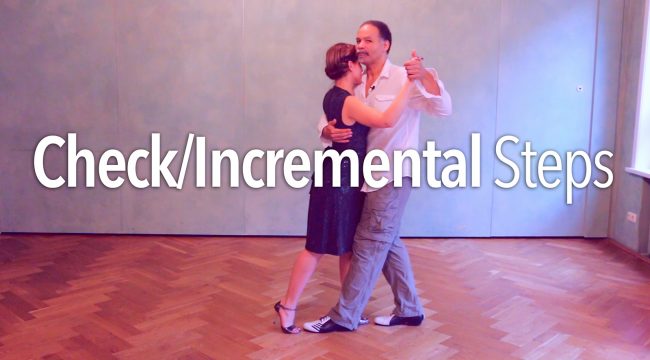
    The ‘Check’ Step & Incremental Steps

    There are pieces of Tango Vocabulary (steps/patterns/figures) that are very complex. The moment you see them you can’t even begin to imagine or even see yourself doing them. And then there are some that are the polar opposite – insanely simple, which for one reason or another require (seemingly so) no explanation! And then there are some pieces that somewhere in between. Today’s Tango Topic falls into the insanely simple category. However this stuff does actually require video, it does actually require an explanation of what not to do, and it does most certainly require an exploration of what’s possible. But let’s not get away from the fact that it’s a step. Nothing more than that. It looks cool, when executed properly, but it’s insanely simple. Like most things that are insanely simple, the devil is in the details. And those details are where you actually have to execute these ideas. In Today’s Tango Topic we’ll explore this from both sides of the embrace, as usual, and discuss the merits and detractions of playing with this stuff.  So without further preamble….let’s look at the Check Steps & Incremental Steps.

    What is a Check Step ? A Check Step is a bit of a misnomer. First and foremost it is a form of movement that we can and do invoke inside of specific moments like the Ocho Cortado for example. Secondly it is its own type of Tango Vocabulary.

    In the first option, the movement itself is a leg extension done by either Lead or Follower (usually the Follower is led to this), where the leg extends through Perihelion phase of the step, but does not progress to the Transfer phase of the step (basically no weight transfer). This form of movement is especially useful in Traspie, and rightfully could be called Traspie but isn’t. Why ? Because, again, there is no weight transfer. In Traspie, there are greater and greater increments of weight transfers.

    What is an Incremental Step ? An Incremental Step is a step that does include a slight weight transfer, however, it only goes a piece or a part of the way. Think of it as a step that only goes about an inch or two, and then with the next increment, the step goes a little further, and then the next increment goes a little further

    Why are these things important ? These pieces are important for a few reasons. First and foremost, variety. They create the option and/or opportunity for variation to occur. Massive variation in any number of areas. Secondly, because these these are steps, basically, they can be initiated anywhere, under any conditions, with all styles of music. Thirdly, because they’re so simple to do, it means that nearly anyone can do them. So with just a little training (this video), and lot of practice, you can implement this stuff in your dance with very little fanfare. 😉

    The Free Tip. In case you hadn’t realized this Leads, you can play too! Let that sink in for a bit. No. Seriously. Let that sink in. All this time, you’ve more than likely been thinking about leading the follower to X, Y, and Z. How about self leading yourself to an Incremental without the Follower! Assuming you pick your jaw up off the floor, go try it. The effect is two fold. a.) it looks cool. and b.) most Followers will think you’re playing with the music! 🙂

    Related Topics. When you’re done with this article, you want to go look at two other videos. 1.) Cross Body Incrementals, where you can apply these things in Close Embrace. 2.) The Golden Nugget Extensions video. Where you have oodles of options beyond your wildest dreams! 😉

    About The Video. This video is 16m:26s in length in 7 sections. Both lead and follower technique are combined and integrated into the video.

    Introduction/Technique – 00:07:00
    The Weight Transfer Illusion – 00:00:56
    Usage – 00:00:48
    Incremental Sice Steps – 00:01:25
    The Example w/Metronome – 00:01:51
    Close Ups of Footwork – 00:02:12
    The Last Word/End – 00:01:45

  • The Argentine ‘Dip’

    The Argentine ‘Dip’

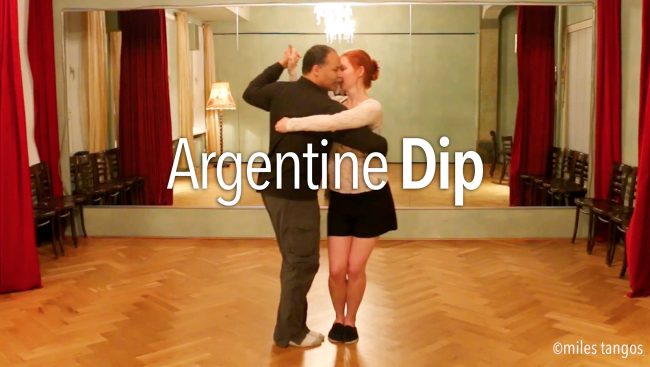
    The ‘Dip’ is a very common form and expressive move used in most social dances. Argentine Tango has it’s own version of a ‘Dip’, however this version of the Dip looks nothing like what you’ve seen before. It’s almost not worth calling it a ‘Dip’ to begin with but it is in truth of fact, the Argentine version does classify as a ‘Dip’.

    Let’s back up a moment and address the possibility that you have no idea what a ‘Dip’ is. A ’Dip’ refers to what is called a Dancing Dip. And it is what it sounds like, a physiological dip in the movement of the couple. Where one partner, the Lead, stops the dance for a moment to express some aspect in the music. Usually that moment is characterized by a long, languid note.  At that point the other partner (the Follower in this case) is led into a controlled, but partial, fall within the embrace of the first partner (the Lead). This is a ‘Dip’ in technical terms. Usually this kind of move is very, very dramatic, and done in the extreme to maximize it’s effect. And the effect is very visual, generating lots and lots visual lines, postures, and poses for the couple. One such idea is the ‘Death Drop Dip’ (which Tango does use in Performance Tango) where the Follower is led to almost touching the ground with their back, and one arm stretched out towards their partner  The Argentine Social Dance version of this idea is the polar opposite of this extreme idea. The Argentine Dip is more felt than it is dip. That said, let’s talk about the Argentine Dip.

    What is an Argentine ‘Dip’ ? Every dance has a form of a ‘dip’ where the Follower is being led to, quite literally, dip their body either forwards or most commonly backward. You’ll see this idea represented in dancing movies from the 1930’s and 40’s, look at the clip below which starts at 01:29, and then wait for it at 01:35! That is a classic dip, more a drop than a dip. But this is the classic dip.

    video
    play-rounded-fill

    Tango has its version of this idea, only it’s not so dramatic, not even close. As a matter of fact you’ve been doing them all along and haven’t even realized it! That’s because the dip is embedded in a very specific piece of tango vocabulary: The Argentine Cross.

    Let’s not make a mountain out of a Mole hill here, after the Follower is led (this part is very important > ‘the follower is led‘, not implied, which frequently happens) to cross their feet in a Normal Cross (See > 256 Argentine Cross Variations) the Argentine Dip can occur at this juncture because it’s an elongated forward step out of the Argentine Cross! There is, however, a catch with this thing. There’s always a catch. And the devil in this case is in the details. And the detail is what specifically is generating the impulse to ‘dip’.

    Aside from the devil in the detail, there’s something else you should know. This isn’t a ‘dip’ per se, not in the traditional sense. Truthfully, it’s a misnomer in terms. It’s more of a ‘hang’ for a long moment more than anything else. It’s not a ‘dip’ as in the sense of the Fred Astaire/Ginger Rogers dip above. It’s not that by any stretch of the imagination. It is however a very, very, very long hang. And even that’s a misnomer, but it’s the closest thing that we can reference that makes any sort of sense.

    The Free Tip. The Argentine Dip does require both parties to aware of what’s going on at all times. This isn’t a situation where you lead and they follow. No. It’s a situational awareness and needs to be trained into the dancer to show exactly what this feels like. The video above is a good start. And the reason is that very few teachers actually show this stuff, let alone talk about it.

    About The Video. This video is 13:14 in length in 5 Sections. Both Lead and Follow technique is co-combined. 

    Introduction/Overview – 03:04
    Engaging Over-Rotation – 03:06
    Close Embrace Details – 01:06
    The ‘Hang’ – 02:45
    Follower Adornments & Embellishments – 01:18

  • The Dark Side Salida

    The Dark Side Salida

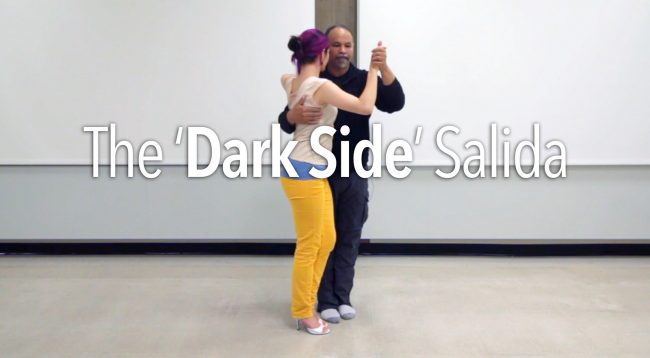
    The Salida. The Spanish word ‘Salida’ translates in English to ‘Exit’ or ‘Left’ as in the past tense of the verb to ‘Leave’. However when we apply this to Argentine Tango it means something else entirely different. It is a process that includes Cabeceo/Mirada, and the Entrada in the line of dance, as well as the Exit (Salida) from the dance, and walking your partner back to where you found them. In BsAs, or more formal Milongas in the world (including Encuentros), this means walking them back to their table. This is the process known as ‘Salida’. However with regards to the dance we typically only equate the word Salida with Entrada phase of the dance, and this is known as a ‘Salida’ Step. An entry (or exit) into (or from) the line and/or lane of dance. There is typically only one that gets talked about and or shown, and that’s the very typical couple side step into the lane of dance. There are, as you might imagine, loads of others. Today’s Tango Topic talks about a very specific and special one referred as the Dark Side Salida.

    What is a Dark Side Salida ? It is a Salida step that is entered into from the ‘Closed’ side of the embrace. Typically any piece of vocabulary that is referred to as such is a Dark Side ‘X’,  where ‘X’ is the vocabulary is the mirror copy of the Open side of the embrace. This has nothing to do with walking systems, or embrace formats. It only refers to the bi-lateral bisection of the body or in this case the couple’s embrace.

    A Dark Side Salida on the other hand is a whole different ball of wax. It’s not your typical side step into the lane of dance, because … because doing so would step you out of the lane of dance and off the floor.  🙁 That would be bad. No. A Dark Side Salida step uses very simple, or basic, tango vocabulary put together to form figure in order to accentuate the ‘Closed’ side of the embrace AS the opening step of the dance! To be fair, while you can use this piece of vocabulary at nearly any point in the dance, employing as the Salida step has certain benefits, one of which is that it has incredible musical properties (not shown in the video).

    About The Video. This video is 12 Minutes in length and shows a very specific Salida step that you can use in the opening of your dance. It can not be purchased at this time, and is only available to Tango Topics Subscribers in the Technique Library. 

  • Contortion

    Contortion

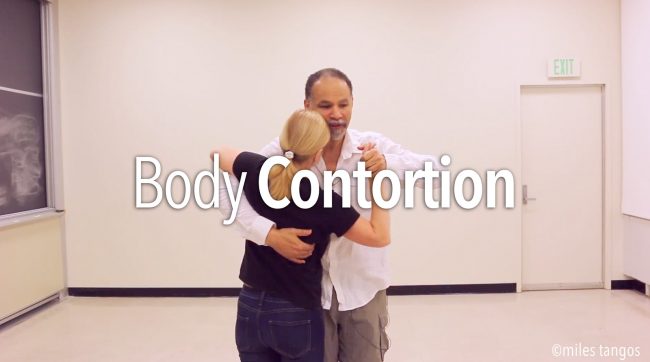
    Contortion.  You see so many different ideas of dancing tango that it sometimes very hard to differentiate desirable from the undesirable. That unless you teach you’re not going to see these issues and need to be reminded of them, frequently so that you stop co-creating these less than desirable issues.

    What is Contortion ? In it’s simplest form, ‘Contortion’ is twisting your body, then placing your body, and further still compressing (squeezing) your partner’s body into you, into a physiologically untenable position, and staying there for the length of a song. Then starting the next song in the tanda from a clean position, and then starting to slide into the contorted position. This is ‘Contortion’.

    And ‘yes’, it is an issue. Everyone exhibits some form of contortion. Everyone.

    Before we go any further, 2 things are going to happen while you read and/or watch the video above: You’re going to immediately run to the judgement that 1.) The author/teacher is being a perfectionist. 2.) That the author/teacher is being arrogant. Neither are true. These are stark observations offered without judgement. If you see yourself in these things, then so much the better. However, the thing that you should rightfully pay attention to is not the resolution example, which gives you the idea of perfectionism, but the latter part of the video that starts at (07:36). 

    That said, let’s talk about Contortion.

    From A Following Perspective you have 3 primary areas of Contortion that come up for you. 1.) Arm Over The Shoulder. 2.) Side of Body Following. and 3.) Follower ‘Chicken Arm’ Distortion.

    Arm Over The Shoulder – This is an outgrowth of wanting more, or deeper physiological contact with the Lead. And while the physiological contact does serve it’s intended purpose, more contact, the problem with it is that it compromises the body to do so. As a result of going over the Lead’s shoulder with yours (as shown) above, you end up raising one shoulder above the other, and thereby curving your spinal column. And as an added bonus you’ll tilt your head into your lead.

    Side of Body Following– This missive is factually placing your body in the Lead’s armpit, but only having the physiological contact of about an inch or so of their body. As a result of this kind of Following, all of your vocabulary will become ‘linear’ or ‘oblong’. Example: Turns will no longer be circular, they’ll be ovals! The back step of the molinete (not a milonguero turn) will become almost impossible to do, and you’ll end up in the Lead’s armpit, thereby being behind the L/lead, seemingly never able to catch up to them. 🙁

    Follower ‘Chicken Arm’ – The Follower will create a loop with their left arm, placing their left hand on the ribcage of the Lead’s right side about 6 inches down from their armpit, and then bend their elbow out at a 90 degree angle, and here’s the wacky part – then they’ll raise their left shoulder above their right, thereby curving their spine, all in ‘close embrace’.

    From a Leading Perspective you also have 3 areas of concern that generate Contortion. 1.) Head Tilt (Away/Towards). 2.) Side of Body Leading. 3.) Lead Chicken Arm.

    Head Tilt – While the topic of Dancer Head Tilt has been detailed before, the Head Tilt that is most common here is the Tilt of the head TOWARDS the Follower. As a result the Lead will place physiological pressure on the Follower’s head. This is done without the Lead necessarily being aware that they’re doing this. Sometimes, infrequently this is Head Tilt AWAY as shown at (00:00) so as to ‘accommodate’ the Follower’s Bodily Contortion or because they don’t want to get too close to the Follower’s face or mouth area. It’s too intimate for some Leads.

    Side of Body Leading– This lead missive is factually placing the Follower’s body along the side of your body. The physiological contact point is about an inch or two wide, and is a strip of contact on your body from the crease of your right armpit to your hip. As a result of this kind of Leading, all of the Follower’s vocabulary will become ‘linear’ or ‘oblong’. Example: Turns will no longer be circular, they’ll be ovals! The back step of the molinete (not a milonguero turn) will become almost impossible to do, and the Follower will end up behind YOU, seemingly never able to catch up. 🙁

    Lead ‘Chicken Arm’ – The Lead holds their left arm out straight, level with their shoulder line, and then bends at the elbow in a 90 degree arc, towards the Follower, then grasps the Follower’s hand.

    [ls_content_block id=”8855″ para=”yes”]

    From a Dancing Perspective these are 3 most common forms of Body Contortion that happen for both roles. You see this stuff everywhere and think to yourself “Well….if so and so is doing it, it must be ok, right ?”, and at that point you normalize the behaviors and postures of the people around you. At the same time you also have something else working against you, your memory of your last session with your ‘teacher’. At some point during that session (assuming said teacher has their collective act together) said teacher should have noticed (frequently a good portion of them don’t) and then remarked upon (again, they don’t want to hurt your feelings…mind you, it’s your money, ‘feelings’ shouldn’t enter into it!) the fact that you’re embrace, your posture, your body is contorting this way or that. And unless you are reminded about it constantly, you’ll think about it for about 2 steps and then you’ll completely forget about it. And if you’re thinking that you’ll remember this stuff on a Social Dance floor at a Milonga…think again. Stress gets in the way that happening. If you are stressed out how much space you have between yourself and the couple ahead or behind you. Or if you’ve missed something and you’re focused on that…posture, embrace, presence are the last things on your mind. You’re too damned busy freaking right the frak out. Dancing ? HA! Again this isn’t about perfectionism, nor is it about arrogance, this is demonstrable fact, proven time and time and time again.

  • Cross Body Incrementals

    Cross Body Incrementals

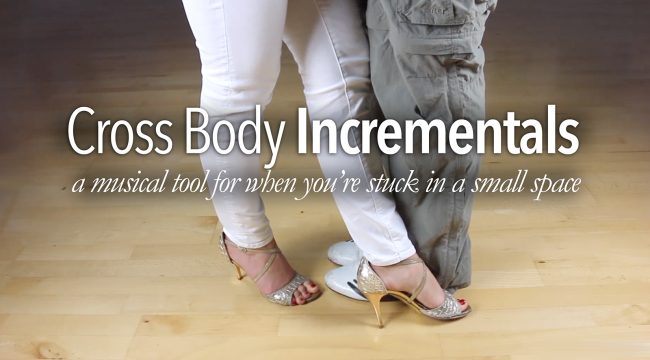
    Let’s get something out of the way immediately, ok…a few things: This particular Tango Topic is a Tango Topics phrase. Meaning that you’re not going to find it in any tango class with any other teacher. Secondly this topic refers to a class of vocabulary that isn’t particularly sexy to talk about, “talk” being the operative word. Thirdly after watching the video above, you’re going to ask yourself, “what’s the point ?”. And you’d be right to ask that question. It’s actually, almost quite boring to watch. Watching it is one thing, doing it on the other hand, is radically different, and it sooooo vicseral in it’s application that you’ll want to spend all of your time doing nothing but just because of the way it feels when it’s done properly.  And that right there is the key component. Doing it properly.

    To be clear a Cross Body Incremental is not necessarily the topic that makes you go, “WOW!!! OMG!! I want THAT!!!”. It’s just not. And yet, this particular topic is quite literally every. single. thing. about tango that you find to be fun, intimate, and absolutely delicious at the same time. It’s that good. So yeah, on the outside looking in, not so much. On the inside,  doing it….OH MY F*CKING GOD!!!! So without further adieu, today’s Tango Topic – Cross Body Incrementals.

    What is a Cross Body Incremental ? In its simplest form a Cross Body Incremental is motion that is generated from Opposition, which results in the Follower’s leg extension across the meridian line of the couple, usually to the opposite side. The distinction between Cross Body Incrementals and a ‘step’, is that there’s typically no weight transfer at all in Cross Body Incrementals. Where it gets its name from is the fact this is all about, say it with me, ‘incremental’ motion. Meaning you don’t have to do this all at once but rather in tiny little bits, which typically match the beat, or an 8th or 16th note in the music (this is NOT shown in the video). So what’s the Cross Body part if it’s just incremental motion ? Isn’t that kinda like Traspie ? No, for two reasons. In Traspie, which is typically employed in Milonga…typically, there is a slight weight transfer. In this instance, there is no weight transfer. Secondly, in Traspie, the motion is usually (very often) linear. Meaning ? That the Lead will invoke the Follower to extend their leg backwards or forward, or side in linear fashion. In this instance, the Follower is being asked to extend and oppose across the Lead’s body, and across the couples meridian line in close embrace. So in essence while it may appear to be a Traspie. It is anything but!

    The Free Tip. While this stuff is all about Opposition, there is another element here at play that has everything to do with ‘Body Position’ and ‘Body Placement’. For those of you that are not keeping up with what those phrases mean, ‘Position’ is where you are in relation to your partner. ‘Placement’ is what you do with that ‘Position’! This is all about ‘Position’. Put another way, if you haven’t seen the video on The Armpit Dancer, then stop here, and go look at the link, and then come back and read this: You need to be ‘buttons-to-buttons’ with your partner or Sternum-To-Sternum. Not in their armpit! Doing so, and this stuff fails! Well, not fail, but not ideal. One side will seemingly work really well, when the other side doesn’t, in specific the Open side of the Embrace will not work very well. The Follower will end up having to contort in all sorts of ways to make this work, none of which are good. So ‘buttons-to-buttons’ is desirable!

    About The Video. This video comes in at 36m:38s in length in 9 Sections. Separate Lead Technique and detailed Follower Technique is explained here in the video.

    Section 1 – Introduction – 00:04:26
    Section 2 – Lead Technique – 00:04:36
    Section 3 – The Weight Change – 00:02:41
    Section 4 – Embrace Clarity – 00:00:53
    Section 5 – Cross Body Close Up – 00:02:34
    Section 6 – Follower Technique – Opposition – 00:05:09
    Section 7 – Follower Technique – Legs – 00:03:05
    Section 8 – Follower Technique – Feet – 00:04:15
    Section 9 – Dancing Ideas/ End – 00:08:20

  • Social Boleos

    Social Boleos

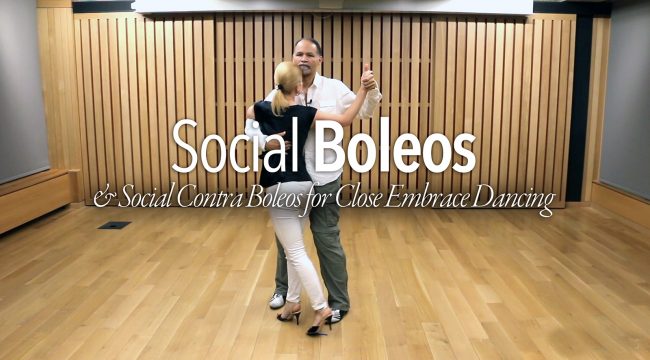
    The word Boleo comes the root Spanish word “Bolear” which roughly translates into English as “To Shine” or “To Throw”. The word ‘Boleo‘ is pronounced: “Boh-Lay-Oh” with the emphasis on the 2nd syllable. Boleo is the first person singular, meaning “I throw” or”I shine”. That’s about where the English and the Spanish meanings stop and take in a completely different meaning from a Tango perspective. From a Tango perspective we view this as a very specific piece of Tango Vocabulary which is nothing short of gob-stopping when executed properly, and in time to the music. Typically for most people when they hear the word Boleo they can only conceive of one type of Boleo, and that’s the flashy, but respectable, High Circular Boleo variety. To be clear, a Boleo, in its simplest definition, is one the four Tango Displacements, (Gancho, Wrap or Enganche, and Sacada being the other 3) that Tango Topics talks about. In the case of the Boleo, the Follower is led to “Throw” their leg behind them in any number of ways. However, that descriptive is a little misleading because the “throw” that is implied isn’t a ‘throw’, it’s a very controlled and contained action that shouldn’t be trifled with. Secondly, there’s a very specific reason why the Boleo occurs, which almost never get’s talked about or shown. There are lots and lots and lots of Boleo videos on YouTube for you to go watch. However, not one of them, not a single one, explains HOW you safely generate one, why a Boleo occurs, and more importantly the necessary skillsets that are required before you can or should attempt to even in engage in one. This video series does. Today’s Tango Topic looks at that set of circumstances and creates a very specific type of Boleo that could easily be called a “Low” Boleo but it is more apt to be called a Social Boleo. So without further adieu or yapping, Tango Topics presents The Social Boleo and Social Contra Boleo.

    What is a Social Boleo ? We must make clear the first part of the Term “Social” of “Social Boleo”. Social in this context that Tango Topics typically defines that word as: 1.) The Ronda of the dance floor, pertaining to the line, lane, and Tango Floorcraft of the couple. 2.) The Milonga experience. Meaning how you enter the room, who you speak to, where you sit, how you sit, what you dance to, who you dance with, how you invite or deny a dance. 3.) Fitting any and all vocabulary choices, regardless of which role is initiating it, within the physical width of the “lane” of dance, and the physical distance of one singular step that goes with the line of dance.

    The definition for a Boleo is as above, but in this context it would be where the Follower (or the Lead) is led (or self-led in the case of the Lead) to extend and then to lift their leg (that’s the throw part from above) behind them in a very controlled and contained fashion that can in certain cases be linear (in or on a line), or circular. Low (sometimes referred to as a ‘Social Boleo’), mid-range, or high (the common one). Quick, languid, and/or frozen. Which are either done “With” the Follower’s motion, or against the Follower’s motion (which would make it a ‘Contra’ Boleo).

    Therefore a Social Boleo is a type of low(emphasis on the ‘low‘ part), circular, ‘With’ type Boleo that can be done quickly or languidly and can also have a frozen component. In this highly specific type of Boleo, the dancer’s foot would never, ever, leave the floor. Typically in High Boleos, the dancer’s foot would come off the floor. In this instance, because these are Social Boleos, the dancer’s foot stays on the floor, and extends in a circular fashion!

    Typically the Social Boleo is ideal for Dancing In A Small Space, the Encuentro Environment, Dancing in confined spaces, and/or certain Milongas in Buenos Aires, like Salon Canning, El Beso, or Cachirulo, and most certainly the quiet, but well attended, Barrio Milongas. The Social Boleo is an easeful, and really, the easiest of Boleos to learn, and then to start dancing, from a Leading and Following perspective. And that’s because, for the most part, you’re already doing them without realizing that you’re doing them!

    About The Video. This video is 37m:34s in length in 15 sections. Both lead and follower vocabulary are combined and integrated into the video.

    Introduction – 00:01:22
    How to Start The Social Boleo – 00:01:05
    The Follower’s Ocho – 00:03:09
    Follower’s Specifics for Back Steps – 00:00:49
    The Follower Stepping Away – 00:00:47
    Leading & Following The Social Boleo – 00:01:54
    The Engine of the Social Boleo – 00:04:33
    Creating The Size of the Boleo – 00:01:24
    The Open Embrace Version – 00:01:19
      — in Slow Motion – 00:01:13
    The Close Embrace Version (and in slow motion) – 00:04:30
    The ‘Rebote’ Idea – 00:01:39
    The Social Contra Boleo – 00:03:09
    A Social Boleo with A Social Contra Boleo – 00:02:56
    Final Thoughts/Closure Items – 00:06:32

  • Ending A Dance

    Ending A Dance

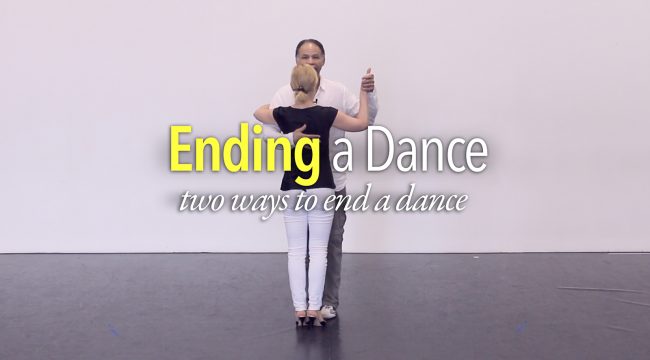
    How To End A Dance. As far as Argentine Tango is concerned we’re taught the steps, the patterns, the figures, a very small amount about the music (that there’s a beat and that you should follow it). We hear these words about ‘following the line of dance’, which is a bit about floorcraft really. We get indoctrinated into the activities, and some never really do, of Cabeceo and to a lessor degree Mirada. And for the most part we’re left to our own devices as to ‘How to start a dance with someone’, ‘What to do during that dance with someone’, and ‘How you may want to interpret the music while dancing’. At no point along the curve has anyone ever said to you, more than likely, “This is how you end a dance with your partner”.

    Guess what ?

    Tango Topics, while what’s about to follow will sound like a sales tool, it is anything but that. It’s express a point that is rarely talked about but rather assumed and not a whole lot of thought is put into it. That said, Tango Topics has put a great deal of thought into ‘How to start a dance with your partner‘. It also has videos on how to Cabeceo and how NOT to Cabeceo. As well the importance and usage of Mirada and why you want to use it. Tango Topics has an inordinate amount of articles (see: Tango Floorcraft) as well as videos on floorcraft and how to engage the idea. It has articles & videos on the specific vocabulary of Argentine Tango to create a little bit of variety and spice in one’s execution of the dance. Like for instance Milonguero Ochos, Traveling Ochos, as well as Ochos Variations, Cortados, Turns, Sacadas, Ganchos, Social Colgadas, Paradas, Social Volcadas, just to name a few. As well as an extensive video series by Detlef Engel and Melina Sedo on Argentine Milonga. It also has extensive video teaching tools on how to listen to the music on the whole, and what you’re wanting to pay attention to and why. It even has a tango thoughts section that can help with your tango issues. Out of all of that, there’s no video and no article that can help you to understand HOW YOU END A DANCE.

    To be fair, there’s a video on how you want to walk someone from the floor, but that’s not really a video and an article on what might seem like common sense when in fact, believe it or not, it’s not common sense for a lot of people.

    So today we’re going to skip all the build up to this and get right down to Today’s Tango Topic – How To End A Dance.

    How Do We Want To End A Dance ? Answer: Simply. Nothing flashy, but very simple and plain which is to say: The way you start a dance is how we want to end a dance. If you started out facing each other, then you want to end up facing each other. How hard is that ?

    How Do We NOT Want To End A Dance ? Answer: In a Pose. Frequently what you’ll see from performances is a ‘Posed’ ending to their dance. Meaning that whatever step they end in, they freeze in a tableau. That ‘tableau’ is usually a very exaggerated and stylized position that almost NEVER happens in tango…ever. Which is great if you’re performing and want to show off. But, in case you hadn’t noticed, you’re not showing off, you’re Social Dancing, and you’re not performing for the room. It’s just YOU and YOUR PARTNER. Which is to say that there’s absolutely ZERO reason to do engage in a Tango ‘Pose’. None. Yes, it may look cool…to you! And, yes, it may be ‘fun’ for about 2 seconds. However, the reality is that you will look a little ridiculous. At the same time if you end with a Pose constantly, it gets (as the Brits say) “Cheeky”. Meaning that it’s just too much. Once or twice in a blue moon, and by that we mean once every few years, but not every song of every tanda. So….ummmmm…not so much with that idea. See the how we want to end a dance above.

    Enter The Salida Step. ‘Salida‘ comes from the root word ‘Salir‘ in Spanish. Which, when translated from Spanish to English, means “to Leave” or “to Exit”. When an ‘IR’ verb in Spanish is put in the past, this is a Past Participle which in English adds an ‘ed’ ending to the verb. In Spanish, we add a ‘ada’ or in this case ‘ida’ ending. Which when translated would make the verb become “Leaved”, which isn’t a word but “Left” or “Exited” is. However, from a Tango perspective, the word Salida means “to leave one’s seat, and enter the floor or the line of dance“. Further still, it also implies the very first step that we engage in as dancers. Typically that first step has always been a side step (Lead Right to Left, and Follower Left to Right) to enter the line of dance as quickly and expeditiously as possible so that we can begin dancing with our partners. Over time the ‘Salida Step’ has become somewhat more intricate in the multiple ways in which we can start the dance and enter the line of dance, thereby expanding the side step to include vast swaths of vocabulary. We even teach a variation on a theme of this idea which we call “The Dark Side Salida” which you should totally go look at. It’s a fun exploration of what you could do to start a dance!

    However the Salida Step also refers to the Closing Step of the Dance! Meaning ? It’s the very last thing that you do. Or in this case invoking the thing we pointed out above, finishing as you started. Facing your partner.

    One More Salida. Over time the Salida Step has also referred to the exiting step. Which is also the step OUT of the Line of Dance. Which in this case, should be, a side step > Lead Left to Right, and Follower Right to Left. This indicates, historically speaking, that we have now ended the dance. While this may sound ‘boring’, and a little antiseptic. It is anything but that. We want to end in such a way that calms things down not ramps things up!

    A Little Squeeze. Typically the end of the dance is a good place to add a bit more a hug, a quick bit of compression to the embrace, to add emphasis to the closure aspect and then a quick release and back to the realities of getting to know this person a bit more.

    However….

    Grrrrrrr…

    This is where a whole swath of Male Leads have gone off the deep end in terms of crossing boundaries. They hold on a little too long. They squeeze a little too tight. And then to add insult to injury, the crown jewel awkwardness > They decide to put their head into the Follower’s neck.

    Ask any Female Follower if they enjoy having a someone they don’t know all that well, have only just met, and that person decides to place their head in the crook of their neck while at the same time turning their face towards that female’s cheek.

    Ask them if they enjoy that ?

    The answer is a qualified “no”.

    Qualified in the sense that if they know that person really well, or they’re married to or dating that person, then it’s sweet…ish…sort of. But for the most part, if that was done out on the street, that Follower would run as far away as possible, as quickly as possible.

    It’s awkward, creepy, strange, and just inappropriate! Which is to say, Male Leads…STOP DOING THIS. You’re crossing boundaries. You may think you’re sharing your ‘soul’ with the female follower you’re doing this to or with, but the reality is that it’s wholly invasive!

    Of course the men that need to hear this message, the men that need to see and feel just how awkward it is, will never hear it because you dear reader aren’t sharing this stuff with them. Which is not a plug to share it, it’s that if you find this stuff invasive and inappropriate then the burden is on you to share this stuff far and wide so that they hear the message.

    Last words. End the dance any way you want, whatever works best for you. However, keep in mind the things were mentioned above. No one, not even this page is telling you what to do. It’s simply pointing out to you that there are desirable ways to engage in the formalities of social convention. Which is to say that ‘simple is best’. Put another way, that we want to end in such a way that we are creating closure with our dancing partners. Or another, there’s closure to the song, yes ? Shouldn’t there be closure to your dancing expression with your partner ? Answer: Yes there should be.

  • The Linear Molinete

    The Linear Molinete

    You’re out social dancing, and you’re finding yourself with either being led to a lot of Follower’s Molinetes, or the you’re leading the Follower’s Molinete over and over again with very little variation. From a Leading perspective, you’re stuck in Lead’s Mindset, or you’re just out of ideas where you feel like you need to impress the Follower with something new or different. From a Following perspective, you really don’t care just as long as the whirling dirvish you’re dancing with stops every once in a while and leads something else that is a bit less stressful. The only thing you’re caring about right now is staying in front of your Lead and trying NOT to be in the Lead’s armpit.

    Scenario over!

    Today’s Tango Topic deals with a variation on a theme that almost never plays itself out in a crowded Milonga mostly because you know…it’s a crowded Milonga. There’s no space for craziness. However, what we’re talking about today isn’t craziness. It’s a variation on a theme that you already know how to do from a Leading and Following perspective.

    So today we’re going to skip all the usual build up to this and generate a bulleted list of what it is that we’re after and why.

    With that said, let’s dive into Today’s Tango Topic – The Linear Molinete.

    First a reminder of What is “Dancing In A Small Space” (or ‘DIASS’ as Tango Topics refers to this idea) ! There are two parts to the answer to this question:

    First, in it’s simplest form, it’s all about the vocabulary and engaging Five pieces of Tango vocabulary. The Five Pieces ? 1.) The 5 of the 6 Ways of Walking. 2.) Milonguero Ochos (sometimes referred to as ‘Lazy’ Ochos)3.) Milonguero Turns (not the Follower’s Molinete). 4.) Back and Forward Crosses (not the Argentine variety, there’s no space!). And 5.) Linear (and Circular) Ocho Cortados. This is all done in Close Embrace. Note that there are no Sacadas, Colgadas, Volcadas, Ganchos, Boloeos, or Death Drops and/or Drags. None. However, there are a whole bunch more pieces of Tango vocabulary that almost never get talked about, or thought of here, that can also be applied, such as Calesitas, Paradas (Step Over), Pasadas (Drags & Sweeps), ’Patter’ (sometimes referred to as ‘Pitter-Patter’), The Incrementals (see Golden Nugget Extensions), just to name a few.

    Secondly, there’s the actual ‘Dancing’ part of the statement which is more about movement more than anything else. Said movement is done in a very confined space, no bigger than one meter square, if that. The people that practice this way of dancing, while they may not be conscious of it, there is a sincere desire to not to take up space, mostly because there isn’t any space to begin with. This is moving in milonga environment really, where the distance between couples, on all sides, is no more than about the length of one hand (about 17 centimeters). So from the perspective of the Small Space Dancer, there is precious little space to ‘do’ anything at all due to the conditions of the ronda, so as a result of this confinement, the dancing part is really about the minimal. Everything is done either around the lead, or the space that the couple current occupies and does not extend beyond that space. Quite factually, depending on which city we’re in when dancing this way (Buenos Aires comes to mind), one would take up no more space than the space that one’s feet occupy at that moment in time, and no more than that, but without moving from that spot!

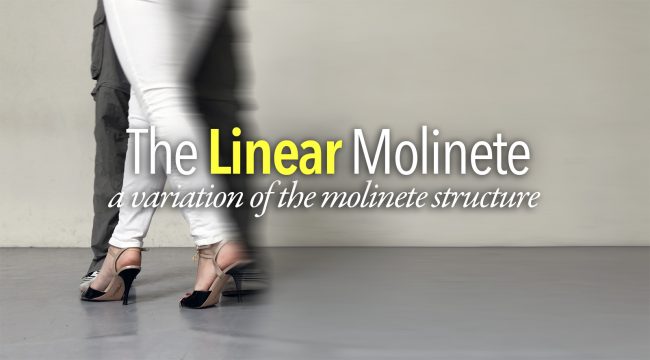
    What is a Linear Molinete ? In its simplest form, it’s the Follower’s Molinete spread out along a line instead of a circle around one’s Lead. In the Follower’s Molinete, the Lead engages in a Giro, or a self-turn over a singular spot. The Lead can not move from that spot otherwise it makes work for the Follower. In the case of the Linear Molinete the Lead has several options, however, the simplest one is that as the Follower is led to engage Back/Side/Forward, the Lead can engage Side/Side/Side, or Forward/Side/Back, or Back/Side/Forward with the Follower’s motion. The difference between the circular version of the Molinete/Giro structure and the Linear version is that the Lead’s steps are also Linear as well.

    So instead of the Follower’s back step going around one’s lead as it would in a normal Follower’s Molinete, the Lead could invoke a side step with their Follower’s Back step. Or they have, as indicated above, three different options > Side/Forward/Back.

    In the example above: The Follower’s back step is indicated by the Lead to go straight back instead of around, and the Lead then goes with them staying the same distance, at the same speed, in the same direction, and at the same level. Only in the example the Lead takes a side step with the Follower’s back step. Same with the Follower”s side step – a linear side step, the Follower goes side, and the Lead matches it. On the Follower’s Forward Step, the Follower is led to go forward and the Lead takes a side step.

    This is, in its simplest form, a Linear Molinete for both roles.

    About The Video. Total runtime for this video is: 09:08. This is a combined video format, lead and follow technique are mixed together.

  • Argentine Barridas

    Argentine Barridas

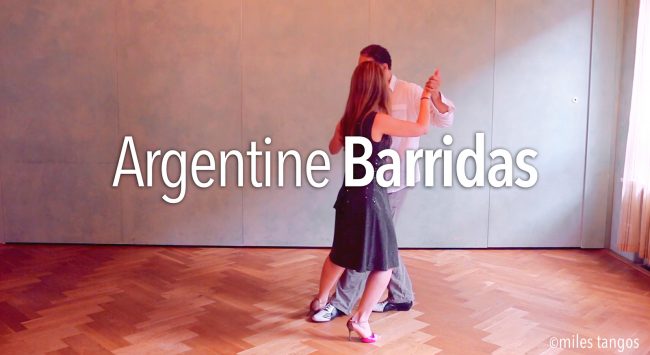
    The word ‘barrida’ translates into English as ‘swept’. And that’s exactly what it is. A sweep. From a Tango perspective this is a somewhat ‘worn’ piece of tango vocabulary that most people see sort of schlock tango schtick. Most people start out with doing it a few times, and then disregard it because they’ve moved on to something else that’s more ‘flashy’. The Barrida is, in common vernacular, a ‘drag’ of the foot (either role can initiate it). And does have a useful application in the dance which is purely musical if not entirely navigational. With that thought in mind, let’s talk “Barridas”, what they are and how they’re useful for both roles of the dance.

    What is an Argentine Barrida ? As if there were another kind of Barrida ? There isn’t. A Barrida in it’s simplest form is where either the Lead’s or the Follower’s foot is deliberately moved from one position to another by either by deliberate intervention or by the illusion of the intervention. In this case, the intervention is by the opposite dancer’s foot seemingly moving the other dancer’s foot. When in fact what is ideally done is to generate the illusion by leading or following a collection and the opposing dancer follows that collection motion with their foot either trailing or leading it so that it appears as if the opposing dancer’s foot is actually generating the motion, when in fact it’s an illusion. This is a Barrida. There are many types of Barridas. Most commonly as the ones where the Lead is generating a Barrida on the Follower’s foot to make it appear as if they’re collecting their feet from the Follower’s side step. Of course, there are multiple, multiple versions of this idea, this is jus tone possible variation on a theme.

    The Free Tip: The Barrida is best done to the Follower’s Back Step and the Lead’s Forward Step on the Open side of the embrace in either Open or Close Embrace.

    Pre-Requisites: Walking. Weight Changes. Extensions. One does have to have mastered one’s walk and possess stability in their embrace without using the embrace for stabilization against their partners before they can initiate these ideas.

    About The Video. This video comes is 14m:21s in length in 8 sections.

    Section 1 – Introduction/Technique – 00:03:01
    Section 2 – Example Barridas – 00:00:16
    Section 3 – Slowed Down Examples – 00:00:52
    Section 4 – The Follower’s Barridas – 00:02:20
    Section 5 – Barrida Ideas – 00:01:27
    Section 6 – Playing With Barridas – 00:00:37
    Section 7 – Reversed Barrida – 00:01:07
    Section 8 – Footwork in Detail/Closure – 00:04:09

Hide picture