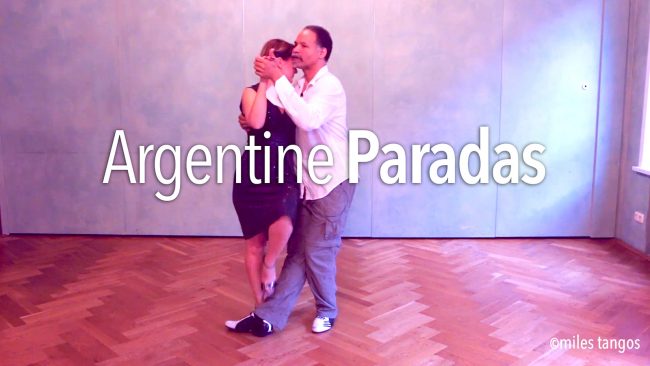
The word ‘parada’ translates into English as ‘stopped’. And that’s exactly what it is. A stop. From a Tango perspective this is a well worn piece of tango vocabulary that most people see as an element towards engaging the illusion of ‘intimacy’ of the dance, or it’s ‘steamy’ aspects. Anyone inside the dance knows that the ‘steamy’ thing is just that, an illusion, and that there’s real work to be done to make this venerable piece of tango vocabulary useful and musical. The vocabulary gets its name from the fact that we are stopping but it’s an unusual stop. It’s a stop not because you’re stopping the Lead’s motion, but in fact stopping the Follower’s motion. It’s more of an interruption really, because the ‘stop’ is momentary. With that thought in mind, let’s talk “Paradas”, what they are and how they’re useful for both roles of the dance.
What is a Parada ? The Parada is a stop of motion, usually for the Follower. The Follower is being led to a position where they can not proceed any further due to a physiological obstruction from the Lead’s leg and foot being deliberately, and decidedly, put into the walking path of the Follower. The Follower will be ‘asked’ to step over the obstruction presented by the Lead and from that ‘step over’ the Follower has lots and lots of options.
The Parada is usually used as an accent to a particular point in the music where a Pause or Stop has happened in the music. However, more of then than not, that’s not its primary usage. It’s just another piece of vocabulary in the Lead’s arsenal of vocabulary as a way to express the intent of the music that is currently occurring at that moment in time.
From the Follower’s side of the equation typically after the Follower has been led to a ‘stop’, they have a few options and opportunities to engage an adornment or embellishment. The more common of those are where the Follower will take their free foot and slide it up the Lead’s leg and then down the other side, and then proceed towards the next step.
The Free Tip. The Parada is the Follower’s choice. They can elect NOT to step over, but rather to step around, especially if the Parada is done in open embrace! The video does not go over this point but does show you a few rather important aspects towards this ideal.
About The Video. This video comes in at 33m:08s in length in 13 Sections. Both lead and follower technique are combined and integrated into the video.
Section 1 – Introduction – 00:00:52 Section 2 – Building A Parada – 00:06:59 Section 3 – Parada Caveat – 00:00:37 Section 4 – Open Side Parada – 00:01:32 Section 5 – Closed Side Paradas – 00:00:58 Section 6 – Embrace Indicators – 00:01:24 Section 7 – Foot Awareness – 00:01:34 Section 8 – Rules for Decoration (Followers Only) – 00:01:51 Section 9 – Follower Embellishments for Paradas – 00:03:46 Section 10 – Multiple Paradas – 00:03:15 Section 11 – The Step Over – 00:04:23 Section 12 – Another Idea – 00:00:35 Section 13 – Gancho/Barrida from Parada/End – 00:04:27
Dancing In A Small Space is not without its challenges for a lot of dancers, space, obviously being chief among them. It doesn’t matter what role you’re dancing, you will still experience one, if not multiple, challenges. One common of those areas of concern is, for the Lead, keeping things small enough- at all times while at the same time not being repetitive (hence this post). As a side note, a Lead will tend towards compressing the embrace to ‘protect’ the Follower and may not realize that their version of an embrace is already compressive! So to them adding more compression with their hand or forearm to protect the Follower further, they’re completely aware that they’re adding compression, but what they’re unaware of is just how much compression is there to begin with! For the Follower, the reason that DIASS is challenging is the clear but obvious awareness that the floor is crowded and that they must keep things as tight as possible without injuring one’s self or any of the dancing couples around them. That means so that we’re clear: 1.) The Follower’s Molinete, and in specific their back step, must not go away from their Lead. 2.) The Follower’s Cross (The Argentine Cross), must be clean and small. 3.) Stability is absolutely crucial to your awareness of your surroundings. IF you’re wobbling all over the place, you’re fighting your stability and what not and are not aware of how much space you’re taking up! And that’s just the tip of the scary iceberg. God help you if you’re in BsAs for the first time, trying to dance at either Salon Canning, Villa Malcolm, El Beso…or the like. You’re going to be challenged in ways that this article will not mention but has mentioned in either our BsAs articles (seen here), or our other articles on Dancing In A Small Space.
All that said, there’s another challenge with Dancing In A Small Space, and that’s the “Lead’s Fallacy”. What’s that ? It’s where the Lead believes, erroneously so, that they can and should add much more vocabulary to keep the Follower interested, or to keep the Follower from being bored, or to seemingly elevate themselves to a better class of dancer. Not true. It is erroneous thinking that will not solve your problems in any way, shape, or form.
Truthfully you can dance the 5 Social Figures of Argentine Tango all night long and never feel a need to expand on it. It should be noted that usually adding more vocabulary is not necessarily a good thing. Ideally what needs to happen is a complete exploration of the variances of the vocabulary that you currently have access to. Again, not to sound like a broken record, this also means from a Leading perspective as well as a Following perspective. Which is to say: Understand what you’re doing. Explore Your Dance! This is also why it is absolutely crucial that the Lead and the Follower understand the Six Ways of Walking in all of their fabulous and wonderful permutations. There’s a reason why this site keeps advocating this idea, and that’s not only because it works, it’s because you could quite conceivably dance nothing but the Six Ways of Walking all night long with every partner and they’d never be bored, you’d never be bored, and you’d have near-infinite exploration of the dance! And then there’s the next layer, that’s adding the musical permutations that can be explored. Hundreds upon hundreds of vocabulary variations that you can think of and then some.
So unless these things are done then Today’s Tango Topic is absolutely pointless! That said, let’s dive into today’s topic of Dancing In A Small Space: The Extended Vocabulary Edition (EVE).
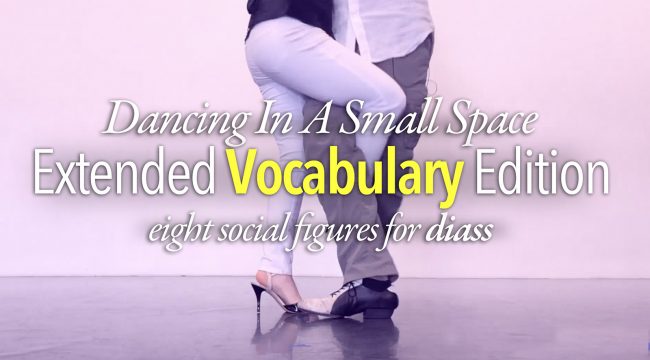
What is DIASS: EVE ? In short, this is a series of 8 pieces of tango vocabulary that tangotopics has identified to be used as accent or “spice” in addition to Five Social Figures (and its variations) as well as volume 1 and volume 2 of Dancing In A Small Space (DIASS) in Argentine Tango. The key component in the sentence here is ‘ACCENT’ or ‘SPICE’. Most of this stuff is a little flash, with the exception of #7 and #8, but aside from those things this stuff is purely to be used as more than a variation and as a singular usage at best. They should not be used as the repetitive movement over and over again so as to annoy one partner and one’s partner should not expect it, nor should it be required of them either!
This isn’t rocket science, it’s really simply in fact. ‘EVE’ as we’re calling it, is really just a conglomeration of vocabulary that you see everyday at Milongas that has been modified to fit within the line, and lane, of dance with one monster modification: They’re Smaller than their regular kissin’ cousins. The idea is to make this stuff fit inside the lane of dance, and fit inside the line of dance, and more importantly to take up no more space than the standing spot that you’re currently over. No stepping backwards (mostly). No breaking the line of dance. No exiting one’s lane. One must keep the ronda moving at all times. This is the Marathon/Encuentro/BsAs environment where things are packed tighter than a snail’s ass! In this environment things have to ‘fit’ precisely, otherwise blood or bones will be exposed and we don’t want that to happen…ever. To be fair, and while it was mentioned above, we’re mentioning it here in its definition as a reminder, do not attempt some of this stuff until you mastered walking cleanly, clearly, and without wobbling or needing your partner to walk. If you can’t walk backwards by yourself in a pair of 3 in heels without crossing over your natural body meridian or you can not walk (as a Lead) without crossing over the body’s natural meridian or supinating your feet to do so, then there are issues to say the least that need to be addressed.
Notation: When the “What is … ” section of an article is blue, that means that the article is freely available to registered, users. When the section is yellow, the article is still free, but the video is for paid users. 😉
What are in the Eight Pieces of Vocabulary in EVE?
1.) – Follower’s Calecita. (All users) This is basically the Follower walking in Forward or Backsteps (although the latter is uncommon and some difficult to actually lead for a variety of reasons, most notably: habit) around their Lead. Calecitas can be done in Open or Close Embrace, but in this case because we’re talking about DIASS methodology, we’re talking in Close Embrace and making things very small and gradual for both roles. All users.
2.) – The Simple Sacada. (Freemium/Subscriber) The Simple Sacada can be done in Open or Close Embrace, but this is DIASS so we’re employing it here in small spaces as methodology to engage a turn. Which by the way has an interesting possible side effect where the Follower can be led to engage in a Milonguero Turn as a result instead of the resolution that you see above. The Tango Topics Subscriber sees both of these options in the full 22-Minute video. 🙂
3.) – Argentine Enganche/Wrap. (Subscriber Only) In North America we call this a ‘Wrap’. Where the Follower’s leg wraps between and around the Lead’s. The problem with these pieces of vocabulary are that they can go wildly wrong, mostly on the part of the Follower who is unconscious of their leg and what has to happen to it. 😉 And when we’re talking about DIASS methodology, that wrap has to be insanely tight, small, and fast. The Follower has to get in and out just as quickly.
4.) – Single Axis Turn. (Subscriber Only) Seemingly this piece of Tango vocabulary was made for DIASS methodology. Thankfully it takes up very little space. The only problem with it is its entry point, and a failure to engage the Mordita (the foot sandwich). A lot of Followers, and rightfully so, mistake the opening of the Single Axis Turn for a Volcada. Why ? That’s because they start out almost exactly the same way. And due to the prevalence of the Volcada over a Single Axis turn the Follower will mistakenly think “Ahh Volcada”, and thereby release their ‘free’ foot/leg and allow it to swing free. While this isn’t such a huge thing. It does impede the required centrifugal force that is generated by the turn itself. Thereby slowing down the turn.
5.) – Social Volcada. (Subscriber Only) Yes you can add a Volcada to DIASS. Should you ? That’s a completely different story. All we’ll say is this: Use. It. Sparingly. Like as in ONCE IN A BLUE MOON! There’s a reason why this entire topic is accent vocabulary and not the meat of the dance. This piece completely exemplifies it. Yes it’s loads of fun, and yes it’s cool. But to engage it as your goto move…not so much with that! That said, the SOCIAL Volcada is not an egregious one. Meaning it’s really small and fits within the line and lane of dance. It’s nothing more than a glorified argentine cross, that’s a bit more flashy. There are several examples of this piece of vocabulary here on Tango Topics, here’s just one of them:
Plays from YouTube. Pressing play connects you to YouTube. Privacy
6.) – Floating Cross. (Subscriber Only) Arguably on this list this one will create an enormous amount of confusion, because watching the floating cross, and doing/feeling the floating cross are two very different things. There is a tiny amount of ‘lilt’, and that lilt is the floating part. It’s a glorified Follower’s Back Cross, but it’s a back cross that takes its time.
7.) – Parallel System Rock Step. (Subscriber Only) The quintessential goto move for most Leads. They use it so often and with such frequency that you’d think that it was one of the 7 primary foundational moves. That’s not true of course. But still. This piece, when used properly and not overused (hint, hint, hint … remember this is accent vocabulary here), can create an interesting surprise for the Follower. At the same time the Follower has loads of options to play with Rock Step adornments and amagues, especially with the resolution. The two problems, as with all adornments and amagues is always a.) the Lead not rushing through X. and b.) time! The other problem with the Step Step/Resolution is that it is all too easy for this thing to violate the prime directive of DIASS. It can take up too much space! Oddly enough this particular Rock Step can lead (no pun intended) to the last item on this list….
8.) – Ocho Cortado. (Subscriber Only) THE goto move of most leads in DIASS, but oddly enough it was left out of the first 2 iterations but was included in the FIVE SOCIAL MOVES
When are Different Vocabulary Used and Why ?
In certain types of Tango Events one particular type of moves are used more often and more predominantly than others. The reason is that some types of vocabulary work best depending on the venue and the type of Tango being invoked or danced. For instance:
Weekly, Local Milonga ? All 8 Marathon? All 8 Festival or Mini-Festival ? All 8 Encuentro ? All but #1 & 3. Buenos Aires ? It depends on the venue. But, all but #1,#3,#5. There’s no space for that noise.
About The Video. Total runtime for this video is: 25:55. This is a combined video format, lead and follow technique are mixed together.
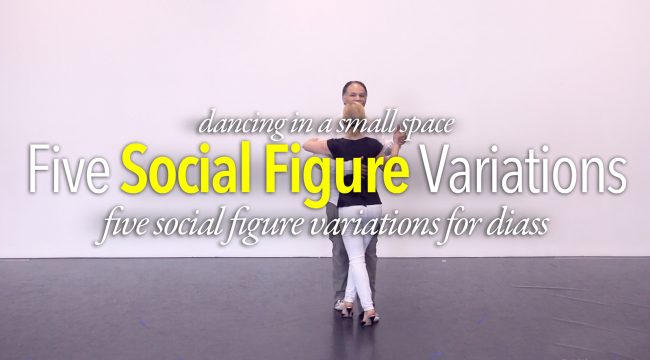
Dancing In A Small Space. Typically the idea of dancing within a confined or restricted space is a fearful one for the inexperienced Lead or Follower. Most of that fear exists in either hitting something or someone, or not being able to contain or control what one is doing. So when things in the line of dance get really confined some people get really nervous, and they can’t think outside the box that they’ve put themselves into. The idea of dancing in this environment plays it’s out in a few places, either a crowded local milonga during a special event like a live orchestra, or at a Marathon, an Encuentro (in Europe, not in the United States), or at any Milonga in Buenos Aries. Tango Topics has defined this idea before of what that means and issued two (actually 3, and now 4) videos on the subject of Dancing In A Small Space which we call “DIASS” for short. Today we further the ‘DIASS’ idea a bit by adding a few variations to a theme. The theme being the Five Common Social Figures or the 5 things that we do constantly on at Milonga within the line and lane of dance. Those Five Common Social Figures are as follows:
To be clear, as there’s a lot of room for interpretation in what those five things actually mean. So let’s clear that up right now:
1.) Walking. Means that we’re engaging only 1 (Parallel System on 2 Tracks) of the 6 Ways of Walking as a foundation of movement.
2.) Ochos. Typically the idea of Ochos engages 2 of the possible 8 types of Ochos > The ‘Lazy’ or Milonguero Ocho or the Traveling Ocho (Forward or Back).
3.) Turns. Turns in Argentine Tango refers to 2 of the possible 8 types of Turns that are commonly used in Argentine Tango. The Follower’s Molinete to the Lead’s Giro, and The Milonguero Turn.
4.) Crosses. Usually when we’re talking about Crosses, we commonly only refer to one type of cross. However, there are in fact multiple variations and several types of Crosses. In this instance we’re only referring to 1 out of 256 types of Argentine Crosses – The common or Normal Cross.
5.) Cortado. In most people’s minds there is only one type of Cortado. However, if you’ve been following this site for some time, you’ll note that’s not the case. In this instance, we’re only referring to the Linear Ocho Cortado from the Closed Side of the Embrace.
These are the Five Social Figures. For more detail on the subject, please go look at the full video in the tangotopics archive.
Using these five figures as a foundation we can create numerous variations on a theme that work with in the line and lane of dance. Those ‘variations on a theme’ are the foundation of this video which are Five Social Figures Variations that we’re exploring today in today’s Tango Topic.
First a reminder of What is “Dancing In A Small Space” (or ‘DIASS’ as Tango Topics refers to this idea) ! There are two parts to the answer to this question:
First, in it’s simplest form, it’s all about the vocabulary and engaging Five pieces of Tango vocabulary. The Five Pieces ? 1.) The 5 of the 6 Ways of Walking. 2.) Milonguero Ochos (sometimes referred to as ‘Lazy’ Ochos)3.) Milonguero Turns (not the Follower’s Molinete). 4.) Back and Forward Crosses (not the Argentine variety, there’s no space!). And 5.) Linear (and Circular) Ocho Cortados. This is all done in Close Embrace. Note that there are no Sacadas, Colgadas, Volcadas, Ganchos, Boloeos, or Death Drops and/or Drags. None. However, there are a whole bunch more pieces of Tango vocabulary that almost never get talked about, or thought of here, that can also be applied, such as Calesitas, Paradas (Step Over), Pasadas (Drags & Sweeps), ’Patter’ (sometimes referred to as ‘Pitter-Patter’), The Incrementals (see Golden Nugget Extensions), just to name a few.
Secondly, there’s the actual ‘Dancing’ part of the statement which is more about movement more than anything else. Said movement is done in a very confined space, no bigger than one meter square, if that. The people that practice this way of dancing, while they may not be conscious of it, there is a sincere desire to not to take up space, mostly because there isn’t any space to begin with. This is moving in milonga environment really, where the distance between couples, on all sides, is no more than about the length of one hand (about 17 centimeters). So from the perspective of the Small Space Dancer, there is precious little space to ‘do’ anything at all due to the conditions of the ronda, so as a result of this confinement, the dancing part is really about the minimal. Everything is done either around the lead, or the space that the couple current occupies and does not extend beyond that space. Quite factually, depending on which city we’re in when dancing this way (Buenos Aires comes to mind), one would take up no more space than the space that one’s feet occupy at that moment in time, and no more than that, but without moving from that spot!
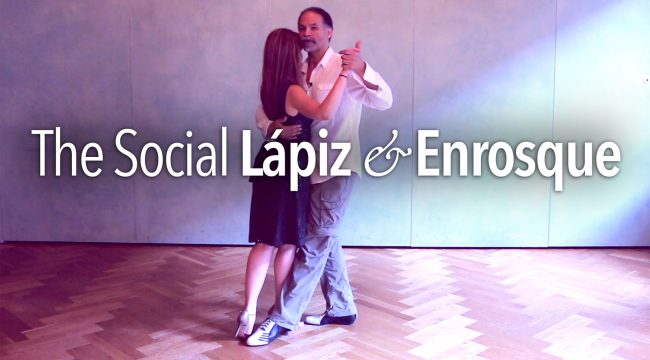
The Spanish word ‘Lápiz’ (pron: lah-pees – emphasis on the ‘LAH‘ and not the ‘pees’) translates to English as Pencil, and the word ‘Enrosque’ translates to English as ‘Screw’ or ‘Thread’. From a Tango perspective these are primarily ideas that relate solely to the Lead’s side of the dancing equation. Mostly. 🙂 A Follower can and does engage in a version of the Lápiz when applying a needle turn in ochos, or a planeo but as it relates to the Enrosque, it is very infrequently done by the Follower on their own. That said, let’s talk about the Social Lápiz & Enrosque.
What is aLápiz & Enrosque ? Let’s take those words one at a time. A Lápiz is a leg extension (and pointing of the foot/toe) done in a circular fashion in response to what the Follower is doing. Usually, this is a leg extension out away from the body (Forward to 12 O’Clock), then around to the side (at Nine O’Clock), and then the back (at Six O’Clock), and then back to collection. The Lápiz is usually done to the Follower’s Molinete or Traveling Ocho on their resulting backstep.
Plays from YouTube. Pressing play connects you to YouTube. Privacy
The Lapiz Exercise
What makes it ‘Social’ is that it is very small, very tiny. Meaning that the footprint (no pun intended) should not take up any more space in the line of dance than say another step forward would. In other words ? No space.
And what about the Enrosque ? An Enrosque is essentially the lead crossing one foot behind the other without space between the crossed feet (better known as a ‘clean’ cross) and then, here’s the hard part, unwinding that cross back to collection without wobbling, wavering, or using the Follower to do it! Typically the Lápiz and the Enrosque Follow each other. First a Lápiz and then the Enrosque.
Plays from YouTube. Pressing play connects you to YouTube. Privacy
The Stability Exercise
The Free Tip. This is going to challenge you. No lie. The rotational pivot that has to occur over the standing foot, will drive you absolutely batty. Now try doing that while your partner is hanging on you, pulling you, pushing you….good luck with that. You must work on your own stability independent of your Follower. So here’s a free hint for you – more compression in the standing knee. The more you have, the easier this becomes. However, you do not want to be on your heel while you’re doing it! 😉 Good luck, you’re going to need it.
Notation: It should be noted that the Lápiz is generally done in concert with the Follower’s Back Step of the Follower’s Molinete; And it can also be done with the Follower’s Traveling Ocho (Back or Forward). It can be done anywhere where the Follower is being led to transit around their Lead. At the same time, it can also be done with the Follower’s side of the Milonguero Turn. However, engaging the Milonguero Turn and then engaging in Lápiz is kinda ‘flashy’ and doesn’t look so good in our opinion.
About The Video. This video is 14:03 in length in 7 Sections
Section 1 – Introduction – 00:00:12 Section 2 – Basic Technique – 00:01:29 Section 3 – Close Embrace Exercise – 00:02:22 Section 4 – Executing The Social Lápiz – 00:03:34 Section 5 – Adding The Enrosque – 00:02:45 Section 6 – The Social Version – 00:04:17 Section 7 – Closing – 00:00:19
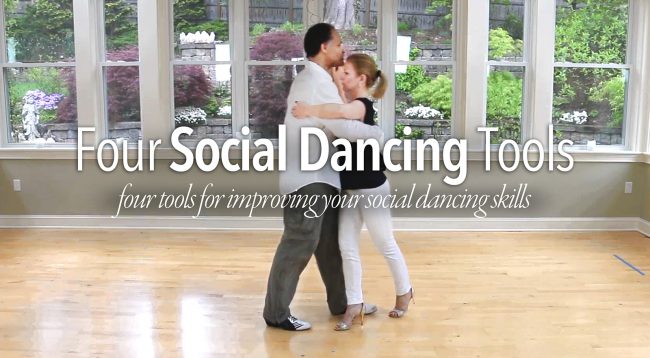
Argentine Tango consists of 3 steps, and only 3 steps: Your Left and Your Right. The 3rd is the Weight Change! 🙂 Another way that people talk about Tango’s steps is to say that the there are only 3 steps: Forward, Side, and Back. Either way you look at it, at some point, usually with the music, the dancers move from position to position via some kind of walking. The are 2 common walking systems in Argentine Tango: 1.) Parallel System Walking and 2.) Cross System Walking. In Parallel Walking, which is sometimes referred to as “Opposite Foot” walking, whereby the Lead steps into the Follower’s Walking paths with the Opposite Foot. For instance if the Lead steps with their Left, the Follower will extend with their Right, and so on. As Tango has grown, developed, and changed, while Parallel system is used as a good tool to get people up and dancing, the star of the show has always been Cross System Walking and Vocabulary. In today’s topic we’re talking about 4 Common Social Dancing Tools that use Parallel Walking as the entry point and NOT Cross System. Meaning ? We’ll start out using Parallel Walking system and then focus on the Transition point on the way to Four very common pieces of Tango vocabulary. So without further adieu, Tango Topics presents the Four Social Dancing Tools.
What are the ‘Four Social Dancing Tools’ ? First, what is a ‘tool’ as we’re defining it here ? A tool is a commonly used element that, and really it’s a transition from one thing to the next, that we use ubiquitously and don’t really pay a lot of attention to because it’s a stepping stone to the really cool thing we have in our minds. This is a tool. It’s the thing we use to make something else. Think of it as a Foundation, or a maker tool. A tool to make other things. And in this case, the Four Social Dancing Tools are maker tools with lots and lots and lots of variation built into them. 😉
These tools are the meat and potatoes of Social Dancing on the whole. While the cool vocabulary (think: Colgada, Volcada, Sacada, Gancho, Boleo, etc) is … ummmm … flashy, this stuff, the Four Social Dancing Tools that are sitting around them, or leading up to them and from them, is where the entire dance is at. Think of it this way, if you remove all the cool, flashy vocab from your dance, what’s left ? The Four Social Dancing Tools!
At the same time, those Four Social Dancing Tools, are really about the Transition points between going from Parallel Walking System to Cross System, most of the time. It should be noted that the Transition point is usually a point of inflection for a lot of dancers. Meaning ? It’s the point where most people have issues. By example the transition is usually where an in/experienced Lead will do one of several things, if not altogether, to get from point a to point b. 1.) They’ll compress the embrace (squeeze their Followers into them with their right forearm to hold them in place or to keep them close). 2.) They’ll rush their Followers and push them from position to position. 3.) They’ll haphazardly invoke leads to do X, Y, and Z, and not complete or follow through on the vocabulary, thinking that the Follower will just ‘get it’ and complete the half-thought that was invoked.
Why Do You Need This Stuff ? Foundation, Foundation, Foundation. That’s why. Or put another way, because these tools work the foundation in a really good way, by breaking them down to their component elements. No one wants to admit that they need help. That their dance isn’t stellar. Furthermore you really don’t know that your dancing skills aren’t absolutely amazing until you see a room full of people all dancing way better than you are. There’s a reason those people have achieved ‘better’. It’s doing work like what you see in the video above. Being able to turn this stuff on and off as if it were a switch. A good portion of the time when we’re dancing we only think about the ‘cool’ toys in our dancing and we neglect the one thing that makes those cool toys possible: Our Foundation. That is, in case you’re not paying attention, this video series and others like it. By employing these four commonly used social dancing elements as your Foundation we work on the underlying elements as well, trying to make them cleaner, sharper, crisper, and that much more fluid. This isn’t about perfection, so get that thought right out of your head, but rather about making our dance flow more freely. There’s knowing the steps of a sequence, and then there’s dancing, and these are not the same things. You can know the steps, but dancing is a whole different thing. These four things can help with that process of ‘dancing’. Dancing does not happen on it’s own. It takes years of practice to create the seamless, flow, and fluidity that you see some dancers exhibit. Seemingly creating something out of nothing and wondering how that was done. These Four Social Dancing Tools are how that was done. By focusing on the foundational elements in each! So if you want your dance to improve, it’s not the fancy vocabulary. It’s make the stuff that surrounds it stellar! This is that ‘stuff’ that surrounds the fancy vocab!
About The Video. This video comes in a combined 50m:37s in length in 4 sections. There is no Lead or Follower Technique explained in this video at all.
Type 1: Parallel Walking > MilongueroOchos (00:12:33) Type 2: Parallel Walking > Milonguero Turns(00:13:55) Type 3: Parallel Walking > Traveling Ochos (00:12:42) Type 4: Parallel Walking > Follower’s Molinete(00:11:27)
You’ve been dancing a while, and as you’ve become more and more proficient with the dance, something begins to dawn on you. And this ‘something’ happens for both roles but it’s not immediate. It only happens after you’ve gotten over the learning hump that happens for us all. And then started the refinement hump. It’s near the end of that second phase of the learning curve that this realization occurs. As a side note, not everyone comes to this realization. Some people in fact, never come to it. They’re still stuck in the perpetual cycle of “More IS Better”. Meaning more vocabulary is better. It’s not by the way, but no matter how often you share this stuff with them, no matter how many times you tell them “Less is more”, they can not and will not see that. Uuuuuugh. Assuming that they start the third phase of their development, understanding the music…not learning it, but understanding it, it is generally about this point in time where the realization occurs.
In case you’re not clear on the Four Phases of Tango Development:
Phase 1 is Learning the Vocabulary and the Codigos of the Dance for the Milonga Environment.
Phase 2 is the Refinements of Phase 1, meaning that you’re in a state of constant refinement of the abilities and techniques of the Vocabulary employed.
Phase 3 is the Musical Understanding of the Dance. This is not learning the music of the dance. That happens in Phases 1 & 2 to a limited degree. And in that case it’s more becoming familiar with the music because it’s played so often, but not really paying a whole lot of attention to it. Phase 3 is where we start to get serious about the orchestras, the structure of the music, the origins of the music, and start to hear the nuances of the music. That last part will go on a long, long, long time even after we’ve passed into the next and last Phase of our development.
Phase 4 is the Social Dancer is Born.
To be honest, some people…ok, MOST people skip Phase 3 entirely and graduate to being a Social Dancer without ever having done their musical homework. At the same time Phase 2 (Refinement) and Phase 3 (Musical Understanding) is not necessarily predicated on each other. They can, and sometimes do, happen concurrently with each other, and very rarely does Phase 3 happen in Phase 1. Just as a side note, with our Intensive Study program this actually does happen and quite frequently. They’re not mutually inclusive.
Today’s Tango Topic is that realization that occurs at near about the end of Phase 2 and/or somewhere in Phase 3. It’s one that we have referenced sporadically in our writings that we’ve sometimes called “Four Common Figures” or “Four Social Dancing Tools” or something very similar. When we stopped and thought about it, it was no longer 4 but in fact 5. It’s really 6, but the 6th is implied and not really a figure, but it’s always there and has a distinct bearing on the other 5!
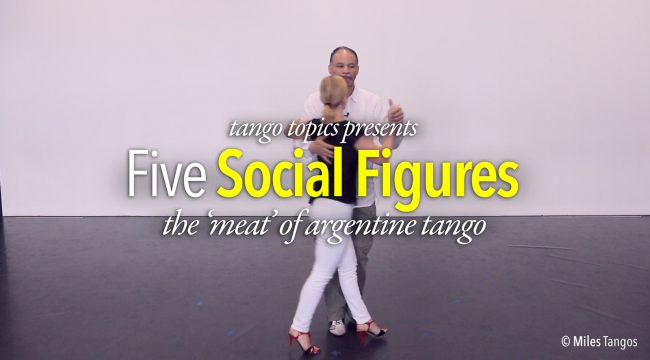
So what on earth is this mysterious ‘thing’ that we’ve referenced so sporadically and we haven’t mentioned until this sentence ? Today’s Tango Topic is the title of the video: Five Social Figures.
What are the Five Social Figures ? In its really basic form, it’s the 5 things that we do all night long with every dance partner. We do these things so often and with such ubiquity that we don’t even consider that we’re doing them or the implications they have for what we’re doing with them, musically or from a floorcraft perspective. The five are detailed below but they are in order of precedence: 1.) Walking. 2.) Ochos. 3.) Turns. 4.) Crosses. & 5.) The Cortado. You can stop reading here, but we can tell you that the vocabulary we just mentioned is kinda barebones and just scratches the surface. And there’s a sort of a gotcha that’s waiting for you near the end of all of this. So you can skip to the end now and read the gotcha, or read on through.
Why Do You Need This Stuff ? Several reasons. First and foremost, your foundation! Honestly, this should come as a no surprise to you, but if you’re studying with anyone, you’ll notice that they continually take you ‘back’ to 4 simple things: Forward Steps, Side Steps, Back Steps, and your embrace. Because these four things are the foundation of the dance. Embedded in those four things are a host of other things that you are more than likely lacking or you have forgotten about. And it’s those 4 things that are continually screwing up your ability to dance the way you want to dance. So it’s not rocket science what we’re on about here. It’s simple foundational stuff. Which, the deeper you go, you realize isn’t so simple and is in fact far more complex than you thought or you understood. The simpler things appear, the more difficult they are in certain situations, this is one of them. Secondly, this is about understanding your vocabulary and not just from a Leading perspective, but also how it’s received by the Follower, thereby the Follower’s perspective. How it’s understood and why things happen or progress as they do. The issue here is assumptions and lots of them. We want to eradicate those assumptions and make absolutely clear why things happen. And the only way to do that is to remove the assumptions completely. Still, another reason why this stuff is important has everything to do with something that we vehemently and passionately believe in: Facility. Facility, in this case, means the ability to do X, Y, or Z. The Five Social Figures affects your underlying Facility to execute whatever you want to dance, in whatever way or to whatever style or genre of music from a Leading OR Following perspective. It effects Every. Single. Part of the dance! Everything. Facility also means the ability to execute what you desire and WHEN you desire it. Tango vocabulary (Ochos, Crosses, Sacadas, Volcadas, etc) is great, but if you can’t execute that stuff in time to the music, it kinda falls flat. So…ummm yeah, FACILITY! Want one more ? Variations! Let’s roll back the article a bit. Remember we reminded you that you dance the same things over and over and over again ? Dancing Symmetrically opens up loads of options and opportunities for you that more than likely didn’t see. For example: Playing with a Mirror Cross opens up the possibility of leading the Follower to a forward step to the Open Side of the Embrace, which only happens … ummm … NEVER! Gosh, have you thought of what do after that ? Well, here’s an opportunity to do precisely that. Discover the possibilities! And that’s all based on taking that one extra step and resolving differently. There are LOADS more of these things. All of your preconceived notions of what you think the dance is about all changes. And change, whether you believe it or not, is a very good thing. So yeah, you need this stuff.
Install Tango Topics on your iPhone: tap Share, then Add to Home Screen.