Offer ends in Offer $99 for 1 year 1daysd 13 13 56 One year for $99 Get your year
Tango Topics info:

Check out the Tango Dictionary for words like Axis and Connection.

Tag: social tango

  • The Lead’s Molinete

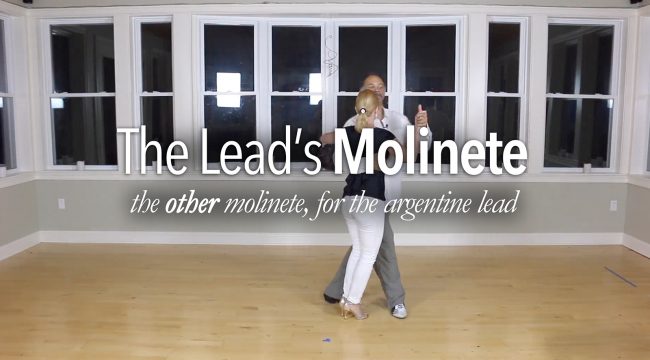
    The Lead’s Molinete

    Most people when they hear the word “Molinete” think of the turn that the Follower is ‘supposed’ to do. They generally commingle the Lead’s role of the ‘Giro’ (which is first person singular, from the root Spanish word ‘Girar’, which means “I turn” when translated from Spanish to English). Generally this is the common turn that is taught to all beginners as what the Follower does in order to turn. Generally speaking, nearly all, social dance possess a turn like the Follower’s Molinete, it’s called a ‘Grapevine Turn’, which basically consists of some form of a backstep, some form of a side step, and some form of a forward step. It’s just that in Argentine Tango’s version that version usually contains disassociation and then applied disassociation (or ideally we’d like it to contain that, but frequently does not). For the most part, the line of reasoning is that the Giro/Molinete construct is Follower vocabulary only. However as the title of Today’s Tango Topic implies, you’ve been fed a line of reasoning and gap that doesn’t necessarily add up. Which is to say that this is not jut for Followers! A Lead can and should engage in this idea as well! So without further adieu, today’s Tango Topic is on The Lead Molinete.

    What is a LEAD Molinete ? It is exactly as described, a Grapevine Turn, that consists of an applied dissociative backstep, a ‘circular’ side step, and a dissociative forward step. That’s it. It doesn’t get any more complex than that. The only difference is that instead of the Follower doing this vocabulary, the Lead does it. However, this particular version of the Molinete can be done in Open Embrace and in Close Embrace, and almost any embrace format that you think of. It can be done to the Close Side, which is perceptional-ly easier (that’s a fallacy by the way), and to the Open Side of the the embrace. Typically you would think that going to the Close Side would be harder, it’s not. It’s the same amount of work going in either direction. 

    About The Video. This video comes in at 22m:07s in length in 8 Sections. Separate Follower Technique and detailed Lead Technique is explained here in the video, as well as the combined elements of what has to happen in order for a successful Lead Molinete to function.

    Section 1 – Introduction – 00:01:47
    Section 2 – Follower Technique – 00:03:48
    Section 3 – Lead Technique – 00:02:56
    Section 4 – Combined Lead & Follow – 00:04:28
    Section 5 – Close Embrace Version Technique – 00:04:36
    Section 6 – Close Embrace Example – 00:01:11
    Section 7 – Open Side Turn – 00:01:24
    Section 8 – Ending – 00:01:13

  • The Rock Step Ocho Cortado

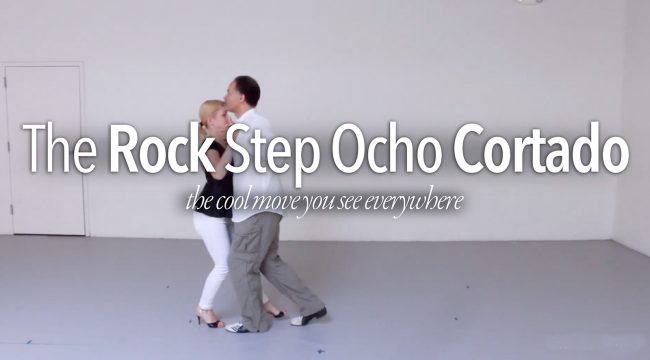
    The Rock Step Ocho Cortado

    There are Eight Turns in Argentine Tango that Tango Topics has identified as Commonly used or Social Turns. There are a few others that are outside of the common eight but for the most part, accept in this moment that there are eight.

    Just in case you were curious, the Eight Common Turns are in no particular order: 1.) The Follower’s Molinete/Lead’s Giro. 2.) Milonguero Turn. 3.) Rock Step. 4.) Ocho Cortado (Linear & Circular). 5.) Calesitas. 6.) Media Luna Turns.  7.) Colgada Turns. 8.) Anti-Molinete.

    Today’s Tango Topic deals with two of those common eight turns and combines them into one movement so that they actually turn down the line of dance. This is an unusual vocabulary for Tango Topics to display because it is one of the very few figures that we teach/show to our Intensive Level Students (in Level 2 & 3) in the combined version that you’re seeing it here. We typically teach these as separate elements and leave it to the student, later on in their level 2 development of solving Tango Problems, to put them together as a possible solution set.

    Some things to keep in mind:

    In order for a Rock Step, by itself, to function as a turning element a.) there must be multiples of them, and b.) they must ‘curve’ OR there must be a resolution of some sort from one to the next element. 

    In order for a Linear Ocho Cortado to be used as a turning element, the step prior to the crossing element must be rotated by the Lead, and/or the Follower’s side step must be curved or rotated slightly.

    In either case, these pieces of venerable tango vocabulary are at best ‘quarter turn’ vocabulary. Meaning that they’ll only turn about 90 to 120 degrees under optimal conditions. However, combining these two turns increases the rotational from 90 to about 150 to a potential 180 degrees, under optimal conditions.

    If all of that seems very technical for you, think of it this way: By themselves, they’re smaller, individual turns or rotationals. Together they have a bigger and better turning radius. Further still, it’s a kind of cool combined turn to do.

    Today we’re going to explore this combination, so without further yapping, Tango Topics presents: The Rock Step & Linear Ocho Cortado!

    What Is A Rock Step & Linear Ocho Cortado ? First we have to be very clear, if it wasn’t clear above that these are two very different pieces of vocabulary. Very different. And they’re frequently commingled due to the fact that the opening step of the Linear Ocho Cortado (not the Circular Ocho Cortado) looks very similar to a Parallel System Rock Step without the Resolution. Secondly, we need to be clear about the difference between a Rock Step and that opening step of the Linear Ocho Cortado, which is called a ‘Check Step’.

    A Rock Step, put simply, is a step where the Follower is led to stepping backwards, engaging a weight change, and then led to a rebote (rebound) into a forward step that may, as an option, resolve into another step. Usually a side or forward step. These steps can be done in Parallel System (meaning opposite feet – lead left to follower right, and lead right to follower left) or Cross System (meaning same feet – lead left to follower left, and lead right to follower right). The most common of the Rock Steps is a Parallel System Rock Step that starts with the Lead left/Follower Right and does not engage a Resolution, but rather curves a bit, about 45 degrees. Further, and lastly, it should be very clearly noted that while the language above is quite ‘passive’ as to what the Follower is being ‘led’ to do, the Follower is by no means a rag doll here or what Tango Topics calls a ‘dead fish’ in the Lead’s arms. Not by any stretch of the imagination. Nor should they be. They can, and should, when engaging in any of the 8 possible Rock Steps, own them completely and step into them with gusto!

    A Linear Ocho Cortado, is an North American construct, at best. Why this idea is more prevalent in the United States and Canada is beyond Tango Topics but it is. In this version of the Ocho Cortado, the Follower is led to a Check Step, then a forward step across their Lead’s body, then a side step, and then led back to a crossing step (more on this later). It should be noted that the Follower does have some level of choice in this particular piece of vocabulary. Not just in where they step, but how the cross is executed, more on this particular element in a bit.

    Ok, so now that we’ve defined what these things are, we need to combine them, and in doing so, we create a much more dynamic, and not to mention but we will anyway, a far more useful social turn than the turns are by themselves! This is the Rock Step & Linear Ocho Cortado vocabulary.

    The Free Tip. Oh boy there’s a ton of possible tips that I could give you here but probably the biggest one of all, aside from the Replacement Step is that you really do want to create variances with your Linear Ocho Cortado, mostly in the Crossing Step and the Side Steps. There are loads that are possible. But keep something in mind, any variation you make must fit musically on the beat, within the pauses. And if you don’t know what a Musical Pause is, then you really should subscribe and go look at the 5 Musical Pause Types, which will invariably lead you (no pun intended) to the 14 Days of Tango Music, and then Tango Del Dia Part 1 and then Part 2. And once you’ve done that, then it will be time to look at how to interpret all of that stuff with actual vocabulary in the Musical Interpretation Series. Let’s be clear about something, musical interpretation is NOT just a Lead thing. It’s as much attributed to the Lead as well as to the Follower for a variety of reasons.

    About The Video. This video is 16m:44s in length in 9 sections. Both lead and follower technique are combined and integrated into the video.

    Introduction – 00:04:48 (this is the video above)
      – Linear Ocho Cortado – 00:00:54
      – A Check Step – 00:00:13
      – A Rock Step – 00:00:23
      – Parallel System Rock Step with Resolution – 00:00:22
      – The Explanation – 00:00:53
      – The Creepy Lead Lunge No-No – 00:01:17
      – The Socially Acceptable Idea for the Rock Step – 00:00:45
    The Follower’s Replacement Step – 00:01:32

    The Rock Step/Linear Ocho Cortado – 00:00:54
    The Cross System Version  – 00:01:54
    The Open Side Version – 00:04:19

    The Curving Version – 00:01:20
    The Closing Ideas – 00:01:24

  • Argentine Rock Steps

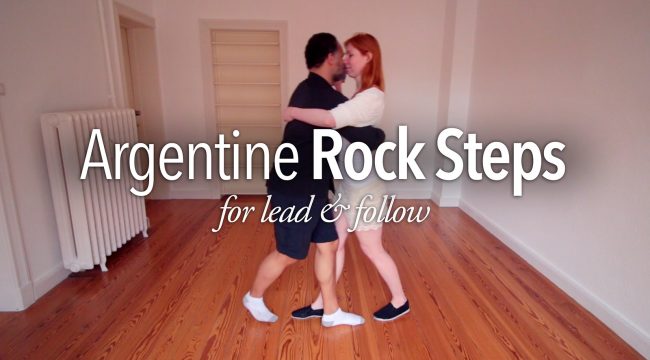
    Argentine Rock Steps

    The Argentine Rock Step is a very venerable piece of tango vocabulary it’s used quite often as a way to avoid a hazard, and infrequently as a what is primarily supposed to be used for as musical interpretation. More often than naught for a lot of people the addition of the Rock Step is where they stop developing kinesthetically. This becomes their experience, their go to move, and they don’t realize that this is the case.  So let’s talk about Today’s Tango Topic: The Argentine Rock Step.

    What is A Rock Step ? First let’s define what the word ‘Rock’ means. According to Webster’s Dictionary, the English word ‘Rock’ in this case is being used as a verb. It has a noun form, which means “a mass of stone”. In its verb form, it means “to sway back and forth”. Next, when we apply that idea to Dancing, a‘Rock’ Step means that you have a step that is going to go from weight transfer to weight transfer, very quickly.

    An Argentine Rock Step is a little different. It refers to a very specific construct and is not swaying to from side to side, but actually weight transfer to weight transfer (usually back and forth) sometimes with a Resolution (more on that later). In a lot of ways, a ‘Rock’ Step appears to look like (operative word) as if the couple dancing is a Rocking Chair. The Argentine Rock Step is in the family of ‘Alterations’ of Tango Vocabulary. Meaning that due to a possible Resolution, the Follower’s direction (orientation) changes as a result. One more thing: There is a distinct and clear difference between an Argentine Rock Step and a Check Step and/or Incremental Step as shown in the video below:

    Plays from YouTube. Pressing play connects you to YouTube. Privacy

    The video above shows the difference between the two (and one possible error that happens quite frequently). A Check Step has no weight transfer forward (for the lead) and backwards (for the follower). In the case of the Rock Step there is a clear, and definitive weight transfer backwards AND THEN forwards. 🙂

    The Free Tip. Stop squeezing your partners! This really about intention, or the lack therein. You lock your arm frame and think that in doing so it will stop your partner from moving. No. All it does is put more money in their chiropractor’s pocket! How does this relate to the Rock Step. Frequently the Rock is led and followed as a ‘jerky’ motion. The Rock Step out (the back step for the Follower, the Linear forward step for the Lead) isn’t the problem. It’s the coming back to resolution part, that is usually jerky, the Lead will PULL their partners back to them instead of stepping back gracefully. Tsk, tsk, tsk.

    Pre-Requisites: Walking. Weight Changes. Extensions. One does have to have mastered one’s walk and possess stability in their embrace without using the embrace for stabilization against their partners before they can initiate these ideas.

    About The Video. This video comes is 14:16 in length in ONE section broken up by markers. Both lead and follower technique are combined and integrated in the video.

    Section 1 – Introduction – 00:00:48
    Section 2 – Lead Technique/Follower Technique – 00:01:15
    Section 3 – Side Step Resolutions – 00:02:06
    Section 4 – Parallel Linear Rock Steps (Example: Close Embrace) – 00:00:20
    Section 5 – Parallel Linear Rock Steps/Resolution (Example: Close Embrace) – 00:00:18
    Section 6 – Cross System Rock Steps – 00:01:27
    Section 7 – Cross System Resolutions – 00:02:38
    Section 8 – Cross System Examples with Resolutions – 00:01:20
    Section 9 – Linked Rock Steps (Multiples) – 00:01:50
    Section 10 – Chained Rock Steps with Resolutions & Closure – 00:01:57.

  • Single Axis Turns

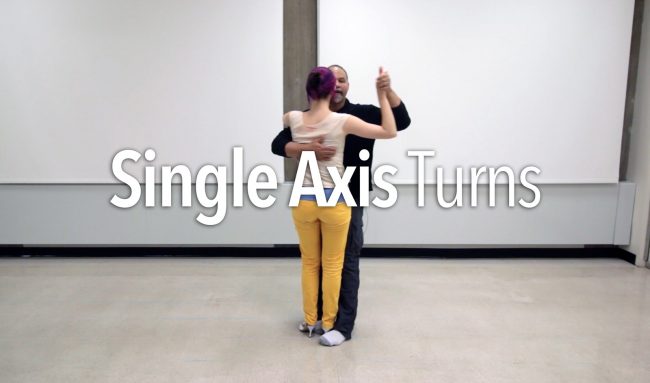
    Single Axis Turns

    There are Eight Turns in Argentine Tango that Tango Topics has identified as Commonly used or Social Turns. There are a few others that are outside of the common eight but for the most part, accept for now that there are eight.

    Just in case you were curious, the Eight Common Turns are, in order of precedence and commonality: 1.) The Follower’s Molinete/Lead’s Giro. 2.) Milonguero Turn. 3.) Rock Step. 4.) Ocho Cortado. 5.) Calesitas. 6.) Media Luna Turns. 7.) Colgada Turns. 8.) Anti-Molinete.

    Today’s Tango Topic deals with one of those common eight turns. This particular turn is an unusual one even though it’s part of the eight. It’s unusual because it’s a variation of a class of turns called “Colgada Turns”, and furthermore it’s also not used all that much, and for good reason. Why ? Because it’s a difficult turn to pull off at first. This one is not for the faint of heart, but once you master it, your coolness factor goes right through the roof. Not to mention you will have also mastered one of Tango’s more difficult aspects that hasn’t been around all that long in the dance: Off-Axis Movements. Tango has traditionally been a couple in Close Embrace type of dance that almost never opens once the Embrace begins. Nor does that Embrace change other than to get closer and closer and closer, and more refined. This type of turn, while done in Close Embrace, creates a version of Close Embrace that from the outside looking in, doesn’t look all that different, but from the inside (the couple’s perspective) feels very different. Today we’re going to explore both sides of the embrace, for both roles, so without further yapping, Tango Topics presents: The Single Axis Turn!

    What Is A Single Axis Turn ? It is tango specific language to describe a type of rotation that occurs between Lead and Follow where the word ‘axis’ refers to not the Follower’s Longitudinal Axis (which is the typical axial line that is referenced with the use of the word ‘axis’) nor is it the Lead’s, but rather a shared Longitudinal Axis between the couple. Truth be told, that axial line is always present. It’s generally the point of contact between the couple. However that longitudinal axis almost never gets used in Social Tango. Almost never. Except, and there is always an exception to these things, when the couple or partnership engages in what’s called ‘Apilado‘ (please follow the link for more information if you need a clear definition of this word). When Apilado is engaged, then the couple is dancing, depending on how it’s done, in either a supported way (shared) or unsupported way (forced). In the latter case, the Follower is being forced to fall on top of the Lead or to place all of their weight on the Lead. While there are times when that is desirable, in the case of the Single Axis Turn, that’s not desirable.

    Another way of looking at the Single Axis Turn is by understanding that this is a Colgada variation. However, unlike most Colgadas though which tend to be executed in Open Embrace, this variation on a theme is done primarily in Close Embrace! So while it can be done in Open Embrace, and doing so will generate more of a ‘whoosh’ factor (see below) than you would normally like to have in a Single Axis Turn, this is generally a Close Embrace movement that is small, social and fits within the line and lane of dance that you’re in. At no point in time, should a Single Axis Turn exit that line or lane of dance at all. The Single Axis Turn is Floorcraft safe, when done properly.

    Another piece of Tango vocabulary that uses very similar methodology and uses the same principle of ‘Apilado’ is the Argentine Volcada. It is also a shared axis movement. The Single Axis Turn is exactly the same in that respect. However, where as in the case of the Volcada, where the couple goes towards each other thereby creating more dependence on each other, in this case, in the case of the Single Axis Turn they go away from each other!

    Put simply the Single Axis Turn is a rotation around a shared longitudinal axial line where the couple seemingly in close or open embrace, rotates around this axial line, thereby creating a ‘turn’.

    The Free Tip. Just as in the case of the Volcada, where there is a natural ‘kickstand’ for all Volcadas, a safety mechanism that the Follower can invoke, if they’re not supported in the initiation phase of the Volcada…the same thing is true here. That same safety mechanism exists in the Single Axis Turn in exactly the same way in EVERY. SINGLE. ONE.

    About The Video. This video is 13m:49s in length in 9 sections. Both lead and follower technique are combined and integrated into the video.

    Introduction – 00:00:34
    Forward Steps – 00:03:09
    Follower Technique for Forward Steps – 00:01:26
    Further Rotation – 00:00:32
    Close Embrace Side Steps  – 00:01:47
    Follower Technique for Side Steps – 00:00:53
    Multiple Single Axis Turns – 00:01:47
    The ‘Whoooosh’ Factor – 00:00:42
    The Hurrican Turn/End – 00:02:09

  • Milonguero Turn ‘Trick’.

    Milonguero Turn ‘Trick’.

    You’re out social dancing, and you’ve been practicing your Milonguero Turns with your favorite partner, and you feel like you’ve got it down, so now it’s time to take it of the lab and put it on the floor and try it with other dancing partners. This, by the way, is not how we want to create a good practice regime. We do have a treatise on what to practice and how to practice. But more on that later in another article. 😉 You’ve accepted a request to dance with someone else, it’s a Di Sarli Tango tanda, and you smile, and you walk to the floor with your partner, engaging a the Lead’s Cabeceo! Stepping onto the floor, and engaging in your partner’s embrace, you settle into each other. Readjust, hopefully employing the “The Readjustment Phase” of the dance, a very important component, and then begin to dance, slowly, patiently, cautiously figuring out each other, rather than throwing every known piece of vocabulary at your partner in the first 30 seconds. Or some crazy cool move that you think is cool but your partner may find somewhat ‘annoying’ at best. Especially dancing to Di Sarli. Tsk, tsk, tsk. It’s around this time near the end of the first musical paragraph that your partner initiates their first turn. If you’re Leading you discover immediately that what your partner heard as a turn was in fact the Follower’s Molinete and not the Milonguero Turn that you intended. If you’re Following at this point, you’re wondering why the Lead keeps turning or why the Lead is squeezing the living daylights out of your back and what that’s all about. As far as you’re concerned you’re doing what the Lead asked invoking a Milonguero Turn by default because you know the rule but they keep squeezing and turning. Uuuugh!

    Scenario over!

    Today’s Tango Topic deals with that moment right there where there is obviously some confusion, a bit of a hiccup in what would have otherwise been a lovely and near perfect dancing experience.

    The Milonguero Turn is one of Tango’s underused but extremely elegant turns. However it comes with a tiny little problem embedded in it. The problem ? Default Behavior and Default Expectation. The Default Behavior ? The Follower’s Molinete as the response to a turn. The Molinete/Giro structure is one of the seven basic moves of Argentine Tango that is used so often and with such ubiquity that we almost don’t even think about it anymore. It’s just that we start turning and magically a Follower’s Molinete occurs. However, as in the case above, what happens when the Lead wants to invoke a Milonguero Turn instead ? A hiccup is what happens and from there things get ugly quickly.

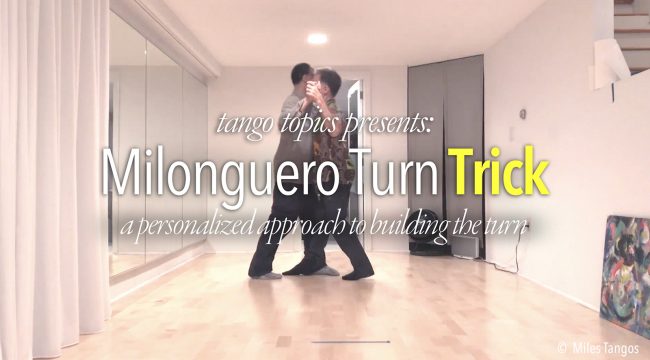
    That’s what Today’s Tango Topic is all about. So without further yappment, here’s Today’s Tango Topic on The Milonguero Turn Trick – Personalized.

    What is the Milonguero Turn Trick ? First and foremost, the Trick itself isn’t a ‘trick’, it’s more of a reliance on Follower Default behaviors. Secondly, the ‘Trick’ only solves the first major hurdle of the Turn itself – The Follower’s Back Cross.

    The problem with the Milonguero Turn, and it is a problem, is the opening step, the Follower’s Back Cross. By default, the Follower will not want to cross behind or back cross, unless this is their default turn or default behavior. Truthfully there are very few Milonguero Turn default based Followers. Usually the Follower has been trained in the Molinete/Giro structure as their default. So the moment that the Lead starts a turn, the Follower thinks and responds with “Molinete”. This is not desirable. While the Molinete is a very sexy turn, it’s not what we’re wanting out of the Follower at all. We ideally want the cleaner, less stressful, Milonguero Turn for a whole bunch of reasons.

    Before you go any further you’re going to ask, “Well, if the Lead led it then the Follower should follow what was led!”. True to a degree but then again, you’re dealing with default behavior, and that stuff is insanely difficult to override, most of the time. That’s why this ‘Trick’ exists.

    The opening back cross presents a problem: How to generate it ? And that’s where the Milonguero Turn ‘Trick’ comes in. It says, “Fine…the Follower has default behaviors, one of them is to come to collection, still another is not to a leg fly away from them, still another they have a desire to make things as small as possible, less work”. All of these default behaviors can be used to the Lead’s advantage if properly invoked. And that’s what the Milonguero Turn Trick does, it invokes all three of those defaults and overrides the Follower’s desire to Molinete. It supersedes it almost immediately so that the Follower never, ever wants to Molinete!

    In its simplest form the Trick is a Simple Sacada, but a fully unrealized one. The reason this is said, is because a Simple Sacada should and would take the place of the Follower, but it doesn’t. In its more complex form, it overrides the Follower’s default behavior to Molinete and replaces it with a back cross.

    Remember that the turn trick only solves ONE problem – Initiating the Follower’s Back Cross. It doesn’t solve the entire Milonguero Turn, you still have to learn to lead and follow those things.

    Notation: When the “What is … ” section of an article is blue, that means that the article is freely available to registered, users. When the section is yellow, the article is still free, but the video is for paid users. 😉 

    Why this video exists ? It exists for 3 reasons. 1.) It was part of a longer lesson for this particular student on the Milonguero Turn, and Elements of Turning itself. 2.) To give the student  a reminder tutorial for when I wasn’t there. 3.) I taught a Milonguero Turn class rather recently and then discovered this a few days after the class, and realized that this is actually a perfect reminder for anyone that wants to play with the Milonguero Turn on how to build it and what should happen.

    Further this video exists with the student’s consent. So don’t get all persnickety that we’re showing you a private lesson without the student’s knowledge. They’re fully aware of the video and fully endorse it.

  • Eight Types of Turns

    Eight Types of Turns

    In today’s Tango world, the Turn has become a necessity. We would like to believe that Tango is the lovely and amazing walking dance that we have heard said it was. The reality is a little different. Tango is no longer a walking dance. Don’t mishear that as the walk is unimportant or that you don’t have to study how to walk. Not true. You absolutely must study your walk: How to extend your leg (forward, side, or back), how to land your foot in a step (forward, side, or back) in relation to specific vocabulary, when to flex or bend the knee and why, what part of the foot is required and when (and why), what muscles to use and why, when to use your toes, how to strengthen the foot, etc. This is the technique of walking and that stuff is extremely important in order to begin to move efficiently, and effectively. This is not something that should be left to watching a 5-minute video on YouTube but actually, spend months and literally years learning and then re-learning, and refining. Because the study of your walk, and its refinements, absolutely makes for Today’s Tango Topic to exist. One can not even begin to study this topic unless one has mastered one’s walk. And by ‘master’ we mean to infer not perfection but rather well beyond functional so that it comes fluidly from you. Without wobbling, wavering, or using your partner for stabilization in any way, shape, or form. Today’s Tango Topic deals with the next most important element beyond the walk and goes right to the heart of the statement above that Tango is no longer a walking dance. In fact, today’s modern tango is more of a turning dance more than anything else. And the reason why isn’t a one-size-fits-all answer. It’s a series of factors that generate the state of affairs in Tango. For more on what those factors are, and why they exist and how to fix it, look at Floorcraft 102 – The Incomplete Turn, it explains those details in spades. So the turn has become the defacto, go to element that one must study with as much diligence as one studies one’s walk.

    We see the turn as one of the 7 Basic Moves of Tango Vocabulary (see link) that is used in every dance by every dancer at every Milonga in the world. It is almost as ubiquitous as the Argentine Cross. So much so that one may lead or follow a turn and not even be aware that they’re doing it. The primary turn that is taught and then danced is the Molinete/Giro structure. From a Leading perspective, this primary or basic piece of vocabulary is one of the ways that we can create navigational structure as well as generate musical structure. And it also has the obvious ability that allows to use it as filler content until we’re ready to do something else that may lead up to something else. From a Following perspective, it is one of the very first things we are taught to master and must become facile with because our very tango lives depend on it for a whole host of reasons which will become obvious later on down the line.

    However, ‘The Turn’ isn’t a singular turn. There are in fact EIGHT, yes you read that correctly, EIGHT types of Turns in Argentine Tango. And that’s what this video is all about.

    That said, let’s take a deep dive into the 8 Types of Turns for Argentine Tango.

    Three Techniques To Turning. Before we get into the Eight Types we have to look at a few foundational tools that must be present before we can even begin to talk about turns. While some of the turns in the Eight Types do require the study of item 2 below, it’s not required for the other turns. In fact, what you’ll find is that items 1 and 3 are far more common than item 2 on the list.

    1.) Walking Technique.
    2.) Disassociation/Applied Disassociation Technique.
    3.) Crossing Technique.

    Walking Technique can loosely be described as how one extends one’s leg and lands one’s foot on the floor, either in response to or initiation to movement. The study of one’s walk is absolutely required before you can even attempt any of the turns in today’s Tango Topic. Why ? You need only look at the following short 3 videos to see why this is an issue that must be resolved before you make the attempt. And if watching the videos below is just too much for you and you want to skip them, the simple answer is: STABILITY. Now go watch the damned videos! 🙂

    Two Extension Errors

    Plays from YouTube. Pressing play connects you to YouTube. Privacy

    Thud

    Plays from YouTube. Pressing play connects you to YouTube. Privacy

    More Extension Errors

    Plays from YouTube. Pressing play connects you to YouTube. Privacy

    Disassociation/Applied Disassociation is really the preferred method of motion for a wide variety of reasons. Most notably because it allows for fluid and seemingly natural movement not to mention it also allows for greater precision control, which in certain cases of the type 7 turn, is absolutely required like where if you don’t complete the turn things are definitely going awry!

    Just so you know, there are two videos on this topic in the archive. And while it’s lovely to sit here and yap about this stuff, you really do need to see it. So here’s a not so subtle plug to actually go and subscribe so you can see those two videos. They’re in the Ochos section. The first two videos. Please, for the love of God, go look at them. They’ll tell you everything you need to know about this fabulous and lovely technique that really are the bee’s knees!

    What are the Different Types of Turns ?

    Type 1 – The Walking Turn. (Freemium) In this type of turn, which has been showcased before in different videos, the couple essentially walks in a very tight circle. What makes this turn unique is that not only is it functional, but it’s also insanely musical, and on top of that, exceptionally easy! However, like everything else on this list, it has a “Gotcha”, and it’s a pretty big one too. There’s a reason why this turn is almost never taught, and it has to do with the rule that we’re all taught as dancers, “Never walk backwards against the line of dance”. Never. Ever. Which is to say that this turn, after about the 2nd or 3rd steps, will have the couple going against the line of dance.  Which as you can imagine creates problems for everyone. However, there is a solution to this problem of walking against the line of dance, and that’s to angle the turn a bit, and keep the turn tight (a small walking circle) to that the effect and timing is absolutely minimized. This turn can be done in open or close embrace, or any embrace format really. It’s best case use is in Close Embrace for a wide variety or reasons. There are multiple variations to this turn, and those variations come in the form of Walking Systems or The Six Ways of Walking. You can add loads of variations to this turn simply by changing the walking system. So while you can use a walking turn as often as you like, it does tend to get a little old after about the 2nd time through, not to mention if you don’t manage the line of dance issue you’re going to be holding up the line of dance. So it is for this reason that once you’ve got this thing down as a couple. You may want to look at Walking Systems in order to add about 18 different ways to vary the Walking Turn. 🙂

    Types 2 – 7 are Subscriber Only Content

    Type 8 – The “Milonguero” Turn. (Freemium) The last item on this list is by far the simplest and easiest as well as what we believe to be the sexiest one, if not the most elegant. From the Follower’s point of view, it’s a back cross, a side step, and a forward cross (sometimes called cross-in-front). The turn is usually done in close embrace for a wide variety of reasons, as this was the predominant turn that was danced for almost 70 years until Gustavo Naveira and Fabian Salas came along and turned (no pun intended) the Tango world on its ear with the Type 7 on this list. There is a gotcha to this turn, and it’s that the Follower more than likely has the Type 7 turn in their heads and getting them to do anything else (this is known as fighting default behavior) is nothing short of like going to dentist, like pulling teeth and just as painful for both parties.

  • The Milonguero Turn

    The Milonguero Turn

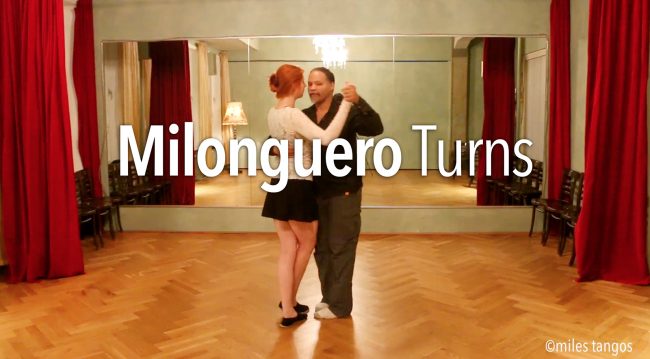
    The Milonguero Turn is a very useful piece of tango vocabulary and yet it is almost never taught anymore, sadly. It has been supplanted by its sexier kissin’ cousin, the Follower’s Molinete. Put simply, when you really stop and think about the Milonguero Turn, is nothing more than a backcross, a side step, and a forward cross (from the Follower’s perspective). This isn’t rocket science, it’s Argentine Tango, and as such there’s not a whole lot of complexity to this particular well worn, and exceedingly useful, but highly underrated Tango vocabulary. The fact is that this was the predominant turn for almost 70 years before Gustavo Naveira came along and changed everything with the sexier Follower’s Molinete, so the story goes. So without further yapping, let’s dive into The Milonguero Turn!

    What is A Milonguero Turn ? First let’s define the words there, as they require a bit of clarity. ‘Milonguero’ is yet another made up word used for marketing purposes that is a bastardization of the true meaning of the word itself. A ‘Milonguero’ is someone who was raised in the milongas, they would pick up discarded tickets to get into the milongas to then watch how people danced and then emulate that so that they could then dance with the pretty girls. This all happened in a 25 year time period from about 1930 to about 1955. If you were born in that time period and ran with this crowd of dancers, then you could rightfully (and distastefully, because it was a term of disparagement in those days) be called a ‘Milonguero’. There are very few of these men left in the world. Very few.

    These men didn’t take classes. They didn’t go to special Tango schools. No. They didn’t have the money. They learned on the floor while watching other people dance, and deconstructed what they saw. They then tried to one-up each other, trying to outdo each other with tricks and what not. While the game was certainly about getting the girl, it was also about showing off. In a lot of ways, the Milongueros of yesteryear bears a striking resemblance to the forerunners of modern hip-hop, minus the gang mentality. This is a ‘Milonguero’.

    The term, so the story goes, was developed as a marketing tool, as a way to describe what one specific teacher saw in the clubs and milongas of Buenos Aires. This was called ‘Milonguero Style’ dancing.

    A Milonguero Turn, on the other hand, is representative of the type of turn that existed prior to Gustavo Naveira (re)discovering the Follower’s Molinete. Again, so the story goes.

    In it’s simplest form, the Milonguero Turn is where the Lead or Follower, typically the Follower, is led to a clean back-crossing step, an arced side step, and then a clean forward cross. The cleanliness of the crossing steps is noted elsewhere on tango topics, known as the “Dirty Cross“. The Milonguero Turn is one of the easiest of turns to accomplish with regards to Argentine Tango for a variety of reasons, most notably because there is no hip rotation for the partner that is performing the turn, there is no ‘pivot’, nor is there any Disassociation or Applied Disassociation. The turn allows of the couple to stay with each other and also allows for an easeful experience vs. the Follower’s Molinete that is the default turn today. And last but not least, it allows for the partnership to stay facing each other, while at the same time not expending a great deal of energy to ‘turn’ whereas the Follower’s Molinete does precisely that. While the Milonguero Turn is not sexy, it is in our estimation the more desirable and elegant turns. It is, however, easy to see why it was abandoned in favor of its sexier cousin. That said, don’t discard it simply because it’s not sexy, use it because it is insanely functional!

    Huge Update: This video, even though it’s only 7 Minutes in length has been expanded upon in 3 other videos on the subject:

    The Milonguero Turn Trick – Which will generate the Milonguero Turn with ANY Follower regardless of whether or not they’ve been trained to do the turn or not.

    The Milonguero Turn Entry Points – Several possible points for the Milonguero Turn and a few Variations.

    and finally Milonguero Ochos into the Milonguero Turn as a practical application.


    Also there 4 of the 32 videos in the Follower Technique archive that go over in detail the idea of the Milonguero Turn.

    And now the rest of the sales pitch…

    From A Following Perspective the Milonguero Turn is insanely easy for you … IF you were to subscribe to tangotopics.com

    From a Leading Perspective the Milonguero Turn is definitely a challenge for you to learn to lead. Mostly because you haven’t subscribed to tangotopics.com

    The 3 Gotchas! There are, as always, some areas of concern that you need to pay attention to.

    One: SUBSCRIBE

    Two: SUBSCRIBE

    Three: SUBSCRIBE

    From a Dancing Perspective as has been indicated, is not used all that often, sadly. However, there are parts of this article you can not see because you haven’t become a subscriber. And all the deets that you want or need are in thext of the subjects above that are screaming at you to subscribe. But because you read this far, you get …

    The Free Tip. Posture, posture, posture. Far too often when engaging a turn a lead will look at or watch the Follower’s feet while engaging their own Giro, and or at the same time, they’ll engage The Lazy Man’s Turn. The Milonguero Turn can not engage either of these two errors. Instead, you want to engage ‘better’ posture at all points along the turn itself. Followers a small tip for you, you’re going to want to step away in the Milonguero turn on your backcross and more importantly in your side step, and you can’t, you want to step around your lead!

    About The Video. This video comes in at 07m:10s in length in 7 Sections. Both lead and follow technique are combined into the video.

    Section 1 – Introduction – 00:00:25
    Section 2 – Lead The Backcross – 00:02:41
    Section 3 – Follower Technique – 00:00:55
    Section 4 – Lead Details – 00:00:38
    Section 5 – Follower’s Big Side Step – 00:00:40
    Section 6 – Lead Footwork – 00:00:30
    Section 7 -Example/End – 00:00:47

  • The Cross – Getting In Front

    The Cross – Getting In Front

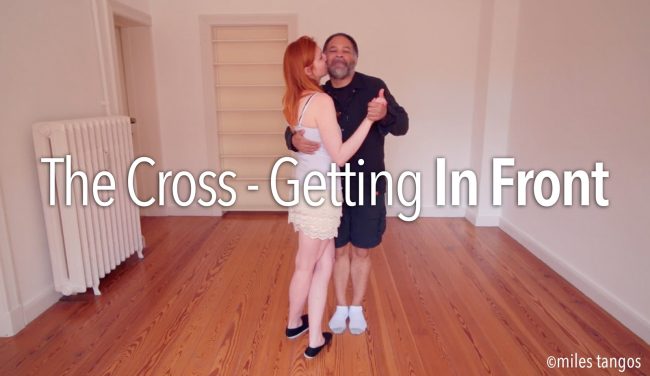
    For most Followers, that haven’t been properly trained, they are rushed into an Argentine Cross right from the start of their Tango dancing lives. Aside from Ochos, it’s the one thing that they’re pressed to do without any training aside from the Lead/er (Controlling Lead hence the ‘/er’ part) that quite literally tells them what to do as they’re doing it. From that moment, right up until this one (assuming you’ve shared this video with them) they more than likely have no idea a.) why they’re crossing their feet. and b.) more importantly what the point of the Cross is, and c.) what it all means.

    The Problem: This isn’t so much a Lead problem as it is a Follower issue. Contrary to what you might have been told, the Argentine Cross does actually serve a function. And believe it or not, it’s not to do a Cross every 15 seconds for no good goddamned reason. No. The function of the cross…is well, you can watch the video for that part. The problem is that not only is the Follower not aware of what the function of the Cross is, they’ve been so indoctrinated into a passive way of dancing that they’ll a.) Willy-nilly cross their feet due Two of the Five Errors of The Cross – specifically the Automagical Cross and the Wimpy Cross (see below), where in the case of the latter, the Follower has to infer what on god’s green earth the Lead is attempting to do. (In the other 3 cases they don’t have to infer, they’re quite literally forced into crossing their feet whether they wanted to or not). and b.) That a good portion of the time, the Follower will end up in the Lead’s Arm Pit. It is for this reason that we talk about – Getting In Front of Your Lead!

    video
    play-rounded-fill

    From a Following Perspective, 10% of this problem is your issue. And it has to do with you understanding that the Cross is actually, in modern Tango, your piece of vocabulary. Not the Lead’s, it’s yours! There are many people that will disagree with this statement that the Cross is the Follower’s vocabulary. The fact is that without you cooperating, the Argentine Cross, is not going to happen. You could say this about almost everything else in Tango, that without you cooperating nothing happens. And you’d be right. However in this instance, this is one of the few places where the Follower has an enormous amount of control of when something is done, how something is done, and most importantly where we go next! All of that from you crossing your feet. In this instance, this one little piece of vocabulary is YOUR place for you to shine, to sparkle, to show off your skillz as a Follower. Instead, what happens ? Well…watch the video.

    To be fair, you have to contend with the Five Errors of the Cross (see above), and then there’s the squeezing, the pushing, the pulling from your Leads. And then there are your issues, while in heels, to contend with. That aside, you do have an issue which is solely yours, which is the whole point of this topic – to get back in front of your lead!

    The simple fact is that your lead (the action, not the person – lowercase ‘l’) either stepped outside partner or stepped into cross system and in either case you’re essentially out of step with them. The whole point of the cross is to get back in front of your Lead (the person).  However, part of your issue is that you’ve been indoctrinated to a way of moving that quite factually doesn’t work for you. The way that you’re moving is to send your leg straight back, and really to cross your body meridian away from the couple. This creates a problem for you, especially when you come to collect your feet in the cross. Your feet look like two mismatched and broken sticks pointing in opposite directions from each other with a watermelon in between them, instead of what they can look like. We do want pretty feet, but we don’t want pretty knees, when we come to collection and even crossed collection! However, there’s a tiny little problem in that your body is in the wrong place, and your hips are all twisted and you’re basically out of alignment with your Lead, and on top of all of that, you’re stuck in the Lead’s arm pit! And there you will stay…sadly. 🙁 Unless…you do something about it. 🙂

    From a Leading Perspective, before we launch into Follower’s side of this. Let’s give credit for this problem, where credit is due. The Lead! Dude, a good 90% of this problem is your fault. Let’s be clear about responsibility here. You created this problem and the Follower is only doing their best trying to fix it. How did this become your problem ? 1.) You lined up with the Follower in your Arm Pit! You placed them in there right from the gitgo (‘start‘ for the non-native english speakers), and what’s worse is that you kept them there, holding them in that spot, because it was convenient for you to pull off some crazy vocabulary, which you think you need to lead every 20 seconds, instead of (gasp!) actually walking with your Follower to the music. Eeeek! Which for some reason is ‘boring’ to you but heaven to them…gosh I wonder why !?!?!?  2.) Your embrace that you think is comfortable is like laying on a bed of nails because it’s too compressive! Think ‘squeeze‘ and you’ll get the right idea. And even if someone tells you that to lighten up and let them loose, you’ll go right back to squeezing the daylights out of your partners because to you think, a.) this is comfortable. and b.) it’s all you know. 3.) Because your right arm is like a vice grip and you have this rather nasty tendency to paddle your Follower’s with your right hand to ‘direct’ them, you somehow believe that this is desirable. Ummmmm not! And lastly you created this problem by 4.) being too damned restrictive and not being responsible by continually placing the Follower in front of you by repositioning your vocabulary to do just that. Instead, doing all 3 previous things to show off to keep the Follower from realizing that you were completely ignorant about 3 steps in and don’t have a plan for the rest of the song let alone for the tanda! Yup, your fault.

    The Dancing Reality is that this stuff happens with such frequency that no one, not even the teachers that you’re studying with pay it any mind. It’s so commonplace that one wonders if anyone is actually teaching technique to specifically create this issue! “Leads! You place the follower in your armpit, and then rush around the room, all the while pulling and pushing! Followers, your whole job here is to stay in the Lead’s armpit and then to come to a crossed collection so that your hips are all twisted up and you’re off to the side of your lead! Ready ? Go!”. Not!

  • 8 Tips To Desirable Tango

    8 Tips To Desirable Tango

    First, let’s get some language out of the way, the title of this article is not “BETTER” tango, but “Desirable”. As ‘desirable’ is a more realistic term towards the idea of ‘Social Tango’. Believe it or not, the descriptives actually matter here. Because what call a thing is what it becomes in your mind! So the clearer you are in that descriptive, the more clear it is to making it a reality! So for that reason alone, we don’t call this ‘Eight Tips to Better Tango’. No. We refer to this as Eight Tips to Desirable Tango. Secondly, the idea that there is a destination here, that you’ll arrive at being amazing in your dancing skills is absolute bullshyte. There is no destination. Get that thought right out of your head. There is only ‘desirable’ and ‘not desirable’. Third and lastly along the lines of language, ‘Desirable’ is a MOVING target. Meaning ? That the idea that you will one day be a magical dancer is not reality, the goal posts for desirable is always, always, always changing. Always. 

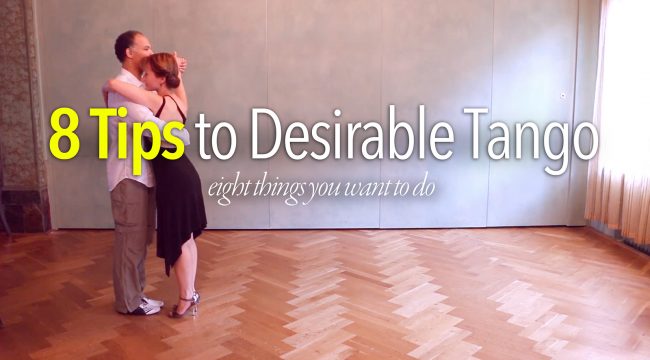
    The more that you have danced, the more that you have learned a way to compromise your body into doing X, Y, and Z that contorts, twists, and mauls you so much so and so often that you erroneously believe that this is how the dance is supposed to be. It’s not. Truthfully the dance is so effortless and easeful that it’s almost scary. The example above shows a couple that is walking together, effortlessly, with ease. Mind you that this ease and effortless ability happened because both partners worked on themselves, individually, on their own technique, in order for the walk to appear as effortless and as easeful as it looks and was. However, you have no idea about this, because you’re so used to moving in your contorted way, using muscled force, hanging, pulling, pushing, and wholly unstable that you think, or believe, that what you are doing is what the couple is doing above. It’s not.

    This couple is moving together is an illusion of techniques. The Lead’s walking technique. The Follower’s walking technique. Together this creates an illusion of effortlessness. When it fact it’s very practiced and second nature to them. This is not something that they learned in 5 minutes in a class once and then magically were able to reproduce this. No. This effortless easeful movement of the couple happens through years of diligent, personal, painstaking, detailed, sometimes disheartening, hard work. Not 5 minutes, not 5 hours, not 5 weeks, not 5 months, but years. 

    The fact is that what you’re seeing is the result of that work. The reality is that if you have to push, if you have to pull, if you have to squeeze, if you have to ‘lead’ with your mouth, if you have to use your arms to direct where the follower is going, if you have to hold on to your lead for dear life because you’re falling all over the place, if you have to squeeze the lead’s arms to stabilize you with every step and on every turn or Ocho, if you have to follow or lead by watching their feet, then you know what ?  You are more than likely compromising your body, contorting it to be able to ‘dance’. This is not tango. This is contortion and it is not easeful or effortlessness by any stretch of the imagination.

    So how do you get to the effortlessness of the dancers above ? Below are 8 Tips to Desirable Tango towards that goal. It is not the only pathway, and this by no means is an exhaustive list of what has to happen, but it is a good starting point. When reading through these points there is something that you absolutely must keep in mind, something that you must not forget: Most of these points (except the musical one) come from a place of self-honesty. The dancers above achieved their level of effortlessness by blatantly and sometimes more often than not by being deeply and harshly self-critical, honest with themselves and their partners, over and over again. Every nuance, every detail, every aspect in exacting precision was scrutinized, reworked, tailored, taken apart and then put back together hundreds of times. If that. It is only through self-honesty and hyper self-awareness that change can occur. It is absolutely crucial towards becoming a dancer that is desirable to dance with. That said, let’s begin….

    Desirable Tip #1

    Working your foundation. While you have heard this page say and me say, and every teacher say that the foundation of the dance is walking. That’s not entirely true. Yes the dance is a walking dance, but the dance almost never walks in Modern Tango, it turns. It would be more accurate to state that the dance is a turning one. But that’s not what this statement really means. “Working Your Foundation”, refers to creating a stable platform from which you can walk, or turn, or cross. ‘Stable’ in this case means that you do not need to hang, you do not need to pull, you do not need to push. You are completely aware of your own equilibrium, and as a result do not need to touch someone in any way, shape, or form in order to move with them. Think of it this way: When you’re walking anywhere (assuming it’s not icy out) do you need to hold onto someone else to do it ? Probably not. So why would you need to do this when dancing Tango ? Answer ? You don’t. And anyone that tells you any different is either lying through their teeth or has a contorted way of looking at the dance that you probably want nothing to do with. So ‘Working Your Foundation’ is really about stabilizing the three primary steps of the dance from a leading perspective as well as from a following perspective, individually (not together), forward, side, and back, independent of someone else. Working your foundation will give you the ability to control your own body without holding onto someone else, being independent and that in turn will allow you, when you are in the confines of the embrace, to be 10 times more controlled, and that control gives you the effortlessness and ease that you seek.

    Desirable Tip #2

    The Onion. Tango is like the unending onion. There is no ‘there’, there is always, always, always something to work on even when you think you have mastered X, you must revisit it constantly with drills and exercises. Constantly. Practice is not, and should not be considered, dancing practice with a partner, but rather should be working the base elements of motion itself – which is stepping forward, stepping backwards, stepping to the side – Forward, Side, and Back. Clean up those things, make those things stable, clear, controlled, contained, consistent, without wobbling, without wavering, without needing to hold on to anyone or anything (no balance bars), and then you’re onto something. The drills and exercises are the onion here because you can always delve deeper into greater and greater levels of control and precision. Finite control is what you’re after here as a Lead and as a Follower! You want to be able to deftly control every aspect of any motion regardless of whether or not you are in an embrace or not! And to be clear, this isn’t about speed, truthfully it’s about slowly, very slow, like a 10th of the speed at which you’d normally do something, it is about doing something thoroughly and slowly and carefully, meticulously detailed and precise control. Through drills and exercises you will gain some measure of finite control, and that finite control will allow you to master forward, side, and back under most conditions.

    Desirable Tip #3

    Learn to Lead AND Follow at the same time. Don’t put it off to wait until you have mastered X. The fact is that you will never master X.  So you may as well start sooner, rather than later. Further still, you will acquire the dance that much faster. Some people are put off by this statement and erroneously think or believe that it means giving up the masculinity or femininity of the dance. Not true. My father always used to say to me “Know Your Stuff”. He meant to educate myself, illuminate the dark corners of topic to know it inside and out. So that when challenged I could speak knowledgeably at the dinner table on a topic and not sound like the proverbial village idiot. The same thing is true here. While you may never use the skill, that doesn’t mean that the knowledge can not and will not benefit you on multiple levels. It does and can do exactly that and a whole lot more.  Right now you have a way of seeing the dance as sort of a ‘Black Art of Leading’ and a ‘Screwup skill of Following’. What does that mean ? It means that for Followers they’re afraid or fearful of leading because it seems so hard. The fact is that you know more about Leading than the lead does! Why ? Because you’ve been led by every awful lead in the room that squeezes, pulls, and pushes, and you know what that feels like and you don’t want to do it. From a Leading perspective, you lead something and the Follower doesn’t follow it but they’re ‘supposed’ to. The fact is the reason why they don’t follow it is because you’re in denial about what you’ve actually led. If you lead it, they will follow it. It’s that simple. If they’re not Following it, it’s because you aren’t leading what you thought you were. So swapping roles every time you learn something new will help you to understand how and why X, Y, and Z works. Didactically breaking it down to it’s component elements (forward, side, back). This isn’t about steps and patterns and learning it, it’s about learning how the coupleship works in relation to what is and how something is being led and followed. This isn’t new information folks. It’s old information. Most of the better dancers that you will see and have seen have all learned to lead and follow and some of them do it elegant and some not so much but that’s more than you have done. So if they can do it, why can’t you ? 

    Desirable Tip #4

    Drop your ego. It’s getting in the way. The fact is that you are fearful of making mistakes, and looking like you don’t know what you’re doing. Guess what ? Every one knows that you don’t know what you’re doing. So get used to it. Some of those people that you’re trying to impress recognize this. Some of them don’t and they’re judgmental about it. They point, they snicker, and they talk about you behind your back or so you think. The fact is that some of them just don’t give a rats frak about you and what you’re doing. That’s reality. Look, you’re going to make mistakes. Lots of them. As a matter of fact, those mistakes are absolutely crucial to you learning what you need to learn. If you put on airs and try (operative word ‘try’) to always get every thing right, or proper, and try to over lead every single physiological aspect or follow every single motion, you’ll never learn to dance. Never. Making those mistakes are absolutely crucial to you building a ‘database’, if you will, of motion and movement. And the only thing that stops you from building that database is your ego. Get rid of it.

    Desirable Tip #5

    Learn your music. Seriously. As arcane as Tango music can be, and it can be just that, its also one of the worlds most multi-leveled, multifaceted styles or genres of music ever devised. It’s quite simply the bee’s knees of the music world on multiple levels. This isn’t about knowing the orchestras, or the singers, or knowing the dates, and places of the events those people’s lives. But trust me when I say that that stuff actually helps you. So knowing it is a benefit. As it gives you the insights to the men and their music. No, this is about understanding the structure of the music and how to listen to it. And that starts with not counting beats, ever. There is another way to handle tango music and counting 8’s and beats is not tango music. It’s all about the pauses folks. Learn the pauses and you’ll master tango music in a way that you can’t even begin to imagine. Just as a side note, as a gold+ user of this site would give you access to the necessary tools of hearing the pauses and musical exercises to help you to practice it.

    Desirable Tip #6

    Tango is a Social dance. Meaning you have to be a social person. If you’re not, then you’re going to have a rather difficult of a time when it comes to meeting people, which will result in getting dances. While it’s true that Tango can help you get out of your shell, to a limited degree. The fact is that Tango can be very isolating due to its focus on technique and the mastery of that technique. So making friends makes that mastery process seem less daunting. So the easiest thing you can do for yourself is to drop whatever you project about yourself to being true, put on a persona (if you have to) of being nice, and pleasant, and then here’s the hard part > start talking to people. Start with an introduction “I’m ….” and then ask who they are and where they’re from. Probably one of the easiest and the more challenging things to do if you’re the shy type, is not seem awkward around the whole reason you’re there, which is to dance. So here’s a simple solution: Talk to people. Ask what they do, where they come from, how they got here, what their day was like, find out about them. Don’t try to look for a dance. The dancing part will happen. Honest. It will. But probably the biggest piece of advice we can give you is to try (operative word in the sentence) to be friendly with everyone you meet. This is far more important that you can imagine it to be. Yes there will be people that for one reason or another will not like you. Don’t let that get in the way of saying “Hello” to everyone and that includes the people that may not like you. It will drive them mad that you’re nice to them. And the reality is that you are being nice to them for a very good and important reason, because this isn’t about being snobby or trying to get on people’s good side. It’s about generating a desirable attitude for yourself, and really the people that you dance with and ultimately the room. The confines of the Milonga can be really awkward, so all you’re really doing is taking the edge off that awkwardness by investigating who these people are, where they come from, how they operate in the world, how they came to be there, and why they’re still there.

    Pro Conversation Tip: Do not ask “Sooooo….how long have you been dancing ?”. Not. Major no-no. You can ask who someone studies with, or where they study, or if they study at all. But if you want to open up a tango conversation beyond the who are you and how they got there, here’s a good one: “Who is your favorite orchestra, and why ?”. Now a likely answer to this is going to be Di Sarli, Canaro, and/or Troilo. However, the more seasoned dancer will answer that question, especially the why part, with the era of the named orchestra (the years) and what specifically was going on for that orchestra at the time. Still another question that will open up a tango dialogue, “Of the three dances, which one is your favorite and why ?”. This one will net you a very varied answer and also open up a wide range of possibilities in places to go with it after that. A very common response from Leads depending on where they’re at in their Tango development either Tango, or Vals. For Follower’s you’ll get a qualified “Milonga with the right Lead!”. Still another one that will open a conversational door is “Where do you practice ?”. An obvious one, “What’s a good Milonga to go to and on which night ?”. And if you live in a small town where they’re only one milonga a week, if that, then a good question to ask anywhere is, “How do you like the Music tonight?”. Which will of course open up a long dialogue on the quality of music, the dj, and the floor’s response. 

    Desirable Tip #7

    Practica, Milonga, Marathon, Encuentro. Put simply, all the classes, workshops, and private study with X, Y, and Z are practically useless unless you actually use it. This is what I call the neurology of dancing (leading or following). There’s something that happens to you within the line of dance, where you are under stress to perform X, Y, and Z. Where you have limitations that you must execute within a given limitation. Where you have move within the construct of the line of dance IN TIME TO THE MUSIC so that you don’t hit or collide with tables, chairs, or other couples. And that only comes from actual dancing. You have to try this stuff out, refine it, play with it, change it, modify it, work with it. So while solo practice is good, going to classes is also good, private practice is even better, and videoing that stuff to improve on it is excellent. What you’re really doing is ‘vamping’ until you’re at a Milonga! And dancing within the confines of the Milonga experience is really what you’re after. And even this is a skill unto itself (see my video on Preparing For Buenos Aires or Dancing In A Small Space). But that’s what you’re shooting for. Going out social dancing once a week is nice, 3 or 4 times a week is better! Go to every practica, every milonga, and then travel for marathons, and encuentros as much as you can. Don’t just dance with all the best dancers in the room but everyone. Every dancer can teach you more about every possible condition that you will run into out there in the dancing world. The more that you do this, the more you will understand how to handle X, Y, and Z. More dancing, can create a more well rounded dancer and dancing experience.

    Desirable Tip #8

    Video Practice. The fact is that mirrors and your ego lie to you every time you dance. You can’t see everything because you’re too busy contorting your body to ‘make’ the dance happen instead of dancing. So you quite honestly can’t see what you need to see in order to make things better. It is for this reason alone (and a whole host of others) that you quite literally must video your private practice dances, and then here’s the hard part – WATCH THEM! What are you looking for when you watch them ? You’re looking for how you leg extends, how your foot lands on the floor, you’re looking for signs of compression, you’re looking for signs of bodily contortion (head tilting towards, or away from your partner), you’re looking at arm positions, hand positions, you’re looking for issues of posture, you’re looking for where and how your foot comes off the floor when it should be on the floor at all times. You’re looking for repetition of vocabulary (the same move over and over again) with no variations. You’re looking for wobbling when you walk, the areas of instability in a turn, you’re looking for the lack of indications of a lead, or the over forcefulness of a lead. You’re looking for all of these things and many more, and probably chief among these is what you are doing (as a Lead or as a Follower) in time to the music. Answer this question, “Is what I am doing in time to the beat, the pauses, and musical phrasing of the music ?” If the answer to any one of those questions is “NO” then you have issues that need to be addressed and I got news for you, it’s not about going back to school to learn to count. It’s about learning how to hear the music properly.

    In conclusion, we’re not saying that any one of these things, and the levels of excruciating, and exhaustive details will change what you’re doing. we are saying that they all will! Doing them on a regular basis will start you off in the right direction that you need to have, so that you change your dance into a far more satisfying dancing experience.

    The fact is that no one likes to be criticized and singled out for their dancing, and then to have it characterized as ‘awful’. We all like to believe that what we’re doing is perfect and wonderful and amazing. The reality is far from this. To witness this stuff and have it pointed out to us is embarrassing and personally painful. However, the sad fact is that this is exactly what does happen and is happening to you and around you in a myriad of different ways. One of them is people saying “no” your cabeceo or mirada (especially from the better dancers in the room), or you sitting most of the night (and not because you want to sit either), or you not dancing because you don’t want to look like you don’t know what you’re doing. There’s a way around all of that: Study, practice, and take private lessons to up your game because the reality is that you need them. Yes, they can be expensive, especially with the more popular and better teachers but you need their honest and clear feedback. And if you aren’t taking privates and you felt like you haven’t gotten a lot out of them, then look at our Five-Point Guide to Private Lessons. It can really help you to getting the most out of your private lessons with almost any teacher!

  • Cabeceo: Asking A Woman To Dance

    Cabeceo: Asking A Woman To Dance

    (note: this is my opinion of how things should work, take it with a grain of salt.)

    ASKING A WOMAN TO DANCE

    She walks into the room, kisses, and hugs her friends on her way to putting down her shoe bag, and then finding her seat to put on her shoes. It seems like she’s kissing and hugging everyone in the room for cryin’ out loud. Finally, she finds half a chair at the crowded milonga, and slips off her street shoes into what appears to be brand new Madame Pivots, all sparkly and shiny new. Just as she finishes her right shoe hook, she looks up and is immediately whisked away out of her chair by a favorite Lead. One tanda, two tandas, three tandas, she comes off the floor to get some water, and no sooner does her foot hit the carpet, when another Lead takes her by the hand, and off they go. One tanda, two tandas, and off the floor to head for water, and a chair! She’s looking a little disheveled after that last Lead. He was a bit rough on her, but she smiled through it, he had some nice qualities. She sits for the first time in 45 minutes, drinking her water, and finally catching up with a friend. Legs crossed and eyeing the room, and avoiding it at the same time.

    Gentlemen, how do you ask this Follower for a dance ?

    Well to be honest with you there are many ways of asking a woman to dance as there are stars in the sky, and they all basically involve the same thing: Being a Gentleman, and not an asswipe! However before we can ask this follower to dance, we need to at least acknowledge a few things: You and your technique, and/or the lack therein. 

    Before you go out social dancing: You want to address your issues. More than likely you have issues, we all do, we are all not perfect dancers. However, the issues that are being referenced here are the ones that you can’t see. They’re structural in nature, and quite honestly you don’t necessary have the training to suss them out. Not kidding. No joke. It is for this reason that we suggest the following: Get thee into some private lessons, and focus on your posture first and foremost, your walk with regards to that posture, and last but not least > your posture, with your walk, with the embrace. Dude look, its not about the steps and the patterns. I know you think you can ‘dance’, I know you believe that you’ve taken a few classes with (fill in the blank), and they’ve taught you some really cool and fancy moves that god him/herself would deem as ‘Yup! That’s pretty cool!”. The fact is, that your posture is more than likely the source of 40% of your issues with followers, and the other 50% is your embrace!!! which is being generated by a poorly executed and unstable walk which you are thereby blaming on the Follower for following your lead which is incomplete at best! Put simply, your embrace is probably like a vice grip and you just don’t realize it. Perhaps you use your left arm as a metronome (bouncing up and down in time to the music). Or on top of that, you’ve been told that you must have ‘resistance’ from her, she has to push into your hand, otherwise you can’t feel her or what she’s doing. There are some teachers that teach ‘Resistance’ Based Dancing, and there some are some that don’t. Most men, when they have the tables turned on them and the ‘resistance’ based dancing mirrored back to them…they never want to do that again, ever! It’s frakkin’ work!!! What we’re wanting is ‘Intention’ Based Dancing.

    There are many things to work on before you ask this Follower to dance, but these things are very important to creating a lovely experience for the Follower, not you, the Follower. Believe it or not, contrary to what you might believe or have been told, the dance is all about the Follower. Without them there is no dancing! Got it ? So it stands to reason that we want to create a quality experience without ego, without arrogance, and without being an ass, but rather a humble but clear lead. Doing all of these things, private lessons (not group classes), focusing on your embrace, your walk, and of course the music (more on that later), and then focusing on the Follower’s enjoyment will create the desired results that you’re looking for on multiple social levels and dancing levels. This isn’t about fancy moves, or steps/patterns/figures. It’s about generating an experince that makes the Follower say one singular word at the end of the tanda: “Another ?“.

    So with all that said and done, can you ask this Follower for a dance yet ? Ummmm not quite….

    Before you can go down the road there’s a list of 9 don’ts and 5 do’s that you want to do, sort of like a check-list, before you can ask this Follower to dance: 

    The Nine Don’ts!

    1.) Do not walk up to her and extend your hand and expect to get a dance! Not…not!
    2.) Do not stalk her around the room. This video shows the follower version of the idea.
    3.) Do not cross a dance floor to get to her.
    4.) Do not walk up to her, stop 5 feet from her, and then Cabeceo her!
    5.) Do not verbally ask her for a dance (there are exceptions to this).
    6.) Do not stand outside the ladies room and get her as she’s coming out. (can you say “awwkward!” ?)
    7.) Do not sit 2 chairs away from her ‘eyeing’ her and expect her to dance with you. (“creeepy!” ewww!)
    8.) Do not come up behind her and tap her on the shoulder.
    9.) Do not sit down next to her and then talk her to death waiting until she does accept.

    The Five Do’s!

    1.) Make certain that you are reasonably dry, and not dripping sweat. Nobody really likes to bathe in sweat, so for this reason always, always have a change of shirt if you’re the profusely sweaty kind of man. Think of it this way, do you want to go home smelling of perfume ? Probably not. Well then she has absolutely ZERO desire to go home smelling like a gym locker! So keep the sweat to an absolute minimum.

    2.) Have a pleasant ‘odor’ to you. This doesn’t mean aftershave but some deodorant is a good choice. Preferably one that doesn’t REEK!

    3.) Make certain you are well manicured. This means that your nails are clipped, hands washed, or cleaned with soap BEFORE you dance with her!

    4.) Have pleasant breath. Two words for you: Breath Mints! Need I say more ?

    5.) Get a towel or something to use as a handkerchief! Place it in your suit jacket pocket, you are wearing one…right ? And at the end of each song, wipe the sweat from your hands, and from your neck, nose, and forehead. Keep your sweat to yourself…let’s not share it, shall we ?

    Ok, so now that we’ve read you the riot act about what to do, and how not to engage her…can you ask her for a dance yet ? 

    One more thing…and it’s kinda imporant: It is strongly suggested you actually know the music that you are asking her to dance to before you ask her to dance. Meaning that just because there is music playing, and you want to dance with her, it is actually rather helpful for you to have some understanding of what you’re listening to, and then dancing to. A fair amount of the time, most lead/ers (and men in particular) quite literally wander around the floor, no where close to the walking beat of the music, not engaging the natural musical pauses that exist in the music, nor picking an instrument to dance to, or even dancing to the singer along, not even an accent note. They wander from vocabulary choice to vocabulary choice without an eye towards what it looks like, what it feels like, and most importantly how it relates the music that they’re ‘dancing’ to. So it is for this reason that you a.) learn what you’re listening for. b.) learn what you’re listening to. c.) then practice that (pauses & then phrases) religiously with an eye towards creating structure from your Musical Interpretation. Structure ? What’s that ? Each piece of music has a very particular lattice work of how it is played and then laid out to you the listener. There are 4, sometimes 5, movements in 2 to 3 minute song, depending on whether or not there’s a singer involved. Those movements, if you will, are the structure or latticework of the song itself. You want to structure your dance around that latticework so that it enhances what you’re listening to and thereby shows anyone that’s watching you dance with your partner that it matches what’s going on, musically! Unfortunately that’s not what happens a good 90% of the time, and we end up with wandering all over the floor! 

    Now to the QUESTION: HOW ????

    The right and proper way to ask her for a dance is to stand or sit approx. 30 to 40 ft from her, and make concerted, direct eye contact with her. It’s her choice at that point to accept or deny your invitation. Give her lots of space my friend. This is elegance in practice. There is a code of operation here and you want use it. Now mind you, sometimes its a little dark in these rooms, and the milonga organizer just doesn’t set up the room in such a way that you can actually send a cabeceo and actually have it seen. In BsAs its a little challenging in some rooms…but it does work.

    Plays from YouTube. Pressing play connects you to YouTube. Privacy

    Understand something else, that if she says “NO”, that does not mean that you get up from your chair, and walk over to her and perform one of the 9 don’ts. No, no, no! Bad form. You simply move onto the next follower that you would like to dance with. “NO” means “NO”. It unfortunately means NOT EVER, IN THIS LIFETIME. DON’T EVEN THINK IT! Now to be fair, that’s not entirely true, “NO” sometimes means NOT RIGHT NOW. How do you know the difference ? You don’t! Again, her call my friend, not yours. You’ve made your interest known at this point….move on. She’ll either pick up the ball later, or not. However, don’t sit there and be all mister pouty face, that’s not going to get you anywhere! This also means don’t ask again that night, again, at all. That also means that you don’t eyeball her all night long either! Once and let it go. Got it ? Trust me, she got the message.

    There are a few Exceptions to the Rules:

    1.) There are women out there, that a.) can’t see 10 feet in front of them, (furthermore neither can you my friend!) and/or b.) Do NOT understand what cabeceo is and how it works. I’ve heard stories of women that go to BsAs and don’t get that men are literally throwing spears at them in terms of cabeceo, and these women are completely oblivious to the practice. And yet when you ask them later, they’re like “Huh ???? What ? Cappa-what ?”. I’ve seen it happen, been party to it, not surprised by it, its just a lack of understanding of the codigos. Now in some cases these women are saving you face by being socially deliberate as to feign ignorance. How do you know the difference ? You don’t. You have to take people at their word until proven otherwise. Which is to say, if she declines your invitation, and then accepts someone else’s and then later on claims to be ignorant of the codigos…draw your own conclusions from there. To be fair there are some men who will not take ‘no’ as an answer, and will walk across the floor and extend their hands to her and get ‘the’ dance. Think nothing of it. Let’s just say that if you watch her face while she’s dancing with him, that should tell you everything you need to know about what she’s enduring at that juncture!

    2.) If you know her fairly well, are on better than speaking terms with her, and have hung out with her, then you can verbally ask for a dance.

    3.) If you’ve just been introduced to her, you can verbally ask her for a dance right then and there, but it is a little awkward.

    4.) If you’ve been seated at her table, you can ask her for a dance, and truth be told I believe you’re expected to dance at least one tanda with her, it would be rude not to do so. There are even exceptions to this ‘suggestion’.

    5.) If you have a friend that knows her fairly well, you can ask for an introduction but that’s about it, and then employ rule #3.

    Having said all of that….breathe, smile, cabeceo.

    See what happens!

Hide picture