
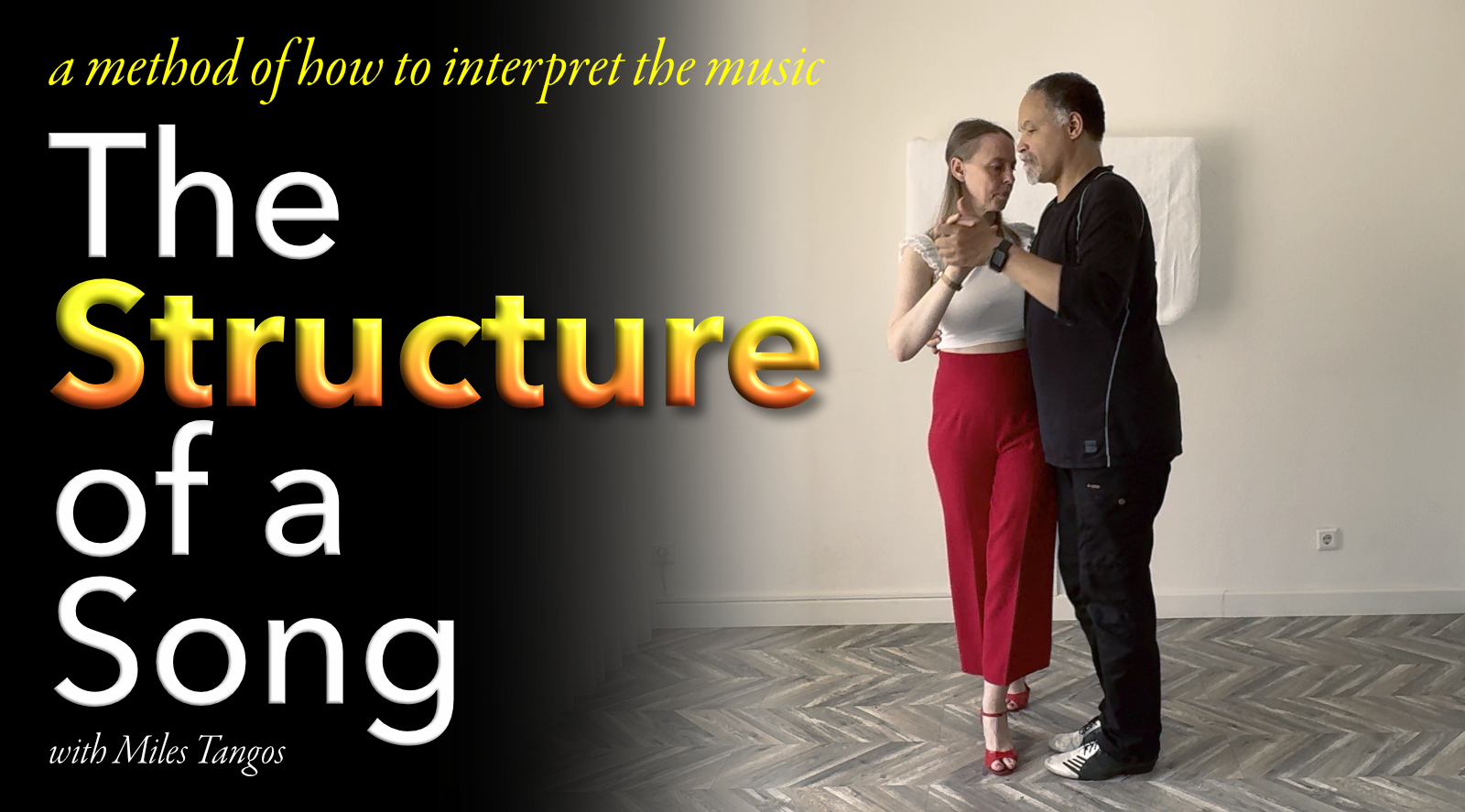
Of all the articles that I’ve written about in Tango and of all the videos I’ve shot, this is probably the most controversial and most seminal work I’ve ever done. Not because it is groundbreaking. It is. Not because it shows deep technique. It does not. It is because it goes against everything that you have been socialized to do. Note what I said there > SOCIALIZED to do and everything that every teacher has ever told you to do! What follows is one method of how to interpret the music. Buckle up!
A song in Tango (the genre, not to be confused with the entire idea of tango music), consists of 5 to 6 musical paragraphs. Those musical paragraphs are generally 6 to 8 phrases in length. Each one of those phrases is punctuated by 6 to 8 musical pause types based on the 5 Musical Pause Types of Argentine Tango music (See article).
SIDE BAR: It should be made clear that the ‘phrases’ that you’re used to identifying in the 8 Count Beat Methodology ARE NOT THE SAME phrases as the phrases in the 5 Pause Type Methodology. The reason ? In the 8 Count Beat Methodology, they’re arbitrary markers that are independent of the structure of the music > IE — Every 8 beats you change regardless of what’s happening musically. Typically that methodology does NOT respect the CHARACTER of the music. Further still that methodology leads to the typical A/B methodology which again does not respect the aforementioned. The 5 Pause Types Methodology does! So that pauses and phrases are actually representative of the music and structure.
From this idea, we can start to think about how best to: a.) Structure what we’re doing. And b.) answer the all-important question that every Lead has at the beginning of their tango lives, “What do I do ?”. As time passes, they ask that question less and less. The answer reveals itself through repetition of what works for them, and more importantly, what no one complains about. They develop patterns, ideas, and things that they believe have succeeded. They actually don’t know if any of what they’re doing has succeeded because they haven’t done any investigation to ask the question. And even if they do, they look for confirmation bias to confirm their belief that X is in fact true. While all that is happening, if it happens at all, there’s a lot of fumbling around in the dark. There is some trial and error. More error than trial in most cases.
In this article, we are going to answer a very basic question: “How Do I Dance The Structure of a Song?” And if we extend the idea beyond that, ultimately the entire tanda! Also, in this article, we will continually reference the ‘FIRST DATE’ mindset.
First and foremost, if you’ve gotten this far and are wondering “What on earth is this Five Pause Types thing that Miles is yammering on about ?”, then not only have you not been keeping up with the Madness that is Miles Tangos (mad in his own mind for certain), but you have certainly been missing a few things. So it is STRONGLY RECOMMENDED that you go down that rabbit hole before you do anything else. Why ? Because everything that I will talk about from this point forward uses that as a reference point. If you fail to understand the 5 Pause Type Methodology, you’re going to miss the whole nine yards of this article. In fact, it’s the underbelly of the whole thing.
Secondly, this article and the video go hand in hand. Further, they invoke a rule-based system to guide you into working structures that you do not want to violate for now, until you are very familiar with the idea. Also, don’t believe for one instant that I don’t practice what I preach. I do constantly. This isn’t a case of do what I do and shut up about it. Everything that you see in the video, I do constantly.
Next, this is NOT a technique video at all. It is, however, assumed that you have more than a passing understanding of proper tango technique. But also the 5 Social Figures of Argentine Tango. If you don’t, then this video may be more than a little confusing to you. If that’s the case, then I strongly suggest you put this idea aside for a while until you do. Because the things that I am going to suggest here are going to run counter to everything you’ve been told. You have to have been dancing for a while to develop a sense of the Milonga environment as well as having a command of the vocabulary used in that environment. This isn’t a sales pitch — BUT it is strongly recommended that you subscribe to the site, become a paying subscriber so that you can see and take advantage of the materials that the outside user doesn’t have access to like > THE FIVE SOCIAL FIGURES of ARGENTINE TANGO.
Next, it is assumed that you will be dancing in Close Embrace. While these ideas can be applied to Open Embrace dancing. The very first suggestion will seem more than a little ‘creepy’ if done in Open Embrace. So you may have to modify these ideas for such.
Next, it occurs to me that we do need to talk about what LANE this all takes place in. In my mind, I’d like to see this done in the outer track. However, I know some of you folks like to be in the inner tracks. Do as you wish here but I always dance in the outer track.
Next, we have to Floorcraft issues with this stuff. And so that we’re clear here, do not confuse the complete idea of Tango Floorcraft as just a spacing issue here. It’s not. This is stuff is all about Floorcraft. You must keep time, make safe, choreograph, and keep things moving in the line of dance at all times. And sometimes that means stretching things out to fit within the pauses and or the paragraph. And sometimes that means shortening them to fit, which may mean dropping certain ‘fluff’ or ‘filler’ ideas.
Lastly, it is also assumed that you have a clear and present understanding of Intention-Based Dancing. Meaning that you do not use resistance, tension, force, your arms, hands, or fingers to direct or indicate to your dance partner what you would like them to do. If you do not, then pushing and pulling your way through these ideas defeats the entire purpose of the instruction set, which is easeful. And resistance-based dancing is NOT easeful. In fact, it’s downright stressful.
That said, let’s dive in.
The First Song of the Tanda.
There are a few assumptions that we need to address in what follows. a.) You cabeceo someone and then walk around the floor (not across) the floor to get to them. b.) This is the first song of the entire tanda. c.) You’ve never danced with the person you cabeceoed before. d.) This is a TANGO or VALS tanda ONLY. Milonga is its own separate thing. So you would NOT do this with Milonga at all.
And now for the instruction set.
The First Paragraph – This first paragraph suggestion is going to run counter to everything that you’ve been taught. Everything that you’ve seen socially. Why ? Because your first instinct with your partner is going to be to get on the floor and get moving immediately. And under normal conditions, with a crowded Milonga and soon to be a crowded floor, this advice is not only to hold up the line of dance, it’s going to piss off a lot of people that want to get moving and do their thing. The mindset ? It’s the complete opposite of what you want to do and why!
I want you to imagine that you’re on a first date with someone and you’re just getting to know someone. Question: Do you show that first date your most intimate of intimates right off the bat or do you wait a little while to fly your freak flag ? I’ll put this another way, when you invite a new friend over to your place, do you clean up first so that they don’t think you’re a slob or do you let them see how you really live ? Most people, most sane people, want to put their best foot (no pun intended) forward. With that spirit in mind, you are going to do something that seems on the surface so whacked that you will reject it out of hand. And what’s that ? The Advice > You’re going to spend that entire first musical paragraph getting into the embrace with your partner. You’re literally going to burn that entire first paragraph doing nothing but getting into the embrace and getting comfortable with your partner.
The Reason > I know there are a lot of people that will radically disagree with this instruction. And I also know why they’ll disagree with it. The most common reason being that if you take that amount of time, you’re going to piss off the LINE of people trying to get onto the floor. True. Further, I also know that it will seem creepy. Also true! I also know that some will see it as controlling and controversial. All true. So why do it ? Let’s first address the floorcraft move. If you follow the instruction, you’re thinking that you are going to enter the line of dance at the general entry point. And that would be wrong. In fact, you are going to walk your dance partner ACROSS THE ROOM to the furthest most point AWAY from the entry points to the dance floor (in case there are multiples)! Secondly, the most important reason this is done is to CREATE THE CONVERSATION with your partner to that particular orchestra and that particular tanda. As we all know, going forward, not every partner is the same, and you have not danced to every orchestra with every partner. So believe it or not, you have an opportunity here to express different parts of yourself with that particular orchestra and perhaps the same partner or someone new! Again, FIRST DATE! Which I believe addresses the ‘Creepiness’ factor as well as the controversial factor. So in other words, > Sit Down and Listen!
You are only going to do this once, and only once. You are going to use bits and pieces of this idea throughout the beginnings of each song, but not for this length of time.
The Second Paragraph – This is really going to a.) piss off a whole swath of Leads, and b.) Make a whole swath of Followers insanely happy. The Advice > You are going to do nothing but engage one of the 6 Ways of Walking. Now in your brain what I said and what you heard were two very different things. Remember I said above that it’s important you familiarize yourself with the 5 Social Figures of Argentine Tango ? The first figure is … say it with me > THE SIX WAYS OF WALKING. In your brain what you heard was PARALLEL SYSTEM WALKING. What I said was engage ONE of the SIX WAYS of WALKING! It’s at this point, you may not begin to see the logic of what I’m doing and why. Again > FIRST DATE territory. You are not wasting time here vamping until you’re ready. You are in fact BUILDING an idea very carefully. You are sculpting with your walk very judiciously. You are using that walk (one of the 6 ways of walking) to express the music! Now you can engage in Symmetry and Alternation if you want by switching to any of the other 4 ways of walking. FOUR ? Miles, you said SIX! Yup. I did. But you’re going to put aside one of them. In specific > The Type 3 Walk – The ‘Lazy’ Ocho. So you’re really only going to use 5 of the 6 Ways. And at this point you’re only playing with 4 of them in this paragraph! The timing ? > You want to slow things down to HALF TIME as an option. OR you could follow not the beat but an instrument on the beat. I suggest either the bando or the violins. Which is to say, when you hear either, that’s when you walk. Trust me, using this methodology, it adds a completely different character to what you’re doing and why!
The reason ? This gives the follower time to get comfortable with you, and more importantly, it gives you time to get comfortable with them. You do not want to rush into vocabulary here. Again, > FIRST DATE. Stop wanting to spew your wad here. Bad idea. Take your time with this stuff. Some of the most satisfying experiences we have as human beings are when we take our time with certain things. Ahem. This is one of those times. So … take your time with your walk here. You’re only going to do this ONCE, so don’t blow it. It’s a single paragraph.
The Third Paragraph – In most Tango Songs of 5 Paragraphs, the 3rd Paragraph is the Singer’s Paragraph. However, if there is a paragraph between the Second and Singer’s Paragraph, then you want to do this. The Advice > This is where you introduce Ochos. Now, before you get all excited — Remember this is the first song of the tanda. Also remember that you’re still on your first date. Meaning ? These are not your typical Type 3 Ocho that you use all the time. In fact, they’re a Type 2 Ocho or a Type 3 Walk known as the ‘Lazy’ or Milonguero Ocho!
The Reason ? We do not want to make the Follower work AND/OR jar or jostle the Follower!
Now, if you’re one of those Leads that has never Followed in their lives and sees it as beneath them, then what I am about to say is going to go right over your head! The Traveling Ocho is a F-ton of work for the Follower. It also causes way more problems than it’s worth — And yes I AM going to mention it — Lazy Ochos do none of that. And again, not to mention but I will, the way that most Leads use that Traveling Ocho, it’s certainly a PIA for most Followers. Here we are taking it off the table. You will get to use it later in the 3rd song of the Tanda. In this instance, we are using it in what’s called ‘Alternation’ fashion. Meaning you’re going to alternate it with a walk using the Pauses of the Paragraph as the change points. Meaning that when you hear a pause, you change from a walk to a Lazy Ocho, and vice versa. Ideally, we want to start the Paragraph with a Walk, then Lazy Ochos, and then proceed from there to the Singer’s Paragraph.
Side Bar: There are a whole bunch of Followers that have no idea what a ‘Lazy’ Ocho is and they will default to the only ‘Ocho’ they’ve ever been taught. And for that reason you just have to roll with this one. You can not force the Lazy Ocho here. You just have to go with the idea that they understand. They’ll get the hint soon enough that what they’re doing is entirely too much work. Furthermore, and this goes right to the heart of those Leads that like to a.) talk to their Followers while their dancing — UMM … DON’T, and b.) This is not the time to instruct the Follower in the line of dance while you are dancing with them on the merits of a Lazy Ocho over a Traveling Ocho. Furthermore, Followers this is not the time to ask the question either. Milongas are for dancing — not for teaching. Not for talking. It is not a class.
The Singer’s Paragraph – This is probably the single most important paragraph of the entire piece of music unless this is an instrumental. In which case this paragraph will get replaced with the 4th paragraph, which we’ll talk about in a minute. And just so that we’re clear, I do NOT discuss this in the video. This is something you will only get from the article. Moving on….
The Advice > In the Singer’s Paragraph, we are going to do nothing more than WALK USING ONE of the SIX WAYS of WALKING!
The Reason ? The singer is there for a reason, and primarily that’s to give voice to the emotional story of the music. The singer is telling a story, literally singing it. And because of that, we don’t want to do anything that would detract from that storytelling. In fact, you want to drop everything and literally just walk to the pauses! You can add in some variation of alternation here and there. But really, it’s all walking. My first tango teacher used to say, “The singer gets the girl for you! So let them and stop interrupting them!”. Meaning ? The singer has a beautiful voice, and you want to let that singer’s voice speak for you. And if you’re busy adding tons of vocabulary on top of that, then you’re completely missing the point of the Singer in the first place. In other words ? STFU and let the singer do their damned job!
Now to be fair, most people do not speak ‘Lunfardo’ (Argentine Spanish slang), which is what the lyrics are written in. And because of that, most don’t understand it nor have they spent years living in 1930s Argentina. Nor has anyone for literally decades. So some of the turn of phrase has fallen out of use, but the ideas and concepts are not that foreign to most people. Boy meets girl. Boy chases girl. Boy falls for girl. Girl breaks boy’s heart. Etc. Because of this, it’s really easy to hear the emotional content even if you don’t understand the words. You can hear the excitement, the thrill, and the loss in the timbre of the singer’s intonations. So — In this instance let the singer do their job.
The Singer’s Paragraph Notation. Sometimes, not always, but sometimes the Singer’s Paragraph appears as the 3rd Paragraph and NOT the 4th. When that happens, as it did in the example song in the video (Carlos Di Sarlis – No Esta), then simply follow the advice of the Singer’s Paragraph no matter where it appears.
The Alternate Fourth Paragraph – In the case of an instrumental and NOT a singer in this position, you’re still going to walk, but you’re going to add in strong usage of ALTERNATES and INSIDE/OUTSIDE SNAKE WALKS adjusted to the Pauses. The Reason ? We are world building here. We are building up a lot of potential that we may use elsewhere, but again, remember first date mindset. The entire first song of the tanda is that first date! So we keep things insanely simple and easy. We do NOT stress the follower or the Lead. As an alternative or an expressive idea here, you can engage in walking turns using one of the Five of the Six Ways of Walking, OR Lazy Ocho Walking Turns, OR Lazy Ocho Back Crosses Turns … What I reference on the site as Floating Back Crosses on a Circle. You can also make the choice of going half time here, respecting the pauses, and/or adjusting to an instrument on the beat! Again, dancing this way adds depth and character to the music!
The Last Paragraph – OK, in this paragraph you’re going to say, “This is the paragraph that we’re going to go crazy and blow my wad. Right ?”. Ummm no. Get that thought right out of your head. Why would you build all that potential just to blow it all in one singular paragraph ? In short, no. Keep in mind you still have 3 more songs to go, and keeping with the DATE Metaphor we want to do something VERY specific here. The Advice > In this paragraph, assuming there is NO La Variacion, we are going to use a structured methodology. 1.) Parallel Walk to the First Pause. 2.) Lazy Ochos to the Second Pause. 3.) Alternate to the 3rd Pause. 4.) Parallel Walk to the Fourth Pause. 5.) Lazy Ocho to the 5th Pause. 6.) And finally ending on Walk to the Cross at the final ‘BUM-BUM’ of the song. Where the Follower’s crossing steps happen directly on the BUM-BUM.
IF there is a La Variacion, then you can invoke Patter to adjust to the faster tempo of the Variacion but we intersperse that patter with a break, then going in the opposite direction of the patter we started with. In the end we are going to end on the BUM-BUM with a walk to the cross! So the structure should be something like > 1.) Parallel Walk to the First Pause. 2.) Lazy Ochos to the Second Pause. 3.) LA VARIACION – Patter to the left. 4.) Patter to the right. 5.) And finally ending on Walk to the Cross at the final ‘BUM-BUM’ of the song.
You should have noticed something by now. Up until now, there have been no traveling ochos, no turns, and certainly no follower’s molinete/lead giros, no cortados, and no crosses. Anywhere. None of that stuff. As a matter of fact, this is the ONLY time when you’re going to invoke a singular cross in the entire first song of the tanda. Why ? Again beating a dead horse — WORLD BUILDING and FIRST DATE!
The song ends, you do NOT hold the embrace here. You release when the last note ends. Do not linger. Again, first date. You don’t want to seem too creepy. Some people have a hard time knowing their boundaries and knowing what’s acceptable and what isn’t. So here’s my advice: The last note ends, release the embrace IMMEDIATELY. And the older you are, the more disaffected you want to be for a whole swath of reasons. Let your dancing speak for itself — not your want to hold someone.
The Embrace Component that ‘Breathes’.
This is another, as we say in English, ‘Pink Elephant in the Room’. What’s that ? Your idea of the embrace and my idea of the embrace is VERY different from each other. Further the reason why this stuff matters is because you’re going to read what’s below and think that you’re doing the same thing you always do. It’s not. So I’d like to present you with another thing that has to be addressed before you make this attempt > Revisit this idea on the embrace. And when you’re done with that, look at this item on ‘2 Millimeters‘. And finally > This is about constantly re-adjusting your body position and body placement not with your arms but with your feet. The arms are merely coming along for the ride without compression, or hanging. The desirable conversation is happening cuerpa de cuerpa. The arms and hands are merely VISUAL constructs. However you continually have to reposition them for the optimal visual but at the same time, NOT use them to direct or be directed. They’re there for visual decoration, like window dressing. There will be a lot of people that will be upset by this statement. Further they’ll dismiss it out of hand because it doesn’t vibe with what they’ve been told or their own confirmation bias like > 1.) They like to believe in the flowery, emotional, experience that they’ve cultivated as reality. or 2.) Their focus is resistance based dancing that teaches and demonstrates that if you push here, and pull there that you get what you want. or 3.) They’re completely unaware of their own physicality. And that’s just the tip of the iceberg. The fact is that the embrace construct that I teach, demonstrate, and dance constantly is not an opinion or style. It’s a fact of dancing tango that is Intention Based.
The End of the First Song.
Let’s pause here. Just a reminder — this is a subscription site, and for that reason, the rest of this information here can only be seen by a paying subscriber. I have already released an enormous amount in this article, and not to mention this side. Which is to say if you agree with this, or just want to see how this story turns out and why, then may I suggest you pay for a month and see what happens ? At the very least, you get to read this rest of this article, and you’ll have access to all the resources here in. I’m just saying. This is not a sales pitch, however what follows after this…is one.