Practice (part 1)

For most people the idea of practice is about practicing the dancing part. Not about the actual “practicing” part. Practice really wants to take apart what one does, how one does it, while asking for feedback & input. Then asking questions, and then figuring out where things aren’t working and why, to smooth out the rough edges of something, and then continually refine, and refine, and refine it so that it becomes effortless. 

Unfortunately, that’s not what happens. What happens is something along the lines of dancing with someone, there’s no feedback, there’s no invitation for discussion of what’s going on, there’s no discussion at all, you dance your way what is comfortable for you without thinking about what someone else is doing and why. Is that helpful ? No. Not generally. But this is what happens. 🙁 Sadly.
MORE REMINDERS

The Waiter Hand

Another one that you’re going to see a lot of is the Lead who places his palm upward, flat, and outwards, sometimes fingers outstretched as if they were a waiter serving drinks at an upscale bar. The elbow is dropped, and the hand is well below shoulder level.

Read More »

New York

Our little summary of dancing in New York City for the World Traveler that will be landing in NY soon and looking for some place to dance.

Read More »

Good/Bad & Dancer/Teacher

At the beginning of our Tango lives, most people go to a Tango Class to learn how to dance Tango. Some people throw caution to the wind and just go to the Milonga and ‘learn’ on the dance floor sometimes with positive but most of the time with disastrous results. And some people take the route of skipping group classes all together and start with one-on-one sessions to begin their Tango journey.

Read More »

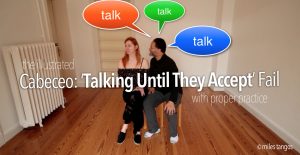
The Talking Cabeco/Mirada

If you’ve been dancing a little while, or for many years, at some point along the curve you’ve heard the word ‘Cabeceo’. Which roughly translates as a slight nod or nodding of the head (Cabeza) for the Lead to invite a Follower. The Follower’s side of that same invitation is referred to as a ‘Mirada’ (to look at, or ‘looked’). It’s an oddity that almost no one knows about the Follower’s side of the equation, that the Follower can ask for a tanda, employing the same methodology. It just has a slightly different name.

Read More »

Magical Improvement

“She’s not magically going to improve just because you ‘show’ her what she’s supposed to do at that moment.” To make this non gender specific, because this axiom applies to both genders, and both roles. As well as teachers and students. Some teachers know this truth, some teachers learn it the hard way. Clarity: The – “supposed to do” part above. This idea frequently occurs where you have a male Lead that has an expectation of X being followed properly, where X is Traveling Ochos, Volcada, Milonguero Turn, etc. And when it doesn’t they stop their dancing and then show the Follower what was intended. And here’s the magical part, they keep showing them, hoping that it will change the Follower’s behavior and frequently it doesn’t.

Read More »

The Same People

You have local friends that you have acquired through the dance. They met you at a very specific point in your tango development. You’ve danced with them over and over again. You almost never say ‘no’ to them because they’re fun to dance with or they’re nice people. Over time you settle into a nice, almost comfortable routine of your dancing friends, where you’ll go to the practica or milonga,

Read More »

Waiting vs. Listening

What is Waiting Vs. Listening ? In it’s simplest form this comparison deals with the axiom of Followers are told to "Wait for your L/lead", and instead implies that there is another idea sitting there that almost never gets talked about and in today’s Tango world almost never gets used, which is "Listening".

Read More »

Body Contortion

A good portion of people come into the embrace, Lead or Follow, and in one way, shape, or form, contort their bodies to make the dance work while dancing, rather than employ proper technique.

Contort ? Yes. For example: As a Lead or Follow they might dance with a ‘head tilt‘ towards (buried into) or away from their partner, or as a Lead they’ll employ ‘waiter arm and hand’, or as a Follower they’ll dance in their Lead’s armpit, twisting their body to the side, and un-leveling their shoulders. This is contortion. 

Read More »

Toe vs. Heel (Follower) ?

In case you have been living under a rock, this Thought is going to shock you somewhat. There is a debate that has been raging for quite some time now. The debate ? Should the Follower step forward with their heel first, or their toe first ? Better known as the Heel or Toe debate only for Followers, not for Leads as is the usual debated topic.

Read More »

10 REASONS TO SUBSCRIBE

There are 4 Levels of Access: Free, Basic, Premium, and Premium+. Free pays nothing but gets a perk just for signing up. 

1.) Free Users get to see 5 of the 125 Different Tango Topics on the site. Plus you get access to the entire Tango Reminders and Tango Ideas sections of the site. These are short form Topic descriptors with a little detail about the topic and the video.

2.) 
Basic and Premium users Save A BOATLOAD of MONEY! Buying this stuff outright is expensive.

3.) Basic, Premium, and Premium+ users get access to the ALL ARTICLES and THE FULL ARTICLE which you can’t see right now.

4.) Basic, Premium, and Premium+ users have way better video resolution: Free = 420p, Basic = 720p, Premium = 1080p and 4K. 

5.) Basic, Premium, and Premium+ users get the ‘Dancing Perspectives’ & ‘The Soup’ sections of the document you just read (Lead, Follow, and Dancing) which are open to you. And that’s where all the good stuff is at. 

6.) Video Downloads! 

7.) Access to the Tango Topics Music Library (22 Curated Golden Age Orchestras)

8.) Access to ‘Tango Del Dia’ – Our Music Education System with access to 14 Days of Music, 30 Days of Music Education, and 30 More Days of Tango Del Dia. 

9.) We explain things, break the vocabulary down in a visual way, from multiple angles, showing feet, hands, and close ups! Yes there’s a lot of talking but we want you to understand what it is that you’re doing and why, not just steps, patterns, and figure

and #10:
No more annoying ads at the bottom of the page, begging you to subscribe! 

Keep something in the back of your mind: What you’re seeing in a youtube video is a couple that is performing for the 15th row for a room full of people. They’re not social dancing! Whereas this website is all about ‘Social Tango’  or how to make things function on a social dance floor. Social Dance floor ? Your local milonga! They are showing you flashy moves as a presentation, to show off! But not stopping and talking about how this works which is what you need to see. This website and all of it’s content show you the how and  why you’d want to put that piece of vocabulary there, or how to make things work. This website is all about those things and more!

You could watch Tango YouTube videos and thereby spend your time, trying to infer, and figure out how things may work in that particular situation. Bend your body this way or that, twist and force this position or that. Place your foot here or there and figure it out. This is known as Tango Twister.  Which can be a lot of fun, but more than likely it won’t help you, because you’re missing something: The explanation from an experienced teacher showing you how to properly excute this stuff from a Leading Perspective as well as from a Following Perspective!

The goal of YouTube videos is to get you to study with those teachers in person. The goal of Tango Topics videos allows you to work at your own pace, in the comfort of your own space, so that you can play them over and over again to improve your understanding of the vocabulary or technique being described to therefore better your dancing experience. The goal of classes and workshops is to get you to come back over and over and over again, thereby spending more money with that teacher. This website and the videos under it are here to act as a resource for you to help you to improve your dance. Pay once and you’re done.

Eventually, one way or another you’re going to pay for this lesson, either here and now, or with them. TANSTAAFL! The difference between that lesson and this ? Is that you get to play this lesson over and over and over again. Further still, there are supporting materials (other videos) that help to explain the language and the underlying technique of how and why things work, so you can easily reference those things in the corresponding articles that go with the material, and or any language in the Tango Topics Dictionary. 

DROP ME A MSG HERE

Hide picture