Offer ends in Offer $99 for 1 year 1daysd 12 50 12 One year for $99 Get your year
Tango Topics info:

Check out the Tango Dictionary for words like Axis and Connection.

Tag: exercise

  • The Follower’s Exercise

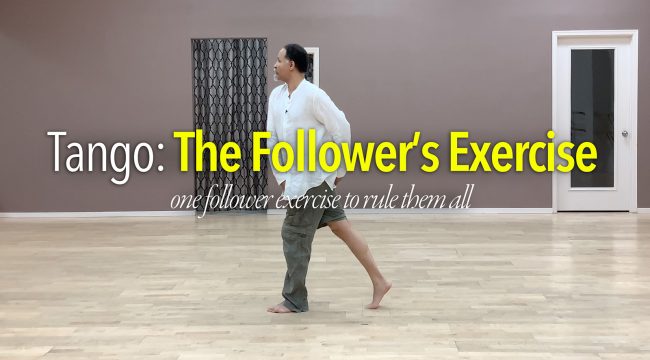
    The Follower’s Exercise

    There are countless drills a Follower can do to sharpen technique, improve control, and fine-tune execution. This site includes several, each designed to strengthen tendons, stretch muscles, and—most importantly—recalibrate neurological awareness and mental habits. But among them, one exercise stands alone.

    It’s the first thing every Follower student does in their private lessons with me. Without exception.

    It is the single most important exercise a Follower will ever do. Why? Eleven reasons, actually (which you’ll see below—assuming you’re a subscriber. If you’re not, you can still fix that for the cost of a monthly subscription).

    At first glance, the exercise looks absurd. Exaggerated steps you’d never actually use on the dance floor. And you’re right—you won’t. But that’s not the point. This is an isolation drill. It’s a neurological reset. A training ground for control, precision, and deep awareness. It sets up everything a Follower will ever do in Tango. And it lays the foundation for one of the most misunderstood, misused, and misnamed techniques in tango: disassociation (a.k.a. “pivot,” a term we don’t use here).

    Let’s be clear: this exercise is deceptively simple. It is anything but easy. It demands obsessive detail, surgical control, and mental clarity. Which is why it drives nearly every Follower a little crazy at first—for two reasons:

    1. Details Matter Here

    Precision matters. A lot.
    Where is your foot landing? Are you crossing over the body meridian ?
    How is your foot landing (in supination or pronation)?
    What’s your level of extension? Are you popping the knee ?
    Are you actually in opposition or faking it? And is the opposition in the extreme as it should be ?
    Where are your arms? Your hands? Your head?

    2.) No Partner Required.

    This is one of those times when you can NOT use a partner to stabilize you. You will feel every instance of your own instability everywhere in every piece of this motion. Further you can not RELY on what you see in the mirror. You will only see bits and pieces of the motion. It’s for this reason you must video everything you’re doing for playback and feedback. You must also be INSANELY RELIGIOUS about doing this work. You can not falter, you can not waver. Ever.

    “But No One Dances Like That!”

    Correct. No one should dance like that. And you won’t—on a social dance floor.

    But here’s what you need to understand:

    a.) The exercise is setting up other things.
    b.) It’s training you in the extreme so that the minimal becomes second nature.
    c.) It’s building control you probably don’t have (yet).
    d.) It’s a full-body isolation drill for balance, control, and proprioception.

    Who Should Do This?

    Short answer: Everyone. Especially experienced dancers.

    But they usually don’t. Why?

    1. They think they’re above this kind of thing.
    2. They see a barefoot man demonstrating a Follower exercise and immediately check out.
    3. They assume I couldn’t possibly have anything useful to say about Follower technique.

    They’re wrong. But that’s their loss. If you’re reading this and doing the work, your gain.

    Why This Exercise Works (If You’re Honest)

    This drill will only help you if you’re brutally honest about what’s happening in your body. If you’re not? It’s a waste of time.

    What you’ll start to notice (and this is where the frustration sets in):

    You don’t actually extend cleanly.
    You bend your knees too much.
    Your extension is inconsistent and visually messy.
    You wobble. A lot.
    You can’t walk in a straight line backward without support.

    And here’s the kicker—if you’re wobbling alone, just imagine what you’re doing in the embrace. If you’re relying on the Lead to keep you upright, that’s a problem. No one wants to be a crutch. If the roles were reversed, you wouldn’t like it either. So let’s stop pretending otherwise.

    This exercise rebuilds your stability from the ground up. No partner required. No excuses allowed.

    Barefoot? Really?

    Yes. And yes, I know: for some people, the moment they see I’m barefoot in the video, they stop listening.

    Here’s why I’m barefoot:

    Shoes compensate. They cover up flaws. They stabilize things for you. That’s not what we want. We want you to feel the floor. Really feel it. Direct contact. Raw data. No buffers. Only then can you train the real systems that keep you balanced and grounded.

    Eventually, we’ll do this work in heels. But only after you’ve built the tendon strength, control, and precision to manage them. Then the heels don’t control you—you control them!

    Heels Are Sexy, But…

    Let’s be honest: heels are gorgeous. They’re sexy. But they’re also unstable torture devices. You’re balancing on the head of a pin. They wreck your joints, cartilage, circulation, and nerves (yes, that nerve behind the ball of your foot that goes numb after 90 minutes—that’s your plantar nerve, and it’s not happy with you).

    And let’s not even talk about the Leads who drill their partners into the floor like jackhammers. It’s not helping. You’re absorbing all of it. In bad shoes. With no training. No strength. Just endurance. And endurance is not the same as training. It’s just pain management.

    That’s why we start in socks or bare feet. You’ll thank me later.

    Final Note

    The “heel work” phase of this training was never posted on this site. It’s something I only ever taught in person during intensives. And maybe one day I’ll share it. But for now, if you want to get there—you start here.

    Do the work. Barefoot. With precision. With brutal honesty.

    The rest will come.

    The Follower’s Exercise: One Exercise to Rule Them All.

    1.) The Turn Out Factor!
    2.) Leg Extensions (Part 1)
    3.) The Straight Line on the Floor!
    4.) The Pigeon Toed Feeling.
    5.) The Weight Transfer.
    6.) Opposition Explained.
    7.) Extreme Opposition Used.
    8.) Homo-Lateral Movement.
    9.) The Long Extension (Part 2)
    10.) The Knee Bend (Compression).
    11.) The Little Lean We Don’t Want.
    12.) Your Body Wavers.
    13.) The Isolation Technique/Ballet Rises
    14.) The Eleven Reminders.
    15.) The Actual Exercise (seen above).
    16.) The Leg/Foot Reminders.
    17.) The Checklist.

    These are the 17 topics that are covered in this extensive article that goes over every aspect of this very important exercise and then some. It’s a full treatise on how to extend one’s leg…as a Follower. Everywhere!
  • 3 Couples Exercises

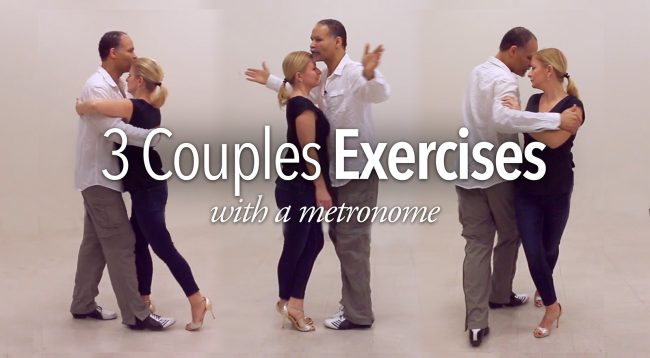
    3 Couples Exercises

    Exercise. The very word makes most people go “Uuuuugh!”, which is right up there with ‘homework’, ‘practice’, ‘taxes’, ‘rent’, and ‘dental visit’, and about as much fun. Sadly. 🙁 And this applies even more so with regards to Argentine Tango. It’s no wonder that when you say the words ‘Tango Exercise’ that most people want to hide under the nearest rock. And there’s a few reasons for this association. The first is that most people’s experience of Tango Exercises is continuous repetition of the same movement. The same movement at faster and faster speeds to seemingly impossible levels of detail. Eeeek! The second is that for the greater number of people, the very idea of Tango Exercise conjures an ideal of perfectionism that you can seemingly never achieve. The third is a load of self-judgement and the judgement of others that prevents us from doing better. All of this stuff, and a lot more that is not said here, is what keeps us from Exercise with regards to Tango.

    The fact is that you absolutely need to exercise your Tango skills. Constantly. This isn’t about going out social dancing and just hoping that all will work itself out. That line of reasoning is one reason why we have the row of women that sit, and the row men that stand at milongas. And before we go any further to dispense with the blame game that happens repeatedly when reading this sort of post, let’s be clear about the fact that these same people haven’t done the necessary underlying work that would smooth out the physiological errors that they’re constantly (and completely unaware of) generating within the construct of the embrace, within the structure of a song, and a tanda, with multiple partners. Then of course, to be fair, there may be a fair amount of Tango Baggage going on for those people as well. 

    Throughout all of that though, most of Tango’s Exercises focus on Solo Exercises for the Individual.  Like for instance the foot crossing exercise, or the ballet rise exercise, or the applied disassociation/ocho exercise, the twisty exercise, or the twirly exercise, or the linear ocho exercise itself, or the stability exercise, just to name a few. However there are a small number of exercises for a couple to work on. Typically when we exercise, or ‘practice’ tango, it’s dancing a song or a tanda to music. While dancing with multiple partners is always helpful, as it gives us really good insight into how and what we think we’re doing vs. reality, it doesn’t hurt to exercise the underlaying common elements of tango. That said, let’s talk about Tango Exercises for Couples.

    The Embrace Work In This Video. Before we begin talking about exercises, we have to talk a little bit about what areas we’re going to exercise or practice. One area that gets overlooked quite frequently is the embrace itself. This is one of the more common areas where most errors are generated, that and our walk. So we do actually want to practice using several forms of the embrace. While there are multiple forms of a Tango Embrace, there are 3 forms that we want to start to use when Exercising for Couples:

    1.) The Symmetrical Embrace. We use a Symmetrical Embrace for many reasons, one of which is that it alleviates most of the embrace peculiarities that crop up for people. The thinking is that if you can employ vocabulary with a Symmetrical Embrace, then everything else will be a piece of cake, and there is some validity to this statement. The ‘Practice’ or ‘Symmetrical’ Embrace is all about the equal and bilateral relationship between the partnership – whatever you can do on one side, you should, technically, be able to do on the other. 🙂

    2.) The Close Embrace. While we don’t necessarily need to talk about a ‘Close Embrace’, we do however have to remind you a ‘Close Embrace’ is not compressive, that we ideally want skin to fabric contact without tension, compression, pressure, or force in our arms in any way, shape, or form…ever. There is a reason for this, most notable is that we want our partner to be able to move freely within the embrace construct, regardless of role. Secondarily we do not want to use our arms or hands for stabilization in any way, shape, or form within the embrace. We want to be fully engaged and independent of needing to hold on to someone to execute what we want to do or are being asked to do.

    3.) The No Embrace. And lastly the No Embrace is a really just a Close Embrace without the arms! It’s a torso-to-torso contact, the trick is to stay in front of your partner at all times while at the same time engaging vocabulary! Easier said than done!

    Free Tip. Longer forward and back steps. Extend, extend, extend. Seriously. You want to really stretch out with the back steps. Elongate them as much as possible. You’re in a practice space, so take the space, and really elongate them. 😉 This is a principle that I teach by, ‘overshoot to under do’ and that principle works really well here when we’re trying to extend as much as possible. Because if you can do it in the extreme, then doing it in the minimal is a piece of cake because you’ve already gone above and beyond it. And you’re if you’re thinking that this is all about the Follower. Wrong! Think again, this is all about both roles working on their ‘issues’

    About The Video. This video comes is 26m:39s in length in 4 sections. Both lead and follower technique are combined and integrated into the video.

    Section 1 – Introduction – 00:00:48
    Section 2 – Walking Exercises – 00:14:34
    –Sub-Section A – Slow Walking for Both Roles – 00:03:27
    –Sub-Section B – Beat Walking @ 40BPM – 00:03:48
    –Sub-Section C – Beat Walking @ 20BPM – 00:03:41
    –Sub-Section D – No Arms Exercise – 00:03:27
    Section 3 – Milonguero Turns & Argentine Crosses – 00:04:30
    Section 4 – The Turn Game & Closure – 00:06:33

Hide picture