
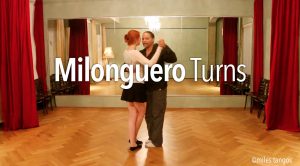
The Milonguero Turn
In it’s simplest form, the Milonguero Turn is one of the easiest of turns to accomplish with regards to Argentine Tango. It allows of the couple to stay with each other, and allows for an easeful experience vs. the Follower’s Molinete that is the default turn today which is a load of work for the Follower to accomplish!
The Linear Molinete
What is a Linear Molinete ? In its simplest form, it’s the Follower’s Molinete spread out along a line instead of a circle around one’s Lead. In the Follower’s Molinete, the Lead engages in a Giro, or a self-turn over a singular spot. The Lead can not move from that spot otherwise it makes work for the Follower.

Milonguero Turn ‘Trick’.
What is the Milonguero Turn Trick ? First and foremost, the Trick itself isn’t a ‘trick’, it’s more of a reliance on Follower Default behaviors. Secondly, the ‘Trick’ only solves the first major hurdle of the Turn itself – The Follower’s Back Cross.
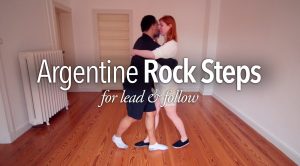
Argentine Rock Steps
An Argentine Rock Step is a little different. It refers to a very specific construct, and is not swaying to from side to side, or back and forth, but actually weight transfer to weight transfer (usually back and forth) sometimes with a Resolution (more on that later). In a lot of ways a ‘Rock’ Step appears to look like (operative word) as if the couple dancing were a Rocking Chair.
Walking Systems
What are Walking Systems ? These are 18 different ways that we can walk in Argentine Tango. Not the how-we-walk, or the mechanics of how we walk but the multiple methods to the ways in which we might want to walk. The ideas comprise a composite or overall vantage point that no matter what situation one is in, there is a walking solution for that situation.
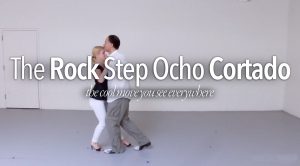
The Rock Step Ocho Cortado
This topic deals with two of the common eight turns, combining them into one movement to turn down the line of dance.
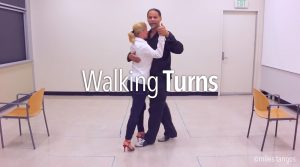
Walking Turns
What is a Walking Turn ? In it’s simplest form, it is exactly what it sounds like, a turn where the Lead is walking in a very tight circle with their Follower. However, note the operative words there ‘simplest form’. Meaning or implying that there are is a level of complexity to this turn. And that’s putting it mildly. The Walking Turn has some tricks up its sleeve. Meaning that you can quite easily augment it with the 6 ways of walking to change it and/or spice it up a bit. The real trick of the turn is that it can be done in close or open embrace, with any partner, regardless of style and yes, it can work within the line AND lane of dance.
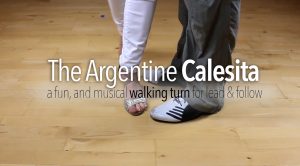
The Argentine Calesita
What is an Argentine Calesita ? The word “Calesita” roughly translates as Carousel or in English, a ‘Merry-Go-Round’. Anytime the you see a ‘sita’ or ‘cita’ ending on a Spanish word, it means that whatever object is being modified is small, or made smaller, tiny. So this is a small carousel, or a small ‘Merry-Go-Round’. The Argentine Calesita is a basically a small turn! It’s nothing more than a variation on a El Giro De Caminando or The Walking Turn.

Five Social Figures
What are the Five Social Figures ? In its really basic form, it’s the 5 things that we do all night long with every dance partner. 1.) Walking. 2.) Ochos. 3.) Turns. 4.) Crosses. & 5.) The Cortados.