
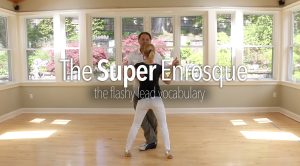
The Super Enrosque
What is a ‘Super’ Enrosque ? You’re going to ask yourself this question: If an Enrosque is placing one foot behind the other, or in front, both are true where the feet are in a crossed position, AND (the ‘and’ is very important) there is a pivoting bodily rotation that occurs. Then what on earth creates a ‘Super’ Enrosque ? MORE ROTATION! And in specific More Applied Disassociation, as there’s an enormous amount of super rotation that can occur due to the release of all that pent up energy. And that release creates some really interesting options and opportunities. 😉 So without further adieu: The Super Enrosque!
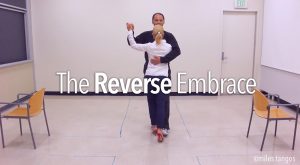
The Reverse Embrace
What is ‘Reversing’ the Embrace ? It is exactly what it sounds like. – as a Lead and a Follow, we’re reversing the embrace structure. Meaning that the Lead’s right arm is where the Follower’s right arm would be, and the lead’s left goes around the Follower. And vice versa. That’s it, that’s all. However, the question you’re going to have is why do this ? For that part, read on. However, the benefits of doing such a thing are wide and varied but this is the short and curly version: Because doing so changes your awareness of what you’re leading and following. For example: In the case of an Ocho from a Follower’s perspective, you may discover that you’re engaging in Traveling Ochos out of habit when in fact there was no actual Lead for the Traveling Ocho to occur.
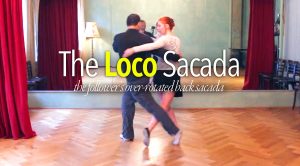
The Loco Sacada
What is a ‘Loco’ Sacada ? It is an over-rotation of the Follower’s Ocho, employing an Over-Rotated Back Ocho for the Follower into the Lead‘s Forward Step.
The Argentine Soltada
What is an Argentine Soltada ? In simple terms it’s a tiny little turn, almost a spin, that has been borrowed from Salsa, and made functional in Argentine Tango. The almost-a-spin part is what the Follower does, and the lead kinda stands there leading the-almost-a-spin part. I say ‘almost’ because quite rightfully, it’s a led rotation really. If this were a true spin, then the Follower would stay over the same axial rotation point, but in this case, does not. The Argentine Soltada is really the rotation part not what you do with it part.

The Americana Embrace
The Embrace is the hallmark of Argentine Tango. It’s what gives the dance its particular look and most certain it’s ‘feeling’ regardless of whether or not you’re watching the dance or in the dance. Most people, once they get over the hump of ‘close embrace’ (and you’re never really over
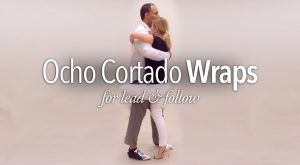
Ocho Cortado Wrap
What is An Ocho Cortado Wrap ? Put simply it’s a Follower’s leg wrap (an Enganche) mixed with an Ocho Cortado (the ‘Broken’ Ocho). To be fair the Ocho Cortado is not really an Ocho, not by any stretch of the imagination, nor is it a broken one at that. It is more akin to the Follower’s Molinete more than anything else.

Linear Boleos
What is a Linear Boleo ? Firstly there are many varieties of Boleos. Tango Topics is only talking about 3 very common ones: Social, Circular, and today’s topic: The Linear Boleo. To be clear there are low linear, midrange linear, and then there are the high Linear Boleo. So what is it ? This is a lifting of the leg (Lead or Follow, typically though it’s the Follower’s leg) that tends to be sent straight back and up. This is why they’re called "Linear" Boleos because they’re in a LINE with the walking step. In this version of the Linear Boleo, we’re exploring a Mid-Range Linear Boleo or what Tango Topics refers to as a Mid-Height Linear Boleo.
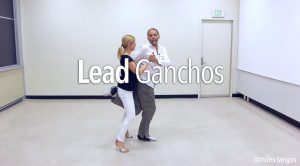
Lead Ganchos
What is a Lead Gancho ? Put simply it’s where the Lead, lifts/and then wraps their free leg around the Follower, on the Follower’s Forward, Side, or Back Steps. More lift then wrap, as a ‘wrap’ is something entirely different. However the lift is quite accurate. As the Lead is factually lifting their leg, knee, and foot to ‘Gancho’ the Follower instead of the other way around. More than likely you’ll end up seeing these done on the Follower’s Side Step first and foremost as they are the easiest of the bunch, and less frequently on the Follower’s Forward step next to their lead, and very, very infrequently on the Follower’s Back Step next to their lead.

Gooey Ganchos
What is a ‘Gooey’ Gancho ? In specific it means that while this particular variety is usually executed from the Follower’s position, the Lead can and should under certain conditions engage in the same variation but not for the same reasons that the Follower will. So what is it ? In specific it is a slow motion Gancho, and in particular the ‘Launching’ leg of the dancer who is being “Gancho’d”. Everything prior to the Gancho happening is not the ‘Gooey’ part. The ‘Gooey’ part comes when the leg that is being lifted moves to engage the hooking action of the Gancho in a very slow, but very deliberate way. Very slow. 🙂