
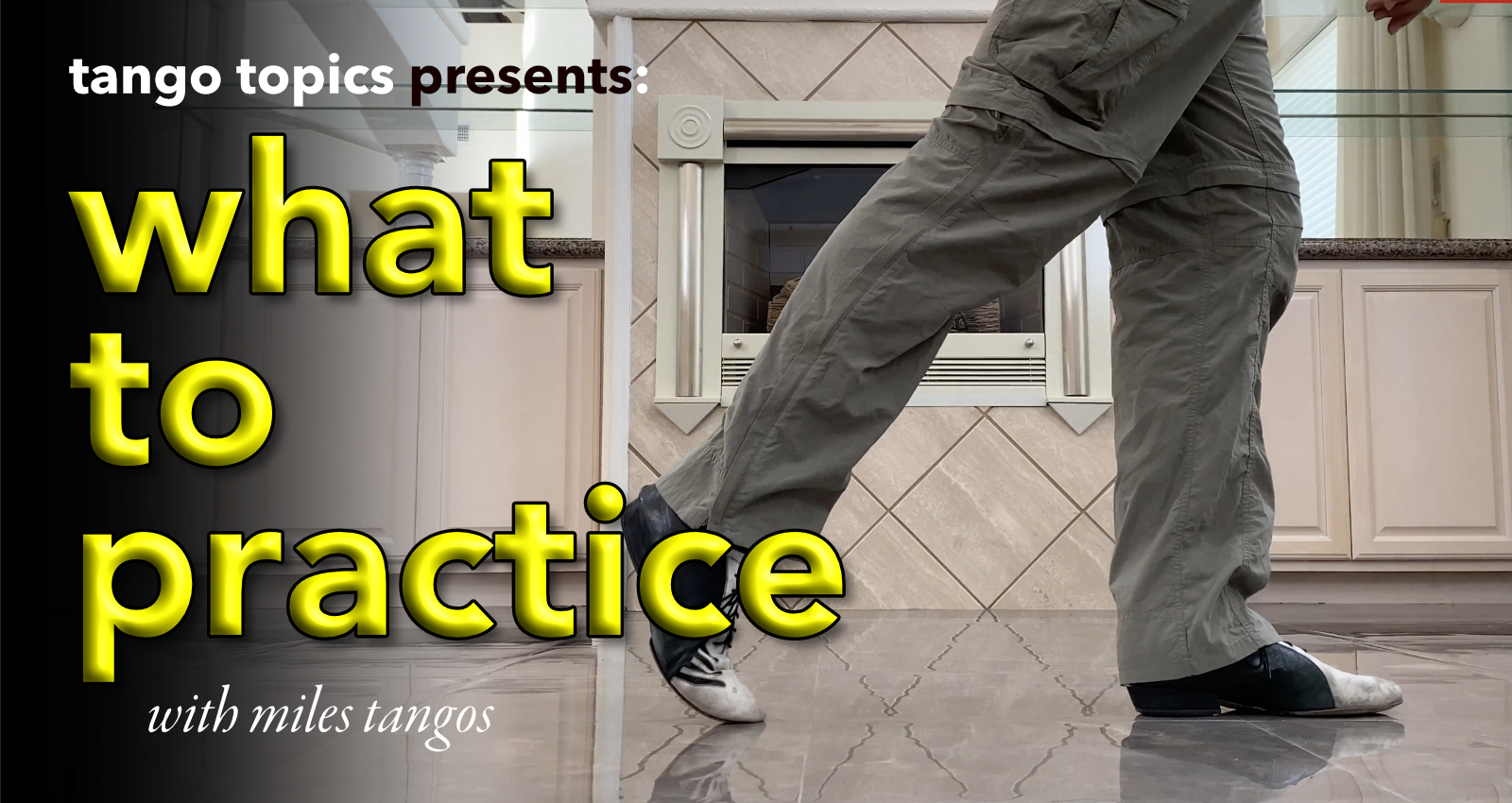
Miles ? What should I practice ?
Before another word is said, I want to address 3 things: 1.) If you are someone who is a hobbyist of Tango, I have a very special message for you below. Stick around, you’ll want to hear it. 2.) I’m not wearing shoes or socks in the video. And 3.) is the reason why I’m not wearing shoes or socks.
That said….
Story Time: Once long ago when I was just an itty-bitty Tango Miles. After leaving the care and feeding from my first tango teacher (after having been at his feet for 4 months), I was back in San Francisco, CA, living out of a car, and studying tango 7 days a week. All day. Every day. It was my sole enterprise. Tango 24/7. If you don’t know my story, you can go here. In short, I was living out of an enterprise rental SUV and sacrificing everything to learn to dance. Some people call it intense. I called it what I was doing in order to learn to dance Argentine Tango.
During this time, I found 3 or 4 practice partners that wanted to work with me. Wanna see an example ? What I didn’t realize at the time was that I had issues. Serious structural flaws in my walk, my embrace, and my understanding of what I was supposed to be doing. Those structural flaws were compounded by the Follower’s issues as we were ‘practicing’.
I thought I was doing what you were supposed to do, which was practicing what I learned from my teachers. What I realized later on, much later on, all that practice really did was bake in the problems without actually fixing or changing anything. So whatever problems I had never got addressed, even though I was studying with 6 different teachers, for 2 hours every day of the week. Nothing got addressed, changed, or modified. I kept paying my teachers thinking that I was learning tango. I wasn’t. That was their fault and mine and the way that tango is taught today. Nobody wants to tell anyone that what they’re doing is less than desirable. No one wants to give feedback that’s going to hurt someone’s feelings. That doesn’t sell classes. And the goal is to sell private lessons, not improve the quality of dance.
I digress. Throughout all of that I had to back and re-work my foundation later on. I had so many issues that I had to go back to the very foundation of how I walk and literally pull up my tango floorboards and replace the floor I was standing on. It was THAT bad. I had to basically teach myself how to walk all over again, several times. The reason it was several times was because there is a lot of confusion in what different teachers tell people about how to walk. I had to pick and choose from what I thought was clear, definitive information to what was poorly communicated information which moved right into flat out wrong information. From there I had to rediscover everything and figure out what worked, what didn’t and why it didn’t, and then figure out ways to make things work. This rediscovery would later help me in more ways than I knew at the time.
Today when I’m working with a student, they honestly don’t want to do that kind of work. They just want the answers. “How do I …?” so I show them what to do, and then how to do it. But that starts with going right back to their foundation. If they’ve been dancing a while, they think or believe that they already know what they’re doing. And to a certain extent they do. But in reality, the fundamental elements have eluded them and they’ve ended up in a place of physical compromise for whatever reason. Once they get over that fact, and they get into a routine that we’re going to do nothing but walking (as a Lead and as a Follow) for 6 weeks straight, then we begin the real process of learning Tango. They go through a movement study (as seen in the Follower’s Exercise and Lead’s Exercise) to emphasize this point. As time passes and they rediscover their foundation, and we move onto the 5 social figures of Argentine tango, I usually get THIS question:
“Miles, what should I practice ?”.
My answer has always been the same, “Your walk”. However, I do expand on that because it’s not just the walk. It’s also a host of ideas that one wants to skillfully and gently remind of one’s foundation and at the same time guide one towards a cleaner, and better foundation. Which is where I remind them that there are 3 things they want to practice:
The first is their walk.
The second is disassociation/applied disassociation in use.
And the third is ‘Fred Torture’.
The Preamble – No Socks or Shoes.
I practice in bare feet. However, that’s me. You ? You want to do what’s laid out in the video in SOCKS. Not tango shoes. Put simply the shoe will compensate for your equilibrium issues that you have going on that you may or may not be aware of. So take the shoes off. Further still we want to feel the floor and see what our foot is doing. Specifically you are looking for how your toes are reacting to the stress and strain you are putting on them. If your toes are coming off the floor at any point, you have problems!
The Hobbyist’s Notation.
Let’s address the ‘hobbyists’ in the room. You don’t believe in practicing, and you certainly don’t believe that you need to do any kind of conditioning work. And articles like these are a complete waste of your time. Right ? Your belief is that you are here to have fun and nothing more than that. Am I right ? OK, if that’s true, then let me ask you a SIMPLE question: why are you at every practice, and every milonga, every night or weekend ? If this was JUST a HOBBY then why the attention ? One could rightfully answer: “I’m there to see my friends and to hang out because it’s fun”. Good answer, okay…then riddle me this: If this is just ‘fun’, why are you trying to get better and better dancers to dance with you ? You see a hobbyist wouldn’t care about that stuff. If you’re here to have fun with everyone and that stuff shouldn’t matter to you. Right ? But it does! And that’s the point. It does matter to you. A lot. Because of that, then might I suggest we stop pretending that practicing, form, comprehension, clarity, and that ‘wasting’ all that time on a ‘hobby’ DOES matter because it can and does create a better dancing experience in the end! So let’s dispense with the hobbyist mentality and get down to business?
Part One – Solo Practice Enters the Chat!
It’s right here that I’m going to tell you that the only thing that consistently improves one’s ability to move efficiently and effectively is SOLO PRACTICE. So here’s what you’ll need: a pair of sliding socks, a little grit and determination, and last but not least, a desire to be honest with yourself and not cheat yourself. Every time that you do compromise or give up, you fail yourself! There’s no greater failure than when you do not accomplish what you set out to do. This stuff requires your due diligence. It requires abject honesty. While you are the only one that knows just how much time you put into this stuff, your partners will feel the difference when they dance with you. The efficiency of your movement, the clarity and cleanliness of the motion, and more importantly, your ability to control and contain yourself WITHOUT needing to hold onto anyone else to execute.
Part Two – Preparing the Instrument.
You do have to do a little prep-work. And that prep work is ‘Presence’ to start with. Presence, if you don’t know, is a Tango Topics-ism. It’s the first part of every movement. This state comprises 5 different things: 1.) Feet in Social Collection. 2.) A micro bend of the knees. 3.) Elongation of the Spinal Column. 4.) Lifting the Head! 5.) Breathing through the Solar Plexus. This state of Presence puts the body into a state of awareness and preparedness for anything that comes at it, or you will ask it to do.
Part Three – Working On Your Walk.
The walking exercise isn’t one exercise.
It’s three > Extensions work, Walking Exercise, and finally a ‘Box’ step.
First we start with extensions: Forward, Side, and Back. In these extensions we engage the idea of ‘Walking In Opposition’ in the extreme, and then embed that idea in those extensions. The reason this is done is because it’s set up for Disassociation and Applied Disassociation. Details matter here. Meaning ? You’re working on everything in the extreme, going as far as you can with your opposition AND your extensions as well as your how you’re landing your feet.
Next we engage a ‘version’ of the Walk. Let me be clear, this is an exaggerated walk for several reasons. In my reasoning that exaggeration exists because we’re always “overshooting to under-do”. That means that we want to do things in the extreme here so that later on, when we may want to do something that requires it, it’s not a stretch or a strain but instead it’s easy for us because we’ve already done that work. This version of walk uses a null embrace format so that you can see embrace collapse if that happens and then correct for it. This version uses BOTH forward and backward steps, not just as a lead or as a Follow but both roles! This version also embeds the idea of Opposition, in the extreme. This version also embeds intention (a little forward lean). This idea pays attention to details like how you land your foot, ‘popping the knee’ as we extend backward, intention, passing thru social collection, posture, etc. The idea is to do this slowly, carefully, in a contained way.
Lastly we engage the idea of a Box Step using all 3 steps, going in both directions. Lead left and then Lead Right. Side with the Left, Forward on the Right, Change weight, Side with the right, Back with the Left, and then reverse it.
Part Four – Rotation – Disassociation and Applied Disassociation.
This part of the article ….
Part Five – Fred Torture.
is not visible to you….
Part Six – Time To Spend ?
because you are not a full subscriber …
Part Seven – The Common Errors!
if you subscribed, you’d see the full article and the 45 minute video.
— IF YOU WERE A SUBSCRIBER YOU WOULDN’T SEE THIS ANNOYING MESSAGE! AND YOU’D BE ABLE TO SEE THE FULL VIDEO (46 minutes), and READ THE FULL ARTICLE —
A Notation for Advancing Dancers.
I got news for you. YOU NEED THIS STUFF JUST AS MUCH AS BEGINNERS DO. Perhaps even more so. Your technique needs to be refined, clean, cared for constantly. And if you thinking dancing is the answer here. It’s not. You still have to take care of your foundation. Judiciously. The only different between you doing this stuff and say someone that’s been dancing for a year or so, is that you don’t have to do this stuff as often > once or twice a week. But you STILL need to do it. Just because you have reached your level don’t mean that you don’t have to continue to do your own personal work.
This Work Will Not Make You A Better Dancer!
Wait! What ?!?!?!?!? Let me be clear here: The mere fact that one is working on their walk, and by extension their foundation, this work IS NOT going to make them a better dancer. What it will do is prepare the instrument, their body, IN ORDER to dance with better partners! Let me say that again for those in the back that seem to think steps, patterns, figures, and one’s embrace make you a better dancer. IT DOES NOT! What makes one a better prepared dancer is reworking one’s foundation. Preparing the body and nervous system to build muscle memory, and neurological memory, so that one reacts properly when the time comes. This is the foundation of that work.
This is why we work on ourselves in SOLO PRACTICE and NOT in PARTNER PRACTICE!
The mistake I see so often is someone practicing with a partner. Yes, Tango is a partner dance. So it stands to reason that if the dance is a Partner Dance, then you should be practicing with a partner. Yup. All true. There’s just one little problem with that line of reasoning. This > When you practice with a partner you are taking your issues, and their issues, and co-combining them into one larger issue, and more importantly unintended issues that can and will get generated because you are in an embrace with each other. Put another way > You have your own issues. They have their own issues going on. If NEITHER one of you addresses the underlying issues that you both have individually then you will combine both of your underlying issues to create more problems than either one of you can figure out. You’ll either get frustrated with each other or yourself. Either way, the end result is NOT good!
So ? Solo Practice FIRST and FOREMOST. Clean you. Then add someone else into the equation. See where the bugs are at. Then go back to solo practice and work out where the issues were at…and keep cycling through.
Burying The Lead.
You don’t want to hear this part. But I have to say it, and you’re not going to like it. Even if you do all that work above. Even if you find a practice partner that is doing the same kind of work. You are still going to need someone like Miles to look at what you’re doing, point out the error(s), and then give you a pathway out. What you don’t want to do is watch yourself in a mirror or video or have someone else do that, and then critique yourself. You will miss things. Yes do video, but don’t use a mirror. Video doesn’t lie. You do. You can and will miss things. Further you will misremember and compromise what you’re doing. So in the end even if you do all that work, you will need a ‘Miles’ with good Tango Analytical skills to look at what you’re doing and give you reliable feedback that’s actionable. Which is to say, plan accordingly!
The Wrap Up.
In the end, remember this: every minute of solo practice you invest is a gift to your future dance partners. It’s not just about perfecting steps or looking good; it’s about removing the body noise, ignorant unaware body motion and uncontrolled movements that create problems. All the work of overshooting to under-do, of disassociation and Fred Torture—they’re not about making you a “better dancer” in some shallow sense because this work isn’t about that. It’s about preparing you for the dance of your future self. This is about re-building your foundation towards solid, clean, and consistent so that when you finally step onto the floor with someone else, it’s a dance between two well-prepared partners. That’s the real reward, and it’s absolutely worth the work in my opinion.