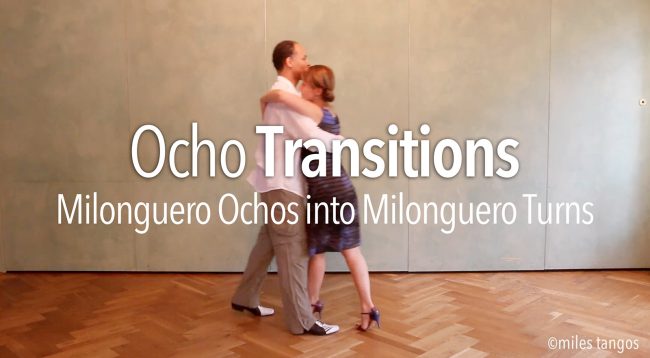
There are 8 types of Ochos, but only 2 of them are used routinely to lead into other things. The 2 types ? “Lazy” or Milonguero StyleOchos, and Traveling Ochos, what you folks think of as an ‘Ocho’. Traveling Ochos ? You know the one where you’re supposed to lead Disassociation and you frequently don’t especially on the closed side of the embrace (tsk, tsk, tsk), and where the Follower infers that led Disassociation and fills in the gap and starts Applying Disassociation all over (what you erroneously think of as a ‘pivot’) ? That ocho ? Yes. Frequently these two types of ochos are used as transitions into other pieces of tango vocabulary without a stop or a pause. There is a natural flow in a good number of these transitions and one of them is from the Lazy Ocho into the Milonguero Turn. They align themselves rather nicely. However with the alignment of these things, and the frequency with which you see these things, you would think that there would be more classes on this stuff. But sadly there isn’t. A good portion of the time, you’re taught the under lining vocabulary technique and then shown for 2 minutes near the end of the class where this stuff could (operative word in the sentence, ‘could’) fit. It is for this reason that this topic and the resulting video exists: Ocho Transitions – Milonguero Ochos into Milonguero Turns!
What is an Ocho Transition ? It is exactly what it sounds like. It’s a transition between a commonly used type of Ocho into another commonly used piece of vocabulary. There are 4 types of Ocho Transitions that rely on 2 of the more common types of Ochos. Milonguero Ochos, which are sometimes referred to as “Lazy” Ochos because the hips of the Follower do not rotate. This type of Ocho is absolutely perfect for dancing in a small space, and requires very little effort to lead and very little effort to follow, hence the reason why they’re called “Lazy” Ochos. The second commonly used type of Ocho is the one that everyone is familiar with, these are called “Traveling Ochos” because they do exactly what they say they do, they “Travel” down the line of dance! A Lead will typically engage one or sometimes both of these types of Ochos as a way to transition into another type of vocabulary, usually as a way to lead upto one of the Eight types of turns that are used in Argentine Tango.
What is a Milonguero Ocho to Milonguero Turn ? It’s quite possibly the single most used transition the Tango world, for those that are Dancing In A Small Space (DIASS). This transition employs the Follower’s natural diagonal backstep (which is the Lazy Ocho part) and uses that as the opening step for the Milonguero Turn to be engaged!
Free Tip – Learning to lead and follow a Milonguero Ocho will open up doors for you in terms of nuance and clarity that you never even imagined. The reality is that the Milonguero Ocho is quite possibly the mic drop that you’ve been looking for in your dance but didn’t realize it because it looks sooo dead simple. And yet it is that dead simple stuff that can change your dance! This is that toy!
Pre-Requisites: So that we’re all clear on this part, note the difficulty rating below, it is not an exaggeration! You would think this is just walking and turning. That would be a mistake. 1.) You must have mastered your walk first and foremost to the point where you are not using your partner (either lead or follow) for stabilization. 2.) You must be familiar with the Milonguero Ocho from a Leading perspective as well as from a Following perspective. 3.) You also must have mastered the Milonguero Turn from both sides of the embrace. While this transition is a natural extension of both ideas put together it’s important that you have them both clearly in your mind before you attempt to put them together. The reason this video exists is to clean up the issues of the transition itself so that you don’t run into the common problems that most people do when they put these things together.
About The Video. This video is 22:40 in length in 4 Sections. Both Lead and Follow technique is co-combined.
Section 1 – Reminder Technique (Milonguero Ochos & Milonguero Turns) – 00:07:02 Section 2 – The Transition Point – 00:07:17 Section 3 – Review – 00:01:13 Section 4 – An Important Detail/End – 00:03:34
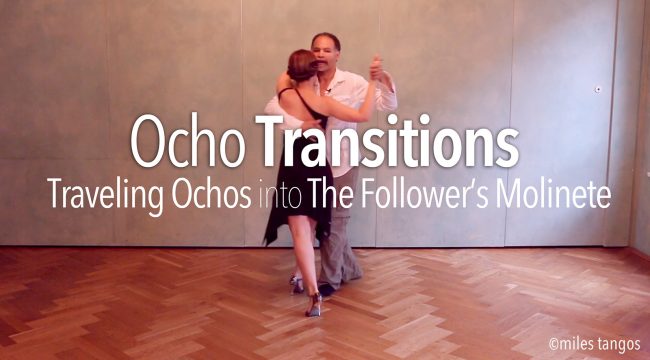
For most people you say the word “Ocho” and only one thing comes to mind. Ummm there are Eight types of Ochos actually. However in Today’s Tango Topic, we deal with that singular type of Ocho and then we tack something on the end to it that makes it more than just a traveling item but a transitional element. The thing that we tack onto the end ? The very venerable and well used singular turn that most people think of when then think of a turn in Argentine Tango: The Follower’s Molinete to the Lead’s Giro. That turn. These two pieces of vocabulary, by themselves, form the backbone of the 7 Basic Moves of Argentine Tango. However, when you put them together, they co-create a well worn pattern that is, unfortunately overused, without any variation, or for that matter distinction! These are amazingly powerful pieces of vocabulary that when executed properly can create such a distinction in our dance that it frequently goes overlooked. Distinction ? Most people lead and follow these ideas the same way each and every time. The distinction comes in how they’re applied to the music! They could be led slowly, the could be adorned, they could be over executed! All of these are possibilities, and yet they’re the same, each and every time. You could quite literally set your watch by them. In Today’s Tango Topic we look at co-combining them so that they work flawlessly each and every time. In this episode of ‘dancing tango better’ (hahahahha) we show you a way to execute these singular pieces of vocabulary so that in the transition state between them, there is no hesitation, no hiccup, no…ummmmm what was that ? It is for this reason that today’s topic is not really about the Ocho itself, but about the Transition between one piece of vocabulary and the next, or Ocho Transitions Part 2 – Traveling Ochos into the Follower’s Molinete!
What is an Ocho Transition ? It is exactly what it sounds like. It’s a transition between a commonly used type of Ocho into another commonly used piece of vocabulary. There are 4 types of Ocho Transitions that rely on 2 of the more common types of Ochos. Milonguero Ochos, which are sometimes referred to as “Lazy” Ochos because the hips of the Follower do not rotate. This type of Ocho is absolutely perfect for dancing in a small space, and requires very little effort to lead and very little effort to follow, hence the reason why they’re called “Lazy” Ochos. The second commonly used type of Ocho is the one that everyone is familiar with, these are called “Traveling Ochos” because they do exactly what they say they do, they “Travel” down the line of dance! A Traveling Ocho is where the hips of the Follower do rotate. A Lead will typically engage one or sometimes both of these types of Ochos as a way to transition into another type of vocabulary, usually as a way to lead upto one of the Eight types of turns that are used in Argentine Tango.
What is a Traveling Ocho to Follower’s Molinete Turn ? It’s quite possibly the single most used transition the Tango world, for those that are Dancing with a Lot of Space. This transition employs the Follower’s taught Ocho technique (applied disassociation) to open into their led Molinete! A bit of clarity as to what a ’Traveling’ Ocho is and is not. A ‘Traveling’ Ocho is an ‘Ocho’ that goes down the line of dance. As shown below:
Plays from YouTube. Pressing play connects you to YouTube. Privacy
It is one of 8 Ocho types that we use quite frequently, and it is the one that most people think of when you say the word. However, there are others, just so you know! Moving on. What is it not ? It’s not a Lazy Ocho (sometimes rightfully referred to as a ‘Milonguero’ Ocho), nor a Circular Ocho, nor a Linear (just to name a few). No this Ocho, is the venerable one that most Followers are forced to do on day one of Following regardless of whether or not they have been properly trained to do them or not. Usually it’s more the ‘not’ variety than anything else. Why are we talking about ochos ? Because this particular variety of Ocho is so venerable that we use it for nearly every kind of transition there is.
Pre-Requisites: So that we’re all clear on this part, note the difficulty rating below, it is not an exaggeration! You would think this is just walking and turning. That would be a mistake. 1.) You must have mastered your walk first and foremost to the point where you are not using your partner (either lead or follow) for stabilization. 2.) You must be familiar with the Traveling Ocho from a Leading perspective as well as from a Following perspective. 3.) You must have mastered Applied Disassociation. This is not a Pivot! And anyone that tells you differently is taking the easy way out. Applied Disassociation is much harder to do but soooo worth it in the end for a variety of reasons, most notably due to its controlled elegance! 4.) You also must have mastered the Follower’s Molinete from both sides of the embrace. While this transition is a natural extension of both ideas put together it’s important that you have them both clearly in your mind before you attempt to put them together. The reason this video exists is to clean up the issues of the transition itself so that you don’t run into the common problems that most people do when they put these things together.
About The Video. This video is 23:52 in length in 1 section. Lead and Follow technique is co-combined.
The funny (strange, not ‘ha-ha’) thing about this Ocho Transition Series is that it is used more often than you would think. So learning both techniques and tools will help you in the long run as you can use both pieces of vocabulary almost anywhere. From a Following perspective, you’re going to make the mistake of believing that this is all about the Lead. And that’s not the case here. You really do want to understand the Milonguero Turn for you, because the question will come up as it always does, when would I do engage one turn over the other ? And who’s actually leading the turn, the Lead or the Follower ? And the answer is a little bit of both in today’s Tango world.
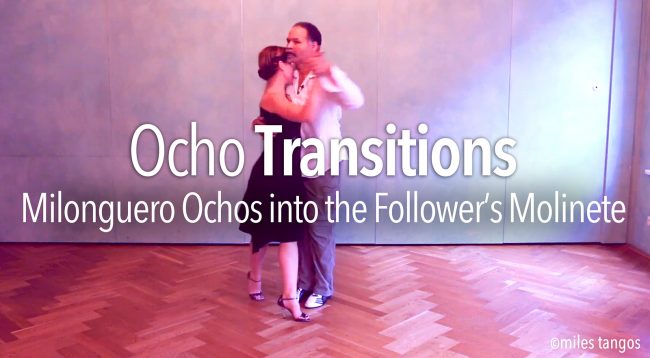
Lazy Ochos into The Follower’s Molinete. This is an odd transition to be certain. It mixes two very different types of tango styles or ideas into one way of dancing. Typically the ‘Lazy’ or Milonguero Style Ocho is done in Milonguero style of dancing, that means that the Lead is not leading the Follower’s hips to rotate at all, ever. And then, all of a sudden, and it is all of a sudden, we ask (note the language here…’ask’) the Follower to engage their Molinete. Not a Milonguero Turn, but a Close Embrace Molinete. Talk about confusing! Oy. So let’s get into L/leading and Following Milonguero Ochos into the Follower’s Molinete!
What is an Ocho Transition ? It is exactly what it sounds like. It’s a transition between a commonly used type of Ocho into another commonly used piece of vocabulary. There are 4 types of Ocho Transitions that rely on 2 of the more common types of Ochos. Milonguero Ochos, which are sometimes referred to as “Lazy” Ochos because the hips of the Follower do not rotate. This type of Ocho is absolutely perfect for dancing in a small space, and requires very little effort to lead and very little effort to follow, hence the reason why they’re called “Lazy” Ochos. The second commonly used type of Ocho is the one that everyone is familiar with, these are called “Traveling Ochos” because they do exactly what they say they do, they “Travel” down the line of dance! A Traveling Ocho is where the hips of the Follower do rotate. A Lead will typically engage one or sometimes both of these types of Ochos as a way to transition into another type of vocabulary, usually as a way to lead upto one of the Eight types of turns that are used in Argentine Tango.
What is a Traveling Ocho to Follower’s Molinete Turn ? It’s quite possibly the single most used transition the Tango world, for those that are Dancing with a Lot of Space. This transition employs the Follower’s taught Ocho technique (applied disassociation) to open into their led Molinete! A bit of clarity as to what a ’Traveling’ Ocho is and is not. A ‘Traveling’ Ocho is an ‘Ocho’ that goes down the line of dance. As shown below:
Plays from YouTube. Pressing play connects you to YouTube. Privacy
Traveling Ochos with Jannie
It is one of 8 Ocho types that we use quite frequently, and it is the one that most people think of when you say the word. However, there are others, just so you know! Moving on. What is it not ? It’s not a Lazy Ocho (sometimes rightfully referred to as a ‘Milonguero’ Ocho), nor a Circular Ocho, nor a Linear (just to name a few). No this Ocho, is the venerable one that most Followers are forced to do on day one of Following regardless of whether or not they have been properly trained to do them or not. Usually it’s more the ‘not’ variety than anything else. Why are we talking about ochos ? Because this particular variety of Ocho is so venerable that we use it for nearly every kind of transition there is.
The Free Tip: ‘Marking’ space means that as a lead you’re going to go with the Follower’s rotation, not ahead, not behind, but with. From a Following perspective you’re going to match the speed of the lead’s torso rotation at all points along the curve…stay with them. Don’t let them get ahead of you!
Pre-Requisites: So that we’re all clear on this part, note the difficulty rating below, it is not an exaggeration! You would think this is just walking and turning. That would be a mistake. 1.) You must have mastered your walk first and foremost to the point where you are not using your partner (either lead or follow) for stabilization. 2.) You must be familiar with the Traveling Ocho from a Leading perspective as well as from a Following perspective. 3.) You must have mastered Applied Disassociation. This is not a Pivot! And anyone that tells you differently is taking the easy way out. Applied Disassociation is much harder to do but soooo worth it in the end for a variety of reasons, most notably due to its controlled elegance! 4.) You also must have mastered the Follower’s Molinete from both sides of the embrace. While this transition is a natural extension of both ideas put together it’s important that you have them both clearly in your mind before you attempt to put them together. The reason this video exists is to clean up the issues of the transition itself so that you don’t run into the common problems that most people do when they put these things together.
About The Video. This video is 12:37 in length in 1 section. Lead and Follow technique is co-combined.
The funny (strange, not ‘ha-ha’) thing about this Ocho Transition Series is that it is used more often than you would think. So learning both techniques and tools will help you in the long run as you can use both pieces of vocabulary almost anywhere. From a Following perspective, you’re going to make the mistake of believing that this is all about the Lead. And that’s not the case here. You really do want to understand the Milonguero Turn for you, because the question will come up as it always does, when would I do engage one turn over the other ? And who’s actually leading the turn, the Lead or the Follower ? And the answer is a little bit of both in today’s Tango world.
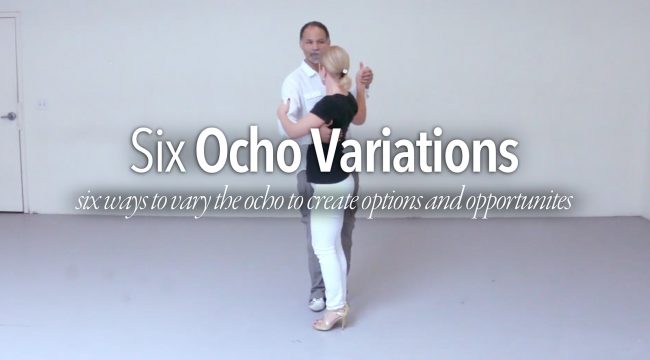
Ochos! They are the stalwart of Argentine Tango. They’re the goto move that keeps the dance moving, almost like the glue that holds everything together. Here’s an interesting experiment to prove if the statement above is valid or not, try not leading or not following them for a little while in the middle of a song, or for an entire song, and see what happens! More than likely you’ll see the validity of the statement, and how often we use them as Transitional Elements. What’s a Transitional Element you may ask ? In it’s simplest form, and yes there are complex forms of this idea, it’s a tool that we use to transition from one Tango idea to the next. Hence there’s a reason why we have detailed 3 of the more commonly used Transitional Elements, which Tango Topics calls Ocho Transitions. You might want to go look at the 3 of the 4 primary Ocho Transitions [ 1.) Milonguero Ochos into the Milonguero Turn. 2.) Traveling Ochos into The Follower’s Molinete. 3.) Traveling Ochos into The Milonguero Turn. 4.) Milonguero Ochos into The Follower’s Molinete (this video is only available to subscribers).] Moving along towards Today’s Tango Topic, there is something else that you may not recognize which is also true: Your understanding of the Ocho itself is not expansive enough. More than likely when we wrote the word “Ochos” above only one image came to your mind. You should know by now that this website details multiple ideas of what a specific piece of vocabulary can be. Take for instance the Ocho Cortado. There are 3 major variations of it. The Circular Ocho Cortado (used in Europe and BsAs), The Linear Ocho Cortado (used in North America and BsAs), and the Ocho Cortado Variations (used everywhere). Or Sacadas, we’ve detailed multiple variations of Sacadas (Simple Sacadas 2018, Close Embrace Sacadas, Crossing Sacada Turns, and Back Sacadas 2019…coming in January ), or any of the 3 types of Boleos (Social, Linear, or Circular), Ganchos (Common Ganchos, Lead Ganchos, Follower Ganchos,Gooey Ganchos), Colgadas, Volcadas…lots and lots and lots of variations. So what would make you believe that there aren’t Ocho Variations here as well. There are in fact Six Common Ocho Variations Tango Topics discusses. So without further adieu, Tango Topics presents the importance of Six Ocho Variations.
What Is An ‘Ocho Variation’ ? It is an Ocho that is varied. Hahahaha. That definition isn’t that far from the truth. Before we dive into the Variations, there’s something that you should know going in which require us to review the types of Eight Types of Ochos that are possible within the structure of Argentine Tango. There are Eight Types ? You thought there was only One, which is our point above. There are in fact Eight that Tango Topics yaps about. So without further delay a little refresher on the Ocho:
Type 1: Milonguero Ochos (sometimes called “Lazy” Ochos). They’re called “Lazy” because there is almost no physiological work for the Follower to invoke the application of this idea. This is the 2nd most common Ocho after Traveling Ochos (see Type 3). This is where the Follower is led to stepping backwards (or forwards) with their legs/feet crossing over their body’s natural meridian line on a 45 degree angle on the diagonal and more importantly their hips do not rotate in any way, shape, or form. Easier done than described or said. Here’s an example >https://www.youtube.com/embed/aname0mIN9s
Type 2: Linear Ochos. These are Ochos that employ Disassociation (from the Lead) and then Applied Disassociation (from the Follower), where the Follower is being led to rotate their torso (via disassociation) and then their entire body 180º (via applied disassociation) perpendicular to their Lead. They are asked to move backward or forwards, typically backward, along a linear line in front of the Lead. Where the Follower’s feet/legs do not cross over their body’s natural meridian line. Where the Lead actually engages Disassociation (not inference) to their Left Side (Open Side), and their Right Side (the Closed Side of the Embrace) which results as Applied Disassociation in the Follower (not a Pivot! Tsk, tsk, tsk).https://www.youtube.com/embed/A0ROD4pTB2Y
Type 3: Traveling Ochos. This type of Ocho is the common one that most people are familiar with, it’s the one that you thought of when the word is used most often. However, in this instance, this particular type of Ocho, and where it gets its name from, is the fact that it ‘travels‘ down the line of dance. Each Ocho invokes a smaller, or lesser amount of Disassociation (from the Lead), and a smaller or lesser amount of Applied Disassociation (from the Follower) which ends up as a 90º rotation perpendicular to the Lead. Typically these should only be done in triplets and not continuously, and going with the Followers motion, and should not be inferred. However, they are typically inferred and the Follower either guesses that they’re being led to Traveling Ochos or because they’ve done them so often they will invoke a Traveling Ocho on their own when none was led, which is better known as ‘The Automatic Ocho‘ or part of their default behavior.https://www.youtube.com/embed/d_UDQBw1n6I
Type 4: Circular Ochos. These Ochos resemble Type 2, but instead of the linear line and 180º in front of the Lead, the Ocho is led on a semi-circular arc 180º in front of the Lead.
Type 5: Over-Rotated Ochos. These Ochos are very uncommon but still a valid form of the Ocho, and to be honest with you loads of work for the Follower, and oodles of fun at the same time. These are Ochos where the Follower is led to an Over-Rotation at 270º to step backward (or forwards) into the space that the Lead has created with the same foot/leg that the Follower is stepping backward (or forwards) with! Example here:https://www.youtube.com/embed/55_Q9MGB0Ac
Type 6: Anti-Ochos. These Ochos resemble Type 2 Ochos except instead of the Lead going with the Follower’s rotation and direction, the Lead goes against it! They’re insanely cool, and looooots of fun to do. Example here:https://www.youtube.com/embed/qW-CeDCK7OY
Type 7: Milonga Ochos. This type of Ocho is only used in one instance, Milonga. And while they resemble the motion of Type 3, the Follower is led to not to step backwards but to rotate over their feet in an actual full body pivot and then change weight and pivot again in the opposite direction, creating the effect of slight but rapid movement down the line dance. This is the only Ocho that seemingly breaks the Tango Topics rule of Resistance when in truth of fact does not and can be led and followed without employing resistance at all. Here’s an example of the Follower’s Milonga Ocho >https://www.youtube.com/embed/2M4Wwv1pue4
Type 8: Dynamic Ochos. These Ochos are more than likely a Tango Topics construct. This is where an Ocho starts out as one thing and is morphed into another type of Ocho where the only requirement is time in relationship to the music! Meaning you might start out in Milonguero Ochos and transition into Traveling Ochos over the course of a few bars of the music.
These are the 8 Types of Ochos. Why list these ? Because our primary topic deals with having the knowledge of these 8 things so that now we can ‘vary’ them into Six possible Variations on a theme.
What are the Six Variations ? The Six Variations are tools used for navigation, music, and just fun or to vary the idea a bit so that you don’t end up doing the same thing over and over again. In the next section we show you what the variations are for this video. However, the short and curly answer is that an Ocho Variation is a variation of one the ideas above that have no been detailed on Tango Topics before this article.
About The Video is 23m:37s in length in 8 sections with a combined technique for Lead and Follow. Item in bold in example video, if the section is partially bolded that means that the section is partially in the video. 🙂
Section 1: Introduction (00:01:32) Section 2: Incremental Ochos (00:04:44) Section 3: Forward Traveling Ochos (00:03:28) Section 4: Forward Milonguero Ochos (00:03:11) Section 5: Lead Traveling Ochos (00:04:09) Section 6: Ocho Reversals (00:01:08) Section 7: Ochos as a Navigation Element (00:01:37) Section 8: Vocabulary Review and Closure (00:03:30)
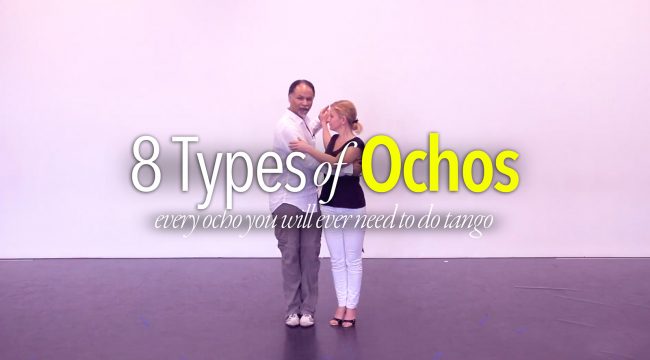
Argentine Tango consists of many ways to interpret it’s musical component through movement. One of those movements is called an “Ocho” which when you translate it from the original Spanish into English means “Eight”. The “Eight”, in this case, refers not a number but to a shape that is created by the Dancer’s feet (typically by the Follower, but as you will soon see it can be done by the Lead as well) on the floor when they’re led to do so.
The Ocho is one of the 7 Basic Moves of Tango Vocabulary (see link) that is used in nearly every dance by every dancer at every Milonga in the world. It is almost as ubiquitous as the Argentine Cross in this respect. So much so that one may lead or follow an Ocho and not even be aware that they’re doing it. The movement is taught as one of the very first things we learn aside from walking. While one’s walk is insanely important, the application of the Ocho is almost, if not as, equally important for both roles. From a Leading perspective, it’s one of the ways that we can create a navigational structure & generate navigational options. We can use the Ocho to interpret the music and to generate musical structure from it. And it also has the obvious ability that allows to use it as filler content until we’re ready to do something else that may lead up to something else. From a Following perspective, it is one of the very first things we are taught to master and must become facile with because our very tango lives depend on it for a whole host of reasons which will become obvious later on down the line.
That said, let’s take a deep dive into the 8 Types of Ochos for Argentine Tango.
What is an Ocho ? In it’s simplest form and right up to its most complex form The Argentine Ocho is a learned, and generated motion. Meaning ? That the Ocho is not a natural construct. It is something must be learned and then mastered by both roles, not just by one.
The Ocho is powered by 1 of 3 types of “Engines of Motion”:
Each one of these techniques can generate no bodily rotation motion, some bodily rotation motion, or an enormous amount of bodily rotation motion at the point of Social Collection. Where, depending on the type of desired Ocho, that no body rotation or some body rotation will be done at very specific angles (0, 45, 90, or 180 or more degrees) where the dancers’ feet will rotate and body either with or against their dancing partner’s motion. In all but one type of Ocho the dancer (Lead or Follower) will step forwards or backward thereby setting up the next Ocho movement. However, and there’s always a however to these things, there is one type of Ocho where the dancer does not step forward or back but instead changes their weight from one foot to the other and then employs one of the 3 techniques above and does this repeatedly in time to the music.
It should be noted that the Argentine Ocho in all 8 varieties listed below all invoke Cross-System walking using either Step Half-Step or a Weight-Change Step, or aCross Behind(not shown in the video) to get into and out of them. If you’re not familiar with this terminology please see their respective links to dive deeper into getting into Cross-System.
Put simpler: The Ocho is where the dancer (lead or follower) steps into Social Collection with their feet, and then assuming one of the 3 techniques above is used to generate bodily rotation that seemingly starts at the feet, and goes all the way up the body. Seemingly. 😉 The reason the Ocho is called an Ocho as was mentioned before, that the dancer will create a pattern on the floor with their feet, that resembles the number 8. However, over the last few decades, the floor pattern isn’t really adhered to, but instead it’s more a straight, curved line or an arc, with a point on either end of the arc. That point on either end, is where a body rotation can occur, or a point of transition occurs using one of the 3 techniques described above.
This is an Argentine Ocho
Notation: When the “What is … ” section of an article is blue, that means that the article is freely available to registered, users. When the section is yellow, the article is still free, but the video is for paid users. 😉
Type 1 – The “Milonguero” Style or “Lazy” (starts at: 00:03:14) Ocho. In this Ocho, the Follower (usually), is led to stepping in a diagonal 45-degree angle across their natural body meridian thereby engaging in the 1st Engine of Motion. The Follower doesnot rotate their hips in any way, shape, or form, nor do they need to do so either. Their legs will cross over their natural body meridian in a walking step to do perform the “Lazy” Ocho. The Lead can also self-lead themselves to do this same motion going backward down the line of dance. This Ocho is ideal for small space dancing and it is ideal for the Encuentro environment. The reason it is called a Milonguero or Lazy Ocho is because in this instance the Follower is emulating minimal body movement of the Milonguero style of dance that emulates a Walk. It’s just that this walk crosses over the body’s natural meridian. Of the 8 types of Ochos, it is by far the easiest to do and the most effortless to dance.
Type 2 – The “Linear” Ocho. (starts at: 00:10:07) In this Ocho, the dancer is led (the Follower) or self-led (the Lead) to using the 2nd Engine of Motion: Disassociation and then Applied Disassociation to self-rotate, due to torsion build up and release. As a result of this type of engine, the dancer rotates to a 90-degree angle perpendicular to their partner, which then can result in either a forward or backward walking linear step on two separate but equal walking tracks. This position is also where the Ocho gets its name from because the Dancer is literally transitioning in front of their dancing partner over a line or a linear space directly perpendicular to their partner. It should be noted that the dancer can employ the 3rd Engine of Motion: A Pivot but it is not desirable to do so. The Linear Ocho can be done from Open or Close Embrace, however it’s typically done from Open Embrace or a Fluid Embrace, as the Close Embrace version of the Linear Ocho can be stressful or uncomfortable due to the fact of some people may want to use arm tension, hand/forearm pressure, compression, and/or resistance in the embrace to generate it. None of that is required. The build-up of Bodily Rotation Torsion via Disassociation, and then the release of that Torsion as Applied Disassociation is what generates the bodily rotation. Primarily the Linear Ocho is used as a teaching tool for both roles to instruct, and then practice, dancer Disassociation and Applied Disassociation. Once learned, Linear Ochos can be employed as a ‘Filler’, or as a navigational tool, or it can be used as an intro that leads into either a series of Sacadas or the opening step to a whole host of vocabulary. “Filler” in the sense that it can be used as some vocabulary to lead into something else or when you’re stuck from a leading perspective. It should be noted that while it’s only hinted at in the video above, the Disassociation and Applied Disassociation element is insanely important. 😉 It is what ‘powers’ all the ochos in this series with the exception of Type 1 and Type 7.
Type 3 – The “Traveling” Ocho. (starts at: 00:12:55) This Ocho is called a “Traveling” Ocho because it Travels down the line of dance. It is the Ocho that everyone thinks of when they hear the word “Ocho”. Typically this Ocho is done by the Follower, however, a Lead can self-lead themselves to engage in a Traveling Ocho as well (going backward down the line of dance). These can be done in Open Embrace, or Close Embrace, however, predominantly see them done in Close Embrace. Ideally, the Traveling Ocho employs the 2nd Engine of Motion thereby resulting in a 45-degree body rotation to create the desired ‘Traveling’ Ocho. Traveling Ochos can be done with Forward steps or Back Steps, and while the Forward Traveling Ocho requires the Lead to walk backward down the line of dance to do engage in it, the Forward Traveling Ocho is a lot of fun and add a lot of variety to the dance. Not to mention it also opens up lots of other options and opportunities to do other things that you wouldn’t ordinarily see. Traveling Ochos have a few built-flaws to them from a Leading Perspective that are discussed below in the Leading Perspective section. The Traveling Ocho is typically the ‘goto’ Ocho in all environments for a wide variety of reasons, mostly because the other 7 Ochos on this list aren’t taught all that often! Sadly. It should be noted that the dancer could employ the 3rd Engine of Motion: A Pivot but it is not desirable to do so.
Type 4 – The “Circular” Ocho. (starts at: 00:17:35) The name for this Ocho is a bit of a misnomer because we’re not actually generating a circle but more of an arc around the dancing partner. So rightfully it should be titled, the “Arced Ocho”, but that’s awkward, so we’re sticking with Circular. 😉 The Circular Ocho can be done from Open and Close Embrace, and typically employs the 2nd Engine of Motion, where the dancing partner will rotate 180 degrees on either end point of the walking Arc. Typically this Ocho is done from a standing position. And more often than not it is used primarily as the opening step to the Follower’s Molinete to the Lead’s Giro. The Ocho itself is not really used as a dancing element over and over again, but rather as a singular element to do something else like engaging the Follower’s Molinete, or any one of 12 types of Ganchos, or a series of Paradas, or changes of direction. It is generally not used as a navigational element either primarily because of its awkward embrace nature (see Linear Ochos). Circular Ochos also have a built-in flaw that is discussed below in the Leading perspective section. Notation: The dancer could use the 3rd Engine of Motion but it is not desirable to do so!
THERE ARE 4 MORE OCHOS
You can’t see them because you’re not a subscriber
Install Tango Topics on your iPhone: tap Share, then Add to Home Screen.