Offer ends in Offer $99 for 1 year 1daysd 13 14 05 One year for $99 Get your year
Tango Topics info:

Check out the Tango Dictionary for words like Axis and Connection.

Tag: molinete

  • The Arm Pit Dancer

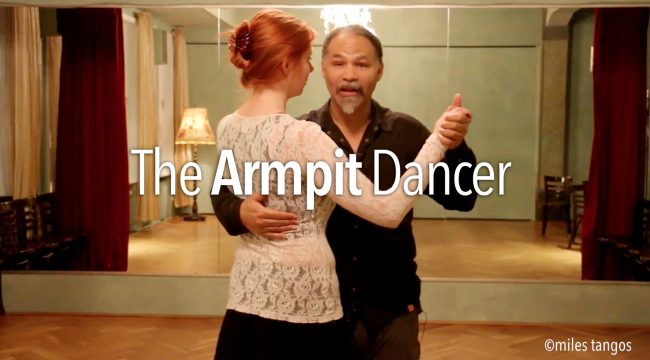
    The Arm Pit Dancer

    For most dancers their embrace is theirs and theirs alone. It’s what separates them from everyone else. It is their signature. Regardless of whether or not that embrace is desirable or not. Mind you they may not realize that their embrace is not desirable, they may not realize that the quality of their embrace is desirable. We like to believe that our embrace is the finest thing since sliced bread, and yet it is that embrace that causes more problems than it’s worth for a greater number of dancers. Take for example an aspect that is frequently passed onto dancers learning close embrace (which turns out to be a grand fallacy) that the Follower must apply ‘Resistance‘ (which generally ends up as ‘Rigidity‘) in order for the Lead/er to feel them. Or still another that the Follower should wrap their left arm around their Lead’s shoulders.

    video
    play-rounded-fill

    Each of these issues, and many more that aren’t listed here create physiological stresses on the couple that we don’t want. And as a result we end up having to compromise our natural bodily structure to compensate for what essentially amounts to an uncomfortable embrace.

    To be clear, and fair, the embrace is not the only problem child here. The other major component to nearly every issue that you can think of comes from one other place, it’s the walk. Or more importantly, one’s stability in one’s walk. Do not discount what you’ll hear in the videos above, and this article as “Ahhh I just need to fix my embrace and then all will be magical!”. Nope. You must, must, must, must, must … let’s stress that one more time with feeeeeling -> you must work on your walk, and in specific, your stability in your walk. And there are loads of exercises you can do to correct for that, one of which has already been covered here “The Ballet Rise“.

    What is an Arm Pit Dancer ? Put simply the Arm Pit Dancer is where most Leads place their Followers in their arm pit in order to dance with the Follower. Here’s the strange part > Most Followers willingly go there and stay there! To be fair, most Leads have a compressive embrace with their right arm so the Follower can not necessarily change their bodily position even if they were a.) aware. and b.) wanted to do so. Why is this a problem ? Read on….

    The Problem: The embrace is massive component to the dance being successful on any level, and yet there is another component is just as important but very infrequently talked about. What’s that ? Body Position and Body Placement for both Lead and Follow! Body Position is where you place yourself within the construct of the embrace, Body Placement is what you do with it (e.g.: vocabulary). The issue is that getting this topic right is the dividing line between ‘ease‘ and ‘work‘, between ‘pain‘ and ‘pleasure‘, between “ouch” and “aaahhhhh“. And yet, no one talks about this thing. So what specifically is the issue ? The fact that a good 90% of the time both Lead and Follow will enter into an untenable embrace structure based on their respective Body Positions right from the start of the dance where the Both dancers will quite literally either place the Follower into their Lead’s Arm Pit, or the Lead will readjust to have the Follower there from the start. And in that we have what is known as “The Armpit Dancer“. 

    From a Following Perspective, this issue is as much yours as it is the Leads’ issue! You either went directly to the Lead/ers arm pit or more importantly you drifted there by means of every cross, turn, and ocho you were ‘asked’ to execute. In short, you are just as responsible for this as the Lead is for allowing the problem to happen in the first place. Let’s go on the theory that you went there by comfort, not by drift, that will happen later anyway. By comfort means that you don’t know anything else. You went right into the armpit of you Lead because you don’t know any thing different. It’s all you know. And quite honestly no one has probably told you that you have a responsibility to be actively ontop of being in front of your lead, and being in their armpit is not that place. Placing yourself in the armpit is less then desirable on several levels: 1.) You’re making work for yourself. 2.) You’re instantly behind on everything that is being asked of you. 3.) You’re more than likely going to end up in long forward steps because of your position.

    Let’s be clear about something, there are certain aspects to the Modern Follow that did not happen 50, 30, and maybe even 20 years ago that does happen today. One of those things is that certain pieces of vocabulary mentioned above are all yours. The Lead may ASK (operative word) for it, but you’re the one that has to execute it with some degree of precision and awareness. And that means that while there’s nothing that you can do about the speed of one of these pieces of vocabulary, there is something you can do to change how things are executed because you’re the one that’s doing the execution! Put simply you are responsible for Forward, Side, & Back, and just how much disassociation you engage to execute X, Y, and Z that is being asked of you. You must place yourself in the right places at all times to allow for these things to occur. That means a.) Execute. b.) Get there in a timely fashion (read that as being on beat). This part is optional, but mostly quite desirable c.) With elegance! Generally the problem is that you have allowed yourself to ‘slip’ in any one of those three steps, in specific the back and forward steps of your Molinete as well as the back step prior to the crossing step of the Argentine Cross.

    To ‘slip’ means that you are out of alignment with your lead. While the video above talks about the Follower’s Molinete where this occurs repeatedly, it also occurs in the Argentine Cross, and you as the Follower need to take control so these things don’t happen. One of the things in your way, unfortunately is a Lead’s embrace that is restrictive that won’t allow you the freedom to move across and around your lead’s body. If the embrace isn’t restrictive, you have the tools you need to accomplish your goals! Technique, and Space! Now the only thing you need to do is execute.

    From a Leading Perspective, this one is as much your issue as it is the Followers! Why are you responsible for this issue ? 1.) It’s your embrace. 2.) You have control. 3.) You’re the one that’s choosing vocabulary, not the Follower. 4.) Navigation! 5.) One of your jobs as a Lead (you have 3), is Music. Your job is to select the beat that the couple is dancing to and on. That is why you are responsible.

    Let’s go on the theory that you are ignorant of why placing the Follower in your armpit is not desirable. That you’re doing what you’re doing out of your own physiological comfort and ignorance:

    Put simply, the Follower has a ton of physical work to do. You, my friend, have a different kind of work to do. While the role of the Follower is all about the physical, your role is intellectual – it’s all about planning. You think, they do. Mind you if you think and do for them, there’s not a whole lot for them to do except look nice and smile. Which is precisely what Tango was for many decades. That’s not the case in today’s Tango world, it’s changing…slowly. The role of the Follower has expanded more over the last 2 decades. And as a result, they have more to do, and you have less to do. The more ? They’re essentially being asked to execute a turn – the how the turn is done, but not when that turn is done (that’s still your job). Still another instance is that they cross their feet automagically because you’re not leading it 90% of the time. Still another is that in traveling ochos (what you call ‘back ochos’), they’re deciding how to ocho and how far that ocho goes, constantly. Put simply, they’re doing the heavy lifting, while all you’re doing is thinking about what should be done in time to the music.

    Those three things (and there are more, these are just the prominent ones) are physical labor for the Follower. Specifically the 1st and the last. Why ? Because they require disassociation and applied disassociation (what you mistakeningly think of as a ‘pivot’) on the Follower’s forward and back steps of their Molinete, and their ochos. 9 times out of 10 you’ll start a turn to the Open side of the embrace (Lead left), using the Follower’s backstep as the opening step either from a stop (bad idea by the way, see a future WHIC video on this topic), or from an ocho (better idea). That disassociation (from you) and applied disassociation in your follower tends to land them right in your armpit and thereby makes it difficult for them to get around you (for a variety of reasons which are not discussed here) for the remaining steps of the turn. The same is true of the ocho! In short, this stuff is work for them, and every time they move from the armpit, they’re having to stretch to go further around you just to end up in the same place. What makes that even more challenging is that you compress the embrace, you turn away from them in turns and in crosses you place them in your armpit deliberately, and you move the center of the circle or you close the distance in crosses, and/or pull them with your left arm, your head is in the way of the turn or cross (watching their feet). Each and every time that you do this it makes their job harder and harder.

    The Dancing Reality. The reality is that this stuff is going to continue to happen. And these words will make no difference. You’ll keep doing this stuff and stressing your heads, bodies, and dances to the breaking point. The reality is that you like dancing like this. You like dancing in pain. You like working harder than you have to. You like force, tension, compression, and resistance. That’s the reality. You see other people doing it and seemingly having fun and think, that’s what I should be doing. What you may not realize is that these people are ignorant of what’s supposed to happen. It’s only after they start rubbing muscles and tendons, that are seemingly strained for some odd reason (!!!!!), and they need a massage or a chiropractic visit the next morning that they realize that Tango is the cause! So ‘no’ you shouldn’t be doing that. What you should do is fix it!

    Paying For The Soup. Change can happen, but only if you want it to happen. And ‘want’ is the key word. First and foremost you have to see that this is an issue. If don’t, then so much the better, that means less work for you. But the reality is that this is a ton of work for both Lead and Follower. Further still you are contorting your bodies to make it happen, and then you wonder why you’re paying a chiropractor every few weeks for an ‘adjustment’. There’s a reason for that, and that’s because you’re contorting your bodies to dance like this. Here’s a helpful hint – STOP DOING IT! As arrogant as that may sound, and quite frankly the whole thing is arrogant, the fact is that it’s not arrogant if you see it as a helpful bit of advice that can stop you from being in pain. 

    Your Free Tip. A key component in this stuff is really about body orientation. One’s own orientation within a given piece of vocabulary, within the construct of the dance changes everything. There are minute changes that must occur every second of the dance, and this must be done without tension, resistance, or force. There should be no pulling or pushing to make these slight orientation changes. These are micro changes really, and unless you make them, sliding into your partner’s armpit or placing them there as a result is going to cause you more problems in 2 or 3 steps than you can possibly imagine. There are a few more components to creating a dance that does NOT end up in someone’s armpit and for that little piece of information, you need to see the entire series on the embrace, and that means you’re going to have to subscribe.

  • The Lead’s Molinete

    The Lead’s Molinete

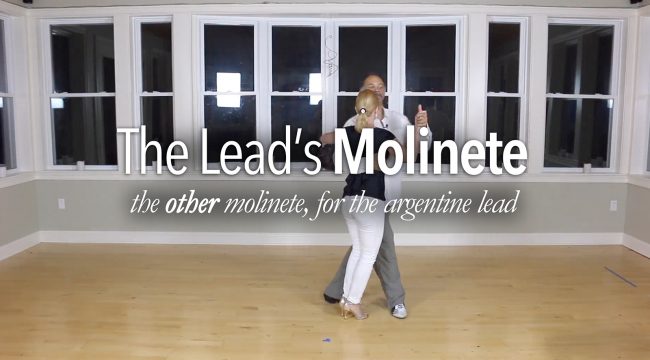
    Most people when they hear the word “Molinete” think of the turn that the Follower is ‘supposed’ to do. They generally commingle the Lead’s role of the ‘Giro’ (which is first person singular, from the root Spanish word ‘Girar’, which means “I turn” when translated from Spanish to English). Generally this is the common turn that is taught to all beginners as what the Follower does in order to turn. Generally speaking, nearly all, social dance possess a turn like the Follower’s Molinete, it’s called a ‘Grapevine Turn’, which basically consists of some form of a backstep, some form of a side step, and some form of a forward step. It’s just that in Argentine Tango’s version that version usually contains disassociation and then applied disassociation (or ideally we’d like it to contain that, but frequently does not). For the most part, the line of reasoning is that the Giro/Molinete construct is Follower vocabulary only. However as the title of Today’s Tango Topic implies, you’ve been fed a line of reasoning and gap that doesn’t necessarily add up. Which is to say that this is not jut for Followers! A Lead can and should engage in this idea as well! So without further adieu, today’s Tango Topic is on The Lead Molinete.

    What is a LEAD Molinete ? It is exactly as described, a Grapevine Turn, that consists of an applied dissociative backstep, a ‘circular’ side step, and a dissociative forward step. That’s it. It doesn’t get any more complex than that. The only difference is that instead of the Follower doing this vocabulary, the Lead does it. However, this particular version of the Molinete can be done in Open Embrace and in Close Embrace, and almost any embrace format that you think of. It can be done to the Close Side, which is perceptional-ly easier (that’s a fallacy by the way), and to the Open Side of the the embrace. Typically you would think that going to the Close Side would be harder, it’s not. It’s the same amount of work going in either direction. 

    About The Video. This video comes in at 22m:07s in length in 8 Sections. Separate Follower Technique and detailed Lead Technique is explained here in the video, as well as the combined elements of what has to happen in order for a successful Lead Molinete to function.

    Section 1 – Introduction – 00:01:47
    Section 2 – Follower Technique – 00:03:48
    Section 3 – Lead Technique – 00:02:56
    Section 4 – Combined Lead & Follow – 00:04:28
    Section 5 – Close Embrace Version Technique – 00:04:36
    Section 6 – Close Embrace Example – 00:01:11
    Section 7 – Open Side Turn – 00:01:24
    Section 8 – Ending – 00:01:13

  • The Molinete Giro Structure

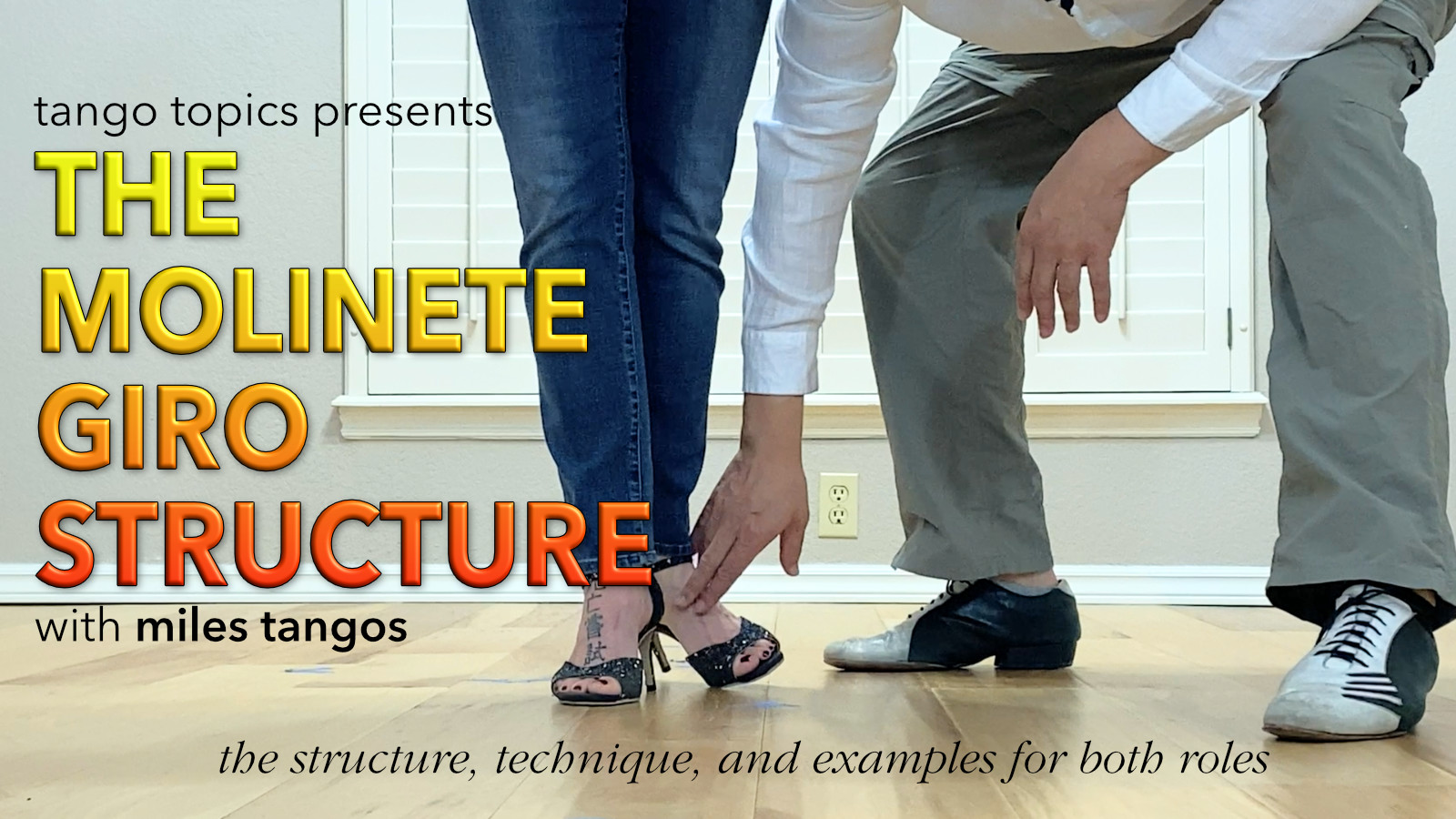
    The Molinete Giro Structure

    Notation: There is another version of this topic that’s in your archive. Now you have a second one that’s a bit more comprehensive and detailed. One is not more important than the other. They both serve as tools for both roles!

    Every social dance has a variation of a very old idea known as a “Grape Vine Turn”, which is generally 3 steps in either a circular or linear pattern. Argentine Tango is no exception to this. Truthfully Tango has spawned and borrowed and given 8 types of turns. The Eight functional types of turns of Tango are: 1.) The Milonguero Turn. 2.) The Walking Turn, 3.) The Rock Step. 4.) The Ocho Cortado (Linear & Circular). 5.) The Media Luna. 6.) The Argentine Calesita. 7.) The Colgada Turn (including The Single Axis). And #8, the topic of Today’s Tango Topic: The Follower’s Molinete/The Lead’s Giro.

    Just as a side note, up until about 1980, oddly enough, The Follower’s Molinete/Lead’s Giro was NOT the predominant turn. That honor goes to first turn on our list above, the Milonguero Turn. So what happened ? Why was the turn supplanted ? You can thank Gustavo Naveira and Fabian Salas for that. If for no other reason these two men aren’t considered the father’s of Modern Argentine Tango than it should be their introduction of the Follower’s Molinete to the world. Which, strangely enough, had been around in various forms for almost 50 years before they came along and … ahem … ‘discovered’ the Molinete.

    The turn itself is taught to every beginner dancer, and every dancer uses this very functional and foundational turn. As this is the case, the turn is so predominant that it is the default motion for every Follower/every Lead whether they realize it or not. The moment that a Lead starts to rotate their body, the Follower will default to the Follower’s Molinete. It should be noted that the Follower’s Molinete doesn’t happen in a vacuum. It happens due to the other side of the equation: The Lead’s Giro. The Lead’s Giro and the Follower’s Molinete co-combine to create the standard turn in Argentine Tango when we talk about turns. So without more yapping, let’s dive into Today’s Tango Topic: The Molinete Giro Structure.

    There are obviously two parts of this conversation that need to get talked about independently of each other. However, at the same time, one can not talk about one and NOT talk about the other. First let’s dive in the Follower’s Molinete and then the Lead’s Giro component.

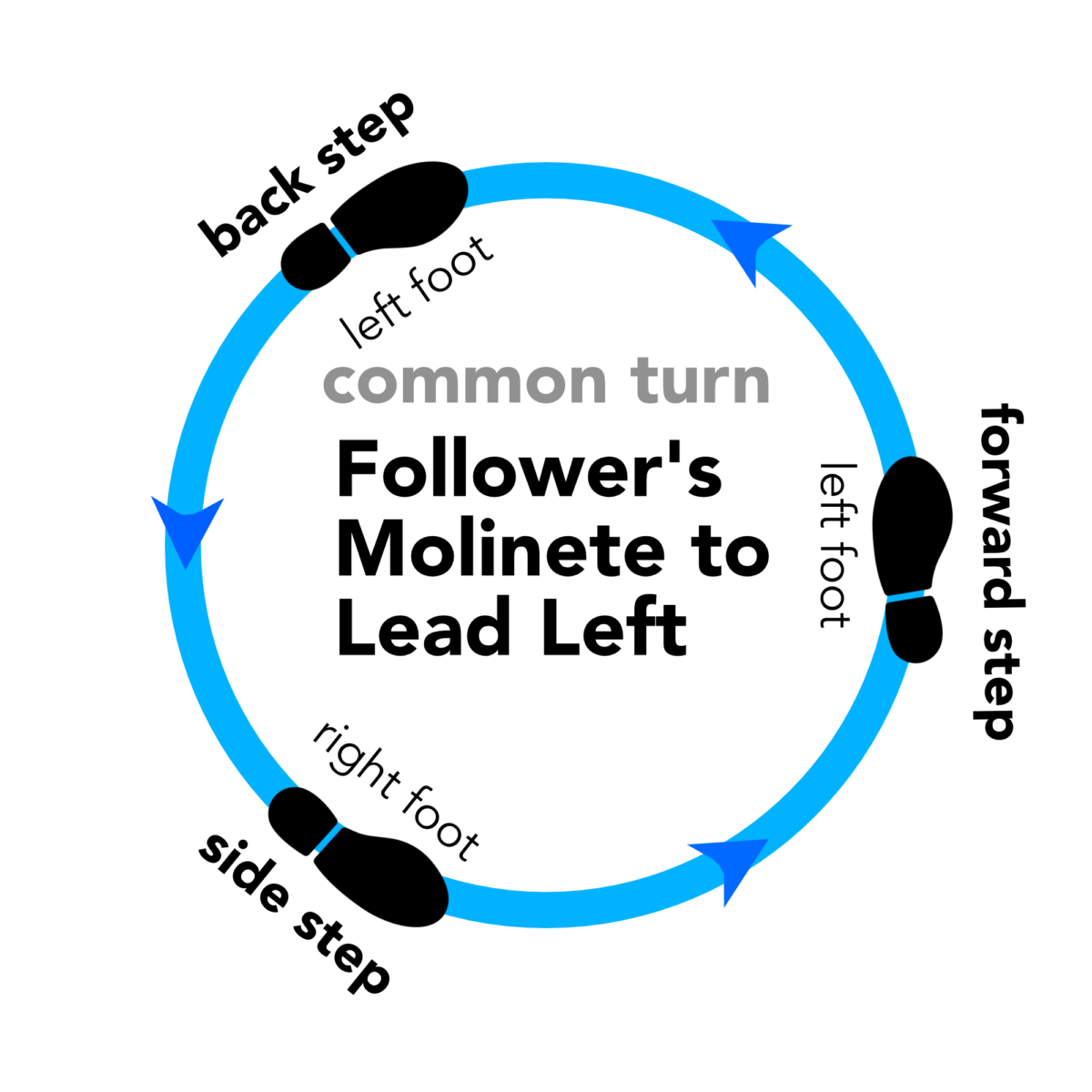
    What is the Follower’s Molinete ?  The term “Molinete” means Wind Mill in English when translated from the Spanish. And as it relates to Argentine Tango this is a Grape Vine Turn with 3 steps. Forward, Side, and Back that executed by the Follower. Which is the reason for the distinction in the moniker, calling it The Follower’s Molinete. So that would lead one to believe, and rightfully so, that there is a Lead’s Molinete. And there is. But that’s a topic for a different Tango Topic. There are two primary versions of the Follower’s Molinete. And the primary distinction is whether or not The Follower’s Molinete is done in Close Embrace or Open Embrace. While the two turns themselves are functionally the same, there are some very nuanced differences between the two. However, at the 50,000 ft level, the turns consist of the 3 steps: Forward, Side, and Back. When you stop and you think about it though, there are actually 4 steps, not three. Even though we would like to use only 3 and it can be done quite easily with practice. There is a fourth step, and it’s a second side step after either the forward or back step. The Follower’s Molinete can start with either the Follower’s Forward step or the Follower’s Backstep. Both will lead to slightly different outcomes. However, the setup for both turns is usually the same: Traveling Ochos! In either case, both the Forward Step, and the Back Step are Applied Disassociative motions which are mostly, and erroneously, thought of as ‘pivots’, which lead to the Follower then extending into a rotating Side Step. It should be noted that of all the foundational moves that the Follower must master, that this is the hardest thing, physiologically speaking that they’ll ever have to do. Ever. It takes considerable time, patience, practice, and did we mention ‘practice’, solo, with a partner, in private instruction to make the Follower’s Molinete fluid. This is not watching a 9 minute video and bam, you have got it down. No. This is going to take a while. A long while. A very LOOOOOONG while. Years. However, having adequate reference material is absolutely key to that process.

    Follower’s Perspective. Because the Molinete and its benefits have been discussed to death, all this section is really going to touch on are some very simple ideas that you may have forgotten about, but are relevant here for a variety of reasons not the least of which is that it opens other options for us, as leads, to play with. When we’re doing fiddling the options, we’re then going to answer one singular question. But before we get to that stuff, let’s do a bit of history. You probably learned the Follower’s Molinete and understand what you have to do in order to generate one. However, more than likely you never actually did the job yourself. A great man once said, “Never ask a man to a job for you, unless you’ve done that job yourself!”, the “walk a mile in someone’s shoes” methodology. Practicing this methodology gives you great perspective, and not to mention but we will anyway, appreciation for the amount of work, care, and detail that goes into that specific thing, or in this case a Molinete. With that thought in mind, it’s probably an eye-opening experience for you to do this amount of work just once, not the millions of times you’ve led this on a Follower and thought to yourself all the things that they should be doing but aren’t, thereby blaming the Follower for their lack of execution. And now that execution is on you IF and ONLY IF you want to execute a nice Follower’s Molinete!

    It’s 3 steps really. It doesn’t get any more complicated than that. Back. Side. Forward. And in those 3 steps you have any one of 27 possible combinations to play with, if we start with particular or dominant step first, which would be:

    [Back Step First] BSF, BFS, BSS, BFF, BBB, BBF, BBS, BSB, BFB. 

    (ommitted)

    The reason we’re discussing possibilities here is that, frequently, we only see one possibility over and over again, the BSF option. There are 26 other possibilities for us to engage in. Exploring these possibilities adds not only spice but variation to our repertoire. However, more than likely you’re still thinking like a Lead and not like a Follower here, in that YOU want to lead YOURSELF to do these, not the Follower. This is just a reminder that there are other options besides BSF out there. That’s all. See ? Simple reminder.

    However, let’s be clear about something, 9 times out of 10, you will NEVER engage in any of those 26 other possibilities nor will you be able to do what you like to accent those ideas, because there’s no space for you to do that. Mostly because your Lead isn’t creating space for you to do that. There are some things you can do to mitigate that prospect but they all rely on choosing a partner who creates space for you to engage ideas. Without that, none of those other 26 variations are possible!

    Follower’s Awareness: Stepping around the…

    (ommitted)

    The Follower’s Practical Reality. You have to understand something about your Molinete. At this point in the life of Tango, this move has become standard behavior, expected. Which is to say that the moment that your Lead starts to rotate, you immediately default to a Molinete, even when that may not be what’s asked of you! What I tell my follower students is that unless there is disassociation, in that rotation, your default behavior SHOULD BE a Milonguero Turn and NOT a Molinete. Most Leads are looking for the Molinete, however that view is changing, so having both in your arsenal is helpful. So it’s important to learn to hear the difference in the type of request that you’ll get. To be clear >

    IF THERE IS NO DISASSOCIATION coming from the Lead > MILONGUERO TURN.
    IF THERE IS DISASSOCIATION coming from the Lead > MOLINETE.

    Are we clear ?

    Moving on from there, now we address 2 issues that are implied in the video but not specifically stated:

    1.) Everything is around your lead in 3 steps, not 4.

    Everything Is Around Your Lead. This means that all 3 steps, BSF/FSB/FFF/BBB/SSS and all the common variations of that idea, are steps that go around your lead > NOT AWAY FROM THEM. This means NO LOOKING DOWN at your FEET on your forward step. This also means being as close to your Lead as is humanly possible. This also means that every step you take is step up for the next step. I have a whole video series on just this topic in the Follower’s Technique section of the library.

    2.) MOVE YOUR ASS!

    MOVE YOUR ASS. Means that you need to be aware that you have mass, and that the turn itself can lag. You can not. In other words, be quick, be expeditious, and be precise in your execution of the move!

    3.) There is Disassociation for a reason!

    Do NOT throw one leg behind the other crossing over. This is cheating the turn structure and doesn’t actually make you look good. You want to engage the Disassociation, and you want to actually use it. Let me be clear here > There are some Leads that rush thru the turn that force you to feel rushed. Which makes employing disassociation nearly impossible. So you have to employ the sloppy method implied at the beginning of this section! So in this instance when the Lead is moving to goddamned fast, USE A MILONGUERO TURN! Got it ?

    The Follower’s Fine Print: Probably the most prominent issue in the fine print is the ….

    (ommitted)

    The Primary Fact: The key to the Follower’s Molinete, is the Follower’s ability to correctly and aptly engage in Disassociation and Applied Disassociation.

    That means in simple parlance, if you haven’t mastered your those skills, so that they become second nature to you, then your back step of the Molinete will fail, and you will be out of position in order to stay with your Lead.

    To be fair, most Lead’s are wholly unaware that they need to stay with their Follower and instead rush ahead of them in their own Giro, thereby leaving the Follower behind and out of position. So what can you do ? Pick a better Lead next time. Seriously. In the moment, there’s not a lot you can do because that’s that Lead’s default behavior and because no one has told them to stop doing it, they’ll continue to to do so. The prevailing wisdom with that line of reasoning is that the Follower should just ‘hurry up’. This is not true.

    Plays from YouTube. Pressing play connects you to YouTube. Privacy

    The Full Ocho Exercise

    Plays from YouTube. Pressing play connects you to YouTube. Privacy

    Linear Ochos Exercise with Marion

    The Fundamental Stepping Stones! The only way this stuff works is Disassociation and Applied Disassociation. That’s it. Fortunately for you, Tango Topics has an extensive video on both of these very important topics for sale, but also included in the video subscription. Follow the links included herein and educate yourself. Or Subscribe. Either way. 🙂 Of course it wouldn’t hurt for you to study the Molinete from the Follower AND Lead’s perspective, so you might need another video for that as well. Fortunately, that particular video is available immediately, just follow this link! What would be helpful here is also a study of what Tango Topics calls “Fred Torture”, as it would help you to define and clarify the Molinete structure in its base elements.

    Plays from YouTube. Pressing play connects you to YouTube. Privacy

    Tango Disassociation

    Next we have to talk about the Lead’s side of the equation, or The Lead’s Giro.

    What is the Lead’s Giro ? Put simply, and literally, it means that the Lead turns themselves. The literal part comes from the fact that the word ‘Giro’ comes from the Spanish verb ‘Girar’ which means ‘To Turn’ in English. ‘Giro’ is the first person singular of the verb, which translates to ‘I turn’. The Lead’s Giro simply means that the Lead acts as the center of the Follower’s Molinete. They’re center pole as it were. Not the center piece but the center pilar that the Follower revolves around. It’s imporant that you recognize that aspect as a Lead. Meaning that as the center pilar, if that pilar moves from it’s position, then the Follower’s Molinete will ‘wobble’, and Follower will end up having to do a BOATLOAD of extra work to stay with Lead’s Rotation! Secondly the Lead Rotates and the Follower Revolves. Typically what happens is the Lead Rotates at their own speed and the Follower has to catch up with that. Which makes the Follower feel rushed. Instead of setting up the turn so that it rotates in time to the music and doesn’t rush the Follower. In other words the Lead has to go at the speed at which the Follower is capable of moving. And sometimes that means, that the turn MAY NOT be completed in time to the music! Which means dropping a note or 3. And rushing the Follower to go any faster isn’t going to help anything. And in fact tends to make things worse in more ways than one. Lastly, speaking about music, while there are multiple ways to address the musical concerns of how the Molinete/Giro structure is applied, this article will not cover this aspect except to address this singular point > One Note = One Step.

    All of that aside the Lead’s Giro consists of two parts:

    1.) The ‘Foot’ Component.
    And 2.) The Upper Body Rotation and Embrace component.

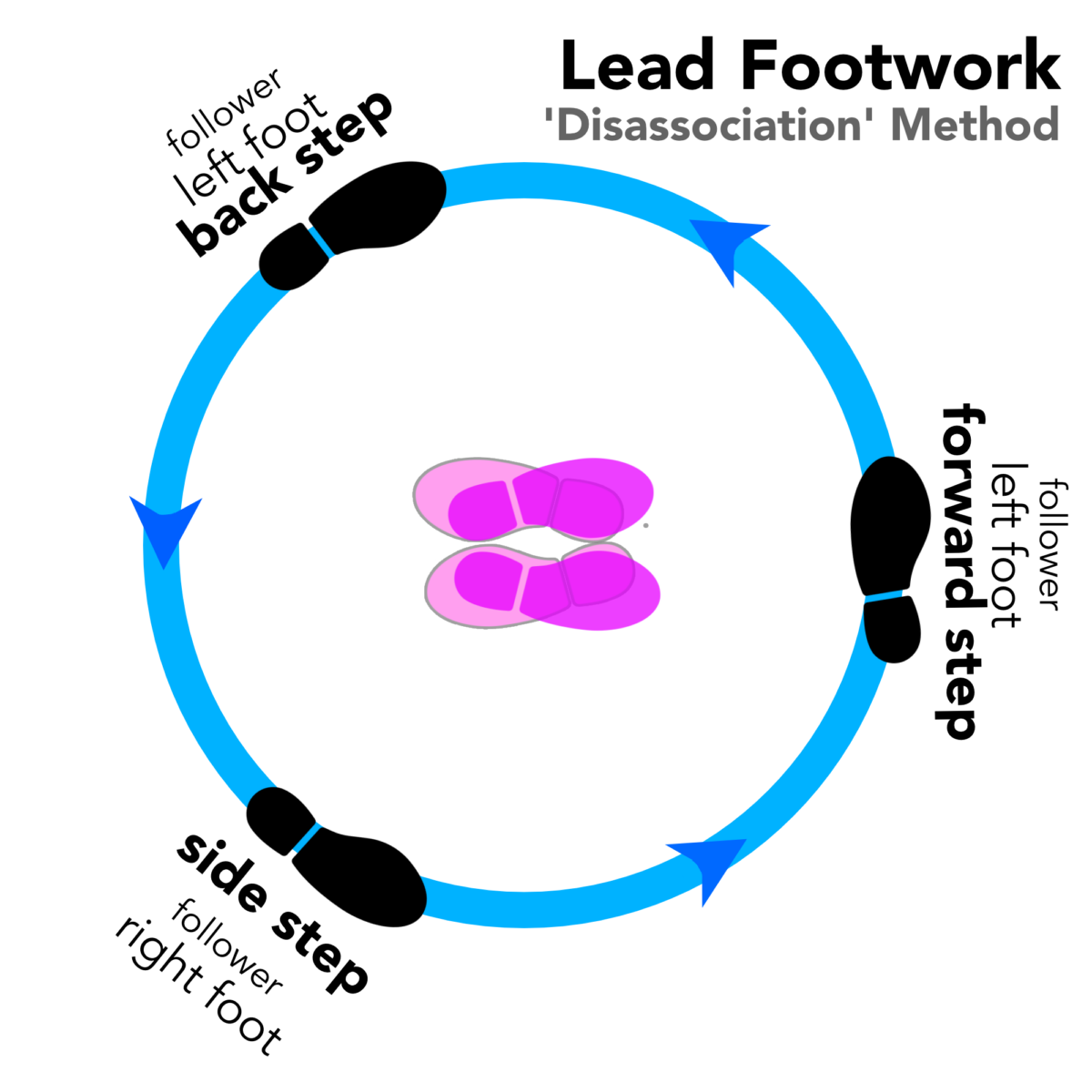
    There are 4 ways for the Lead to turn their body with their feet: 

    a.) The ‘Pie Wedge’ Methodology.
    b.) The ‘T’ Step Method.
    c.) The ‘Paddle’ Method.
    And d.) The ‘Applied Disassociative’ Method.

    All four of these methods do the job of the Lead turning the Lead’s body with their feet. This is shown in the video, so please reference it there. However, the most efficient of the methods is probably ‘d’. From a dancing perspective, the easiest one to execute is ‘c’.  The simplest of the four is ‘a’ but it’s not exactly elegant but it is functional. And while ‘b’ is very functional it tends to ‘drift’ a bit. Drift in the sense that you can and will move the center point of the Follower’s Molinete if you’re not paying attention. Which, as a result, means more work for the Follower. The same is true of ‘a’ and ‘c’ to a limited degree for different reasons. Item ‘d’ does not move the Lead’s center point at all. It should be noted that in item ‘d’ that the Lead’s feet, always, always, always stay together and over one foot or the other, not both. But the heels are always kept together and do NOT split apart. Nor should there be a weight transfer in ‘c’ or ‘d’. However, there are obvious weight transfers in ‘a’, and ‘b’. Speaking of weight transfers, and in specific ‘c’, there is a push-off the from the free leg, but not a weight transfer! In other words do not wobble back and forth using ‘c’ as you push off! Oh and regarding ‘d’ and the term “Applied Disassociation”, this refers to when the upper body rotates in Disassociation but the lower body has to catch up with a slight delay (which is deliberate). That delay is the application of disassociation! You are releasing the torsion and tension built up by the disassociation, and that release is contained rotation of the legs and feet over a singular point. 

    The Lead’s Upper Body has two methods of motion. 

    a.) Rotate your …

    (ommitted) 

    If all that sounds like deep technical details, that’s because it is. It’s the kind of clarity that must happen for the Lead kinesthetically everywhere. And that’s just in this move alone when it comes to what they’re doing. However, typically what happens, for most Leads is their embrace collapses, and their footwork is sloppy! They tend to use their arms, apply pressure, tension and force to ‘move’ their followers instead of applying intention to INVITE their followers. Do you see the difference. Intention is a huge component in the application of the Lead’s Giro. Without that, then you’re literally pushing and pulling your follower around. There are LOADS of Tango teachers that will tell you in no uncertain terms that you must apply tension, and force, or RESISTANCE in order to use the Molinete/Giro structure. And there is a certain amount of truth to that > IF AND ONLY IF you want to scream at your dance partner and be a lethargic weight! I can hear the commentary now, assuming you’ve gotten this far, that the you don’t do that. Trust me when I say this, you do. You just don’t know it. Nor have you had anyone, like me, point it out to you.

    The Lead’s Practical Reality. The matter of the fact is that your Giro the Follower’s Molinete has become the staple of the dance. Further, there’s a reality you must understand that for the most part, the Lead’s Giro here is purely decorative and performative. Meaning that you’re not actually doing a whole lot. Nor do you need to! The fact is that the due to certain factors of the state of the dance, and because this move has become so ubiquitous, that the moment the lead starts any kind of rotation, the Follower will default to their Molinete in either BSF or FSB depending on what position they’re in. In this instance, you don’t really have to ‘lead’ per se. And as one of my early teachers put it, the Follower is the Engine of the TURN! They’re literally going to turn us! The only thing you really need to do here is guide them thru to where you want to come out of the turn facing in what direction. That’s it. That’s all. However, if you want to get fancy you can break up that turn. And in that respect you want to go look at the Molinete Giro Variations video I produced a while back. That the game changer. Aside from that, this is now a staple of the dance and you as the Lead don’t need to push, pull, compress, squeeze, or use your arms to direct your Follower! Got it ? To be fair there are some Followers that have not mastered this turn and will lag or step away slightly. And for that reason I have a whole video series on both of those things. They’re in your library, go look. However, in either case, you should not need to direct your Follower with your arms which is what a LOT of Leads do and this is NOT desirable.

    The One More Thing: DO NOT

    (ommitted)

    Got it ? Good.

    The Lead’s Cool Toys. 1.) Lead Adornos

    (ommitted)

    These are just some of the Lead’s choice of course, to engage them or to not engage them.

    The Lead’s Fine Print.

    (ommitted)

    About The Video. This video comes in at 1 hour and 22 minutes and goes over Follower Technique in the 3 steps. Lead Technique in the 4 types of steps for their Giro. And then Applied Disassocation and what that looks like for both roles. And then presents some examples which is what the video above is all about.

  • Ocho Transitions: Traveling Ochos into The Follower’s Molinete

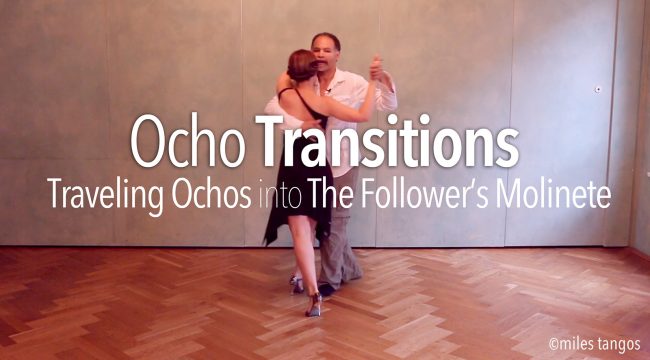
    Ocho Transitions: Traveling Ochos into The Follower’s Molinete

    For most people you say the word “Ocho” and only one thing comes to mind. Ummm there are Eight types of Ochos actually. However in Today’s Tango Topic, we deal with that singular type of Ocho and then we tack something on the end to it that makes it more than just a traveling item but a transitional element. The thing that we tack onto the end ? The very venerable and well used singular turn that most people think of when then think of a turn in Argentine Tango: The Follower’s Molinete to the Lead’s Giro. That turn. These two pieces of vocabulary, by themselves, form the backbone of the 7 Basic Moves of Argentine Tango. However, when you put them together, they co-create a well worn pattern that is, unfortunately overused, without any variation, or for that matter distinction! These are amazingly powerful pieces of vocabulary that when executed properly can create such a distinction in our dance that it frequently goes overlooked. Distinction ? Most people lead and follow these ideas the same way each and every time. The distinction comes in how they’re applied to the music! They could be led slowly, the could be adorned, they could be over executed! All of these are possibilities, and yet they’re the same, each and every time. You could quite literally set your watch by them. In Today’s Tango Topic we look at co-combining them so that they work flawlessly each and every time. In this episode of ‘dancing tango better’ (hahahahha) we show you a way to execute these singular pieces of vocabulary so that in the transition state between them, there is no hesitation, no hiccup, no…ummmmm what was that ?  It is for this reason that today’s topic is not really about the Ocho itself, but about the Transition between one piece of vocabulary and the next, or Ocho Transitions Part 2 – Traveling Ochos into the Follower’s Molinete!

    What is an Ocho Transition ? It is exactly what it sounds like. It’s a transition between a commonly used type of Ocho into another commonly used piece of vocabulary. There are 4 types of Ocho Transitions that rely on 2 of the more common types of Ochos. Milonguero Ochos, which are sometimes referred to as “Lazy” Ochos because the hips of the Follower do not rotate. This type of Ocho is absolutely perfect for dancing in a small space, and requires very little effort to lead and very little effort to follow, hence the reason why they’re called “Lazy” Ochos. The second commonly used type of Ocho is the one that everyone is familiar with, these are called “Traveling Ochos” because they do exactly what they say they do, they “Travel” down the line of dance! A Traveling Ocho is where the hips of the Follower do rotate. A Lead will typically engage one or sometimes both of these types of Ochos as a way to transition into another type of vocabulary, usually as a way to lead upto one of the Eight types of turns that are used in Argentine Tango.

    What is a Traveling Ocho to Follower’s Molinete Turn ? It’s quite possibly the single most used transition the Tango world, for those that are Dancing with a Lot of Space. This transition employs the Follower’s taught Ocho technique (applied disassociation) to open into their led Molinete!  A bit of clarity as to what a ’Traveling’ Ocho is and is not. A ‘Traveling’ Ocho is an ‘Ocho’ that goes down the line of dance. As shown below:

    Plays from YouTube. Pressing play connects you to YouTube. Privacy

    It is one of 8 Ocho types that we use quite frequently, and it is the one that most people think of when you say the word. However, there are others, just so you know! Moving on. What is it not ? It’s not a Lazy Ocho (sometimes rightfully referred to as a ‘Milonguero’ Ocho), nor a Circular Ocho, nor a Linear (just to name a few). No this Ocho, is the venerable one that most Followers are forced to do on day one of Following regardless of whether or not they have been properly trained to do them or not. Usually it’s more the ‘not’ variety than anything else. Why are we talking about ochos ? Because this particular variety of Ocho is so venerable that we use it for nearly every kind of transition there is.

    Pre-Requisites: So that we’re all clear on this part, note the difficulty rating below, it is not an exaggeration! You would think this is just walking and turning. That would be a mistake. 1.) You must have mastered your walk first and foremost to the point where you are not using your partner (either lead or follow) for stabilization. 2.) You must be familiar with the Traveling Ocho from a Leading perspective as well as from a Following perspective. 3.) You must have mastered Applied Disassociation. This is not a Pivot! And anyone that tells you differently is taking the easy way out. Applied Disassociation is much harder to do but soooo worth it in the end for a variety of reasons, most notably due to its controlled elegance! 4.) You also must have mastered the Follower’s Molinete from both sides of the embrace. While this transition is a natural extension of both ideas put together it’s important that you have them both clearly in your mind before you attempt to put them together. The reason this video exists is to clean up the issues of the transition itself so that you don’t run into the common problems that most people do when they put these things together. 

    About The Video. This video is 23:52 in length in 1 section. Lead and Follow technique is co-combined.

    The funny (strange, not ‘ha-ha’) thing about this Ocho Transition Series is that it is used more often than you would think. So learning both techniques and tools will help you in the long run as you can use both pieces of vocabulary almost anywhere. From a Following perspective, you’re going to make the mistake of believing that this is all about the Lead. And that’s not the case here. You really do want to understand the Milonguero Turn for you, because the question will come up as it always does, when would I do engage one turn over the other ? And who’s actually leading the turn, the Lead or the Follower ? And the answer is a little bit of both in today’s Tango world.

  • Ocho Transitions: Milonguero Ochos into the Follower’s Molinete

    Ocho Transitions: Milonguero Ochos into the Follower’s Molinete

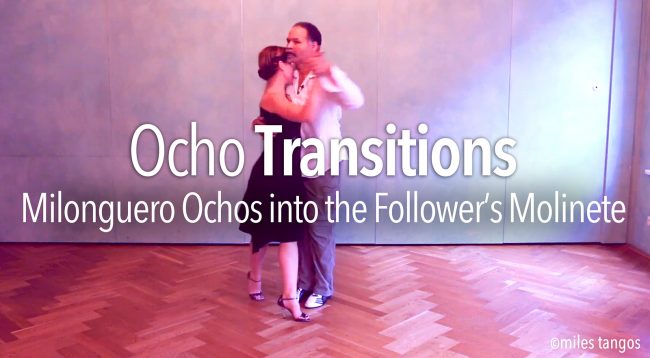
    Lazy Ochos into The Follower’s Molinete. This is an odd transition to be certain. It mixes two very different types of tango styles or ideas into one way of dancing. Typically the ‘Lazy’ or Milonguero Style Ocho is done in Milonguero style of dancing, that means that the Lead is not leading the Follower’s hips to rotate at all, ever. And then, all of a sudden, and it is all of a sudden, we ask (note the language here…’ask’) the Follower to engage their Molinete. Not a Milonguero Turn, but a Close Embrace Molinete. Talk about confusing! Oy. So let’s get into L/leading and Following Milonguero Ochos into the Follower’s Molinete!

    What is an Ocho Transition ? It is exactly what it sounds like. It’s a transition between a commonly used type of Ocho into another commonly used piece of vocabulary. There are 4 types of Ocho Transitions that rely on 2 of the more common types of Ochos. Milonguero Ochos, which are sometimes referred to as “Lazy” Ochos because the hips of the Follower do not rotate. This type of Ocho is absolutely perfect for dancing in a small space, and requires very little effort to lead and very little effort to follow, hence the reason why they’re called “Lazy” Ochos. The second commonly used type of Ocho is the one that everyone is familiar with, these are called “Traveling Ochos” because they do exactly what they say they do, they “Travel” down the line of dance! A Traveling Ocho is where the hips of the Follower do rotate. A Lead will typically engage one or sometimes both of these types of Ochos as a way to transition into another type of vocabulary, usually as a way to lead upto one of the Eight types of turns that are used in Argentine Tango.

    What is a Traveling Ocho to Follower’s Molinete Turn ? It’s quite possibly the single most used transition the Tango world, for those that are Dancing with a Lot of Space. This transition employs the Follower’s taught Ocho technique (applied disassociation) to open into their led Molinete!  A bit of clarity as to what a ’Traveling’ Ocho is and is not. A ‘Traveling’ Ocho is an ‘Ocho’ that goes down the line of dance. As shown below:

    Plays from YouTube. Pressing play connects you to YouTube. Privacy

    Traveling Ochos with Jannie

    It is one of 8 Ocho types that we use quite frequently, and it is the one that most people think of when you say the word. However, there are others, just so you know! Moving on. What is it not ? It’s not a Lazy Ocho (sometimes rightfully referred to as a ‘Milonguero’ Ocho), nor a Circular Ocho, nor a Linear (just to name a few). No this Ocho, is the venerable one that most Followers are forced to do on day one of Following regardless of whether or not they have been properly trained to do them or not. Usually it’s more the ‘not’ variety than anything else. Why are we talking about ochos ? Because this particular variety of Ocho is so venerable that we use it for nearly every kind of transition there is.

    The Free Tip: ‘Marking’ space means that as a lead you’re going to go with the Follower’s rotation, not ahead, not behind, but with. From a Following perspective you’re going to match the speed of the lead’s torso rotation at all points along the curve…stay with them. Don’t let them get ahead of you!

    Pre-Requisites: So that we’re all clear on this part, note the difficulty rating below, it is not an exaggeration! You would think this is just walking and turning. That would be a mistake. 1.) You must have mastered your walk first and foremost to the point where you are not using your partner (either lead or follow) for stabilization. 2.) You must be familiar with the Traveling Ocho from a Leading perspective as well as from a Following perspective. 3.) You must have mastered Applied Disassociation. This is not a Pivot! And anyone that tells you differently is taking the easy way out. Applied Disassociation is much harder to do but soooo worth it in the end for a variety of reasons, most notably due to its controlled elegance! 4.) You also must have mastered the Follower’s Molinete from both sides of the embrace. While this transition is a natural extension of both ideas put together it’s important that you have them both clearly in your mind before you attempt to put them together. The reason this video exists is to clean up the issues of the transition itself so that you don’t run into the common problems that most people do when they put these things together. 

    About The Video. This video is 12:37 in length in 1 section.  Lead and Follow technique is co-combined.

    The funny (strange, not ‘ha-ha’) thing about this Ocho Transition Series is that it is used more often than you would think. So learning both techniques and tools will help you in the long run as you can use both pieces of vocabulary almost anywhere. From a Following perspective, you’re going to make the mistake of believing that this is all about the Lead. And that’s not the case here. You really do want to understand the Milonguero Turn for you, because the question will come up as it always does, when would I do engage one turn over the other ? And who’s actually leading the turn, the Lead or the Follower ? And the answer is a little bit of both in today’s Tango world.

Hide picture