Offer ends in Offer $99 for 1 year 1daysd 13 14 22 One year for $99 Get your year
Tango Topics info:

Check out the Tango Dictionary for words like Axis and Connection.

Tag: lead

  • The Arm Pit Dancer

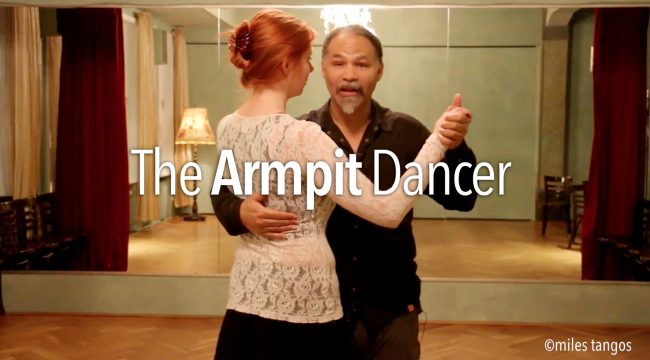
    The Arm Pit Dancer

    For most dancers their embrace is theirs and theirs alone. It’s what separates them from everyone else. It is their signature. Regardless of whether or not that embrace is desirable or not. Mind you they may not realize that their embrace is not desirable, they may not realize that the quality of their embrace is desirable. We like to believe that our embrace is the finest thing since sliced bread, and yet it is that embrace that causes more problems than it’s worth for a greater number of dancers. Take for example an aspect that is frequently passed onto dancers learning close embrace (which turns out to be a grand fallacy) that the Follower must apply ‘Resistance‘ (which generally ends up as ‘Rigidity‘) in order for the Lead/er to feel them. Or still another that the Follower should wrap their left arm around their Lead’s shoulders.

    video
    play-rounded-fill

    Each of these issues, and many more that aren’t listed here create physiological stresses on the couple that we don’t want. And as a result we end up having to compromise our natural bodily structure to compensate for what essentially amounts to an uncomfortable embrace.

    To be clear, and fair, the embrace is not the only problem child here. The other major component to nearly every issue that you can think of comes from one other place, it’s the walk. Or more importantly, one’s stability in one’s walk. Do not discount what you’ll hear in the videos above, and this article as “Ahhh I just need to fix my embrace and then all will be magical!”. Nope. You must, must, must, must, must … let’s stress that one more time with feeeeeling -> you must work on your walk, and in specific, your stability in your walk. And there are loads of exercises you can do to correct for that, one of which has already been covered here “The Ballet Rise“.

    What is an Arm Pit Dancer ? Put simply the Arm Pit Dancer is where most Leads place their Followers in their arm pit in order to dance with the Follower. Here’s the strange part > Most Followers willingly go there and stay there! To be fair, most Leads have a compressive embrace with their right arm so the Follower can not necessarily change their bodily position even if they were a.) aware. and b.) wanted to do so. Why is this a problem ? Read on….

    The Problem: The embrace is massive component to the dance being successful on any level, and yet there is another component is just as important but very infrequently talked about. What’s that ? Body Position and Body Placement for both Lead and Follow! Body Position is where you place yourself within the construct of the embrace, Body Placement is what you do with it (e.g.: vocabulary). The issue is that getting this topic right is the dividing line between ‘ease‘ and ‘work‘, between ‘pain‘ and ‘pleasure‘, between “ouch” and “aaahhhhh“. And yet, no one talks about this thing. So what specifically is the issue ? The fact that a good 90% of the time both Lead and Follow will enter into an untenable embrace structure based on their respective Body Positions right from the start of the dance where the Both dancers will quite literally either place the Follower into their Lead’s Arm Pit, or the Lead will readjust to have the Follower there from the start. And in that we have what is known as “The Armpit Dancer“. 

    From a Following Perspective, this issue is as much yours as it is the Leads’ issue! You either went directly to the Lead/ers arm pit or more importantly you drifted there by means of every cross, turn, and ocho you were ‘asked’ to execute. In short, you are just as responsible for this as the Lead is for allowing the problem to happen in the first place. Let’s go on the theory that you went there by comfort, not by drift, that will happen later anyway. By comfort means that you don’t know anything else. You went right into the armpit of you Lead because you don’t know any thing different. It’s all you know. And quite honestly no one has probably told you that you have a responsibility to be actively ontop of being in front of your lead, and being in their armpit is not that place. Placing yourself in the armpit is less then desirable on several levels: 1.) You’re making work for yourself. 2.) You’re instantly behind on everything that is being asked of you. 3.) You’re more than likely going to end up in long forward steps because of your position.

    Let’s be clear about something, there are certain aspects to the Modern Follow that did not happen 50, 30, and maybe even 20 years ago that does happen today. One of those things is that certain pieces of vocabulary mentioned above are all yours. The Lead may ASK (operative word) for it, but you’re the one that has to execute it with some degree of precision and awareness. And that means that while there’s nothing that you can do about the speed of one of these pieces of vocabulary, there is something you can do to change how things are executed because you’re the one that’s doing the execution! Put simply you are responsible for Forward, Side, & Back, and just how much disassociation you engage to execute X, Y, and Z that is being asked of you. You must place yourself in the right places at all times to allow for these things to occur. That means a.) Execute. b.) Get there in a timely fashion (read that as being on beat). This part is optional, but mostly quite desirable c.) With elegance! Generally the problem is that you have allowed yourself to ‘slip’ in any one of those three steps, in specific the back and forward steps of your Molinete as well as the back step prior to the crossing step of the Argentine Cross.

    To ‘slip’ means that you are out of alignment with your lead. While the video above talks about the Follower’s Molinete where this occurs repeatedly, it also occurs in the Argentine Cross, and you as the Follower need to take control so these things don’t happen. One of the things in your way, unfortunately is a Lead’s embrace that is restrictive that won’t allow you the freedom to move across and around your lead’s body. If the embrace isn’t restrictive, you have the tools you need to accomplish your goals! Technique, and Space! Now the only thing you need to do is execute.

    From a Leading Perspective, this one is as much your issue as it is the Followers! Why are you responsible for this issue ? 1.) It’s your embrace. 2.) You have control. 3.) You’re the one that’s choosing vocabulary, not the Follower. 4.) Navigation! 5.) One of your jobs as a Lead (you have 3), is Music. Your job is to select the beat that the couple is dancing to and on. That is why you are responsible.

    Let’s go on the theory that you are ignorant of why placing the Follower in your armpit is not desirable. That you’re doing what you’re doing out of your own physiological comfort and ignorance:

    Put simply, the Follower has a ton of physical work to do. You, my friend, have a different kind of work to do. While the role of the Follower is all about the physical, your role is intellectual – it’s all about planning. You think, they do. Mind you if you think and do for them, there’s not a whole lot for them to do except look nice and smile. Which is precisely what Tango was for many decades. That’s not the case in today’s Tango world, it’s changing…slowly. The role of the Follower has expanded more over the last 2 decades. And as a result, they have more to do, and you have less to do. The more ? They’re essentially being asked to execute a turn – the how the turn is done, but not when that turn is done (that’s still your job). Still another instance is that they cross their feet automagically because you’re not leading it 90% of the time. Still another is that in traveling ochos (what you call ‘back ochos’), they’re deciding how to ocho and how far that ocho goes, constantly. Put simply, they’re doing the heavy lifting, while all you’re doing is thinking about what should be done in time to the music.

    Those three things (and there are more, these are just the prominent ones) are physical labor for the Follower. Specifically the 1st and the last. Why ? Because they require disassociation and applied disassociation (what you mistakeningly think of as a ‘pivot’) on the Follower’s forward and back steps of their Molinete, and their ochos. 9 times out of 10 you’ll start a turn to the Open side of the embrace (Lead left), using the Follower’s backstep as the opening step either from a stop (bad idea by the way, see a future WHIC video on this topic), or from an ocho (better idea). That disassociation (from you) and applied disassociation in your follower tends to land them right in your armpit and thereby makes it difficult for them to get around you (for a variety of reasons which are not discussed here) for the remaining steps of the turn. The same is true of the ocho! In short, this stuff is work for them, and every time they move from the armpit, they’re having to stretch to go further around you just to end up in the same place. What makes that even more challenging is that you compress the embrace, you turn away from them in turns and in crosses you place them in your armpit deliberately, and you move the center of the circle or you close the distance in crosses, and/or pull them with your left arm, your head is in the way of the turn or cross (watching their feet). Each and every time that you do this it makes their job harder and harder.

    The Dancing Reality. The reality is that this stuff is going to continue to happen. And these words will make no difference. You’ll keep doing this stuff and stressing your heads, bodies, and dances to the breaking point. The reality is that you like dancing like this. You like dancing in pain. You like working harder than you have to. You like force, tension, compression, and resistance. That’s the reality. You see other people doing it and seemingly having fun and think, that’s what I should be doing. What you may not realize is that these people are ignorant of what’s supposed to happen. It’s only after they start rubbing muscles and tendons, that are seemingly strained for some odd reason (!!!!!), and they need a massage or a chiropractic visit the next morning that they realize that Tango is the cause! So ‘no’ you shouldn’t be doing that. What you should do is fix it!

    Paying For The Soup. Change can happen, but only if you want it to happen. And ‘want’ is the key word. First and foremost you have to see that this is an issue. If don’t, then so much the better, that means less work for you. But the reality is that this is a ton of work for both Lead and Follower. Further still you are contorting your bodies to make it happen, and then you wonder why you’re paying a chiropractor every few weeks for an ‘adjustment’. There’s a reason for that, and that’s because you’re contorting your bodies to dance like this. Here’s a helpful hint – STOP DOING IT! As arrogant as that may sound, and quite frankly the whole thing is arrogant, the fact is that it’s not arrogant if you see it as a helpful bit of advice that can stop you from being in pain. 

    Your Free Tip. A key component in this stuff is really about body orientation. One’s own orientation within a given piece of vocabulary, within the construct of the dance changes everything. There are minute changes that must occur every second of the dance, and this must be done without tension, resistance, or force. There should be no pulling or pushing to make these slight orientation changes. These are micro changes really, and unless you make them, sliding into your partner’s armpit or placing them there as a result is going to cause you more problems in 2 or 3 steps than you can possibly imagine. There are a few more components to creating a dance that does NOT end up in someone’s armpit and for that little piece of information, you need to see the entire series on the embrace, and that means you’re going to have to subscribe.
  • The Lead’s Molinete

    The Lead’s Molinete

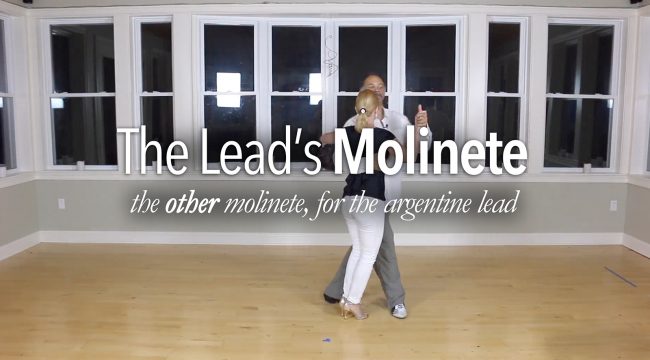
    Most people when they hear the word “Molinete” think of the turn that the Follower is ‘supposed’ to do. They generally commingle the Lead’s role of the ‘Giro’ (which is first person singular, from the root Spanish word ‘Girar’, which means “I turn” when translated from Spanish to English). Generally this is the common turn that is taught to all beginners as what the Follower does in order to turn. Generally speaking, nearly all, social dance possess a turn like the Follower’s Molinete, it’s called a ‘Grapevine Turn’, which basically consists of some form of a backstep, some form of a side step, and some form of a forward step. It’s just that in Argentine Tango’s version that version usually contains disassociation and then applied disassociation (or ideally we’d like it to contain that, but frequently does not). For the most part, the line of reasoning is that the Giro/Molinete construct is Follower vocabulary only. However as the title of Today’s Tango Topic implies, you’ve been fed a line of reasoning and gap that doesn’t necessarily add up. Which is to say that this is not jut for Followers! A Lead can and should engage in this idea as well! So without further adieu, today’s Tango Topic is on The Lead Molinete.

    What is a LEAD Molinete ? It is exactly as described, a Grapevine Turn, that consists of an applied dissociative backstep, a ‘circular’ side step, and a dissociative forward step. That’s it. It doesn’t get any more complex than that. The only difference is that instead of the Follower doing this vocabulary, the Lead does it. However, this particular version of the Molinete can be done in Open Embrace and in Close Embrace, and almost any embrace format that you think of. It can be done to the Close Side, which is perceptional-ly easier (that’s a fallacy by the way), and to the Open Side of the the embrace. Typically you would think that going to the Close Side would be harder, it’s not. It’s the same amount of work going in either direction. 

    About The Video. This video comes in at 22m:07s in length in 8 Sections. Separate Follower Technique and detailed Lead Technique is explained here in the video, as well as the combined elements of what has to happen in order for a successful Lead Molinete to function.

    Section 1 – Introduction – 00:01:47
    Section 2 – Follower Technique – 00:03:48
    Section 3 – Lead Technique – 00:02:56
    Section 4 – Combined Lead & Follow – 00:04:28
    Section 5 – Close Embrace Version Technique – 00:04:36
    Section 6 – Close Embrace Example – 00:01:11
    Section 7 – Open Side Turn – 00:01:24
    Section 8 – Ending – 00:01:13

  • The Cross – Getting In Front

    The Cross – Getting In Front

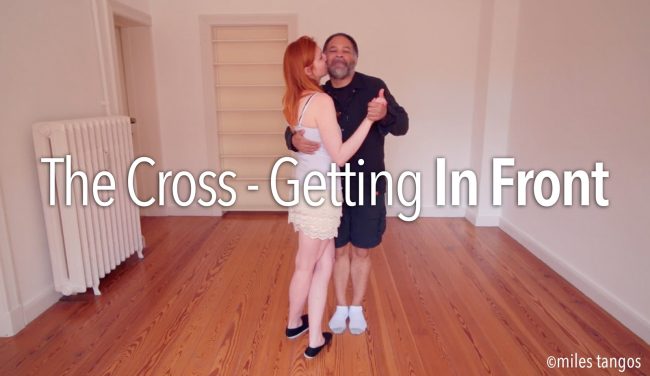
    For most Followers, that haven’t been properly trained, they are rushed into an Argentine Cross right from the start of their Tango dancing lives. Aside from Ochos, it’s the one thing that they’re pressed to do without any training aside from the Lead/er (Controlling Lead hence the ‘/er’ part) that quite literally tells them what to do as they’re doing it. From that moment, right up until this one (assuming you’ve shared this video with them) they more than likely have no idea a.) why they’re crossing their feet. and b.) more importantly what the point of the Cross is, and c.) what it all means.

    The Problem: This isn’t so much a Lead problem as it is a Follower issue. Contrary to what you might have been told, the Argentine Cross does actually serve a function. And believe it or not, it’s not to do a Cross every 15 seconds for no good goddamned reason. No. The function of the cross…is well, you can watch the video for that part. The problem is that not only is the Follower not aware of what the function of the Cross is, they’ve been so indoctrinated into a passive way of dancing that they’ll a.) Willy-nilly cross their feet due Two of the Five Errors of The Cross – specifically the Automagical Cross and the Wimpy Cross (see below), where in the case of the latter, the Follower has to infer what on god’s green earth the Lead is attempting to do. (In the other 3 cases they don’t have to infer, they’re quite literally forced into crossing their feet whether they wanted to or not). and b.) That a good portion of the time, the Follower will end up in the Lead’s Arm Pit. It is for this reason that we talk about – Getting In Front of Your Lead!

    video
    play-rounded-fill

    From a Following Perspective, 10% of this problem is your issue. And it has to do with you understanding that the Cross is actually, in modern Tango, your piece of vocabulary. Not the Lead’s, it’s yours! There are many people that will disagree with this statement that the Cross is the Follower’s vocabulary. The fact is that without you cooperating, the Argentine Cross, is not going to happen. You could say this about almost everything else in Tango, that without you cooperating nothing happens. And you’d be right. However in this instance, this is one of the few places where the Follower has an enormous amount of control of when something is done, how something is done, and most importantly where we go next! All of that from you crossing your feet. In this instance, this one little piece of vocabulary is YOUR place for you to shine, to sparkle, to show off your skillz as a Follower. Instead, what happens ? Well…watch the video.

    To be fair, you have to contend with the Five Errors of the Cross (see above), and then there’s the squeezing, the pushing, the pulling from your Leads. And then there are your issues, while in heels, to contend with. That aside, you do have an issue which is solely yours, which is the whole point of this topic – to get back in front of your lead!

    The simple fact is that your lead (the action, not the person – lowercase ‘l’) either stepped outside partner or stepped into cross system and in either case you’re essentially out of step with them. The whole point of the cross is to get back in front of your Lead (the person).  However, part of your issue is that you’ve been indoctrinated to a way of moving that quite factually doesn’t work for you. The way that you’re moving is to send your leg straight back, and really to cross your body meridian away from the couple. This creates a problem for you, especially when you come to collect your feet in the cross. Your feet look like two mismatched and broken sticks pointing in opposite directions from each other with a watermelon in between them, instead of what they can look like. We do want pretty feet, but we don’t want pretty knees, when we come to collection and even crossed collection! However, there’s a tiny little problem in that your body is in the wrong place, and your hips are all twisted and you’re basically out of alignment with your Lead, and on top of all of that, you’re stuck in the Lead’s arm pit! And there you will stay…sadly. 🙁 Unless…you do something about it. 🙂

    From a Leading Perspective, before we launch into Follower’s side of this. Let’s give credit for this problem, where credit is due. The Lead! Dude, a good 90% of this problem is your fault. Let’s be clear about responsibility here. You created this problem and the Follower is only doing their best trying to fix it. How did this become your problem ? 1.) You lined up with the Follower in your Arm Pit! You placed them in there right from the gitgo (‘start‘ for the non-native english speakers), and what’s worse is that you kept them there, holding them in that spot, because it was convenient for you to pull off some crazy vocabulary, which you think you need to lead every 20 seconds, instead of (gasp!) actually walking with your Follower to the music. Eeeek! Which for some reason is ‘boring’ to you but heaven to them…gosh I wonder why !?!?!?  2.) Your embrace that you think is comfortable is like laying on a bed of nails because it’s too compressive! Think ‘squeeze‘ and you’ll get the right idea. And even if someone tells you that to lighten up and let them loose, you’ll go right back to squeezing the daylights out of your partners because to you think, a.) this is comfortable. and b.) it’s all you know. 3.) Because your right arm is like a vice grip and you have this rather nasty tendency to paddle your Follower’s with your right hand to ‘direct’ them, you somehow believe that this is desirable. Ummmmm not! And lastly you created this problem by 4.) being too damned restrictive and not being responsible by continually placing the Follower in front of you by repositioning your vocabulary to do just that. Instead, doing all 3 previous things to show off to keep the Follower from realizing that you were completely ignorant about 3 steps in and don’t have a plan for the rest of the song let alone for the tanda! Yup, your fault.

    The Dancing Reality is that this stuff happens with such frequency that no one, not even the teachers that you’re studying with pay it any mind. It’s so commonplace that one wonders if anyone is actually teaching technique to specifically create this issue! “Leads! You place the follower in your armpit, and then rush around the room, all the while pulling and pushing! Followers, your whole job here is to stay in the Lead’s armpit and then to come to a crossed collection so that your hips are all twisted up and you’re off to the side of your lead! Ready ? Go!”. Not!

  • Lead Exercises

    Lead Exercises

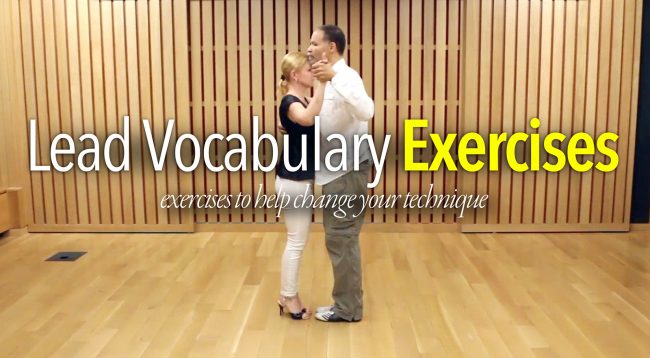
    Most Leads come to the dance floor with the idea in their head of what they’re going to do from the moment they come into the Embrace. This is not always true, but a good portion of the Salon, Marathon, and Encuentro Leads will already have the first few bars of music mapped out. While their dance is not entirely mapped out (tsk, tsk, tsk), the first few measures are, and this is based on the Neurology of Leading that they’ve trained themselves to do over time with experience. And from there they choreograph a dance on the fly that fits the music within the available space (again the Neurology of Leading). To the casual observer, they’re dancing fluidly. Seemingly effortlessly putting one idea behind another.  However, in order to get to this stage of dancing seemingly takes a long time to do.

    There is the traditional method of trial and error to achieve this way of dancing: Which is lots of endless classes/workshops on vocabulary that they’ll almost never use, to pieces of music that they’ll never hear again (thankfully), and then spending lots and lots and lots of time social dancing, and ‘practicing’ (ahem), and throwing in a few private lessons here and there for good measure, and hopefully coming out the other side a slightly improved competent social dancer, which speaks nothing to their embrace, interpretation the music, their ability to execute vocabulary, or attention to detail, or leaving their ego at the door. This is the norm of how things are done. This is ‘trial and error’ because the Lead tries things out and the results are pretty hit or miss most of the time for a variety of reasons that are nuanced to detail here (that’s another topic for another day). Also during this time period, the experience can be long, usually painful, ego-bruising process (if they’re lucky), that can take upwards of two to three years at minimum assuming travel, number of partners, distance to larger and multiple cities, level of diligence and attention to detail in multiple disciplines: Technique, Vocabulary, Musical Interpretation, Codigos, Marathon vs. Encuentro vs. Salon styles of dancing, and a host of other things with the end goal being not just a competent social dancer, but rather a competent social dancer that can freely and fluidly interpret the music with their partners, e.g. dancing fluidly. 

    What if we could shave off (to reduce by) a few months, maybe a year, this process, possibly cut it back to about 6 months entirely ? What if there were a series of stepping stones that could quite rightfully change how a Lead responds to the music, changes how they interpret the music, that reduces their inhibitions, their hesitations, and removes all repetition from their vocabulary choices, and removes any and all excessive usages vocabulary ? That’s where Today’s Tango Topic comes in. 

    There is another method that creates this series of stepping stones (no pun intended) to getting the Lead to a place where they can freely interpret the music, and freely choreograph their ideas that map their vocabulary onto the music so that it fits perfectly. These are Lead Exercises.

    What is a Lead Exercise ? This is a series of linked vocabulary choices that are practiced with some frequency on a weekly basis within the construct of 2 different embrace ideas, as well as with a metronome and NOT a piece of music. The reason ? A piece of music has lots and lots of nuances that can and do throw most people off, it confuses the hell out of them. So rather than work with a specific piece of music, we work with a time signature independent of the musical nuances, or in this case…the beat and ONLY the beat with pauses every 4 or 8 notes. So put simply a Lead Exercise is not about technique in this case, but rather a series of exercises designed specifically to retrain your Leading mind to respond to the changing conditions of the floor, the changing or challenges of Leading someone, what to do next, and most importantly to fix that tiny little problem of the hesitation described below. At the same time, this series of exercise also solves two latter problems of repetition and too much vocabulary by pairing things back to simple constructs to start with, instead of complex vocabulary sequences. Which is all designed to force you to work on the transitional elements rather than remembering steps, patterns, and figures that often fail and don’t necessarily help you all that much.

    About The Video. This video comes in at 21m:40s in length in 9 Sections. Lead Technique is explained here in the video. No Follower technique is explored. 

    Section 1 – Introduction – 00:03:04
    Section 2 – Walking Into Lazy Ochos – 00:01:35
    Section 3 – Walking Into Lazy Ocho – The Other Side – 00:02:05
    Section 4 – Walking Into Traveling Ochos – 00:00:48
    Section 5 – The ‘Dropped’ Traveling Ocho – 00:01:03
    Section 6 – The Close Embrace Variations – 00:02:59
    Section 7 – The ‘Practiced’ Weight Change – 00:00:38
    Section 8 – The 3rd Cross System Entry – Lead Cross Behind – 00:04:05
    Section 9 – The Frequencies/Closure – 00:04:42

    Video pre-requisites: 1.) 6 Ways of Walking. 2.) Milonguero Ochos. 3.) Traveling Ochos. 4.) The 5 Pause Types! 

  • Lead Technique 2019

    Lead Technique 2019

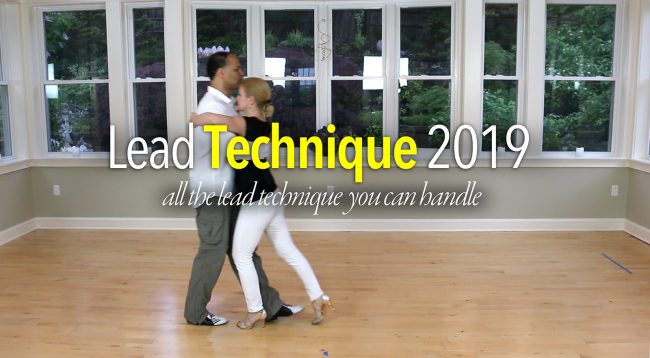
    Leading. Often the first thing we see when looking at Argentine Tango is the Tango Lead. It’s that sharp, clear, clean visual that strikes us almost immediately. We see the the visual of someone leading, and it’s this confusion, appreciation, amusement, bewilderment and just down right awe (in some cases) of a ‘wow’. Next the thing that we pay attention to is what they’re doing, not how they’re doing it, but what specifically they’re doing. You’re waiting, with anticipation, for that next cool, flashy move that screams – ‘Good Lead’. And the last thing that you start to become aware of is the musical expression, meaning how they’re placing the what they’re doing in time to the music, not necessarily how specifically it relates (that’s called interpreting the music by the way) to the music but really the execution in time to the music.

    Truthfully depending on where we are in/at in the spectrum of leading (the activity), then this explanation of the dynamic of leading can be an eye opening experience on multiple levels for a variety of reasons (again, depending on where you are on the spectrum). At the same time, that experience is what usually shapes us, defines us, and ultimately it will inspire us to want to study toward being like that which we see…to emulate it. 🙂 Or it may turn us off entirely for a variety of reasons, perhaps because it looks too complex, too difficult, or it’s too much, or not ‘us’ at all. Again, this all depends on where you are on the spectrum of leading. If you’re just starting out then literally everything you see everyone else is doing is nothing short of magical. The further you go towards the ‘advanced’ dancer and closer towards the teacher class dancer (those who could teach but don’t) realm the less magical things are and the more technical things become, and the more you want to figure out why X, Y, and Z happens. That’s exactly where this topic comes into play. 

    This topic assumes that you’ve gotten beyond the “Wow!!! That’s Amazing!!” phase and have just started to get down to the actual business of leading. And to be clear, this topic also assumes that you’ve gotten beyond the rudimentary foundation of walking, embrace, turning, crossing, and leading ochos, and are looking for a change towards something that looks a bit more elegant than the random, haphazard thing you have witnessed at your local milongas that’s loosely called ‘dancing‘.

    Perhaps you’ve started to pay attention to how someone is doing X, Y, and Z, and found it to be lacking or amazing and wondered….’how do they do that ?’. Or more than likely you have caught a glimpse of yourself in the mirror as you turn a corner and are either impressed with what you see and want more, or generally you try to avert your eyes as you pass by a mirror or someone’s facebook picture of you. You generally try to avoid it because you know it’s just going to be awful to look at. The mere thought of you leading, or watching yourself lead, is an exercise in excruciating visual pain. You know where all the problems are at, you know what you have forgotten in the multiple private lessons that you’ve taken, you know that you should be practicing this stuff on a daily if not weekly basis but you don’t. You know all of this stuff…you’ve just forgotten it, and there it is in the mirror, staring back at you, unapologetic, and very truthful that you could do better than you are right now.  

    If all of that is true, then this topic of Leading Technique is all for you. 

    What is ‘Leading Technique’ ? First let’s get a few words out of the way. L/lead, L/led, L/leading, Lead/er. 1.) A ‘Lead’ (note the capitalization) is the person who is performing the action of initiating choices in the dance that we know as Argentine Tango. In this state, it is not a given that the person initiating choices is initiating those choices through Intention Based Dancing. More on this later. 2.) A ‘lead’ is the activity or action of the role of the Lead. In this state, this activity employs the usage of ‘Intention Based Dancing’ at every point along the course of an active dancing experience. 3.) The action of someone who is doing the activity of the role of the ‘Lead’ is someone who has ‘L/led’ or is ‘L/leading’. And last but not least, ‘Lead/er’, this is not what you think it is. It’s a person who quite decidedly uses their arms, forearms, biceps, fingers, and hands which employes layers or levels of pressure and/or compression (squeezing) their Followers to physiologically force, and/or indicate and then to direct their Followers to do X, Y, and Z. The Follower in this instance is told verbally (most often) to create ‘Resistance‘ so that the Lead/er can “feel” the Follower.  This is known as Resistance Based Dancing that reinforces La Marca as the way to indicate choices and then to respond to those choices. The reason for the capitalization trickery and chicanery is to create some clarity and specificity with the language that is used to describe these things.

    For the purposes of this article we will be using L/lead, L/led, L/leading to talk about Leading Technique.

    Leading Technique is about how a Lead walks, how they land their feet, how they engage their posture, and how they engage their embrace to a.) Invite. b.) Cajole. c.) Suggest. d.) Propose. And then finally e.) Initiate and Follow through to the execution of some piece of intended vocabulary. But all of that stuff has to first start with a clean and clear base. And that’s what this entire video series is about. It takes the foundation material that is generic for both roles, and then applies it for the role of the Lead and what has to happen to those physiological movements in order to “lead” with Leading Technique.

    This is Leading Technique.

    Free Advice – Change. (Change isn’t going to happen by itself. It requires a few thing. First, a willingness to make these kinds of changes. Secondly, a good, reliable source for this kind of information. And thirdly demonstratable, repeatable information that you can play with, over and over again.

    Is Leading Technique easy work? No! Although to listen to some people spouting their idea of what the Lead can and should do, you’d think you can master this stuff in an afternoon. Ummm in a word, “NOT!”. Is Leading Technique, as a whole, something you can learn in a 6-week cycle? Possibly, depending on the teacher. But really Leading Technique takes more than a few sessions to work out the bugs (as it were). First and foremost it’s about Body awareness. Your own, not the Followers. The ability to hear/feel your body in every detail and nuance. Being able to tell when something isn’t right or it is!  Secondly, it’s about balance and stability, again…your own. Not the Follower! And lastly Leading Technique is about hyper-awareness, using your nervous system, to accurately gauge where the Follower is in space and time in relation to the Lead.

    About The Video. This video is 9 separate videos for a total run time of 101 minutes! 

    Video 1 – Overview & Exercise – 00:23:21
    Video 2 – Opposition – 00:17:37
    Video 3 – Lead Extensions – 00:04:08
    Video 4 – Lead Foot Placement – 00:05:50
    Video 5 – Lead Entry Paths – Part A – 00:03:00
    Video 6 – Lead Entry Paths – Part B – 00:02:02
    Video 7 – Lead Embraces Foundation – 00:14:54
    Video 8 – Lead Embraces – Repositioning – 00:17:43
    Video 9 – Enrosque Foundation – 00:12:20

    The Ultimate Arbiter. The last word on this subject is not your teacher, it’s not this website, nor is it you. There’s really only one arbiter of good taste in this case, and it’s the Follower. If the class of follower that you’re used to dancing with approves of what you’re doing, you’re on to something. Truthfully they are the final word on whether or not you’re doing good things or less than desirable things. That assumes that a.) You have the fortitude to ask (at a practica) about how you look and feel to them. b.) That their response is honest. (Frequently they’re not for the reasons already stated above) and c.) There’s some kind of meaningful feedback that you can pull from the most basic of frequent replies “That was nice”. Which is the extent of what you’ll get most of the time, unless you ask a series of leading questions of what in specific was ‘nice’ about it.

    You know you’re on to something when other people that you don’t dance with acknowledge the change in you and start to compliment you on the difference in you.

  • The Second Step Problem

    The Second Step Problem

    As Leads, there are many issues that we need to address and then redress, and then revisit several million times over and the reason is that while we may believe (operative word in the sentence) that we’re leading X, Y, or Z, the reality is far from that. Usually. It’s only when someone shows us video of what we’re doing that we actually begin to believe it. Watching ourselves in a mirror, or getting verbal feedback from a Follower that is keenly aware of these things, assuming that we’re open for feedback in the first place that we even begin to suspect that there may be an issue. In Today’s Tango Topic we visit one of those issues.

    Today’s issue deals with a near constant malady for Leads. It’s one that in typical leading fashion they may not realize that they’re generating at all. This problem comes up regardless of whether or not the Lead is an intention based dancer, or a resistance based dancer. Either one, in either way of Leading will generate the problem.

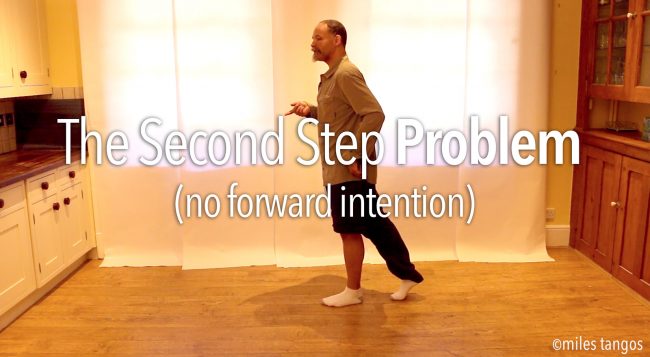
    Assuming for the moment that the Lead has placed their Follower on their left foot to start the dance. The typical opening first step, known as a Salida step, and then engaged in Forward Intention which in turn asks the Follower to extend their free right leg backward. This is, by the by, a huge assumption, and the problem child, because this is where the problem stated above (assuming that we’re doing X) begins. What happens on the next step is The 2nd Step Problem!

    What Is The Second Step Problem ? In it’s simplest form, as a Lead gets to the end of their first forward step, they’ll tend towards standing upright, or becoming vertical. And then thinking or believing that the Follower is following them, they’ll continue forwards without engaging Forward Intention on the next step. So in effect, they’re moving forward without sending the signal for the Follower to extend their leg. As a result, they’ll slide their foot (really their leg) ‘under‘ and into their Follower’s free space on the second step.

    The problem is two-fold, not just one. First and foremost, there’s a lack of Forward Intention going on. Secondly the Follower is giving the Lead a walking extension without actually being led to do so!

    In it’s complex form, this problem can come up anywhere. In the video above it’s show just from a walking step. In reality it can and will come up nearly anywhere at all. This problem/issue/concern is far more widespread than you think it is. The belief is that it’s just beginner dancers that exhibit this assumption. The reality is closer to almost anyone, almost 90% of dancers generate this issue.

    Fixing it ? The solution to this problem is actually not as simple as you might imagine, and it has everything to do with ingrained habits for both roles not just the Lead…

    However, since this is just a teaser post..you don’t get to see how to fix this problem…you should really subscribe!

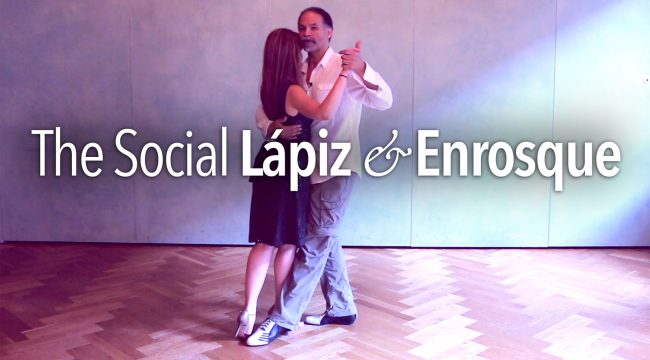
  • The Social Lápiz & Enrosque

    The Social Lápiz & Enrosque

    The Spanish word ‘Lápiz’ (pron: lah-pees – emphasis on the ‘LAH‘ and not the ‘pees’) translates to English as Pencil, and the word ‘Enrosque’ translates to English as ‘Screw’ or ‘Thread’. From a Tango perspective these are primarily ideas that relate solely to the Lead’s side of the dancing equation. Mostly. 🙂 A Follower can and does engage in a version of the Lápiz when applying a needle turn in ochos, or a planeo but as it relates to the Enrosque, it is very infrequently done by the Follower on their own. That said, let’s talk about the Social Lápiz & Enrosque.

    What is a Lápiz & Enrosque ? Let’s take those words one at a time. A Lápiz is a leg extension (and pointing of the foot/toe) done in a circular fashion in response to what the Follower is doing. Usually, this is a leg extension out away from the body (Forward to 12 O’Clock), then around to the side (at Nine O’Clock), and then the back (at Six O’Clock), and then back to collection. The Lápiz is usually done to the Follower’s Molinete or Traveling Ocho on their resulting backstep.

    Plays from YouTube. Pressing play connects you to YouTube. Privacy

    The Lapiz Exercise

    What makes it ‘Social’ is that it is very small, very tiny. Meaning that the footprint (no pun intended) should not take up any more space in the line of dance than say another step forward would. In other words ? No space.

    And what about the Enrosque ? An Enrosque is essentially the lead crossing one foot behind the other without space between the crossed feet (better known as a ‘clean’ cross) and then, here’s the hard part, unwinding that cross back to collection without wobbling, wavering, or using the Follower to do it! Typically the Lápiz and the Enrosque Follow each other. First a Lápiz and then the Enrosque.

    Plays from YouTube. Pressing play connects you to YouTube. Privacy

    The Stability Exercise

    The Free Tip. This is going to challenge you. No lie. The rotational pivot that has to occur over the standing foot, will drive you absolutely batty. Now try doing that while your partner is hanging on you, pulling you, pushing you….good luck with that. You must work on your own stability independent of your Follower. So here’s a free hint for you – more compression in the standing knee. The more you have, the easier this becomes. However, you do not want to be on your heel while you’re doing it! 😉 Good luck, you’re going to need it.

    Notation: It should be noted that the Lápiz is generally done in concert with the Follower’s Back Step of the Follower’s Molinete; And it can also be done with the Follower’s Traveling Ocho (Back or Forward). It can be done anywhere where the Follower is being led to transit around their Lead. At the same time, it can also be done with the Follower’s side of the Milonguero Turn. However, engaging the Milonguero Turn and then engaging in Lápiz is kinda ‘flashy’ and doesn’t look so good in our opinion.

    About The Video. This video is 14:03 in length in 7 Sections

    Section 1 – Introduction – 00:00:12
    Section 2 – Basic Technique – 00:01:29
    Section 3 – Close Embrace Exercise – 00:02:22
    Section 4 – Executing The Social Lápiz – 00:03:34
    Section 5 – Adding The Enrosque – 00:02:45
    Section 6 – The Social Version – 00:04:17
    Section 7 – Closing – 00:00:19

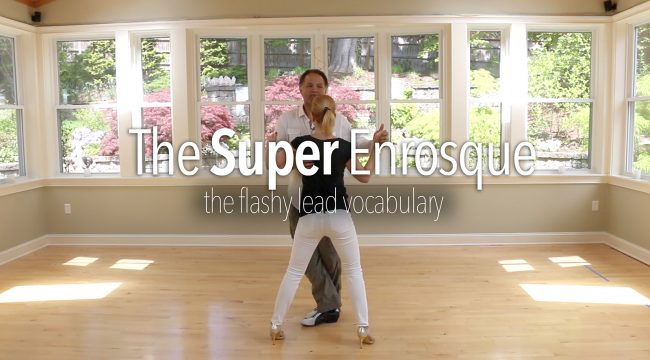
  • The Super Enrosque

    The Super Enrosque

    The Super Enrosque. There are only a small handful of things that a lead can do to ‘decorate’ what a Follower is doing. Usually, as Leads, we tend to leave the ‘decoration’ to the Follower. However we can in a small number of ways adorn what the Follower is doing, while they’re doing it. Doing so, tends to draw attention away from the Follower and towards the Lead, but sometimes that is desirable, sometimes. Today’s Tango Topic deals with one of these pieces of Tango vocabulary that isn’t seen too often (for a variety of reasons, see below), that when executed nicely can have a really nice effect on the dance, and at the same time open options and opportunities for both roles, not just the lead! 🙂

    Let’s get this out the way, before another word is read, the Enrosque, and it’s kissin’ cousin of Today’s Tango Topic: The Argentine Super Enrosque is quite simply Lead flash, spectacle, and nothing more than that. Furthermore there’s absolutely nothing here for the Follower to do or to think about. Got it. You do not need to add this to your repertoire of tango vocabulary. It does not need to be executed every 3rd step simply because you believe that it’s cool Nor does every Follower want you to do this. Once or twice is fine in a night and then LET IT GO, move on to something else. Trust that the room has seen it all before, they don’t care that you can do 57 versions in 3 minutes, nor should a single song ever be populated with more Enrosques and Super Enrosques than the time it took for you to read this. Never. Ever. This is flashy vocabulary. It’s fun, to be certain but lord knows you don’t need to execute it!

    That said, before we talk about what a Super Enrosque is, we have to define what an Enrosque is and is not!

    The word ‘Enrosque’ (pron: ehn-RrOhs-kay – accent on the ‘O’) loosely translated to English from Spanish means ‘Thread’ or ‘Screw’. However, from a Tango perspective it has a very specific meaning. This a Lead based piece of vocabulary that can be done as adornment or accent to what the Follower is doing. It’s usually done with the Follower’s Molinete, but can be done anywhere really. But the place where it shines really is the Follower’s Molinete. So what is it ? The Enrosque is where the lead will cross one foot behind the other (in a clean fashion – there should be no daylight between the feet) and as the crossing behind happens there’s usually a pivoting rotation of the bodily position – This is the ‘Screw’ part of the definition of the Enrosque, not the crossing feet part. An actual ‘pivot’ may occur, however where things get flashy and really where the Super Enrosque comes in, is where the Lead engages Applied Disassociation! There is a common misconception that the Enrosque also contains a Lapíz (a lead leg extension) that trails the Follower’s motion. This is not part of the Enrosque! It is it’s own separate thing, and you quite literally must separate these things, one from the other. Doing so will create a greater range of capabilities.

    Below you should see one of two videos: Free/Open users will see an Enrosque without any explanation of what should happen, or the paid subscribers should see the Entire Enrosque video from your Lead Technique section which fully explains the technique that generates the example videos. 😉 Without this explanation you’re quite literally pissing into the wind!

    What is a ‘Super’ Enrosque ? You’re going to ask yourself this question: If an Enrosque is placing one foot behind the other, or in front, both are true where the feet are in a crossed position, AND (the ‘and’ is very important) there is a pivoting bodily rotation that occurs. Then what on earth creates a ‘Super’ Enrosque ? MORE ROTATION! And in specific More Applied Disassociation, as there’s an enormous amount of super rotation that can occur due to the release of all that pent up energy. And that release creates some really interesting options and opportunities. 😉 So without further adieu: The Super Enrosque!

    There’s a lot that’s missing here…you need to subscribe to see the whole article which is extensive.

    The Free Tip.  In an ideal world the Enrosque is easy, and the addendum Lapíz is a snap. But as you’ll soon see, saying it is one thing, doing it is another! Which is to say that extending your leg for the lapíz after the Enrosque, is going to throw you off balance. You’re going to have stability issues, which is another reason WHY you study this stuff independent of the Follower not with the Follower! You only study with the Follower AFTER you have mastered the skills noted above.

    About The Video. This video comes in at 23m:34s in length in 11 Sections. Lead Technique is explained here in the video. No Follower technique is explored. 

    Section 1 – Introduction – 00:01:33
    Section 2 – Applied Counter Disassociation – 00:00:52
    Section 3 – Enrosque with Lapíz – 00:01:48
    Section 4 – The ‘Super’ Part – 00:04:08
    Section 5 – A Few ‘Gotchas’ – 00:01:41
    Section 6 – The Super Exercise – 00:01:40
    Section 7 – Super Exercise Notes – 00:02:26
    Section 8 – The Enrosque with a Follower – 00:02:50
    Section 9 – The Super Part – 00:01:25
    Section 10 – The Second Side Step – 00:01:20
    Section 11 – A Few More Details/Closure – 00:03:05

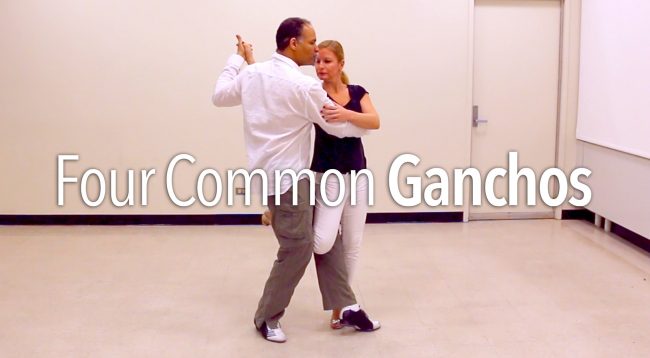
  • Four Common Ganchos

    Four Common Ganchos

    Gancho. The word in Spanish translates to the English word, roughly, as ‘Hook’. From an Argentine Tango perspective, it has a very specific meaning. You’ve seen these things hundreds of times, and while the vocabulary itself has a connotation as being somewhat ‘cheesy’, and only done by beginner leads who don’t know any better, the reality is a that it is a venerable piece of Tango vocabulary that do have a valid place off the main trunk of the Tango history tree. The story goes that while the Gancho existed long before Norberto “El Pulpo” Esbrez came along, his contribution to its storied history is where creativity meets innovation, specifically with regards to ‘elasticity’ and the Enganche. He is/was credited with pioneering and exploration the ‘invasion’ of the standing leg, the response of the free leg, as well as the space in between the opening of a step, and quite factually (if not literally), the intersection of these ideas.

    What is a Gancho ? In it’s simplest form, in the modern vernacular of Tango, it is a hooking of the free leg around your partner’s leg or thigh. It is an interruption of the extension phase of the step, which can (not always) result in the lifting of the respondent’s leg either as a result of, or by deliberate intention.

    Today’s Tango Topic deals with just Four of the most Common Ganchos and a few of their issues that happen for both roles. While there are many, many, many types of Ganchos to explore and play with, these 4 only scratch the dancing surface of them. They are the foundation for nearly every other Gancho that comes after them. The Rotating Gancho, the Gooey Gancho series, the Follower Gancho series, the Ganchito (which is an itty-bitty Gancho), the Lead Gancho series, the Volcada Gancho, just to name a few, owe their foundation to the Four Common Ganchos in Parallel and Cross System.

    The Free Tip. In all 4 of these Ganchos, for the Lead, you want your heel of the ‘free’ leg to be off the Floor. There should be no weight on it. Ever. From a Following perspective, sometimes you’re going to feel this desire to bend backwards, and you can’t.

    About The Video.This video package comes in at 49m:29s in length in 8 Sections. What you’re seeing above is only the introduction to the topic before we dive into the topics below. The one you probably want to see is #6 as it contains all 4 of the Ganchos. However, the rest of the videos make that last video possible. They’re all about set up, proper technique, and really the underlying method of how a Gancho works and where things can go terribly wrong, and how to correct for it.

    Section 1 – Introduction – 00:07:13
    Section 2 – Lead Technique – 00:04:01
    Section 3 – Follower Technique  – 00:05:38
    Section 4 – Free Leg Launch  – 00:05:13
    Section 5 – Gancho Exercise – 00:05:35
    Section 6 – Gancho Set up – 00:06:42
    Section 7 – Four Common Ganchos – 00:19:27
    Section 8 – Gancho Closeups – 00:15:17

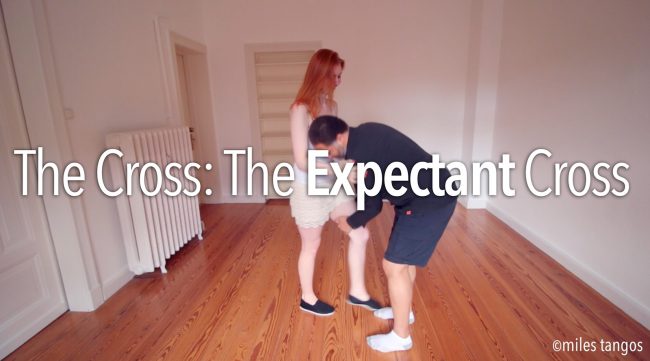
  • The Expectant Cross

    The Expectant Cross

    For most Lead/ers (and Leads) we lead the Argentine Cross so often that we stop thinking about actually leading it and it just sort of ‘happens’. The reason it just happens is because of it’s ubiquitousness, its frequency. You do this enough times and even the most battle hardened Follower will cross their feet just to shut you up so that you’ll stop asking for the damned thing! 

    The Problem: This is clearly a Lead/er (and Lead) issue. Contrary to what you may have been told the Argentine Cross is not two steps outside partner and the Follower automagically crosses their feet. If that were true then walking on 3 tracks would never happen. No the problem is the fact that we, as Leads, are expectant that we go to the cross, and then the cross just magically happens. We walk, they cross. Viola! Moving on to other things. Not! No. Not ‘moving on to other things’. The problem here is that you, as a a lead, are entirely expectant of the Follower crossing their feet every 20 steps.

    From a Following Perspective, 10% of this problem is your issue, the other 90% is your Lead. The fact is that you should adhere to one singular rule at all times (as a Passive Follow, not as an Active Follow — not yet at least). The rule (again as a Passive Follow – this rule doesn’t apply to the Active Follow) ? If you don’t feel it, you don’t go there. It’s a pretty simple rule really. If it’s not led, then you don’t go there. More clearly – if you’re not aware of what your Lead is proposing, suggesting, inviting, engaging, while they’re attempting to being insanely clear about what they’re leading – minus the arm pulling, tension, resistance, forcing, pushing, and pulling that generally passes for leading at most milongas….assuming there is none of that business going on, then there’s only one thing left: If you didn’t feel it, then there’s absolutely no reason for you to do anything. Period. No lead ? Then listen (note the language there….’listen‘ not wait….’listen‘ for what’s going on). Do not give the Lead a Cross, simply because they stepped outside partner and took two steps. Unless, and there is always an unless, one of two conditions has been met. Condition 1.) They’ve actually generated the proper conditions for an argentine cross to exist. or 2.) It’s at a Milonga. If it’s at a Class, a Practica, a Guided Practica, a Workshop, or a Seminar, then don’t cross your feet unless led to do so. Assuming what’s already been discussed. Every time that you do give a Lead a Cross, it reinforces the belief that they’ve led things in a desirable manner that is conducive to dancing. And every time that you don’t, you force the lead to … well … actually guide, invite, suggest, cajole, propose, intend,… ummm lead a cross! Mind you a discussion might ensue of why you’re not crossing your feet. Which may involve a teacher or two getting a teacher to discuss the matter. But that’s what they are there for anyway. 😉 

    At the same time, because we’ve broached the subject of the Role of the Active Follower, you do have a golden opportunity here because your lead isn’t clear, they’re not necessarily paying attention to what they’re leading at this point, this is an opportunity for you to interject an idea or two. More important to our point: To take a modicum of control and quite literally, if not factually, redirect the next step! I know…HERESY! Absolute Heresy! How dare I advocate a Follower interjecting an idea of their own….eeeek!

    Believe it or not, you can slow the Lead down at this point to accentuate what’s happening in the music, you can speed it up, you can even control what step will happen next, and more importantly where you want to go! That’s a part of being an Active Following, we want to start to engage with what’s going on! That’s why the language above is LISTEN and not WAIT! 

    However, as an Active (not Passive) Follow, there are 2 rules that we have to adhere to as Followers in this instance: 1.) If it’s not in the music, then it’s not on the floor! 2.) If you’re going to redirect the lead, then you have to have an exit strategy for where you’re going next and more importantly how to get out of things! In other words – a plan! To be fair it is important to recognize that a good portion of Leads freak right out when you ‘screw up‘ (which is really their fault to begin with because they weren’t clear) and then you take responsibility for by saying “sorry“.  One can only imagine if you interject an idea or two and watch what happens then. Talk about losing your proverbial mind! Good lord. So a.) Pick your Leads very carefully with this ‘active’ Following business, and b.) whatever you do, it’s got to be musically driven!

    While this post is not on the Role of the Active Follower per se, it does touch on it considerably because the cross is all about the role of the active Follower for a variety of reasons most notably because the Cross is the Follower’s vocabulary, not the Lead’s. That said it should be noted that as a Follower, this whole Active Follower business is a little scary at first but once you open the door way to that happening….really cool things can occur! Cool and wonderful things actually. 

    From a Leading Perspective, 90% of the reason why the Follower does not cross their feet is really your issue. Let’s call a spade, a spade: You expect a cross to just ‘magically‘ happen. The fact is that a good 99% of your crosses aren’t led in any way, shape, or form. You step into a parallel system cross (not exactly the most elegant crossing structure in the world, it screams ‘beginner lead’ ) and then take 2 steps, and the Follower just ‘crosses’ because they’re supposed to. Right ? There’s no question in your mind, or theirs. Right ? The problem is that is the problem! You’re not actually leading. You’re abdicating control of options and opportunities for both roles at this point. Every time that you expect a cross to magically happen, you create the situation for the Follower to actually take control and choose what’s going to happen next, whether or not you or they are aware of it. Mind you a good portion of Followers don’t do this, and they should because it opens options and opportunities for us to make other choices. At the beginning those choices are haphazard and untried and you’re going to stumble a bit. But in the end your versatility goes right through the proverbial roof! And we want our versatility to do precisely that! 

    We want to encourage an active participation behavior from our Followers because it makes them feel as though they have a voice in the dance. Why ? Answer – Imagine someone dictating to you what you should do all day long. Every hour of every day. You have a mind of your own, and you do like to solve problems your own way. You don’t like to be told what to do or what to think. But that’s exactly what you’re telling your Follower to do each and every time you dance with them. “Don’t think. Don’t move, unless I say so. Don’t have an idea! That’s my job!”. How boring is that ? Ideally you want them to be a co-creating partner in the dance. Not just a vocabulary plaything. Which is precisely what they are now. By going at things in a slightly different way,  you open the doorway to a far more satisfying and co-creating dancing experience than anything else! Don’t mishear this as ‘Passive’ dancing is bad (which is what happens a good portion of the time), it isn’t fun and Miles said….not! Some people like that. They like turning off their ability to chose and would rather let someone else do the driving. But then … (there’s always a ‘then’) a piece of music comes on that they really like and well…they get involved and would like to make a few choices on their own. But unfortunately they’re with a Lead who just doesn’t allow for this stuff. And it feels kind of limiting. And once they’ve gotten used to making a few choices, they’ll want to do more of it and make it a regular part of their dance to interpret those musical ideas they’re having in their head.

    Put another way, ideally we want to create ‘space’ for the Follower to have a choice in what they’re being asked to do. Doing so generates a sensation of comfort that you’re allowing the freedom to choose, which in turn generates an investment in what they’re doing and more importantly how they’re doing it. All this from an Argentine Cross! 

    The Dancing Reality is that no matter what’s written here, no matter what I say as a teacher, you’re not going to change what you’re doing. You’re going to keep doing what you do because you a.) don’t know any better. and b.) It’s comfortable. c.) Change is hard. d.) All this business of the Active Follower is absolute crap (unless you’re the Follower in which case, they completely get it). 

    Thought is hard. Better…yes…better is hard. So who wants to do all that work to be better when it’s so much easier to just to continue doing the same things over and over again! The reality is that you would rather continue down the pathway that you’re on than to change what you’re doing. The reality is that you like the automagical cross. It just makes things soooo much easier for both partners and really the whole floor if the Follower just crosses their damned feet. It means that as a Lead, you don’t have to think so much.  And as a Follower we can have about 10 seconds of what is essentially 2 and a half minutes of pushing and pulling, of peace.  That’s the reality. 

    Fixing it ? Well, there’s a really simple solution, it’s something that both lead and follower must do. Hmmmm, however as a FREE user, you’re not able to see the full solution, you have to upgrade to either a Silver, Gold, or Diamond level user! Once you do that you’ll be able to see this solution to this problem as well as over 100+ videos on tango technique, codigos, and more.

Hide picture