

Social Boleos
What is a Social Boleo ? First and foremost we must make clear the first part of the Term “Social” of “Social Boleo”. Social in this context that Tango Topics typically defines that word as: 1.) The Ronda of the dance floor, pertaining to the line, lane, and Tango Floorcraft of the couple. 2.) The Milonga experience. Meaning how you enter the room, who you speak to, where you sit, how you sit, what you dance to, who you dance with, how you invite or deny a dance. 3.) Fitting any and all vocabulary choices, regardless of which role is initiating it, within the physical width of the “lane” of dance, and the physical distance of one singular step that goes with the line of dance.
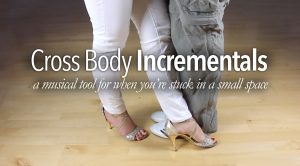
Cross Body Incrementals
What is a Cross Body Incremental ? In its simplest form a Cross Body Incremental is motion that is generated from Opposition, which results in the Follower’s leg extension across the meridian line of the couple, usually to the opposite side. The distinction between Cross Body Incrementals and a ‘step’, is that there’s typically no weight transfer at all in Cross Body Incrementals. Where it gets its name from is the fact this is all about, say it with me, ‘incremental’ motion. Meaning you don’t have to do this all at once but rather in tiny little bits, which typically match the beat, or an 8th or 16th note in the music (this is NOT shown in the video).
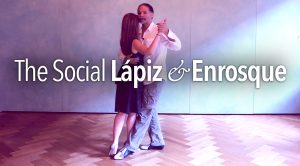
The Social Lápiz & Enrosque
What is a Lápiz & Enrosque ? A Lápiz is a leg extension (and pointing of the foot/toe) done in circular fashion in response to what the Follower is doing. Usually this is a leg extension out away from the body (Forward to 12 O’Clock), then around to the side (at Nine O’Clock), and then the back (at Six O’Clock), and then back to collection. The Lápiz is usually done to the Follower’s Molinete or Traveling Ocho on their resulting back step.

The Dark Side Salida
The Salida. The Spanish word ‘Salida’ translates in English to ‘Exit’ or ‘Left’ as in the past tense of the verb to ‘Leave’. However when we apply this to Argentine Tango it means something else entirely different. It is a process that includes Cabeceo/Mirada, and the Entrada in the line of dance, as well as the Exit (Salida) from the dance, and walking your partner back to where you found them. In BsAs, or more formal Milongas in the world (including Encuentros), this means walking them back to their table. This is the process known as ‘Salida’. However with regards to the dance we typically only equate the word Salida with Entrada phase of the dance, and this is known as a ‘Salida’ Step. An entry (or exit) into (or from) the line and/or lane of dance. There is typically only one that gets talked about and or shown, and that’s the very typical couple side step into the lane of dance. There are, as you might imagine, loads of others. Today’s Tango Topic talks about a very specific and special one referred as the Dark Side Salida.

The Argentine ‘Dip’
What is The Argentine Dip ? The ‘Dip’ is a very common form and expressive move used in most social dances. Argentine Tango has it’s own version of a ‘Dip’, however, this version of the Dip looks nothing like what you’ve seen before. It’s almost not worth calling it a ‘Dip’ to begin with but it is in truth of fact, the Argentine version does classify as a ‘Dip’.

Argentine Paradas
The word ‘parada’ translates into English as ‘stopped’. And that’s exactly what it is. A stop. From a Tango perspective this is a well worn piece of tango vocabulary that most people see as an element towards engaging the illusion of ‘intimacy’ of the dance, or it’s ‘steamy’ aspects. Anyone inside the dance knows that the ‘steamy’ thing is just that, an illusion, and that there’s real work to be done to make this venerable piece of tango vocabulary useful and musical. The vocabulary gets its name from the fact that we are stopping but it’s an unusual stop. It’s a stop not because you’re stopping the Lead’s motion, but in fact stopping the Follower’s motion. It’s more of an interruption really, because the ‘stop’ is momentary. With that thought in mind, let’s talk “Paradas”, what they are and how they’re useful for both roles of the dance.

The ‘Check’ Step & Incremental Steps
Check Steps/Incremental Steps. These are simple pieces of tango vocabulary really. It’s a step. Nothing more than that. Don’t get confused or lost in thinking this is overly complex. It’s not. It looks cool but there it’s insanely simple. It is leading and following a step. That’s it, that’s all. To be a bit more clear, there are two piece of vocabulary, one is an extension of the other. The Check Step…
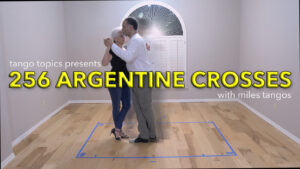
256 Argentine Cross Variations
What is an argentine cross variation ? In it’s simplest form it’s variation on where the crossing step can occur and in which direction, as well as who is doing the ‘crossing’.

Argentine Barridas
The word ‘barrida’ translates into English as ‘swept’. And that’s exactly what it is. A sweep. From a Tango perspective this is a somewhat ‘worn’ piece of tango vocabulary that most people see sort of schlock tango schtick. Most people start out with doing it a few times, and then disregard it because they’ve moved on to something else that’s more ‘flashy’. The Barrida is, in common vernacular, a ‘drag’ of the foot (either role can initiate it). And does have a useful application in the dance which is purely musical if not entirely navigational. With that thought in mind, let’s talk “Barridas”, what they are and how they’re useful for both roles of the dance.