Offer ends in Offer $99 for 1 year 1daysd 13 14 20 One year for $99 Get your year
Tango Topics info:

Check out the Tango Dictionary for words like Axis and Connection.

Tag: technique

  • The Cross – Getting In Front

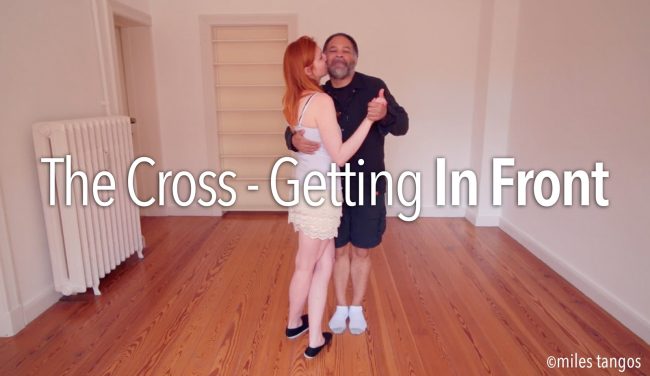
    The Cross – Getting In Front

    For most Followers, that haven’t been properly trained, they are rushed into an Argentine Cross right from the start of their Tango dancing lives. Aside from Ochos, it’s the one thing that they’re pressed to do without any training aside from the Lead/er (Controlling Lead hence the ‘/er’ part) that quite literally tells them what to do as they’re doing it. From that moment, right up until this one (assuming you’ve shared this video with them) they more than likely have no idea a.) why they’re crossing their feet. and b.) more importantly what the point of the Cross is, and c.) what it all means.

    The Problem: This isn’t so much a Lead problem as it is a Follower issue. Contrary to what you might have been told, the Argentine Cross does actually serve a function. And believe it or not, it’s not to do a Cross every 15 seconds for no good goddamned reason. No. The function of the cross…is well, you can watch the video for that part. The problem is that not only is the Follower not aware of what the function of the Cross is, they’ve been so indoctrinated into a passive way of dancing that they’ll a.) Willy-nilly cross their feet due Two of the Five Errors of The Cross – specifically the Automagical Cross and the Wimpy Cross (see below), where in the case of the latter, the Follower has to infer what on god’s green earth the Lead is attempting to do. (In the other 3 cases they don’t have to infer, they’re quite literally forced into crossing their feet whether they wanted to or not). and b.) That a good portion of the time, the Follower will end up in the Lead’s Arm Pit. It is for this reason that we talk about – Getting In Front of Your Lead!

    video
    play-rounded-fill

    From a Following Perspective, 10% of this problem is your issue. And it has to do with you understanding that the Cross is actually, in modern Tango, your piece of vocabulary. Not the Lead’s, it’s yours! There are many people that will disagree with this statement that the Cross is the Follower’s vocabulary. The fact is that without you cooperating, the Argentine Cross, is not going to happen. You could say this about almost everything else in Tango, that without you cooperating nothing happens. And you’d be right. However in this instance, this is one of the few places where the Follower has an enormous amount of control of when something is done, how something is done, and most importantly where we go next! All of that from you crossing your feet. In this instance, this one little piece of vocabulary is YOUR place for you to shine, to sparkle, to show off your skillz as a Follower. Instead, what happens ? Well…watch the video.

    To be fair, you have to contend with the Five Errors of the Cross (see above), and then there’s the squeezing, the pushing, the pulling from your Leads. And then there are your issues, while in heels, to contend with. That aside, you do have an issue which is solely yours, which is the whole point of this topic – to get back in front of your lead!

    The simple fact is that your lead (the action, not the person – lowercase ‘l’) either stepped outside partner or stepped into cross system and in either case you’re essentially out of step with them. The whole point of the cross is to get back in front of your Lead (the person).  However, part of your issue is that you’ve been indoctrinated to a way of moving that quite factually doesn’t work for you. The way that you’re moving is to send your leg straight back, and really to cross your body meridian away from the couple. This creates a problem for you, especially when you come to collect your feet in the cross. Your feet look like two mismatched and broken sticks pointing in opposite directions from each other with a watermelon in between them, instead of what they can look like. We do want pretty feet, but we don’t want pretty knees, when we come to collection and even crossed collection! However, there’s a tiny little problem in that your body is in the wrong place, and your hips are all twisted and you’re basically out of alignment with your Lead, and on top of all of that, you’re stuck in the Lead’s arm pit! And there you will stay…sadly. 🙁 Unless…you do something about it. 🙂

    From a Leading Perspective, before we launch into Follower’s side of this. Let’s give credit for this problem, where credit is due. The Lead! Dude, a good 90% of this problem is your fault. Let’s be clear about responsibility here. You created this problem and the Follower is only doing their best trying to fix it. How did this become your problem ? 1.) You lined up with the Follower in your Arm Pit! You placed them in there right from the gitgo (‘start‘ for the non-native english speakers), and what’s worse is that you kept them there, holding them in that spot, because it was convenient for you to pull off some crazy vocabulary, which you think you need to lead every 20 seconds, instead of (gasp!) actually walking with your Follower to the music. Eeeek! Which for some reason is ‘boring’ to you but heaven to them…gosh I wonder why !?!?!?  2.) Your embrace that you think is comfortable is like laying on a bed of nails because it’s too compressive! Think ‘squeeze‘ and you’ll get the right idea. And even if someone tells you that to lighten up and let them loose, you’ll go right back to squeezing the daylights out of your partners because to you think, a.) this is comfortable. and b.) it’s all you know. 3.) Because your right arm is like a vice grip and you have this rather nasty tendency to paddle your Follower’s with your right hand to ‘direct’ them, you somehow believe that this is desirable. Ummmmm not! And lastly you created this problem by 4.) being too damned restrictive and not being responsible by continually placing the Follower in front of you by repositioning your vocabulary to do just that. Instead, doing all 3 previous things to show off to keep the Follower from realizing that you were completely ignorant about 3 steps in and don’t have a plan for the rest of the song let alone for the tanda! Yup, your fault.

    The Dancing Reality is that this stuff happens with such frequency that no one, not even the teachers that you’re studying with pay it any mind. It’s so commonplace that one wonders if anyone is actually teaching technique to specifically create this issue! “Leads! You place the follower in your armpit, and then rush around the room, all the while pulling and pushing! Followers, your whole job here is to stay in the Lead’s armpit and then to come to a crossed collection so that your hips are all twisted up and you’re off to the side of your lead! Ready ? Go!”. Not!

  • Lazy Follower Foot

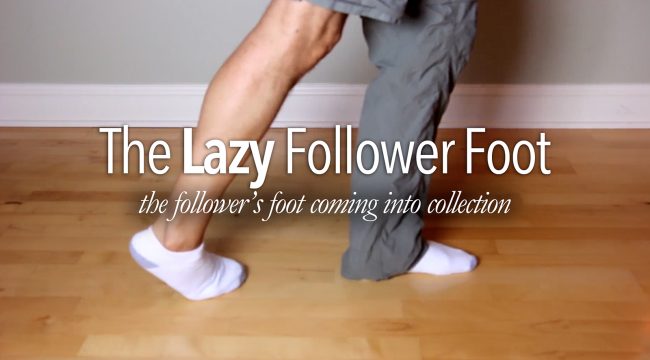
    Lazy Follower Foot

    Lazy Follower Foot. Most people don’t think about this stuff except for when they’re in a class or a Follower Technique Seminar, or in a private lesson. Mostly they hear it and completely forget about it about 10 seconds after it’s been said. That is unless some diligent teacher continually reminds you of this stuff, constantly. To be fair, while this particular topic happens a lot for Followers, this happens everywhere across the entire spectrum of the dance and into real life. If someone says something to you that needs to be corrected, it will take you a few tries to remember to do it, and even then that’s a stretch. The fact is that you’re dealing with muscle memory or in this case ‘muscle comfort’. It’s comfortable for you to do this stuff. So why change it. The reality is that the change comes hard to some people, and comfort is easy. If you’re comfortable why bother changing ? Right ? What you may not realize is that that comfort may or may not be desirable to look at, as in this case of Lazy Follower Foot.

    What is ‘Lazy Follower Foot’ ? It is a state where the Follower’s back foot as it comes into collection from a Forward step, is either dragged without care or unconsciously. The foot itself, seemingly hangs off the ankle, and is summarily dragged into collection from the Forward step. This doesn’t happen from the Back or Side step, that’s the ‘Dangling’ Foot error. Whole different ball of wax, but the solution is exactly the same as shown in today’s video! 

    The Error In Your Thinking. The reason why this dance was challenging for you, and this is the error, is that’s just their ‘style’ of dance, and it’s not your style. Yes there is an estillo to some people’s dance, but sometimes with the more advanced dancers this isn’t about style…it’s about technique and the execution of that technique! So, put simply you’re missing the other side of the equation: You’re not ready for them! And the reason is, because your understanding of your own technique, your underlying foundation, how you move, how you land your feet, how you extend your legs, how you embrace your partners, where you place your body in relationship to your L/lead, where and how you engage X piece of vocabulary…all of that stuff is not trained in you. It’s just not. Further, because you’re dancing with a certain class of L/lead mostly you only get to experience a very small sliver of what a fully trained and operational Lead can actually do. Further still the Neurology of Following (as opposed to the Neurology of Leading) is lacking in you. So as a result you ‘miss’ things. So a Lead like that above, is mostly lost on you. Yes it’s insanely fun, and challenging, but you ‘missed’ so much and what’s worse is you know it. It wasn’t embarrassing, thank god, but you know in your heart you missed so much of what was ‘said’. You missed the nuances. The subtlety.

    Diving Deep.

    There is a reason this stuff happens, actually four possibilities: 1.) Poor execution of technique. 2.) Poorly understood technique.  3.) No Practice. or 4.) All of the above!

    While it’s not rocket science what those things mean, they do require a bit of detail.

    1.) Poor Execution. This means that your attention to detail of your technique is sloppy. Meaning that you allow your foot to unconsciously move as it sees fit to move in relation to your ankle and leg. Even though you have been shown X, it’s not showing up in your dance. Either consciously or unconsciously.

    2.) Poorly Understood. This happens quite frequently. We hear ‘X’ when a teacher says something to us, and in reality they meant ‘Y’.  But because we hear it through the filter of our understanding we end up misunderstanding more often than not. Poorly understood means that you hear or see something and presume that ‘A’ is ‘A’ instead of diving deeply to dig down to the roots of what ‘A’ actually is. To see it’s inner workings. Not just to accept it, but figure out for yourself how and why something functions.

    3.) No Practice. This should be a no-brainer. But you’d be surprised just how many people will go to a teacher or a class and magically expect them to fix everything, and that now that they’ve visited with teacher ‘C’ that things are all better and they can go back to what they were doing in the first place. Because teacher ‘C’ said they’re “you’re doing fine but…” and “that’s fabulous, and…”, or … did you see it ? Probably not. You missed the ‘but’/‘and’ at the ends of those sentences. You only heard the praise and not the rest! Which was… “You should go home and practice the frak out of this stuff that I just spent the better portion of the last hour showing you! Not to mention you just handed me a boatload of cash to tell you this stuff, so you had damned well better go home and practice this stuff!!”.

    4.) All of the Above! This needs no explanation. It’s not one or the other, but actually All of them together.

  • The Four Parts of Social Milonga

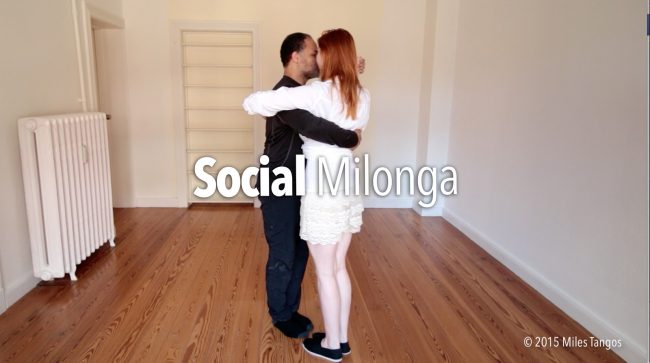
    The Four Parts of Social Milonga

    Milonga, and really ‘Social’ Milonga, is a difficult dance to Lead, but an easy one to Follow. Easy, if and only if, the Lead (person, not the action – ‘lead’) has a frakkin’ clue about what they’re doing. If they don’t, you, as the Follower are screwed and not in a good way either! Good Milonga is a step above modern Tango in that it requires both parties to be at their best technique wise. It requires both parties to understand an embrace that is non-compressive, non-restrictive, and have mastered a stable, clean, clear walking platform that does not ‘thud’. There is no need to ‘hang’, ‘pull’, or ‘push’ in any way, shape, or form. 

    Let’s get a few terms and definitions out of the way before we go any further for the initiated and the uninitiated. The word ‘Milonga‘ has 3 definitions.

    1.) It refers to the ‘dance’ party, and social experience that we aspire towards dancing at via classes and workshops and learning the codigos of the dance itself. The whole point of tango is to emulate the Milonga experience as a whole that we would find in Buenos Aires.

    video
    play-rounded-fill

    2.) It refers to a musical style of music that is typically written as 2/4 time, or at about 80 – 100 beats per minute. There are several versions of Milonga music, not the least of which is Tango-Milonga, Milonga Porteña, Milonga Criolla, and a few others. Candombe is not Milonga, but is frequently confused with Milonga. A poorly trained DJ will add one into a milonga tanda thinking that it’s Milonga music when in fact it’s not.

    video
    play-rounded-fill

    Further still, a common error is to add a Foxtrot or a Tango Foxtrot, thinking that it’s milonga when it’s not.

    3.) Refers to the dance itself, which is a frequently, and mistakenly thought of as a subset of Tango movement, and this is an error. Milonga (not Milonga Porteña or Modern Milonga) begat Tango, and from that Tango as we think of it today grew.

    What is ‘Social’ Milonga ? Social Milonga is a Milonga of ease, of least resistance, of effortlessness. It’s what we would dance at the Milonga when Milonga music is played but for a social environment not a performance! Which translates to smaller (very small) movements, and steps. This isn’t about turns, ganchos, volcadas, sacadas, colgadas, death drops, …. no, none of that. Simple, clean, small movement. Rather it’s about linear movements with one’s partner in either close or open embrace (yes Milonga can be done in open embrace), small linear movements that move down the line of dance. Social Milonga should not back up against the line of dance, but rather angle against the line of dance, think of 45º angles so that no one backs up directly into another couple. Social Milonga is small, compact, and doesn’t need to take up a whole lot of space…ever.  Horacio Godoy, who is a god of Milonga, is a good example of performance milonga, but it’s still a performance! What he’s doing is nothing short of magical, however…it should be noted that again, it’s a performance and not social dancing. He’s taking up oodles of space, and in the line of dance, you don’t have oodles of space! This is Social Milonga.  

    Just as a side note: Social Milonga rightfully should never be attempted with a new partner that you’ve never danced with before.

    From a Following Perspective, you’re in for a rough ride, because a good portion of your leads don’t have a frakkin’ clue as to what they’re doing when it comes to Milonga. They will either race you around the floor and take a breather in odd places that have no relationship to anything that’s happening in the music, all the while squeezing the living daylights out of you, hoping you won’t notice that they’re not anywhere close to a beat that has any relation to anything that’s happening in the music. Or they’re so timid as to not wanting to step on your toes because they’ve recognized that this is insanely difficult that they back off completely. That’s the bulk of your experience. It’s rare, ever so rare that you have a lead that dances Milonga Lisa with you, and then expands that to Milonga con Traspie, and actually builds a milonga experience on the whole. These leads are rare, but oh such a wonder when you find one. It’s like Christmas morning, Easter day, and a box of chocolates all rolled into one! Fab! At the same time, let’s not kid ourselves…you as the Follower, have to be up for the challenge. Which is to say that your skills in Forward steps, Side Steps, and Back Steps must be absolutely spot on! Repeat after me: “I MOVE ME“. You must be responsible for your own movement. You must listen to what is being led (not waiting but listening) and then engage that movement immediately without fail. If you feel it, you go there, if you don’t feel it, you don’t go there. A good portion of the time, most followers fail these most basic things. And we end up with a less than desirable experience.

    From a Leading Perspective, it means that you must have mastered all of the things listed above in addition to understanding and employing ‘Intention’. Why ? Because Milonga is all about the small, tiny movements, not about squeezing the living daylights out of your Followers with your embrace trying to make things small. It’s about leading small, tiny, incremental. It’s not about big, galloping steps…it can be, but isn’t. It’s about the tiny movements between the partners to the accents in the music.

    However, the real key to milonga is the Weight Change. Being able to generate it in its myriad of forms without pushing, pulling, using force, and/or compression to accomplish this goal. If you can lead a weight change through opposition or a with-weight change instead of pushing or pulling, you’re onto a better class of leading as a whole.

    Leading Milonga, or we should say, “modern” milonga, is a whole different class of leading. And doing it well, is a different kind of Lead (the person, not the action). How’s that ? This is choreographing on-the-fly, they’re making minor adjustments on-the-fly, they’re maintaining the line of dance on-the-fly…are you seeing the trend yet ? > on-the-fly! Is the key component. Mind you this happens in Tango and Vals as well, but there is a difference! The difference is the kinesthetics involved are a whole different class of minimal, minute movement, that is seemingly imperceptible except to the people dancing it, and to the trained eye.

    In this version of Milonga the same thing that happens in the 5 Common Social Figures (which is a reduction of vocabulary choices) of Tango, happens in Milonga! Only instead of 5 Common Figures, it boils down to about 4 very specific choices.

    1.) A variation of the Baldosa Box.
    2.) A very simple and occasional Traspie, with a single Traspie, not multiples but not, and mostly not aligned with the habanera’s El Golpe! (and if you don’t know what that is…follow the link). You might…eeek, learn something.
    3.) An occasional scissor step (not a pendulum step). and
    4.) Every once in a blue-moon when there is a ‘race’ in the milonga beat and not the habanera, Patter In Milonga is used to accent the race of the beat.

    Most of the better Milonga Leads have realized that a simplified Milonga is actually a better way to go than to race around the room which is what typically happens and why the better Followers will say “NO” to a particular Lead/er (follow the link for what that ‘/’ means) repeatedly. The better Milonga Lead will engage this simplified Milonga over and over and over again. It will look somewhat repetitive until you actually dance the Milonga with that Lead and for a time after the shock wears off that you’re dancing Milonga with that Lead it may even feel somewhat repetitive, until you start to listen to the music, and then the genius hits you like a ton of bricks. It’s simplified for a reason, to accent the music itself! Which is to say that you don’t need a vocabulary for good Milonga, what you need is an understanding of Music. And for that you first have to be able to hear the Habanera, and then, and only then can you start to play with the music. Once Habanera awareness occurs, and it will take some time for this to happen, it’s not something that happens overnight. More on this in a bit. Once Habanera awareness occurs, then the refinements of the dance of Milonga start to happen. Sometimes. Some Leads never, ever make this leap of logic > Less Is More. Most of them go in the opposite direction > MORE is BETTER! And this is a mistake. But they don’t and won’t ever realize it for a wide variety of reasons that are too numerous to mention here. Suffice it said, some folks never learn.

    And unfortunately this space is too small to incorporate those ideas here. Fortunately for you Tango Topics does possess a Milonga track > Milonga Madness that discusses some, not all, of this stuff. For the rest that isn’t covered in Milonga Madness, we strongly recommend a long series of private lessons with the Author!

    From a Dancing Perspective, ‘Social‘ Milonga is insanely difficult to master. It requires all of the above to ‘work’, to ‘function’ with ease. Not an easy task at all. When done properly it’s simply divine. When done poorly…well we’ve all had that happen, and it’s just an absolute disaster. There’s no nice way to put that. More often than not we have all had far too many Milonga tandas that is nothing short of “GAWD PLEASE MAKE IT STOP!”. And a good portion of the time it’s because the embrace needs to be reset and is too restrictive, and/or the Lead (person), needs to actually listen to the beat and then walk (see ? walking, not running) the Follower on that beat…but doesn’t.

    The Musical Prerequisite

    There is an absolute prerequisite to this milonga business – two things about Tango Music as whole that you, as a Lead, or a Follower must know:

    a.) The Musical Pause in Tango Music as a whole! Without understanding this, you’re kinda screwed when it comes to dancing and really milonga as a whole. Oh and if you’re thinking that you can just ‘count’ beats and that will get you to your pauses…no. Fully 40% of Tango music does not contain an 8 count beat. Sometimes its a derivative of 4 yes…but sometimes it’s 4,8,12,16, or 24 beats before you hit an actual rest. So counting is about as useful as a small kitchen appliance unplugged. Why ? Because a good portion of the time, your count will be off for a variety of reasons. 1.) The transfer from shellac to digital (assuming it’s that direct and it almost never is) is probably flawed, scratchy, crackly, and slows down and speeds up. and 2.) Two words for you — TANGO MILONGA, which is to say that that the 2/4 time signature that you’re used to hearing in Milonga Porteña (or Modern Milonga), not so much with that! And that’s just the tip of the iceberg. Long story short, you want to actually learn to hear the 5 Major Types of Pauses in Tango Music.

    b.) The Rhythm of Milonga which should not be confused with beat, melody, nor tempo, which is what a lot of you do. You do actually have to understand the Habanera Rhythm which is the basis of ALL Milongas. Not Candombe, Not Foxtrots…MILONGA! If you don’t know what the Habanera is, and/or think you have a handle on it, you really do want to go look at this definition of the Habanera on TangoTopics. This is the Rhythm that you absolutely must pay attention to because it quite literally forms the backbone of the music itself. If you can’t hear that, if you cannot find it in the music, then we have a problem, and it may require you to actually do a little study. Now to be fair, there are some milongas where the Habanera only appears sporadically, there are some milongas where the Habanera is a variation and you have to hear the variation, there are some milongas where the habanera is so distorted and so off of what you think it might be that it’s almost….ALMOST unrecognizable. However, that’s still no excuse for not practicing, and then working on finding the Habanera and then figuring out WTF to do with it.

    That said…

    Rather than show you charts and images which are about as helpful as a screen door on a submarine…let’s skip to a class summary by Oliver Koklier and Silvina Valz shot at the 2009 Portland Tango Festival. This is probably one of the best didactic Milonga videos you will need to see…ever. What Oliver & Silvina talk about in under 9 minutes will blow your mind. It’s a simple, clean, and clear, almost religious explanation of what Habanera and really the Milonga Rhythm is and is not, and what you can do with it. In 90 seconds they pretty much nail the Habanera. Quite honestly contained within this video is the basis of almost everything you need to know about a Milonga Rhythm. Once you understand the Rhythm of Milonga (and it is a rhythm, not a beat!) it is only then that we start to talk about what you actually do with it.

    Ok, now that you’ve got your pound of free flesh that will only help you so far, now comes the real toy, which when this article was written originally hadn’t actually happened yet. Actually this article was written a year before what we’re about to talk about: Milonga Madness. This is going to sound like a sales pitch for Milonga Madness. It’s not. It’s the fact that we really have studied with a lot of people on this topic, spent years and more money than you can shake a stick at, at how to hear Milonga and then dance Milonga. This is one of the ONLY workshops that we’ve ever attended where we came away with a deeper understanding that Milonga does not need or want to be complex. It is a simple thing that does require you to actually hear the Habanera. Without that, then you’re just racing around the room. So here’s our advice. Go subscribe to Milonga Madness, you won’t be sorry! Truthfully, and we say this with how much we teach and talk about tango, it’s even better than all our own videos! Go SUBSCRIBE! Just scroll down to the bottom of the page, and click on the Milonga Madness Button! You’re welcome.

    4 Parts of Social Milonga

    Part 1.) The Baldosa Box & one of several Baldosa Box Variations
    Part 2.) Milonga Traspie and the many many variations
    Part 3.) Scissor & Pendulum steps and variations.
    Part 4.) Milonga Patter

  • Lead Technique 2019

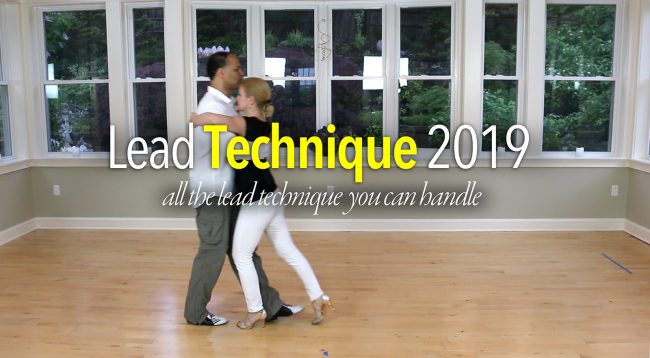
    Lead Technique 2019

    Leading. Often the first thing we see when looking at Argentine Tango is the Tango Lead. It’s that sharp, clear, clean visual that strikes us almost immediately. We see the the visual of someone leading, and it’s this confusion, appreciation, amusement, bewilderment and just down right awe (in some cases) of a ‘wow’. Next the thing that we pay attention to is what they’re doing, not how they’re doing it, but what specifically they’re doing. You’re waiting, with anticipation, for that next cool, flashy move that screams – ‘Good Lead’. And the last thing that you start to become aware of is the musical expression, meaning how they’re placing the what they’re doing in time to the music, not necessarily how specifically it relates (that’s called interpreting the music by the way) to the music but really the execution in time to the music.

    Truthfully depending on where we are in/at in the spectrum of leading (the activity), then this explanation of the dynamic of leading can be an eye opening experience on multiple levels for a variety of reasons (again, depending on where you are on the spectrum). At the same time, that experience is what usually shapes us, defines us, and ultimately it will inspire us to want to study toward being like that which we see…to emulate it. 🙂 Or it may turn us off entirely for a variety of reasons, perhaps because it looks too complex, too difficult, or it’s too much, or not ‘us’ at all. Again, this all depends on where you are on the spectrum of leading. If you’re just starting out then literally everything you see everyone else is doing is nothing short of magical. The further you go towards the ‘advanced’ dancer and closer towards the teacher class dancer (those who could teach but don’t) realm the less magical things are and the more technical things become, and the more you want to figure out why X, Y, and Z happens. That’s exactly where this topic comes into play. 

    This topic assumes that you’ve gotten beyond the “Wow!!! That’s Amazing!!” phase and have just started to get down to the actual business of leading. And to be clear, this topic also assumes that you’ve gotten beyond the rudimentary foundation of walking, embrace, turning, crossing, and leading ochos, and are looking for a change towards something that looks a bit more elegant than the random, haphazard thing you have witnessed at your local milongas that’s loosely called ‘dancing‘.

    Perhaps you’ve started to pay attention to how someone is doing X, Y, and Z, and found it to be lacking or amazing and wondered….’how do they do that ?’. Or more than likely you have caught a glimpse of yourself in the mirror as you turn a corner and are either impressed with what you see and want more, or generally you try to avert your eyes as you pass by a mirror or someone’s facebook picture of you. You generally try to avoid it because you know it’s just going to be awful to look at. The mere thought of you leading, or watching yourself lead, is an exercise in excruciating visual pain. You know where all the problems are at, you know what you have forgotten in the multiple private lessons that you’ve taken, you know that you should be practicing this stuff on a daily if not weekly basis but you don’t. You know all of this stuff…you’ve just forgotten it, and there it is in the mirror, staring back at you, unapologetic, and very truthful that you could do better than you are right now.  

    If all of that is true, then this topic of Leading Technique is all for you. 

    What is ‘Leading Technique’ ? First let’s get a few words out of the way. L/lead, L/led, L/leading, Lead/er. 1.) A ‘Lead’ (note the capitalization) is the person who is performing the action of initiating choices in the dance that we know as Argentine Tango. In this state, it is not a given that the person initiating choices is initiating those choices through Intention Based Dancing. More on this later. 2.) A ‘lead’ is the activity or action of the role of the Lead. In this state, this activity employs the usage of ‘Intention Based Dancing’ at every point along the course of an active dancing experience. 3.) The action of someone who is doing the activity of the role of the ‘Lead’ is someone who has ‘L/led’ or is ‘L/leading’. And last but not least, ‘Lead/er’, this is not what you think it is. It’s a person who quite decidedly uses their arms, forearms, biceps, fingers, and hands which employes layers or levels of pressure and/or compression (squeezing) their Followers to physiologically force, and/or indicate and then to direct their Followers to do X, Y, and Z. The Follower in this instance is told verbally (most often) to create ‘Resistance‘ so that the Lead/er can “feel” the Follower.  This is known as Resistance Based Dancing that reinforces La Marca as the way to indicate choices and then to respond to those choices. The reason for the capitalization trickery and chicanery is to create some clarity and specificity with the language that is used to describe these things.

    For the purposes of this article we will be using L/lead, L/led, L/leading to talk about Leading Technique.

    Leading Technique is about how a Lead walks, how they land their feet, how they engage their posture, and how they engage their embrace to a.) Invite. b.) Cajole. c.) Suggest. d.) Propose. And then finally e.) Initiate and Follow through to the execution of some piece of intended vocabulary. But all of that stuff has to first start with a clean and clear base. And that’s what this entire video series is about. It takes the foundation material that is generic for both roles, and then applies it for the role of the Lead and what has to happen to those physiological movements in order to “lead” with Leading Technique.

    This is Leading Technique.

    Free Advice – Change. (Change isn’t going to happen by itself. It requires a few thing. First, a willingness to make these kinds of changes. Secondly, a good, reliable source for this kind of information. And thirdly demonstratable, repeatable information that you can play with, over and over again.

    Is Leading Technique easy work? No! Although to listen to some people spouting their idea of what the Lead can and should do, you’d think you can master this stuff in an afternoon. Ummm in a word, “NOT!”. Is Leading Technique, as a whole, something you can learn in a 6-week cycle? Possibly, depending on the teacher. But really Leading Technique takes more than a few sessions to work out the bugs (as it were). First and foremost it’s about Body awareness. Your own, not the Followers. The ability to hear/feel your body in every detail and nuance. Being able to tell when something isn’t right or it is!  Secondly, it’s about balance and stability, again…your own. Not the Follower! And lastly Leading Technique is about hyper-awareness, using your nervous system, to accurately gauge where the Follower is in space and time in relation to the Lead.

    About The Video. This video is 9 separate videos for a total run time of 101 minutes! 

    Video 1 – Overview & Exercise – 00:23:21
    Video 2 – Opposition – 00:17:37
    Video 3 – Lead Extensions – 00:04:08
    Video 4 – Lead Foot Placement – 00:05:50
    Video 5 – Lead Entry Paths – Part A – 00:03:00
    Video 6 – Lead Entry Paths – Part B – 00:02:02
    Video 7 – Lead Embraces Foundation – 00:14:54
    Video 8 – Lead Embraces – Repositioning – 00:17:43
    Video 9 – Enrosque Foundation – 00:12:20

    The Ultimate Arbiter. The last word on this subject is not your teacher, it’s not this website, nor is it you. There’s really only one arbiter of good taste in this case, and it’s the Follower. If the class of follower that you’re used to dancing with approves of what you’re doing, you’re on to something. Truthfully they are the final word on whether or not you’re doing good things or less than desirable things. That assumes that a.) You have the fortitude to ask (at a practica) about how you look and feel to them. b.) That their response is honest. (Frequently they’re not for the reasons already stated above) and c.) There’s some kind of meaningful feedback that you can pull from the most basic of frequent replies “That was nice”. Which is the extent of what you’ll get most of the time, unless you ask a series of leading questions of what in specific was ‘nice’ about it.

    You know you’re on to something when other people that you don’t dance with acknowledge the change in you and start to compliment you on the difference in you.

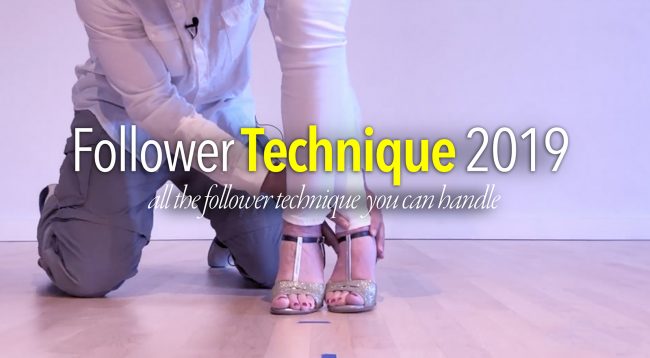
  • Follower Technique 2019

    Follower Technique 2019

    For most Followers the words “Follower Technique” boils down to 5 things (minus adornments and embellishments): 1.) Posture. 2.) Embrace. 3. ) Forward Steps. 4.) Side Steps. 5.) Back Steps. Sometimes this line of thinking may cover the concept of Body Position (where one is in relation to the Lead) and beyond that even, Body Placement (what one does with that Body Position – e.g. vocabulary) within the construct of the embrace (e.g. how to stay in front of and then with your Lead). The thinking usually stops right about there. Most Follower’s, and even Leads don’t even consider that Walking-in-Opposition, then Disassociation, and then finally, Applied Disassociation as a basis for Follower Technique, and why it’s an important piece of the equation in certain pieces of Tango Vocabulary (such as Traveling Ochos, or the Follower’s Molinete). Today’s Tango Topic deals with explaining this stuff and then going a little deeper with these things. It should be noted that just because the title is “Follower Technique” that the Lead should tune out because there’s nothing here for you. And that would be flat out wrong! This topic is not just for Followers looking for a hint, any hint, that could boost their understanding. It’s also for the Lead wanting to understand what the Follower has to do in order to stay with them. So without Further yapping, Tango Topics Presents: Follower Technique.

    What is ‘Follower Technique’?In its simplest form, it is a series of skills that when put together create a ‘dancing platform’ for the Follower. This is a platform that the Follower builds into their body through painstaking, detailed, carefully crafted motions that consists of: How to walk forward, side, and/or back; What one’s stance or posture should be like and under what conditions it may change; How to embrace and where and why;  What Close Embrace wants to be; What Open Embrace wants to be; Where and how the Follower has to be in relation to their Lead, within the different embrace types (‘Close Embrace, Open Embrace, Vee Embrace, Open Vee, Closed Vee, Berlin, etc) so that they’re always…always…always in ‘front of’ their Lead;  How to land the foot; How to extend the leg; Where the knee bend occurs;  Why one would ‘open’ one’s hip and under what conditions;  How to generate a slight open ‘v’ with the feet, and when, where, and why one would want to do that….just to name a few. For most people when they hear the phrase “Follower Technique” they think ‘pretty’ feet or most people think of Follower technique as just the Follower’s Back Step or a Forward step in the Molinete, and everything else just sort of works.

    That’s not true.

    Follower Technique is an economical, efficient, movement platform that is based on decades-old work, that many Followers have passed down from one Follower to another, who have been out social dancing within the Milonga experience. And then taken that social dancing knowledge and refined it, honed it, made it their own.

    Follower Technique can go a lot deeper…a lot deeper! In Deeper Follower Technique, the Follower studies all three of the three primary steps and then takes it to a whole other level. Truly, Deep Follower Technique is all about the detail, it is all about the precision. And lastly, but not the least of which is that it’s all about the execution! Yes it is learning about to use one’s feet in relationship to the structure that is Argentine Tango, but it is also about learning how to use one’s body in an efficient, economical, and elegant way that accentuates themselves as well as their L/lead and what’s being done, while at the same time keenly aware of one overriding principle: One Step At A Time! But contained within that step is a monster amount of kinesthetic awareness, body consciousness, physiological history, a corporeal locomotion, muscle memory, tendon memory, nervous system memory, that when executed altogether – creates that one singular step that brings into it all of the things mentioned before.

    This is Follower Technique.

    Is Follower Technique easy work ? No! Although to listen to some Leads spouting their idea of what the Follower should or shouldn’t do, you’d think it was a cake walk! Ummm in a word, “NOT!”. Is Follower Technique, as a whole, something you can learn in an afternoon ? Possibly, depending on the teacher. But really Follower Technique takes more than a few sessions to work out the bugs (as it were). This isn’t about balance and stability, yes those things are there but there are other things to consider. In the end Follower Technique wants to become rote behavior, second nature, a naturally built-in response, or default but controlled, contained, and conscious behavior in the person that is dancing the role of the Follower. So a better answer to that second question is “NO”. Follower Technique is going to take a while. And anyone that tells you different either hasn’t studied the role of the Follower for very long or is lying through their teeth. The fact is that Follower Technique takes years to get, then to adjust and finally to perfect. And going further down the rabbit hole what works for some people may not work for everyone! In case you were unclear on this part, some people’s bodies are built differently, and that means their anatomical areas may not necessarily line up with what some Amazing Follower Teacher has said and/or shown. So, no, sometimes other ways of moving have to be employed. Follower Technique is not a one size fits all! Some of it is, and some of it isn’t. The part that is confusing about it, is figuring out which one is which! 😉

    What To Focus On ?  The Follower wants to pay attention to these things in sequence:

    1.) Posture, Posture, Posture. Learning what it means, from a Tango Perspective, to stand upright without creating rigidity in one’s body or stance. Learning how to elongate one’s spinal column without injury and/or pain. Learning how to lengthen one’s body, how to stand, how and why a slight compression (a micro-bend) of the knee is incredibly important…everywhere! That’s a hint by the way…the rest of this type of information is in the Foundations Video Series. However, one’s posture will affect the next 8 points. Hunch over, and nothing looks desirable. Ramrod straight, and you end up looking like a Robot. We want something in between that is comfortable and maintainable.

    2.) The Weight Change, and later on the weight transfer. A weight change is done from a standing or collection position. A weight transfer is done from passing through collection position!

    3.) The Leg Extension Begins Where? The leg extension comes from a very specific place, and understanding what that place is and under what conditions, and why is insanely important. As a.) The conditions are not always the same. and b.) The Extension is not always the same under certain conditions.

    4.) Extending The Leg. This is actually extending the leg from a static position and working that extension over and over and over again. But more importantly focusing on what that looks like from multiple angles, using video from the side and from the front and back, and not just a mirror. Mirrors can and do ‘lie’ quite frequently. “Lie” isn’t the right word there. More like when you’re looking in the mirror, you only see a moment of time, not the entire thing. And you want the entire movement over time. It is for this reason that the Follower wants to use VIDEO from the side, and front, and back…constantly IN ADDITION to the mirror!

    5.) The Shape of the Leg over that same period of time – where the knee must bend, and why, and under what conditions because they’re not always the same!

    6.) Landing the Foot, where, and what part of the foot one lands on, and under what conditions. Because again, it’s not always the same. Which may come as a surprise to some of you reading this and wondering what those conditions might be. Here’s a helpful hint: SUBSCRIBE!

    7.) The Shape of the Foot in the landing on part 6 above. The reality is that the shape of the foot creates the end point of the step and if that shape looks shoddy, then the extension that created it will look shoddy. 🙁 Shape ? It’s very important!

    8.) The Weight Transfer. Now the weight transfer comes into play because more than likely you’re in motion after the first step….and now you need to understand where that weight transfer comes into play and why steps 3 – 7 are insanely important! Because now you’re in motion and while the static positions of an extension are nice to look at, that’s not where the problems come up once you’ve got the extensions down (or so you think), it’s the transition from one element to the next!

    Now without going into a lot of detail, that’s what the video series is for, you really do need constant reminders, constant practice, and constant visuals to guide you towards a better way to doing these things. This is, unfortunately not something you can do on your own. You do actually require someone else to, at the very least show you what you need to focus on. Those 8 points above are all fine and good in text, but seeing it is very important…hence the video thing. This is an hour long video series that goes into great depth.

    Class/Seminar Work vs. Video. Work. There really isn’t an either – or. The reality is that the whomever is studying the role of the Follower needs as many reminders, and valid examples of what should happen within the construct of the 3 primary steps as well as the inner workings of Traveling Ochos, the Follower’s Molinete, the Argentine Cross, and that’s just the tip of the iceberg! Class/Seminar work is great for in person, time spent, corrective work. Video work is great for seeing the same work that was done in a classroom setting and giving you a chance to see it again, and again, and again so that you can get every last piece of information you can from what was said and shown.

    In this video series, which is ongoing by the by, there are (at the time of this writing) 13 sections that cover mostly what one does with one’s legs, and how we want our legs to appear, as well as how to move them, what to practice, how to land your foot, how NOT to land your foot (Lazy Follower’s Foot), how handle the most troubling aspect in all of Argentine Tango: The Follower’s Molinete, and to make it functional instead of an exercise in pain! However, understand that this video series is also spread out over a wide range of videos that integrate Follower’s Technique into the Movements/Topics on this site.

    Heelwork. Working in Flats is all fine and good but at some point, someone or something is going to drive you to want to put on a pair of heels. And that’s where the Follower’s whole world is going to go topsy-turvy all over again. Balance will need to be redone. Stability will be an issue, again. And the embrace will change (slightly) due to the fact that the Follower is now in a pair of 3 in heels!

    Heelwork is not easy, it’s elegant, yes….but it is not easy work. It doesn’t happen overnight. It takes time, patience, and a lot of trial and error, lots and lots and lots of errors, to get this stuff just right so that it doesn’t look ungainly, so that all that Follower Technique doesn’t go out the window, while at the same time it isn’t too much a stretch of your physiological capabilities. Truthfully, Heelwork is refining the Follower’s skillset, while at the same time taking it to a whole other level and then adding ‘gracefulness’ to it.

    Understand something – Heelwork plays hell with one’s anatomy and in specific the Plantar Nerve! So it stands to reason that we want to ease into heelwork by building up the muscles around the Plantar Nerve in flats and then start working on refining our skills, not being thrown into the deep end of the pool right from the start (learning in heels immediately). And then going one step further (no pun intended), adding style and detail to that heelwork! This is one reason why the Follower works in flats to start off with building up slowly to working towards the ultimate goal of being in a pair of heels.

    Who to work with ? The question comes up, can you learn proper technique in person ? Yes. Can you learn less than desirable technique in person ? YUP! And the same is true of video work. What matters is the source of the information and goes right back to picking a good teacher or a knowledgeable source of the skill set. Which brings up another question, does that source have to be a woman ? Answer…No, it does not. It can be anyone that has spent a good amount of time studying the form of either role, gender doesn’t matter. What matters most is how deeply involved that person has immersed themselves in the form. Quite frankly, most men that invest in being a ‘good’ Follower want to be better than the women around them because they’ve recognized that they don’t want to be that ‘girl’ that sits. Further still they want to get it ‘right’, so they’ll invest hours…weeks…months in learning the intricate in’s-and-out’s of Following. Their goal is not to perform, nor is it necessarily to teach, it’s to understand the form as a whole. Truth be told there are more than a few really amazing male Followers in the world and to be quite honest with you, they blow the doors off your run-of-the-mill Followers and more than a few ‘performing’ teacher Followers IMHO.

    About The Video. This video is 2hr:37m:14s in length in 25 sections. Follower technique is the bulk of this video.

    Collection – (00:01:19) {Also See “Social Collection”}
    Forward Steps – Footwork (00:03:03)

    Forward Steps – Extension (00:02:21)
    Side Steps – Footwork (00:01:21)
    Side Steps – Linear (00:04:02)
    Side Steps – Circular (00:03:30)
    Back Steps – Extension (00:06:23)
    Back Steps – Circular (00:04:26)
    Back Steps – Footwork (00:05:48)
    “Opening” The Hip (00:04:00)
    Posture – Send/Counter-Send (00:05:53)
    Molinete – Level 1 (00:13:33)
    Backstep Pre-Launch Technique (00:05:50)
    Molinete Pre-Launch Example (00:00:39)
    Lazy Follower Foot (00:05:46)
    Leg Shape (00:08:23)
    Weight Change (00:01:23)
    Weight Transfer (00:01:34)
    Weight Transfer – Weight Change (00:01:34)
    Landing The Foot (00:09:09)
    Traveling Ocho Technique/Exercise (00:15:32)
    Milonguero Ocho Exercise (00:09:38)
    The Follower’s Molinete – All the Details (00:21:58)
    The Milonguero Turn – Body Details (00:04:43)
    The Milonguero Turn – Footwork (00:10:20)
    Errors #1 (00:05:06
    )

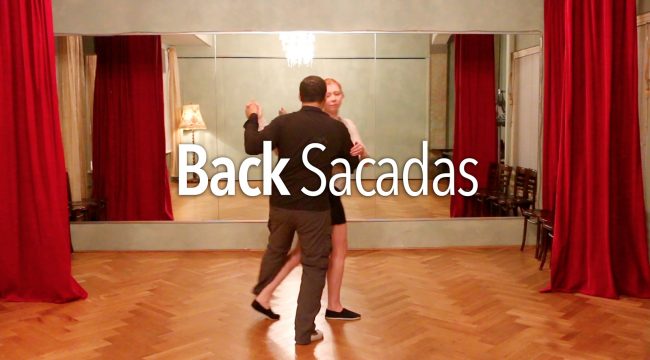
  • Follower Back Sacada

    Follower Back Sacada

    Realistically there are a few sources of information about this stuff, but honestly most of them are done in a performance OR are missing the requisite detail of the HOW you set up a Follower Back Sacada or more importantly the underlaying technique that is frequently not discussed at all.

    With that in mind, let’s briefly talk about the Follower’s Back Sacada.

    The reality is that for a lot of people this move is a flashy piece of vocabulary that mostly takes up way too much space on Social Dance floor even when done under the best conditions by trained professionals. However, there are some benefits to learning how to do them economically and for you to occasionally dropping ONE into your dance.

    Let’s get some facts out of the way first and foremost.

    a.) The Follower will NOT engage in a Back Sacada simply because you set one up. That dog is NOT going to hunt.
    b.) The Follower will more than likely not ‘hit’ the Sacada for a few reasons, most notably because their own underlaying technique is missing or underdeveloped.
    and c.) It’s not their fault!

    That out of the way > In order to be an efficacious dancing partner for a Lead that engages with these things, there are 3 things you, as a Follower absolutely must be able to do without hanging, pulling, or pushing on your Lead:

    1.) Disassociation/Applied Disassociation.
    2.) Controlled Collection from the Forward (Lead/Follower), Side, or Back Steps. and
    3.) Heels, heels, heels in every sense of the word! This means you must keep your heels ON THE FLOOR!

    The simple fact is that good tango, from the Follower’s side of things via a Lead perspective, comes from a Follower who has mastered these things in lurid detail, you practice and practice and practice this stuff religiously so that you don’t have to think about it at all when you’re dancing…instead you ‘react’ and that reaction is born of the technique that you clearly have built into you over and over and over again.

    But let’s be clear about something this ‘technique’ is not just about repetition. That’s a mistake. This is MINDFUL repetition. Meaning that you consciously build or weed out errors from a movement and a motion, slowly, carefully building it to the point where it becomes reactionary. However, again, this is not necessarily all about reaction but a good portion of the time – very controlled!

    You want to be able to control every facet of your movements from toes to feet, to heel, to ankle, knees, hips, torso, shoulders, head, arms, and fingers. Every aspect of those body parts in exacting precision. Failure to do that, and you have not mastered your tool. Your body is an instrument and it must be learned, toned, tooled, and retooled, constantly. You are never a finished product, never.

    What specifically are you focusing on then ? 

    Your forward step, your side step, and in this case, your back step. Your embrace within the construct of the movement of those steps. Your disassociation. Your applied disassociation. And you would think that this is just easy work…like hell it is! It’s a ton of work that must be controlled, tamed, tooled and re-tooled….hours, weeks, months of time just to weed out your issues so that better technique can creep in.

    Ok, so let’s get to the nitty gritty of what it is that you, as the Follower are trying to do >

    1.) Disassociate, then apply that Disassociation to the point where you are over-rotated.
    2.) Your feet are facing opposite of where they were, 180 degrees in fact. Anything less than that and you’re going to have problems. The aforementioned not ‘hitting’ the Sacada.
    3.) Not pushing, pulling, or hanging with your embrace.

    To be fair, most Leads engage in resistance mindset when it comes to this stuff. “You have to push into me”, they will say. Or “You have to resist me”…OY!!! This isn’t your fault, and it’s not the Lead’s either. It’s what you were both taught, and it doesn’t work. The reason it doesn’t work is that in order for you to push into your Lead, you are essentially creating a wall of pressure against the Lead, right? That means that the Lead has to meet that, match it and then…OVER COME IT! The Lead literally has to OVERPOWER YOU in order for the Lead to then ‘PUSH’ you.

    4.) You’re trying to step backwards THRU the Lead’s open step, and closer to their unweighted step or what is sometimes referred to as the ‘Free Leg’. A problem happens where you don’t want to hit the Lead’s leg. And that’s precisely what you want to have happen. Your Achilles’ Tendon wants to strike or brush very close to their ankle. In other words, ‘hit them’. You don’t want to but that’s what you’re aiming for.
    5.) Keep your heels ON THE GROUND. I can’t say this enough. Remember, you’re in 3 inch heels. Do you want to impale your Lead WHILE you are dancing with them ? Probably not. Well not unless the Lead is not acting in a safe or emulating ‘gentlemanly’ qualities. Other than that > “No we do not want to impale them!”. Which is to say, keep your heels on the ground as you step thru the Lead’s open step.


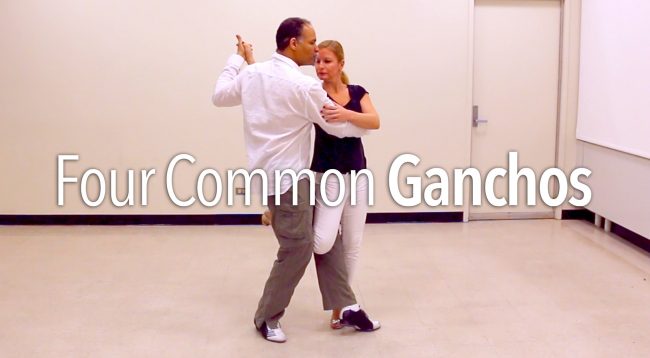
  • Four Common Ganchos

    Four Common Ganchos

    Gancho. The word in Spanish translates to the English word, roughly, as ‘Hook’. From an Argentine Tango perspective, it has a very specific meaning. You’ve seen these things hundreds of times, and while the vocabulary itself has a connotation as being somewhat ‘cheesy’, and only done by beginner leads who don’t know any better, the reality is a that it is a venerable piece of Tango vocabulary that do have a valid place off the main trunk of the Tango history tree. The story goes that while the Gancho existed long before Norberto “El Pulpo” Esbrez came along, his contribution to its storied history is where creativity meets innovation, specifically with regards to ‘elasticity’ and the Enganche. He is/was credited with pioneering and exploration the ‘invasion’ of the standing leg, the response of the free leg, as well as the space in between the opening of a step, and quite factually (if not literally), the intersection of these ideas.

    What is a Gancho ? In it’s simplest form, in the modern vernacular of Tango, it is a hooking of the free leg around your partner’s leg or thigh. It is an interruption of the extension phase of the step, which can (not always) result in the lifting of the respondent’s leg either as a result of, or by deliberate intention.

    Today’s Tango Topic deals with just Four of the most Common Ganchos and a few of their issues that happen for both roles. While there are many, many, many types of Ganchos to explore and play with, these 4 only scratch the dancing surface of them. They are the foundation for nearly every other Gancho that comes after them. The Rotating Gancho, the Gooey Gancho series, the Follower Gancho series, the Ganchito (which is an itty-bitty Gancho), the Lead Gancho series, the Volcada Gancho, just to name a few, owe their foundation to the Four Common Ganchos in Parallel and Cross System.

    The Free Tip. In all 4 of these Ganchos, for the Lead, you want your heel of the ‘free’ leg to be off the Floor. There should be no weight on it. Ever. From a Following perspective, sometimes you’re going to feel this desire to bend backwards, and you can’t.

    About The Video.This video package comes in at 49m:29s in length in 8 Sections. What you’re seeing above is only the introduction to the topic before we dive into the topics below. The one you probably want to see is #6 as it contains all 4 of the Ganchos. However, the rest of the videos make that last video possible. They’re all about set up, proper technique, and really the underlying method of how a Gancho works and where things can go terribly wrong, and how to correct for it.

    Section 1 – Introduction – 00:07:13
    Section 2 – Lead Technique – 00:04:01
    Section 3 – Follower Technique  – 00:05:38
    Section 4 – Free Leg Launch  – 00:05:13
    Section 5 – Gancho Exercise – 00:05:35
    Section 6 – Gancho Set up – 00:06:42
    Section 7 – Four Common Ganchos – 00:19:27
    Section 8 – Gancho Closeups – 00:15:17

  • Sacada Triangle Methodology

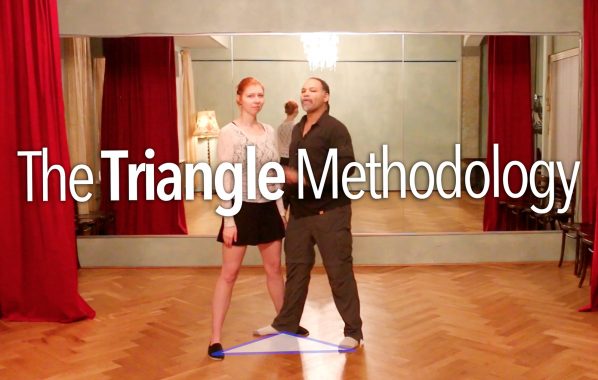
    Sacada Triangle Methodology

    The Sacada is probably one of Tango’s more interesting pieces of Tango vocabulary. Mostly because it looks really cool and complicated. And yet it’s complexity can be explained in one simple sentence – It’s an illusion! The illusion is an intersection of walking techniques. The Lead’s walk intersecting the Follower’s. It’s walking, nothing more than that. It’s just never explained that way. And yet, that’s exactly what it is. However, there’s a cute little trick that happens for every sacada, every single sacada no matter how complex, no matter how difficult it may appear. It’s an observation that I don’t own, but rather compsve fro a very reliable argentine source. So what’s the cute little trick ? The Triangle Methodology!

    What is a Sacada ? First, a Sacada consists of a walking step that just so happens to intersect with your partner’s walking step at the same time that they’re stepping forward, side, or back. Secondly and this part you have to keep in the back of your mind: It’s an illusion. An illusion of walking, an illusion of technique, and an illusion of execution. To put it simply the Sacada is really just a walking illusion that intersects with someone else’s walk. And that’s the part that most people are confused by. What they see is the illusion, and try to re-create the illusion instead of focusing on the part that will actually help them to get to the root of the Sacada, the walking part! Which is to say that people focus on the flash and not the substance! It’s just a step forward and side (and sometimes back, but not in Today’s Tango Topic), which is going cut through, and step very close to someone else’s step which results in a displacement of someone’s leg. The hard part for most people is the timing of that displacement, not to mention where that displacement goes. Speaking of ‘displacements’ the Sacada is in the family of Tango vocabulary that are called ‘displacements‘, and that’s because of two factors that occur: 1.) Because whoever is initiating the Sacada will take the place of the one who is receiving the Sacada. You are displacing, and sometimes being displaced. And 2.) The one who is receiving the Sacada will displace their free leg as a result of the intersection of the walk. Further down the rabbit hole, the Sacada is one of the 4 common Displacements that Tango Topics talks about which are: 1.) The Sacada. 2.) Ganchos. 3.) Boleos. 4.) Enganches or what is commonly known as an Argentine Wrap!

    And just for your further edification because some people ask the question “How many types of Sacadas are there ?”. Answer: There are 22 Types of Sacadas, and a total of 501 variations of those 22 Types. And yes we have done the math, and it comes out to 501. The types, just in case you hadn’t thought about it, but we have, are as follows:

    1.) Forward Sacadas (from Linear, Circular, or Over-Rotated Ochos) in Parallel & Cross System.
    2.) Side Sacadas (from a Curved Side Step) in Parallel & Cross System.
    3.) Back Sacadas (from Back step, or Circular or Over-Rotated Ochos) in Parallel & Cross System.
    4.) Linear Sacadas (from a Linear Side Step, or Linear Forward Step) in Parallel & Cross System.
    5.) Chained Sacadas (Think: Cadenas) In Parallel & Cross System.
    6.) Walking Displacement Sacadas in Parallel & Cross System.
    7.) Multiple Forward/Side/Back Sacadas in Parallel & Cross System.
    8.) Multiple Alternate A (same foot) Sacadas (You’ll see an example of this in the Forward Sacadas section).
    9.) Molinete Sacadas (from the Follower’s Molinete, The Lead’s Molinete, and/or the Anti-Molinete).
    10.) Orientation Change Sacadas (See the Anti-Molinete, and/or the American Embrace).
    11.) Two Footed Sacadas (jump into the sacada).

    That’s 11 Types of Sacadas, and each role can perform these, so we end up with 22 Types of Sacadas. Now there are even further variations on a theme of these ideas where you can theoretically mix and match any one of these ideas with another on the list and create a hybrid of the two. However, it was late and we’d already gone through 1002 possibilities and then someone mentioned the concept of Tango Topology and that just blew everything out of the water by halving everything and so we stopped counting there … so 501, and 22 types is enough for one lifetime. 🙂

  • THUD!

    THUD!

    It doesn’t matter if you’re a Lead, or a Follower, we all at some point have to learn how to walk properly and for a good portion of us learning that proper walk is either an absolute joy, or such a pain in the ass to learn that you wonder why you’re dancing Tango in the first place! Why ? Because learning how to walk, if done properly, is a detailed analysis that seeks to break down the underpinnings of the mechanical aspects of your walk, the weight transitions that must occur, where and how to land on your feet and what parts of your foot you want to use….just to name a few. Walking isn’t just putting one foot in front of the other, as much as we’d like to believe. It’s not. Walking takes time, patience, and a lot of due diligence to move it into the area of ‘desirable’.

    One aspect of learning to walk properly is learning what not to do. Unfortunately for a greater number of teachers, and dancers, the idea of giving and receiving feedback that is useful to them is relegated to “That’s nice” and/or “Try this instead” which doesn’t really encourage change. Instead of detailed questions, and constructed feedback that will ultimately lead to desirable dancing, on multiple levels, we end up with feedback that is pleasant and pleasing but not really helpful to change.

    Believe it or not this is all relevant to Today’s Tango Topic of “THUD”. Believe it or not you have experienced the idea and practice of THUD so often that you’d think there was a course or class on the idea of THUD. At one point in time, you were even using THUD, and may still be using it and not realizing that you’re generating this. So without further yappage, Tango Topics Presents: THUD!

    Notation: And so that we’re clear here, there is no ‘right’ walk, there is no ‘wrong’ walk. There is only a desirable walk, and an undesirable, with lots of shades in between. Going further down the rabbit hole, of the language here, it’s important to understand that this isn’t just simple word replacement. But thought change as well. We want to change our thinking about how these concepts are placed in our heads, “right” and “wrong” create barriers to our understanding and creating meaningful change. “Desirable” and “Undesirable” are not ‘right’ and ‘wrong’ cognates, but allow for a greater range of moving the dial!

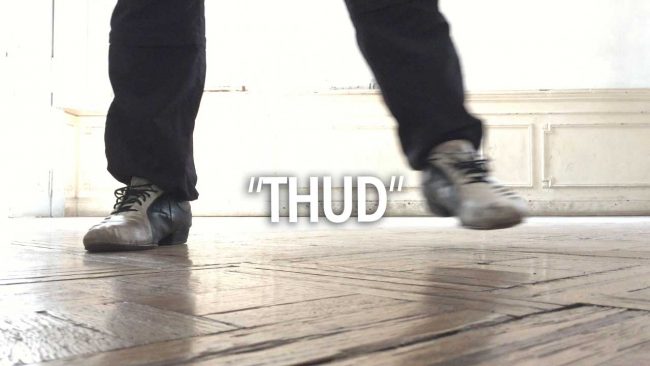
    What is “THUD!” ? In the simplest way we know how to describe this stuff, “THUD” is an uncontrolled, unsightly, and ungainly foot heavy and overly weighted placement of the dancers foot, which results in a sound that resembles a rumbling of the floorboards under your feet when you jump up and down: THUD!  It occurs because the dancer in question has generated a heavy step, an impacted step, that they don’t realize that they’re doing it. That step reverberates up through the bones of the foot, then the ankle, then the knees, the legs to the hips, up along the spinal column, and then out through the arms in the embrace which is then transmitted to your partner! Usually ‘Thud!” occurs in concert with instability, hanging, pulling, pushing, and contortion. While one could easily paint this as a Follower only issue. That’s not the case. It occurs for both roles, regardless of age, height, weight, or any other issue you can think of. The reason it happens is primarily because no one has instructed that dancer on how to walk properly. Or in this case, how not to “THUD”. The general belief of THUD is that it can, and does, mostly occur when the leg is going backards or fowards (usually back) and the knee is bent, but the foot is lifted or raised off the floor! When the foot comes down (that’s the impact that you feel through the embrace), we have our ‘THUD!’.

    From a Following perspective, usually, a Lead will feel the impact of your foot hitting the floor, more than you will unless the Lead is clearly unaware of their own presence (that happens too by the way). Typically for you, even though it’s demonstrated from a side step above, your version of THUD occurs because of how you’re walking backwards. You quite literally pick your foot up off the floor at the very end of your what you think your extension is! The fact is that more than likely you have an issue with how you are understanding and then applying your walk. You ideally want your walk to resemble something very similar to this idea:

    Plays from YouTube. Pressing play connects you to YouTube. Privacy

    Walking In Opposition With Miles Tangos
    video
    play-rounded-fill

    Aside from the opposition that’s being employed here, You’ll notice that this particular Follower sort of ‘slides’ their foot along the floor, that it never leaves the floor really ? That’s what you’re looking for. However this creates a problem, resistance against the floor! We want the leg to fully extend in response to the amount intention that our lead is generating, but there should be a slide, not a weight transfer until the we’re near the end of the step. And even then the weight transfer is gentle and gradual, not sudden and sharp, and occurs at perihelion in the extension phase of the step. When we extend our legs with bent knees we are more prone to a sudden and sharp transfer of our weight than we are a controlled one! And we want the controlled one! Tango Topics has a series of videos that show you exactly what you have to do in order to generate this, which can be found in the Foundation Bundle!

    In the end, we want something like the above video to happen in concert with our partner. To be fair, this is not somethat will happen over night and watching a single video on this stuff and then you trying to replicate that is not going to change a damned thing. Furthermore as it relates to THUD, that will continue to happen. Sounds dire, right ? No. It’s a stark realization and only from that stark honesty can change occur. 🙂 There’s hope.

    From a Leading perspective, we feel the impact of the Follower’s foot on the floor, as a heavy step usually on their side and back steps. While at the same time we as L/leads must realize that we can and do generate a heavy impacted step as well. In short, there’s merit to the statement ‘walk softly’. The Lead can create the same problems that the Follower creates for exactly the same reasons above. Nothing has changed except the role. The walking technique is nearly the same, nearly, the only thing that’s changed is the direction that we’re moving in. However in our case, we want to generate Forward Intention first and foremost before we extend our legs, but that’s topic for another time. The end result of this is that when we generate THUD! it’s because we are more than likely driving forward with a lot of force, thereby driving the Follower into the floor! We’re stepping forward or side in a heavy-footed manner that belays what we want to do. There are some instances under which we actually do want to be heavy-footed, and that’s when we’re accenting an accent note, or dancing to Biagi’s music where you’ll hear a strong, sharp SHUM in the music on first beat of a measure. Which is what Biagi is known for, accenting the downbeat! That’s the “SHUM!”. There’s one other instance under which we want to engage in the practice of THUD!, and that’s when you have a Follower that a little unclear as to what’s going on. So for a few steps (A FEW, meaning 3 or 4) you may want to be slightly more heavy-footed than you would normally, but for the most part, walking in a heavy-footed maner is mostly undesirable and is a lot of work for the Follower to follow and maintain and to receive coming from you.

    You may not realize this but that heavy-footed walk is felt coming up from the floor and up through your spinal column and out through the embrace! The Follower more than likely will not be able to tell you what they feel other than dancing with you tires them out. This is one reason why. Because you’re driving into them with heavy steps! THUD! Not so much with that.

    From a Dancing Perspective, both roles do feel the THUD! when it happens, and once or twice it’s not so much of an issue. However, over time, after more than 10 or 15 steps it starts to drain their energy. The heavy-steps, the heavy-footed walking, and then dancing that way while being entirely unconscious in certain circumstances, and entirely conscious in others, is a lot of work for both roles. Ideally we want to walk lightly and with nimbleness, and then apply that to our dance. That would be ideal. Unfortunately that’s not what’s going to happen. And the reason is a really simple one: Comfort. You’re comfortable with what you’re doing. Further still you’re not even aware that you’re doing it, and beyond that most of the people you’re currently dancing with will tell you in no uncertain terms that you’re doing just fine. So how can you tell if you’re generating this stuff ?

    Plays from YouTube. Pressing play connects you to YouTube. Privacy

    Video yourself. Aim the camera so that you can see legs and feet only. Skip the embrace, it’s useless at this juncture. You need to diagnose what you’re doing and how! Look at the video above, and then the video below, and if you’re doing either of the following as a Follower, then it’s more than likely you’re generating instability. As a Lead these same things apply to you as well. The same constructs even though the steps are going backwards and it represents what’s happening with the Follower, they all so happen for the lead only in reverse!

    Plays from YouTube. Pressing play connects you to YouTube. Privacy

    That is how you know that you’re generating this stuff. Once you have identified that it’s going on, how do you fix it ? Fortunately Tango Topics has a solution, we have a Foundation package just for you. One of them is included in your free sign up! So go register today and get started in cleaning up your dance.

  • Engaging The Embrace

    Engaging The Embrace

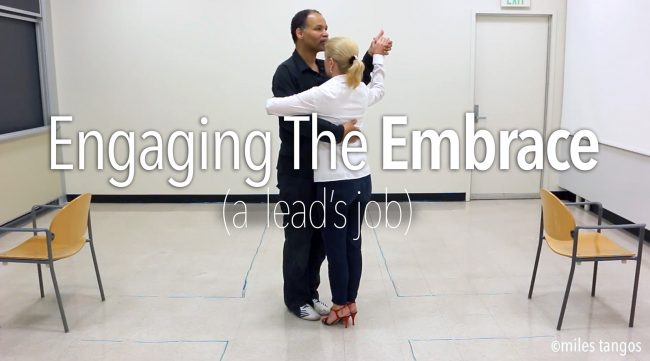
    A Lead’s Job. The fact is that in modern Argentine Tango, while the Follower most certainly has a role and a job (several), setting the tone and style of the embrace is the squarely the job of the Lead. The Follower, as sexist as this sounds, fills that space with their complimentary embrace. And so that we don’t slight the Follower’s role in this regard, we will discuss the Follower’s side of this equation in a later article and requisite video. Right now we’re talking about a Lead thing. Further still, a Follower should not stop reading at this point. Think of this article, from your perspective, as pulling back the curtain of the seemingly black art of leading. Or think of it as ideally what your lead wants to do but more than likely is not doing.

    Leads you have a role and a job, several, and one of them is ‘creating an embrace structure’ which is comfortable for the Follower, while at the same time creating the iconic visual that is a Tango embrace. An embrace which just so happens to allow for maximum effect (free range of motion, visual impact, etc) with minimal input (easeful, non-stressful, no pain, no pushing, no pulling, no hanging, etc).

    Put another way, you have 3 primary goals: 1.) Navigation. 2.) Architecture. and 3.) Music. Under the category of Architecture, we have 2 sub-categories. 2a.) Form. and 2b.) Vocabulary. Think of 2a as what we look like (the visual), and think of 2b as what you do with 2a in time to 3, while employing 1. However, all of 1, 2, and 3 starts with – Engaging The Embrace.

    [ls_content_block id=”6272″ para=”yes”]

    Typically what happens: You step onto the floor without engaging proper floorcraft, then you grab your follower’s right hand, lift it, then step in with your right, leaning in with your right shoulder, and then place them in your armpit (the Follower willy-nilly goes there as well), and then wrap your right arm around them, and then almost immediately thereafter you begin throwing vocabulary at your Followers in the hopes that they won’t see that you have no idea what you’re doing to a tango, milonga, or vals!

    The Problem ? For a good portion of Followers they want a gentle, guiding, clear, clean, non-compressive, non-restrictive, non-pushing, non-pulling, non-resistive experience that does not include being told what to do as their doing it. But what they get is something akin to what typically happens. And that’s not covering what happens inside the dance itself. Typically the Lead is forceful – using their arm, which they don’t realize they’re doing, and then doesn’t listen for the Follower’s response to a specific piece of vocabulary,  thereby whisking them from idea (ochos) to idea (molinetes, repetitive molinetes) to idea (crosses, sacadas, ganchos, volcadas, colgadas, etc). The issue is that throughout all of that usually the Lead’s embrace is restrictive, resistive, and compressive (resistance based dancing), trying to control the Follower instead of inviting them to do X, Y, and Z. Guiding them, suggesting, inviting, proposing. What the Follower gets instead is control, contain, push, pull, and a host of manhandling with the lead’s arms. This is not something that anyone wants to have happen to them, and yet this is precisely what passes for ‘dancing’ a good portion of the time and it’s not desirable on multiple levels.

    [ls_content_block id=”7949″ para=”yes”]

    The Right Conditions. The whole issue above stems from the Lead’s inability to create a platform to work from – an embrace that is calming at at the same time clear without the use of force. That starts with creating the right conditions. The Right Conditions ? We ideally want to calm the Follower’s mind. Quite honestly, they’re freaking out. Why ? Because they have no idea what craziness (especially if it’s a Milonga tanda) that the Lead is going to come up with. They have to be ready for anything. Understand that it is a jarring experience for most Followers. The Right Conditions here are first creating calmness in your body, in your posture, in your arms, everywhere. Just calm, quiet. That quietness is incredibly important. We want kinesthetic silence. What we generate is what they hear. And if they’re hearing kinesthetic ‘noise’ then we’ll get that in response! So ideally, we want a calmness in our attitude and kinesthetic quietness in our bodies. We don’t want anything that will create a ripple in them. Think of the right conditions as though it were a placid lake at dawn or sunset. We want that mirror reflection of motionless to reflect the sky. The Follower, in this analogy, is the sky.

    Where To Begin. Most of this ‘calming’ starts with your own body posture. Learning how to engage good posture that is at once not ramrod straight but rather upright using the body’s natural inclinations (corrected of course because a good portion of you have terrible ‘natural’ posture). A posture that does not rely on force, or tension in any way, shape, or form. No more than is necessary to hold the body upright. And even that’s sometimes too much, and the language used to describe this stuff is sometimes very vague and not very helpful. However, there is a language that describes this stuff perfectly – Alexander Technique! Put simply Alexander Technique was developed by Frederick Matthias Alexander, and is an kinesthetic process that retrains your ability to realign your body’s natural posture and secondarily to avoid unnecessary muscular tension. Alexander had the belief that your self-awareness could be inaccurate which is created as a result of bodily stresses and situations that we learn over time that we must unlearn, which as a result in created unnecessary muscular tension when standing or sitting with body weight unevenly distributed, holding the head incorrectly, walking or running inefficiently, etc. In other words, Alexander Technique is the language that you have been looking for to describe how to correct what you’re doing with your posture and so much more.

    [ls_content_block id=”8747″ para=”yes”]

    To be a bit clearer, there is a perception in Tango that your posture must be ramrod straight, this is a holdover from two very distinct areas. 1.) Ballroom (yes Ballroom has infected tango). 2.) Performance Based Tango. Both of these things have contributed to the less than helpful idea that we must hold ourselves in these almost impossible positions for hours on end to ‘look nice’ to dance with. Followers will know this the moment it’s written here, but you see they’ve danced with those ramrod straight dancers, the ones that look nice to dance with but the moment they get into the embrace they realize they’ve made a mistake. Good posture does not need to be ramrod straight in order to be good. It does however, need to be comfortable, and at the same time upright without contortions in any way, shape, or form.

    That Thing We Do. The fact is that a good portion of you reading this have a body problem. You want and then again you don’t want. In one respect you want to be touched and in another respect you don’t. You want to be hugged and embraced, and then again you don’t. You want to be next to someone, close, very close, touching close, but at the same time….not. Society says one thing, Tango says another. It’s a diametric opposite that you just can’t get away from. There are perfectly good reasons why you want, because it feels good. It’s pretty simple. And there are a few double dozen reasons why you don’t want….someone hasn’t showered recently, is really sweaty, has bad breath, someone is soaked through with sweaty clothing, and then there’s the ‘sexual energy’ thing that most men are completely unaware of, but women are very aware of. And while we’re talking about sex. From a Male Leading position, there’s the whole female breast/body thing. Society says you can look (not directly) while publicly you can not touch directly. Which flies in the face of Tango, which says ‘touch’ and quite literally place your body wrapped around your partners, while at the same time don’t touch too much. It can be a little confusing, but you generally follow the rules of good, respectful conduct, which states – don’t do anything that you wouldn’t want your mother to know about! At the same time, as a Lead, you want to create a platform from the plane of your body that is almost like a comfortable couch or bed to sleep on. Why ? Because the Follower is going to spend the next 9 to 12 minutes there! That’s why. From a Female Following position, you have a body with a brain, chest, hips, and curves everywhere. I know, right ? Mansplaining….oy. Society sexualizes your body constantly, in every detail, it’s not like you can forget it because it’s everywhere you look. Your body, is as happenstance of Argentine Tango, going to be touched, in sometimes inappropriate places and ways by men you wouldn’t normally have anything to do with except as it happens to be required in Tango. That requirement ? The plane of your body must meet the plane of your lead’s body in every way possible. It’s like form meeting function. Or peanut butter meeting jelly. Or … you get the point. Why ? Because you want to be able to hear (kinesthetically speaking) your Lead in exacting details, and that requires the plane of your body to be in complete contact with your Lead. Backing away from that, makes your job, your role, much….much more difficult than it needs to be. From a dancing perspective, what we’re really talking about is close embrace dancing. Ideally we want to be sternum to sternum, sometimes referred to as a ‘core’ embrace format, or ‘square’ embrace format. Sometimes referred to as Body-On-Body contact. That’s not to say that a ‘v’ or ‘closed-v’ or ‘open-v’, or ‘open’, ‘slightly off-gigline’ body-on-body isn’t valid. It just means that these versions of close embrace create situations or kinesthetic dynamics that are more or less preferable for the Lead and not necessarily the Follower. Like for instance Turns (see the Armpit Dancer). Ideally you want your partner to be right in front of you, gigline to gigline for a variety of reasons, not the least of which is ease of dancing on multiple levels. So the whole body-on-body is very important as it relates to what has to happen in the dance, it’s the thing we do. Without that physiological, deep (psychological), physical, kinesthetic contact in the dance, let’s just say it makes things a bit more challenging.

    Your Arms. Frequently a good portion of you use your arms and hands to direct the Follower. This is called ‘Paddling the Follower’. We do not want to do this. Instead we want to allow the Follower to ‘float’ or move within your embrace structure. However, that’s not what happens. We apply tension, force, compression, to either control or to indicate which way we’d like the Follower to go. In specific we use our right hand, right forearm, and left arm as a whole. This is not desirable. By the way, this is that bullshit paragraph that appears in every single one of these articles that is just specific enough but not entirely specific to actually help you. If you were to upgrade your subscription, you would see an entirely different paragraph here that tells you specifically what you want to do. And you’d see the missing 4 minutes of the video above in the proper order. Oh yeah, the video above is slightly out of order than how I shot it. You want to see it in it’s proper context.

    Free Tip – Left Arm Lead. Ideally you want want your left arm to go around the Follower but without creating tension, force, or compression. We’re looking for feather light contact, skin to fabric, fabric to fabric, and nothing more than that.

Hide picture