Tango Topics info:

Check out the Tango Topics Lexicon for words like Axis and Connection.

Tag: follower’s molinete

  • Crossing Sacada Turn

    Crossing Sacada Turn

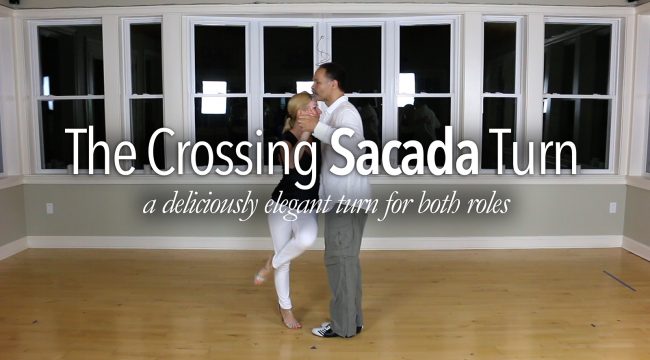
    What is a Crossing Sacada Turn ? In its simplest form, it’s nothing more than a series of Simple Sacadas that are chained together that just so happen to utilize the Follower’s Molinete or ‘Turn’, which employs the Argentine Cross as it’s basis for entry. While the turn can be done without this entry point, it loses it’s ‘elegance’ by without using the Argentine Cross.

    To be clear, a ‘Sacada’ is one of 4 types of Tango Displacements (Boleos, Gancho, Wrap/Enganche, and Sacadas), meaning that either the dancer’s leg will displace or their entire body will be displaced or take the place of their partner. A Sacada can be done from open or close embrace, it can be done by either role to the other, and has lots and lots and lots of options (about 501, at last count – not kidding).

    A turn, as defined by Tango Topics, can be but is not limited to these ideas in order of precedence: 1.) The Follower’s Molinete to the Lead’s Giro (the Common ‘Turn’). 2.) A Milonguero Turn. 3.) The Ocho Cortado. 4.) The Argentine Rock Step/Turn. 5.) The Calecita. 6.) A Walking Turn.  7.) The Media Luna. and 8.) A Single Axis Turn.

    A ‘Crossing’ Sacada Turn ? Is exactly what it sounds like, a turn that has a bunch of Sacadas as part of it. In this particular case, this Sacada Turn uses the Follower’s Molinete, and a very important structure that Tango Topics completely eschews repeatedly, and says that you should never, ever do. This is the ONE time when you do want to do that, however with all things, there’s always a caveat to the caveat. That said, let’s talk about The Crossing Sacada Turn.

    The Free Tip. Something to keep in the back of your mind is that while this is a cool piece of vocabulary and you’ll see it executed a lot, there is another version of this that does NOT include the last Sacada. Truthfully we can execute the Sacada Turn without the 3rd Sacada, and everything works just fine, sort of. Doing so, can generate other options and opportunities for us as Leads and Followers. However, one thing that will continually plague you is why the Follower continually turns away from the Lead after the 2nd or 3rd Sacada! There’s a reason for that, and there’s also a solution for it which is why it is important that you watch the video in it’s entirety to see exactly what is generating proper execution of the Sacada Turn! And don’t just rely on your eyes to assume what’s happening here.

    About The Video. This video comes in at 34m:02s in length in 13 Sections. This video contains no Follower and/or and very little Lead Technique.

    Section 1 – Introduction – 00:00:52
    Section 2 – Argentine Cross – The Starting Point – 00:01:32
    Section 3 – The Lead’s Cross Behind – 00:02:35
    Section 4 – The First Sacada – 00:01:09
    Section 5 – The Follower’s Flailing Foot Error – 00:02:17
    Section 6 – The Second Sacada – 00:01:32
    Section 7 – The Third Sacada – 00:03:10
    Section 8 – The First Complete Sacada Turn – 00:01:32
    Section 9 – The Turning Brake – 00:04:08 (technique)
    Section 10 – Removing The 3rd Sacada – 00:00:58
    Section 11 – A Variation On A Theme – 00:03:47
    Section 12 – The Close Embrace Version – 00:01:34

    Section 13 – With A Metronome/Closure – 00:02:34

  • Follower’s Molinete

    Follower’s Molinete

    Every social dance has a variation of a very old idea known as a “Grape Vine Turn”, which is generally 3 steps in either a circular or linear pattern. Argentine Tango is no exception to this factoid. Truthfully Tango has spawned and borrowed and given 8 types of turns based on simple walking principles. The Eight functional types of turns of Tango are: 1.) The Milonguero Turn. 2.) The Walking Turn, 3.) The Rock Step. 4.) The Ocho Cortado (Linear & Circular). 5.) The Media Luna. 6.) The Argentine Calesita. 7.) The Colgada Turn (including The Single Axis). And #8, the topic of Today’s Tango Topic: The Follower’s Molinete. The turn itself is taught to every beginner dancer, and every dancer uses this very functional and foundational turn. Just as a side note, up until about 1980, oddly enough, The Follower’s Molinete was NOT the predominant turn. That honor goes to first turn on our list above, the Milonguero Turn. So what happened ? Why was the turn supplanted ? You can thank Gustavo Naveira and Fabian Salas for that. If for no other reason these two men aren’t considered the father’s of Modern Argentine Tango than it should be their introduction of the Follower’s Molinete to the world. Which, strangely enough, had been around in various forms for almost 50 years before they came along and … ahem … ‘discovered‘ the Molinete. Moving along, the Follower’s Molinete did go on to supplant the Milonguero Turn, and it is now the common turning element for all dancers to learn and then to dance. As this is the case, the turn is so predominant that it is the default motion for every Follower whether they realize it or not. The moment that a Lead starts to rotate their body, the Follower will default to the Follower’s Molinete. It should be noted that the Follower’s Molinete doesn’t happen in a vacuum. It happens due to the other side of the equation: The Lead’s Giro. The Lead’s Giro and the Follower’s Molinete co-combine to create the standard turn in Argentine Tango when we talk about turns. So without more yapping, let’s dive into Today’s Tango Topic: The Follower’s Molinete.

    What is the Follower’s Molinete ?  The term “Molinete” means Wind Mill in English when translated from the Spanish. And as it relates to Argentine Tango this is a Grape Vine Turn with 3 steps. Forward, Side, and Back that executed by the Follower. Which is the reason for the distinction in the moniker, calling it The Follower’s Molinete. So that would lead one to believe, and rightfully so, that there is a Lead’s Molinete. And there is. But that’s a topic for a different Tango Topic. There are two primary versions of the Follower’s Molinete. And the primary distinction is whether or not The Follower’s Molinete is done in Close Embrace or Open Embrace. While the two turns themselves are functionally the same, there are some very nuanced differences between the two. However, at the 50,000 ft level, the turns consist of the 3 steps: Forward, Side, and Back. When you stop and you think about it though, there are actually 4 steps, not three. Even though we would like to use only 3 and it can be done quite easily with practice. There is a fourth step, and it’s a second side step after either the forward or back step. The Follower’s Molinete can start with either the Follower’s Forward step or the Follower’s Backstep. Both will lead to slightly different outcomes. However, the setup for both turns is usually the same: Traveling Ochos! In either case, both the Forward Step, and the Back Step are Applied Disassociative motions which are mostly, and erroneously, thought of as ‘pivots’, which lead to the Follower then extending into a rotating Side Step. It should be noted that of all the foundational moves that the Follower must master, that this is the hardest thing, physiologically speaking that they’ll ever have to do. Ever. It takes considerable time, patience, practice, and did we mention ‘practice’, solo, with a partner, in private instruction to make the Follower’s Molinete fluid. This is not watching a 9 minute video and bam, you have got it down. No. This is going to take a while. A long while. A very LOOOOOONG while. Years. However, having adequate reference material is absolutely key to that process.

    About The Video.  This video comes in two parts, the Open Embrace version (00:24:12), and the Close Embrace version (00:08:34). This is a combined video format, lead and follow technique are mixed together.

    Open Embrace

    Follower/Lead Embrace – 00:09:35
    Lead Footwork Details – 00:05:47
    Follower Footwork Details – 00:08:32

    Close Embrace

    Introduction – 00:01:10
    Two Lead Accommodations – 00:00:37
    Lead Hip Detail – 00:02:27
    Lead Space Detail – 00:00:43
    Lead Footwork – 00:01:10
    The Close Embrace Dip – 00:01:03
    The Recap – 00:00:51

Hide picture