Offer ends in Offer $99 for 1 year 1daysd 13 14 22 One year for $99 Get your year
Tango Topics info:

Check out the Tango Dictionary for words like Axis and Connection.

Tag: follower

  • Lazy Follower Foot

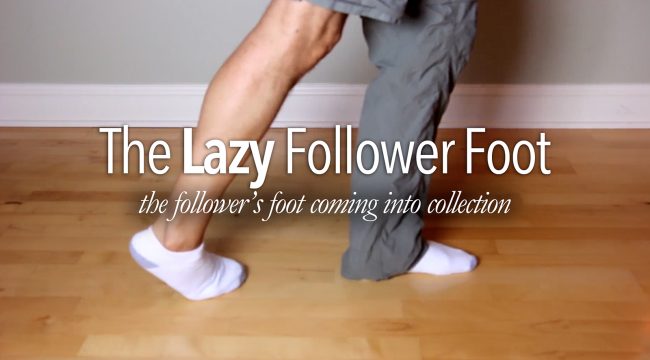
    Lazy Follower Foot

    Lazy Follower Foot. Most people don’t think about this stuff except for when they’re in a class or a Follower Technique Seminar, or in a private lesson. Mostly they hear it and completely forget about it about 10 seconds after it’s been said. That is unless some diligent teacher continually reminds you of this stuff, constantly. To be fair, while this particular topic happens a lot for Followers, this happens everywhere across the entire spectrum of the dance and into real life. If someone says something to you that needs to be corrected, it will take you a few tries to remember to do it, and even then that’s a stretch. The fact is that you’re dealing with muscle memory or in this case ‘muscle comfort’. It’s comfortable for you to do this stuff. So why change it. The reality is that the change comes hard to some people, and comfort is easy. If you’re comfortable why bother changing ? Right ? What you may not realize is that that comfort may or may not be desirable to look at, as in this case of Lazy Follower Foot.

    What is ‘Lazy Follower Foot’ ? It is a state where the Follower’s back foot as it comes into collection from a Forward step, is either dragged without care or unconsciously. The foot itself, seemingly hangs off the ankle, and is summarily dragged into collection from the Forward step. This doesn’t happen from the Back or Side step, that’s the ‘Dangling’ Foot error. Whole different ball of wax, but the solution is exactly the same as shown in today’s video! 

    The Error In Your Thinking. The reason why this dance was challenging for you, and this is the error, is that’s just their ‘style’ of dance, and it’s not your style. Yes there is an estillo to some people’s dance, but sometimes with the more advanced dancers this isn’t about style…it’s about technique and the execution of that technique! So, put simply you’re missing the other side of the equation: You’re not ready for them! And the reason is, because your understanding of your own technique, your underlying foundation, how you move, how you land your feet, how you extend your legs, how you embrace your partners, where you place your body in relationship to your L/lead, where and how you engage X piece of vocabulary…all of that stuff is not trained in you. It’s just not. Further, because you’re dancing with a certain class of L/lead mostly you only get to experience a very small sliver of what a fully trained and operational Lead can actually do. Further still the Neurology of Following (as opposed to the Neurology of Leading) is lacking in you. So as a result you ‘miss’ things. So a Lead like that above, is mostly lost on you. Yes it’s insanely fun, and challenging, but you ‘missed’ so much and what’s worse is you know it. It wasn’t embarrassing, thank god, but you know in your heart you missed so much of what was ‘said’. You missed the nuances. The subtlety.

    Diving Deep.

    There is a reason this stuff happens, actually four possibilities: 1.) Poor execution of technique. 2.) Poorly understood technique.  3.) No Practice. or 4.) All of the above!

    While it’s not rocket science what those things mean, they do require a bit of detail.

    1.) Poor Execution. This means that your attention to detail of your technique is sloppy. Meaning that you allow your foot to unconsciously move as it sees fit to move in relation to your ankle and leg. Even though you have been shown X, it’s not showing up in your dance. Either consciously or unconsciously.

    2.) Poorly Understood. This happens quite frequently. We hear ‘X’ when a teacher says something to us, and in reality they meant ‘Y’.  But because we hear it through the filter of our understanding we end up misunderstanding more often than not. Poorly understood means that you hear or see something and presume that ‘A’ is ‘A’ instead of diving deeply to dig down to the roots of what ‘A’ actually is. To see it’s inner workings. Not just to accept it, but figure out for yourself how and why something functions.

    3.) No Practice. This should be a no-brainer. But you’d be surprised just how many people will go to a teacher or a class and magically expect them to fix everything, and that now that they’ve visited with teacher ‘C’ that things are all better and they can go back to what they were doing in the first place. Because teacher ‘C’ said they’re “you’re doing fine but…” and “that’s fabulous, and…”, or … did you see it ? Probably not. You missed the ‘but’/‘and’ at the ends of those sentences. You only heard the praise and not the rest! Which was… “You should go home and practice the frak out of this stuff that I just spent the better portion of the last hour showing you! Not to mention you just handed me a boatload of cash to tell you this stuff, so you had damned well better go home and practice this stuff!!”.

    4.) All of the Above! This needs no explanation. It’s not one or the other, but actually All of them together.

  • Follower Back Sacada

    Follower Back Sacada

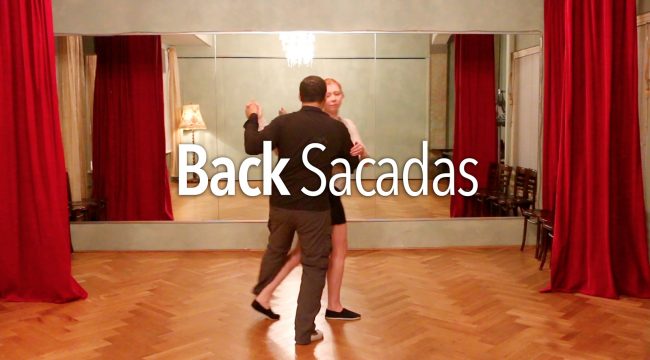
    Realistically there are a few sources of information about this stuff, but honestly most of them are done in a performance OR are missing the requisite detail of the HOW you set up a Follower Back Sacada or more importantly the underlaying technique that is frequently not discussed at all.

    With that in mind, let’s briefly talk about the Follower’s Back Sacada.

    The reality is that for a lot of people this move is a flashy piece of vocabulary that mostly takes up way too much space on Social Dance floor even when done under the best conditions by trained professionals. However, there are some benefits to learning how to do them economically and for you to occasionally dropping ONE into your dance.

    Let’s get some facts out of the way first and foremost.

    a.) The Follower will NOT engage in a Back Sacada simply because you set one up. That dog is NOT going to hunt.
    b.) The Follower will more than likely not ‘hit’ the Sacada for a few reasons, most notably because their own underlaying technique is missing or underdeveloped.
    and c.) It’s not their fault!

    That out of the way > In order to be an efficacious dancing partner for a Lead that engages with these things, there are 3 things you, as a Follower absolutely must be able to do without hanging, pulling, or pushing on your Lead:

    1.) Disassociation/Applied Disassociation.
    2.) Controlled Collection from the Forward (Lead/Follower), Side, or Back Steps. and
    3.) Heels, heels, heels in every sense of the word! This means you must keep your heels ON THE FLOOR!

    The simple fact is that good tango, from the Follower’s side of things via a Lead perspective, comes from a Follower who has mastered these things in lurid detail, you practice and practice and practice this stuff religiously so that you don’t have to think about it at all when you’re dancing…instead you ‘react’ and that reaction is born of the technique that you clearly have built into you over and over and over again.

    But let’s be clear about something this ‘technique’ is not just about repetition. That’s a mistake. This is MINDFUL repetition. Meaning that you consciously build or weed out errors from a movement and a motion, slowly, carefully building it to the point where it becomes reactionary. However, again, this is not necessarily all about reaction but a good portion of the time – very controlled!

    You want to be able to control every facet of your movements from toes to feet, to heel, to ankle, knees, hips, torso, shoulders, head, arms, and fingers. Every aspect of those body parts in exacting precision. Failure to do that, and you have not mastered your tool. Your body is an instrument and it must be learned, toned, tooled, and retooled, constantly. You are never a finished product, never.

    What specifically are you focusing on then ? 

    Your forward step, your side step, and in this case, your back step. Your embrace within the construct of the movement of those steps. Your disassociation. Your applied disassociation. And you would think that this is just easy work…like hell it is! It’s a ton of work that must be controlled, tamed, tooled and re-tooled….hours, weeks, months of time just to weed out your issues so that better technique can creep in.

    Ok, so let’s get to the nitty gritty of what it is that you, as the Follower are trying to do >

    1.) Disassociate, then apply that Disassociation to the point where you are over-rotated.
    2.) Your feet are facing opposite of where they were, 180 degrees in fact. Anything less than that and you’re going to have problems. The aforementioned not ‘hitting’ the Sacada.
    3.) Not pushing, pulling, or hanging with your embrace.

    To be fair, most Leads engage in resistance mindset when it comes to this stuff. “You have to push into me”, they will say. Or “You have to resist me”…OY!!! This isn’t your fault, and it’s not the Lead’s either. It’s what you were both taught, and it doesn’t work. The reason it doesn’t work is that in order for you to push into your Lead, you are essentially creating a wall of pressure against the Lead, right? That means that the Lead has to meet that, match it and then…OVER COME IT! The Lead literally has to OVERPOWER YOU in order for the Lead to then ‘PUSH’ you.

    4.) You’re trying to step backwards THRU the Lead’s open step, and closer to their unweighted step or what is sometimes referred to as the ‘Free Leg’. A problem happens where you don’t want to hit the Lead’s leg. And that’s precisely what you want to have happen. Your Achilles’ Tendon wants to strike or brush very close to their ankle. In other words, ‘hit them’. You don’t want to but that’s what you’re aiming for.
    5.) Keep your heels ON THE GROUND. I can’t say this enough. Remember, you’re in 3 inch heels. Do you want to impale your Lead WHILE you are dancing with them ? Probably not. Well not unless the Lead is not acting in a safe or emulating ‘gentlemanly’ qualities. Other than that > “No we do not want to impale them!”. Which is to say, keep your heels on the ground as you step thru the Lead’s open step.


  • Your Trip to BsAs

    Your Trip to BsAs

    The fact is that for a lot of you, 2 weeks in Buenos Aires is all you can really manage. You’ll go, spend scads of money on airfare, apartment, shoes, clothes, privates with X and Y, and then spend every waking moment taking class after class after class in those 2 weeks. You’ll be filled with Tango morning, noon, and night. Milongas, classes, food, more milongas, more classes. Your every waking moment will be tango, tango, tango…which is the whole reason you’re there in the first place. You didn’t fly 10000+ miles to sit on your ass you know!

    From a Leading perspective, yes you’re going to get your head handed to you from the moment you land, yes you’re going to be intimidated, and yes you’re going to have more than a few dances with people from all over the world that will challenge you, change you, and bless you…all at the same milonga in the same night. That’s day one. The rest is an uphill climb for a variety of reasons.

    From a Following perspective, same as above. You’ll see footwork that will confound you and then you’ll want to take privates to be able to do just that. Go ahead, knock yourself out.

    The Dancing Reality is:

    a.) You’re not going to be able to retain 90% of what you’ve seen, heard, or practiced. Even if you video the end result. The “how” you got there will elude you. And it’s the ‘how‘ part that’s insanely important!

    b.) Most of what you have seen, heard, or tried to practice, you’re going to screw up and misremember. You’ll think you’re doing one thing, when in fact you’re doing another! The kicker is that you won’t notice it.

    c.) Most of what you will see, hear, and learn will screw with your head because a good portion of the information is specific to just BsAs. Meaning that it only applies to BsAs.

    d.) Most of what you will experience from shows and classes is showy noise that does not and can not work in the line of dance. The trick is to focus on the social stuff that you can actually use in the line of dance. The real trick is being able to see the difference between Tango for Export and Social Tango!

    d.) The trick to getting the most out of your trip to BsAs is working on your foundation (your walk, your stability, your underlying technique). This can create change in you. Steps, patterns, figures, or dancing like X, Y, or Z will not help you. Change comes from how the foundation is put together. 🙂

    e.) The Argentines are a lovely people. They are. They’ve been through hell and back again. There is one immutable fact, no matter how ‘nice’ they are, they’re STILL not going to dance with you until you prove that you have a handle on this Tango thing…that means:

    From a Leading perspective: Following the line of dance, not killing your partners with crazy, bullshit vocabulary (all 502 Sacadas known to man, or the 410 types of volcadas, etc all thrown into one song), and not bumping into anyone causing blood or limb loss. While at the same time looking elegant.  All the while, making it musical, fun, and engaging for your Follower partners and showing them off! This may prove to be challenging for you because the embrace will be filled with levels of compression, and the walk will be a near constant ‘impact’ that you’ll feel of the follower’s foot on the floor – not to mention the hanging, the pulling, and the pushing. If you’re looking for ‘stellar’, you’re lookin’ in the wrong place! Good luck!

    From a Following perspective: Dancing with the locals is a bit easier. They’re actually wanting to dance with you, and not because you’re stellar either. It’s because you’re Norte Americano. The fact that you’re female and susceptible to their charms is…icing on the cake! Truth be told you’ve never had a man woo you like an Argentine man will. And the attention is unlike anything you’ve ever experienced (unless you’re Italian, or from NYC, and in which case you got this).

    f.) The floors, at certain times of the years, are packed. Read that as Jan – Mar. That’s the ‘high‘ season. When every teacher in the known universe is in Buenos Fuckin’ Aires. The floors are packed with teacher/dancers…of a sufficient quality that will quite literally blow your mind. The rest of the year, if you’re looking for that experience…good luck with that. It’s like a ghost town by comparison. Keep that in mind when you’re booking your trip, and looking for the dancing reality that is Buenos Aires.

    g.) Two fucking weeks is not fucking long enough. Quite honestly, you’re wasting your time and your money by spending two weeks there. It’s a waste of money to rush down there for 2 weeks. You ideally want to be there at least a month, and really 3 and that’s just the tip of the iceberg. Quite honestly those first 2 weeks is just getting the lay of the land. The rest of the time is figuring out how you’re going to extend your stay by another 2 to 3 months! Realistically, you’ll be afraid and isolated the first few days. You’ll wonder how on earth you got yourself into this mess. Going to the Milongas and classes and wonder ‘WTF!‘. In the end you’ll be so sad when you leave that you’ll have forgotten the depths of the horrors your were thinking just a few days earlier.

    h.) Learn to pace yourself. All the running around you’re going to do is going to tire you out no matter how old or young you are. You can not do it all. Realistically it’s about finding good experiences, not about the quantity of those experiences. Quality is the order of the day. And learning how to pace yourself in the face of those quality experiences in the mass that is BsAs is quite essential.

    i.) You’re going to find people that you groove with, and not groove with. You will dance really well with some people and not others. There’s a reason for this: You’re all at very different places in your tango development. The more experienced you are as a dancer will allow you to dance with nearly everyone and create a ‘nice’ experience, and know how to manage those dances to make them palatable for both parties. The less experienced dancer (the ones that hang, pull, push,can not navigate the floor musically. And then a few days later…you’ll ‘magically‘ be able to dance with X, Y, and Z for some reason. Again, simple reason, you’re getting in tune with the pace of Tango, and the idea of Tango that is BsAs. That getting in tune will leave you when you go back home.

    j.) Tango is very different at home than what you’ll experience in Buenos Aires. Very different. And yet…it is the same thing. Which is to say that while it looks the same, the music is the same, the people are the same…the experience itself is vastly different for a reason:  Dancing in Buenos Aires is about a way of life. At home, you’re trying to imitate that way of life in a 4 or 5 hour time period through a Milonga. The Milonga is a way of life in Buenos Aires, better known as “Tango Es Vida”. Once you understand this thing, Tango then takes on a whole different way of being as does your ‘two weeks‘ in BsAs. ©Tango Topics.

Hide picture