Offer ends in Offer $99 for 1 year 1daysd 12 59 26 One year for $99 Get your year
Tango Topics info:

Check out the Tango Dictionary for words like Axis and Connection.

Tag: Exercises

  • The Lead’s Exercise

    The Lead’s Exercise

    There are many exercises that one can do as a Lead to improve one’s abilities and executions. To clean them up, sharpen them, hone them. This site boasts a few that have developed over the years and that I teach the intensive student to use to strengthen their tendons and stretch their muscles, and mostly to retool their neurological awareness. However, there’s one exercise that I make every Lead student do in their private lessons. Truthfully it’s the first thing they do when they come into class. Moreover it is the single most important exercise that they can and will ever do for so many reasons. 11 actually, which you’ll see in just a moment (assuming you’re a subscriber). This exercise is, on one level, a precursor and set up for doing everything that the Lead will ever do in Tango. Secondly, it’s also set up for a very important technique that gets talked about but never enacted (disassociation). We’ll get to what those things are in just a bit. And lastly this exercise is seemingly really, insanely, simple. It is anything but that for a wide variety of reasons. Why ? Mostly, it requires exacting precision, control, and an attention to detail that more than likely will drive you batty. It does that with each and every Lead that does it for 2 reasons.

    1.) The attention to detail is absolutely crucial to your awareness and your control.

    2.) The Turn Out Factor (More on that later).

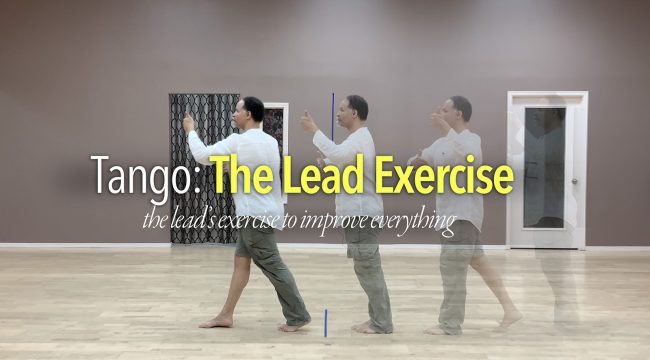
    On the surface, just looking at the sample above, it looks like 4 steps, in the extreme, that you’d never…ever do on a social dance floor. So as far as you’re concerned you’re gonna say to yourself “That’s ridiculous! No one dances like that!“. And you’d be right. You’re never, ever going to dance like that. Ever. Except when you understand a few things about the exercise that a.) It’s set up for other things. b.) it’s doing things in the extreme so that doing them in the minimal, later on, is a piece of cake. c.) it’s creating a level of precision and control that as a Lead you more than likely may not possess today. And d.) It’s one long isolation technique (more on this later). That said, let’s dive into the video that I call: The Lead Exercise > One Exercise To Rule Them All!

    A Few Things…

    1.) This exercise can be done by seasoned dancers, and should be actually, but won’t be for a variety of reasons, as well as the absolute beginner. a.) The seasoned dancer doesn’t read this stuff, they feel it’s beneath them (mostly). b.) The seasoned dancer will take one look at the video above, or just screenshot image and completely disregard what’s here because I’m barefoot.

    Truth be told, the sooner that you start doing this exercise, the easier things will get in more ways than can imagine.

    2.) The simplicity of the exercise itself is beguiling on multiple levels, and also exceptionally frustrating IF and ONLY IF you are honest with yourself. If you’re not honest, then the exercise is exceptionally easy and a complete waste of your time.

    So what are you being honest about ? Where you’re landing your foot and more importantly HOW you’re landing your foot (supination), where you’re sending your leg (the extension), how much opposition you’re actually engaging (extreme opposition), what’s going on with your arms, hands, and your head (where’s your head pointed)! This exercise, done properly, should challenge you in every way possible. The tolerances involved should push you to your extremes, it should push you beyond your comfort zone. And that’s what we want, we want you outside of your comfort zone. Why ? It is only through pushing beyond that zone, that change and awareness begins to happen.  Further the exercise is the embodiment of a simple but overriding principle of Tango Topics: Overshooting to Under do! Why is that relevant here ? Because if you can do this stuff in the extreme, then doing it in the minimal, will be a piece of cake for you, because you’ve already done that and more! That’s why. So you being honest with yourself and what your body is doing is kinda important.

    3.) Seemingly you’re never going to apply any of this stuff. Not true. You’re going to apply it everywhere. Here’s just 2 benefits. a.) You’re extensions. Sometimes called ‘Projections’. Cleaning those up will visually create the lines that you’re looking for. Do yourself a favor, video your walk going forwards from your hips down, from the side. Do it in skin tights or stalkings please, not pants. You need to see your legs. You’ll be surprised at a few things, most notably how much you bend your knees (more on this later), and more importantly how unattractive and inconsistent your extensions are. b.) You should start to notice how unstable you are. How much you wobble when you walk, and the fact that you more than likely can not follow a straight line going forwards! And all done without holding onto someone or using someone else’s walk to keep you from falling forward. If you’re wobbling that much by yourself, imagine what’s happening in the embrace with someone else!! For those of you that will argue, “that’s what the Follower is for”…No, it’s not. No one likes to be used to hold someone else up. No one. If the roles were reversed (and I have done this with Female students), more than likely you wouldn’t like it either. So what on god’s green earth makes you believe that a Female Follower would like it ? Answer ? They don’t. So…not so much with that. This exercise will help you with your stability, with your control, with your executions of everything that you can imagine and more that you can’t.

    4.) Socks or Bare feet. In the video above I’m not wearing any shoes. That immediately and completely discredits the validity of what I’m saying in the video. To those people I say this: The barefoot thing is all about feeling your foot in contact with the floor. The shoes, whether you know it or not, are compensating for you in more ways than you’re currently aware of. So we want to remove any and all compensation! We want you to feel the floor with your foot and not the shoe impacting the floor. And remember this is an exercise.

    Further still on this topic, at some point later on, we do engage what we call ‘shoe work’ for the Lead. Where we engage all of the work above, and then some to apply it in a pair of shoes, only because you’ve done it with precision, control, containment, and you’ve built up the necessary strength in your tendons, it’s not so much of a bother to be in a pair of shoes. The only difference now is that you have control over them. Versus wobbling all over the damned place.

    Put another way, a pair of shoes literally hides things from you. It compensates for your lack of balance with the edges of the shoe. Working in a pair of socks doesn’t allow for that. So therefore once that is mastered, then putting on a pair of shoes should be second nature at that point.

    This article contains the following topics:

    1.) The Turn Out Factor!
    2.) Leg Extensions (Part 1)
    3.) The Straight Line on the Floor!
    4.) The Pigeon Toed Feeling.
    5.) The Weight Transfer.
    6.) Opposition Explained.
    7.) Extreme Opposition Used.
    8.) Homo-Lateral Movement.
    9.) The Long Extension (Part 2)
    10.) The Knee Bend (Compression).
    11.) The Little Lean We Don’t Want.
    12.) Your Body Wavers.
    13.) The Isolation Technique/Ballet Rises
    14.) The Eleven Reminders.
    15.) The Actual Exercise (seen above).
    16.) The Leg/Foot Reminders.
    17.) The Checklist.

    These are the 17 topics that are covered in this extensive article that goes over every aspect of this very important exercise and then some. It’s a full treatise on how to extend one’s leg…as a Lead. Everywhere!
  • Lead Exercises

    Lead Exercises

    Most Leads come to the dance floor with the idea in their head of what they’re going to do from the moment they come into the Embrace. This is not always true, but a good portion of the Salon, Marathon, and Encuentro Leads will already have the first few bars of music mapped out. While their dance is not entirely mapped out (tsk, tsk, tsk), the first few measures are, and this is based on the Neurology of Leading that they’ve trained themselves to do over time with experience. And from there they choreograph a dance on the fly that fits the music within the available space (again the Neurology of Leading). To the casual observer, they’re dancing fluidly. Seemingly effortlessly putting one idea behind another.  However, in order to get to this stage of dancing seemingly takes a long time to do.

    There is the traditional method of trial and error to achieve this way of dancing: Which is lots of endless classes/workshops on vocabulary that they’ll almost never use, to pieces of music that they’ll never hear again (thankfully), and then spending lots and lots and lots of time social dancing, and ‘practicing’ (ahem), and throwing in a few private lessons here and there for good measure, and hopefully coming out the other side a slightly improved competent social dancer, which speaks nothing to their embrace, interpretation the music, their ability to execute vocabulary, or attention to detail, or leaving their ego at the door. This is the norm of how things are done. This is ‘trial and error’ because the Lead tries things out and the results are pretty hit or miss most of the time for a variety of reasons that are nuanced to detail here (that’s another topic for another day). Also during this time period, the experience can be long, usually painful, ego-bruising process (if they’re lucky), that can take upwards of two to three years at minimum assuming travel, number of partners, distance to larger and multiple cities, level of diligence and attention to detail in multiple disciplines: Technique, Vocabulary, Musical Interpretation, Codigos, Marathon vs. Encuentro vs. Salon styles of dancing, and a host of other things with the end goal being not just a competent social dancer, but rather a competent social dancer that can freely and fluidly interpret the music with their partners, e.g. dancing fluidly. 

    What if we could shave off (to reduce by) a few months, maybe a year, this process, possibly cut it back to about 6 months entirely ? What if there were a series of stepping stones that could quite rightfully change how a Lead responds to the music, changes how they interpret the music, that reduces their inhibitions, their hesitations, and removes all repetition from their vocabulary choices, and removes any and all excessive usages vocabulary ? That’s where Today’s Tango Topic comes in. 

    There is another method that creates this series of stepping stones (no pun intended) to getting the Lead to a place where they can freely interpret the music, and freely choreograph their ideas that map their vocabulary onto the music so that it fits perfectly. These are Lead Exercises.

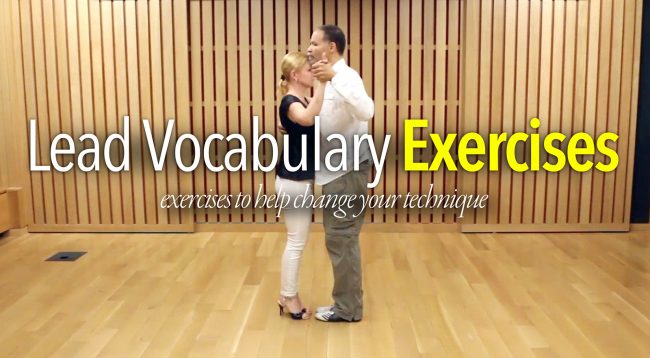
    What is a Lead Exercise ? This is a series of linked vocabulary choices that are practiced with some frequency on a weekly basis within the construct of 2 different embrace ideas, as well as with a metronome and NOT a piece of music. The reason ? A piece of music has lots and lots of nuances that can and do throw most people off, it confuses the hell out of them. So rather than work with a specific piece of music, we work with a time signature independent of the musical nuances, or in this case…the beat and ONLY the beat with pauses every 4 or 8 notes. So put simply a Lead Exercise is not about technique in this case, but rather a series of exercises designed specifically to retrain your Leading mind to respond to the changing conditions of the floor, the changing or challenges of Leading someone, what to do next, and most importantly to fix that tiny little problem of the hesitation described below. At the same time, this series of exercise also solves two latter problems of repetition and too much vocabulary by pairing things back to simple constructs to start with, instead of complex vocabulary sequences. Which is all designed to force you to work on the transitional elements rather than remembering steps, patterns, and figures that often fail and don’t necessarily help you all that much.

    About The Video. This video comes in at 21m:40s in length in 9 Sections. Lead Technique is explained here in the video. No Follower technique is explored. 

    Section 1 – Introduction – 00:03:04
    Section 2 – Walking Into Lazy Ochos – 00:01:35
    Section 3 – Walking Into Lazy Ocho – The Other Side – 00:02:05
    Section 4 – Walking Into Traveling Ochos – 00:00:48
    Section 5 – The ‘Dropped’ Traveling Ocho – 00:01:03
    Section 6 – The Close Embrace Variations – 00:02:59
    Section 7 – The ‘Practiced’ Weight Change – 00:00:38
    Section 8 – The 3rd Cross System Entry – Lead Cross Behind – 00:04:05
    Section 9 – The Frequencies/Closure – 00:04:42

    Video pre-requisites: 1.) 6 Ways of Walking. 2.) Milonguero Ochos. 3.) Traveling Ochos. 4.) The 5 Pause Types! 

  • What To Practice ?

    What To Practice ?

    Miles ? What should I practice ?  

    Before another word is said, I want to address 3 things: 1.) If you are someone who is a hobbyist of Tango, I have a very special message for you below. Stick around, you’ll want to hear it. 2.) I’m not wearing shoes or socks in the video. And 3.) is the reason why I’m not wearing shoes or socks. 

    That said….

    Story Time: Once long ago when I was just an itty-bitty Tango Miles. After leaving the care and feeding from my first tango teacher (after having been at his feet for 4 months), I was back in San Francisco, CA, living out of a car, and studying tango 7 days a week. All day. Every day. It was my sole enterprise. Tango 24/7. If you don’t know my story, you can go here. In short, I was living out of an enterprise rental SUV and sacrificing everything to learn to dance. Some people call it intense. I called it what I was doing in order to learn to dance Argentine Tango. 

    During this time, I found 3 or 4 practice partners that wanted to work with me. Wanna see an example ? What I didn’t realize at the time was that I had issues. Serious structural flaws in my walk, my embrace, and my understanding of what I was supposed to be doing. Those structural flaws were compounded by the Follower’s issues as we were ‘practicing’. 

    I thought I was doing what you were supposed to do, which was practicing what I learned from my teachers. What I realized later on, much later on, all that practice really did was bake in the problems without actually fixing or changing anything. So whatever problems I had never got addressed, even though I was studying with 6 different teachers, for 2 hours every day of the week. Nothing got addressed, changed, or modified. I kept paying my teachers thinking that I was learning tango. I wasn’t. That was their fault and mine and the way that tango is taught today. Nobody wants to tell anyone that what they’re doing is less than desirable. No one wants to give feedback that’s going to hurt someone’s feelings. That doesn’t sell classes. And the goal is to sell private lessons, not improve the quality of dance. 

    I digress. Throughout all of that I had to back and re-work my foundation later on. I had so many issues that I had to go back to the very foundation of how I walk and literally pull up my tango floorboards and replace the floor I was standing on. It was THAT bad. I had to basically teach myself how to walk all over again, several times. The reason it was several times was because there is a lot of confusion in what different teachers tell people about how to walk. I had to pick and choose from what I thought was clear, definitive information to what was poorly communicated information which moved right into flat out wrong information. From there I had to rediscover everything and figure out what worked, what didn’t and why it didn’t, and then figure out ways to make things work. This rediscovery would later help me in more ways than I knew at the time.

    Today when I’m working with a student, they honestly don’t want to do that kind of work. They just want the answers. “How do I …?” so I show them what to do, and then how to do it. But that starts with going right back to their foundation. If they’ve been dancing a while, they think or believe that they already know what they’re doing. And to a certain extent they do. But in reality, the fundamental elements have eluded them and they’ve ended up in a place of physical compromise for whatever reason. Once they get over that fact, and they get into a routine that we’re going to do nothing but walking (as a Lead and as a Follow) for 6 weeks straight, then we begin the real process of learning Tango. They go through a movement study (as seen in the Follower’s Exercise and Lead’s Exercise) to emphasize this point. As time passes and they rediscover their foundation, and we move onto the 5 social figures of Argentine tango, I usually get THIS question: 

     “Miles, what should I practice ?”. 

    My answer has always been the same, “Your walk”. However, I do expand on that because it’s not just the walk. It’s also a host of ideas that one wants to skillfully and gently remind of one’s foundation and at the same time guide one towards a cleaner, and better foundation. Which is where I remind them that there are 3 things they want to practice:

    The first is their walk. 

    The second is disassociation/applied disassociation in use. 

    And the third is ‘Fred Torture’. 

    The Preamble – No Socks or Shoes. 

    I practice in bare feet. However, that’s me. You ? You want to do what’s laid out in the video in SOCKS. Not tango shoes. Put simply the shoe will compensate for your equilibrium issues that you have going on that you may or may not be aware of. So take the shoes off. Further still we want to feel the floor and see what our foot is doing. Specifically you are looking for how your toes are reacting to the stress and strain you are putting on them. If your toes are coming off the floor at any point, you have problems! 

    The Hobbyist’s Notation. 

    Let’s address the ‘hobbyists’ in the room. You don’t believe in practicing, and you certainly don’t believe that you need to do any kind of conditioning work. And articles like these are a complete waste of your time. Right ? Your belief is that you are here to have fun and nothing more than that. Am I right ? OK, if that’s true, then let me ask you a SIMPLE question: why are you at every practice, and every milonga, every night or weekend ? If this was JUST a HOBBY then why the attention ? One could rightfully answer: “I’m there to see my friends and to hang out because it’s fun”. Good answer, okay…then riddle me this: If this is just ‘fun’, why are you trying to get better and better dancers to dance with you ? You see a hobbyist wouldn’t care about that stuff. If you’re here to have fun with everyone and that stuff shouldn’t matter to you. Right ? But it does! And that’s the point. It does matter to you. A lot. Because of that, then might I suggest we stop pretending that practicing, form, comprehension, clarity, and that ‘wasting’ all that time on a ‘hobby’ DOES matter because it can and does create a better dancing experience in the end! So let’s dispense with the hobbyist mentality and get down to business? 

    Part One – Solo Practice Enters the Chat! 

    It’s right here that I’m going to tell you that the only thing that consistently improves one’s ability to move efficiently and effectively is SOLO PRACTICE. So here’s what you’ll need: a pair of sliding socks, a little grit and determination, and last but not least, a desire to be honest with yourself and not cheat yourself. Every time that you do compromise or give up, you fail yourself! There’s no greater failure than when you do not accomplish what you set out to do. This stuff requires your due diligence. It requires abject honesty. While you are the only one that knows just how much time you put into this stuff, your partners will feel the difference when they dance with you. The efficiency of your movement, the clarity and cleanliness of the motion, and more importantly, your ability to control and contain yourself WITHOUT needing to hold onto anyone else to execute. 

    Part Two – Preparing the Instrument. 

    You do have to do a little prep-work. And that prep work is ‘Presence’ to start with. Presence, if you don’t know, is a Tango Topics-ism. It’s the first part of every movement. This state comprises 5 different things: 1.) Feet in Social Collection. 2.) A micro bend of the knees. 3.) Elongation of the Spinal Column. 4.) Lifting the Head! 5.) Breathing through the Solar Plexus. This state of Presence puts the body into a state of awareness and preparedness for anything that comes at it, or you will ask it to do.

    Part Three – Working On Your Walk. 

    The walking exercise isn’t one exercise. 

    It’s three > Extensions work, Walking Exercise, and finally a ‘Box’ step. 

    First we start with extensions: Forward, Side, and Back. In these extensions we engage the idea of ‘Walking In Opposition’ in the extreme, and then embed that idea in those extensions. The reason this is done is because it’s set up for Disassociation and Applied Disassociation. Details matter here. Meaning ? You’re working on everything in the extreme, going as far as you can with your opposition AND your extensions as well as your how you’re landing your feet. 

    Next we engage a ‘version’ of the Walk. Let me be clear, this is an exaggerated walk for several reasons. In my reasoning that exaggeration exists because we’re always “overshooting to under-do”. That means that we want to do things in the extreme here so that later on, when we may want to do something that requires it, it’s not a stretch or a strain but instead it’s easy for us because we’ve already done that work. This version of walk uses a null embrace format so that you can see embrace collapse if that happens and then correct for it. This version uses BOTH forward and backward steps, not just as a lead or as a Follow but both roles! This version also embeds the idea of Opposition, in the extreme. This version also embeds intention (a little forward lean). This idea pays attention to details like how you land your foot, ‘popping the knee’ as we extend backward, intention, passing thru social collection, posture, etc. The idea is to do this slowly, carefully, in a contained way. 

    Lastly we engage the idea of a Box Step using all 3 steps, going in both directions. Lead left and then Lead Right. Side with the Left, Forward on the Right, Change weight, Side with the right, Back with the Left, and then reverse it. 

    Part Four – Rotation – Disassociation and Applied Disassociation. 

    This part of the article ….

    Part Five – Fred Torture. 

    is not visible to you….

    Part Six – Time To Spend ?

    because you are not a full subscriber …

    Part Seven – The Common Errors!  

    if you subscribed, you’d see the full article and the 45 minute video.

    — IF YOU WERE A SUBSCRIBER YOU WOULDN’T SEE THIS ANNOYING MESSAGE! AND YOU’D BE ABLE TO SEE THE FULL VIDEO (46 minutes), and READ THE FULL ARTICLE —

    A Notation for Advancing Dancers. 

    I got news for you. YOU NEED THIS STUFF JUST AS MUCH AS BEGINNERS DO. Perhaps even more so. Your technique needs to be refined, clean, cared for constantly. And if you thinking dancing is the answer here. It’s not. You still have to take care of your foundation. Judiciously. The only different between you doing this stuff and say someone that’s been dancing for a year or so, is that you don’t have to do this stuff as often > once or twice a week. But you STILL need to do it. Just because you have reached your level don’t mean that you don’t have to continue to do your own personal work.

    This Work Will Not Make You A Better Dancer! 

    Wait! What ?!?!?!?!? Let me be clear here: The mere fact that one is working on their walk, and by extension their foundation, this work IS NOT going to make them a better dancer. What it will do is prepare the instrument, their body, IN ORDER to dance with better partners! Let me say that again for those in the back that seem to think steps, patterns, figures, and one’s embrace make you a better dancer. IT DOES NOT! What makes one a better prepared dancer is reworking one’s foundation. Preparing the body and nervous system to build muscle memory, and neurological memory, so that one reacts properly when the time comes. This is the foundation of that work.

    This is why we work on ourselves in SOLO PRACTICE and NOT in PARTNER PRACTICE!

    The mistake I see so often is someone practicing with a partner. Yes, Tango is a partner dance. So it stands to reason that if the dance is a Partner Dance, then you should be practicing with a partner. Yup. All true. There’s just one little problem with that line of reasoning. This > When you practice with a partner you are taking your issues, and their issues, and co-combining them into one larger issue, and more importantly unintended issues that can and will get generated because you are in an embrace with each other. Put another way > You have your own issues. They have their own issues going on. If NEITHER one of you addresses the underlying issues that you both have individually then you will combine both of your underlying issues to create more problems than either one of you can figure out. You’ll either get frustrated with each other or yourself. Either way, the end result is NOT good! 

    So ? Solo Practice FIRST and FOREMOST. Clean you. Then add someone else into the equation. See where the bugs are at. Then go back to solo practice and work out where the issues were at…and keep cycling through. 

    Burying The Lead. 

    You don’t want to hear this part. But I have to say it, and you’re not going to like it. Even if you do all that work above. Even if you find a practice partner that is doing the same kind of work. You are still going to need someone like Miles to look at what you’re doing, point out the error(s), and then give you a pathway out. What you don’t want to do is watch yourself in a mirror or video or have someone else do that, and then critique yourself. You will miss things. Yes do video, but don’t use a mirror. Video doesn’t lie. You do. You can and will miss things. Further you will misremember and compromise what you’re doing. So in the end even if you do all that work, you will need a ‘Miles’ with good Tango Analytical skills to look at what you’re doing and give you reliable feedback that’s actionable. Which is to say, plan accordingly! 

    The Wrap Up. 

    In the end, remember this: every minute of solo practice you invest is a gift to your future dance partners. It’s not just about perfecting steps or looking good; it’s about removing the body noise, ignorant unaware body motion and uncontrolled movements that create problems. All the work of overshooting to under-do, of disassociation and Fred Torture—they’re not about making you a “better dancer” in some shallow sense because this work isn’t about that. It’s about preparing you for the dance of your future self. This is about re-building your foundation towards solid, clean, and consistent so that when you finally step onto the floor with someone else, it’s a dance between two well-prepared partners. That’s the real reward, and it’s absolutely worth the work in my opinion. 

Hide picture