Offer ends in Offer $99 for 1 year 6daysd 23 22 04 One year for $99 Get your year
Tango Topics info:

Check out the Tango Dictionary for words like Axis and Connection.

Tag: back sacada

  • Back Sacadas 2019

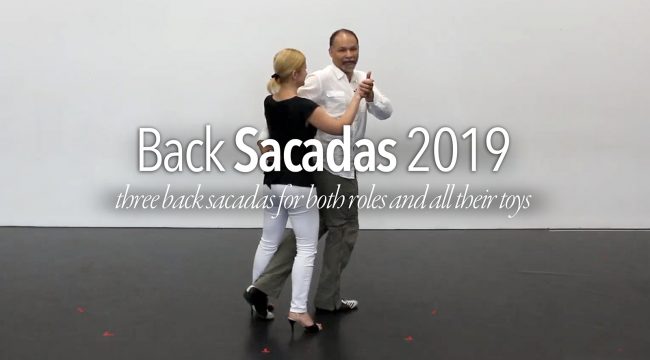
    Back Sacadas 2019

    Sacada. Meaning – ‘a-really-cool-move-that-you-think-is-really-complicated-but-is-an-illusion of techniques’.  For most people when they see a sacada for the first time, their reaction is one of surprise that a.) it looks really complicated (it’s not). and b.) that they can never see themselves doing one (you will). And these are usually forward sacadas for the Lead into the Follower’s side step. Usually. There are about 1024 sacadas, which drops to 512 when you rule out certain impossibilities. In reality, there are about 10 different ‘flavors‘ of them that when you combine the different flavors of walking systems, that number jumps to an insane number.  Things go right off the rails (as the saying goes) when we see a sacada that does not fit into this paradigm. Enter the “Back Sacada“.

    Important Notation: This article & video has been re-written, updated, and the video has been completely redone for 2019 going forward. Originally the video that accompanied this article was 31 minutes and 35 second in length. It is now over 1 hr and 35 minutes.  The original video is still present and available for purchase, as it contains desirable information. However, the article that represented it is no longer present. 😉 Enjoy.

    What is a Back Sacada ? The easiest way to describe this Sacada, which is a displacement, where either the Lead or the Follower will displace and then take the place of their partner by using a Back Step! Generally, these types of Sacadas require Applied Disassociation to make them happen for either role. Typically this type of Sacada is created whereby the Follower is led to Sacada the Lead, whereas the second most common variety is the Lead will Sacada the Follower.  Of all the Sacadas that one can lead and follow, this is probably the most challenging for a variety of reasons. Most notably because you quite literally have to have mastery over proprioception in order for them to work properly. Most people, however, do not have the necessary mastery, so they end up bumping into one another and feet getting stepped on, repeatedly. While this isn’t always the case, and not to disparage anyone’s experience of them Leading or Following these ideas, the fact remains that unless proprioception has been mastered then this type of Sacada will repeatedly fail.

    The Free Tip. The Back Sacada is only one of 501 possible Sacadas, yes FIVE HUNDRED and ONE, that are available to you. However, this particular Sacada has one unique quality that sets it apart that may not seems apparent to you, in nearly all cases of Back Sacadas, they nearly all require one or both partners to do some form of over-rotation! Meaning that in order for them to work, you must, must, must apply disassociation, and then release that energy that’s built up as if it were a rubber band snapping back to achieve the over-rotation.


    About The Video. Total runtime for this video is: 01:38:55. This is a combined video format, lead and follow technique are mixed together.

    Introduction – 00:06:22
    Disassociation/Applied Disassociation Review – 00:20:54
    Trailing Foot – 00:05:27
    Leg Extension – 00:11:06
    Dangling Foot Error – 00:04:18
    First Common Back Sacada – 00:12:35
    Second Common Back Sacada – 00:07:00
    Dancer’s Cheat/Lead’s Cheat – 00:05:41
    First Common Multiple Back Sacada – 00:07:34
    Second Common Multiple Back Sacada – 00:02:26
    An Interesting Back Sacada and a Surprise Back Sacada – 00:07:47
    Close Embrace Back Sacadas/Closure – 00:07:45

  • The Lead Step Over Back Sacada

    The Lead Step Over Back Sacada

    In Tango, we have multiple types of Sacadas, from multiple types of positions, with varying levels of complexities. Typically, the most difficult Sacada to execute for BOTH roles is the Back Sacada. The reason for that is because the Back Sacada usually requires a level of disassociation and applied disassociation that is difficult to accomplish. Most especially if either role has not done the necessary ‘ground’ work to make that happen.

    However, there are a series of Back Sacadas that DO NOT require that aspect at all! They’re typically not done for one reason or another, with the most common one being that they tend to break the embrace or the structure of the couple. Because no matter what happens, the back sacada must at some point face against the partner. And the set up for that is problematic, which is where the disassociation comes in.

    In this type of Sacada, none of that is necessary. When you stop and you think about it, this type of Sacada is one of the easiest Back Sacadas to execute for a Lead or a Follower. However, in this video, we’re going to look at the Lead’s version of this idea ONLY. And in a later video, we’ll take up the Follower’s version of this idea, which is slightly different in terms of how it would be set up and led. It should be noted that the basic structure of either side of this type of sacada is nearly identical across both roles!

    What is a Step Over Back Sacada ?

    This is a type of Sacada where one party steps over the leg they’re going to eventually sacada, forwards or back. Typically, it’s done from a Back Step. However, the sacada can also be done from a Forward step for either role. In this instance, we will not be looking at the Forward Step, but just the limited vantage point of the Back Sacada.

    The Follower’s Side of the Equation.

    For the Follower, there are 3 areas that we need to pay attention to:

    1.) The Collapsing Embrace.
    2.) The ‘Free’ Leg Component.
    3.) Coming To Collection.

    Let’s get some issues out of the way before we dive into the details. First and foremost, for you, this is the Lead Sacada-ing you. You don’t need to concern yourself with anything other than keeping your leg in the position it was left in. The reason why this is important is because most Followers are trained to collect their feet after a movement. In this instance, the Lead is literally stopping you from doing precisely that. You see, if you collect your feet, then there’s nothing for the Lead to Sacada! So don’t collect, yet.

    Secondly, quite honestly, this is one of those weird moments in your Following experience that’s going to be a bit out of the norm. It doesn’t happen all that often, if ever. However, now that I’m pointing it out and showing just how dead simple this is, be prepared for an onslaught of Step Over Back Sacadas. I am sorry about that. While I will address this later in the Lead’s section of this article, ideally, what should happen is that the Lead should ONLY do this no more than 3 times in a Song. And even that’s a stretch. 
    Lastly, this is one of those moves where you, as the Follower, are waiting for his majesty to do his thing to be flashy and ‘cool’. You basically just have to hang out until he steps backwards into you. When that happens, we ideally want your controlled displacement to occur (see collection below).

    The Follower Details.

    Collapsing Embrace.This means that your left hand is on his shoulder (more than likely), and your arm has collapsed inward towards you (as shown in the video). Ideally, what we want to have happen is that you want your arm to go AROUND your Lead as they lead you in back step around them.

    Free Leg. This refers to a very common issue that crops up, that we as followers want to just let the leg fly freely backwards out of collection. While this is desirable in certain situations. This is NOT one of those times. Ideally, you want to keep your motions separate from each other and really listen to what’s being asked of you. There’s another reason why you want to contain or curtail your ‘free’ leg. Because it’s all too easy for you to let that leg fly and then hit someone behind you! So … try NOT to do this!

    Caveat > Most Leads are NOT this clear where they are deliberately leading X to get Y response out of you. So as a result, they’ll muddle through. However, the resistance-based Lead will use their arms and physical pressure to generate those clear individual motions. This is NOT desirable. Ideally, we want our Lead to use intention to generate, ask for, and follow through on any motion that we’re being led to do. 

    Collect Your Feet. This should be a no-brainer, but sometimes we need the reminder. Remember to collect your feet/bring your feet together in the appropriate places! One appropriate place is when you are being sacada-ed, and the Lead has stepped back into your leg; your leg wants to fly free, but it can’t, and this is where you must remember to invoke a controlled displacement of the leg and bring your feet to collection. As they continue their rotation, it will lead you stepping backwards and ending up back in front of your Lead. 

    The Role of the Active Follower.

    In the role of the active follower, there is something here that can affect what the lead does NEXT and how they do it. By changing the angle of your rotations either towards or away, you affect how close the sacada will be and, more importantly, what is done next. You can actually prevent them entirely by stepping slightly away or by coming to collection everywhere deliberately! Remember, if there’s no leg there, there’s nothing to sacada! Why do this ? By NOT participating here, it prevents the possibility of opening the embrace and further forces the lead to keep things on the simple and clear. 

    The Lead’s Side of the Equation.

    This is really simple for you, just a reminder but:


    Final Thoughts.

    This is a fun little sacada that can be used in any number of places to either taTangor vaVals MusicHowever, it’s best in taTangousic. Usually late Pugliese, Calo, or D’Agostino. Any music where there are lolongtringy notes. You want to use the loLongstStringyote as the ststep overart!

Hide picture