The word ‘Cortado’ translates into English as ‘cut’ or cutted (which isn’t a word in English) or an Ocho that is Cut. In today’s version of the modern Ocho Cortado, it rarely resembles its Ocho roots. It’s no wonder when people say the words for the first few times they get a little confused and can’t see the embedded Ocho properties that are sitting in front of them.
When we think of ochos, we tend to only think of BACK (Traveling) Ochos, not their Forward variety which is where the confusion comes from. Further, still it’s the interruption that of the Ocho (hence the ‘cut’ part) that people don’t see which creates even more confusion.
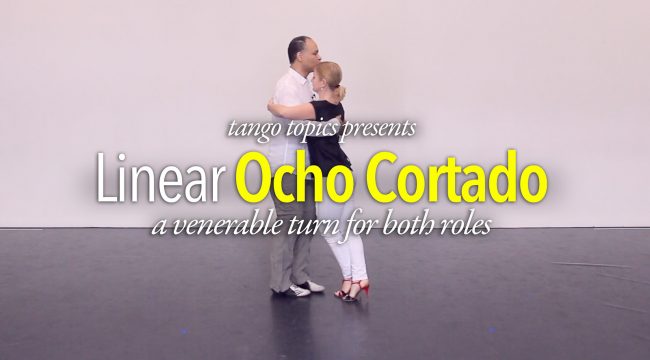
Today’s Tango Topic looks at this venerable Tango Turn and Vocabulary and looks at the Linear version of it, known as “The Linear Ocho Cortado”. So named because it’s done along a line. It should be noted that Tango Topics contains several variations of this venerable piece of vocabulary and that you really should check them all out. There’s lots and lots and lots of variation with this stuff. Further, still it should also be noted that this Linear Ocho Cortado is the ‘vanilla’ version of the Cortado. It’s the most common form and in Today’s Tango Topic we will not be showing any of the variations of the Cortado. For that, you really should go visit the link below and look at the other options. That said, let’s dive right into Today’s Tango Topic: The Linear Ocho Cortado.
What is a ‘Linear Ocho Cortado’ ? The are multiple versions or ideas of the Cortado. However, this particular piece of vocabulary is also what we consider to be one of the Seven Foundational Moves of Tango that every dancer must learn in order to be a socially competent dancer. Note that we said, not ‘Lead’, not ‘Follower’, but ‘Dancer’. That’s because both roles have a responsibility to this piece of vocabulary which we detail below. The Linear Ocho Cortado or ‘LOC’ as we’ll refer to it from here on out, is not something that is learned in a very specific progression of ideas. First and foremost you must learn how to walk, then Disassociation and Applied Disassociation which translates to Traveling Ochos, then Turns (Usually the Follower’s Molinete to the Lead’s Giro, and the Milonguero Turn as well), then the Argentine Cross, and finally the LOC. The LOC gets its name from the fact that it’s done in a line or along a linear path within the Line and Lane of Dance and does not break that convention. The LOC has multiple uses, from a Parallel System walk (shown in the full video above) to an endpoint or completion element. Meaning that you’ll use it as a resolution from a Molinete/Giro structure (mostly) as an example. The vocabulary itself is done on the beat, while the variations on a theme can be done in half-time, as well as double time. The LOC can be interpreted many, many, many different ways from a musical perspective. That’s one reason why it’s so venerable and versatile.
About The Video. Total runtime for this video is 26:19. Lead and Follower Steps and Technique are separated. The item in bold is unedited and is at the top of this article as a sample.
Introduction – 01:46 Lead Steps – 04:08 Follower Steps – 03:02 The Couple’s Posture – 01:46 Lead/Follower Steps Together – 02:37 The Importance of the ‘Replacement Step’ – 02:23 The Follower’s Side Step Error – 03:04 The Close Embrace Version – 01:05 The Walking Example – 02:20 The Embrace Reminder/Closure – 03:16
In today’s Tango world, the Turn has become a necessity. We would like to believe that Tango is the lovely and amazing walking dance that we have heard said it was. The reality is a little different. Tango is no longer a walking dance. Don’t mishear that as the walk is unimportant or that you don’t have to study how to walk. Not true. You absolutely must study your walk: How to extend your leg (forward, side, or back), how to land your foot in a step (forward, side, or back) in relation to specific vocabulary, when to flex or bend the knee and why, what part of the foot is required and when (and why), what muscles to use and why, when to use your toes, how to strengthen the foot, etc. This is the technique of walking and that stuff is extremely important in order to begin to move efficiently, and effectively. This is not something that should be left to watching a 5-minute video on YouTube but actually, spend months and literally years learning and then re-learning, and refining. Because the study of your walk, and its refinements, absolutely makes for Today’s Tango Topic to exist. One can not even begin to study this topic unless one has mastered one’s walk. And by ‘master’ we mean to infer not perfection but rather well beyond functional so that it comes fluidly from you. Without wobbling, wavering, or using your partner for stabilization in any way, shape, or form. Today’s Tango Topic deals with the next most important element beyond the walk and goes right to the heart of the statement above that Tango is no longer a walking dance. In fact, today’s modern tango is more of a turning dance more than anything else. And the reason why isn’t a one-size-fits-all answer. It’s a series of factors that generate the state of affairs in Tango. For more on what those factors are, and why they exist and how to fix it, look at Floorcraft 102 – The Incomplete Turn, it explains those details in spades. So the turn has become the defacto, go to element that one must study with as much diligence as one studies one’s walk.
We see the turn as one of the 7 Basic Moves of Tango Vocabulary (see link) that is used in every dance by every dancer at every Milonga in the world. It is almost as ubiquitous as the Argentine Cross. So much so that one may lead or follow a turn and not even be aware that they’re doing it. The primary turn that is taught and then danced is the Molinete/Giro structure. From a Leading perspective, this primary or basic piece of vocabulary is one of the ways that we can create navigational structure as well as generate musical structure. And it also has the obvious ability that allows to use it as filler content until we’re ready to do something else that may lead up to something else. From a Following perspective, it is one of the very first things we are taught to master and must become facile with because our very tango lives depend on it for a whole host of reasons which will become obvious later on down the line.
However, ‘The Turn’ isn’t a singular turn. There are in fact EIGHT, yes you read that correctly, EIGHT types of Turns in Argentine Tango. And that’s what this video is all about.
That said, let’s take a deep dive into the 8 Types of Turns for Argentine Tango.
Three Techniques To Turning. Before we get into the Eight Types we have to look at a few foundational tools that must be present before we can even begin to talk about turns. While some of the turns in the Eight Types do require the study of item 2 below, it’s not required for the other turns. In fact, what you’ll find is that items 1 and 3 are far more common than item 2 on the list.
Walking Technique can loosely be described as how one extends one’s leg and lands one’s foot on the floor, either in response to or initiation to movement. The study of one’s walk is absolutely required before you can even attempt any of the turns in today’s Tango Topic. Why ? You need only look at the following short 3 videos to see why this is an issue that must be resolved before you make the attempt. And if watching the videos below is just too much for you and you want to skip them, the simple answer is: STABILITY. Now go watch the damned videos! 🙂
Plays from YouTube. Pressing play connects you to YouTube. Privacy
More Extension Errors
Plays from YouTube. Pressing play connects you to YouTube. Privacy
Disassociation/Applied Disassociation is really the preferred method of motion for a wide variety of reasons. Most notably because it allows for fluid and seemingly natural movement not to mention it also allows for greater precision control, which in certain cases of the type 7 turn, is absolutely required like where if you don’t complete the turn things are definitely going awry!
Just so you know, there are two videos on this topic in the archive. And while it’s lovely to sit here and yap about this stuff, you really do need to see it. So here’s a not so subtle plug to actually go and subscribe so you can see those two videos. They’re in the Ochos section. The first two videos. Please, for the love of God, go look at them. They’ll tell you everything you need to know about this fabulous and lovely technique that really are the bee’s knees!
What are the Different Types of Turns ?
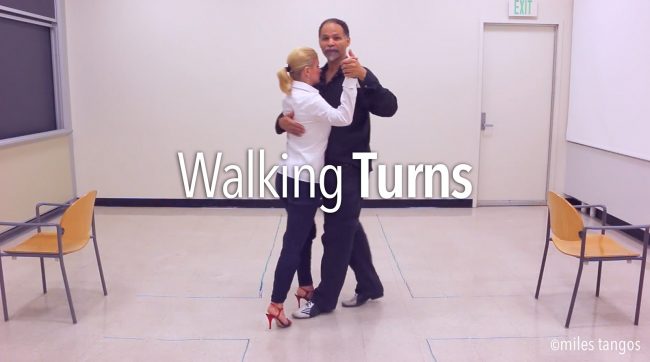
Type 1 – The Walking Turn. (Freemium) In this type of turn, which has been showcased before in different videos, the couple essentially walks in a very tight circle. What makes this turn unique is that not only is it functional, but it’s also insanely musical, and on top of that, exceptionally easy! However, like everything else on this list, it has a “Gotcha”, and it’s a pretty big one too. There’s a reason why this turn is almost never taught, and it has to do with the rule that we’re all taught as dancers, “Never walk backwards against the line of dance”. Never. Ever. Which is to say that this turn, after about the 2nd or 3rd steps, will have the couple going against the line of dance. Which as you can imagine creates problems for everyone. However, there is a solution to this problem of walking against the line of dance, and that’s to angle the turn a bit, and keep the turn tight (a small walking circle) to that the effect and timing is absolutely minimized. This turn can be done in open or close embrace, or any embrace format really. It’s best case use is in Close Embrace for a wide variety or reasons. There are multiple variations to this turn, and those variations come in the form of Walking Systems or The Six Ways of Walking. You can add loads of variations to this turn simply by changing the walking system. So while you can use a walking turn as often as you like, it does tend to get a little old after about the 2nd time through, not to mention if you don’t manage the line of dance issue you’re going to be holding up the line of dance. So it is for this reason that once you’ve got this thing down as a couple. You may want to look at Walking Systems in order to add about 18 different ways to vary the Walking Turn. 🙂
Types 2 – 7 are Subscriber Only Content
Type 8 – The “Milonguero” Turn. (Freemium) The last item on this list is by far the simplest and easiest as well as what we believe to be the sexiest one, if not the most elegant. From the Follower’s point of view, it’s a back cross, a side step, and a forward cross (sometimes called cross-in-front). The turn is usually done in close embrace for a wide variety of reasons, as this was the predominant turn that was danced for almost 70 years until Gustavo Naveira and Fabian Salas came along and turned (no pun intended) the Tango world on its ear with the Type 7 on this list. There is a gotcha to this turn, and it’s that the Follower more than likely has the Type 7 turn in their heads and getting them to do anything else (this is known as fighting default behavior) is nothing short of like going to dentist, like pulling teeth and just as painful for both parties.
The Walking Turn. Right from the start the 2nd or 3rd thing a Lead must learn is how to turn the Follower. Usually, most Leads are taught the sexier turn, learning to lead the Follower’s Molinete to their Lead Giro. It’s a harder turn to learn for a variety of reasons, not the least of which is that the Lead must master disassociation first and foremost, and secondarily not to use their arms or hands to push or pull the Follower. That along with the timing of certain aspects of the guidance of the Follower’s Molinete can make it rather challenging. So you would think, given all that, that teachers would eschew teaching the Lead how to generate the Follower’s Molinete in favor of a much simpler turn. Nope. Most teachers go right for the Molinete/Giro combo and skip right past the simplest turn of all: The Walking Turn!
What is a ‘Walking Turn’ ? It’s a turn where the couple walks in a very tight circle within the line of dance. Obviously this type of turn has issues, in that 2 of it’s steps will go AGAINST the line of dance. However, this can be alleviated by ‘cutting’ the corner of the first turning step, thereby curving the turning step towards being even tighter.
There are many benefits to this type of turn even though it isn’t taught that often if at all. One benefit is that the turn allows for the continuation of walking with your partner. Still another benefit is that it also allows one to engage any one of the five of the six ways of walking! Usually this turn is done in Close Embrace, and in Parallel Walking System. However, that doesn’t mean that it has to stay that way. 🙂 It can be a very nice exploration, musically speaking, of Close Embrace walking on 3 tracks or Milonguero Ochos or a host of other things.
The primary reason we use this turn is to add to our repertoire of available turns. We could use the Follower’s Molinete or the Milonguero Turn, or it’s kissin’ cousin, the Calecita. Which, as a side note, is a great addition to the Walking Turn itself. You can go from Calecita to Walking Turn in a continual cycle back and forth. Just a thought. 😉
The Problem: There’s a reason why this turn isn’t taught all that often. Actually 3 reasons. 1.) It is all too easy for The Walking Turn to become a navigational hazard, meaning that the turn can go outside one’s lineandlane of dance when executed by a beginner Lead. 2.) It’s not sexy by comparison to the follower’s molinete, but rather it is very functional. And for some reason we like sexy and eschew functional. 🙂 The problem is that the turn itself while being very easy to learn, can be difficult to execute. 3.) Probably the biggest issue is that after about 2 or 3 steps, depending on the size of your steps, you will invariably be facing against the line of dance. And this is a major no-no! And if this something your teacher has not told you about, then fire that teacher immediately! Because this is one of those things that you should have drilled into your head! One never, ever, ever walks or dances against the line of dance!
For these 3 reasons, this is why the turn is almost never taught to beginner leads, because they’ll end up doing all 3 things, thereby freaking out when something doesn’t go right, and thereby screwing up the line of dance which in turn creates a navigational nightmare!
However, with a little judicious study, and some hard work, the turn can be taught, and then executed with a great deal of control and precision, and eventually can become a useful staple of every Lead’s arsenal of turning tools in today’s modern version of Argentine Tango.
The Free Tip: This turn can be used in a tight space, but the turn gives up one of its elegant pieces, it’s not gradual anymore. At the same time, there is no more force in the arms in any way, shape, or form. 🙂 That said, the tightness of the turn, the size of it, can be controlled through foot placement, and rotation of the new standing foot. So wherever that foot lands it wants to rotate towards the inside of the walking circle.
About The Video. This video comes in at 1hr:8m in length in 19 Sections. Both lead and follower technique is combined and integrated in the video.
Section 1 – Introduction – 00:01:00 Section 2 – Set Up: 5 Embraces – 00:01:20 Section 3 – Basic Floorcraft – 00:02:00 Section 4 – Tango Hapitcs – 00:01:02 Section 5 – Without The Lead Back Step – 00:00:37 Section 6 – Set Up – Relationship = Alignment – 00:01:23 Section 7 – Starting The Turn – 00:02:00 Section 8 – The Walking Turn – 00:00:58 Section 9 – The Walking Turn with the 5 Embraces – 00:07:47 Section 10 – Follower Technique – 00:06:11 Section 11 – Lead Technique – 00:01:37 Section 12 – The Relationship – 00:03:21 Section 13 – Footwork: Close-ups – 00:04:59 Section 14 – Why Walking Systems – 00:00:58 Section 15 – Walking Turns with 6 Walking Systems Explained – 00:06:49 Section 16 – Walking Turns with 6 Walking Systems Applied – 00:11:38 Section 17 – Walking Turns – Errors – 00:05:44 Section 18 – Embrace Reminders – 00:04:46 Section 19 – Closure – 00:02:07
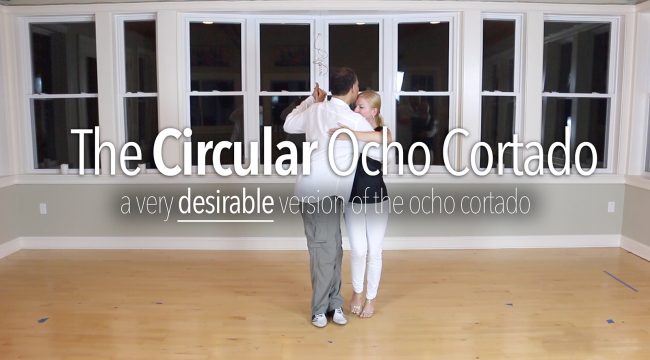
The Circular OchoCortado. First let’s get the language out of the way. The phrase “Ocho Cortado” translates from the Spanish to English like so: ‘Ocho’ translates as the number 8. ‘Cortado’ comes from the root Spanish -AR verb ‘CortAR’ which translates as the infinitive ‘to Cut’ (or to Slice). However, you’ll notice that there’s an ‘ADO’ ending on the verb, which is akin to an ‘ed’ ending of a verb in English as in ‘HelpED’ or ‘LikED’, or ‘WalkED’. It’s the past participle version of the word. 🙂 However, when you put them together the translated phrase almost makes no sense. So we have to move things around a bit for it make sense to an English speaker. So ‘8 Cut-ed’ makes absolutely no sense, however if we invert the words so that it becomes ‘Cut-ed 8’, it starts to make a bit more sense. Typically when dealing with other languages we end up having to infer the meaning. ‘Cut-ed’ in English makes no sense, however…it’s secondary meaning does, ‘SlicED’! A ’SlicED 8’ or Half of an 8! So quite rightfully an Ocho Cortado is a HalvED 8! Language lesson over….
There are two varieties of the Ocho Cortado, the Linear variety and Today’s Tango Topic: The Circular Ocho Cortado. In the case of the Linear Ocho Cortado, it really is a linear step. Meaning ? That it’s stretched out along a walking line. The vocabulary itself is really great for rounding corners, when you need to ‘cut’ a 90º corner. They’re great for musical interpretation elements. They’re great for cross play. And they’re even better when inverted! 🙂 However, the Linear Ocho Cortado is only taught in certain places. Tango Topics talks about the Linear Ocho Cortado as if it were the default Ocho Cortado. That is not the case. In other parts of the world, The Circular Ocho Cortado is the default and the Linear variety is weird one. In certain places the Linear variety is almost never taught, so you’ll never see it on a social dance floor at all. In certain places, the Circular variety is the odd man out and you’ll never see it either. So today without further adieu Tango Topics presents – The Circular Ocho Cortado. The OTHER Ocho Cortado. [Editorial Note: This site will be cleaning up the language for the Ocho Cortado in the other posts that deal with this to make the clear distinction of Linear vs. Circular.]
What is a ‘Circular’ Ocho Cortado ? Put simply it is leading the Follower to a Forward Ocho. However this is a very specific kind of Ocho that we only use for teaching purposes. In this particular case, that teaching Ocho is what’s sometimes called (and this site referred to as such) a ‘Linear Forward Ocho’. They’re called that because these ochos don’t go anywhere at all, and in fact they’re done directly in front of the Lead on a line. Hence the ‘Linear’ part of it’s name. 😉 The Lead invites the Follower to a Linear Forward Ocho across their body (to the open or closed side of the embrace, usually the closed side), and then interrupts that motion to invite a change of direction, and that change of direction is the Ocho part. The ‘Cortado’ part comes from the fact that only ONE HALF or one side of the Ocho is danced. Typically an complete Ocho is both sides of the 8 or the Applied Disassociation. However in this case, only one half is done, and as a result we have a Cortado or Halved 8. What makes it Circular is the fact that the Ocho itself is the circular part. The curvature of the opening step into and out of the Ocho (the applied disassociation part) Cortado where the Follower is at first stepping next to their Lead and then back to the same position again.
About The Video. This video comes in at 31m:28s in length in 9 Sections. Follower and Lead Technique is explained in the video.
Section 1 – Follower’s Perspective – 00:12:43 Section 2 – The Difference Between Linear & Circular – 00:01:07 Section 3 – Leading Perspective – 00:03:09 Section 4 – The Open Side Circular Cortado – 00:02:44 Section 5 – The Close Embrace Version – 00:03:52 Section 6 – The Lead’s Error! – 00:01:34 Section 7 – The Lead’s Head – 00:01:34 Section 8 – Lead/Follower Footwork Detail – 00:03:41 Section 9 – Closure – 00:00:22
Of the Seven Basic “Moves” for the Follower, the Argentine Cross is probably the most overused and, at the same time, least understood and quite honestly, least explored by the modern Tango dancer. It’s just accepted that it happens.
Just imagine for a moment, that you’re dancing along as a Lead or a Follower and you’re dancing the same Argentine Cross again, and again, and again. After about 5th or 6th time, it would become so rote that you’d stop thinking about it and it would happen by default. No artistry, no distinction, nothing. That is precisely what has happened with the modern version of this idea. The cross has become so ubiquitous that we have stopped exploring it and mining it for its rather unique properties. Like for instance the mere fact that it is the only time in any couple social dance where the Follower willingly (a very important distinction) crosses their feet! Or the singular distinction that there are about 256 Variations of the Argentine Cross, and yet…you only know one of them ?
Yup. You read that rightly…TWO HUNDRED & FIFTY-SIX different combinations.
Have you seen the Argentine Cross video ? You may want to go look at that, as it’s the foundation of this video. Without it, these are just interesting ideas but they have no context. The Argentine Cross video is what makes this entire video possible. It’s also FREE if you register. Just scroll to the bottom of this page, and register! And then follow the link below. You’re welcome. 🙂
What is a ‘Variation’ of the Argentine Cross ? It is an alteration, a deviation from the ‘Normal’ Argentine Cross, and while the steps themselves don’t change, the direction and options for the Cross do change. This is a ‘variation’. The way that we get to Two-Hundred & Fifty-six is first we accept the direction of the cross. Meaning that it generally goes to the Lead’s left/Follower’s right and walks in Parallel system. The Lead generally steps ‘outside partner’ to the Follower’s right (Lead left) and the Follower crosses their feet (Left over Right). This is a ‘Normal’ Cross. However if we instead step not outside partner Right, but outside partner LEFT (the Lead’s Right this time), and complete the cross that way (Follower crosses Right over Left). This would be a Mirror Image or a Mirror Cross in Parallel System! There are two other parallel crosses sitting here, and it requires us to visualize that if there is a Normal Cross, and a Mirror Cross, then there must be an Inverted Cross and an Inverted Mirror Cross, where in both cases the Follower would cross behind not in front. These are the Four Parallel System Crosses: Normal, Mirror, Inverted Normal, Inverted Mirror (N, M, IN, IM). Aside from Parallel system we have Cross Systemwalking which we can apply to these Crosses, so instead of 4 Crosses, we just doubled to 8 because we’re doing these same crosses, only not in Parallel System, but Cross System! These are the common variations. There are 5 more types of variations, which each time that you add another variation type, it doubles the number of available Crosses. Thereby taking it from 4 to 256 variations!
Why Do You Need This ? Actually, you don’t. The reality is that while these variations can be danced, and used once in a while as spice or accent material, they’re not meant to be danced! Yup. You read that correctly. They’re not meant to be danced. So why are they here ? They’re there to expand your functional Tango Brain of what is possible with Argentine Tango. This video is all about something that Tango Topics talks about in nearly every post, and it’s never more present than in this one video that exemplifies what we talk about: Options & Opportunites. This video is the epitome of the ideal to expand your foundation, to work your foundation in a myriad of different ways. The video is meant as a way to spark the question “What if…” ? To get you to start asking questions by showing you a venerable piece of Tango vocabulary that is used every day, and turning it on its proverbial ear. 🙂 Whether or not you ever dance this stuff, remember it’s not about the dancing part, it’s about the mind expansion part! To get you to think outside your proverbial Tango box!
About The Video. This video comes in at 28m:25s in length in 7 Sections. This video contains has no Lead or Follower Technique. This is a process video for you to explore ideas.
Introduction – 04:37 All 4 Modifiers – 02:54 All 7 Multipliers – 11:58 Why ? – 02:02 A Few Ideas – 03:28
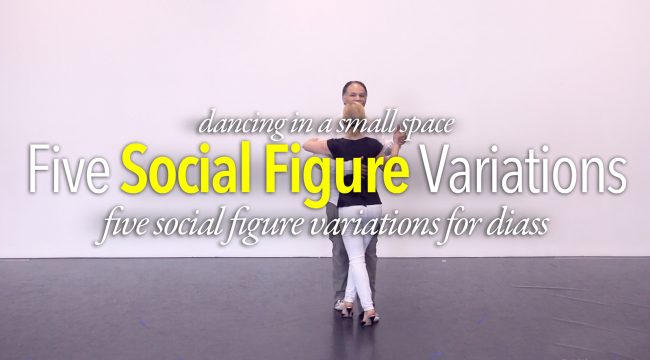
Dancing In A Small Space. Typically the idea of dancing within a confined or restricted space is a fearful one for the inexperienced Lead or Follower. Most of that fear exists in either hitting something or someone, or not being able to contain or control what one is doing. So when things in the line of dance get really confined some people get really nervous, and they can’t think outside the box that they’ve put themselves into. The idea of dancing in this environment plays it’s out in a few places, either a crowded local milonga during a special event like a live orchestra, or at a Marathon, an Encuentro (in Europe, not in the United States), or at any Milonga in Buenos Aries. Tango Topics has defined this idea before of what that means and issued two (actually 3, and now 4) videos on the subject of Dancing In A Small Space which we call “DIASS” for short. Today we further the ‘DIASS’ idea a bit by adding a few variations to a theme. The theme being the Five Common Social Figures or the 5 things that we do constantly on at Milonga within the line and lane of dance. Those Five Common Social Figures are as follows:
To be clear, as there’s a lot of room for interpretation in what those five things actually mean. So let’s clear that up right now:
1.) Walking. Means that we’re engaging only 1 (Parallel System on 2 Tracks) of the 6 Ways of Walking as a foundation of movement.
2.) Ochos. Typically the idea of Ochos engages 2 of the possible 8 types of Ochos > The ‘Lazy’ or Milonguero Ocho or the Traveling Ocho (Forward or Back).
3.) Turns. Turns in Argentine Tango refers to 2 of the possible 8 types of Turns that are commonly used in Argentine Tango. The Follower’s Molinete to the Lead’s Giro, and The Milonguero Turn.
4.) Crosses. Usually when we’re talking about Crosses, we commonly only refer to one type of cross. However, there are in fact multiple variations and several types of Crosses. In this instance we’re only referring to 1 out of 256 types of Argentine Crosses – The common or Normal Cross.
5.) Cortado. In most people’s minds there is only one type of Cortado. However, if you’ve been following this site for some time, you’ll note that’s not the case. In this instance, we’re only referring to the Linear Ocho Cortado from the Closed Side of the Embrace.
These are the Five Social Figures. For more detail on the subject, please go look at the full video in the tangotopics archive.
Using these five figures as a foundation we can create numerous variations on a theme that work with in the line and lane of dance. Those ‘variations on a theme’ are the foundation of this video which are Five Social Figures Variations that we’re exploring today in today’s Tango Topic.
First a reminder of What is “Dancing In A Small Space” (or ‘DIASS’ as Tango Topics refers to this idea) ! There are two parts to the answer to this question:
First, in it’s simplest form, it’s all about the vocabulary and engaging Five pieces of Tango vocabulary. The Five Pieces ? 1.) The 5 of the 6 Ways of Walking. 2.) Milonguero Ochos (sometimes referred to as ‘Lazy’ Ochos)3.) Milonguero Turns (not the Follower’s Molinete). 4.) Back and Forward Crosses (not the Argentine variety, there’s no space!). And 5.) Linear (and Circular) Ocho Cortados. This is all done in Close Embrace. Note that there are no Sacadas, Colgadas, Volcadas, Ganchos, Boloeos, or Death Drops and/or Drags. None. However, there are a whole bunch more pieces of Tango vocabulary that almost never get talked about, or thought of here, that can also be applied, such as Calesitas, Paradas (Step Over), Pasadas (Drags & Sweeps), ’Patter’ (sometimes referred to as ‘Pitter-Patter’), The Incrementals (see Golden Nugget Extensions), just to name a few.
Secondly, there’s the actual ‘Dancing’ part of the statement which is more about movement more than anything else. Said movement is done in a very confined space, no bigger than one meter square, if that. The people that practice this way of dancing, while they may not be conscious of it, there is a sincere desire to not to take up space, mostly because there isn’t any space to begin with. This is moving in milonga environment really, where the distance between couples, on all sides, is no more than about the length of one hand (about 17 centimeters). So from the perspective of the Small Space Dancer, there is precious little space to ‘do’ anything at all due to the conditions of the ronda, so as a result of this confinement, the dancing part is really about the minimal. Everything is done either around the lead, or the space that the couple current occupies and does not extend beyond that space. Quite factually, depending on which city we’re in when dancing this way (Buenos Aires comes to mind), one would take up no more space than the space that one’s feet occupy at that moment in time, and no more than that, but without moving from that spot!
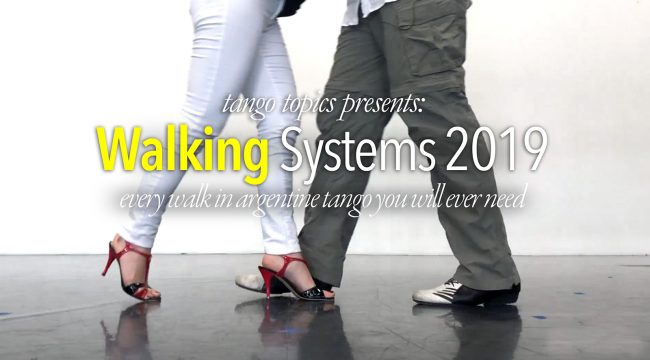
In today’s Tango world when we talk about the foundations of Tango, we talk about “how” to walk. Or actually the mechanics of how we walk, how we extend our legs, what happens to the knees, what happens to the ankles, what happens to the feet, and how we land our feet as a Lead or as a Follow. These things are vitally important as to how to move efficiently, effectively, and with ease. Suffice it said that these things, the how-we-do parts are a matter of opinion in some cases, an informed opinion in others, and still this stuff is not a settled issue at this point almost 100 years on going forward. The reason we mention these things is because this video is not about how to walk, or how to land your foot, or even how to extend your leg. But rather it’s about the different ways, 18 in fact, in which we walk in regards to Tango. And these things are insanely important for two reasons as it relates to Argentine Tango: 1.) Because these 18 ideas are the foundation of everything that you will ever do with regards to tango. They’re the step into and out of every piece of vocabulary. 2.) These 18 ideas are very nature of versatility and really they’re the foundation of improvisation! If you study and practice these ideas to the point of mindful repetition, then you will have the ability that we all seek: Improvisation. That’s not a sales boast to get you to register. That’s a fact. These 18 ideas comprise the pathway that we all seek as Leads or as Follows, to inspire, enhance, and generate a creative interpretation of the Music, or to improvise to any piece of music regardless of genre, or partner, using nothing more than forward steps and back steps! That said, let’s dive into what Tango Topics calls “Walking Systems for 2019“.
What are Walking Systems ? These are the many different ways that we can walk in Argentine Tango. Not the how-we-walk but the multiple methods to the ways in which we might want to walk, first canonized by Gustavo Naveira & Fabian Salas, and then expanded upon here for your edification. The ideas comprise a composite or overall vantage point that no matter what situation one is in, there is a walking solution for that situation. One example of this is the Walking Turn. Most Leads, when they hit an obstacle in their pathway, will invoke a Rock Step as a way to solve that problem. It’s their go-to move. A Walking Turn on the other hand, is another more creative way to solve the same problem while at the same time creates far more options and opportunities for both roles to engage in musically as well as from a vocabulary perspective and a navigational perspective. Tango Topics Walking Systems provide a way into any situation and any number of ways out of a situation that does not include a piece of specialty vocabulary (Volcada, Sacada, Colgada, Parada, Pasada, Boleo, Gancho, Calesita, Rock Step/Resolution, Single Axis Turn, etc) as a possible resolution, or for that matter any of the 7 of the 8 Types of Ochos, OR any of the 8 Types of Turns, or for that matter an Argentine Cross as a potential resolution! No. Walking Systems are the Resolution! They’re the solution to each and every issue that you can come up with. Not to mention they also solve an age old problem for most Leads, “What do I do next ?”. Walking Systems is one of the simplest yet most powerful answers to that question! Because not only do Walking Systems answer the question they go far beyond it!
Years ago when Gustavo and Fabian came up with a way of describing Walking Systems, as they pertain to Argentine Tango, it was a way of systemizing or standardization of the dance. Meaning that if you could look at something and describe what was happening with a simple phrase, then you could also repeat it and build on it! Those standardizations became what we now know today as the two predominant ways in which we talk about Tango Vocabulary and the dance as a whole: Either a piece of vocabulary is done in Parallel System, or Cross System.
Tango Topics Walking Systemsfor2019 encompasses these two primary ideas and adds a bit more to them each, and then goes far beyond them to encompass 4 other ideas which on the surface may appear to not be one or the other, but in reality is both at the same time as you’ll see especially when you get to the section on “Alternates”!!!
Walking Systems expands on these ideas by using Orientation changes, Changes of the Embrace, and lastly a completely new idea (for some of you) that almost never gets talked about but is in fact quite revolutionary in our opinion!
These are Walking Systems for 2019 going forward as Tango Topics sees them.
Why do you need this stuff ? Think of Walking Systems as what you do AFTER you’ve learned the foundations of how one walks as a Lead or Follow. Walking Systems are what you can do with that walk. Hence the ‘ideas’ part above. Another reason why you need this topic in your understanding of Tango is Versatility. And still, another is, and a longer answer, Improvisation. The fact is that you could do worse by just studying this stuff alone. If you did nothing else except studying walking and walking systems, you’d already be ahead of the game but the reality is that most people study the mechanics of walking for about 5 minutes and then move on to the vocabulary that they see everyone else doing, Ochos, Turns, Crosses, and then the specialty vocabulary which is studying all the crazy stuff they think that Followers want so that their Follower’s don’t become bored (Volcadas, Colgadas, etc). This is commonly known as Lead Mindset. This mindset a false belief system that, erroneously, believes that the Lead must perform all sorts of vocabulary and have a dizzying array of said vocabulary that will keep the Follower entertained in the course of dancing with said Lead. This is, of course, not true but no one wants to hear that fact.
Versatility means that these 18 ideas by themselves are just that, ideas. Implying that on their own they’re not going to do much for you. However, when you place one idea behind another and continually swap them out for the next, something very interesting begins to occur: Facility. You begin to have ease, a comfort with exploring the “What If…” realm. At the same time when you put them together, they can form an entire dance all on their own without doing anything else! We know, we’ve spent entire nights doing nothing but these ideas just to prove a point to see how successful or interesting this stuff can get. Versatility means that as a Lead, or as a Follow, you become so conversant with these ideas that variations of these ideas start to emerge on their own! And there are more here that we haven’t even begun to touch on.
Now to the longer answer, is that while no one has said anything about how to put things together, meaning that a Lead must choreograph an entire song on the fly right from the moment they step on the floor. That ‘choreography’ has to come from somewhere, right ? One place it could come from is steps, patterns, and figures. There is a certain comfort in employing steps, patterns, and figures. It gives one a false sense of competency. The real test comes when you run out of figures to employ, lest you repeat one’s self (which we do not want to do), and then you’re stuck with the problem you had when you started. What do next ?!?!?!? Again, you’ve run out of figures and you don’t want to repeat yourself. And this is where Walking Systems comes into play. They replace the need to invoke figures. Completely. It should be noted that another problem with the steps/patterns/figures solution is that somewhere about 10th or 15th figure, and after you’ve danced with every Potential Partner in the room, they all have your number and what you’re capable of doing! Further still is that in order to keep yourself from being ‘stale’ you absolutely must learn new material constantly and pepper in an ever-dizzying array to one-up yourself. How do you spell work ? We spell it “steps, patterns, and figures”. Which is to say, “Not so much with that idea!”.
Improvisation refers to two things: 1.) It refers to creation on the fly of singular or individual steps not a group or pattern of steps or figures but nothing more than walking forwards or backward. But it’s how you do that, hence the walking systems themselves which creates variety. 2.) It refers to the musical interpretation of one note for one step. Which gives you greater levels of granular control over what you’re doing in a dizzying array of possibilities.
The Walking Systems
Before we get into the systems themselves, it’s important to recognize that we walk on paths or ‘tracks’. Meaning that our feet (ankles, and 1st metatarsals) pass very close to each other (slide next to). This is known as “passing through collection”. These tracks do not cross over each other except in very specific circumstances. Think of train tracks, that are very close to each other. Typically there are 2 tracks of walking paths, sometimes there are 3, and sometimes there are 4. Sometimes, as you’ll see, their “Orientation” changes, meaning that in order for some of this stuff to work, either the Lead or the Follower must change their orientation towards or away from their partner in the line of dance. And sometimes that orientation change may invoke an embrace change. That said, on to the Walking Systems:
1.) Parallel System. This walking tool comes in 3 flavors, 1 of which we use all the time. It is the staple of the dance. This system is walking with a partner using opposite feet.
Example: If Follower is led to step backward with their Right leg/foot, the Lead steps into that space that has been vacated with their Left leg/foot, and then continue on with the Lead stepping with their Right leg/foot into the space that Follower just vacated with their Left leg/foot.
This walking system can be done on 2 or 4 tracks without an orientation change and is done without crossing over the body’s natural meridian. As well as on 2, 3, or 4 tracks with an orientation change. However, in the case of 3 or 4 track, these variations can only be achieved by changing the position or orientation of the Follower by use of an “Americana” Embrace either to place the Follower to the side of the Lead or directly in front of the Lead!
The 3 flavors of Parallel Walking are:
Type 1a – 2 Track Parallel walking (with and without an orientation change). Type 1b – 3 Track Parallel with an orientation change. And Type 1c – 4 Track walking with and without an orientation change.
2.) Cross System. This complex walking tool comes in 3 flavors, as well as 3 different types of entry variations, and 2 different exit variations. This system is walking with a partner uses the same feet.
Example: If the Lead steps with their Left leg/foot, the Follower is led to step with their corresponding Left leg/foot, and then continues on with the Lead stepping with their Right leg/foot, and the Follower stepping with their Right leg/foot at the same time.
This walking system can be done on 3 or 4 tracks walking without an orientation change (not shown in the video above), and 2, 3, or 4 tracks with an orientation change. 2, 3, or 4 track these variations must use an “Americana” embrace format either to place the Follower to the side of the Lead, or directly in front of the Lead!
Type 2a – 3 Track Walking without an orientation change using 1 of the 3 entry methods below. Type 2b – 4 Track Walking with an orientation change.
3 Types of Entry Points to Cross System:
a.) Step/Half-Step. (see video) This method can only be used while in motion walking down the line of dance. b.) Weight-Change/Step. (see video) This method can only be used from a standing position and is ideally used or invoked from one of the 5 Musical Pause types. c.) Cross Behind Method. (see video) This method is used as the ‘flashy’ version and can be used from a standing position or while in motion.
2 Different Exits from Cross System:
a.) Step/Half-Step. (see video) In this method, the half-step is on the same side that you entered on with step/half-step. b.) Inverse Half-Step Method. (see video) In this method, the half-step is on the opposite side of the foot that you entered on with step/half-step.
3.) ‘Lazy’ Ochos. This walking tool comes in 2 flavors, the common Follower’s version, and the less common Lead version. This walking tool is where the Follower (or Lead, self-lead’s themselves) is led to stepping across their natural body meridian with each step.
Example: If the Lead steps with their Right, the Follower is led to step with their Right diagonally across their body meridian at a 45-degree pathway angle, while keeping the foot in alignment with the floorboards and not allowing the hips to rotate in any way, shape, or form.
All 3 types of entry points and both exit types can be used with ‘Lazy’ Ochos. It should be noted that Lazy (sometimes referred as to Milonguero Ochos) are both a Walking System and an Ocho in their own right.
Type 3a – “Lazy” Follower Ochos. Type 3b – “Lazy” Lead Ochos.
Surely that’s not all the walking systems, right ? You’re right. It’s not. This is just a taste. 😉 An informed tease. Nothing has been left out of this first 22 minutes of video, including footwork. However, the thing we did leave out was the other ELEVEN walking systems! If you want to read about the other walking ideas, and see examples of them, especially the Type 6 Walking System, which in our opinion is the Bee’s Knees, then you’ll need to register as a Freemium User which costs nothing and you get to read about the other eleven Walking Systems for 2019! If you want to go one step further, no pun intended, and actually Subscribe to Tango Topics, meaning to spend a few dollars/euros/rubles/pesos…then you can see the entire 1hr and 22-minute video on Walking Systems as Tango Topics sees it! Plus you get access to over 400 videos on a wide range of topics and techniques. What have you got to lose ?
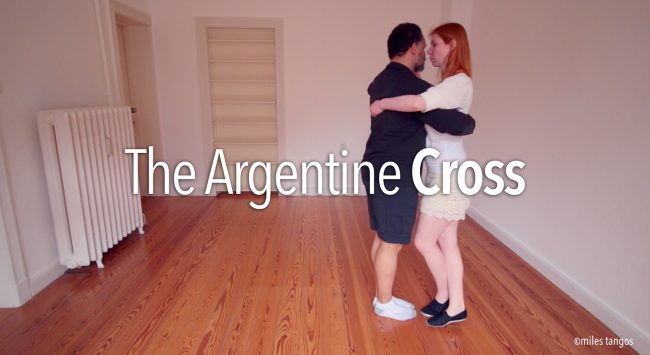
The Argentine Cross. Probably the single most used piece of tango vocabulary. In a given song, you’ll end up either leading or following a Cross a dozen or so times, at minimum! From a leading perspective we believe that we’re leading a cross, when in actuality it’s more like we’re expecting it more than anything else. From a Following perspective we’ve been led to this venerable piece of vocabulary 10 thousand times and then some, and what’s so weird about that figure is that we can’t even recount just one of them. It’s so engrained in us, so ubiquitous, used so often that we will cross our feet by default without understanding why, or even when it happens, or (and here’s the kicker) that we crossed at all!
What is The Argentine Cross ? In it’s simplest form, the ‘Cross’, as it is known, is a distinct and unique piece of Tango vocabulary that doesn’t exist in any other social dance in this form. While there are ‘crosses’ in other social dances, there isn’t another cross like this anywhere else. What makes it unqiue ? For one, in this version of the cross, the Follower is a willing participant, and actually an expectant one. Why ? Because it’s used so often nearly everywhere that you really do have to wonder sometimes if that’s all we ever do in Tango. Two steps and then we cross. You could quite literally spend entire song or tanda doing nothing but Argentine Crosses. Mind you, doing so will not achieve the desired results of pleasure that you’re looking for out of your partner. More like they’ll be insanely bored and pissed off at the same time. So, not so much with the ‘Cross’ for an entire song. Still another reason why this is unique is because, in every other social dance, the Cross is ‘placed‘. Meaning that the Follower is put into position by either crossing the Follower’s legs deliberately which ends in crossed feet, or moving their feet to a crossed position deliberately. In this cross, while the Follower can be placed, or forced, or pushed, which by the way we do not want to do, in this instance, they’re quite decidedly led in a very specific way to put them and their body into a position where they have only one option, to cross their feet, hence the reason where it get’s it’s name from. Further still in every other social dance, their version of a Cross is where the Follower simply crosses their feet. In Argentine Tango, the Follower is walked into a position to thereby cross their feet. This is known as “walking them to the cross”.
About The Video. This video comes in at 21m:13s in length in 6 Sections. This video contains has combined Follower and Lead Technique.
Section 1 – Lead & Follower Technique – 00:11:28 Section 2 – Open Embrace – 00:01:28 Section 3 – Close Embrace – 00:00:54 Section 4 – 5 Errors of The Cross – 00:03:24 Section 5 – Getting In Front – 00:01:51 Section 6 – Examples – 00:01:39
You’ve been dancing a while, and as you’ve become more and more proficient with the dance, something begins to dawn on you. And this ‘something’ happens for both roles but it’s not immediate. It only happens after you’ve gotten over the learning hump that happens for us all. And then started the refinement hump. It’s near the end of that second phase of the learning curve that this realization occurs. As a side note, not everyone comes to this realization. Some people in fact, never come to it. They’re still stuck in the perpetual cycle of “More IS Better”. Meaning more vocabulary is better. It’s not by the way, but no matter how often you share this stuff with them, no matter how many times you tell them “Less is more”, they can not and will not see that. Uuuuuugh. Assuming that they start the third phase of their development, understanding the music…not learning it, but understanding it, it is generally about this point in time where the realization occurs.
In case you’re not clear on the Four Phases of Tango Development:
Phase 1 is Learning the Vocabulary and the Codigos of the Dance for the Milonga Environment.
Phase 2 is the Refinements of Phase 1, meaning that you’re in a state of constant refinement of the abilities and techniques of the Vocabulary employed.
Phase 3 is the Musical Understanding of the Dance. This is not learning the music of the dance. That happens in Phases 1 & 2 to a limited degree. And in that case it’s more becoming familiar with the music because it’s played so often, but not really paying a whole lot of attention to it. Phase 3 is where we start to get serious about the orchestras, the structure of the music, the origins of the music, and start to hear the nuances of the music. That last part will go on a long, long, long time even after we’ve passed into the next and last Phase of our development.
Phase 4 is the Social Dancer is Born.
To be honest, some people…ok, MOST people skip Phase 3 entirely and graduate to being a Social Dancer without ever having done their musical homework. At the same time Phase 2 (Refinement) and Phase 3 (Musical Understanding) is not necessarily predicated on each other. They can, and sometimes do, happen concurrently with each other, and very rarely does Phase 3 happen in Phase 1. Just as a side note, with our Intensive Study program this actually does happen and quite frequently. They’re not mutually inclusive.
Today’s Tango Topic is that realization that occurs at near about the end of Phase 2 and/or somewhere in Phase 3. It’s one that we have referenced sporadically in our writings that we’ve sometimes called “Four Common Figures” or “Four Social Dancing Tools” or something very similar. When we stopped and thought about it, it was no longer 4 but in fact 5. It’s really 6, but the 6th is implied and not really a figure, but it’s always there and has a distinct bearing on the other 5!
So what on earth is this mysterious ‘thing’ that we’ve referenced so sporadically and we haven’t mentioned until this sentence ? Today’s Tango Topic is the title of the video: Five Social Figures.
What are the Five Social Figures ? In its really basic form, it’s the 5 things that we do all night long with every dance partner. We do these things so often and with such ubiquity that we don’t even consider that we’re doing them or the implications they have for what we’re doing with them, musically or from a floorcraft perspective. The five are detailed below but they are in order of precedence: 1.) Walking. 2.) Ochos. 3.) Turns. 4.) Crosses. & 5.) The Cortado. You can stop reading here, but we can tell you that the vocabulary we just mentioned is kinda barebones and just scratches the surface. And there’s a sort of a gotcha that’s waiting for you near the end of all of this. So you can skip to the end now and read the gotcha, or read on through.
Why Do You Need This Stuff ? Several reasons. First and foremost, your foundation! Honestly, this should come as a no surprise to you, but if you’re studying with anyone, you’ll notice that they continually take you ‘back’ to 4 simple things: Forward Steps, Side Steps, Back Steps, and your embrace. Because these four things are the foundation of the dance. Embedded in those four things are a host of other things that you are more than likely lacking or you have forgotten about. And it’s those 4 things that are continually screwing up your ability to dance the way you want to dance. So it’s not rocket science what we’re on about here. It’s simple foundational stuff. Which, the deeper you go, you realize isn’t so simple and is in fact far more complex than you thought or you understood. The simpler things appear, the more difficult they are in certain situations, this is one of them. Secondly, this is about understanding your vocabulary and not just from a Leading perspective, but also how it’s received by the Follower, thereby the Follower’s perspective. How it’s understood and why things happen or progress as they do. The issue here is assumptions and lots of them. We want to eradicate those assumptions and make absolutely clear why things happen. And the only way to do that is to remove the assumptions completely. Still, another reason why this stuff is important has everything to do with something that we vehemently and passionately believe in: Facility. Facility, in this case, means the ability to do X, Y, or Z. The Five Social Figures affects your underlying Facility to execute whatever you want to dance, in whatever way or to whatever style or genre of music from a Leading OR Following perspective. It effects Every. Single. Part of the dance! Everything. Facility also means the ability to execute what you desire and WHEN you desire it. Tango vocabulary (Ochos, Crosses, Sacadas, Volcadas, etc) is great, but if you can’t execute that stuff in time to the music, it kinda falls flat. So…ummm yeah, FACILITY! Want one more ? Variations! Let’s roll back the article a bit. Remember we reminded you that you dance the same things over and over and over again ? Dancing Symmetrically opens up loads of options and opportunities for you that more than likely didn’t see. For example: Playing with a Mirror Cross opens up the possibility of leading the Follower to a forward step to the Open Side of the Embrace, which only happens … ummm … NEVER! Gosh, have you thought of what do after that ? Well, here’s an opportunity to do precisely that. Discover the possibilities! And that’s all based on taking that one extra step and resolving differently. There are LOADS more of these things. All of your preconceived notions of what you think the dance is about all changes. And change, whether you believe it or not, is a very good thing. So yeah, you need this stuff.
Argentine Tango consists of many ways to interpret it’s musical component through movement. One of those movements is called an “Ocho” which when you translate it from the original Spanish into English means “Eight”. The “Eight”, in this case, refers not a number but to a shape that is created by the Dancer’s feet (typically by the Follower, but as you will soon see it can be done by the Lead as well) on the floor when they’re led to do so.
The Ocho is one of the 7 Basic Moves of Tango Vocabulary (see link) that is used in nearly every dance by every dancer at every Milonga in the world. It is almost as ubiquitous as the Argentine Cross in this respect. So much so that one may lead or follow an Ocho and not even be aware that they’re doing it. The movement is taught as one of the very first things we learn aside from walking. While one’s walk is insanely important, the application of the Ocho is almost, if not as, equally important for both roles. From a Leading perspective, it’s one of the ways that we can create a navigational structure & generate navigational options. We can use the Ocho to interpret the music and to generate musical structure from it. And it also has the obvious ability that allows to use it as filler content until we’re ready to do something else that may lead up to something else. From a Following perspective, it is one of the very first things we are taught to master and must become facile with because our very tango lives depend on it for a whole host of reasons which will become obvious later on down the line.
That said, let’s take a deep dive into the 8 Types of Ochos for Argentine Tango.
What is an Ocho ? In it’s simplest form and right up to its most complex form The Argentine Ocho is a learned, and generated motion. Meaning ? That the Ocho is not a natural construct. It is something must be learned and then mastered by both roles, not just by one.
The Ocho is powered by 1 of 3 types of “Engines of Motion”:
Each one of these techniques can generate no bodily rotation motion, some bodily rotation motion, or an enormous amount of bodily rotation motion at the point of Social Collection. Where, depending on the type of desired Ocho, that no body rotation or some body rotation will be done at very specific angles (0, 45, 90, or 180 or more degrees) where the dancers’ feet will rotate and body either with or against their dancing partner’s motion. In all but one type of Ocho the dancer (Lead or Follower) will step forwards or backward thereby setting up the next Ocho movement. However, and there’s always a however to these things, there is one type of Ocho where the dancer does not step forward or back but instead changes their weight from one foot to the other and then employs one of the 3 techniques above and does this repeatedly in time to the music.
It should be noted that the Argentine Ocho in all 8 varieties listed below all invoke Cross-System walking using either Step Half-Step or a Weight-Change Step, or aCross Behind(not shown in the video) to get into and out of them. If you’re not familiar with this terminology please see their respective links to dive deeper into getting into Cross-System.
Put simpler: The Ocho is where the dancer (lead or follower) steps into Social Collection with their feet, and then assuming one of the 3 techniques above is used to generate bodily rotation that seemingly starts at the feet, and goes all the way up the body. Seemingly. 😉 The reason the Ocho is called an Ocho as was mentioned before, that the dancer will create a pattern on the floor with their feet, that resembles the number 8. However, over the last few decades, the floor pattern isn’t really adhered to, but instead it’s more a straight, curved line or an arc, with a point on either end of the arc. That point on either end, is where a body rotation can occur, or a point of transition occurs using one of the 3 techniques described above.
This is an Argentine Ocho
Notation: When the “What is … ” section of an article is blue, that means that the article is freely available to registered, users. When the section is yellow, the article is still free, but the video is for paid users. 😉
Type 1 – The “Milonguero” Style or “Lazy” (starts at: 00:03:14) Ocho. In this Ocho, the Follower (usually), is led to stepping in a diagonal 45-degree angle across their natural body meridian thereby engaging in the 1st Engine of Motion. The Follower doesnot rotate their hips in any way, shape, or form, nor do they need to do so either. Their legs will cross over their natural body meridian in a walking step to do perform the “Lazy” Ocho. The Lead can also self-lead themselves to do this same motion going backward down the line of dance. This Ocho is ideal for small space dancing and it is ideal for the Encuentro environment. The reason it is called a Milonguero or Lazy Ocho is because in this instance the Follower is emulating minimal body movement of the Milonguero style of dance that emulates a Walk. It’s just that this walk crosses over the body’s natural meridian. Of the 8 types of Ochos, it is by far the easiest to do and the most effortless to dance.
Type 2 – The “Linear” Ocho. (starts at: 00:10:07) In this Ocho, the dancer is led (the Follower) or self-led (the Lead) to using the 2nd Engine of Motion: Disassociation and then Applied Disassociation to self-rotate, due to torsion build up and release. As a result of this type of engine, the dancer rotates to a 90-degree angle perpendicular to their partner, which then can result in either a forward or backward walking linear step on two separate but equal walking tracks. This position is also where the Ocho gets its name from because the Dancer is literally transitioning in front of their dancing partner over a line or a linear space directly perpendicular to their partner. It should be noted that the dancer can employ the 3rd Engine of Motion: A Pivot but it is not desirable to do so. The Linear Ocho can be done from Open or Close Embrace, however it’s typically done from Open Embrace or a Fluid Embrace, as the Close Embrace version of the Linear Ocho can be stressful or uncomfortable due to the fact of some people may want to use arm tension, hand/forearm pressure, compression, and/or resistance in the embrace to generate it. None of that is required. The build-up of Bodily Rotation Torsion via Disassociation, and then the release of that Torsion as Applied Disassociation is what generates the bodily rotation. Primarily the Linear Ocho is used as a teaching tool for both roles to instruct, and then practice, dancer Disassociation and Applied Disassociation. Once learned, Linear Ochos can be employed as a ‘Filler’, or as a navigational tool, or it can be used as an intro that leads into either a series of Sacadas or the opening step to a whole host of vocabulary. “Filler” in the sense that it can be used as some vocabulary to lead into something else or when you’re stuck from a leading perspective. It should be noted that while it’s only hinted at in the video above, the Disassociation and Applied Disassociation element is insanely important. 😉 It is what ‘powers’ all the ochos in this series with the exception of Type 1 and Type 7.
Type 3 – The “Traveling” Ocho. (starts at: 00:12:55) This Ocho is called a “Traveling” Ocho because it Travels down the line of dance. It is the Ocho that everyone thinks of when they hear the word “Ocho”. Typically this Ocho is done by the Follower, however, a Lead can self-lead themselves to engage in a Traveling Ocho as well (going backward down the line of dance). These can be done in Open Embrace, or Close Embrace, however, predominantly see them done in Close Embrace. Ideally, the Traveling Ocho employs the 2nd Engine of Motion thereby resulting in a 45-degree body rotation to create the desired ‘Traveling’ Ocho. Traveling Ochos can be done with Forward steps or Back Steps, and while the Forward Traveling Ocho requires the Lead to walk backward down the line of dance to do engage in it, the Forward Traveling Ocho is a lot of fun and add a lot of variety to the dance. Not to mention it also opens up lots of other options and opportunities to do other things that you wouldn’t ordinarily see. Traveling Ochos have a few built-flaws to them from a Leading Perspective that are discussed below in the Leading Perspective section. The Traveling Ocho is typically the ‘goto’ Ocho in all environments for a wide variety of reasons, mostly because the other 7 Ochos on this list aren’t taught all that often! Sadly. It should be noted that the dancer could employ the 3rd Engine of Motion: A Pivot but it is not desirable to do so.
Type 4 – The “Circular” Ocho. (starts at: 00:17:35) The name for this Ocho is a bit of a misnomer because we’re not actually generating a circle but more of an arc around the dancing partner. So rightfully it should be titled, the “Arced Ocho”, but that’s awkward, so we’re sticking with Circular. 😉 The Circular Ocho can be done from Open and Close Embrace, and typically employs the 2nd Engine of Motion, where the dancing partner will rotate 180 degrees on either end point of the walking Arc. Typically this Ocho is done from a standing position. And more often than not it is used primarily as the opening step to the Follower’s Molinete to the Lead’s Giro. The Ocho itself is not really used as a dancing element over and over again, but rather as a singular element to do something else like engaging the Follower’s Molinete, or any one of 12 types of Ganchos, or a series of Paradas, or changes of direction. It is generally not used as a navigational element either primarily because of its awkward embrace nature (see Linear Ochos). Circular Ochos also have a built-in flaw that is discussed below in the Leading perspective section. Notation: The dancer could use the 3rd Engine of Motion but it is not desirable to do so!
THERE ARE 4 MORE OCHOS
You can’t see them because you’re not a subscriber
Install Tango Topics on your iPhone: tap Share, then Add to Home Screen.