
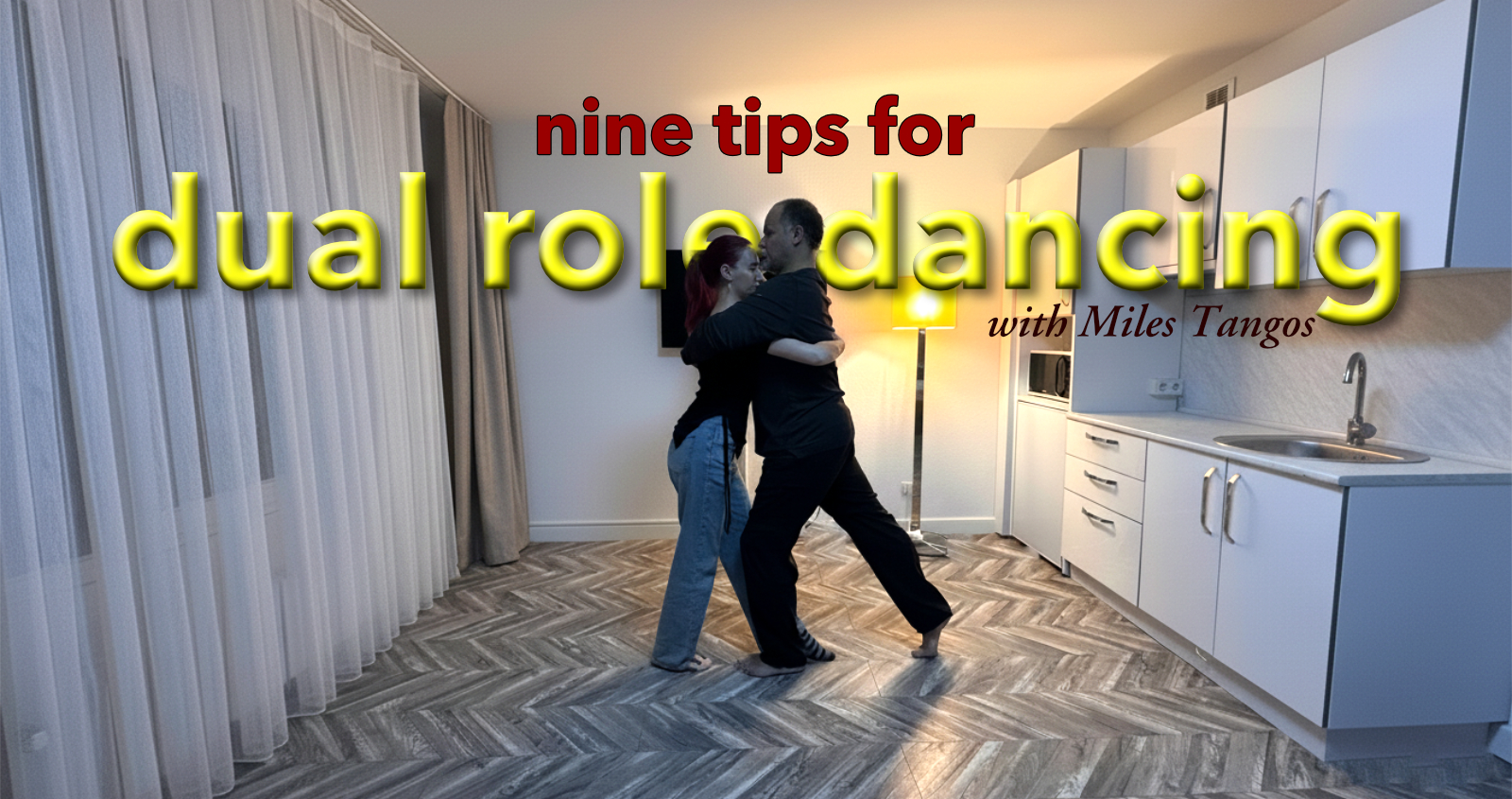
This Miles Meandering is for those of you thinking, “Hey! What’s all this noise about dual-role dancing?”
A little backstory and preamble before we get to the good stuff.
Tango, in case it wasn’t clear, has a long history of being gender-driven. That means that MEN LEAD and WOMEN FOLLOW. And the twain of the two never swapped. Except… they did. Sort of. Quite frequently.
There’s an old tango wives’ tale that goes: If you were a young man and wanted to marry the woman your parents had picked out for you, you had to learn to Tango. And as such, you had to learn to Follow first and foremost. Once you had mastered Following, then you were allowed to learn to Lead. Still another one says that men practiced with other men throughout the better part of the 20th century in BsAs. That last one is a bit more realistic for a whole bunch of historical reasons that are too lengthy to get into here.
As times and social mores changed, the idea of men practicing with men to learn both sides of the embrace wasn’t such a crazy idea. However, what was a crazy idea — even as recently as 20 to 30 years ago — was women learning to Lead.
If it weren’t for pioneers like Daniel Trenner, Rebecca Shulman, Erik Jorissen, and El Corte, the idea of dancing outside your gendered role might never have happened in our lifetime. We owe a debt of gratitude to those who came before us and pushed the boundaries of what was acceptable.
In today’s tango world, it’s far more accepted — especially in Europe — that no one gives a rat’s damn which role you want to dance. Some men prefer dancing as Followers. Some women prefer dancing as Leads. And some of us learn both roles, dance both roles, and even teach both roles so that others can do what they want.
So let’s clarify what it means to be a dual-role dancer:
- You are studying or dancing both roles — or both.
- You can swap the embrace at any point in a song and either follow someone else’s lead or lead someone else, without blinking or freaking out about it.
- Dancing both roles also means that you either promote the practice, attend events that allow it, or both.
Put simply, dancing both roles isn’t a gender thing — it’s a dance thing. It means you have the understanding, aptitude, ability, and wherewithal to dance either side of the embrace with whomever, wherever, and however.
Who am I to talk about this stuff? I come by it honestly — I was raised as a dual-role dancer when
a.) it wasn’t called that, and
b.) it wasn’t fashionable to do so.
I was tango-raised in a time when going to a men’s-only práctica was a crazy idea. I came up when most men looked at you and thought you were “gay” because you danced both roles.
I went to practices where I was confronted in the line of dance and told that I shouldn’t be doing that.
I went to classes where men wouldn’t dance with me in the rotation because they felt threatened.
Today’s Tango world is different. There are still people who feel that way, but dancing both roles has become more accepted and commonplace.
Having said all that, this website and the tools contained in it are here to help you — regardless of whichever role you want to dance. I honestly don’t give a rat’s f*ck. Use the resources to improve yourself. That’s what they’re here for.
However, what’s contained in this article is the condensed version — stripped down to the core components of what you need to begin your path toward being a dual-role dancer.
One More Thing, an Important Caveat: I have been known to have an uncompromising, almost militaristic point of view about what’s below. The reason is that I believe that if you going to do something, you do it. Full on. No trying it out. Or as Yoda would say “Do or do not, there is no try!“. However, let me be clear about something, I am NOT advocating for perfection. Actually, quite the opposite. I am advocating for doing the deep dive, and not giving up because it’s uncomfortable or hard. Hard things usually take time, patience, practice, and due diligence. And the results are usually worth the effort. Usually. Tango is one of those things that doesn’t necessarily show up in the immediate. It takes a bit of time, about 2 years of diligent effort with self guided and occasional coaching to transform you into from the dancer you are today into something refined that is anything but what you were before. The transformation is slow, painful, and winding. It comes in fits and starts. Usually it takes my students about 6 months to transform. However, for those of you NOT in the Intensive Process, this will take a bit of time. So give yourself a bit slack here and there…HERE and THERE, but eventually you want to get back to work. And right now, all of what’s below will seem like WORK. It’s not, I assure you.
Nine Things to Focus On
- Lessons. Take lessons in both roles at least twice a week — one hour as a Lead, one as a Follow. Don’t waste time on steps or patterns. They’re useless to you. Focus on FOUNDATION, FOUNDATION, FOUNDATION. How you walk, when you walk, why you walk. Focus on the Five Social Figures of Argentine Tango > Walking, Ochos, Turns, Crosses, and Cortados. You want this stuff repeatable, clean, and consistent. When you’re in the lesson, ask LOTS of questions, about how you’re landing your feet, how you’re moving your legs, how your toes are touching the floor, where your head should be, what your arms are doing in the embrace. Pay close attention to the pressures that your teacher (assuming they’re an Intention Based Tango Teacher) is showing you (see point 3). Take video of not the end result, but before, during, and after. If and only if they’ll allow you. IF not, start taking detailed notes. If notes don’t work for you, start recording your thoughts on your phone IMMEDIATELY after the lesson. Make a checklist of what you worked on while it’s still fresh in your mind. The fact is that you will forget the details of what you have been shown almost immediately right after your teacher says it. So you have get this stuff down, qiuckly. You will misremember something and then misapply something. This happens more times than you can shake a stick at. Also if your teacher doesn’t give you homework to do in the first few weeks of working together, which you should be doing, fire them. You want exercises that you can take home, practice, and replicate that exemplify the work that you’re doing.
- Deep Technique & Practice. Solo Practice at least 2 to the 3 times a week. Don’t skimp on this stuff either. I have an entire series of videos on this stuff on what to practice and how to do it. You are not practicing dancing, you are practicing your independent motions. How to extend, how to land, how to move. Making those things clean, clear, consistent, as well as 2nd nature. The last thing in the world you want to do is to have to stop and think about how to do something in the line of dance! Practice, Practice, Practice. Next > Focus on walking cleanly (see the Lead’s Exercise and Follower’s Exercise videos), generating clear Disassociation and Applied Disassociation for clean Type 2 and 3 Ochos, the molinete/giro structure (see Fred Torture), and consistent crosses that don’t end up in the Lead’s Armpit or the Follower’s Dirty Cross. As a by-product of that work, you’ll get the foundations for Sacadas (front and back), Ocho Cortados, Milonguero Turns, Ganchos, Boleos, Wraps, and Social Volcadas.
- Embrace. Develop a feather lite, non-constrictive, non-compressive embrace which engages an upright (not rigid) posture, and above all else which uses Intention-Based Dancing as your core dancing tool. If you don’t know what any of that is, follow the links and research it. This stuff is NOT a style; it’s a mindset, and a practice. The embrace, posture, and intention based dancing ideas are all here on Tango Topics. All you have to is research it. This stuff is far more important than you realize. Do not skimp on this one. Nor should you in any way, shape, or form allow yourself to believe that what you’re doing right now is passable. It’s probably not. The people that you’re dancing with right now more than likely have no idea what any of this stuff about the embrace means, or have very clear ideas of embrace, which mostly boils down to pull, push, squeeze, compress. This is isn’t that, and you don’t know it yet. So, time to man/woman up and get to this Intention Based Dancing idea. Lastly, the reason why you are developing a feather lite embrace is to develop a hyper awareness of everything. It is easier to hear/feel things when you have been trained in the extreme ends of the physical spectrum than it is to do things in the reverse. You may never use those skills but at least you won’t have to stretch to do them when you need to do them, why ? Because your regime has already trained you in the extreme. This idea of the embrace is just a further extension of that principle.
- Honest feedback. Find a teacher who will be brutally honest with you — not one who blows smoke up your a$$. You need detailed feedback from qualified sources, not soft encouragement from friends who don’t want to hurt your feelings.
- Ask better questions. Don’t just ask, “How was that?” Instead ask:
- “How do my arms feel? My fingers? My Thumbs ? My Forearms ?”
- “Am I applying too much pressure on your body ? Am I hanging on you ? Am I placing weight on you ? Is my right arm pulling down on your left when I Follow ? Is there too much tension in my Left arm when I Lead ?”
- “Do you feel rushed when I’m Leading ? Do you feel I am lagging behind you when I’m Following ? Am I pushing you around the floor ? Am I pushing your arms ?, Am I pulling with my arms at at any point ?, squeezing or compressing with my embrace at any point as we’re walking, ochoing, or turning ?”
- “Do I feel stable to you, and or grounded in my walk, in my turns, in my ochos — and if so, how does that help you?”
- “Do I feel ‘light’ in your embrace?”
- “Am I responsive? How or how not?” (See How to Give and Receive Feedback.)
If this seems excessive, that’s because your awareness of what it means to do these things is limited. Very limited. This stuff requires you to go beyond your understanding and take a very deep dive and that means to ask very probing questions. The fact is that most people will only want to give you positive feedback for fear of hurting your feelings. You can NOT accept ‘nice’ feedback. That tells you absolutely nothing. There may be things that someone else feels but isn’t able to articulate it, and by asking these series of deep probing questions, you can get at the heart of things. Do not accept platitudes. Don’t get me wrong, they’re nice to hear, and it’s a positive boost, but quite honestly those do not help you to change and internalize what you’re doing and how. You need clear, consistent, detailed feedback. And this, as excessive as it is, is one pathway to getting to the heart of things.
- Video everything. Every time you dance, record it. Not kidding. EVERY. SINGLE. TIME. That footage is key to your development. The reality is that mirrors lie. And you can’t see everything at every point along the curve. Video sees all and captures all. And if you’re in the line of dance vs. class that’s even better. The reality is that class video is an antiseptic environment. A video of you in the Milonga dancing in the line of dance is YOU under pressure! That stuff is pure gold! Yes it is PAINFUL to watch because all of your errors will come out, you’ll see all the repetitions, you’ll see you watching your partners feet, you’ll see all the times you didn’t walk properly, or when you stepped away in the molinete, or when your traveling or circular ocho crossed over your body meridian in an uncontrolled manner, or when you land your feet improperly anywhere, and every error that is detailed below. That stuff will force you to be hyper critical and dispassionate about what you’re doing. Truthfully, it’s hard but the good kind of hard and honestly it’s better than any teacher you will ever go to with one exception (present company not included).
- Video review. When you review the video, you are looking for all the things above and this too:
- If you’re Leading: Are you being repetitive? Are you squeezing your followers? Are you looking at the floor or their feet? Are you placing the follower in your armpit when you lead? Is your embrace dropping or collapsing, or are you maintaining the asymmetry of the embrace construct? Are you dancing to beat, pause, or melody? Are you rushing your follower or are you guiding them? And this is just a small smattering of things to look for.
- If you’re Following: Are you hanging on your lead? Are you using the embrace as a crutch? Are you dancing in the lead’s armpit? Are you stepping away from them in the molinete/giro or around them? Are you watching the lead’s feet? Are you talking while you’re dancing? Are your eyes open or closed (you want them open)? Are you dancing in the lead’s armpit or in front of them? Those are some of the things you’re watching for.
- If you’re Leading: Are you being repetitive? Are you squeezing your followers? Are you looking at the floor or their feet? Are you placing the follower in your armpit when you lead? Is your embrace dropping or collapsing, or are you maintaining the asymmetry of the embrace construct? Are you dancing to beat, pause, or melody? Are you rushing your follower or are you guiding them? And this is just a small smattering of things to look for.
- Patience. Understand that dancing both roles is not something you get overnight. It takes time, patience, practice, and persistence to reach a point of “almost.” There is no “there” there. There’s no point where you have magically arrived. There is only now and what you bring with you. You are going to suck for a while until, little by little and with due diligence, you suck less than you did before. Give yourself about two years of diligent study and humility. Accept that you are not going to be amazing. Once you start there, the real education of being a dual-role dancer can begin. This is a practice as much as it is a state of mind.
- Leave your ego at the door. Accept that you know nothing with each and every dance. Your ego is going to get in the way. Seriously, in more ways than you can count. It’s also going to get bruised along the way. One of the greatest gifts I ever got was having my sh1t handed to me. Let me tell you a little story:
I was at a men’s only practica, and this man asked me to dance, then asked if I’d like to Lead or Follow. I said, “Follow”. He embraced me, which was quite lovely by the way, and took about 4 walking steps. He stopped, dropped the embrace and then said, “How do you want it ?”. I said, “Straight”. He said, “Rather than give you a private lesson on this stuff, I am going to do to you what you are doing with me!”. He then swapped the embrace and then I felt it. He was placing his entire weight on me, and this was no small man either. I could barely move. And then as we took one step, he just wouldn’t effing move! I asked, “OMG!!! Do I feel like that ?”. He said, emphatically, “Yes!”. I was in shock! I thought I was doing well. I thought after 9 months of classes and 7 days a week of study that my teachers were doing right by me. Nope. I was heavy, slow, lethargic, and worst of all, PAINFUL to dance with. But the joy ride didn’t stop there. Then he said, “Let’s try out your Leading skills!”. So we resumed me leading him. He was light as a feather, responsive, sharp, crisp, he Followed me even when I wasn’t clear. Another 15 steps later, he stopped. I knew what was coming by this point. He said, “How do you want it ?”. I said, “Straight please!”. He then proceeded to pick apart everything that I was doing that literally created problems for my Follower. By this point in his feedback I was taking notes. Best private lesson, that wasn’t a private lesson EVER. I went back to my private lesson teachers, all 7 of them, and told them that if they didn’t stop blowing smoke up my ass I was going to stop coming to them. Things changed from that point forward. Months later I went back to that same Men’s Only Practica, and found the same guy. He said, “You want to try this again ?”. I said that I did. We got thru the first song without a word. As the second song started, he said, “You have improved…” and we went from there. The rest of what he said, was detailed, clear feedback that I took to heart. But the hard work had paid off but it was only the beginning of the process.
The only reason that I tell you this story is because I left my ego at the door. Note at the very first sign him giving me feedback of what I felt like, I didn’t act indignant, but rather inquisitive. And that’s because the mindset I had was I knew I had issues. I just didn’t know what they were or how to focus or what to focus on. But the biggest part was to jettison my ego so that I could hear what he had to say. What I didn’t know at the time was that who I was dancing with was one San Francisco’s better REITIRED tango teachers and he was just slumming it that day. I would eventually end up studying with him.
My point here is that when you leave your ego at the door, some really cool things can happen > Start there.
If all of that sounds like too much for you, and you just want to have fun with your partners, that’s fine — but understand it may not be fun for them because all of that stuff mentioned above hasn’t been addressed.
Now for the kicker > All of that stuff listed above is the BARE MINIMUM you should be doing for your own gendered role. This is the kind of detailed checks you should be doing constantly. And if you’re thinking, again, that this sounds like it’s too much and you just want to have fun. You’re not thinking about this the right way. What’s the right way ? I want you to imagine that you’re dancing with the best dancer in the room, the person you’ve always wanted to dance with. Got the image in your head ? Good. Now imagine coming off the floor and they say “Thank you!” and walk away. You’re probably wondering how they felt in dancing with you. And while you were dancing with them, you were hyper critical of what you were doing and chiding yourself for not practicing more. Further still long after that dance is over you will turn it over and over in your mind, “How did I feel to them?”. You may even work up the courage to ask them. Bad idea by the way, not at a Milonga. Never at a Milonga. Practica ? Yes. Milonga, NOOOOO! Never. Let me put this to you in a way that you can understand this > If you want that dance to happen, if you want to be READY for that dance to happen, regardless of whether or not it EVER does, this work is the bare minimum you have to do IN ORDER for that dance to even having a chance at success! All this work does is prepare you for dancing with that partner. And that requires work. So if you want the dance, do the work. If you don’t want the dance, don’t do the work. At the same time, you shouldn’t complain when X, Y, or Z doesn’t cabeceo or mirada you. The fact is that you’re not on their radar for a reason, and the stuff above is part of that reason. Now there are those of you reading this that will think, “Well…so and so is snobby”, or “They won’t dance with me because I’m not this or that”. That may or may not be true. But that’s a projection in your head, it may or may not be real. But the fact is that the work above is trying to negate your tango baggage that you have. And dancing both roles helps you to alleviate that tango baggage. So if you want the dance, do the work. Doing the work above is not going to guarantee you getting the dance. This work will only open other people’s perception of you and what you’re about, which will in turn, down the line possibly open the doorway to dancing with X.
Now back to the DUAL ROLE STUFF > The reality is that dancing both roles can and will elevate your abilities. Further still it will allow you to dance all night with any partner at any time. You are no longer locked into just waiting for something to happen, you can make it happen. If you hear a great piece of music or tanda, you can now go dance that tanda, because you can always swap shoes and go dance it!
There is one huge caveat to dancing both roles and that’s it will open you up to a whole different world, a different way of seeing the dance. If your goal is to go and have fun, fun is a long way away. The reality is that dual role dancers work harder because they know that can’t slack. They work harder because they have to be proficient on both sides of the embrace at the drop of a dime.
There’s one more pink elephant we have to talk about before I finish off this article. Musical Interpretation. You’ll notice I have NOT even once mentioned it here. That I have kept the entire discussion focused on embrace, feedback, and taking a deep dive into technique. There’s a reason why I haven’t mentioned music. And that reason is that is the other major game changer regardless of role. It rightfully deserves its own article….oh wait. there is one, several actually but this is a good place to start > the Five Pause Types and A Method for Interpretation. Start there.
Having said all of that, if I were you, after reading all of that, I’d either be afraid, overwhelmed, and/or energized. If it’s the latter drop me a note and let’s talk about a tango intensive. Because all of the stuff that I mention here in this article IS THE INTENSIVE PROCESS. If you’re curious about it, look at this link here.
If you have questions, reach out and ask.