Limited time offer One year for $99 (regularly $129, save $30) Get your year
Tango Topics info:

Check out the Tango Topics Lexicon for words like Axis and Connection.

Category: Technique

  • Giving (and Receiving) Feedback.

    Giving (and Receiving) Feedback.

    We would like to believe that we are perfect that everything that we do functions to what we believe is ‘right’ or ‘good’ or to our ideals of these things. They don’t have to be perfect, but things have to work. The problem with this line of reasoning is that a good portion of the time, this is essentially operating in a vacuum without external input, or external query, or oversight. This way of operating (anything really) can be desirable and it can also be less than desirable. A good portion of the time it’s less than desirable, but you don’t know that because you live in a bubble of information that is self deluding and self created. Think election 2016 and you’ll sort of get the idea of where this is going. 

    Related to Tango ? Yes. This is entirely related to Tango. Without clear, clean, and honest feedback from the people that we dance with we can never change what we’re doing, or even know that change is required. And that’s the kicker right there, for a lot of you reading this and watching the video above, change is required, the problem is that you don’t know it. And furthermore, rightfully so, you’re afraid to ask for feedback because it means change, which means work You’re fearful of the work involved, that it will be hard, difficult, work. Further still that work will, or so you believe, uncover your ignorance around X, Y, and Z. And no one, absolutely no one wants to look like they’re ignorant of the facts. And when you really get down to it, you just don’t want to do that kind of work for something that is supposed to be ‘fun’. Right ? But here’s the kicker, you absolutely need to do that work. And you absolutely need to start from a place of ignorance. Why ? Think of it as if you were going to do your taxes for the year. And you forget a few things that are the difference between paying no taxes (cool) and paying hundreds of dollars/euros/rubles/etc in taxes. And all because you left out a few very important details. It’s the details that matter. Get those details right, and you pay no taxes. Get them wrong, or don’t supply them, and there goes your tango budget for the year! How is this related to Tango ? The details matter in Tango, everywhere, everywhere.

    Qualified Feedback. The fact is that good portion of people are 1.) not comfortable giving feedback. 2.) don’t feel qualified (because they’re not a teacher) to give feedback. and/or 3.) that they could be of any help to you because they don’t want to feel responsible or give you false information. At the same time we want to give qualified feedback, and receive qualified feedback, from a qualified source or a source of information that has a track record of teaching. The fact is that most people do have qualified feedback, they just don’t know how to put into a form that is useful to anyone. At the same time, we also have to give feedback that is useful and helpful to someone else. The fact is most people can’t do this, they feel overwhelmed as to what to say to someone without hurting their feelings, while at the same time providing useful information that could help someone.

    So here’s how to give constructive feedback. Use “I” statements. Example ? “I feel pressure from your right arm and shoulder” or “I see that you’re watching my feet” or “I know that we’re not on the beat”. And so on. However those statements don’t go far enough, you must be specific in exactly what isn’t working in your opinion. Note the very last words there -“in your opinion”. Understand that you are not the sole of all wisdom and as such you have an opinion about how things operate, so you must state things as such. Saying anything more than that, unless you teach professionally, makes you seem arrogant and out of touch with reality. Further you must keep whatever feedback you do offer limited to you and what you are experiencing and not extend that to what your teachers have said, or what others have said. Example: “I am feeling pressure from your right arm and shoulder, and it’s causing me pain to have to resist you like that”. And not,“My teacher said that you have to resist me” or “Chicho said…” Got it? What this boils down to is that we want the feedback to be authentic and real. 

    Where to give Feedback ? There is really only one appropriate place to give someone feedback, and that is at a practica (as defined in the video above). Never while dancing with someone, even if they ask for it and make it ‘ok’ for you to do so. Never while on a social dance floor at a Milonga. Ever. Again, not even if they ask for it.

    When to give Feedback ? When someone has specifically asked for it, and/or when you have cleared with them first if they would like to hear some feedback about their dance. But only under those conditions. Any other time, it is not appropriate to do so.

    Asking For Feedback ? There’s a desirable way to ask for feedback and dare I say it, an effective one. And there is an ineffective method of doing so. Lots of them actually. By example a very desirable method would be to say directly to someone at a practica, “I would love some feedback about my embrace from you, if you feel comfortable giving it ?”. Notice that it was specific and not nebulous. The questioner asked specifically what they wanted feedback on and didn’t just leave it at “Feedback”. Also notice that the questioner gave them the opportunity to not participate at all, “if you feel comfortable giving it”. This part is absolutely critical to getting direct feedback and making someone feel ok with giving you feedback.

    Asking To Give Feedback ? It’s important to recognize even though you may have tons of information to hand someone about their dance, that they quite honestly don’t want to know about it, especially from the likes of you! So how do figure out if someone wants feedback ? Ask them. “Would you like some feedback about your embrace ?” or their walk, or their ochos. And so on. If they don’t want any, and no coaxing either, then you must, absolutely must let it go. 

    What To Feedback ? This one is difficult but there are generally four areas that we want to talk about when giving feedback, and really 5 if we’re being detailed. And of course we’re being detailed.

    1.) The Embrace (yours and theirs)

    2.) Posture (yours and theirs)

    3.) Compression, Pressure, Force, Rigidity, and Resistance.

    4.) Walking – The stability and equilibrium of the walk.

    and 5.) Applied Disassociation. (Pivots! Oy!)

    Most times your feedback will be limited to item #1, the Embrace. Relating that something isn’t working. But really the rest of it comes into play when you start to think about it. And again, we’re using “I” statements to reference this stuff. “I am feeling a lot of _____________ (pressure, tension, force, lightness, softness) from your right arm along my back. It feels _________ (nice, not nice, painful, hurtful, etc).” The more detailed you are with this stuff the more helpful it is.

    Too Much Feedback ? Yes. You can in fact overwhelm people with too much feedback and this happens a lot especially with beginner teachers, they suffer from this problem as well. So here’s a good rule of thumb. No more than 3 things to feedback in one dance. And really just the one. So you can mention the 3 things that are going on. But focus on just the most prominent one and stay with it until they get what you’re on about.

    The Last Word. The fact is that just because you gave someone feedback, does not mean that they’re going to change magically. Recognize and understand that people like what they’re doing. They don’t see anything wrong with it, or right with it for that matter. A good portion of the time what they’re doing is unconscious behavior and because it is that, you may have to remind them every few steps that they’re doing X, Y, and Z. Which is to say that most people will revert to what’s comfortable for them and instead of doing what’s right for the dance, they’ll revert to what’s comfortable for them to do. And more frequently than you would imagine. Like as in, every 2 or 3 steps! So reminders are kinda helpful here, and lots of them. At the same time, you have to remember something, that too many reminders and you’ll drive someone crazy. So it’s important to let a few go by and then remind someone, let 10 more screw ups go by and then gently remind them and so on. Oh and by the way, if you like this website, and the resulting videos, and want to actually, oh I don’t know…become a better dancer ? you might want to hit that annoying button in between the paragraphs…just saying. 😉
  • Intention Based Dancing

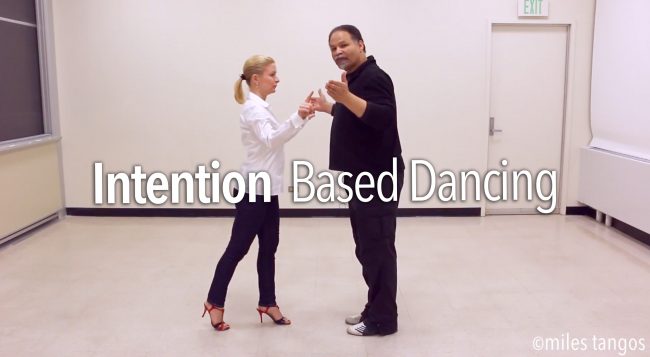
    Intention Based Dancing

    “Resistance, give me resistance! I can’t feel you!“. Followers hear this so often that it begs the question if Leads learn this as part of their technique classes on “How to be annoying in 10 seconds or less!” or “10 things to say to your Follower that will piss them off!”. Piss them off ? Yup. Why ? From a Leading perspective you’re screaming to your Followers that you need to control them, and that’s all you know and or can hear. From a Following perspective, it screams…”I am unstable” and “I need to hang on you!”. Tango is all about nuance, and that means asking your dance partners to move in a way that does not use ‘force’ on any level. While you think or believe that you would never, ever, force your dancing partners to do X, the fact is that you do it constantly with every partner. Until you are properly trained to hear this aspect of dancing, you will continue to do it. Today’s Tango Topic deals with the first step in this process of changing how we dance for the better. This topic is only a stepping stone. While the article and video, and really this website are those first stepping stones, the reality is that this is all about learning the kinesthetics of the situation, and that means studying with an Intention Based Teacher. But first we have to define, Intention Based Dancing.

    What is Intention Based Dancing? In its simplest form ‘Intention’ is really about not using pressure, tension, or force, with one’s arms, or hands in any way, shape, or form to communicate an idea, a thought, or a movement. But rather the idea of ‘Intention’ is to intend to do something. To propose, to invite, to advice, to guide, to profer…these are all statements that we, as dancers, are asking our Partners to engage X. Where X can be, but is not limited to, a specific piece of tango vocabulary (Ocho, Cross, Molinete), a timing change, an embrace change, etc. Typically Intention is action of the Lead to the Follower, however the Follower can and should reciprocate this idea and practice as often as possible. We propose to our partners that we would like X to happen. That proposal is generally an extremely light physiological, and tactile contact, where the contact is not pressured at all. But rather the direction that we are going in is the intention of what X can be. This is the foundation of Intention Based Dancing. Because, as a rule, we use this technique throughout the entire lifecycle of a dance with our partners. 

    From a Following perspective: Truth be told, you have been told so often, in nearly every class or workshop, by Female teachers (who rightfully should know better) and Male teachers that you must … ‘wait for your lead‘. As a result, that waiting turns into lag, or hesitation, in you. You get so used to ‘waiting’ and hesitation that you become reliant on that hesitation to do everything! That lag results in the Lead needing to push or force you to do X, Y, and Z which as a result turns into…resistance. In this instance, you want to move with the intent of what is being asked of you, quickly and decisively. As you feel the intent to move, GO! Don’t sit there and wait to be pushed to do something…GO! This is better known in the Tango Topics world as MYA (Move Your Ass). These statements can easily lead one to believe that we’re talking about an out of control Follower, or a willful Follower that is willy-nilly going wherever they feel the need to. That’s not the case. The intent in this case is very small, your goal is to read that ‘small’ part and then to interpret it as either forward, side, back, or incremental, and either linear or circular and then to go with it while at the same time following a basic principle: Staying ‘with‘ your Lead. 

    From a Leading perspective: You believe erroneously that you must apply force, pressure, tension, and ask for resistance to get what you want out of your Followers. When the complete opposite is true. Yes, you can apply force to them to get them to do what you want. This methodology, however, says that you must control them. It also says to them that you don’t trust them and can’t rely on them to listen to what you’re leading, and then to execute it. Furthermore what it also says is that they will never, ever be able to hear the level of precision that you desire the most. Put simply if you don’t take the ‘guiding’ (ahem… and this is being kind when using that word…it’s more ‘steering’ and rough steering at that) platform of your arms and hands away from them, then they’ll never be able to control that stuff themselves because you’re too busy being heavy-handed. As a result they’ll never learn how to manage their own stability, and their own bodily control. Further still, you’ll never learn to lead someone with nuance instead of Force! And beyond that, you’ll never be able to tell when you have a Follower in your arms that responds to effortless dancing because you’re too busy over-functioning, over-managing, over-controlling them! Further still is that there is no way to separate what’s your’s and what’s theirs if you’re constantly forcing your dance partner to do X, Y, and Z. There’s only one game here, and that’s you telling, or dictating to the Follower what they should do. The whole point is to suggest, invite, engage…not tell! No one, absolutely no one likes to be told what to do. So if you don’t like it, what on god’s green earth makes you believe the Follower is going to enjoy it ? 

    From a Dancing perspective: Most of this topic has dealt with resistance and it’s deleterious effects on the dancing couple. However, what would happen if you removed all that ‘stuff’ above ? What would happen if you were to engage stability as a Follower, where you didn’t need to be so heavy handed as a Lead ? What would happen if you were be responsible for your own walk, your own embrace, your own individual component of the dance ? What would happen ? Freedom is what happens! Options and opportunities happen! At first there is a lack of precision that occurs, and then later on the more that you practice this way of dancing the more precise control you have over the tiniest of things. For one thing there’s less sweat! This was of dancing is almost unreal! The dancing couple that is engaging in Intention Based Dancing is lighter, appears and acts effortless, there’s less stress on the couple as a whole, and more over far more precision in technique as well as musically. Over time what ends up happening to those people that dance from intention, both parties enjoy the experience and can then access the whole reason that they’re there for in the first place: Tango Nirvana. Now comes the kicker – a good portion of the better dancers use this ‘way’ of dancing. They don’t require the things described here because they know that something else is possible! Not all of them but a good portion of them employ this way of dancing.

    Think of This: Applying resistance, tension, force, compression: Each time that you apply any of these things in any level of measure, it’s like a jarring transition from sleep! Do you like it when your alarm clock goes off first thing in the morning ? Probably not. Guess what ? You’re doing the same thing here with all that stuff to your dancing partners!

    How do you change ? First do you want to change ? Put another way, do you want to wake your partners as if you were an alarm clock ? Probably not. Guess what ? You’re doing just that in a myriad of ways from your walk to your embrace to the choice of vocabulary. From a ‘THUD‘ to ‘Compression’ and everything in between. So if the answer to that question is a “I’d like to do that but it sounds like too much work and too much effort…” then thank you very much for reading, and have a lovely day!  Otherwise if the answer to that question is an emphatic “Yes Miles!!!” then there are a few solutions for you.

    The Free Tip – Actual Change ? Sadly. This is not something that you can learn from a video. More specifically you can not learn the kinesthetics from a video. However, you can learn the vocabulary and how to move from a video. The kinesthetics is something that must be felt and then replicated over time with someone who can adjust how you feel in every aspect of your embrace and your walk at the same time. And this means from a Leading perspective as well as from a Following perspective. 😉 

    Truth be told this isn’t just about the embrace for either party. That is a mistake that a good portion of dancers make. If you change just the embrace, that everything will be fine. No. It won’t. You must address both the walk and the embrace at the same time for issues of stability and clarity and cleanliness from every possible perspective. This change is also about the precise control that you have over that walk, without hanging, pulling or pushing on your partner! Failure to address both aspects and you’re just putting money into someone else’s pocket and wasting your time.

  • Social Collection

    Social Collection

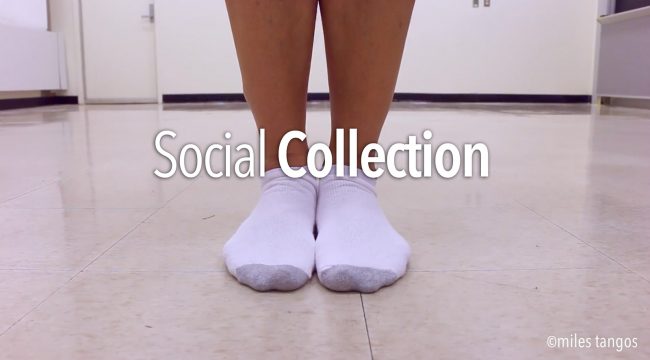
    “Collection”, this is an odd word in the Tango world. It has come to mean that we, as dancers, want to bring our feet ‘together’ in some fashion. Some people refer to this idea or concept as “closing” your feet. Meaning to close the gap that naturally exists between them from a standing position where our legs are slightly apart to create more stability in our stance. ‘Collection’ is a refined version of this idea that exists 2 primary reasons. The first is very practical. And the second is purely visual. We’ll get to those in just a moment. There is another form of Collection that we want to start to be crystal clear about in today’s Tango world.

    There’s a very clear reason why we need a clearer distinction of this word we use to define “Collection”. The reason has everything to do with the competition based Tango that is occurring with greater and greater frequency – The Mundials come to mind. As such there is greater attention to detail on precision-based Tango that is more focused on what things look like than their social function counterparts. Hence a bit of distinction that is required when talking about ‘Collection’ or more importantly ‘Social Collection’.

    The Visual Idea. From a Leading or Following perspective, when we’re talking about Collection what is generally taught is usually the visual idea of collection. Not just bringing your feet together but generating a visual inverted triangular tapered form of the body to the legs to the feet. And as such we want to make that taper as clean, and sharp as possible. So for this reason you’ll see a good portion of dancers who have been taught to will pull one leg slightly behind the other, and one foot off at an angle. In either Lead or Follow it’s right behind left for a variety of reasons. The reason this is done is to remove the gap between the shins and ankles that naturally occurs in some people’s legs and feet. Further it creates that ‘nice’ taper that we desire. Why not left behind right ? Because from a salida step we tend to go (lead) left into (follower) right. Meaning that the Lead will step forward with their left leg/foot first, and the Follower will step backwards with their right. The visual idea is really all about the visual lines that are generated in either partner when coming together and creating a nice architecture. That’s it, that’s all and Collection, in the way that it’s taught and presented above, in both partners contributes to that.

    The Practical Idea. From either roles perspective the idea of Collection makes things very clear that we’re in the right place, doing the right thing, at the right time. From the Lead’s perspective it helps to clarify that the follower is in the right place when they collect so that they can proceed. It’s really easy to see or in this case ‘feel’ that the Follower is off and then to adjust for that ‘off’. Frequently however, that off is never adjusted for and the Follower ends up in the Lead’s armpit. 🙁 From a Follower’s perspective it’s the same idea only that when your lead collects it creates certainty in you. Think of the ‘cowboy walk’ when leading any of the 8 types of ochos.

    From a Dancing Reality Social Collection is really about the practical idea of bringing your feet together not for the visual idea but rather out of function more than anything else. It makes things rather simple and easy, that you’re not performing for the 15th row! Social Collection doesn’t mind that there is a tiny gap between your legs at the ankles to the knees, but rather it’s more important that you’re in the right place at the right time. Now if you want you can go the extra step (no pun intended) by creating a cleaner visual, however most people don’t and won’t go that extra step because it’s too much work for them. It’s another thing they have to remember and that’s already too much for them. So again, we’re at Social Collection. So if we define Social Collection as being too lazy but being practical. What’s it’s opposite ? Performance Collection! And that’s a whole different animal.

    The reality is that a good portion of you are going to look at this video above, disagree with it because your teacher told you ages ago that collection is supposed to be the visual reason. But in reality do you actually understand any of what’s been said above ? Or did you just watch the video ? There’s a reason why we want Social Collection above all else that has not been mentioned, and it has everything to do with the role of the Follower as they’re being led to an Argentine Cross. Mind you this is just 1 of 3 reasons, but this is the most prominent. Think Armpit Dancer, and you’ll begin to get an idea of what’s going on, as a matter of fact, go look at that video, it talks about this aspect of Performance Collection. That’s the reality. Put simply if you as a Lead, want your Follower in your armpit, please keep doing what you’re doing, and pay this topic no mind.  Or if you as a Follower like being in your Lead’s armpit and quite literally behind your lead, then again….don’t pay any attention to this topic. It’s a complete waste of your time.

  • The Ballet Rise

    The Ballet Rise

    Let’s dispense with a few misnomers right out of the gate. 1.) Balance is not the same thing as Stability. 2.) Balance is a component of Stability. 3.) Your stability is generated via 3 very different mechanisms that are all connect via your nervous system. And so that we’re clear on this one, one of them is not your ‘core‘, and anyone that tells you different is either lying through their eye-teeth, or doesn’t understand anatomy and physiology of the human body. Truth be told, your ‘core‘ muscles have absolutely nothing to do with stability. Nada. Zip. Zero. 

    A Ballet Rise is an exercise that every Tango dancer should be familiar with before they put on a pair of heels as either a lead or a follow, it does not matter. The exercise is designed specifically to strengthen your very, very, very weak muscles and more importantly the tendons around the first 5 metatarsals of your foot. For some people that walk in heels all day long, those tendons will be a bit stronger than some, but not always. The tendons that surround the 5 Metatarsals are the weakest for a variety of reasons, and for some people they never bother to strengthen them mostly because no one tells them that they need to do so, and as a direct result of the lack of work (read that as exercise) that they’re not doing, they’ll end up with weak tendons, and thereby unable to hold a walking or articulated foot position, or they’ll land improperly and not be able to recover from it, and or the more common of the affectations is clear and present lack of stability. This singular exercise is quite possibly the single most important exercise that they will ever need to do. And yes, believe or not, they do not know how to do this. But you’re a smart person, right ? You know how to do this, right ? Right ? Hmmmm, well just as a refresher you should watch the teaser video above to refresh your memory.

    Truthfully when this topic comes up for students, they make a few very important and key errors. Not the least of which is going too fast. This exercise isn’t about speed. Speed teaches and strengthens nothing. This is about going slow. Very slow. The slower, the better! 

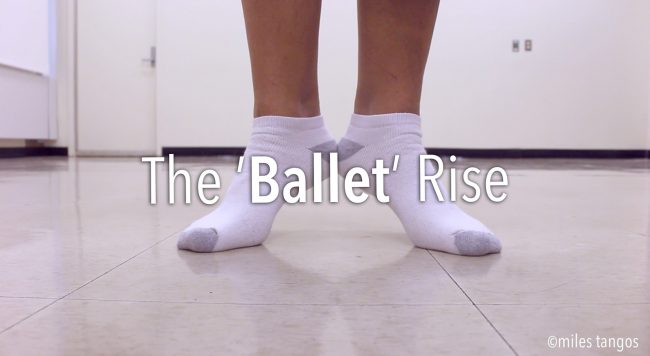
    What is a ‘Ballet Rise’?  It is where the feet are placed together in what Tango Topics calls ‘Social Collection’, with the first metatarsals touching, and the heels touching. With one’s feet firmly planted on the floor, and the weight distributed slightly forward from the arch towards the metatarsals, and just forward of them. The dancer would rise their body upwards just using the the metatarsals in what is called a ‘relevé‘. This is done SLOWLY, on an 8 count. Very slowly. The slower, the better. And then, slowly down on an 8 count. This is one ballet rise. Theoretically one would do 10 of these each morning. The video above shows you what an Ballet Rise is. Please go watch.  

    The Problem ? Most dancers tend to think that their stability comes from their ‘core’. This is not true. Their stability comes from first and foremost their awareness of it, that’s their equilibrium, which is generated in their inner ear. And secondly that information is transmitted to their feet. The problem comes when a.) the feet are in heels. b.) the ankle and tendons that surround it, and the 25 bones of the feet, and those tendons, are WEAK. So as a result of their tendon weakness, the dancer loses their balance nearly instantly when walking. The other side of this problem is that as we get older, the problem increases for a whole host of reasons. Most notably that the thing that’s generating the dancer’s awareness of their own instability is becoming more and more ‘brittle’ every day (that’s the sillia in your inner ear).

    It should be noted that some people will have difficulty with this practice for a variety of reasons, most notably that the muscles and tendons that are used in this practice aren’t strong enough. Further one may still have issues with their equilibrium as well, which has nothing to do with the muscular or tendon strength that is required here. So it’s important to recognize that a few things have to happen here. One of which is a little time and a little patience, and two after about 3 weeks of doing this every morning right after you get up one of two things should start to happen. 1.) You’re able to do this with some difficulty. or 2.) You’re still not able to do this yet. If it’s the latter of the two, then there are equilibrium issues that need to be addressed before going any further. 😉 

    The Benefits ? The benefits of this exercise will take time to show up. It’s not going to magically happen over night. Get used to that fact. This exercise requires patience, practice, and persistence to see the benefits. And quite honestly just because you do this a few times, nothing is going to magically change in your dance. Nothing. The exercise must performed religiously every. single. day. before you start your day!  The benefits will be felt gradually, and in specific how your foot comes in contact with the floor. You’ll feel a bit more control, a bit more stability and a bit more as if you can do what you want with very little effort. That’s because you’re building up the strength in the tendons around the bones in question. Something you quite honestly don’t use all that often in quite this way. This exercise forces you to use those tendons in new and expansive ways that you will end up using in tango whether or not you realize it or not. One benefit is that you will finally be able to control that super enrosque that you want, or an over-rotation because the muscles of the foot have been strengthened for you to effectively hold your weight. Whereas prior to this work, you would fall out of the rotation or enrosque! Still another benefit is that you’ll be able to hold a backstep for a few seconds longer without wobbling, or a forward step without needing to hold onto your Follower for stability! See there’s that word again, stability! In short, control the foot, and you control the application of your stability! Oh and before we forget, so the 3 things above that control your stability ? 1.) Your feet. 2.) Your inner ear. 3.) Your cerebellum! Your ‘balance’ is an affectation of your inner ear, not (for the love of christ) your ‘core’, please stop repeating that lie.

    About The Video: It’s in one section, and is 10m:09s in length, and is for both roles as a practice exercise to be done everyday.

  • Tango Articulation

    Tango Articulation

    The moment you hear the word “Articulation” you’re going to say to yourself, “What the frak does that have to do with Argentine Tango ?”. And you’d be right to ask that question. That’s because this word isn’t necessarily related to Tango all that much, if ever. It’s a Tango Topics term. When we hear the word we’re more than likely to think of its literal iteration, “the formation of clear and distinct sounds in speech. The act of putting into words an idea or feeling of a specified type. The act or manner of uttering a speech sound, especially a consonant”. However, if you’re a music geek, the word has another meaning, “The clarity in the production of successive notes”. In either case, neither of those two definitions have anything to do with Articulation from a Tango Perspective.

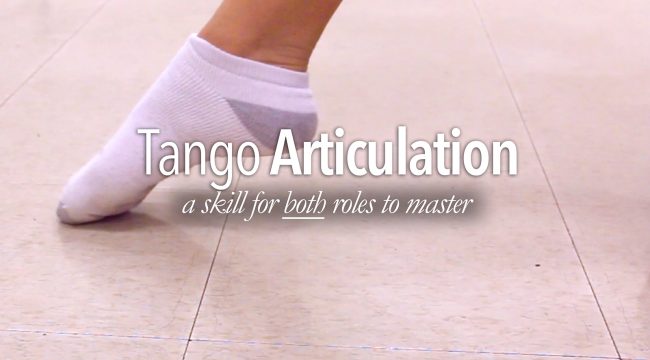
    What is Tango Articulation ? Articulation and Tango Articulation are the same things, just one is from a Tango perspective: Tango Articulation is a state where by the movement of one’s body parts, specifically the extremities of feet, legs, arms, and hands, create sharp and detailed lines that accentuate the form of the body in relationship to the pleasing and iconic shape of the couple in the embrace. The idea of ‘Articulation’ could mean, but is not limited to, pointing the toes, pointing the foot, generating a horizontal line with the arm around and across the back of your partner, raising of the head and pulling the head backwards towards the spinal column, the elbows, elongating the spinal column….all of these can be ‘Articulation’. Articulation is an accentuation of the form to detail the lines or shape of the dancers at all points along a movement, and in long form, the dance. To be aware of that movement and to create clean, clear, sharp lines of those shapes. So in essence the original English dictionary definition of this word isn’t that far off. Further one might start to think of this particular topic as ‘Posture’. Posture is only one place where Articulation can occur. It’s everywhere, toes, feet, legs, arms, hands, head but not necessarily the ‘trunk’ of the body. In the video above, Articulation is only viewed from the perspective of the feet and toes at first and then later legs. While it’s good focus on feet in this instance, that’s not the only place where Articulation can and should occur! 

    For a lot of dancers Tango Articulation is a very foreign idea to a certain extent. And that’s because the moment the some people see it, and truly understand it for what it is, it’s very possible that those people will see it as ‘perfectionism’ and/or ‘performance’ Tango. Yes, it is ‘detailed’ work and for some people, it’s just too much work for them, and this topic is unimportant minutiae. The dance is about ‘fun’ for them, and this is not ‘fun’, it’s work. From their perspective, Articulation is too difficult, an effort to remember (true to a point), hard to practice (lie), not important (another lie), and hard to do (another lie). Yet, at the same time, Articulation is what sets the better dancer apart from the dancer that views this stuff as ‘work’. 

    From a Following perspective Articulation of one’s feet is what factually defines the elegance that is looked at in ochos, molinetes, crosses, adornments/embellishments. The more that a Follower Articulates, the more the Follower ‘sells the shoes’ as it were, and the move, and in a larger sense…the couple! And by ‘sell’, meaning that the visual presentation is seen as very desirable. Whether or not it’s ‘pleasurable’ is a different story all together.

    To be clear, Articulation is not something you’re going to come to on your own. It requires that you have some awareness of what you’re doing and why and that means being exposed to a teacher who can and should point these things out to you…religiously! Just watching this video is NOT enough! You must be kept after, constantly. Why ? Because you’ll slip back to doing what’s comfortable for you.

    This is NOT easy work. It’s not like you’ll spend 45 minutes in a class or workshop and then you’ve “got” it. NOT going to happen. This is blistering amounts of detailed work, every day for weeks, if not (depending on your age, and personal work ethic) months on end. You are going to suck at this stuff at first. And then later on, ‘poco a poco’. A little bit at a time…

    Going a little deeper, once you start paying attention to this stuff, you’re going to start seeing this stuff EVERYWHERE! Everywhere in others at first, and then later on in you. And so that we’re clear about this, generally not in a good way either. You’ll notice that a good portion of the people that dance around you are generating a ‘sloppiness’ in their Articulations. While this may seem like pointing at other people’s flaws, it’s a good exercise for you so that you can see all the places where this stuff occurs, and it occurs a lot!

    The humbling point: Once you think you’ve got a handle on Articulation in yourself, you’ll see that you don’t. How’s that ? This is about learned behavior, and about you unlearning what you have learned and replacing that with a more visually desirable end result. In many ways this is like editing your own words that you’ve written, words that you’ve fallen in love with…and you can’t bear to part with. However you have to in order to make the overall point of your words much better, cleaner, sharper, and on point!

    From a Leading perspective it’s easy to dismiss this topic as solely a Follower issue, especially given the video above. That would be unwise. Articulation matters to you as well.

    Articulation defines the presentation of the Follower’s movements.

    Everywhere.

    Why ? While the Lead is leading, they’re quite literally, if not actually, pointing at something the Follower is doing the entire time. For you, as the Lead, your whole thing is about presenting the Follower. The more that you present the Follower, the more people see the couple! The current line of thinking for most Leads is that ‘Presenting the Follower’ means adding oodles of vocabulary (sacadas, colgadas, volcadas, ganchos, boleos, etc) … and while these things have their place, usually these things are poorly executed (sloppy), and ill timed, and so we do not want to use them. Instead we want to add these things as accent, or ‘spice’ to the meal! And the meal is ? Less vocabulary and focusing on the 5 Basics of Social Tango. In short this means: 1.) Walking. 2.) Milonguero Ochos or Traveling Ochos. 3.) Milonguero Turns or Follower’s Molinete. 4.) Crosses & Cortados. and most importantly 5.) Dancing to the Pauses, and Accentuating the Musical Phrase!

    The Lead has an incredible responsibility here, and that’s to Articulate wherever possible to accentuate the Follower’s execution, everywhere. However this is typically NOT what happens.

    Putting this as simply as is possible: Articulation is not a role issue. It’s a dancer issue. So regardless of whether you dance one role predominantly or not, you still must articulate everywhere.

  • The Reverse Embrace

    The Reverse Embrace

    There are certain defaults that we possess after years of dancing. We don’t realize that they’re defaults but they are. And for the Non-native speaker, ‘default’ in this case means unconscious ways or methods of doing something that is performed frequently. ‘Defaults’ from a Tango perspective could mean but is not limited to how one crosses one’s feet, how one engages the embrace, how one asks for and follows a series of ochos, how one would follow a molinete, etc. These are default behaviors. We learn them as a result of several things, not the least of which is how we (at the time that we acquired the information) bodies weren’t able to accomplish an end goal so we do what we can and as a result we end up imprinting the ‘less-than-desirable’ way of moving, or engaging the embrace (read that as squeezing, pulling, pushing, hanging, etc), or crossing, or molinete, or …. or…. those ways of moving into vocabulary to accomplish the goal, even though it’s not desirable. We don’t realize that we have formed this way of moving, and it’s now ‘comfortable’ even though it’s contorted (mostly) and at the same time we sort of forget how to do X, Y, and Z properly (mostly because we don’t have someone poking and prodding us to remind us about X, Y, and Z and how it should be done) and therefore we stop paying attention to it. This becomes our ‘default’ behavior in Tango.

    The Concern: This isn’t so much of a problem but rather a ‘concern’, something to be mindful of that if left unchecked, can create problems for us later on down the line. A good portion of you reading this will only look at the video and see this cool toy, and not look at the deeper issue that’s really going on here. A fair number of you will see the issue but not pay it any mind, thinking that this doesn’t happen for you. You’re perfect. Right ? Furthermore, a smaller number of you will only see that this isn’t just a Lead issue, but a Follower one as well! 😉 So what’s the concern ? That we as dancers become very accustomed to sending AND receiving kinesthetic pressure/compression/force/resistance information via the embrace which 9 times out of 10 creates more issues for us than we would like. This becomes our default behavior in the dance. The key component here is ‘sending’ and ‘receiving’. You’re going to think that sending refers to ‘leading’ and that receiving refers to ‘following’, when both messaging happen for both roles at the same time. A lead or follow both send AND receives information. Mind you a good portion of both roles, don’t actually listen to the other but that’s a story for a later topic. However, as a result of this way of dancing, we tend to get stuck or bogged down in our default behavioral responses and can’t see another way of moving.

    One way that we can get unstuck and really start to open ourselves up to our preconceived notions of what we’re doing and why we’re doing it is to Reverse the Embrace structure.

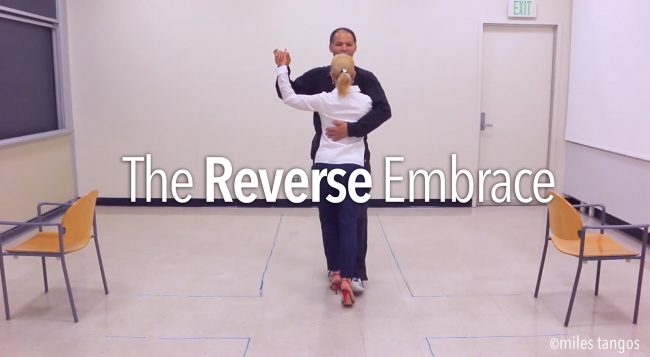
    What is ‘Reversing’ the Embrace ? It is exactly what it sounds like. – as a Lead and a Follow, we’re reversing the embrace structure.  Meaning that the Lead’s right arm is where the Follower’s right arm would be, and the lead’s left goes around the Follower. And vice versa. That’s it, that’s all. However, the question you’re going to have is why do this ? For that part, read on. However, the benefits of doing such a thing are wide and varied but this is the short and curly version: Because doing so changes your awareness of what you’re leading and following. For example: In the case of an Ocho from a Follower’s perspective, you may discover that you’re engaging in Traveling Ochos out of habit when in fact there was no actual Lead for the Traveling Ocho to occur. Another example: If you’re leading the Follower’s Molinete to your own Giro, you’ll more than likely discover that you’ve been engaging in a Lazy Man’s Turn for ages without realizing that you’ve been doing it! Crosses, Turns, Sacadas, Colgadas, and Volcadas even….everything gets turned upside down and in that turning things upside down, things tend to get righted, quickly!

  • Contortion

    Contortion

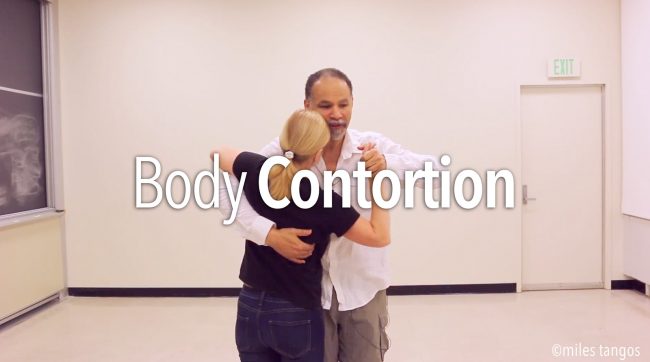
    Contortion.  You see so many different ideas of dancing tango that it sometimes very hard to differentiate desirable from the undesirable. That unless you teach you’re not going to see these issues and need to be reminded of them, frequently so that you stop co-creating these less than desirable issues.

    What is Contortion ? In it’s simplest form, ‘Contortion’ is twisting your body, then placing your body, and further still compressing (squeezing) your partner’s body into you, into a physiologically untenable position, and staying there for the length of a song. Then starting the next song in the tanda from a clean position, and then starting to slide into the contorted position. This is ‘Contortion’.

    And ‘yes’, it is an issue. Everyone exhibits some form of contortion. Everyone.

    Before we go any further, 2 things are going to happen while you read and/or watch the video above: You’re going to immediately run to the judgement that 1.) The author/teacher is being a perfectionist. 2.) That the author/teacher is being arrogant. Neither are true. These are stark observations offered without judgement. If you see yourself in these things, then so much the better. However, the thing that you should rightfully pay attention to is not the resolution example, which gives you the idea of perfectionism, but the latter part of the video that starts at (07:36). 

    That said, let’s talk about Contortion.

    From A Following Perspective you have 3 primary areas of Contortion that come up for you. 1.) Arm Over The Shoulder. 2.) Side of Body Following. and 3.) Follower ‘Chicken Arm’ Distortion.

    Arm Over The Shoulder – This is an outgrowth of wanting more, or deeper physiological contact with the Lead. And while the physiological contact does serve it’s intended purpose, more contact, the problem with it is that it compromises the body to do so. As a result of going over the Lead’s shoulder with yours (as shown) above, you end up raising one shoulder above the other, and thereby curving your spinal column. And as an added bonus you’ll tilt your head into your lead.

    Side of Body Following– This missive is factually placing your body in the Lead’s armpit, but only having the physiological contact of about an inch or so of their body. As a result of this kind of Following, all of your vocabulary will become ‘linear’ or ‘oblong’. Example: Turns will no longer be circular, they’ll be ovals! The back step of the molinete (not a milonguero turn) will become almost impossible to do, and you’ll end up in the Lead’s armpit, thereby being behind the L/lead, seemingly never able to catch up to them. 🙁

    Follower ‘Chicken Arm’ – The Follower will create a loop with their left arm, placing their left hand on the ribcage of the Lead’s right side about 6 inches down from their armpit, and then bend their elbow out at a 90 degree angle, and here’s the wacky part – then they’ll raise their left shoulder above their right, thereby curving their spine, all in ‘close embrace’.

    From a Leading Perspective you also have 3 areas of concern that generate Contortion. 1.) Head Tilt (Away/Towards). 2.) Side of Body Leading. 3.) Lead Chicken Arm.

    Head Tilt – While the topic of Dancer Head Tilt has been detailed before, the Head Tilt that is most common here is the Tilt of the head TOWARDS the Follower. As a result the Lead will place physiological pressure on the Follower’s head. This is done without the Lead necessarily being aware that they’re doing this. Sometimes, infrequently this is Head Tilt AWAY as shown at (00:00) so as to ‘accommodate’ the Follower’s Bodily Contortion or because they don’t want to get too close to the Follower’s face or mouth area. It’s too intimate for some Leads.

    Side of Body Leading– This lead missive is factually placing the Follower’s body along the side of your body. The physiological contact point is about an inch or two wide, and is a strip of contact on your body from the crease of your right armpit to your hip. As a result of this kind of Leading, all of the Follower’s vocabulary will become ‘linear’ or ‘oblong’. Example: Turns will no longer be circular, they’ll be ovals! The back step of the molinete (not a milonguero turn) will become almost impossible to do, and the Follower will end up behind YOU, seemingly never able to catch up. 🙁

    Lead ‘Chicken Arm’ – The Lead holds their left arm out straight, level with their shoulder line, and then bends at the elbow in a 90 degree arc, towards the Follower, then grasps the Follower’s hand.

    [ls_content_block id=”8855″ para=”yes”]

    From a Dancing Perspective these are 3 most common forms of Body Contortion that happen for both roles. You see this stuff everywhere and think to yourself “Well….if so and so is doing it, it must be ok, right ?”, and at that point you normalize the behaviors and postures of the people around you. At the same time you also have something else working against you, your memory of your last session with your ‘teacher’. At some point during that session (assuming said teacher has their collective act together) said teacher should have noticed (frequently a good portion of them don’t) and then remarked upon (again, they don’t want to hurt your feelings…mind you, it’s your money, ‘feelings’ shouldn’t enter into it!) the fact that you’re embrace, your posture, your body is contorting this way or that. And unless you are reminded about it constantly, you’ll think about it for about 2 steps and then you’ll completely forget about it. And if you’re thinking that you’ll remember this stuff on a Social Dance floor at a Milonga…think again. Stress gets in the way that happening. If you are stressed out how much space you have between yourself and the couple ahead or behind you. Or if you’ve missed something and you’re focused on that…posture, embrace, presence are the last things on your mind. You’re too damned busy freaking right the frak out. Dancing ? HA! Again this isn’t about perfectionism, nor is it about arrogance, this is demonstrable fact, proven time and time and time again.

  • 3 Couples Exercises

    3 Couples Exercises

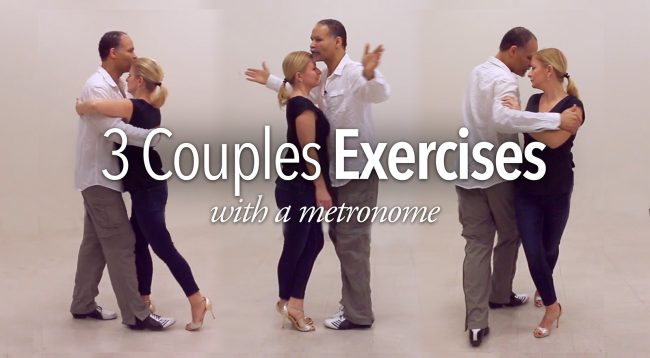
    Exercise. The very word makes most people go “Uuuuugh!”, which is right up there with ‘homework’, ‘practice’, ‘taxes’, ‘rent’, and ‘dental visit’, and about as much fun. Sadly. 🙁 And this applies even more so with regards to Argentine Tango. It’s no wonder that when you say the words ‘Tango Exercise’ that most people want to hide under the nearest rock. And there’s a few reasons for this association. The first is that most people’s experience of Tango Exercises is continuous repetition of the same movement. The same movement at faster and faster speeds to seemingly impossible levels of detail. Eeeek! The second is that for the greater number of people, the very idea of Tango Exercise conjures an ideal of perfectionism that you can seemingly never achieve. The third is a load of self-judgement and the judgement of others that prevents us from doing better. All of this stuff, and a lot more that is not said here, is what keeps us from Exercise with regards to Tango.

    The fact is that you absolutely need to exercise your Tango skills. Constantly. This isn’t about going out social dancing and just hoping that all will work itself out. That line of reasoning is one reason why we have the row of women that sit, and the row men that stand at milongas. And before we go any further to dispense with the blame game that happens repeatedly when reading this sort of post, let’s be clear about the fact that these same people haven’t done the necessary underlying work that would smooth out the physiological errors that they’re constantly (and completely unaware of) generating within the construct of the embrace, within the structure of a song, and a tanda, with multiple partners. Then of course, to be fair, there may be a fair amount of Tango Baggage going on for those people as well. 

    Throughout all of that though, most of Tango’s Exercises focus on Solo Exercises for the Individual.  Like for instance the foot crossing exercise, or the ballet rise exercise, or the applied disassociation/ocho exercise, the twisty exercise, or the twirly exercise, or the linear ocho exercise itself, or the stability exercise, just to name a few. However there are a small number of exercises for a couple to work on. Typically when we exercise, or ‘practice’ tango, it’s dancing a song or a tanda to music. While dancing with multiple partners is always helpful, as it gives us really good insight into how and what we think we’re doing vs. reality, it doesn’t hurt to exercise the underlaying common elements of tango. That said, let’s talk about Tango Exercises for Couples.

    The Embrace Work In This Video. Before we begin talking about exercises, we have to talk a little bit about what areas we’re going to exercise or practice. One area that gets overlooked quite frequently is the embrace itself. This is one of the more common areas where most errors are generated, that and our walk. So we do actually want to practice using several forms of the embrace. While there are multiple forms of a Tango Embrace, there are 3 forms that we want to start to use when Exercising for Couples:

    1.) The Symmetrical Embrace. We use a Symmetrical Embrace for many reasons, one of which is that it alleviates most of the embrace peculiarities that crop up for people. The thinking is that if you can employ vocabulary with a Symmetrical Embrace, then everything else will be a piece of cake, and there is some validity to this statement. The ‘Practice’ or ‘Symmetrical’ Embrace is all about the equal and bilateral relationship between the partnership – whatever you can do on one side, you should, technically, be able to do on the other. 🙂

    2.) The Close Embrace. While we don’t necessarily need to talk about a ‘Close Embrace’, we do however have to remind you a ‘Close Embrace’ is not compressive, that we ideally want skin to fabric contact without tension, compression, pressure, or force in our arms in any way, shape, or form…ever. There is a reason for this, most notable is that we want our partner to be able to move freely within the embrace construct, regardless of role. Secondarily we do not want to use our arms or hands for stabilization in any way, shape, or form within the embrace. We want to be fully engaged and independent of needing to hold on to someone to execute what we want to do or are being asked to do.

    3.) The No Embrace. And lastly the No Embrace is a really just a Close Embrace without the arms! It’s a torso-to-torso contact, the trick is to stay in front of your partner at all times while at the same time engaging vocabulary! Easier said than done!

    Free Tip. Longer forward and back steps. Extend, extend, extend. Seriously. You want to really stretch out with the back steps. Elongate them as much as possible. You’re in a practice space, so take the space, and really elongate them. 😉 This is a principle that I teach by, ‘overshoot to under do’ and that principle works really well here when we’re trying to extend as much as possible. Because if you can do it in the extreme, then doing it in the minimal is a piece of cake because you’ve already gone above and beyond it. And you’re if you’re thinking that this is all about the Follower. Wrong! Think again, this is all about both roles working on their ‘issues’

    About The Video. This video comes is 26m:39s in length in 4 sections. Both lead and follower technique are combined and integrated into the video.

    Section 1 – Introduction – 00:00:48
    Section 2 – Walking Exercises – 00:14:34
    –Sub-Section A – Slow Walking for Both Roles – 00:03:27
    –Sub-Section B – Beat Walking @ 40BPM – 00:03:48
    –Sub-Section C – Beat Walking @ 20BPM – 00:03:41
    –Sub-Section D – No Arms Exercise – 00:03:27
    Section 3 – Milonguero Turns & Argentine Crosses – 00:04:30
    Section 4 – The Turn Game & Closure – 00:06:33

  • Tango Noise

    Tango Noise

    Today’s Tango Topic is not a sexy topic, and it may almost sound like perfectionism, or complaining. When in fact it is a real world example of what can and does happen in Argentine Tango. Think of it as minutiae, but this minutiae has massive implications for how you dance and more importantly how your dancing skills are perceived!  Today’s topic deals with what can be referred to as ‘Tango Noise’. The word ‘Noise’ is a slight misnomer because this is not something that is heard but more importantly felt via the nervous system of the human body.

    Before we go any further, let’s be clear about something: This topic is not about perfectionism! It’s an observation of what happens to the human body. This article and free video are not here to point out that you’re failing (which may or may not be true), so that you’ll be a perfect dancer in the end (as there is no end to this stuff). No! This article exists for the sole purpose of bringing your attention to the issues that you’re generating and then showing you a possible solution set. And so that we’re absolutely clear, this isn’t a beginner thing, nor intermediate, nor is it an advanced thing, nor does it have to do with those that have been dancing a minimal amount of time or a long period of time. Nor does it have to do with ‘style’, or genre of Tango in any way, shape, or for. No. Tango Noise as a whole is generated by those that have been dancing for 5 minutes and those that have been dancing for 5 years and/or 55  years, that dance any style or ideal of tango. Time and/or Style are not factors here. Perceived skill is not a factor here. Awareness is a factor, and it’s the only factor that matters at all.

    What is ‘Tango Noise’ ? In its simplest form, it is a series of motions that by themselves are individual problems that we want to avoid, but are grouped together to describe what can, and does, happen to the human body while dancing that can generate kinesthetic unintentional motion which is perceived as instability or being unsteady. One of them this site has already detailed in detail is ‘Thud’. ‘Thud’, to refresh your memory, is where the dancer’s leg lifts the foot off the floor, and then is put down with some force, resulting in an impact with the floor that is heard as a ’Thud’. However more importantly the ’Thud’ is felt as a tremor which travels up the leg, through the hip, and then up through the spinal column and out through the arms of the embrace. This is just one element of Tango Noise.

    Typically Tango Noise manifests itself as either unintended or unconscious motion in either the spine, hips, legs, arms, head, and feet. Which is your entire body. It is neurological in nature, meaning that it is generated by the dancer’s lack of kinesthetic awareness, however we only see the skeletal effect of this neurological lack of awareness.

    Mostly everyone generates some kind or type of Tango Noise. Our goal in our solo practice is to minimize those issues or areas of Tango Noise as much as humanly possible. However the fact is that a lot of people don’t do that. They’re completely unaware that they’re generating these things to begin with, and believe, erroneously, that what they’re doing is desirable because no one has said anything about their abilities or skills. This is a fallacy of delusion. The reality is that a.) a good portion of the people that you dance with have not been trained to feel this stuff. and b.) because they’re untrained they’re not going to say anything about it. and then there’s c.) The Feedback Problem. Meaning that even if they knew about it, they have an issue with how to give you feedback so that you can hear it. 😉

    That said…let’s talk about Tango Noise!

    From A Dancer’s Perspective you can and do generate Tango Noise in a myriad of ways. While this is not necessarily an exhaustive list, it does touch on the major points that you want to become acquainted with.

    1.) Tilting from side to side, breaking at the waist, usually in a side step.  2.) Pitching forwards and back (with & without breaking at the waist). 3.) Head Tilt towards and away from your partner. 4.) Wavering from side to side, or back and forth. 5.) Flailing arms, or threshing elbows. 6.) The leg going backwards, crossing the body meridian in an unintended, unaware, and uncontrolled fashion. and 7.) Obviously, ‘Thud’, which we’ve already detailed. There is one more which is common to both Follower and Leads, and we’ll get to that one below, and really it’s the focus of this article which is not shown in the video for good reason, it’s because it’s unseen, but rather felt: Wiggle. There are two areas where we feel ‘Wiggle’:

    Spinal Column: The Spine can, and does, move a good amount which is desirable, we want that motion, mostly to be somewhat steady circular motion as it relates to Argentine Tango. At the same time a good portion of you are unaware that you are generating lateral ‘wiggle’ motion. This ‘wiggle’ happens in your spinal column which is felt as a slight or minor displacement that go from side to side, very slight. This motion is all to easily confused with walking instability. However if you stop moving, then then the ‘unsteadiness’ or ‘wiggle’ is felt independent of the walk. Ideally we seek a ‘quiet’ spinal column, no unintended motion, the less unintended or uncontrolled lateral movement in the spinal column the better. 🙂

    Your Hips: While there is a certain amount of motion that we want in the hips, what we do not desire is where the sockets or joins are seemingly ‘wiggly’ through and through, meaning there’s a bit too much ‘give’ or looseness in them. This is usually felt as the leg extends, that it extends slightly diagonally to the left or to the right, and always to the same side with the same leg. To be clearer, sometimes this is an affectation of age and there’s seemingly not a whole lot you can do about this one, it’s just what happens to your body. Seemingly being the operative word. As you can in fact strengthen the tendons that surround those joints to a certain degree. Going forward, the looseness is felt as a ‘Wiggle’ and is undesirable. 🙁

    From A Student’s Perspective let us be absolutely clear about something: “Tango Noise” is a Tango Topics term. Other teachers may have a different way of talking about this stuff, if they talk about it at all to this level of detail. Quite possibly this is not something that you’re going to hear from a lot of teachers on this topic in specific. You won’t find this stuff on YouTube or vimeo, and there is sincere doubt that your teacher is going to discuss it with you in any way, shape, or form, except as bypassing commentary while you’re dancing with them, and not necessarily address the underlining issues. That’s not a disparagement of your teachers or any teacher for that matter, it’s a statement of fact that they have a whole bunch of other things that they may need to address, so this particular point of minutiae may not be addressed at all, if ever. 

    The Fix ? Ok, so we’ve identified the issue oh so wise and sage tango teacher (ha-ha-ha, as if!)…is there a fix for this stuff ? Yes, and no. Yes. The ‘Yes’ requires that the dancer start doing solo practice work. And in specific working on their extensions, and weight transfers. This site has a number of exercises that you can use to help you with that process if you need ideas and really what to focus on. Just by example ideally we want to focus on the minute movements, specifically at the beginning of the extension phase of the step, just as the leg is extending, that motion. Not the entire extension, sometimes referred to as a ‘projection’, but just the starting point of that extension. And learn to control it in ever increasingly smaller and smaller motion. 😉 No. The ’No’ part is that you can’t necessarily do the spinal corrective parts on your own. For that, you’d need another human being that has been trained in this stuff so that you can begin to hear it, and then learn to control it.

    However in either case of “YES” or “NO” there is something that we can do to at least see the effects of this stuff, and that’s where we talk about “Glass” or “Water Work”.

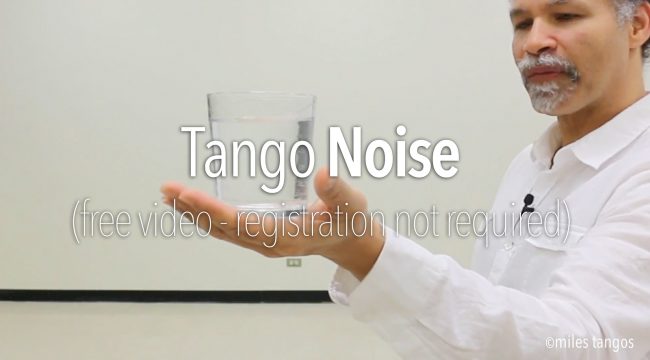
    Working With Water. The fact is that water is a great truth teller in this instance. Fill a flat bottomed glass with water about 90% of the way full. And then do 1 of 2 things, preferably in sequence.

    One: Stretch out your hand as shown in the video above, and walk forwards or back, attempting to minimize the amount of motion in the water!

    Two: Place said glass of water on your head, and walk with the embrace, as a Lead or as a Follow, by yourself! Not with a partner.

    Working with water in this case is a great mitigator, it shows you where you are the most stable, and where you’re the least, it also shows you where you need to focus on to create a clean and stable walk.

    Reality. Rightfully you must be trained to hear this stuff in order to correct for it. And you do want to correct for it. Because doing so will clarify and clean up the sensation of how you move. Truthfully most people, erroneously believe, that Tango is all about the steps, patterns, figures, and it is not that. It’s about how you move! The dance can be about anything you want, but in reality what lay under that dance is the technique of how you move. If you ‘just walk’ in Tango, this will get you around the floor. But if you were to video that ‘just walking’ around the floor, more than likely you’ll be unimpressed with the results, you’ll want it to look more elegant than that, more refined, much sharper, clearer. Tango Noise, and the topics under it as a concept, deals with that are beneath that ‘just walking’ part. It’s more about what is felt than what is seen. While you can present for the 15th row (if you were performing), that’s all fine and good, but most people do not perform, they Social Dance with their friends and acquaintances, and they’d like to that Social Dance to not only look nice but also feel nice. Tango Noise is all about removing those things that can generate a less than desirable experience, and thereby making the dance feel as good as it can without pulling, pushing, pressure, compression, tension, rigidity, or force in any way, shape, or form. 🙂 YMMV

  • Lazy Follower Foot

    Lazy Follower Foot

    Lazy Follower Foot. Most people don’t think about this stuff except for when they’re in a class or a Follower Technique Seminar, or in a private lesson. Mostly they hear it and completely forget about it about 10 seconds after it’s been said. That is unless some diligent teacher continually reminds you of this stuff, constantly. To be fair, while this particular topic happens a lot for Followers, this happens everywhere across the entire spectrum of the dance and into real life. If someone says something to you that needs to be corrected, it will take you a few tries to remember to do it, and even then that’s a stretch. The fact is that you’re dealing with muscle memory or in this case ‘muscle comfort’. It’s comfortable for you to do this stuff. So why change it. The reality is that the change comes hard to some people, and comfort is easy. If you’re comfortable why bother changing ? Right ? What you may not realize is that that comfort may or may not be desirable to look at, as in this case of Lazy Follower Foot.

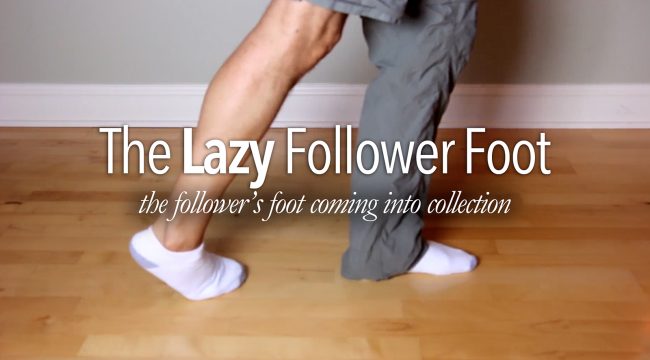
    What is ‘Lazy Follower Foot’ ? It is a state where the Follower’s back foot as it comes into collection from a Forward step, is either dragged without care or unconsciously. The foot itself, seemingly hangs off the ankle, and is summarily dragged into collection from the Forward step. This doesn’t happen from the Back or Side step, that’s the ‘Dangling’ Foot error. Whole different ball of wax, but the solution is exactly the same as shown in today’s video! 

    The Error In Your Thinking. The reason why this dance was challenging for you, and this is the error, is that’s just their ‘style’ of dance, and it’s not your style. Yes there is an estillo to some people’s dance, but sometimes with the more advanced dancers this isn’t about style…it’s about technique and the execution of that technique! So, put simply you’re missing the other side of the equation: You’re not ready for them! And the reason is, because your understanding of your own technique, your underlying foundation, how you move, how you land your feet, how you extend your legs, how you embrace your partners, where you place your body in relationship to your L/lead, where and how you engage X piece of vocabulary…all of that stuff is not trained in you. It’s just not. Further, because you’re dancing with a certain class of L/lead mostly you only get to experience a very small sliver of what a fully trained and operational Lead can actually do. Further still the Neurology of Following (as opposed to the Neurology of Leading) is lacking in you. So as a result you ‘miss’ things. So a Lead like that above, is mostly lost on you. Yes it’s insanely fun, and challenging, but you ‘missed’ so much and what’s worse is you know it. It wasn’t embarrassing, thank god, but you know in your heart you missed so much of what was ‘said’. You missed the nuances. The subtlety.

    Diving Deep.

    There is a reason this stuff happens, actually four possibilities: 1.) Poor execution of technique. 2.) Poorly understood technique.  3.) No Practice. or 4.) All of the above!

    While it’s not rocket science what those things mean, they do require a bit of detail.

    1.) Poor Execution. This means that your attention to detail of your technique is sloppy. Meaning that you allow your foot to unconsciously move as it sees fit to move in relation to your ankle and leg. Even though you have been shown X, it’s not showing up in your dance. Either consciously or unconsciously.

    2.) Poorly Understood. This happens quite frequently. We hear ‘X’ when a teacher says something to us, and in reality they meant ‘Y’.  But because we hear it through the filter of our understanding we end up misunderstanding more often than not. Poorly understood means that you hear or see something and presume that ‘A’ is ‘A’ instead of diving deeply to dig down to the roots of what ‘A’ actually is. To see it’s inner workings. Not just to accept it, but figure out for yourself how and why something functions.

    3.) No Practice. This should be a no-brainer. But you’d be surprised just how many people will go to a teacher or a class and magically expect them to fix everything, and that now that they’ve visited with teacher ‘C’ that things are all better and they can go back to what they were doing in the first place. Because teacher ‘C’ said they’re “you’re doing fine but…” and “that’s fabulous, and…”, or … did you see it ? Probably not. You missed the ‘but’/‘and’ at the ends of those sentences. You only heard the praise and not the rest! Which was… “You should go home and practice the frak out of this stuff that I just spent the better portion of the last hour showing you! Not to mention you just handed me a boatload of cash to tell you this stuff, so you had damned well better go home and practice this stuff!!”.

    4.) All of the Above! This needs no explanation. It’s not one or the other, but actually All of them together.

Hide picture