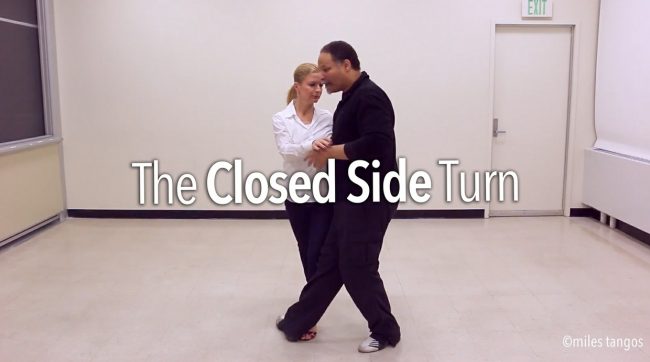
Frequently when we are out social dancing, because tango is no longer a walking dance but rather a turning dance, is to turn to the Open side of the embrace. Meaning we turn to the Left (for the Lead), and Right (for the Follower). And the reason we turn to the Left is because it’s far easier. Or so that’s the perception. And when we turn to the Right, again our perception is, that it’s difficult. That perception is a reality because IT IS difficult for a few reasons. One of the more common reasons why it’s difficult is because the Follower gets caught in the Lead’s armpit resulting in Arm Pit Dancing. And the reason why that happens is usually because both roles, do not make the necessary adjustment to allow for the turn to the right to happen at all. That’s not what this video is about. This video is about another solution to that problem that does not require adjustment from either role!
What is a Closed Side Turn ? The simplest way that I can put this is that the Closed Side Turn is a Molinete/Giro structure that turns to the right (for the Lead), and the left (for the Follower) with a very simple modification. Usually this idea is shown as an error, and sometimes as an inadvertent error that happens, and sometimes as an unconscious one. In this video I show you that not only is this NOT an error but it is a highly desirable idea that opens up options and opportunities for both roles, not just the Lead. However, let me be clear about something, while I don’t show the options available those options are available in other videos on this site > The Argentine Enganche or ‘Wrap’, The Social Sacada, The Social Single Axis Turn, The Social Step-Over Colgada, etc.
From a Follower’s Perspective. For you this is a Follower’s Molinete to your Lead’s Giro. But that Girl is slightly different which we’ll get into in a bit from the Lead’s side of things. For you > It’s Back-Side- Forward. Don’t get confused, don’t get lost, don’t mishear me, or misunderstand me, there is nothing different about what you’re doing that you have to do that you haven’t done before. But there are some things that we do have to talk about, to remind you about that are kind of important:
There are Eight Turns in Argentine Tango that Tango Topics has identified as Commonly used or Social Turns. There are a few others that are outside of the common eight but for the most part, accept for now that there are eight.
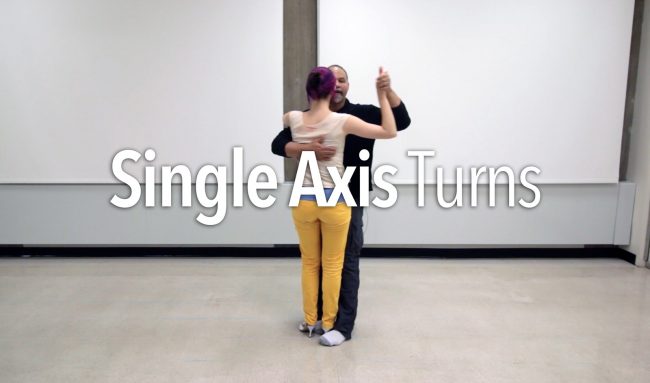
Today’s Tango Topic deals with one of those common eight turns. This particular turn is an unusual one even though it’s part of the eight. It’s unusual because it’s a variation of a class of turns called “Colgada Turns”, and furthermore it’s also not used all that much, and for good reason. Why ? Because it’s a difficult turn to pull off at first. This one is not for the faint of heart, but once you master it, your coolness factor goes right through the roof. Not to mention you will have also mastered one of Tango’s more difficult aspects that hasn’t been around all that long in the dance: Off-Axis Movements. Tango has traditionally been a couple in Close Embrace type of dance that almost never opens once the Embrace begins. Nor does that Embrace change other than to get closer and closer and closer, and more refined. This type of turn, while done in Close Embrace, creates a version of Close Embrace that from the outside looking in, doesn’t look all that different, but from the inside (the couple’s perspective) feels very different. Today we’re going to explore both sides of the embrace, for both roles, so without further yapping, Tango Topics presents: The Single Axis Turn!
What Is A Single Axis Turn ? It is tango specific language to describe a type of rotation that occurs between Lead and Follow where the word ‘axis’ refers to not the Follower’s Longitudinal Axis (which is the typical axial line that is referenced with the use of the word ‘axis’) nor is it the Lead’s, but rather a shared Longitudinal Axis between the couple. Truth be told, that axial line is always present. It’s generally the point of contact between the couple. However that longitudinal axis almost never gets used in Social Tango. Almost never. Except, and there is always an exception to these things, when the couple or partnership engages in what’s called ‘Apilado‘ (please follow the link for more information if you need a clear definition of this word). When Apilado is engaged, then the couple is dancing, depending on how it’s done, in either a supported way (shared) or unsupported way (forced). In the latter case, the Follower is being forced to fall on top of the Lead or to place all of their weight on the Lead. While there are times when that is desirable, in the case of the Single Axis Turn, that’s not desirable.
Another way of looking at the Single Axis Turn is by understanding that this is a Colgada variation. However, unlike most Colgadas though which tend to be executed in Open Embrace, this variation on a theme is done primarily in Close Embrace! So while it can be done in Open Embrace, and doing so will generate more of a ‘whoosh’ factor (see below) than you would normally like to have in a Single Axis Turn, this is generally a Close Embrace movement that is small, social and fits within the line and lane of dance that you’re in. At no point in time, should a Single Axis Turn exit that line or lane of dance at all. The Single Axis Turn is Floorcraft safe, when done properly.
Another piece of Tango vocabulary that uses very similar methodology and uses the same principle of ‘Apilado’ is the Argentine Volcada. It is also a shared axis movement. The Single Axis Turn is exactly the same in that respect. However, where as in the case of the Volcada, where the couple goes towards each other thereby creating more dependence on each other, in this case, in the case of the Single Axis Turn they go away from each other!
Put simply the Single Axis Turn is a rotation around a shared longitudinal axial line where the couple seemingly in close or open embrace, rotates around this axial line, thereby creating a ‘turn’.
The Free Tip. Just as in the case of the Volcada, where there is a natural ‘kickstand’ for all Volcadas, a safety mechanism that the Follower can invoke, if they’re not supported in the initiation phase of the Volcada…the same thing is true here. That same safety mechanism exists in the Single Axis Turn in exactly the same way in EVERY. SINGLE. ONE.
About The Video. This video is 13m:49s in length in 9 sections. Both lead and follower technique are combined and integrated into the video.
Introduction – 00:00:34 Forward Steps – 00:03:09 Follower Technique for Forward Steps – 00:01:26 Further Rotation – 00:00:32 Close Embrace Side Steps – 00:01:47 Follower Technique for Side Steps – 00:00:53 Multiple Single Axis Turns – 00:01:47 The ‘Whoooosh’ Factor – 00:00:42 The Hurrican Turn/End – 00:02:09
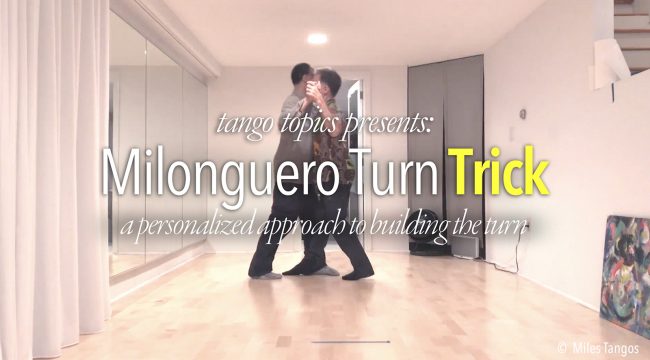
You’re out social dancing, and you’ve been practicing your Milonguero Turns with your favorite partner, and you feel like you’ve got it down, so now it’s time to take it of the lab and put it on the floor and try it with other dancing partners. This, by the way, is not how we want to create a good practice regime. We do have a treatise on what to practice and how to practice. But more on that later in another article. 😉 You’ve accepted a request to dance with someone else, it’s a Di Sarli Tango tanda, and you smile, and you walk to the floor with your partner, engaging a the Lead’s Cabeceo! Stepping onto the floor, and engaging in your partner’s embrace, you settle into each other. Readjust, hopefully employing the “The Readjustment Phase” of the dance, a very important component, and then begin to dance, slowly, patiently, cautiously figuring out each other, rather than throwing every known piece of vocabulary at your partner in the first 30 seconds. Or some crazy cool move that you think is cool but your partner may find somewhat ‘annoying’ at best. Especially dancing to Di Sarli. Tsk, tsk, tsk. It’s around this time near the end of the first musical paragraph that your partner initiates their first turn. If you’re Leading you discover immediately that what your partner heard as a turn was in fact the Follower’s Molinete and not the Milonguero Turn that you intended. If you’re Following at this point, you’re wondering why the Lead keeps turning or why the Lead is squeezing the living daylights out of your back and what that’s all about. As far as you’re concerned you’re doing what the Lead asked invoking a Milonguero Turn by default because you know the rule but they keep squeezing and turning. Uuuugh!
Today’s Tango Topic deals with that moment right there where there is obviously some confusion, a bit of a hiccup in what would have otherwise been a lovely and near perfect dancing experience.
The Milonguero Turn is one of Tango’s underused but extremely elegant turns. However it comes with a tiny little problem embedded in it. The problem ? Default Behavior and Default Expectation. The Default Behavior ? The Follower’s Molinete as the response to a turn. The Molinete/Giro structure is one of the seven basic moves of Argentine Tango that is used so often and with such ubiquity that we almost don’t even think about it anymore. It’s just that we start turning and magically a Follower’s Molinete occurs. However, as in the case above, what happens when the Lead wants to invoke a Milonguero Turn instead ? A hiccup is what happens and from there things get ugly quickly.
That’s what Today’s Tango Topic is all about. So without further yappment, here’s Today’s Tango Topic on The Milonguero Turn Trick – Personalized.
What is the Milonguero Turn Trick ? First and foremost, the Trick itself isn’t a ‘trick’, it’s more of a reliance on Follower Default behaviors. Secondly, the ‘Trick’ only solves the first major hurdle of the Turn itself – The Follower’s Back Cross.
The problem with the Milonguero Turn, and it is a problem, is the opening step, the Follower’s Back Cross. By default, the Follower will not want to cross behind or back cross, unless this is their default turn or default behavior. Truthfully there are very few Milonguero Turn default based Followers. Usually the Follower has been trained in the Molinete/Giro structure as their default. So the moment that the Lead starts a turn, the Follower thinks and responds with “Molinete”. This is not desirable. While the Molinete is a very sexy turn, it’s not what we’re wanting out of the Follower at all. We ideally want the cleaner, less stressful, Milonguero Turn for a whole bunch of reasons.
Before you go any further you’re going to ask, “Well, if the Lead led it then the Follower should follow what was led!”. True to a degree but then again, you’re dealing with default behavior, and that stuff is insanely difficult to override, most of the time. That’s why this ‘Trick’ exists.
The opening back cross presents a problem: How to generate it ? And that’s where the Milonguero Turn ‘Trick’ comes in. It says, “Fine…the Follower has default behaviors, one of them is to come to collection, still another is not to a leg fly away from them, still another they have a desire to make things as small as possible, less work”. All of these default behaviors can be used to the Lead’s advantage if properly invoked. And that’s what the Milonguero Turn Trick does, it invokes all three of those defaults and overrides the Follower’s desire to Molinete. It supersedes it almost immediately so that the Follower never, ever wants to Molinete!
In its simplest form the Trick is a Simple Sacada, but a fully unrealized one. The reason this is said, is because a Simple Sacada should and would take the place of the Follower, but it doesn’t. In its more complex form, it overrides the Follower’s default behavior to Molinete and replaces it with a back cross.
Remember that the turn trick only solves ONE problem – Initiating the Follower’s Back Cross. It doesn’t solve the entire Milonguero Turn, you still have to learn to lead and follow those things.
Notation: When the “What is … ” section of an article is blue, that means that the article is freely available to registered, users. When the section is yellow, the article is still free, but the video is for paid users. 😉
Why this video exists ? It exists for 3 reasons. 1.) It was part of a longer lesson for this particular student on the Milonguero Turn, and Elements of Turning itself. 2.) To give the student a reminder tutorial for when I wasn’t there. 3.) I taught a Milonguero Turn class rather recently and then discovered this a few days after the class, and realized that this is actually a perfect reminder for anyone that wants to play with the Milonguero Turn on how to build it and what should happen.
Further this video exists with the student’s consent. So don’t get all persnickety that we’re showing you a private lesson without the student’s knowledge. They’re fully aware of the video and fully endorse it.
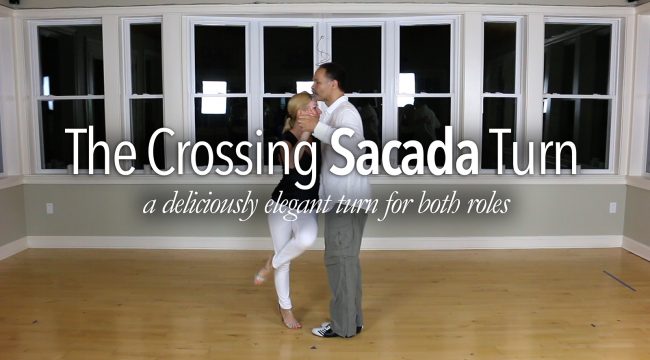
What is a Crossing Sacada Turn? In its simplest form, it’s nothing more than a series of Simple Sacadas that are chained together that just so happen to utilize the Follower’s Molinete or ‘Turn’, which employs the Argentine Cross as it’s basis for entry. While the turn can be done without this entry point, it loses it’s ‘elegance’ by without using the Argentine Cross.
To be clear, a ‘Sacada’ is one of 4 types of Tango Displacements (Boleos, Gancho, Wrap/Enganche, and Sacadas), meaning that either the dancer’s leg will displace or their entire body will be displaced or take the place of their partner. A Sacada can be done from open or close embrace, it can be done by either role to the other, and has lots and lots and lots of options (about 501, at last count – not kidding).
A ‘Crossing’ Sacada Turn ? Is exactly what it sounds like, a turn that has a bunch of Sacadas as part of it. In this particular case, this Sacada Turn uses the Follower’s Molinete, and a very important structure that Tango Topics completely eschews repeatedly, and says that you should never, ever do. This is the ONE time when you do want to do that, however with all things, there’s always a caveat to the caveat. That said, let’s talk about The Crossing Sacada Turn.
The Free Tip. Something to keep in the back of your mind is that while this is a cool piece of vocabulary and you’ll see it executed a lot, there is another version of this that does NOT include the last Sacada. Truthfully we can execute the Sacada Turn without the 3rd Sacada, and everything works just fine, sort of. Doing so, can generate other options and opportunities for us as Leads and Followers. However, one thing that will continually plague you is why the Follower continually turns away from the Lead after the 2nd or 3rd Sacada! There’s a reason for that, and there’s also a solution for it which is why it is important that you watch the video in it’s entirety to see exactly what is generating proper execution of the Sacada Turn! And don’t just rely on your eyes to assume what’s happening here.
About The Video. This video comes in at 34m:02s in length in 13 Sections. This video contains no Follower and/or and very little Lead Technique.
Section 1 – Introduction – 00:00:52 Section 2 – Argentine Cross – The Starting Point – 00:01:32 Section 3 – The Lead’s Cross Behind – 00:02:35 Section 4 – The First Sacada – 00:01:09 Section 5 – The Follower’s Flailing Foot Error – 00:02:17 Section 6 – The Second Sacada – 00:01:32 Section 7 – The Third Sacada – 00:03:10 Section 8 – The First Complete Sacada Turn – 00:01:32 Section 9 – The Turning Brake – 00:04:08 (technique) Section 10 – Removing The 3rd Sacada – 00:00:58 Section 11 – A Variation On A Theme – 00:03:47 Section 12 – The Close Embrace Version – 00:01:34 Section 13 – With A Metronome/Closure – 00:02:34
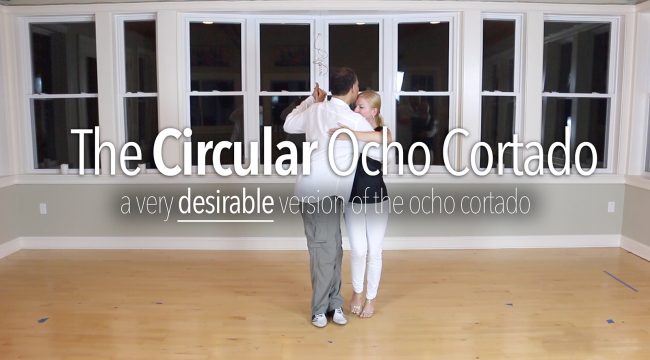
The Circular OchoCortado. First let’s get the language out of the way. The phrase “Ocho Cortado” translates from the Spanish to English like so: ‘Ocho’ translates as the number 8. ‘Cortado’ comes from the root Spanish -AR verb ‘CortAR’ which translates as the infinitive ‘to Cut’ (or to Slice). However, you’ll notice that there’s an ‘ADO’ ending on the verb, which is akin to an ‘ed’ ending of a verb in English as in ‘HelpED’ or ‘LikED’, or ‘WalkED’. It’s the past participle version of the word. 🙂 However, when you put them together the translated phrase almost makes no sense. So we have to move things around a bit for it make sense to an English speaker. So ‘8 Cut-ed’ makes absolutely no sense, however if we invert the words so that it becomes ‘Cut-ed 8’, it starts to make a bit more sense. Typically when dealing with other languages we end up having to infer the meaning. ‘Cut-ed’ in English makes no sense, however…it’s secondary meaning does, ‘SlicED’! A ’SlicED 8’ or Half of an 8! So quite rightfully an Ocho Cortado is a HalvED 8! Language lesson over….
There are two varieties of the Ocho Cortado, the Linear variety and Today’s Tango Topic: The Circular Ocho Cortado. In the case of the Linear Ocho Cortado, it really is a linear step. Meaning ? That it’s stretched out along a walking line. The vocabulary itself is really great for rounding corners, when you need to ‘cut’ a 90º corner. They’re great for musical interpretation elements. They’re great for cross play. And they’re even better when inverted! 🙂 However, the Linear Ocho Cortado is only taught in certain places. Tango Topics talks about the Linear Ocho Cortado as if it were the default Ocho Cortado. That is not the case. In other parts of the world, The Circular Ocho Cortado is the default and the Linear variety is weird one. In certain places the Linear variety is almost never taught, so you’ll never see it on a social dance floor at all. In certain places, the Circular variety is the odd man out and you’ll never see it either. So today without further adieu Tango Topics presents – The Circular Ocho Cortado. The OTHER Ocho Cortado. [Editorial Note: This site will be cleaning up the language for the Ocho Cortado in the other posts that deal with this to make the clear distinction of Linear vs. Circular.]
What is a ‘Circular’ Ocho Cortado ? Put simply it is leading the Follower to a Forward Ocho. However this is a very specific kind of Ocho that we only use for teaching purposes. In this particular case, that teaching Ocho is what’s sometimes called (and this site referred to as such) a ‘Linear Forward Ocho’. They’re called that because these ochos don’t go anywhere at all, and in fact they’re done directly in front of the Lead on a line. Hence the ‘Linear’ part of it’s name. 😉 The Lead invites the Follower to a Linear Forward Ocho across their body (to the open or closed side of the embrace, usually the closed side), and then interrupts that motion to invite a change of direction, and that change of direction is the Ocho part. The ‘Cortado’ part comes from the fact that only ONE HALF or one side of the Ocho is danced. Typically an complete Ocho is both sides of the 8 or the Applied Disassociation. However in this case, only one half is done, and as a result we have a Cortado or Halved 8. What makes it Circular is the fact that the Ocho itself is the circular part. The curvature of the opening step into and out of the Ocho (the applied disassociation part) Cortado where the Follower is at first stepping next to their Lead and then back to the same position again.
About The Video. This video comes in at 31m:28s in length in 9 Sections. Follower and Lead Technique is explained in the video.
Section 1 – Follower’s Perspective – 00:12:43 Section 2 – The Difference Between Linear & Circular – 00:01:07 Section 3 – Leading Perspective – 00:03:09 Section 4 – The Open Side Circular Cortado – 00:02:44 Section 5 – The Close Embrace Version – 00:03:52 Section 6 – The Lead’s Error! – 00:01:34 Section 7 – The Lead’s Head – 00:01:34 Section 8 – Lead/Follower Footwork Detail – 00:03:41 Section 9 – Closure – 00:00:22
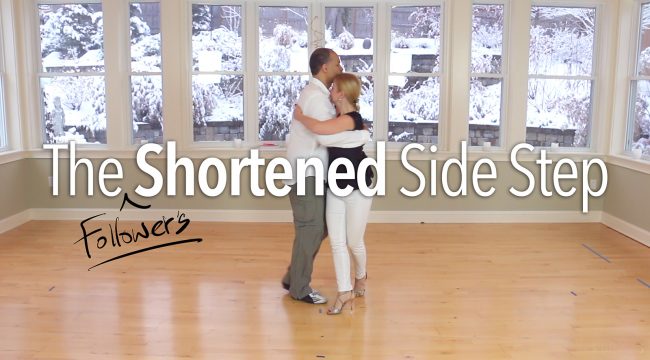
The Shortened Side Step. The Follower’s Molinete in one respect it has become the staple of the dance due to the fact that the dance is no longer a walking dance but rather a turning dance. This, aspect, is due in part to the fact that the Ronda (the line of dance) no longer moves, it hesitates, it hovers. As such is the case, we have become students not of the walk, but of the Follower’s Molinete and the Lead’s Giro in Open and Close Embrace. More the Close Embrace variety more than anything else. And so that we hit all the hot spots here, that idea of Close Embrace is in an Open Vee, Closed Vee, Pseudo, Berlin, and/or Square Embrace format. In any and/or all of these varieties of the Embrace the Follower’s Molinete and the Lead’s Giro is the staple or go to turn. Even though there are 7 other types (Milonguero Turn, Ocho Cortado – Circular or Linear, Single Axis, Colgada Turns, Rock Steps, Walking Turns, and Calesitas.) that we want to use to create a little bit of variety with our dance on multiple levels. Not just from a vocabulary standing but from a musical interpretation position. But that’s a horse of a different color for another day. As it stands with the Follower’s Molinete there is a huge or monster issue that happens in that turn that is created by 4 separate issues that create a less than desirable experience for both Lead AND for the Follower. Before we get to those 4 issues. So without further yappage, the Follower’s Shortened Side Step.
What is the Follower’s Shortened Side Step ? It’s exactly what it sounds like, it’s a side step that is much, much smaller. By default when we’re performing the Follower’s Molinete (as Followers) you may have been told early on by various and sundry teachers that we want to create evenly sized steps. The reason for this is really simple: Predictability! That predictability is, so we are told, a way for the Lead to be able to rely on the consistency of your steps as a Follower. They require it. They need it. They can’t possibly dance any other way. That’s not true by the way. There is another way which Tango Topics teaches and promotes, and that’s Intention Based Dancing. Part of the goal of Intention Based Dancing is to create a hyper-awareness in the dancer so that they can and should be able to ‘feel’ via their nervous system the small and seemingly imperceptible changes that can occur in someone’s posture, body position, body placement, weight position, foot position, foot placement. And in ‘listening’ to those cues we can surmise where someone’s body is in space and time and then enact Newton’s 3rd Law of Thermodynamics in real time! So the Follower’s Shortened Side Step is really a side step that allows for a Lead to have not only predictability but also gives control back to the Follower. Control ? You see in this entire discussion of the Follower’s Side Step of their Molinete, they’ve lost control over their choices. They’ve been told this is how things are supposed to be done, when in fact they have oodles of choices. Lots really. This idea of the Shortened Side Step is just one of them.
About The Video. This video is 10m:51s in length in 2 sections. Lead causes and then Follower Technique is shown in the video only. There is virtually no Lead Instruction in this video.
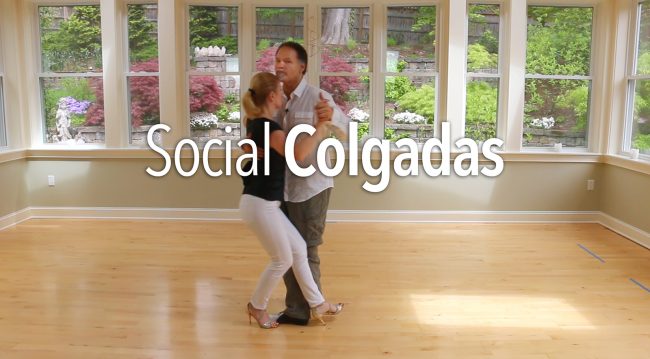
The Social Colgada is in many ways very similar to the Single Axis Turn. That’s because they’re from the same family of vocabulary. So theoretically, if you know one, ha ha ha, you should be able to execute the other. Not true actually, there are stark differences between the two. One primary difference from the Single AxisTurn is that the Social Colgada is done with the partnership in a perpendicular position to each other rotating around a singular axis vs. the Single Axis turn where the partnership is facing each other. Still another is the Single Axis Turn rotates the couple 180 degrees without invoking a second step around, typically. Whereas the Social Colgada is typically a 270 to 360 degree turn!
The Colgada Rap! Before we go any further, truthfully Colgadas are typically manhandling events that most Follower’s want to avoid like the plague. The reason is a.) that they’re poorly executed. b.) they’re usually arm pushing and pulling experiences, and c.) someone (read that as the Follower) invariably gets hurt because their back has been wrenched this way or that. Most of this occurs because the Lead in question has not learned how to properly generate a Colgada. Where Colgadas get a bad rap is because of these 3 aspects which turns off a lot of people, obviously. However a Social Colgada on the other hand, while it has all the potential for these things to happen, is much smaller, and exists within solely within Close Embrace. When executed properly it can be one of Tango’s more elegant specialty pieces of spice or accent vocabulary.
What is aSocial Colgada ? A ‘Social’ Colgada means that the Colgada itself takes up very little space, that it fits within the line & lane of dance, while the couple is in Close Embrace, and instead of executing the Follower’s Molinete to turn the couple, we invoke a Social Colgada. As to a Colgada aspect ? The word “Colgada” comes from the root Spanish verb “Colgar” which translates to English as “Hang”. The word ‘Colgada’ is the past participle version of the verb which adds an ‘ed’ ending to the word. Which when translated to English is ‘Hanged’ or rightfully ‘Hung’. So ? A ‘Social’ Colgada is a move where the Follower (specifically) is in a hanging state off their Lead, deliberately. More specifically, they’re being placed in a position where they’re going to hang. And that’s where we talk about a shared axis, and more importantly balance.
Ideally the Colgada itself is not about taking the Follower off axis, as you may have been told, but rather about creating a state of shared balance & equilibrium along the shared axis between the partnership. As there is always a shared axis between the dancing couple. Truthfully there are actually 6, not one. There’s the lead’s central longitudinal axis, the follower’s central longitudinal axis, and the shared central one between the two dancers which is created by their relationship to each other. It’s the last one that we’re interested in because it generates the space for a Colgada to exist.
The Free Tip. From the Follower’s position, and point is not shown in the video at all, the follower’s knees want to be “soft” or pliant. You don’t want them locked out or bent, but rather a micro-bend to allow for maximum flexibility!
About The Video. This video is 29m:09s in length in 12 sections. Both lead and follower technique are combined and integrated into the video.
Introduction – 00:01:04 The Mordida – 00:02:28 Balance & Planking – 00:03:06 The Kickstand – 00:01:41 The 3 Linear Cologadas – 00:03:08 The Circular Colgada – 00:01:40 The Colgada Embrace – 00:02:15 The Step Over Colgada – 00:02:56 The ‘Social’ Colgada – 00:03:03 In The Line Of Dance – 00:03:44 The ‘Whoosh’ Factor – 00:01:39 A Primary Lead Error/End – 00:01:39
The Colgada is in many ways very similar to the Single Axis Turn. That’s because they share the same basic attributes, and they’re from the same family of vocabulary. So theoretically, if you know one, ha ha ha, you should be able to execute the other. Not true actually, there are stark differences between the two. One primary difference from the Single AxisTurn is that the Social Colgada is done with the partnership in a perpendicular position to each other rotating around a singular axis vs. the Single Axis turn where the partnership is facing each other.
The Colgada Rap! Before we go any further, truthfully Colgadas are typically manhandling events that most Follower’s want to avoid like the plague. The reason is a.) that they’re poorly executed. b.) arm pushing and pulling experiences, and c.) that someone invariably gets hurt because their back has been wrenched this way or that. Most of this occurs because the Lead in question has not learned how to properly generate a Colgada. Where Colgadas get a bad rap is because of these 3 aspects which turns off a lot of people, obviously. However a Social Colgada on the other hand, while it has all the potential for these things to happen, is much smaller, and exists within solely within Close Embrace. It is and can be one of Tango’s more elegant specialty pieces of spice or accent vocabulary.
What is a Colgada ? The word “Colgada” comes from the root Spanish word “Colgar” which translates to English as “Hang”. The word ‘Colgada’ is the past participle version of the verb which adds an ‘ed’ ending to the word. Which when translated to English is ‘Hanged’ or rightfully ‘Hung’. So a Colgada is where the Follower (specifically) is in a state where they’re going hang off their Lead, deliberately, or more specifically, they’re being placed in a position where they’re going to hang. And that’s where we talk about a shared axis, and more importantly balance, all of this fitting within the line and lane of dance.
Ideally, the Colgada itself is not about taking the Follower off-axis, as you may have been told, but rather about creating a state of shared balance & equilibrium along the shared axis between the partnership. As there is always a shared axis between the dancing couple. Truthfully there are actually 6, not one. There’s the lead’s central longitudinal axis, the follower’s central longitudinal axis, and the shared central one between the two dancers which is created by their relationship to each other. It’s the last one that we’re interested in because it generates the space for a Colgada to exist.
From A Following Perspective let’s get this right out of the way immediately. You’re going to fall, backwards or in this case, to the side away from your lead. That’s the whole point of a Colgada in the first place, the falling part. There’s nothing you can do about it, except to engage teh Follower’s Kickstand (see above in the video). However understand something that the “fall” is a controlled hang more than anything else, and the control comes from two important aspects 1.) the elasticity of the couple’s embrace, and 2.) body position, placement, and balance between the couple. 🙂
If there is rigidity in the embrace from either partner, nasty things are going to happen. “Elasticity” in this instance is a somewhat relative term, as there does have to be some firmness there, but not to the point where you’re holding on for dear life! That’s not what a Colgada is about. 😉 So yes, dear Follower, you’re going to fall to the side, and yes you’re going to be off-balance, and quite rightfully it’s going to be a little scary for obvious reasons. No one, absolutely no one wants to fall. However in this instance we actually do want to fall, a bit. Not a lot, just a bit. And that’s where the controlled part comes in. It’s a very controlled ‘hang’ through technique, and more importantly through a shared balance point between the partnership.
Planking: Before we go any further we have to talk about when you “fall”, you’re desire is to stiffen your body, and then ‘Plank’ it to save it from impacting the floor. But before we get there, we’ll engage the Kickstand Mechanism to prevent that from happening. But before the “fall” happens we invoke, as Followers, the ’plank’ of our bodies. What is that ? It means that you’re going to stiffen your body and straighten it out as if it were an elongated piece of wood, falling backwards, hence the term ‘plank’, which refers to a plank of wood. 😉 “Planking” is an error as there is something else we want to do.
Planking is an error when engaging a Colgada. It is however a perfectly natural response to do this. So don’t freak out. However, planking is not what we’re after. We’re actually after something else. This is why we learn the proper position for a Colgada to exist. What’s the more desirable position for us ? For that, you’ll have to see the video. However the descriptive for it is very simple, it’s almost as if you’re sitting, you’re going to send your hips away from your lead, while keeping your torso with them. Or in the case of the Social Colgada, you’re going to be perpendicular to your lead so you want your hips to go away while the side of your torso faces your Lead.
The Controlled Hang: Another aspect of the Colgada is that we want our arms, and hands to a certain degree, to be able to slide almost as if you’re arms were a collapsible telescoping bar. ‘Telescoping’ in the adjective form, meaning that one part slides into another. We do not want rigidity in our arms and/or hands. We also don’t want to hold on for dear life with our hands, like your grabbing the lead’s bicep with your spiny fingers. Not. Less than desirable. Instead we want arms and hands to be able to slide within the Lead’s embrace – hence the ‘telescoping’ part. 🙂
The Kickstand Mechanism: There is a safety mechanism that is built into each and every Colgada, and it’s called The Follower’s Kickstand. What’s that ? It’s where the Follower’s free leg extends backwards as if they were going to step backwards but there’s no weight on it. The Kickstand in this case occurs under ONE condition. If and only if there is no counterbalance (or counter send) from their lead. If there is counterbalance then the Follower should not release from their invited Mordida (see video above).
From a Leading Perspective the Social Colgada is all about balance. It’s the Lead’s job, function, to create physiological balance, a state of equilibrium, within the couple. Mistakenly this is done with your arms, but instead we want to employ counterbalance the Follower with our mass, not our arms. Our arms are there to ‘guide’ our intention, but the real toy here is counterbalance. Truth be told the Lead (the person not the action) is more than likely going to have more mass than their Followers will posses. And as such the counterbalance point will be slight, while at the same time, the proper ‘sitting’ position of the Colgada will be almost, but not quite planking. So, in other words, the break at the waist, will be slight. 🙂
The Used Mordida: A good portion of Leads, overuse the Mordida usually mistakenly in the Salida Step of the dance. What’s a Mordida ? It’s a ‘foot’ sandwich. Where the lead, traps one of the Follower’s feet and sandwiches it between the Lead’s feet. Far too often once a Lead learns how to create a Mordida they use it everywhere. As a place to stop, as a place to reset the couple, as a place to end the dance. This is know on Tango Topics as The Unused Mordida. It’s ‘Unused’ because the Mordida is an indicator to the Follower that something is about to change, usually entering either a Volcada, a Barrida, a Parada, or in this case, a Colgada. However in this case we actually use it and rightfully need it to set up the Colgada, because without our feet are going to slide every which way, and we obviously don’t want that to happen.
The Arm-y Pushme-Pullyou Colgada: Typically most leads use their arms to generate a Colgada, as has been said, however one aspect of this is that once the Colgada starts the Lead will pull the Follower towards them with their arms instead of directing their intention with their mass. One of these is desirable (mass direction), and one these is not (pulling). This type of error makes almost any Colgada very undesirable. So it’s a good idea to learn how to direct that mass, without pulling or pushing so that the experience is a pleasant one and not one of dread for the Follower! Just a hint, this video shows you how to do that, properly.
A Turning Colgada ? The Colgada gets a really bad rap most of the time. It’s poo-poo’d because most people think of it as ‘Nuevo’ vocabulary or open embrace vocabulary. Frequently this type of vocabulary is poorly executed, thereby making it visually unappealing, not to mention wholly uncomfortable. However, this particular version of the Colgada is far from the unsightly ‘nuevo’ aspects that you’re used to seeing, and that’s because of its ‘whoosh’ factor. The ‘whoosh’ is a rush of energy that happens because the couple is turning to one side or the other! Most colgadas are done in linear fashion. This Colgada series is done on the circular, and then to exit the Colgada, the Follower steps, over and (here’s the important part) around their lead! While this can be done in Open Embrace, and there’s nothing wrong with that, doing so tends to take up way too much space, so instead we want to do this in Close Embrace in no more space than a single forward step. Put succinctly, a Social Colgada, when properly executed (hence the video), can be a way to turn the couple down the line of dance! This aspect of the Colgada makes it a very useful and powerful turning tool for the lead to use in 2 ways: 1.) Navigationally. and 2.) The Spice Factor, which we’re not going to get into.
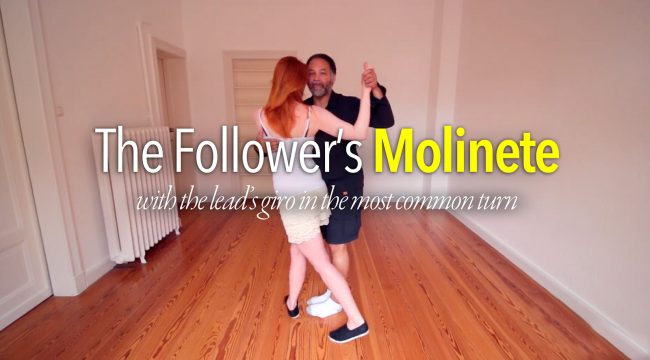
Every social dance has a variation of a very old idea known as a “Grape Vine Turn”, which is generally 3 steps in either a circular or linear pattern. Argentine Tango is no exception to this factoid. Truthfully Tango has spawned and borrowed and given 8 types of turns based on simple walking principles. The Eight functional types of turns of Tango are: 1.) The Milonguero Turn. 2.) The Walking Turn, 3.) The Rock Step. 4.) The Ocho Cortado (Linear & Circular). 5.) The Media Luna. 6.) The Argentine Calesita. 7.) The Colgada Turn (including The Single Axis). And #8, the topic of Today’s Tango Topic: The Follower’s Molinete. The turn itself is taught to every beginner dancer, and every dancer uses this very functional and foundational turn. Just as a side note, up until about 1980, oddly enough, The Follower’s Molinete was NOT the predominant turn. That honor goes to first turn on our list above, the Milonguero Turn. So what happened ? Why was the turn supplanted ? You can thank Gustavo Naveira and Fabian Salas for that. If for no other reason these two men aren’t considered the father’s of Modern Argentine Tango than it should be their introduction of the Follower’s Molinete to the world. Which, strangely enough, had been around in various forms for almost 50 years before they came along and … ahem … ‘discovered‘ the Molinete. Moving along, the Follower’s Molinete did go on to supplant the Milonguero Turn, and it is now the common turning element for all dancers to learn and then to dance. As this is the case, the turn is so predominant that it is the default motion for every Follower whether they realize it or not. The moment that a Lead starts to rotate their body, the Follower will default to the Follower’s Molinete. It should be noted that the Follower’s Molinete doesn’t happen in a vacuum. It happens due to the other side of the equation: The Lead’s Giro. The Lead’s Giro and the Follower’s Molinete co-combine to create the standard turn in Argentine Tango when we talk about turns. So without more yapping, let’s dive into Today’s Tango Topic: The Follower’s Molinete.
What is the Follower’s Molinete ? The term “Molinete” means Wind Mill in English when translated from the Spanish. And as it relates to Argentine Tango this is a Grape Vine Turn with 3 steps. Forward, Side, and Back that executed by the Follower. Which is the reason for the distinction in the moniker, calling it The Follower’s Molinete. So that would lead one to believe, and rightfully so, that there is a Lead’s Molinete. And there is. But that’s a topic for a different Tango Topic. There are two primary versions of the Follower’s Molinete. And the primary distinction is whether or not The Follower’s Molinete is done in Close Embrace or Open Embrace. While the two turns themselves are functionally the same, there are some very nuanced differences between the two. However, at the 50,000 ft level, the turns consist of the 3 steps: Forward, Side, and Back. When you stop and you think about it though, there are actually 4 steps, not three. Even though we would like to use only 3 and it can be done quite easily with practice. There is a fourth step, and it’s a second side step after either the forward or back step. The Follower’s Molinete can start with either the Follower’s Forward step or the Follower’s Backstep. Both will lead to slightly different outcomes. However, the setup for both turns is usually the same: Traveling Ochos! In either case, both the Forward Step, and the Back Step are Applied Disassociative motions which are mostly, and erroneously, thought of as ‘pivots’, which lead to the Follower then extending into a rotating Side Step. It should be noted that of all the foundational moves that the Follower must master, that this is the hardest thing, physiologically speaking that they’ll ever have to do. Ever. It takes considerable time, patience, practice, and did we mention ‘practice’, solo, with a partner, in private instruction to make the Follower’s Molinete fluid. This is not watching a 9 minute video and bam, you have got it down. No. This is going to take a while. A long while. A very LOOOOOONG while. Years. However, having adequate reference material is absolutely key to that process.
About The Video. This video comes in two parts, the Open Embrace version (00:24:12), and the Close Embrace version (00:08:34). This is a combined video format, lead and follow technique are mixed together.
Introduction – 00:01:10 Two Lead Accommodations – 00:00:37 Lead Hip Detail – 00:02:27 Lead Space Detail – 00:00:43 Lead Footwork – 00:01:10 The Close Embrace Dip – 00:01:03 The Recap – 00:00:51
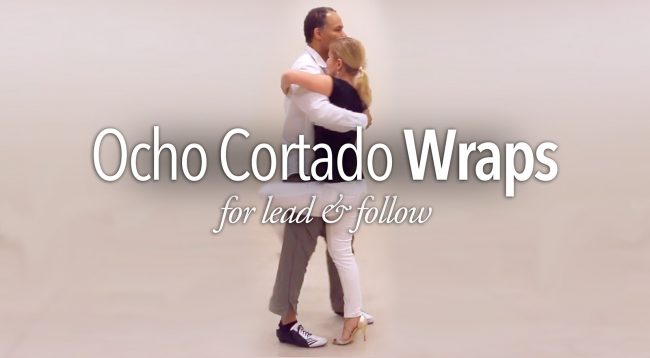
The Linear Ocho Cortado is a venerable piece of tango vocabulary used primarily for cutting turns, adding accents to the ends of musical paragraphs, or just to add a bit more ‘fun’ to the dance. It’s great in open, fabulous in close embrace, and just delish when led and followed slowly. There’s nothing crazier than an Anti-OchoCortado (reversing the Cortado, lead doing the follower’s steps & the follower doing the lead’s), while going against the music as counter point. 🙂 However, far too often a fair number of Leads, and a good number of Follower overuse it as if it were going out of style and they just have to get all they can in, before the end of the Ocho Cortado. After about the 3rd time most Followers yawn and yearn for something else, a little nuance, a little spice, a little…something else. While this belief could make most Leads (the person, not the action) cop to the ‘more vocabulary is better’ philosophy that pervades most leading classes, there is another way to go here. And that’s the add nuance. The nuance in this case is today’s Tango Topic: The Ocho Cortado Wrap.
What is An Ocho Cortado Wrap ? Put simply it’s a Follower’s leg wrap….
mixed with an Ocho Cortado (the ‘Cut’ Ocho).
To be fair the Ocho Cortado is not really an Ocho, not by any stretch of the imagination, nor is it a broken one at that. It is more akin to the Follower’s Molinete more than anything else.
What is an Ocho Cortado Wrap ? In it’s simplest form, and there are a few versions of this variation on a theme, it uses the Linear Ocho Cortado’s “Open” Side step as a place for an Enganche or ‘Wrap’ to occur instead of the completion step of the Corrected Cross that we would normally see.
There are a few benefits to adding a Wrap in this position, one of them is that it allows for variation to occur. More variation instead of the same-ole, same-ole. Furthermore, it also adds a bit of fun for the Follower to engage a really wonderful Wrap or Enganche to the Lead’s invocation. The Wrap component on the side step is not the only possible wrap that’s sitting there. There’s an Enganche on the Follower’s step out of the Side Step. There’s also a Lead Enganche on the step into the Ocho Cortado! Then there’s the reverse Linear Ocho Cortado where the couple would invoke a Linear Ocho Cortado only from the open side of the Embrace. 🙂 There’s also a possible back cross that can occur in either variation as the closing step.
The Free Tip. The Wrap from the Follower’s perspective is ENTIRELY OPTIONAL, it’s not required. Ever. Meaning ? That the wrap itself is always, always, always, always the Follower’s CHOICE. If they don’t feel safe, or taken care of, then they quite rightfully should not wrap at all, ever. That means no pushing, no pulling, no squeezing, and the invasion of the wrap itself should be just enough to indicate the wrap but not forceful enough to push them into it. They must be given the choice to do it. The wrap itself is entirely learned behavior, this is not something that the Follower is going to do on their own by default. So if you lead it, don’t sit their and expect that it’s magically going to happen. It’s not. There’s a reason why this particular wrap occurs, and you as a lead must create those conditions. And so that we’re absolutely clear here, one of those conditions is not using your arms at all!
About the Video: This video comes is 21:44 in length in 14 Sections.
Section 1 – Introduction – 00:00:20 Section 2 – Ocho Cortado Review – 00:00:48 Section 3 – Lead Reminders – 00:02:22 Section 4 – Follower Reminders – 00:03:23 Section 5 – Ocho Cortado Both Roles – 00:00:23 Section 6 – The Wrap For Leads – 00:01:33 Section 7 – The Wrap for Followers – 00:01:42 Section 8 – Wrap and Cortado Together – 00:01:43 Section 9 – The Open Embrace Version – 00:00:50 Section 10 – The Close Embrace Version – 00:01:14 Section 11 – The Open Side Cortado Wrap – 00:00:40 Section 12 – Why This ? – 00:01:56 Section 13 – A Double Wrap – 00:01:53. Section 14 – Adding a Lead Gancho – 00:01:19. Section 15 – Closing.
Install Tango Topics on your iPhone: tap Share, then Add to Home Screen.