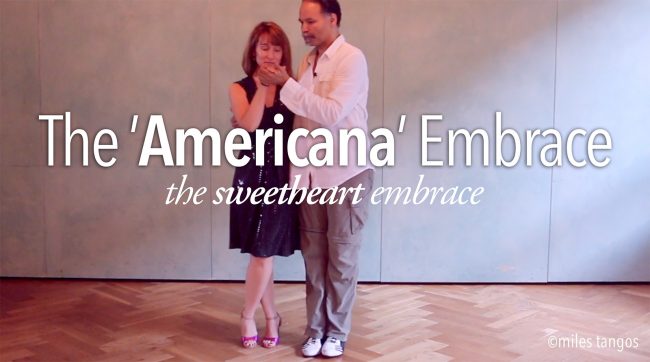
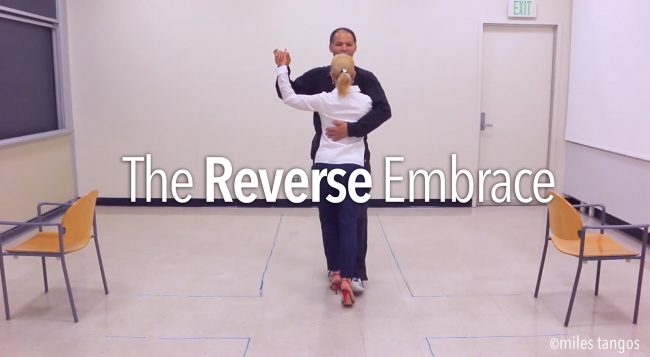
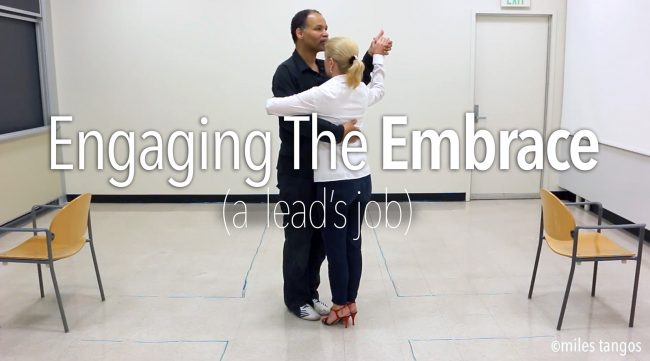
A Lead’s Job. The fact is that in modern Argentine Tango, while the Follower most certainly has a role and a job (several), setting the tone and style of the embrace is the squarely the job of the Lead. The Follower, as sexist as this sounds, fills that space with their complimentary embrace. And so that we don’t slight the Follower’s role in this regard, we will discuss the Follower’s side of this equation in a later article and requisite video. Right now we’re talking about a Lead thing. Further still, a Follower should not stop reading at this point. Think of this article, from your perspective, as pulling back the curtain of the seemingly black art of leading. Or think of it as ideally what your lead wants to do but more than likely is not doing.
Leads you have a role and a job, several, and one of them is ‘creating an embrace structure’ which is comfortable for the Follower, while at the same time creating the iconic visual that is a Tango embrace. An embrace which just so happens to allow for maximum effect (free range of motion, visual impact, etc) with minimal input (easeful, non-stressful, no pain, no pushing, no pulling, no hanging, etc).
Put another way, you have 3 primary goals: 1.) Navigation. 2.) Architecture. and 3.) Music. Under the category of Architecture, we have 2 sub-categories. 2a.) Form. and 2b.) Vocabulary. Think of 2a as what we look like (the visual), and think of 2b as what you do with 2a in time to 3, while employing 1. However, all of 1, 2, and 3 starts with – Engaging The Embrace.
[ls_content_block id=”6272″ para=”yes”]
Typically what happens: You step onto the floor without engaging proper floorcraft, then you grab your follower’s right hand, lift it, then step in with your right, leaning in with your right shoulder, and then place them in your armpit (the Follower willy-nilly goes there as well), and then wrap your right arm around them, and then almost immediately thereafter you begin throwing vocabulary at your Followers in the hopes that they won’t see that you have no idea what you’re doing to a tango, milonga, or vals!
The Problem ? For a good portion of Followers they want a gentle, guiding, clear, clean, non-compressive, non-restrictive, non-pushing, non-pulling, non-resistive experience that does not include being told what to do as their doing it. But what they get is something akin to what typically happens. And that’s not covering what happens inside the dance itself. Typically the Lead is forceful – using their arm, which they don’t realize they’re doing, and then doesn’t listen for the Follower’s response to a specific piece of vocabulary, thereby whisking them from idea (ochos) to idea (molinetes, repetitive molinetes) to idea (crosses, sacadas, ganchos, volcadas, colgadas, etc). The issue is that throughout all of that usually the Lead’s embrace is restrictive, resistive, and compressive (resistance based dancing), trying to control the Follower instead of inviting them to do X, Y, and Z. Guiding them, suggesting, inviting, proposing. What the Follower gets instead is control, contain, push, pull, and a host of manhandling with the lead’s arms. This is not something that anyone wants to have happen to them, and yet this is precisely what passes for ‘dancing’ a good portion of the time and it’s not desirable on multiple levels.
[ls_content_block id=”7949″ para=”yes”]
The Right Conditions. The whole issue above stems from the Lead’s inability to create a platform to work from – an embrace that is calming at at the same time clear without the use of force. That starts with creating the right conditions. The Right Conditions ? We ideally want to calm the Follower’s mind. Quite honestly, they’re freaking out. Why ? Because they have no idea what craziness (especially if it’s a Milonga tanda) that the Lead is going to come up with. They have to be ready for anything. Understand that it is a jarring experience for most Followers. The Right Conditions here are first creating calmness in your body, in your posture, in your arms, everywhere. Just calm, quiet. That quietness is incredibly important. We want kinesthetic silence. What we generate is what they hear. And if they’re hearing kinesthetic ‘noise’ then we’ll get that in response! So ideally, we want a calmness in our attitude and kinesthetic quietness in our bodies. We don’t want anything that will create a ripple in them. Think of the right conditions as though it were a placid lake at dawn or sunset. We want that mirror reflection of motionless to reflect the sky. The Follower, in this analogy, is the sky.
Where To Begin. Most of this ‘calming’ starts with your own body posture. Learning how to engage good posture that is at once not ramrod straight but rather upright using the body’s natural inclinations (corrected of course because a good portion of you have terrible ‘natural’ posture). A posture that does not rely on force, or tension in any way, shape, or form. No more than is necessary to hold the body upright. And even that’s sometimes too much, and the language used to describe this stuff is sometimes very vague and not very helpful. However, there is a language that describes this stuff perfectly – Alexander Technique! Put simply Alexander Technique was developed by Frederick Matthias Alexander, and is an kinesthetic process that retrains your ability to realign your body’s natural posture and secondarily to avoid unnecessary muscular tension. Alexander had the belief that your self-awareness could be inaccurate which is created as a result of bodily stresses and situations that we learn over time that we must unlearn, which as a result in created unnecessary muscular tension when standing or sitting with body weight unevenly distributed, holding the head incorrectly, walking or running inefficiently, etc. In other words, Alexander Technique is the language that you have been looking for to describe how to correct what you’re doing with your posture and so much more.
[ls_content_block id=”8747″ para=”yes”]
To be a bit clearer, there is a perception in Tango that your posture must be ramrod straight, this is a holdover from two very distinct areas. 1.) Ballroom (yes Ballroom has infected tango). 2.) Performance Based Tango. Both of these things have contributed to the less than helpful idea that we must hold ourselves in these almost impossible positions for hours on end to ‘look nice’ to dance with. Followers will know this the moment it’s written here, but you see they’ve danced with those ramrod straight dancers, the ones that look nice to dance with but the moment they get into the embrace they realize they’ve made a mistake. Good posture does not need to be ramrod straight in order to be good. It does however, need to be comfortable, and at the same time upright without contortions in any way, shape, or form.
That Thing We Do. The fact is that a good portion of you reading this have a body problem. You want and then again you don’t want. In one respect you want to be touched and in another respect you don’t. You want to be hugged and embraced, and then again you don’t. You want to be next to someone, close, very close, touching close, but at the same time….not. Society says one thing, Tango says another. It’s a diametric opposite that you just can’t get away from. There are perfectly good reasons why you want, because it feels good. It’s pretty simple. And there are a few double dozen reasons why you don’t want….someone hasn’t showered recently, is really sweaty, has bad breath, someone is soaked through with sweaty clothing, and then there’s the ‘sexual energy’ thing that most men are completely unaware of, but women are very aware of. And while we’re talking about sex. From a Male Leading position, there’s the whole female breast/body thing. Society says you can look (not directly) while publicly you can not touch directly. Which flies in the face of Tango, which says ‘touch’ and quite literally place your body wrapped around your partners, while at the same time don’t touch too much. It can be a little confusing, but you generally follow the rules of good, respectful conduct, which states – don’t do anything that you wouldn’t want your mother to know about! At the same time, as a Lead, you want to create a platform from the plane of your body that is almost like a comfortable couch or bed to sleep on. Why ? Because the Follower is going to spend the next 9 to 12 minutes there! That’s why. From a Female Following position, you have a body with a brain, chest, hips, and curves everywhere. I know, right ? Mansplaining….oy. Society sexualizes your body constantly, in every detail, it’s not like you can forget it because it’s everywhere you look. Your body, is as happenstance of Argentine Tango, going to be touched, in sometimes inappropriate places and ways by men you wouldn’t normally have anything to do with except as it happens to be required in Tango. That requirement ? The plane of your body must meet the plane of your lead’s body in every way possible. It’s like form meeting function. Or peanut butter meeting jelly. Or … you get the point. Why ? Because you want to be able to hear (kinesthetically speaking) your Lead in exacting details, and that requires the plane of your body to be in complete contact with your Lead. Backing away from that, makes your job, your role, much….much more difficult than it needs to be. From a dancing perspective, what we’re really talking about is close embrace dancing. Ideally we want to be sternum to sternum, sometimes referred to as a ‘core’ embrace format, or ‘square’ embrace format. Sometimes referred to as Body-On-Body contact. That’s not to say that a ‘v’ or ‘closed-v’ or ‘open-v’, or ‘open’, ‘slightly off-gigline’ body-on-body isn’t valid. It just means that these versions of close embrace create situations or kinesthetic dynamics that are more or less preferable for the Lead and not necessarily the Follower. Like for instance Turns (see the Armpit Dancer). Ideally you want your partner to be right in front of you, gigline to gigline for a variety of reasons, not the least of which is ease of dancing on multiple levels. So the whole body-on-body is very important as it relates to what has to happen in the dance, it’s the thing we do. Without that physiological, deep (psychological), physical, kinesthetic contact in the dance, let’s just say it makes things a bit more challenging.
Your Arms. Frequently a good portion of you use your arms and hands to direct the Follower. This is called ‘Paddling the Follower’. We do not want to do this. Instead we want to allow the Follower to ‘float’ or move within your embrace structure. However, that’s not what happens. We apply tension, force, compression, to either control or to indicate which way we’d like the Follower to go. In specific we use our right hand, right forearm, and left arm as a whole. This is not desirable. By the way, this is that bullshit paragraph that appears in every single one of these articles that is just specific enough but not entirely specific to actually help you. If you were to upgrade your subscription, you would see an entirely different paragraph here that tells you specifically what you want to do. And you’d see the missing 4 minutes of the video above in the proper order. Oh yeah, the video above is slightly out of order than how I shot it. You want to see it in it’s proper context.
Free Tip – Left Arm Lead. Ideally you want want your left arm to go around the Follower but without creating tension, force, or compression. We’re looking for feather light contact, skin to fabric, fabric to fabric, and nothing more than that.