Offer ends in Offer $99 for 1 year 1daysd 12 59 16 One year for $99 Get your year
Tango Topics info:

Check out the Tango Dictionary for words like Axis and Connection.

Tag: colgada

  • Single Axis Turns

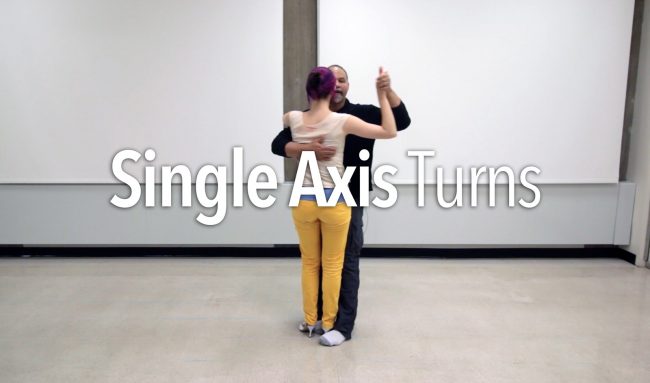
    Single Axis Turns

    There are Eight Turns in Argentine Tango that Tango Topics has identified as Commonly used or Social Turns. There are a few others that are outside of the common eight but for the most part, accept for now that there are eight.

    Just in case you were curious, the Eight Common Turns are, in order of precedence and commonality: 1.) The Follower’s Molinete/Lead’s Giro. 2.) Milonguero Turn. 3.) Rock Step. 4.) Ocho Cortado. 5.) Calesitas. 6.) Media Luna Turns. 7.) Colgada Turns. 8.) Anti-Molinete.

    Today’s Tango Topic deals with one of those common eight turns. This particular turn is an unusual one even though it’s part of the eight. It’s unusual because it’s a variation of a class of turns called “Colgada Turns”, and furthermore it’s also not used all that much, and for good reason. Why ? Because it’s a difficult turn to pull off at first. This one is not for the faint of heart, but once you master it, your coolness factor goes right through the roof. Not to mention you will have also mastered one of Tango’s more difficult aspects that hasn’t been around all that long in the dance: Off-Axis Movements. Tango has traditionally been a couple in Close Embrace type of dance that almost never opens once the Embrace begins. Nor does that Embrace change other than to get closer and closer and closer, and more refined. This type of turn, while done in Close Embrace, creates a version of Close Embrace that from the outside looking in, doesn’t look all that different, but from the inside (the couple’s perspective) feels very different. Today we’re going to explore both sides of the embrace, for both roles, so without further yapping, Tango Topics presents: The Single Axis Turn!

    What Is A Single Axis Turn ? It is tango specific language to describe a type of rotation that occurs between Lead and Follow where the word ‘axis’ refers to not the Follower’s Longitudinal Axis (which is the typical axial line that is referenced with the use of the word ‘axis’) nor is it the Lead’s, but rather a shared Longitudinal Axis between the couple. Truth be told, that axial line is always present. It’s generally the point of contact between the couple. However that longitudinal axis almost never gets used in Social Tango. Almost never. Except, and there is always an exception to these things, when the couple or partnership engages in what’s called ‘Apilado‘ (please follow the link for more information if you need a clear definition of this word). When Apilado is engaged, then the couple is dancing, depending on how it’s done, in either a supported way (shared) or unsupported way (forced). In the latter case, the Follower is being forced to fall on top of the Lead or to place all of their weight on the Lead. While there are times when that is desirable, in the case of the Single Axis Turn, that’s not desirable.

    Another way of looking at the Single Axis Turn is by understanding that this is a Colgada variation. However, unlike most Colgadas though which tend to be executed in Open Embrace, this variation on a theme is done primarily in Close Embrace! So while it can be done in Open Embrace, and doing so will generate more of a ‘whoosh’ factor (see below) than you would normally like to have in a Single Axis Turn, this is generally a Close Embrace movement that is small, social and fits within the line and lane of dance that you’re in. At no point in time, should a Single Axis Turn exit that line or lane of dance at all. The Single Axis Turn is Floorcraft safe, when done properly.

    Another piece of Tango vocabulary that uses very similar methodology and uses the same principle of ‘Apilado’ is the Argentine Volcada. It is also a shared axis movement. The Single Axis Turn is exactly the same in that respect. However, where as in the case of the Volcada, where the couple goes towards each other thereby creating more dependence on each other, in this case, in the case of the Single Axis Turn they go away from each other!

    Put simply the Single Axis Turn is a rotation around a shared longitudinal axial line where the couple seemingly in close or open embrace, rotates around this axial line, thereby creating a ‘turn’.

    The Free Tip. Just as in the case of the Volcada, where there is a natural ‘kickstand’ for all Volcadas, a safety mechanism that the Follower can invoke, if they’re not supported in the initiation phase of the Volcada…the same thing is true here. That same safety mechanism exists in the Single Axis Turn in exactly the same way in EVERY. SINGLE. ONE.

    About The Video. This video is 13m:49s in length in 9 sections. Both lead and follower technique are combined and integrated into the video.

    Introduction – 00:00:34
    Forward Steps – 00:03:09
    Follower Technique for Forward Steps – 00:01:26
    Further Rotation – 00:00:32
    Close Embrace Side Steps  – 00:01:47
    Follower Technique for Side Steps – 00:00:53
    Multiple Single Axis Turns – 00:01:47
    The ‘Whoooosh’ Factor – 00:00:42
    The Hurrican Turn/End – 00:02:09

  • Nine Common Tango Habits

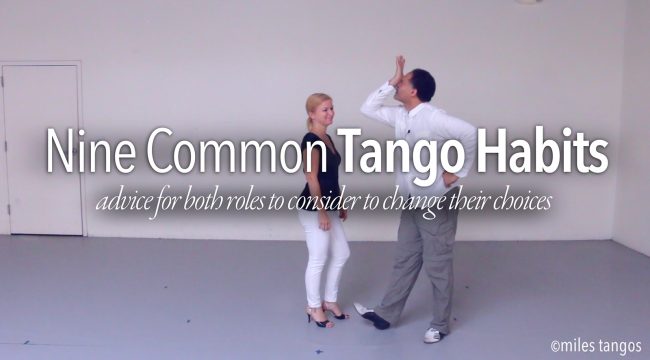
    Nine Common Tango Habits

    The deeper we get into Argentine Tango, and the more that we develop, we begin to generate specific habits. Habits of how we move, familiar patterns of vocabulary,  comfortable ways of moving. Which, as a side note, is comfortable for us, but may or may not be so comfortable for someone else. Further, and more importantly, those comfortable ways of moving usually create some very repetitive motions. These are habits that may hinder our long-term development in ways we hadn’t even considered. It’s really the repetition, our habitual way of doing things that need to be watched, checked on, and then dealt with. Today’s post deals with Nine Common Tango Habits we can change in our dance that can lead to less repetition, and greater variance in what we are ultimately trying to create: A very desirable dancing experience for our partners.

    A good deal of dancers like to believe that they are the exception to the rule. They will be different. They’ll be better because they have studied with Magical Teacher X. The common thinking is that a few minutes, or an hour or two a week, or a weekend ‘boot camp’ or a week-long seminar of study with said Magicical Teacher X, and not to mention a few steps/patterns/figures, and then miraculously there will be ‘change‘. Everyone, their partners, everyone will immediately notice the difference and fall madly in love with the difference from where they were to where they are now due to Magical Teacher X. “You studied with X!!!! OMG you’re so much better now!!”.  The belief is that studying with X will create a better and more desirable dancing experience for your partners and more importantly for you.

    While there may be some validity that X is indeed an amazing teacher, it is more than likely something else occurred that the dancer was wholly unaware of after the fact of studying with X: The dancer ‘backslid’! Meaning the reverted back to doing what they were before time spent with Magical Teacher X. Quite realistically almost immediately after leaving X’s presence! And the reason is really a simple one: Comfort. Meaning ?

    a.) What that dancer is doing right now is far more comfortable, than what they were shown to do. So the dancer will revert to what is more comfortable than what they were shown.

    b.) The dancer will ‘drift’ from what they were shown. They’ll misremember what was said, or shown to them, or even if they write down what was shown, the exact language of what was said, the exact bodily positions and placements will not be retained and as a result the dancer will drift to what is comfortable for them to do, not what they need to do. As a result, they’ll begin to miss-practice what was shown to them thereby creating more problems.

    c.) More than likely the dancer will end up using their arms, and hands to push and pull/push their partners.

    The Good News! All of the above sounds almost dire, doesn’t it ? Like what’s the point of studying if you’re just going to backslide and go back to what you’re doing right ? However there is some good news. There are some ways, assuming that you implement them, and (this part is very important) actively want to change what you’re doing that can change your habits. While this video doesn’t go into the technique of how to do A, B, and C (please register, it’s free, and then subscribe to get access to all the details), it does show you Nine Common Tango Habits where we could, if we made a slightly different choice here and there, create a difference or change in how we access and thereby execute our dancing ideas.

    To be clear, ‘Change‘, regardless of whether or not you want to believe it, will only come, if you put the time in to actively take charge of your tango (re)education. And that means concerted, continuous, near daily reminders about the execution of technique, daily solo practice, bi-daily private partner practice, bi-daily or weekly private lessons, and actual social dancing at every opportunity. It means working on your foundation with clear, detailed, and intricately laid out instruction with oodles of visual, verbal, textual, and kinesthetic examples. Every. Single. Day. It means practicing daily. It means daily solo work. It means a daily consumption of tango music. It means analyzing your dance in a constructive fashion with detailed, honest, and clear language to describe what’s actually happening instead of the tried and true euphemisms of tango (“Being on your axis”, “I need resistance”, etc). It also means using video and video feedback of the foundational technique (how you’re walking close up, from the hips to the feet, from the side, and from the back/front) replayed, then demonstrated to the dancer, and then having the dancer replicate what they’ve seen with oodles of video trials. Doing it once correctly is not enough. Doing it a hundred times the same way without error is better! This, for those of you who think this is crazy talk or Perfectionistic Tango, is what Tango Topics has developed and is known as The Intensive Process.

    It is from this process that we have the Nine Common Tango Habits that Tango Topics has identified as places where a dancer can make a different choice. And that if you stack these different choices on top of each other they can by the whole create nuance or variance in the dancer’s choices. And that’s ideally what we’re after. However, understand that if you only make these nine changes, this is not going to improve your ability to dance. Nor will it improve the execution of your dance. Nor will it improve how you hear the music. It will not improve your ability to embrace, or your habitual errors that you aren’t even aware of! The only way those things will change is with a continued, concerted, and detailed study of your movements with a qualified instructor of The Intensive Process! (see: Tango Topics Teacher Training)

    So without further adieu, here are the Nine Common Tango Habits that we want to keep an eye on:

    1.) Stepping Outside Partner. Meaning, that if the couple is walking in Parallel system (lead left to follower right, and lead right to follower left) and the lead steps with their right to the Lead’s left side (the open side of the embrace) the Follower will more than likely believe that what comes next is an Argentine Cross. This is habit. This is also default behavior. There are multiple ideas that are possible here from that simple outside step: An Outside “Snake” Walk (type 5 of 6 of Tango Topics 6 Ways of Walking), the opening step to a Media Luna turn, a scissor step, etc. There are options here, and the idea is that we want to break those habits and make different choices. However, a problem will occur and that’s where when leading a Follower is that because the Argentine Cross is so ubiquitous and done so often, that you’re now invoking their habit instead of their listening skills. And so they’ll immediately think, “Ahhhhh Argentine CROSS!!!!”….and then you’re off to the races, as it were.

    2.) Turning To The Open Side. Most dancers think of a turn to the Open Side of the Embrace. This is the ONLY direction that a turn can happen. There is no other.  Ummm not. Simply put, you do know there is another direction you can turn in ? 😉 There is no rule that says you can only turn to the left (as a Lead, or Right as a Follower). You do know that ?  There are 3 types of turns, specifically, that Tango Topics Talks about that are designed for the Closed Side of the Embrace. 1.) The Linear Ocho Cortado or it’s kissin’ cousin the Circular Ocho Cortado. 2.) The Close Side Turn Trick. 3.) The Close Side Turn. Regardless of the variations of the turns the Closed Side of the Embrace, changing this simple action opens up ideas that you more than likely haven’t even considered. You may also discover that you have a weakness on the Close Side of the Embrace attempting to turn in that direction. You may also discover that you have an instability (as a Lead and as a Follower). And more than likely a little bit of both!

    3.) The Followers Molinete Default. In case you weren’t aware, and you’d be surprised at how many people aren’t aware of this: There are 7 other types of turns. Crazy !?!??! Huh ? Yup. There are seven other types of turns that you can engage in. 1.) Milonguero Turns. 2.) Linear Ocho Cortado & Circular Ocho Cortado. 3.) Rock Step Turns. 4.) Walking Turns. 5.) Calesitas 6.) Colgadas & Single Axis Turns. 7.) The Anti-Molinete Turn. Mind you that last one requires an orientation change, but it’s still kinda cool. The point is that most people only consider this one type of turn as the ONLY turn that is available to you. And as a result your dancing abilities and available options and opportunities become somewhat limited. Very limited. Just as a side note, it wasn’t until about 30 years ago, that the predominant Tango Turn was the Follower’s Molinete but in fact the Milonguero Turn! Gustavo Naveira changed all that, or so the story goes.

    4.) The Rock Step Default. When a lead hits an obstacle they’ll slam on the brakes and immediately go into Rock Step Mode. This has been detailed here on Tango Topics in two places in Practical Tango Advice: The Rock Step Everywhere and The Lead Back Step Issue. Obviously this is not desirable, and yet…how many of you engage in this process continuously ? A LOT! Aside from that, there are other ways to solve for there being an obstacle in the couple’s line of dance. Most notably one could engage any one of the 7 other types of turns to avoid the impending crash of bodies, or one could come to a complete stop and reset the embrace, which is always a good idea no matter what’s going on.

    5.) The Same Five People Default. The reality is that we get comfortable dancing with the people that we enjoy dancing with. And once we get comfortable we tend to only allow a recommended few into our dancing circle for a variety of reasons. Basically this is closing off our options. What you may not realize is doing that limits not only your dance partners, but more importantly it limits your available options and opportunity for growth and change in your dance. You may like what you’re doing but it can easily become stale if you don’t let it out for a breath of fresh air now and again. Meaning that introducing other people into the equation is what’s required here. Those other people will have different ways of reacting to your dancing style and that will create the necessity in you to learn to compensate for them, or more importantly to adapt! And in case you weren’t aware, a Tango dancer’s greatest strength is their ability to adapt every kind of dancer that they may encounter in their tango life! So… more people, means more options and the greater possibility for your dance to be a bit more nuanced and fresh!

    6.) Three Ochos Default! Before we go any further with this one, the reality is that Tango Topics Musical Interpretation series (1 – 5) talks about employing a standard number of Ochos in its Interpretations exercises, and as a standard rule no more than 3 Traveling Ochos in a row. Why ? Because it’s inordinate amount of work for the Follower. And we don’t want them to work so hard, they have a whole bunch of other things to do. This shouldn’t be one of them. Besides repetition isn’t exactly what the Follower signed on for. So…not so much with that one! That out of the way…. The reality is that a greater number of dancers have a set number of Ochos that they’ll lead and follow before they’ll do anything else, and it never, ever varies. So the suggestion is try mixing up from time to time! Fewer or More now and again.

    7.) Traveling Ochos Default. Traveling Ocho. Traveling Ocho. In case you weren’t aware. There are 7 other types of Ochos that you may wish to investigate. For most people when they hear the word Ocho they immediately only think of one variety of Ocho, and that’s the Traveling Ocho. In case you were unclear, and you may be, that there are seven other varieties of Ochos, most notably the 1.) Milonguero Ocho (sometimes referred as ‘Lazy Ochos’). 2.) Linear Ochos. 3.) Circular Ochos. 4.) Over-Rotated Ochos. 5.) Anti-Ochos. 6.) Milonga Ochos. 7.) Time Based Ochos. Remember that what you think of as an ‘Ocho’ is what Tango Topics refers to as a Traveling Ocho. This is the default Ocho that everyone thinks of and only considers this to be the only ocho ever.

    Whether you realize it or not, engaging in Milonguero Ochos, for example, opens up a whole line of dancing that you may not have been aware of, like for instance it opens the possibility for Floating, Linear, or Rotating Crosses down the line of dance. It opens the real possibility for Milonguero Turns to happen. It also opens up a variation on the Linear Ocho Cortado. It also opens up the Close Embrace Sacada options, and a host of other possibilities that occur simply because you’re working with less. Speaking of which the Traveling Ocho tends to take up space, whereas the Milonguero Ocho, or the Floating Backcross does not! Which leads one to working on Dancing In A Small Space! 🙂 You’re welcome!

    8.) The Open Side Opening Step Default. This may come as a shock to you, but in case you were unaware, you have a Left Foot, and a Right Foot! IKR ? Shocking, no ? Why is this important ? Because most people start off the dance on the standard Lead Left Foot/Follower Right Foot! That’s why. This instantly leads to item #9 on this list but it also limits you in terms of what you will normally do. There are other options to as your opening step. Actually 17 of them (In the form of the 6 Ways of Walking), and that’s not including The Salida Steps or Side Step options. Why any of this relevant ? Because it’s yet another way to break your habits of how you access or start a dance. Try this really simple exercise. The next time you start a dance start on the Right Foot (lead)/Left Foot (follower) and see what happens. However if we take that idea to the next level, and it is the next level, now try to start any vocabulary with the Right Foot ONLY (lead)/Left Foot ONLY (follower). And if you want to really add an interesting idea, Leads, you can only step with your Right foot, the Follower can do whatever they like. (See: The Dark Side Salida for more information.)

    9.) Parallel System Walking Only Default – This last one is pretty much self-explanatory, and we’ll just leave you with this idea…there are 5 other types of Walking! What are they ? If you were a subscriber, you would see all 6 methods, while there are a few on screen in the video above, trust that you’re not seeing the whole of it. It’s a bit more complicated than just the 6. Register, (it’s free) and see the entire list!

    The Wrap Up

    Let’s be clear about something watching a 6 minute sampler video, and then the full 20 minute video is not going to change your tango habits. It’s just not. What needs to happen is actual mental discipline. You first have to recognize that there is something better or different and then you have actually go out and get it, and then…here’s the hard part – do it! Watching this video (and if you register to see the full video) is only the first part of changing those habits for the better. The rest is entirely up to you and your process. This video is only the first part of that. It’s a gateway to more diverse and varied tango to step (no pun intended) outside of your regular tango way of dancing. That’s it, that’s all. It will not change your dancing skills at all. It will not change how you access those dancing skills. Nor will it change how you hear the music. You’re still going to hear the music the same way, which by the by you may be missing something. To change how you hear the music, consider registering for our Music Course! All of those things will still be true. However, the one thing that will no longer be true with time and practice is the variances that you put into your dance.

    There’s one thing that is NOT covered in this video. And it’s a notable absence. Most of the stuff that’s discussed here is from a Leading perspective. There’s the Follower’s side of the equation! For that ? Please see our forthcoming video on Adornments and Embellishments. Trust us, it’s an eye-opener!

    Lastly, and mostly, overall enjoy and explore your dance.

    See you in class and on the dance floor!

  • The 5 Point Guide to Private Lessons

    The 5 Point Guide to Private Lessons

    Whether you’re a beginner or an advancing dancer, or feel like you’re Jesus H. Christ that walks on water, at some point in the near or distant future you’re going to find yourself in the position of needing, or more than likely, wanting to study with X. ‘X’ being the amazing couple or individual that you’ve seen in YouTube videos or in person. And as a result of that ‘want’, this is going to mean, especially for Followers, after a certain point in their development, private lessons only. For Leads, it will mean going to group classes for the barebones of the vocabulary or musical interpretation being taught, and then private lessons for the numerous refinements and retooling that has to happen to their embraces, their walk, and not to mention the innumerable amount of feedback that is required to refine things further. Because there’s doing it a few times in a session with a teacher who’s expecting it, and then there’s reality on a social dance floor. And that is a whole different ball of wax! However, Today’s Tango Topic isn’t about that. It’s about the process that you absolutely should go into to get into a private lesson with a teacher. And in specific a Five Point Guide to Private Lessons.

    (notation: This is a longish article. There are no pix. There are also some, somewhat controversial ideas that you may or may not agree with. So for the sake of argument let’s just say that in the 12 years that the author has been teaching, these things tend have tended to come up and these things towards generating a successful private lesson experience that changes the student for the better. So take it with a grain of salt, or not. But please, don’t lose your proverbial mind over it. If what you think is attitude is getting in your way, just skip to pink parts and you can read the rest later or not). 😉 Have a nice tango day. 

    POINT ONE

    Go in with a plan to work on ‘X’. Where ‘X’ in this case could be but is not limited to: Your back steps, your side steps, your forward steps.  The Follower’s Molinete, Traveling Ochos, Milonguero Ochos, Forward Lead Sacadas, Follower Back Sacadas, The Argentine Cross, Ganchos, Boleos, Paradas, The Media Luna, The Ocho Cortado…just to name a few. Pick something that you find difficult and challenging and go to said teacher and ask for their take on the vocabulary. And if you don’t know the name of the vocabulary, ask the people that you’re dancing with what it’s called so that you can properly identify it to the teacher. If it’s a sequenced move, then try to get someone to record it as you’re doing it with a partner and show it to the Teacher. This makes things so much easier for the teacher to help you with your issues instead of having to guess through a series of steps that it might be.

    First and foremost, if you’re going to the hot-flavor-of-the-month teacher because they’re cute, or you like their embrace, or you’ve heard that they’re amazing. Then you’re going for all the wrong reasons. If you’re going to study with someone, then get your head out of the clouds and go for all the right reasons. This is no time to be wasting valuable dollars/rubles/euros/pesos on the superficial. You’re there to WORK. So here are the reasons you should go:

    1.) You want to change your dance from what it is today to something better than you can imagine in the future.
    2.) You want to have more fun with the partners you currently dance with.
    3.) You like the way that they dance and believe they can convey that to you.
    4.) You have reached what you think is the end of your development or that you think or believe that you’re stagnating.
    5.) You recognize that there are gaps in your knowledge and it’s becoming apparent that you need to address that stuff asap. (Can you say Milonga ? Wow, good, you can. In that case, visit Milonga Madness with Detlef and Melina!) and/or you need a reality check. “Am I screwing up ?”.

    If it’s anything beyond that, then you’re going for all the wrong reasons.

    You go to private lessons because you want to improve. Not to sleep with the instructor (Sorry! Ok, not sorry!) or to feel their body up close (Not!)

    You go to private lessons because you want to be a better dancer. Not to dance around the room with the instructor just to have a nice tanda. That what Taxi Dancers are for.

    You go to private lessons to change your walk, your embrace, to clarify and refine your skill set. Not to blow smoke up your a$$ for an hour of platitudes! “Oh you’re doing wonderful! Fabulous!! Wow….so much better”….and the like. You want and need absolute, strict, honesty from your teacher. Anything less than that and you’re wasting your time and money. And we don’t mean ‘nice-nice’ honesty, we mean what you would call ‘brutal’ (and you absolutely have to use this word with them) honesty. Otherwise, they’re going to blow smoke up your ass for an hour, and then collect their fee. They don’t want to hurt your feelings, and they believe that if they tell you the truth, the whole truth, the unvarnished truth, that they’ll turn away a cash cow of a resource. They have bills to pay too. However, you have to be firm, and state with absolute certainty that you want the absolute truth with them. They’ll say “Are you sure ?”. You’ll nod. And then they’ll tell you, hopefully. Be prepared for some truth bombs dropped. And if they’re still giving it to you ‘soft’ and ‘nice’ then it’s time fire that teacher and go find one that speaks the language of truth.

    If there’s one thing we’ve learned in our tango travels it’s this: Truth is a requirement towards better. The more truth that you have the easier it is to change towards that idea of ‘better’ (more on what ‘better’ is below). Truth does not need to be harsh, and that’s how some people will hear this reality. Truth can be delivered without demeaning behavior. Truth can be delivered without a charge to it. Truth is also an active process and both parties must be able to hear it as well as to speak it.

    Then, of course, there is the understanding that you want to change what you’re doing. Perhaps you like it, what you may not realize is that you may be creating or generating issues that may in fact be getting in your own way and/or others! And the only way that you’ll know that is by asking for truth from your instructors. But if you have a timidity to hear these things, if you persist in a self-delusion, if you continue along the line that everything you’re doing with said teacher is absolutely frakkin’ amazing…then well, you’ll get what you paid for….which is, if you’re a Follower, this. And if you’re a Lead, this.

    So it’s a good idea to have a teacher to be honest with you, and to drill down to the absolute truth with them.

    POINT TWO

    Dance Two Example Dances with your teacher and video both of them in good light with good sound. Then watch the resulting video with your teacher, and say nothing while it’s happening. Make mental notes about what’s going on and then explain to the teacher where there were areas of confusion or concern. Why only two example dances ? One in Open Embrace, and One in Close Embrace. That’s why. Also, dance only to a Tango or a Vals. If you’re there to work on Milonga then pick a milonga (usually one by Canaro). Know thy Milongas! Oh, and shameless plug – Not to put too fine a point on this…but have you seen Milonga Madness ??? And then when you’re done with the dance and your notes, and feedback. Try to get their feedback either on video or in written form (write down what they say and if you can get it with time stamps of where X, and Y happens in a dance that’s even better). This is insanely important as it will give you something else to work on. 

    The Teacher Component. We have to address the quality of instruction as a factor here when taking private lessons. We need to remove the teacher from the equation, sort of, and focus on the student and not the teacher as a potential cause for why a student would or wouldn’t necessarily improve. Why ? Answer: Because not all teachers are alike. And not to misquote the book ‘Animal Farm’, “Some are more equal than others”. Meaning that some are better than others. So for the moment, what’s below are 5 points to points to consider that can help you to determine if you’re picking a teacher with some mad skillz to help you in your quest of getting to ‘better’:

    1.) Look at the students that they generate. If there is a long, long, long, long line of students of theirs that everyone raves about dancing with, then that might be someone you want to spend some time with. This isn’t about the popular dancer-teacher, it’s about the dancer-teacher that consistently generates a series of dancers that are very desirable to dance with.

    2.) Look at how they move because you’re going to look like that in some way, shape, or form. Teachers tend to create mirror images of themselves.  While there are some necessities to this, what you’re looking for is a wide range of dancing skills in their movement. Specifically, someone that is well versed in the various forms of the Embrace like Open, Close, Vee (Open Vee, Closed Vee), and the like. You’re also looking at how they land their feet in the three steps. Whether they land heel to toe or toe to heel consistently. Or whether their steps are varied for the movement that they’re engaged in (in case it’s not clear, you want the last one – varied). You’re looking at how and if they apply disassociation (what you erroneously think of as a ‘pivot’), or whether or not they ‘cheat’ and throw their leg behind them in the Follower’s Molinete, or a Back Sacada. You’re looking for how smoothly they apply that disassociation or whether or not it’s jerky and broken. The details matter here for a whole bunch of reasons. You’re looking at whether or not they invoke compression, force, and tension in their embrace, and if they do then this is an indicator of being pushed, pulled, and squeezed. In other words whether or not they use their arms and hands to direct their dancing partners. Uuuugh. Yes, sadly, there are teachers that do this. It’s not ideal but it’s what happens. These are just some of the things to look for in and that matter in choosing an instructor.

    3.) Everything you will ever need to know about a particular Teacher, and the quality of their instruction, resides in their Beginner Lesson. If it seems ‘fast’ to you, or they skip over salient details of the embrace, the walk, the whatever…then this is probably not a teacher you want to spend a whole lot of time on. If on the other hand, you see in their beginner lesson they balance the intricacies of one’s walk, and their foundation with a use case at a Milonga. If you see that they show you basics and what you can do with them. If they generate elegant and the simplicity of walking and all the things you can do with it on a social dance floor. Then this is a teacher you want to spend ooodles of time with. Vocabulary means NOTHING. Walking well is EVERYTHING. Anything else is a waste of your time and money.

    4.) The teacher that can swap roles is the proverbial bomb. If they dance both roles, socially, not at a practica now and again where they look all gangly dancing their non-gendered role, then you’re onto something. If they dance at a Milonga, their non-gendered role, on regular basis then this is someone you want to spend lots of time and money on. Why ? Look no further than some of the world’s best teacher-class dancers! In this clip on youtube, brought to you by 030 Tango and the Lodz Tango Festival in 2014, you have Sebastian Achaval dancing with Fabián Peralta, Sebastián Jiménez dancing with Juan Martín Carrara, Roxana Suárez dancing with Stefanía Colina, María Inés Bogado dancing with Josefina Bermudez Avila. And then they switch it up again, the men all rotate, and the women do to. See for yourself -> Here. You might be inclined to think that this is an isolated incident. It’s not. There are many of these ‘fun’ Cambios de Roles (changes of roles or role changing), this is just one among many. Why is this relevant ? Because it’s clear from watching the clip that they actually know what they’re doing and aren’t all gangly with their opposite role but they’re quite facile with it all. This speaks to the larger skill set. They’ve been working on their non-gendered role for a long time. But why, you may ask, is this relevant to picking a teacher with skillz that you want ? Here’s why! Because a teacher that understands both roles, and dances both roles, and teaches both roles can speak to the whole of the dance and not just one side of it. Further a teacher that actually dances the other role is speaking from personal experience and not from some cocked up theory of dancing. Hmmm and now that we think of it, one more rather important reason: A teacher that dances both roles has discovered that one role is the core of the other. And that by learning one, you’re really learning the core of the other. And still one more: A teacher that dances both roles has also learned that both roles are a necessity towards a more well balanced and well thought out form of the dance instead of the genderization of the dance. This is why it’s important. This type of teacher usually imparts this type of knowledge to their students and as a direct result of that, their students tend to develop a little more quickly and tend to be more balanced dancers.

    5.) The teacher that focuses on Foundation, and the importance of walking. This may sound simple and everyone mouths the words but a teacher that actually enforces that you do nothing else for weeks if not months on end ? That’s a teacher that you want to spend oodles of time with. Why is this important above all else ? Because the teacher that forces you to work on your walk knows that the key to better tango isn’t the steps, patterns, and figures. It’s your walk. Fix that. Change that, and everything else about your dance will change. Everything. So private lessons with a near militant instructor on the need to work on your walk and probably nothing else for a very long time is what you’re really after.

    There are a few other telltale signs that you’re dealing with a quality instructor like the attention to detail, minutiae is their calling card. An apt expression and explanation of the music and not the typical 8 beat count or phrases mantra that occurs quite frequently. The ability to analyze and diagnose movement not from the Resistance-based Dancing methodology (push here, lean here, pull there, etc) but rather the Intention-Based dancing camp is ideally what you seek. Why this and not the other. Go look at our article on Intention-Based Dancing. It answers most of the why. Moving on. The ability to build a community of dancers and not just clones of themselves. An accepting personality of all ideas of Tango and not just one narrow vantage point that one idea of tango is right over all others. Tango is a living breathing organism that is changing daily. Not this idea that there is only one original Tango and that’s it. They include all dancers and not just the young, pretty ones. Size, age, disposition doesn’t matter. What matters is skill, patience, and time. Of course, not being a conceited _____ (ahem) helps too that and having a sense of self-depricating sense of humor is also a plus…not required, just a plus. 😉 Hmmm, probably one thing that gets overlooked is the ability to empathize with where the student is at, and then have the ability to help them past their emotional stuff that’s holding them back. Calming someone’s fears, their personal issues and challenges is sometimes what can change someone’s dance from “Please! God! NOOOOO!” to “Hmmm, yes that was pleasant”. Sometimes.  This is who you’re looking for to study with.

    It should be noted, that while what’s above is ideal, there are times and places where because you only have access to small or very limited number of teachers that studying with the noted tango god above may not be possible. You’ve got what you’ve got access to. And that’s all you’ve got. Which is not to say that the homegrown variety isn’t da bomb, it’s to say that sometimes (not always) that the just because they live in a small town doesn’t make them undesirable. Far from it. Typically the teacher in the small town has to serve many roles and they end up having many hats to wear. So don’t take this as a disparagement of the local teaching crop. It’s to say that the ideals above are what you’re shooting for but sometimes a corner must be cut here and there. That’s why it’s insanely important to study with visiting instructors, and when there is an instructor passing through your region that you go spend a few hours. A single instructor does not a tango dancer make anymore. That used to be the case. That’s not true any longer. It takes a village to raise a tango dancer these days. And the more voices you have, the more ideas you’re exposed to, the easier this gets!

    POINT THREE

    Ask a series of detailed questions about your form, your walk, your embrace, your … everything. Here are some examples of what you should be asking of your teachers on a regular basis, with every session:

    a.) How does my posture appear and feel to you ?
    b.) How does my embrace feel to you ? (this is a loaded question that needs some clarity – see below).
    c.) How does my walk look and feel to you ?
    d.) How does my Forward Step appear to you ? What should it look like ? How and where should I land it and in what situations should I change the shape of my foot and the direction it lands ?
    e.) [Followers] How does my back step appear to you ? What needs to change or improve about it ? [Leads] Am I generating enough forward intention to create the Follower’s back step ?
    f.) Am I stable ? Do you feel me using you for my own stability with my hands ?
    g.) What needs to change or to improve about my walk ? And how do you do that ?
    h.) What does the visual line of my extensions (projections) look like to you ?
    i.) Am I using my hands to push or pull you ?
    j.) Do you feel compression from my forearms on your back or sides ?
    k.) Am I generating ‘resistance‘ ? And if so, where do you feel it coming from ?
    l.) [Followers] Am I extending enough in Back Traveling Ochos ? [Leads] Am I collecting in Traveling Ochos ?
    m.) [Followers] Am I creating enough Applied Disassociation to generate rotation for the back step of my Molinetes. AND/OR Am I stepping away from you in the Molinete. [Leads] Am I actually leading the Follower’s Back Step and/or Forward step of the Follower’s Molinete.
    n.) [Followers] Are my crosses clean or dirty? And where should I be in relation to the Lead in an Argentine Cross ? [Leads] Am I actually Leading the Cross or inferring it ?
    o.) Am I stepping into the middle of the step in Sacadas or the Trailing foot ?

    These are just some of the questions you should be asking your Teacher in a private lesson. Print out this list and take it with you. Do not rely on your memory for this stuff. You can’t. You will misremember it. Print it out and take it with you.

    Don’t just go and be a sheep. Get involved in your education. The teacher is not magical. They’re not god. And they are fallible in certain conditions. Stop revering them as if they walked on water and get involved in your own development.

    One more thing along these lines: Do you want to look your teacher when they dance ? Or do you want to look like you imitating them ? Or do you want to do your own thing with their ideas incorporated ? If it’s the latter, then you’re onto something. Tango is all about individuality. So…BE Individual. Correct your issues. And then … here’s the hard part grow beyond your original programming!

    Let’s get one more thing out of the way, while we’re on the subject because this stuff is all related in a myriad of different ways: No matter what you do, unless you invoke an Intensive Study Program (hint, hint, hint), you’re still going to be less-than-desirable in a whole host of areas even with Private Lessons. Let that sink in for a moment.

    Breathe!

    Also there is the prevalent idea that with just a few Private Lessons that you’ll ‘suck less’.

    Ummmm…..nope. Sadly not.

    The ‘sucking less’ part will go on for a long, long, long while. Years in fact. The reason ? Habits. You have habits that you’re going to revert to for a variety of reasons. Most notably is because you are comfortable doing what you’re doing, and diverting from that is a conscious effort that takes time and patience. What needs to occur is that you need to eradicate those ‘habits’. First by recognizing them, and then by altering them, and then removing them altogether, one by one. That will take time. Lots of time, with lots of verbal, visual and pointed reminders. Ooooodles of them.

    Also that while you’re in this state of ‘change’, and we’ll call it that for the moment, you’re going to develop habits that are not born of the teaching your receiving (either in group classes or in private lessons) but rather through dancing with other people and less than desirable partners and convenience. Those habits that you’ll develop will quite literally get in your way. It’s kinesthetic convenience really. It’s easier if you do this or that. When the ‘right’ way, the desirable way is more difficult at least from where you’re sitting right now.

    POINT FOUR

    Video the Session. Assuming that the Teacher will allow it. And if they do, then promise (and keep it) that you will not, under any circumstances, post it to youtube or share it with anyone else. Look, you may find this very hard to believe when it comes to Tango but your memory for what was said and what was done, and more importantly how it was done is incredibly faulty. You can not rely on it. Ever. Further, you can’t even trust that you what you think was said, was said. There is an exception to this, such as the person who has an eidetic visual memory type. Those people are exempt from this stuff. You, on the other hand, can not be trusted with this stuff. That’s what VIDEO is FOR!!!! Do not video the instruction part, just the dancing part. However if the teacher is cool with videoing the instruction part (very few are) then do it. If you have issues with video, get over it. Video doesn’t lie. People and mirrors do! Don’t trust them, and don’t rely on them. You need hard evidence of what you’re doing and how you’re doing it. 

    ‘Better’. We have to address this idea. What is ‘better’ ? First and foremost, ‘better’ is a moving target. It’s a not a fixed item. It continually changes. Once you reach one plateau, you realize there’s another one above that and above that and above that and so on…it’s dizzying. Secondly, your idea of ‘better’ and your teacher’s idea of ‘better’ are two very different things. And in order for you to understand ‘better’ you will have to, for a little while take on the persona of your teacher’s vantage point of what they see as desirable or ‘better’, just for a little while. Thirdly, ‘better’ is not a destination. It’s not that you magically arrive at being ‘better’ one day. That never happens. Ever. So get that thought right out of your head. ‘Better’ is a process, it will take you time, patience, and lots and lots of trials to achieve ‘better’. And ‘better’ is also the recognition that ‘better’ doesn’t happen overnight. Truthfully it takes it’s sweet old time to get from point a to point wherever. 😉 At the same time ‘better’ is also a choice. You have to want to be that. It’s not something that you can just snap your fingers and it magically happens. No. You actually, god forbid, have to work for this stuff, rapaciously.  ‘Better’ also comes with it a work ethic. One that is based in diligence, patience, practice (lots and lots and lots of practice). And ‘better’ is also based on feedback, and the realization that that healthy, truthful, honest, direct, clear feedback (see: Giving and Receiving Feedback) is an absolute component towards ‘better’.

    Lastly, we have to address what a Private Lesson is NOT:

    a.) Private Lessons are not a panacea. They’re not going to fix everything that ails you. What they will do is, if the teacher is worth their salt (and this is a huge if), is fix or address or create awareness of a series of underlying issues that plague you (usually in one of three areas: Embrace, Walk, & Habit). And then as a result of private lessons with them, you’ll be able to do more with less!

    b.) One Private Lesson is not going to do much for you. The reality is that one private a week or per month or every six months isn’t going to do diddly for you! The problem ? The frequency. In order for Privates to have any effect on you at all, there has to be more than a few and that has to be consistent behavior with them.

    c.) Private Lessons are not for training. Ideally we want to use private lessons for refining what you’re doing. These are used to take what you’re currently doing and hone it, taper it, remove extraneous motions and make it cleaner, sharper, crisper. To remove excess. To reduce repetitions.

    POINT FIVE

    Ask the Teacher for Practice Exercises that will help with at least one thing on the list above that you are to practice between now and your next session. Video the teacher doing exercise! Again, your memory is FAULTY do not trust it. You will misremember whole sections of what was said or done. Video the feet, the posture, the legs, get DETAILED! 

    Furthermore, ask the teacher for homework. You need to practice. So make absolutely certain before you leave that you have a dedicated homework assignment that you should complete before you see them again, preferably within the week. 

    If all this sounds like work to you then stay the hell home and save your money. No. Seriously. We’re not kidding. What you’re doing, if you proceed down this pathway of willy-nilly taking a private, has nothing to do with actually learning anything but instead is all about vanity and because you can. You’re not really there to work. You’re there for any other reason except to learn. Don’t waste the teacher’s time or your money simply out of vanity or because you’re bored and want a nice tanda with someone that is easy to dance with. No. If you’re going to go take privates, then take it with the utmost seriousness that it deserves. You really do have to show up. You really do have to your homework. You really have to go home and … god forbid… actually practice what you’ve ‘learned’. You really do have to put your head and your heart into it.

    This is a dance that you love, yes ? Then why would you devote anything less than 100% of who and what you are to the process!

    This is really simple, the haphazard way you’re going about studying tango hasn’t worked for you thus far, has it ? If it has, great! But this method of serious study is really about change. It’s not for the faint of heart. It’s not for the casual observer. And it’s most certainly not for the person with way too much money and time on their hands. This process is for the individual that honestly, and genuinely wants to be the best dancer that they can be. Some people will see this is too much work to have a little bit of fun. And some people, those that know the benefits of this kind of work, know exactly how to take private lessons, and it’s much in this way. This process is all about investing your head in the game. Thinking about what you want to be when you grow up. Imagining ‘better’, and what that might look like. This process means being frugal with your mental energy and engaging in a targeted, surgical, methodical, if not tactical strike towards becoming a better dancer from within the private lesson process itself.

  • Social Colgadas

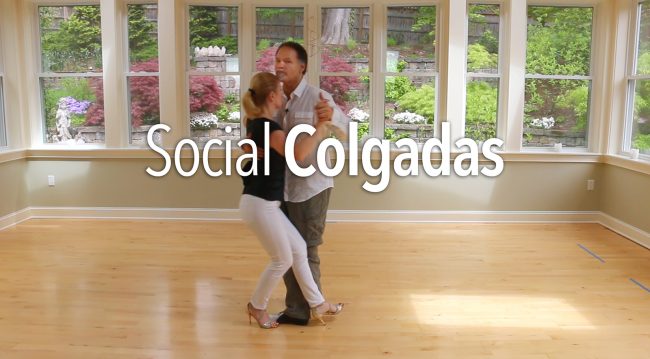
    Social Colgadas

    The Social Colgada is in many ways very similar to the Single Axis Turn. That’s because they’re from the same family of vocabulary. So theoretically, if you know one, ha ha ha, you should be able to execute the other. Not true actually, there are stark differences between the two.  One primary difference from the Single Axis Turn is that the Social Colgada is done with the partnership in a perpendicular position to each other rotating around a singular axis vs. the Single Axis turn where the partnership is facing each other. Still another is the Single Axis Turn rotates the couple 180 degrees without invoking a second step around, typically. Whereas the Social Colgada is typically a 270 to 360 degree turn! 

    The Colgada Rap! Before we go any further, truthfully Colgadas are typically manhandling events that most Follower’s want to avoid like the plague. The reason is a.) that they’re poorly executed. b.) they’re usually arm pushing and pulling experiences, and c.) someone (read that as the Follower) invariably gets hurt because their back has been wrenched this way or that. Most of this occurs because the Lead in question has not learned how to properly generate a Colgada. Where Colgadas get a bad rap is because of these 3 aspects which turns off a lot of people, obviously. However a Social Colgada on the other hand, while it has all the potential for these things to happen, is much smaller, and exists within solely within Close Embrace. When executed properly it can be one of Tango’s more elegant specialty pieces of spice or accent vocabulary.

    What is a Social Colgada ? A ‘Social’ Colgada means that the Colgada itself takes up very little space, that it fits within the line & lane of dance, while the couple is in Close Embrace, and instead of executing the Follower’s Molinete to turn the couple, we invoke a Social Colgada. As to a Colgada aspect ? The word “Colgada” comes from the root Spanish verb “Colgar” which translates to English as “Hang”. The word ‘Colgada’ is the past participle version of the verb which adds an ‘ed’ ending to the word. Which when translated to English is ‘Hanged’ or rightfully ‘Hung’. So ? A ‘Social’ Colgada is a move where the Follower (specifically) is in a hanging state off their Lead, deliberately. More specifically, they’re being placed in a position where they’re going to hang. And that’s where we talk about a shared axis, and more importantly balance.

    Ideally the Colgada itself is not about taking the Follower off axis, as you may have been told, but rather about creating a state of shared balance & equilibrium along the shared axis between the partnership. As there is always a shared axis between the dancing couple. Truthfully there are actually 6, not one. There’s the lead’s central longitudinal axis, the follower’s central longitudinal axis, and the shared central one between the two dancers which is created by their relationship to each other. It’s the last one that we’re interested in because it generates the space for a Colgada to exist. 

    The Free Tip. From the Follower’s position, and point is not shown in the video at all, the follower’s knees want to be “soft” or pliant. You don’t want them locked out or bent, but rather a micro-bend to allow for maximum flexibility!

    About The Video. This video is 29m:09s in length in 12 sections. Both lead and follower technique are combined and integrated into the video.

    Introduction – 00:01:04
    The Mordida – 00:02:28
    Balance & Planking – 00:03:06
    The Kickstand – 00:01:41
    The 3 Linear Cologadas – 00:03:08
    The Circular Colgada – 00:01:40
    The Colgada Embrace – 00:02:15
    The Step Over Colgada – 00:02:56
    The ‘Social’ Colgada – 00:03:03
    In The Line Of Dance – 00:03:44
    The ‘Whoosh’ Factor – 00:01:39
    A Primary Lead Error/End – 00:01:39

  • A Common Colgada

    A Common Colgada

    The Colgada is in many ways very similar to the Single Axis Turn. That’s because they share the same basic attributes, and they’re from the same family of vocabulary. So theoretically, if you know one, ha ha ha, you should be able to execute the other. Not true actually, there are stark differences between the two.  One primary difference from the Single Axis Turn is that the Social Colgada is done with the partnership in a perpendicular position to each other rotating around a singular axis vs. the Single Axis turn where the partnership is facing each other.

    The Colgada Rap! Before we go any further, truthfully Colgadas are typically manhandling events that most Follower’s want to avoid like the plague. The reason is a.) that they’re poorly executed. b.) arm pushing and pulling experiences, and c.) that someone invariably gets hurt because their back has been wrenched this way or that. Most of this occurs because the Lead in question has not learned how to properly generate a Colgada. Where Colgadas get a bad rap is because of these 3 aspects which turns off a lot of people, obviously. However a Social Colgada on the other hand, while it has all the potential for these things to happen, is much smaller, and exists within solely within Close Embrace. It is and can be one of Tango’s more elegant specialty pieces of spice or accent vocabulary. 

    What is a Colgada ? The word “Colgada” comes from the root Spanish word “Colgar” which translates to English as “Hang”. The word ‘Colgada’ is the past participle version of the verb which adds an ‘ed’ ending to the word. Which when translated to English is ‘Hanged’ or rightfully ‘Hung’. So a Colgada is where the Follower (specifically) is in a state where they’re going hang off their Lead, deliberately, or more specifically, they’re being placed in a position where they’re going to hang. And that’s where we talk about a shared axis, and more importantly balance, all of this fitting within the line and lane of dance. 

    Ideally, the Colgada itself is not about taking the Follower off-axis, as you may have been told, but rather about creating a state of shared balance & equilibrium along the shared axis between the partnership. As there is always a shared axis between the dancing couple. Truthfully there are actually 6, not one. There’s the lead’s central longitudinal axis, the follower’s central longitudinal axis, and the shared central one between the two dancers which is created by their relationship to each other. It’s the last one that we’re interested in because it generates the space for a Colgada to exist.

    From A Following Perspective let’s get this right out of the way immediately. You’re going to fall, backwards or in this case, to the side away from your lead. That’s the whole point of a Colgada in the first place, the falling part. There’s nothing you can do about it, except to engage teh Follower’s Kickstand (see above in the video). However understand something that the “fall” is a controlled hang more than anything else, and the control comes from two important aspects 1.) the elasticity of the couple’s embrace, and 2.) body position, placement, and balance between the couple. 🙂

    If there is rigidity in the embrace from either partner, nasty things are going to happen. “Elasticity” in this instance is a somewhat relative term, as there does have to be some firmness there, but not to the point where you’re holding on for dear life! That’s not what a Colgada is about. 😉 So yes, dear Follower, you’re going to fall to the side, and yes you’re going to be off-balance, and quite rightfully it’s going to be a little scary for obvious reasons. No one, absolutely no one wants to fall. However in this instance we actually do want to fall, a bit. Not a lot, just a bit. And that’s where the controlled part comes in. It’s a very controlled ‘hang’ through technique, and more importantly through a shared balance point between the partnership.

    Planking: Before we go any further we have to talk about when you “fall”, you’re desire is to stiffen your body, and then ‘Plank’ it to save it from impacting the floor. But before we get there, we’ll engage the Kickstand Mechanism to prevent that from happening. But before the “fall” happens we invoke, as Followers, the ’plank’ of our bodies. What is that ? It means that you’re going to stiffen your body and straighten it out as if it were an elongated piece of wood, falling backwards, hence the term ‘plank’, which refers to a plank of wood. 😉 “Planking” is an error as there is something else we want to do.

    Planking is an error when engaging a Colgada. It is however a perfectly natural response to do this. So don’t freak out. However, planking is not what we’re after. We’re actually after something else. This is why we learn the proper position for a Colgada to exist. What’s the more desirable position for us ? For that, you’ll have to see the video. However the descriptive for it is very simple, it’s almost as if you’re sitting, you’re going to send your hips away from your lead, while keeping your torso with them. Or in the case of the Social Colgada, you’re going to be perpendicular to your lead so you want your hips to go away while the side of your torso faces your Lead.

    The Controlled Hang: Another aspect of the Colgada is that we want our arms, and hands to a certain degree, to be able to slide almost as if you’re arms were a collapsible telescoping bar. ‘Telescoping’ in the adjective form, meaning that one part slides into another. We do not want rigidity in our arms and/or hands. We also don’t want to hold on for dear life with our hands, like your grabbing the lead’s bicep with your spiny fingers. Not. Less than desirable. Instead we want arms and hands to be able to slide within the Lead’s embrace – hence the ‘telescoping’ part. 🙂

    The Kickstand Mechanism: There is a safety mechanism that is built into each and every Colgada, and it’s called The Follower’s Kickstand. What’s that ? It’s where the Follower’s free leg extends backwards as if they were going to step backwards but there’s no weight on it. The Kickstand in this case occurs under ONE condition. If and only if there is no counterbalance (or counter send) from their lead. If there is counterbalance then the Follower should not release from their invited Mordida (see video above).

    From a Leading Perspective the Social Colgada is all about balance. It’s the Lead’s job, function, to create physiological balance, a state of equilibrium, within the couple. Mistakenly this is done with your arms, but instead we want to employ counterbalance the Follower with our mass, not our arms. Our arms are there to ‘guide’ our intention, but the real toy here is counterbalance. Truth be told the Lead (the person not the action) is more than likely going to have more mass than their Followers will posses. And as such the counterbalance point will be slight, while at the same time, the proper ‘sitting’ position of the Colgada will be almost, but not quite planking. So, in other words, the break at the waist, will be slight. 🙂

    The Used Mordida: A good portion of Leads, overuse the Mordida usually mistakenly in the Salida Step of the dance. What’s a Mordida ? It’s a ‘foot’ sandwich. Where the lead, traps one of the Follower’s feet and sandwiches it between the Lead’s feet. Far too often once a Lead learns how to create a Mordida they use it everywhere. As a place to stop, as a place to reset the couple, as a place to end the dance. This is know on Tango Topics as The Unused Mordida. It’s ‘Unused’ because the Mordida is an indicator to the Follower that something is about to change, usually entering either a Volcada, a Barrida, a Parada, or in this case, a Colgada. However in this case we actually use it and rightfully need it to set up the Colgada, because without our feet are going to slide every which way, and we obviously don’t want that to happen.

    video
    play-rounded-fill

    The Arm-y Pushme-Pullyou Colgada: Typically most leads use their arms to generate a Colgada, as has been said, however one aspect of this is that once the Colgada starts the Lead will pull the Follower towards them with their arms instead of directing their intention with their mass. One of these is desirable (mass direction), and one these is not (pulling). This type of error makes almost any Colgada very undesirable. So it’s a good idea to learn how to direct that mass, without pulling or pushing so that the experience is a pleasant one and not one of dread for the Follower! Just a hint, this video shows you how to do that, properly. 

    A Turning Colgada ? The Colgada gets a really bad rap most of the time. It’s poo-poo’d because most people think of it as ‘Nuevo’ vocabulary or open embrace vocabulary. Frequently this type of vocabulary is poorly executed, thereby making it visually unappealing, not to mention wholly uncomfortable. However, this particular version of the Colgada is far from the unsightly ‘nuevo’ aspects that you’re used to seeing, and that’s because of its ‘whoosh’ factor. The ‘whoosh’ is a rush of energy that happens because the couple is turning to one side or the other! Most colgadas are done in linear fashion. This Colgada series is done on the circular, and then to exit the Colgada, the Follower steps, over and (here’s the important part) around their lead!  While this can be done in Open Embrace, and there’s nothing wrong with that, doing so tends to take up way too much space, so instead we want to do this in Close Embrace in no more space than a single forward step. Put succinctly, a Social Colgada, when properly executed (hence the video), can be a way to turn the couple down the line of dance! This aspect of the Colgada makes it a very useful and powerful turning tool for the lead to use in 2 ways: 1.) Navigationally. and 2.) The Spice Factor, which we’re not going to get into.

Hide picture